48
COLOSTRUM. A practical guide for correct colostrum feeding in calves
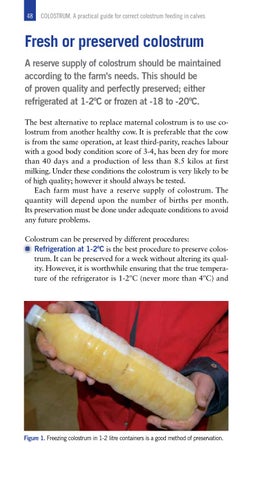
Fresh or preserved colostrum A reserve supply of colostrum should be maintained according to the farm's needs. This should be of proven quality and perfectly preserved; either refrigerated at 1-2ºC or frozen at -18 to -20ºC. The best alternative to replace maternal colostrum is to use colostrum from another healthy cow. It is preferable that the cow is from the same operation, at least third-parity, reaches labour with a good body condition score of 3-4, has been dry for more than 40 days and a production of less than 8.5 kilos at first milking. Under these conditions the colostrum is very likely to be of high quality; however it should always be tested. Each farm must have a reserve supply of colostrum. The quantity will depend upon the number of births per month. Its preservation must be done under adequate conditions to avoid any future problems. Colostrum can be preserved by different procedures: Refrigeration at 1-2ºC is the best procedure to preserve colostrum. It can be preserved for a week without altering its quality. However, it is worthwhile ensuring that the true temperature of the refrigerator is 1-2ºC (never more than 4ºC) and
Alternatives to the mother's colostrum: replacers and supplements
49
e The best alternativrum to maternal colost the is colostrum from same farm. Figure 2. The thawing process requires great care to avoid immunoglobulin denaturation. This should take place in a warm water bath at a temperature inferior to 50ºC. Once thawed the colostrum should be used immediately.
that the colostrum was obtained under guaranteed hygienic conditions. Freezing at –18 or –20ºC destroys the cells but does not affect the immunoglobulin concentration. Freezing is ideal in plastic bags or bottles of 0.5 to 2 litres, as they are easy to handle. A smaller container is quicker to freeze and thaw. To thaw, place the container in a warm water bath at a tem-
Figure 1. Freezing colostrum in 1-2 litre containers is a good method of preservation. Figure 3. Thawing in a microwave oven should be controlled carefully, as the heat distribution is not homogeneous and can deteriorate the quality of the colostrum.