students become more familiar with metacognitive strategies and more proficient in French, they will be better able to express their ideas more explicitly in French.
Metacognition should be taught explicitly in the FSL classroom. Over time, students will develop their own strategies for monitoring their thinking and learning.
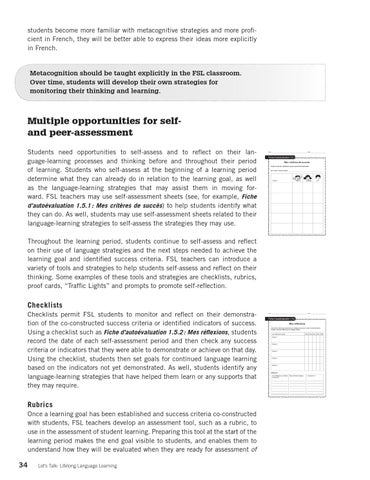
Multiple opportunities for selfand peer-assessment Students need opportunities to self-assess and to reflect on their language-learning processes and thinking before and throughout their period of learning. Students who self-assess at the beginning of a learning period determine what they can already do in relation to the learning goal, as well as the language-learning strategies that may assist them in moving forward. FSL teachers may use self-assessment sheets (see, for example, Fiche d’autoévaluation 1.5.1 : Mes critères de succès) to help students identify what they can do. As well, students may use self-assessment sheets related to their language-learning strategies to self-assess the strategies they may use. Throughout the learning period, students continue to self-assess and reflect on their use of language strategies and the next steps needed to achieve the learning goal and identified success criteria. FSL teachers can introduce a variety of tools and strategies to help students self-assess and reflect on their thinking. Some examples of these tools and strategies are checklists, rubrics, proof cards, “Traffic Lights” and prompts to promote self-reflection.
checklists Checklists permit FSL students to monitor and reflect on their demonstration of the co-constructed success criteria or identified indicators of success. Using a checklist such as Fiche d’autoévaluation 1.5.2 : Mes réflexions, students record the date of each self-assessment period and then check any success criteria or indicators that they were able to demonstrate or achieve on that day. Using the checklist, students then set goals for continued language learning based on the indicators not yet demonstrated. As well, students identify any language-learning strategies that have helped them learn or any supports that they may require.
Rubrics Once a learning goal has been established and success criteria co-constructed with students, FSL teachers develop an assessment tool, such as a rubric, to use in the assessment of student learning. Preparing this tool at the start of the learning period makes the end goal visible to students, and enables them to understand how they will be evaluated when they are ready for assessment of
34
I-VI,1-46.indd 34
Let’s Talk: Lifelong Language Learning
13-07-10 15:06