sneakers or a tennis racket. It’s all so deeply meaningful and individual. Before I go, I have to pick his brain for some of his favorite Japanese spots around LA, especially for vegetables. Jon loves Aburiya Raku in West Hollywood where he orders the eggplant cooked directly on the yakitori grill. He also tells me to ask for the off-menu kamameshi —“crazy delicious rice cooked in a clay pot,” he says. Downtown, Hayato is a Japanese kaiseki restaurant at The Row DTLA where Jon says to splurge on their omakase menu at dinner. You can also pre-order bento boxes for lunch. He also recommends Yakitoriya on Sawtelle, but as he tells me, “this is a chicken place, but they do great veggies too.” Ultimately, chefs come here to learn, gather, and be among like minds. It feels unique and intentional, not like anywhere else in the city. ◆
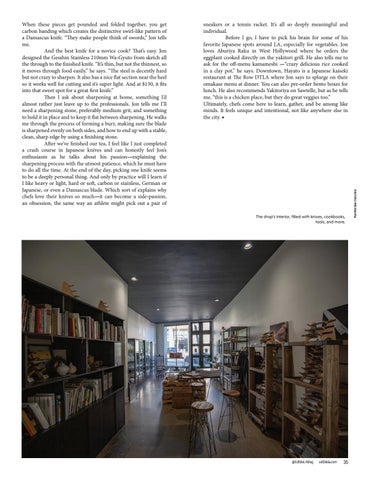
The shop’s interior, filled with knives, cookbooks, tools, and more.
@EdibleLAMag
ediblela.com
35
Photo © Brett Donar / Stocksy United
When these pieces get pounded and folded together, you get carbon banding which creates the distinctive swirl-like pattern of a Damascus knife. “They make people think of swords,” Jon tells me. And the best knife for a novice cook? That’s easy. Jon designed the Gesshin Stainless 210mm Wa-Gyuto from sketch all the through to the finished knife. “It’s thin, but not the thinnest, so it moves through food easily,” he says. “The steel is decently hard but not crazy to sharpen. It also has a nice flat section near the heel so it works well for cutting and it’s super light. And at $130, it fits into that sweet spot for a great first knife.” Then I ask about sharpening at home, something I’d almost rather just leave up to the professionals. Jon tells me I’ll need a sharpening stone, preferably medium grit, and something to hold it in place and to keep it flat between sharpening. He walks me through the process of forming a burr, making sure the blade is sharpened evenly on both sides, and how to end up with a stable, clean, sharp edge by using a finishing stone. After we’ve finished our tea, I feel like I just completed a crash course in Japanese knives and can honestly feel Jon’s enthusiasm as he talks about his passion—explaining the sharpening process with the utmost patience, which he must have to do all the time. At the end of the day, picking one knife seems to be a deeply personal thing. And only by practice will I learn if I like heavy or light, hard or soft, carbon or stainless, German or Japanese, or even a Damascus blade. Which sort of explains why chefs love their knives so much—it can become a side-passion, an obsession, the same way an athlete might pick out a pair of