EDGEDAVAO
THE BIG NEWS
VOL.5 ISSUE 24 • APRIL 5-7, 2012
House approves whistleblower law
T
HE House of Representatives has approved on third and final reading a measure that seeks to curtail graft and corruption in government by providing protection, security and benefits to whistleblowers. With 234 affirmative votes, the House passed House Bill 5715, to be known as the “Whistleblower Protection, Security and Benefit Act of 2011,” which aims to promote good governance and safeguard national interest through the prosecution of corrupt and erring public officials and employees. The measure was filed in accordance with the State’s declared policy, which states that public office is a public trust. It is the policy of the State to promote and ensure full accountability in the conduct of its officers and employees, and exact full retribution from those who shall engage in graft and corruption practices. Rep. Teddy Casiño (Party-list, Bayan Muna), author of the bill, said an honest to goodness measure protecting whistleblowers should
be enacted into law to attract more people to come out in the open and denounce the corrupt officials in the government. Rep. Neri Javier Colmenares (Party-list, Bayan Muna), another author of the bill, said it is imperative that a mechanism be set up to secure the person of a whistleblower and counter the stigma of ostracism so that the potential whistleblower or informant on graft and corrupt activities will not hesitate to come out in the open. Rep. Juan Edgardo Angara (Lone District, Aurora), also an author of the measure, said the government needs a new institutional mechanism for integrity and accountability to eliminate scandals and restore credibility in public service. “The litmus test for such reforms is the government’s treatment of whistleblowers. Those ‘who blow the whistle’ are most often fired and ostracized by friends and coworkers. They are accused of having a grievance with their employer or trying to profit from their accusations,” Angara said.
ASEAN to accelerate economic integration
S
OUTHEAST Asian leaders agreed to accelerate the ongoing integration initiatives in five of the area’s sub-regional groupings as they vowed to “redouble” the efforts towards the establishment of a single economic community in the region by the year 2015. In its five-page declaration adopted during its 20th summit here on Tuesday, the leaders and heads of states of the Association of Southeast Asian Nations (ASEAN) vowed to provide the necessary support to further build up its five sub-regional growth areas, which includes the resurging Brunei, Indonesia, Malaysia, PhilippinesEast ASEAN Growth Area (BIMP-EAGA). BIMP-EAGA comprises the entire sultanate of Brunei Darussalam; the provinces of East and West Kalimantan, North Sulawesi, Kalimantan, Maluku island chain and Irian Jaya in Eastern Indonesia; the federal states of Sabah and Sarawak and the federal territory of Labuan in Eastern Malaysia; and, the islands of Mindanao and Palawan in the Philippines. The region’s other sub-regional groupings are the Greater Mekong Sub-Region Economic Cooperation, IndonesiaMalaysia-Thailand Growth Triangle, Ayeyawady-Chao Phraya-Mekong Economic Cooperation Strategy and the Cambodia-Lao-Viet Nam Development Triangle. “(We) do hereby agree to continue to support the
initiative for ASEAN integration as well as other sub-regional growth areas…that would bridge the development gap within ASEAN,” the leaders noted in its 32-point “Phnom Penh Declaration on ASEAN: One Community, One Destiny.” The declaration was signed by the region’s 10 heads of states, including President Benigno Simeon C. Aquino III. As support to the subregional economic integration efforts, the leaders agreed to “operationalize and utilize fully the ASEAN Infrastructure Fund (AIF) to further improve physical connectivity and narrow the infrastructure development gap in ASEAN.” In an earlier meeting here, ASEAN’s finance ministers initially set the formal launching in May of the AIF, which is a US$4billion financing project that may be accessed by member countries through the year 2020. The fund, which was announced last year, was started with an initial equity contribution of $485.2 million, with $335.2 million coming from nine ASEAN members and the remaining $150 million provided by Asian Development Bank (ADB). In a press conference at the Peace Palace here on Tuesday afternoon, ASEAN Secretary General Surin Pitsuwan said they will utilize the AIF to jumpstart the implementation of priority projects identified under a regional master plan on connectivity.[ALLEN V. ESTABILLO / MINDANEWS]
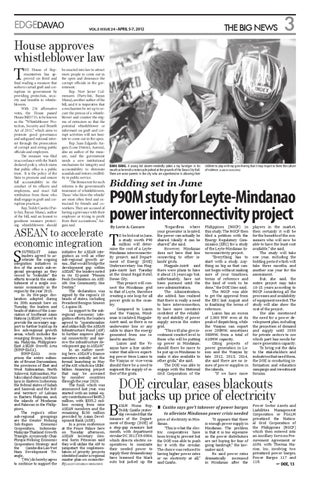
BANG BANG. A young kid absent-mindedly pokes a toy handgun in his mouth as he tends a motorcycle parked at the grounds of the Davao City Hall. There are some parents in the city who are apprehensive in allowing their
3
children to play with toy guns fearing that it may impart to them the culture of violence. [KARLOS MANLUPIG]
Bidding set in June
P90M study for Leyte-Mindanao power interconnectivity project By Lorie A. Cascaro
T
O be bid out in June, a study worth P90 million will determine the cost of a LeyteMindanao interconnectivity project, said Department of Energy (DOE) Undersecretary Ina Magpale-Asirit last Tuesday at the Grand Regal Hotel, Davao City. This project will connect the Mindanao grid to that of Leyte, therefore creating a one loop for all power grids in the country. Compared to Luzon and the Visayas, Mindanao is isolated, MagpaleAsirit said, as there is no underwater line or any cable to share the energy generated from one island to another. Luzon and the Visayas have a line underwater that allows exporting power from Luzon to the Visayas or vice-versa should there be a need to augment the supply of either of the grids.
B
“Regardless where your generator is located, the power can actually be shared. Ideally it can be shared,” she said. However, Mindanao does not have that line connecting to other islands’ grids. Magpale-Asirit said there were plans to have it about 15 years ago but, unfortunately, have not been pursued until the new administration. The Administration, she added, has realized that there is really a need to have interconnection, to have more investors confident of the reliability and stability of power supply across the entire grid. “This will also give investment comfort level to those who will be putting up power in Mindanao, should there be more to be put up in Mindanao to make it also available to other grida,” she said. The DOE was able to engage with the National Grid Corporation of the
Philippines (NGCP) in this study. The NGCP then filed a petition with the Energy Regulatory Commission (ERC) for a study of the Leyte-Mindanao Interconnectivity project. “Everything has to start with a study. Anything as big as that cannot begin without making sure of your timelines, terms of reference and the kind of work to be done,” the DOE Usec said. The NGCP was able to get the approval from the ERC last August and is finalizing the terms of reference. Luzon has an excess of 2,000 MW even at its peak of dispatching, while the Visayas can export over 200MW, sometimes 300MW, from a total of 610MW capacity. Citing projects of power generation in Luzon and the Visayas by late 2012, 2013, 2014, she said there are no issues of power supplies in the islands. “If we have more
players in the market, then certainly it will be for the benefits of the consumers who will now be able to have the least cost available,” she said. The study will take one year, excluding the bidding period which will take three months, and another one year for the assessment. But, she said, the entire project may take 10-15 years according to NGCP considering all the processes and availability of equipment needed. The study will also show the cost of the project. She also mentioned the need for a power development plan, including the projection of demand and supply until 2030 for private sectors to see which part has needs for more generation capacity. To bring out the data to the stakeholders and industries that need them, the DOE is conducting information and education campaign and investment forums.
DOE circular, eases blackouts but jacks up price of electricity
AYAN Muna Rep. Teddy Casiño yesterday revealed that the issuance of the Department of Energy (DOE) of a stop-gap measure last month, with department circular DC 2012’03-0004, which directs electric cooperatives to nominate their needed power to supply their demands may have lessened the black outs but jacked up the
n Casiño says gov’t takeover of power barges Power Sector Assets and
to alleviate Mindanao power crisis needed
price of electricity in Mindanao. “This is what the electric cooperatives have been trying to prevent but the DOE was able to push for it with the circular. The choice was reduced to having higher power rates or no electricity at all,” said Casiño.
“It appears that there is enough power supply in Mindanao. The problem is that it is too expensive so the power distributors are not buying for fear of going bankrupt,” the lawmaker said. He said power rates dramatically increased in Mindanao after the
Liabilities Management Corporation or PSALM privatized the National Grid Corporation of the Philippines (NGCP) which then entered into an Ancillary Services Procurement Agreement or ASPA with Therma Marine, Inc. involving two privatized power barges, Power Barges 117 and 118.
FDOE, 13