6 ECONOMY EDGEDAVAO
VOL.13 ISSUE 211 • THURSDAY, DECEMBER 17, 2020
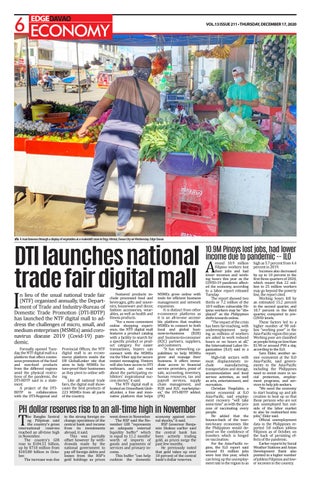
A man browses through a display of vegetables at a makeshift store in Brgy. Mintal, Davao City on Wednesday. Edge Davao
DTI launches national A trade fair digital mall
10.9M Pinoys lost jobs, had lower income due to pandemic -- ILO
I
n lieu of the usual national trade fair (NTF) organized annually, the Department of Trade and Industry-Bureau of Domestic Trade Promotion (DTI-BDTP) has launched the NTF digital mall to address the challenges of micro, small, and medium enterprises (MSMEs) amid coronavirus disease 2019 (Covid-19) pandemic.
Formally opened Tuesday, the NTF digital mall is a platform that offers continuous promotion of the food and non-food products from the different regions amid the physical restrictions of the pandemic, the DTI-BDTP said in a statement. A project of the DTIBDTP in collaboration with the DTI-Regional and
Provincial Offices, the NTF digital mall is an e-commerce platform inside the UB GlobalLinker site that aims to help MSMEs future-proof their businesses as they pivot to online selling. Like all national trade fairs, the digital mall showcases the best products of 223 MSMEs from all parts of the country.
Featured products include processed food and beverages, gifts and souvenirs, houseware and decor, fashion accessories, wearables, as well as health and fitness products. “For a more convenient online shopping experience, the NTF digital mall features a product catalog with a facility to search for a specific product or product category. For easier transactions, buyers can connect with the MSMEs via the Viber app for secure instant messaging. Visitors will also have access to DTI webinars, and can read about the participating exhibitors’ inspirational success stories,” it said. The NTF digital mall is hosted on UnionBank GlobalLinker, a free and innovative platform that helps
to the strong foreign exchange operations of the central bank and income from its investments abroad, it said. This was partially offset however by withdrawals made by the national government to pay off foreign debts and losses from the BSP's gold holdings as prices
went down in November. The BSP said the November GIR "represents an adequate external liquidity buffer" which is equal to 11.2 months’ worth of imports of goods and payments of services and primary income. This buffer "can help cushion the domestic
MSMEs grow online with tools for efficient business management and network expansion. It is distinct from other e-commerce platforms as it is an all-in-one accessible platform that enables MSMEs to connect to both local and global business-to-business (B2B) and business-to-consumer (B2C) partners, suppliers, and customers. “It has networking capabilities to help MSMEs grow and manage their business. It offers immediate access to financial service providers, point of sale, accounting, inventory, human resources, tax and payroll services, supply chain management, and B2B and B2C marketplaces,” the DTI-BDTP added. (PR)
PH dollar reserves rise to an all-time high in November
T
he Bangko Sentral ng Pilipinas said the country's gross international reserves reached an all-time high in November. The country's GIR rose to $104.51 billion, up by $710 million from $103.80 billion in October. The increase was due
economy against external shocks," it said. BSP Governor Benjamin Diokno earlier said the central bank has been actively trading gold, as prices surge the past few months. He previously noted that gold takes up over 10 percent of the central bank's dollar reserves.
round 10.9 million Filipino workers lost their jobs and had lower incomes and working hours this year as the COVID-19 pandemic affected the economy, according to a labor report released Tuesday. The report showed two thirds or 7.2 million of the 10.9 million vulnerable Filipino workers may be “displaced” as the Philippines shifts towards online. “The impact of the crisis has been far-reaching, with underemployment surging as millions of workers are asked to work reduced hours or no hours at all,” the International Labor Organization (ILO) said in a report. High-risk sectors with most displacements include manufacturing, transportation and storage, accommodation and food service activities, as well as arts, entertainment, and recreation. Christian Viegelahn, a senior economist at ILO Asia-Pacific, said employment recovery “will take some time” as with the process of vaccinating every people. He added that the bounce-back of the tourism-heavy economies like the Philippines would depend on the confidence of travelers which is hinged on vaccination. For the Asia-Pacific region, the ILO report said around 81 million jobs were lost this year, which can bring up the unemployment rate in the region to as
high as 5.7 percent from 4.4 percent in 2019. Incomes also decreased by up to 10 percent in the first three quarters of 2020, which meant that 22 million to 25 million workers may go beyond the poverty line, the report cited. Working hours fell by an estimated 15.2 percent in the second quarter, and 10.7 percent in the third quarter, compared to preCOVID levels. These factors led to a higher number of 98 million “working poor” in the Asia-Pacific region this year. Working poor are classified as people living on less than $1.90 or around P90 a day, according to the ILO. Sara Elder, another senior economist at the ILO Asia-Pacific, said governments in the Asia-Pacific including the Philippines need to invest more in social protection, employment programs, and services to help job seekers. “We need the economy to start heating up and job creation to heat up so that those persons who are not just unemployed but outside of the labor market to also be reabsorbed into jobs,” Elder said. Official unemployment data in the Philippines reported 3.8 million jobless Filipinos as of October, on the back of persisting effects of the pandemic. Earlier reports by Social Weather Stations and Asian Development Bank also pointed to a higher number of jobless Filipinos and lower incomes in the country.