Local News
North Coast news online
Local small breweries feeling the pinch ▶ Continued from page 1 hand, have much larger profit margins to play with. ‘And every six months, the government excise on alcohol is going up at a rate that is simply breaking small to medium producers’. The Independent Brewers Association (IBA), who represent the industry, confirmed with The Echo that there have been ‘massive increases in costs’. The IBA’s Kelly Falconer told The Echo, ‘For example the cost of CO2 (used to carbonate the beer) is up by as much as 51 per cent, raw material costs up by 37 per cent, and the cost of living has impacted on consumer buying behaviour, drastically reducing expenditure on independent craft beer, as it is a “premium product”.’
Large brewery dominance Another major factor is competition with the larger breweries – Rupert and Chrissy from Wandana say that wholesale has become increasingly difficult owing to multinationals contracting 90 to 100 per cent of beer taps at pubs and clubs, and they offer very lucrative rebates and upgrades in return. The IBA’s Kelly Falconer agrees: ‘Large breweries such as CUB and Lion have been able to use their market power to instigate tap contracts (including rebates and cash incentives) to lock at least 85 per cent of beer taps in the country, limiting distribution channels available to independent brewers and consumer choice’. ‘They have also reduced competition by acquiring any
independent breweries that are in a significant growth phase’. Founding Drongo/head brewer from Murwillumbahbased brewery, Spangled Drongo, Brian Kiss Von Soly, told The Echo that because the industry is geared towards the bigger players, many smaller brewers set themselves up with the intention to flip the business when it gets big enough to buy. And big is not necessarily better – Brian says that cheaper beer made by some multinationals may have additives that are not listed on the label. Brian says, ‘They are called “processing aids’, which are technically not ingredients, additives or preservatives, so they are not required to be on the label. While these pass as food-grade, it’s questionable as to whether they are healthy or not.’ ‘It’s a loophole in the industry’, he says. ‘Processing aids increase efficiencies of production, for example. One is an anti-foam (dimethylpolysiloxane), which looks like PVA glue. It is foodgrade plastic silicone and is added to increase profits. ‘It’s also added to every McDonald’s fryer. ‘We don’t add such things to our beers because these add to your hangover.’ Also known as E900, The US National Institute of Health say the consensus on its use as a food additive ‘is that it is safe; however, studies should continue to confirm this safety and degree of safety with certainty’. As for Australia’s beer sales, Brian says Asahi controls the majority, along with Lion Nathan/Kirin. Coopers is
protecting local fauna/ habitats/ emergency relief, etc’. ‘Local breweries need the community in exchange to get behind us and help us, because if they don’t there is a real risk that they may not all be around for much longer.
Simple support
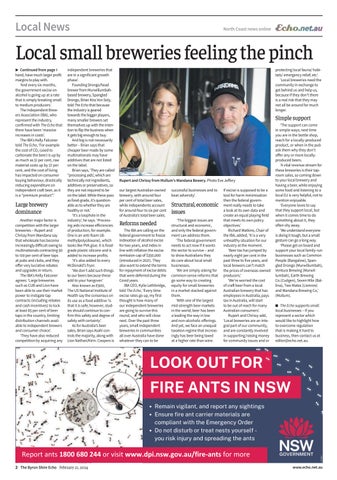
Rupert and Chrissy from Mullum’s Wandana Bewery. Photo Eve Jeffery our largest Australian-owned brewery, with around four per cent of total beer sales, while independents account for around four to six per cent of Australia’s total beer sales.
successful businesses and to beat adversity’.
Reforms needed
‘The biggest issues are structural and economic, and only the federal government can address them. ‘The federal government needs to act now if it wants the sector to survive – and to show Australians they do care about local small businesses. ‘We are simply asking for common-sense reforms that go some way to creating equity for small breweries in a market stacked against them. ‘With one of the largest mid-strength beer markets in the world, beer has been a leading the way in low and non-alcoholic offerings. And yet, we face an unequal taxation regime that increasingly has beer being taxed at a higher rate than wine.
The IBA are calling on the federal government to freeze indexation of alcohol excise for two years, and index in line with inflation the excise remission cap of $350,000 (introduced in 2021). They also want to extend the terms for repayment of excise debts that were deferred during the Covid years. IBA CEO, Kylie Lethbridge, told The Echo, ‘Every time excise rates go up, my first thought is how many of our independent breweries are going to survive this round, and who will close next. Over the past three years, small independent breweries in communities all over Australia have done whatever they can to be
Structural, economic issues
If excise is supposed to be a tool for harm minimisation then the federal government really needs to take a look at its own data and create an equal playing field that meets its own policy objectives.’ Richard Watkins, Chair of the IBA, added, ‘It is a very unhealthy situation for our industry at the moment. ‘Beer tax has jumped by nearly eight per cent in the past three to five years, and local brewers can’t match the prices of overseas-owned producers.’ ‘We’re worried the cost of craft beer from a local Australian brewery that has employees in Australia, pays tax in Australia, will start to be out of reach for many Australian consumers’. Rupert and Chrissy add, ‘Local breweries are an integral part of our community, and are constantly involved in supporting/raising money for community issues and or
‘The support can come in simple ways; next time you are in the bottle shop, reach for a locally-produced product, or when in the pub ask them why they don’t offer any or more locallyproduced beers. ‘A vital revenue stream for these breweries is their taproom sales, so coming down to your local brewery and having a beer, while enjoying some food and listening to a local DJ is very helpful, not to mention enjoyable. ‘Everyone loves to say that they support local, but when it comes time to do something about it, they often shy away. ‘We understand everyone is doing it tough, but a small gesture can go a long way. ‘Please get on board and support your local family-run businesses such as Common People (Bangalow), Spangled Drongo (Murwillumbah), Ventura Brewing (Murwillumbah), Earth Brewing Co.(Cudgen), Seven Mile (Ballina), Two Mates (Lismore) and Wandana Brewing Co,’ (Mullum). Q The Echo supports small local businesses – If you represent a sector which would like to highlight how to overcome regulation that is making it hard to business, then contact us at editor@echo.net.au.
XffVȎf Ȏ<f <F (Ȏ _ ȎF_Ȏ_ °
ZĞƉŽƌƚ ĂŶƚƐ ϭϴϬϬ ϲϴϬ Ϯϰϰ Žƌ ǀŝƐŝƚ ǁǁǁ͘ĚƉŝ͘ŶƐǁ͘ŐŽǀ͘ĂƵͬĨŝƌĞͲĂŶƚƐ ĨŽƌ ŵŽƌĞ 2 The Byron Shire Echo DĕćſƖëſƷ ǩǨǽ ǩǧǩǫ
LP1801
êĤÃĉĥȎŶĉĀĉĞÃĥŚǣȎÃĥåȎŋêňĬŋŚȎÃĥŽȎŒĉĀąŚĉĥĀŒ êĤÃĉĥȎŶĉĀĉĞÃĥŚǣȎÃĥåȎŋêňĬŋŚȎÃĥŽȎŒĉĀąŚĉĥĀŒ (ĥŒŠŋêȎÿĉŋêȎÃĥŚȎßÃŋŋĉêŋȎĤÃŚêŋĉÃĞŒȎÃŋê (ĥŒŠŋêȎÿĉŋêȎÃĥŚȎßÃŋŋĉêŋȎĤÃŚêŋĉÃĞŒȎÃŋê ßĬĤňĞĉÃĥŚȎŷĉŚąȎŚąêȎ(ĤêŋĀêĥߎȎfŋåêŋ ßĬĤňĞĉÃĥŚȎŷĉŚąȎŚąêȎ(ĤêŋĀêĥߎȎfŋåêŋ #ĬȎĥĬŚȎåĉŒŚŠŋÞȎĬŋȎŚŋêÃŚȎĥêŒŚŒȎŽĬŠŋŒêĞÿȎǹ #ĬȎĥĬŚȎåĉŒŚŠŋÞȎĬŋȎŚŋêÃŚȎĥêŒŚŒȎŽĬŠŋŒêĞÿȎǹ ŽĬŠȎŋĉŒěȎĉĥĘŠŋŽȎÃĥåȎŒňŋêÃåĉĥĀȎŚąêȎÃĥŚŒ ŽĬŠȎŋĉŒěȎĉĥĘŠŋŽȎÃĥåȎŒňŋêÃåĉĥĀȎŚąêȎÃĥŚŒ
www.echo.net.au