Issue# 35.33 January 27 – February 3, 2021 Editor : Mandy Nolan Editorial/gigs : gigs@echo.net.au Copy deadline: 5pm each Friday Advertising : adcopy@echo.net.au P : 02 6684 1777 W : echo.net.au/entertainment
ENTERTAINMENT
M A N DY N O L A N ’ S
SOAPBOX THE EARS HAVE IT
It’s 6am, the sun is only just nudging its way through the clouds. I am up early to write my Soapbox. I was going to write on something else, but this morning when I woke and stumbled to my desk I saw my open diary: 22 January, Michael’s birthday. He would have been 61 today. I have never written about Michael. There just seemed to be too much said, too much that couldn’t be taken back, too much that he could never defend himself against. I certainly didn’t want to add to that. I’ve read so many things where people try and pinpoint who he was, and the closer they get the further away he seems. It’s like chasing shadows. It’s almost impossible to encapsulate a person with language, especially when they’re gone. A person’s essence has this fluidity that makes them illusive when drawn onto paper or the flickering words of a screen. But today I feel drawn to write something; a small acknowledgement to a man I knew for only four years. My then partner’s brother, Michael Hutchence. I wasn’t really into INXS, I thought they were too mainstream. I didn’t think I should mention that upfront. When you meet a rock star it's best not to insult them off the bat. It’s awkward meeting famous people. There’s a massive status imbalance. It’s probably why most celebs prefer to speak to each other. It’s hard to have a regular chat when someone’s laundry is laid out in the tabloids and they have this huge public profile, that you notice even when you haven’t been paying attention and you’re just a regular Joe. You think, should I tell them about my last trip to Centrelink? You certainly don’t expect them to be interested in you. But that was what Michael was exceptional at; making people feel comfortable. He asked questions. Some people ask questions because they know they are supposed to ask questions– but they’re not actually interested in the answers. They usually fire out another unrelated question half way through your response. Michael actually listened. I remember being shocked. Which is weird in itself. But I didn’t expect him to be so interested – not just in me, but in everyone he talked to. He could be in a room full of super
22 The Byron Shire Echo January ǩǮ, ǩǧǩǨ
famous hob-nobby people, but if he was talking to you he wasn’t looking over your shoulder for someone better, he was actively listening to you. It taught me something quite profound. All these noisy people in a room vying for attention, and the most intensely charismatic person is the one who is quietly focusing on the conversation of another. How can that be? What is it about truly listening that is so intoxicating? I’ve always been one of the noisemakers. It never occurred to me that the most powerful people in the room know how to stand back, choosing not to absorb the spotlight but to reflect light on another. To be truly heard, to be truly seen is a deeply sensual human experience. To be acknowledged, understood and validated is one of our most primal human needs, but so often it eludes us. And in constantly seeking to be listened to, we often forget to listen. Being listened to is incredibly seductive. To have someone make themselves completely available to you, to be present and to really see you is more alluring than good looks or tight pants or big boobs. It’s an intimate human engagement. Who would have thought? Listening is sexy! When people met Michael they would talk about how he lit up a room, about his incredible charisma. The foundation of his charisma wasn't being a focus puller, a show off, or a ‘rock star’ it was simply how he made other people feel. They’d tell their story. He’d listen to them, and then they’d walk away going ‘that guy’s amazing’. He didn’t really have to say anything. He just had to give them his attention. Giving real attention to another human being is truly generous. It affects people. I remember driving through Sydney in the early hours of the morning with Michael at the wheel, I think we were going home from a party. I was in the back, half asleep with my partner and baby. There was an old woman on the side of the road hitching. Michael pulls the Jag over and offers her a lift. It’s clear she’s distressed. She wants to be dropped at The Gap. Michael won’t take her there. He asks her questions. She tells her story, about what has happened to her. It takes a long time. We seem to be driving forever. Eventually, as the sun comes up, Michael drops her at the beach. She leaves the car with a little more hope. Someone has shown her kindness. Just a random man in a nice car with a small family in the backseat. She didn't know she’d been picked up by someone who was the lead singer of some world-famous band. That was irrelevant. What was relevant was that someone had shown her the kindness of caring about her story. Someone had listened. That night sits as one of my most enduring memories of Michael. It reminds me to be quiet. To listen rather than always speak. It’s a big learning for me. I make a living out of making noise. But this morning, when I sat at my desk, I wasn’t going to write this – then I closed my eyes and this came. I guess you could say, I listened.
Laura Bloom
FEMALE FRIENDSHIPS
IN FULL BLOOM
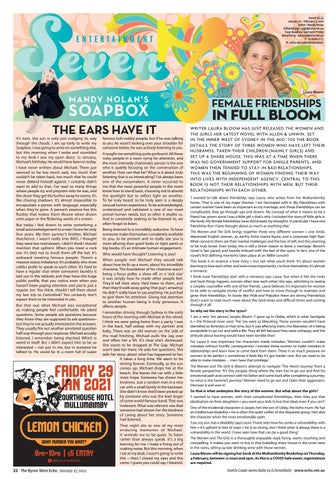
WRITER LAURA BLOOM HAS JUST RELEASED THE WOMEN AND THE GIRLS HER LATEST NOVEL WITH ALLEN & UNWIN. SET IN THE INNER WEST OF SYDNEY IN THE MID ‘70S THE BOOK DETAILS THE STORY OF THREE WOMEN WHO HAVE LEFT THEIR HUSBANDS, TAKEN THEIR CHILDREN (MAINLY GIRLS) AND SET UP A SHARE HOUSE. THIS WAS AT A TIME WHEN THERE WAS NO GOVERNMENT SUPPORT FOR SINGLE PARENTS, AND WOMEN THEN TENDED TO STAY IN BAD RELATIONSHIPS. THIS WAS THE BEGINNING OF WOMEN FINDING THEIR WAY INTO LIVES WITH INDEPENDENT AGENCY. CENTRAL TO THIS BOOK IS NOT THEIR RELATIONSHIPS WITH MEN, BUT THEIR RELATIONSHIPS WITH EACH OTHER. ‘I wanted to talk about friendship,’ says Laura, who writes from her Mullumbimby home. ‘That is one of my major themes. I am fascinated with it. My friendships with certain women have been as important as my marriage, and those friendships can be complicated, they go through ups and downs. My concept of what it means to be a friend has grown since I was a little girl – that's why I included the story of little girls in the book. My female friendships have dominated my thoughts. In particular I have one friendship that I have thought about as much as anything else.’ The Women and The Girls brings together three very different women – one timid, depressed English woman, an earthy boho mama figure, and a corporate high flyer. What connects them are their marital challenges and the loss of self, and this yearning to be truly loved. Even today this is still a brave reason to leave a marriage. Bloom’s novel is fast paced, and heavily imbued with the feel of the 1970s. In fact, one of the novel’s first defining moments takes place at an ABBA concert! This book is in essence a love story – but not what you’d think. It’s about women learning to love each other, and even more importantly – to love themselves; it’s almost a romance. ‘I think most friendships start with a romance,’ says Laura, ‘but when it hits the rocks and hard things happen, women often lose each other,’ she says, admitting to seeing a couples counsellor with one of her friends. Laura believes it’s important for women to be able to navigate stories of conflict and how to move through to maintain and grow their friendships. ‘In books like Pride and Prejudice there are strong friendships [but] I want to read much more about the hard times and difficult times and coming through it all.’ So why set the story in the 1970s? ‘I am a very ‘70s person,’ laughs Bloom. ‘I grew up in Glebe, which is what Sandgate is – the fictional inner west. The ‘70s were so liberating. These women wouldn’t have identified as feminists at that time, but it was affecting them; the liberation of it being acceptable to go out and seek a life. They all left because they were unhappy, and the attitude about leaving would have been terrible then.’ For Laura it was important her characters made mistakes. ‘Women couldn’t make mistakes without horrific consequences. I wanted these women to make mistakes in relationships and learn how to come back from them. There is so much pressure on women to be perfect – sometimes it feels like it’s got harder now. But we need to be able to make mistakes… men have that privilege.’ The Women and The Girls is Bloom’s attempt to navigate ‘The Hero’s Journey’ from a female perspective. ‘It’s this Jungian thing where the man has to go out and find his emotional path and connect with his father and come back after completing a journey. So what is the heroine’s journey? Women need to go out and claim their aggression. Discover it and own it.’ So that is what underpins the story of the women. But what about the girls? ‘I wanted to have women, with their complicated friendships, then they put that idealisation on their daughters – you want your kids to live that ideal, even if you can’t.’ One of the incidental characters is Jasper, he’s the son of Libby, the boho mum. He has an intellectual disability – he is often the quiet unifier of the disparate group. He’s also the character who’s the most emotionally open. ‘Leo, my son, has a disability’ says Laura. ‘I have seen how he carries a vulnerability, with him – it’s upfront in lots of ways – he is so strong, but I think what is always there is a vulnerability in the world. I have seen how that can be a good thing.’ The Women and The Girls is a thoroughly enjoyable read; funny, warm, touching and compelling. It makes you want to live in that bubbling share house in the inner west in the 1970s, sitting up late drinking wine with those women. Laura Bloom will be signing her book at the Mullumbimby Bookshop on Thursday, 4 February, between 12 noon and 2pm. As this is a COVID Safe event, registrations are required.
North Coast news daily in Echonetdaily www.echo.net.au