Articles
Burning trees for electricity is not ‘green energy’ Marion Riordan The horror of recent drought and bushfires has made the urgency for action on climate change ever more apparent to most Australians. Our continent is expected to suffer more than any other. The intense logging that is happening right now in the small patches of state forest that have survived the recent bushfires is appalling. These trees are the only habitat left for the wildlife that has survived. It is estimated that over one billion animals perished in NSW fires alone.
Logging increases ćƖƆIJǕ ſĕ ſĶƆŊƆ Yet there are plans to significantly increase logging of our native forests. There are some who claim this is in order to combat climate change, regardless of the fact that it has been scientifically proven that logging increases the risk of more intense and devastating fires (https://go.nature. com/2U0Idvm). Right now, Australia’s renewable energy agency
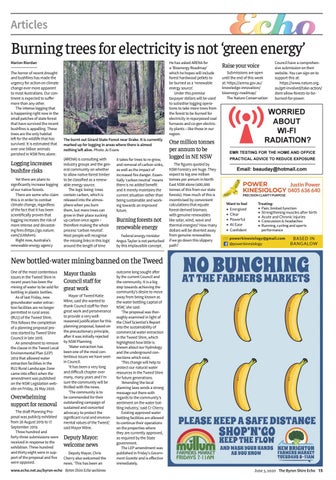
He has asked ARENA for a ‘Bioenergy Roadmap’ which he hopes will include forest hardwood pellets to be burned as a ‘renewable energy source’. Under this premise taxpayer dollars will be used to subsidise logging operations to take more trees from the forest to be burned for electricity in repurposed coal furnaces and co-gen electricity plants – like those in our region. The burnt out Girard State Forest near Drake. It is currently marked up for logging in areas where there is almost nothing left alive. Photo Jo Evans (ARENA) is consulting with industry groups and the general community on whether to allow native forest timber to be classified as a renewable energy source. The logic being: trees contain carbon, which is released into the atmosphere when you burn them, but more trees can grow in their place sucking up carbon once again – therefore making the whole process ‘carbon neutral’. Most people will recognise the missing links in this logic around the length of time
it takes for trees to re-grow, and removal of carbon sinks, as well as the impact of increased fire danger. Essentially ‘carbon neutral’ means there is no added benefit and it merely maintains the current situation rather than being sustainable and working towards an improved future.
Burning forests not renewable energy Federal energy minister Angus Taylor is not perturbed by this implausible concept.
One million tonnes per annum to be logged in NE NSW The figures quoted by NSW Forestry are huge. They expect to log one million tonnes per annum in North East NSW alone (400,000 tonnes of this from our state forests). How much of this is incentivised by convenient calculations that equate forest-derived biomass with genuine renewables like solar, wind, wave and thermal energies? How many dollars will be diverted away from genuine renewables if we go down this slippery path?
Raise your voice Submissions are open until the end of this week at: https://arena.gov.au/ knowledge-innovation/ bioenergy-roadmap/ The Nature Conservation
Council have a comprehensive submission on their website. You can sign on to support this at: https://www.nature.org. au/get-involved/take-action/ dont-allow-forests-to-beburned-for-power.
WORRIED ABOUT WI-FI RADIATION? EMR TESTING FOR THE HOME AND OFFICE PRACTICAL ADVICE TO REDUCE EXPOSURE
Email: beauday@hotmail.com
POWER Justin Power KINESIOLOGY 0405 636 640 PRECISION CLARITY PURPOSE
Want to feel • Energised • Clear • Powerful • At Ease • &RQĆGHQW
Treating: • Pain, limited function • Strengthening muscles after birth • Acute and Chronic injuries • Concussion & headaches • Running, cycling and sports performance
powerkinesiology@gmail.com @powerkinesiology
BASED IN BANGALOW
New bottled-water mining banned on the Tweed One of the most contentious issues in the Tweed Shire in recent years has been the mining of water to be sold for bottling in plastic bottles. As of last Friday, new groundwater water extraction facilities are no longer permitted in rural areas (RU2) of the Tweed Shire. This follows the completion of a planning proposal process started by Tweed Shire Council in late 2018. An amendment to remove the clause in the Tweed Local Environmental Plan (LEP) 2014 that allowed water extraction facilities in the RU2 Rural Landscape Zone came into effect when the amendment was published on the NSW Legislation website on Friday, 29 May 2020.
Overwhelming support for removal The draft Planning Proposal was publicly exhibited from 20 August 2019 to 17 September 2019. Three hundred and forty-three submissions were received in response to the exhibition. Three hundred and thirty-eight were in support of the proposal and five were opposed.
lëƷşſ ƐIJëŕŊƆ !şƖŕĈĶō ƆƐëǔ Īşſ īſĕëƐ ƱşſŊ Mayor of Tweed Katie Milne, said she wanted to thank Council staff for their great work and perseverance to provide a very wellreasoned justification for this planning proposal, based on the precautionary principle, after it was initially rejected by NSW Planning. ‘Water extraction has been one of the most contentious issues we have seen in Council. ‘It has been a very long and difficult chapter over many, many years and I’m sure the community will be thrilled with the news. ‘The community is to be commended for their outstanding campaign of sustained and concerted advocacy to protect the significant rural and environmental values of the Tweed,’ said Mayor Milne.
Deputy Mayor: welcome news Deputy Mayor, Chris Cherry also welcomed the news. ‘This has been an
www.echo.net.au/byron-echo Byron Shire Echo archives
outcome long sought after by the current Council and the community. It is a big step towards achieving the community’s desire to move away from being known as the water bottling capital of NSW,’ she said. ‘The proposal was thoroughly examined in light of the Chief Scientist’s Report into the sustainability of commercial water extraction in the Tweed Shire, which highlighted how little is known about our hydrology and the underground connections which exist. ‘This change will help to protect our natural water resources in the Tweed Shire for future generations. ‘Amending the local planning laws sends a strong message out there with regards to the community’s sentiment on the water bottling industry,’ said Cr Cherry. Existing approved water bottling facilities are allowed to continue their operations on the properties where they are currently approved, as required by the State government. The LEP amendment was published in Friday’s Government Gazette and is effective immediately. `Ɩŕĕ Ǫǽ ǩǧǩǧ The Byron Shire Echo 15