Articles
The corpse of Being reanimated Michael McDonald
It lives! In a style reminiscent of HP Lovecraft’s Herbert West, author Sarah Bakewell has successfully brought to life the philosophy of Existentialism in an age plagued by Hedonism Lite. Her book, At the Existentialist Cafe: Freedom, Being & Apricot Cocktails, recounts the beginnings of existentialism in Paris in the 1930s and explains the philosophy as clearly and simply as it can be done. She wittily examines the lives of its proponents, chiefly Jean-Paul Sartre and Simone de Beauvoir, the quarrels between several philosophers, and looks at the rise of Nazism, which certainly made the dilemmas of existence more pressing. For the existentialists and for the English surrealist poet David Gascoyne, ‘What is detestable about war is that it reduces the individual to complete insignificance.’
Dizzying choice By the time I learnt in the first few pages that ‘anxiety is the dizziness of freedom’, according to Kierkegaard, and that Sartre was fond of imitating Donald Duck, I was hooked. Ms Bakewell rose even higher in my esteem when she suggested that one of my favourite SF movies, the 1957 cult classic The Incredible Shrinking Man, is ‘one of the best mid-century expressions of paranoia about the disappearing powers of authentic humanity’. Kierkegaard’s remark is about the dizzying freedom of choice that existentialists see as the outcome of not relying on a sky-god, instilled morality or a bourgeois authority to form one’s opinions – how then should one act? Existentialism takes thinking out of the realm of philosophy for philosophy’s sake – a sure way to disappear up one’s own bum – and urges us to look at the world as it is, to grasp things and describe them. and listed in the NSW Threatened Species Conservation Act 1995 and the EPBC Act 1999. An additional report did include a passing reference to electromagnetic radiation, which stated: With the construction of the telecommunications tower some potential for emissions of electromagnetic radiation may result during the operational phase’.
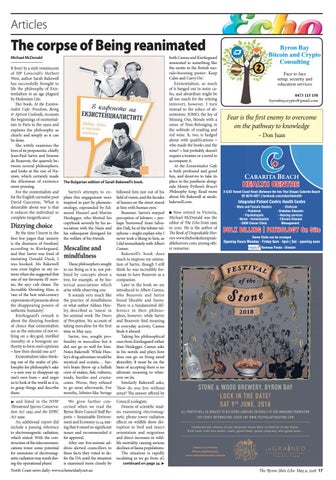
The Bulgarian edition of Sarah Bakewell’s book.
Sartre’s attempts to explain this engagement were inspired in part by phenomenology, expounded by Edmund Husserl and Martin Heidegger, who blotted his copybook severely by his association with the Nazis and his subsequent disregard for the welfare of his friends.
These philosophers sought to see Being as it is, not polluted by concepts about a tree, for example, or by historical associations which arise while observing one. It sounds very much like the practice of mindfulness or what author Aldous Huxley described as ‘isness’ in his seminal work The Doors of Perception, his account of taking mescaline for the first time in May 1953. Sartre, too, sought profundity in mescaline but it did not go so well for him. Notes Bakewell: ‘While Huxley’s drug adventure would be mystical and ecstatic… Sartre’s brain threw up a hellish crew of snakes, fish, vultures, toads, beetles and crustaceans. Worse, they refused to go away afterwards. For months, lobster-like beings
followed him just out of his field of vision, and the facades of houses on the street stared at him with human eyes.’ Bummer. Sartre’s warped perception of lobsters – perhaps ‘borrowed’ from Salvador Dali, he of the lobster telephone – might explain why I never took a liking to him, as I did immediately with Albert Camus. Bakewell’s book does much to improve my estimation of Sartre, though I still think he was incredibly fortunate to have Beauvoir as a companion. Later in the book we are introduced to Albert Camus, who Beauvoir and Sartre found likeable and funny. There is a fundamental difference in their philosophies, however: while Sartre and Beauvoir find meaning in everyday activity, Camus finds it absurd. Taking his philosophical cues from Kierkegaard rather than Heidegger, Camus asks in his novels and plays how does one go on living amid absurdity. It must be on the basis of accepting there is no ultimate meaning to whatever we do. Similarly Bakewell asks, ‘How do you live without sense? The answer offered by
We grew further concerned when we read the Byron Shire Council Staff Reports – Sustainable Environment and Economy 13.14, stating that it raised no significant issues and recommended it for approval. After our five-minute address alerted councillors to these facts they voted to defer the DA until the situation is examined more closely by
Council ecologists. Dozens of scientific studies examining electromagnetic phone tower radiation effects on wildlife show disruption to bird and insect orientation and migration and direct increases in wildlife mortality causing serious declines of fauna populations. The situation is rapidly escalating as we go from 3G continued on page 24
Mescaline and mindfulness
North Coast news daily: www.echonetdaily.net.au
both Camus and Kierkegaard amounted to something like the motto in the British morale-boosting poster: Keep Calm and Carry On.’ Existentialism, so much of it banged out in noisy cafes, and absurdism might be all too much for the retiring introvert, however. I turn instead to the solace of absenteeism. JOMO, the Joy of Missing Out, blends with a sense of Non-Belonging in the solitude of reading and red wine. It, too, is hedged about with qualifications – who made the books and the wine? – but probably doesn’t require a treatise or a novel to accompany it. At the Existentialist Cafe is both profound and good fun, and deserves to take its place in the pantheon alongside Monty Python’s Bruce’s Philosophy Song. Read more about Ms Bakewell at sarahbakewell.com. Now retired in Victoria, Michael McDonald was the editor of The Echo from 1995 to 2010. He is the author of The Book of Unspeakable Horrors www.thebookofunspeakablehorrors.com, among other nonsense.
Byron Bay Bitcoin and Crypto Consulting Face to face setup, security and education services 0473 115 150 byronbaycrypto@gmail.com
Fear is the first enemy to overcome on the pathway to knowledge – Don Juan
CABARITA BEACH
HEALTH CENTRE 3-5/33 Tweed Coast Road (Between the two Thai Shops) Cabarita Beach 02 6676 4027 | facebook.com/cabaritahealth
Integrated Patient Centric Health Centre - Male and Female Doctors - Podiatrist - Psychologists - Nurse - Immunisation - SKIN Cancer Clinic
Q
- Dietician - Diabetes Educator - Hearing services - Chronic Disease Management
BULK BILLING | PATHOLOGY On Site Home Visits can be arranged
Opening Hours Monday - Friday 8am - 5pm | Sat - opening soon Ramana Panda - Director
STONE & WOOD BREWERY, BYRON BAY LOCK IN THE DATE! SAT 9 TH JUNE, 2018 ALL PROFITS WILL BE DONATED TO BIG SCRUB LANDCARE ON BEHALF OF OUR INGRAINED FOUNDATION FOR TICKET INFORMATION, CHECK OUT WWW.FESTIVALOFTHESTONE.COM Celebrate the release of our seasonal Stone Beer at Festival of the Stone. Kick back with live music, stalls, good food, good company and good beer...
*SUBJECT TO APPROVAL
#festivalofthestone www.stoneandwood.com.au
The Byron Shire Echo May 9, 2018 17