Byron Shire Echo December 18, 2007 35
www.echo.net.au
Articles Hans Lovejoy examines a large and essential part of this newspaper’s production
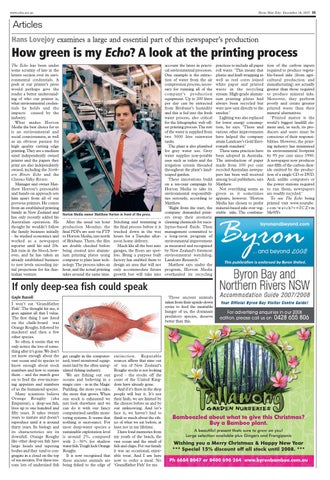
How green is my Echo? A look at the printing process The Echo has been under some scrutiny of late in the letters section over its environmental credentials. A peek at our printer’s press would perhaps give the reader a better understanding of who our printer is, what environmental credentials he holds and the impacts caused by the industry. What makes Horton Media the best choice for us is an environmental and social consciousness, as well as an obvious passion for high quality cutting edge printing. They are a medium sized independently owned printer and the papers they print are also independently owned, including the Northern Rivers Echo and the Clarence Valley Review. Manager and owner Matthew Horton’s personable and hands-on approach sets him apart from all of our previous printers. He comes from an established printing family in New Zealand and has only recently added his Australian operation. He thought he wouldn’t follow the family business initially – he studied economics and worked as a newspaper reporter until his mid 20s. Ink runs in the blood, however, and he has taken an already established business to new levels exceeding initial projections for his Australian venture.
Horton Media owner Matthew Horton in front of the press.
After the usual ten hour production Monday, the final PDFs are sent via FTP to Horton Media, just north of Brisbane. There, the files are double checked before being created into aluminium printing plates using computer to plate laser technology. The process takes an hour, and the actual printing takes around the same time.
Stitching and trimming is the final process before it is trucked down in the wee hours for a Tuesday afternoon home delivery. Much like all the best auto garages, the floors are spotless. Being a purpose built factory has enabled them to design an area that will not only accommodate future growth but will take into
account the latest in practical environmental processes. One example is the extraction of water from the air compression process, necessary for running all of the company’s production equipment. Up to 200 litres per day can be extracted from Brisbane’s humidity and this is fed into the fresh water process, also critical for the lithographic web offset printing process. The rest of the water is supplied from two 3000 litre rainwater tanks. The plant is also plumbed for grey water use. Grey water supplies non-potable uses such as toilets and the irrigation system threaded throughout the plant’s landscaped garden. These innovations build on a ten-year campaign by Horton Media to take its environmental responsibilities seriously, according to Matthew. ‘Right from the start, the company demanded printers swap their aromatic cleaning chemicals for eucalyptus-based fluids. Then management committed to a long-term program of environmental improvement as measured and recognised by New Zealand’s foremost environmental watchdog, Landcare Research.’ Matthew says under the program, Horton Media overhauled its recycling
practices to include all paper roll waste. ‘This meant that plastic and kraft wrapping as well as reel cores joined white paper and printed waste in the recycling stream. High-grade aluminium printing plates had always been recycled but were now sent directly to the smelter.’ Lighting was also replaced for lower energy consumption, he says. ‘These and various other improvements have helped the company attain Landcare’s Gold Enviromark standard.’ These same practices have been adopted in Australia. The introduction of paper made from 100 per cent recycled Australian newspapers has been well received among local publishers, says Matthew. Not everything seems as green as it sometimes appears, however. ‘Horton Media has chosen to prefer mineral-based inks over vegetable inks. The combina-
tion of the carbon inputs required to produce vegetable-based inks (from agricultural production and manufacturing) are actually greater than those required to produce mineral inks. Moreover, they perform poorly and create greater printed waste than their mineral alternatives. ‘Printed matter is the world’s biggest landfill element and, as such, its producers and users must be conscious of their responsibilities. However, the printing industry has minimised its environmental footprint by 95 per cent since 1990. A newspaper now produces one-fifth of the carbon dioxide emitted by the production of a single CD or DVD. And, unlike computers or the power stations required to run them, newspapers are readily recycled.’ To see The Echo being printed visit www.youtube. com/watch?v=ICZvm Me9lYs
If only deep-sea fish could speak Gayle Russell I won’t eat ‘Grandfather Fish’. The thought hit me, it goes against all that I value. The first thing I saw listed on the chalk-board was Orange Roughy, followed by mackerel and then a few other species. So often, it seems that we only notice the loss of something after it’s gone.We don’t yet know enough about the vast ocean and its species to know enough about stock numbers and how to sustain them – and the march goes on to feed the ever-increasing appetites and numbers of us the humanoid species. Many scientists believe Orange Roughy (aka Empereur), a deep-sea fish, lives up to one hundred and fifty years. It takes twenty years to mature and doesn’t reproduce until it is around thirty years. Its biology and its characteristics are its downfall. Orange Roughy like other deep-sea fish have large heads and tapering bodies and they tend to congregate in a cloud on the top of sea mounts. For these reasons lots of undersized fish
These ancient animals taken from their upside-down eyries to feed the insatiable hunger of us, the dominant predatory species, deserve better than this.
get caught in the computerised, trawl monitored equipment laid by the often unregulated fishing industry. We are fishing out our oceans and believing in a magic cure – as in the Magic Pudding, the more you take, the more that grows. When one stock is exhausted we just look elsewhere and we can do it with our fancy computerised satellite monitoring systems. It seems that nothing is sacrosanct. For most deep-water species a sustainable exploitation level is around 2%, compared with 2—30% for shallow water fish.Tough luck Orange Roughy. It is now recognised that these ancient animals are being fished to the edge of
extinction. Reputable sources affirm that nine out of ten of New Zealand’s Roughy stocks is not looking good – the stocks off the coast of the United Kingdom have already gone. And if it’s there in the shop people will buy it. It’s not their fault, we are limited by the choices before us and by our unknowing. And let’s face it, we haven’t had to think so much about the ethics of what we eat before, at least not in my lifetime. I have fond memories from my youth of the beach, the vast ocean and the smell of fish and chips. For our family it was an occasional, enjoyable treat. And I am here now to order a meal. No ‘Grandfather Fish’ for me.
Bamboozled about what to give this Christmas? Buy a Bamboo plant. A beautiful present thats sure to grow on you! Large selection available plus Gingers and Frangipanis
Wishing you a Merry Christmas & Happy New Year *** Special 15% discount off all stock until 2008. *** Ph 6684 8047 or 0400 696 264 www.byronbamboo.com.au