Much of the work you write focuses on warfare during World War II. If you were to write a comic book about contemporary warfare, in what ways would it differ from books set during earlier wars? Probably in technological terms as much as anything else. And, of course, there’d be a lot more low-intensity warfare, featuring terrorism and counterinsurgency rather than the huge battlefield confrontations of the past. Based on your body of work, you have no problem writing a story that courts controversy. That said, have there been any situations in which your work was censored or you felt the need to self-censor? How did you respond? Almost everything is controversial these days; the word is flung around willy-nilly to the point that it’s almost lost all meaning. Personally, whenever I hear it mentioned I prepare myself for a nice, relaxing snooze. My own attitude is that I write each story the way that feels appropriate to me and let the chips fall where they may. Since I began working for independent comics about ten years ago I’ve never had to worry about censorship, and even on my recent work for DC and Marvel I’ve been surprised at how much has gotten through. What doesn’t is usually for reasons more bizarre or even amusing than anything else—for instance, in Section Eight #1 there was a panel in which a tormented Batman claims not to be a racist, accompanied by art from the old Death in the Family storyline. Originally, John McCrea and I wanted to use the cover to Dark Knight Returns #2, where Batman looks so tense he’s ready to snap in half. But this was nixed, because—we found out later—Frank Miller was about to sign the contract for Dark Knight III, and they didn’t want to piss him off. A few years ago, a comics fan living in Qatar ran afoul of the country’s censors when she tried to import copies of The Boys. How does it feel to draw the ire of a sovereign nation’s censorship board? Hardly surprising under the circs, but I do hope nothing awful happened to the lady in question. [The worst thing that happened was that she didn’t get her books. Despite her understandable annoyance with a censorious regime, she managed to find humor in the story. More: http://tinyurl.com/jgac47n. ED] You’ve been a long-time supporter of CBLDF. Why is protecting free speech important to you? I’ve always assumed that one day I’d drop myself in the shit, so helping the CBLDF stick around has always just seemed like sensible self-preservation.
Remembering Steve Dillon
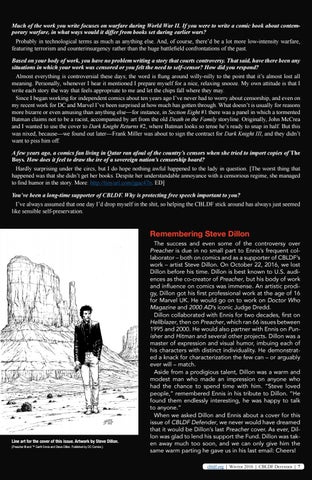
Line art for the cover of this issue. Artwork by Steve Dillon. (Preacher © and ™ Garth Ennis and Steve Dillon. Published by DC Comics.)
The success and even some of the controversy over Preacher is due in no small part to Ennis’s frequent collaborator – both on comics and as a supporter of CBLDF’s work – artist Steve Dillon. On October 22, 2016, we lost Dillon before his time. Dillon is best known to U.S. audiences as the co-creator of Preacher, but his body of work and influence on comics was immense. An artistic prodigy, Dillon got his first professional work at the age of 16 for Marvel UK. He would go on to work on Doctor Who Magazine and 2000 AD’s iconic Judge Dredd. Dillon collaborated with Ennis for two decades, first on Hellblazer, then on Preacher, which ran 66 issues between 1995 and 2000. He would also partner with Ennis on Punisher and Hitman and several other projects. Dillon was a master of expression and visual humor, imbuing each of his characters with distinct individuality. He demonstrated a knack for characterization the few can – or arguably ever will – match. Aside from a prodigious talent, Dillon was a warm and modest man who made an impression on anyone who had the chance to spend time with him. “Steve loved people,” remembered Ennis in his tribute to Dillon. “He found them endlessly interesting, he was happy to talk to anyone.” When we asked Dillon and Ennis about a cover for this issue of CBLDF Defender, we never would have dreamed that it would be Dillon’s last Preacher cover. As ever, Dillon was glad to lend his support the Fund. Dillon was taken away much too soon, and we can only give him the same warm parting he gave us in his last email: Cheers! cbldf.org | Winter 2016 | CBLDF Defender | 7