International As 2016 draws to a close, attacks on cartoonists and individuals sharing cartoons in countries around the world are on the rise.
INTERNATIONAL INCIDENTS Musa Kart Jailed in Turkey
Ahmed Naji Files New Appeal
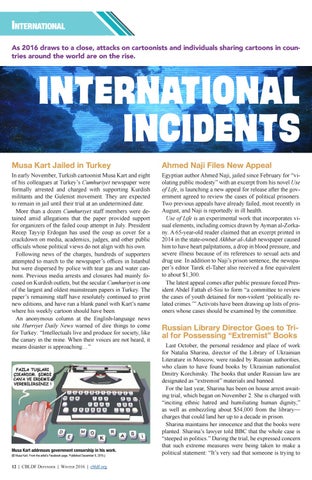
In early November, Turkish cartoonist Musa Kart and eight of his colleagues at Turkey’s Cumhuriyet newspaper were formally arrested and charged with supporting Kurdish militants and the Gulenist movement. They are expected to remain in jail until their trial at an undetermined date. More than a dozen Cumhuriyet staff members were detained amid allegations that the paper provided support for organizers of the failed coup attempt in July. President Recep Tayyip Erdogan has used the coup as cover for a crackdown on media, academics, judges, and other public officials whose political views do not align with his own. Following news of the charges, hundreds of supporters attempted to march to the newspaper’s offices in Istanbul but were dispersed by police with tear gas and water cannons. Previous media arrests and closures had mainly focused on Kurdish outlets, but the secular Cumhuriyet is one of the largest and oldest mainstream papers in Turkey. The paper’s remaining staff have resolutely continued to print new editions, and have run a blank panel with Kart’s name where his weekly cartoon should have been. An anonymous column at the English-language news site Hurriyet Daily News warned of dire things to come for Turkey: “Intellectuals live and produce for society, like the canary in the mine. When their voices are not heard, it means disaster is approaching…”
Egyptian author Ahmed Naji, jailed since February for “violating public modesty” with an excerpt from his novel Use of Life, is launching a new appeal for release after the government agreed to review the cases of political prisoners. Two previous appeals have already failed, most recently in August, and Naji is reportedly in ill health. Use of Life is an experimental work that incorporates visual elements, including comics drawn by Ayman al-Zorkany. A 65-year-old reader claimed that an excerpt printed in 2014 in the state-owned Akhbar al-Adab newspaper caused him to have heart palpitations, a drop in blood pressure, and severe illness because of its references to sexual acts and drug use. In addition to Naji’s prison sentence, the newspaper’s editor Tarek el-Taher also received a fine equivalent to about $1,300. The latest appeal comes after public pressure forced President Abdel Fattah el-Sisi to form “a committee to review the cases of youth detained for non-violent ‘politically related crimes.’” Activists have been drawing up lists of prisoners whose cases should be examined by the committee.
Musa Kart addresses government censorship in his work. (© Musa Kart. From the artist’s Facebook page. Published December 9, 2015.)
12 | CBLDF Defender | Winter 2016 | cbldf.org
Russian Library Director Goes to Trial for Possessing “Extremist” Books Last October, the personal residence and place of work for Natalia Sharina, director of the Library of Ukrainian Literature in Moscow, were raided by Russian authorities, who claim to have found books by Ukrainian nationalist Dmitry Korchinsky. The books that under Russian law are designated as “extremist” materials and banned. For the last year, Sharina has been on house arrest awaiting trial, which began on November 2. She is charged with “inciting ethnic hatred and humiliating human dignity,” as well as embezzling about $54,000 from the library— charges that could land her up to a decade in prison. Sharina maintains her innocence and that the books were planted. Sharina’s lawyer told BBC that the whole case is “steeped in politics.” During the trial, he expressed concern that such extreme measures were being taken to make a political statement: “It’s very sad that someone is trying to