

NORTH CAROLINA LITERARY
poetry by Amber Flora Thomas n creative nonfiction by Erick Daniel Aguilar n reviews of books by David Sedaris, Minrose Gwin, and Marshall Moore n and more n n n
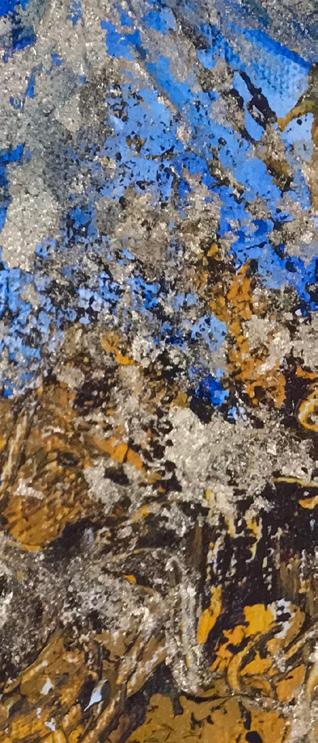
COVER ART
Detail from Home/Life , 2024 (mixed media installation, various dimensions, acrylic on reclaimed mylar with thread and chain, mixed media collage on wood panel, community collaborative installation, community collaborative audio installation) by Jane Cheek
JANE CHEEK was born in Winston-Salem, NC, and earned a BA in Art Studies from NC State University and a K-12 Visual Arts Education certification from East Carolina University. Cheek’s work includes commissions at the North Carolina Museum of Art, outdoor art installations for Artsplosure and Downtown Raleigh Alliance, and a large-scale, immersive installation for IBMA Live!, an international bluegrass festival in Raleigh, NC, as well as a solo installation at Waterworks Visual Arts Center (Salisbury, NC), and exhibits at Wilson Arts Center (Wilson, NC), The Arts Center (Carrboro, NC), and Pullen Arts Center (Raleigh, NC). While her identity as a bisexual woman, mother, and wife informs her perspective, her work reaches beyond personal narrative to address universal themes of transformation and empowerment. For Cheek, joy is an act of creation and resistance–a celebration of possibility that reclaims spaces and reimagines boundaries.
The cover image is a detail from Jane Cheek’s full-scale solo exhibition Home/ Life (shown below) at Artspace in Raleigh, NC, in 2024. The project was supported by a grant from VAE’s Snapdragon Fund, an Andy Warhol Fund partner.
COVER DESIGNER
NCLR Art Director DANA EZZELL is a Professor at Meredith College in Raleigh. She has an MFA in Graphic Design from the Rhode Island School of Design in Providence. Her design work has been recognized by the CASE Awards and in such publications as Print Magazine ’s Regional Design Annual, the Applied Arts Awards Annual, American Corporate Identity, and the Big Book of Logos 4. She has been designing for NCLR since the fifth issue, and in 2009 created the current style and design. In 2010, the “new look” earned NCLR a second award for Best Journal Design from the Council of Editors of Learned Journals. In addition to the cover, she designed the essay by Erick Aguilar and the poem by Amber Flora Thomas in this issue.

Home/Life, 2024 (mixed media installation, various dimensions, acrylic on reclaimed mylar with thread and chain, mixed media collage on wood panel, community collaborative installation, community collaborative audio installation) by
Produced annually by East Carolina University and by the North Carolina Literary and Historical Association
© COPYRIGHT 2025 NC LR
Jane Cheek
NORTH CAROLINA LITERARY
WINTER 2025
NORTH CAROLINA
LGBTQ+ LITERATURE
IN THIS ISSUE
6 n North Carolina LGBTQ+ Literature includes poetry, creative nonfiction, and book reviews
Erick Daniel Aguilar
Barbara Bennett
Olivia Cash
Minrose Gwin
Jennifer McGaha
Marshall Moore
David Sedaris
Amber Flora Thomas
22 n Flashbacks: Echoes of Past Issues includes poetry, creative nonfiction, book reviews, and literary news
J.S. Absher
Dale Bailey
Nathan Ballingrud
Joseph Bathanti
Lisa Wenger Bro
Kim Church
Mae Miller Claxton
Anna Julia Cooper
Howard L. Craft
Moira Crone
Thomas Rain Crowe
Ariel Dorfman
Julia Nunnally Duncan
Georgann Eubanks
Charles R. Ewen
Heather Frese
George Frizzell
Regina YC Garcia
Kaye Gibbons
Rebecca Godwin
Janis Harrington
Donald Paul Haspel
David Joy
Horace Kephart
James Kirkland
Amber Knox
Douglas C. MacLeod, Jr.
Brent Martin
Jill McCorkle
Trevor McKenzie
Alec McWalters
Lenard D. Moore
Elaine Neill Orr
Dannye Romine Powell
Ron Rash
Bland Simpson
85 n North Carolina Miscellany includes poetry, book reviews, and literary news
Heather Bell Adams
Michael Beadle
Meagan Church
Sharon Colley
Ralph Earle
Elizabeth S.D. Engelhardt
Janis Harrington
Halle Hill
Jon Kesler
Adele Meyers
Heather Newton
Susan Reinhardt
n North Carolina Artists in this issue n
Jane Cheek
Moira Crone
Maud Gatewood
Clarissa Gernat
Max Herbert
Lynn Marshall-Linnemeier
Julia Ridley Smith
Wendy Tilley
Lucinda Trew
Stephanie Whetstone
Karin Zipf
George Masa
Prioli
Crystal Simone Smith
Evan Peter Smith
Kristi Southern
Elaine Thomas E. Thomson Shields, Jr.
Devra Thomas
Shirley Moody-Turner
Daniel Wallace
Alicia D. Williams
Marly Youmans
Elizabeth
North Carolina Literary Review is published annually in the summer by the University of North Carolina Press. The journal is sponsored by East Carolina University with additional funding from the North Carolina Literary and Historical Association. NCLR Online, published in the winter, spring, and fall, is an open access supplement to the print issue.
NCLR is a member of the Council of Editors of Learned Journals and the Council of Literary Magazines and Presses, and it is indexed in EBSCOhost, the Humanities International Complete, the MLA International Bibliography, Proquest, and the Society for the Study of Southern Literature Newsletter.
Address correspondence to Dr. Margaret D. Bauer, NCLR Editor ECU Mailstop 555 English Greenville, NC 27858-4353
252.328.1537 Telephone 252.328.4889 Fax BauerM@ecu.edu Email NCLRstaff@ecu.edu
https://nclr.ecu.edu Website
NCLR has received 2024–2025 grant support from the North Caroliniana Society and rom the North Carolina Arts Council, a division of the North Carolina Department of Natural and Cultural Resources.

Subscriptions to the print issues of NCLR are, for individuals, $20 (US) for one year or $40 (US) for two years, or, for institutions and foreign subscribers, $30 (US) for one year, $54 for two. Libraries and other institutions may purchase subscriptions through subscription agencies. Individuals or institutions may also receive NCLR through membership in the North Carolina Literary and Historical Association. More information on our website
Individual copies of the annual print issue are available from retail outlets and from UNC Press. Back issues of our print issues are also available for purchase, while supplies last. Find prices and tables of contents of the back issues on the NCLR website
Submissions
NCLR invites proposals for articles or essays about North Carolina literature, history, and culture. Much of each issue is thematically focused, but a portion of each issue is open for developing interesting proposals, particularly interviews and literary analyses (without academic jargon). NCLR also publishes high-quality poetry, fiction, drama, and creative nonfiction by North Carolina writers or set in North Carolina. We define a North Carolina writer as anyone who currently lives in North Carolina, has lived in North Carolina, or has used North Carolina as subject matter.
Consult our website for submission guidelines for the various sections of each issue. Submissions to each issue’s special feature section are due August 31 of the preceding year, though proposals may be considered through early fall.
2026 issues will feature Literature by Veterans, Active Military, and their Families, guest edited by Anna Froula
Please email your suggestions for other special feature topics to the editor.
Book reviews are usually assigned, though suggestions will be considered as long as the book is by a North Carolina writer, is set in North Carolina, or deals with North Carolina subjects. NCLR prefers review essays that consider the new work in the context of the writer’s canon, other North Carolina literature, or the genre at large. Publishers and writers are invited to submit North Carolina–related books for review consideration. See the index of books that have been reviewed in NCLR on our website NCLR does not review self-/subsidy-published or vanity press books.
EDITORIAL BOARD
Jim Clark
Emeritus, Barton College
Kevin Dublin
Elder Writing Project, Litquake Foundation
William Eddins
English, East Carolina University
Gabrielle Brant Freeman
English, East Carolina University
Rebecca Godwin
Emeritus, Barton College
Editor
Margaret D. Bauer
Art Director
Dana Ezzell
Guest Feature Editor
Dwight Tanner
Digital Editor
Devra Thomas
Art Editor
Diane A. Rodman
Poetry Editor
Jeffrey Franklin
Fiction Editor
Rebecca Bernard
Founding Editor
Alex Albright
Original
Art Director
Eva Roberts
Graphic Designers
Karen Baltimore
Sarah Elks
Senior Associate Editor
Christy Alexander Hallberg
Assistant Editors
Desiree Dighton
Anne Mallory
Randall Martoccia
Managing Editor
Lyra Thomas
Book Review Editor
Kristi Southern
Senior Editorial Assistant
Amber Knox
Editorial Assistant
Kenly Corya
Senior Intern
Abby Trzepacz
Interns
Thomas Adcock
Abby Fletcher
Anna Hancock
Robert Miranda
Rebecca Hardin-Thrift
English, Wayne Community College
George Hovis
English, SUNY-Oneonto
Jessica Jacobs
Executive Director, Yetzirah: A Hearth for Jew
Rebecca McClanahan
MFA Creative Writing Program, Queens University
Angela Raper
English, East Carolina University
Kirstin L. Squint
English, East Carolina University
Amber Flora Thomas
English, East Carolina University
Dean Tuck
English, Wayne Community College
Robert M. West
English, Mississippi State University
Charles De’Shawn Winslow
Writer, Newark, NJ
Seeing Ourselves:
North Carolina LGBTQ+ Literature
by Dwight Tanner, Guest Feature Editor
I am honored and delighted – and maybe even a little daunted – to be the guest feature editor for NCLR’s 2025 special feature sections on North Carolina LGBTQ+ literature. Exploring and learning more about the rich history of queer North Carolina voices, I’ve been repeatedly reminded of the diverse range of LGBTQ+ writing: powerful stories that can broaden perspectives, foster understanding, and provide invaluable representation, effectively allowing queer individuals the benefit of “seeing” themselves in a world that often asks them to hide.
I’m reminded of a character description in Randall Kenan’s A Visitation of Spirits. Horace Cross – a gay, Black teenager in Kenan’s fictional Tims Creek, NC – a is described as “flawed as far as the community was concerned. First, he loved men; a simple, normal deviation, but a deviation this community would never accept. And second, he didn’t quite know who he was.” By depicting a wide range of historically overlooked identities and experiences, LGBTQ+ literature has the ability to help queer readers understand who they are, our history and varied experiences, and, perhaps most importantly in 2025, that we are not alone in our struggles and in our joys.
Working on gathering material for this special feature occasioned me to recall being a teenager in a local bookstore in Phoenix, AZ, where I came across a copy of David Sedaris’s Naked. I had no
a kindred spirit in the voice on the page. I scoured the back cover; no mention of his sexuality in the bio or in the description of the essays, which previewed stories about Sedaris growing up in North Carolina, a place I had never been or guessed would one day be my home. Clearly, I did not look closely at the table of contents, where I would have noticed the ninth essay, titled “I Like Guys.”
I remember, quite vividly, my reading experience; the distinct style and wry humor was both hilarious and oddly comforting. My suspicions grew, particularly when Sedaris describes in various essays how, growing up, he never quite felt like he belonged, even if he didn’t understand why. I finally got to that ninth essay – and, for the first time that I recall, I read about another person realizing and coming to terms with the fact that he was gay. I don’t know how much I registered at the time exactly what this meant to me; but I know that I felt something, certainly less alone.
For many, encountering characters and stories that reflect their own experiences can be a transformative and affirming experience. It offers a sense of belonging and validation, counteracting the feelings of isolation that often accompany being part of a marginalized group, which is also why it remains critical that we continue to find, bolster, and celebrate a diverse range of voices, even within this multi-faceted community.

This section, the first of the year’s featured content, begins with poet Amber Flora Thomas’s “Afterlife.” The poem explores the poignancy of quotidian intimacy, particularly the thoughts,

memories, and impressions that can be evoked by first noticing the otherwise easily overlooked evidence of those we love.
The consideration of things and people who are often unconsidered continues in the next entry, Erick Daniel Aguilar’s “Hurricane Season,” selected by Rebecca McClanahan for honorable mention in the 2024 Alex Albright Creative Nonfiction Prize.
While on a plane flying to see his dying father, the author begins to tell his father’s story as a Honduran immigrant working in North Carolina, first in the tobacco fields and then at a turkey processing facility. The story is punctuated, however, with Aguilar’s own life experiences, particularly after he and his mother reunite with his father in Mt. Olive, reminding us of the ways that, perhaps even more so in immigrant and migrant families, both a parent’s story and their children’s become, in many ways, inextricable from each other.
Aguillar’s essay – accompanied by the evocative artwork of Clarissa Gernat (who was also born in Honduras) – avoids easy morals and trite meanings, while importantly depicting the far-too-often overlooked lives and histories of the migrant workers and their families, whom North Carolina, and the US as a whole, rely upon.
Hurricanes and their aftermath appear throughout this timely essay, functioning as an impactful illustration of the aftereffects of storms and immigrant policies, that what happens “over there” is inextricably linked to “here,” and vice versa –reminders of all that gets swept up (literally and figuratively) in such storms.
continued on page 8

LGBTQ+ Literature NORTH CAROLINA
9 Afterlife a poem by Amber Flora Thomas art by Jane Cheek
10 Hurricane Season creative nonfiction by Erick Daniel Aguilar art by Clarissa Gernat
16 Have No Fear: David Sedaris is Still Here a review by Jennifer McGaha n David Sedaris, Happy-Go-Lucky
18 Snake in the Grass a review by Barbara Bennett n Minrose Gwin, Beautiful Dreamers
20 Finding a Way Out: Finding Yourself a review by Olivia Cash n Marshall Moore, I Wouldn’t Normally Do This Kind of Thing
ALSO IN THIS ISSUE
22 n Flashbacks: Echoes of Past Issues poetry, creative nonfiction, and book reviews
85 n North Carolina Miscellany poetry, book reviews, and literary reviews
In the first of three book reviews in this special feature section, Jennifer McGaha assesses David Sedaris’s latest essay collection, Happy-Go-Lucky, reminding us of all of the things we love about Sedaris and his writings. These essays run the gamut of heavy topics (COVID-19 and gun violence) to the more lighthearted (flea market adventures and getting his teeth straightened late in life), often within the same essay. McGaha’s review highlights how Sedaris manages to make us laugh, even in the most serious moments, while still finding ways to surprise and to make the reader think critically and anew about the various topics he dissects. If there is a through-thread in the collection, McGaha posits, it’s that of the decline and ultimate death of Sedaris’s problematic father, which becomes an opportunity to also explore not only the history of his abusive treatments, but also how Sedaris and his siblings “pulled together” to both process the trauma and mourn “the father [they] never had.” As McGaha argues, one of the valuable aspects of Sedaris’s writing is his unapologetic and brave choice to “lay bare what most of us would never have spoken of,” effectively allowing “us to see our own flawed selves” on the page.
Next, long-time NCLR contributor Barbara Bennett reviews Minrose Gwin’s latest novel, Beautiful Dreamers. Bennett first outlines Gwin’s story, which focuses on three “othered” characters in the Deep South in 1953. As Bennett notes, the value of Gwin’s novel goes well beyond the intricacies of the fascinating characters and engaging story to also situate the narrative in the context of Civil Rights protests and the “virulent homophobic rhetoric” on the rise nationally. This historical context aids the novel in its exploration of the often tragic “consequences of being the other” in a novel about people who, nevertheless, “imagine a better world than they live in.”
Finally, Olivia Cash reviews the affecting memoir I Wouldn’t Normally Do This Kind of Thing, by Marshall Moore, which details his experiences growing up in Greenville, NC, and how he ultimately moves on and past the trauma inflicted by his parents who were unhealthily obsessed with their son’s gender and masculinity. Nevertheless, the memoir also details how Moore uses his intellect and talent to escape and ultimately find himself and his community. Cash notes how Moore avoids linking his parents’ abusive treatment of him to stereotypes of the South and the oft-perpetuated notion of the South itself as an “othered” aberration, and his memoir raises questions about the culpability of community at large while highlighting how the harm often inflicted upon queer children does not solely occur in a far off and particularly deviant place.
As we finalize this section for the Winter issue, I’m excited to share in the coming months the many diverse and powerful selections by and about LGBTQ+ writers in the remaining online issues and the upcoming print issue. Be sure to subscribe (or resubscribe) now to receive the summer print issue, which, among other pieces, will include three interviews with incredible North Carolina writers – Gabrielle Calvocoressi, De’Shawn Charles Winslow, and Jessica Jacobs –and essays and critical articles about a wide-range of established, emerging, and even overlooked writers, such as Randall Kenan, Carter Sickels, and Carl Wittman and Allan Troxler, respectively.
You can also look forward to the publication of new and exciting creative pieces from writers you probably recognize (such as Jim Grimsley), and authors we expect to hear more from in the future. Personally, I’m so grateful to NCLR for the opportunity to play a small part in sharing and learning more – both about and from – these vital North Carolina LGBTQ+ voices. n
BY AMBER FLORA THOMAS
Afterlife
The scalloped crest of old lipstick on a favorite mug. We’ve kissed so many times now. I want to find you again. Your lips. My lips. Some familiar word. A braided smile against ceramic, speaking back.
Sunday breakfast over thick coffee and greasy plates. Ting. Ting. How you say Anthropocene and solastalgia. Marking your long speech with a slow sip. A shade like coral, peach pit.
I rub my thumb inside the handle and think back: smooth acidic fire, drinking every word, an invitation to what can’t be helped.
I’m calling you home. Your bottom lip. The brown mug, kissing you again.

AMBER FLORA THOMAS is the winner of the 2004 Cave Canem Poetry Prize, the Ann Stanford Poetry Prize, and the Rella Lossy Poetry Award. She has an MFA in poetry writing from Washington University in St. Louis and is an Associate Professor at East Carolina University. She has published three collections of poetry: Eye of Water (University of Pittsburgh Press, 2005), The Rabbits Could Sing (University of Alaska Press, 2012), and Red Channel in the Rupture (Red Hen Press, 2018; reviewed in NCLR Online 2019). Read more of Amber’s poetry in the 2019 print issue of NCLR
JANE CHEEK is this issue’s cover artist. Read about her in the inside front cover.
Where Joy Blooms, Study #14 (collage on holographic paper, 11x8.5) by Jane Cheek
COURTESY OF THE ARTIST
HONORABLE
MENTION, 2024 ALEX ALBRIGHT CREATIVE NONFICTION PRIZE
HURRICANE

1.
The land was tilled and seeded, the fertilizer was massaged into the soil, and the water had been cast across the expansive green. Lamplights glowed and faltered when the wind struck while power lines rocked and bounced mockingly in the air. I booked my flights to North Carolina and imagined what colors the clouds would be at the exact moment I jetted across them.
At the beginning of my dad’s illness, I learned how to make filo dough. I learned how to layer it carefully so that the dough would bake crisp and sweet. I ran every morning before work and ate more green vegetables. I tried in all manners and regard to turn away from the world, from all that was falling apart in my life at the time. As he lay dying, he asked me to write the story of his American dream. While traveling above the clouds on my return, I wrote all I could remember.
SEASON
by Erick Daniel Aguilar
is a Honduran-American writer, born in Tegucigalpa. He moved to Mount Olive, NC, in 2003 and currently lives in Chicago, IL. During the day, he works in corporate strategy, and he writes at night. This is his first published essay.
ERICK DANIEL AGUILAR
Changes, 2020 (acrylic on canvas with gold leaf, 13x26) by Clarissa Gernat
with art by Clarissa Gernat
A S HE LAYDYING, HE ASKEDME TO W ETIR THE STORYOF HIS A VARTELIHW.MAERDNACIREM E LINGABOVE THECLOUD
S ON M Y I,NRUTER
2.
The illuminated parking lot of the trailer park stood still with the washing rain. My father etched his footsteps on the loose gravel as the large crowds of trees leaned back and forward bending at the wind. Hurricane Fran was gaining strength and it would be a few hours before it made landfall.
My dad lost everything in Honduras. He would never return after he left in 1995, but he did not know that at the time. As I drew my first breath of air in Honduras, Hurricane Fran raged thousands of miles away.
That night, he was slouching through the rambling country roads to reach a nearby tobacco field that he worked. Mr. Hill, his employer, had called a few minutes earlier, pleading for help. The tobacco crop that my father tended to that summer would be drowned by the never-ending rains from the storm. He put his work clothes on: two
layers of shirts topped with a buttoned shirt, two layers of socks, and his boots.
Once at the fields, he used the lights from Mr. Hill’s truck to illuminate the field as they covered each row of crops in tarpaulin to protect the crop. With the wind picking up speed, they tacked the plastic to the ground for hours. After they finished, Mr. Hill took my dad into his arms and sobbed, grateful to have someone there, helping the crop survive the night. The story astonished me as I grew older since Fran wrought long-standing damage to the land and homes of our area.
“How did that miracle happen?” I once asked him.
“Even God needs a helper, right? You can’t wait for Him to finish each task.”
3.
I was raised in Mount Olive, North Carolina. It is a rural community, known mostly for its vast agricultural industry of grains, tobacco, and cotton as well as its food processing industry, which includes Butterball Turkey and Mount Olive Pickles. Fields surrounded the trailer park where my father lived when my mother and I moved from Honduras to reunite with him in 2003.
On one of my first bus rides home from school, I sat with the other Spanish-speaking students in my grade. I remember the putrid stench that rose from the soil that surrounded us in every direction, across the fields. The smell left a distinct taste in the back of your throat, a taste that made you want to turn away from your neighbor in embarrassment. Could they taste what I tasted in the air?
“This deeply affecting memoir, rich with sensory description and fueled by the narrator’s dying father’s wish to tell ‘the story of his American dream,’ takes us into a world most readers would never otherwise experience: the plight of migrant workers who, like the father, ‘worked the fields, slaughtered hogs, and cleaned the flesh off turkeys.’ Like the hurricanes that threaten the physical landscape, the uncertainty and fears – of deportation or family dissolution – threaten these immigrant families’ very existence. But even the most difficult story can redeem us, and this author, in telling the father’s story, becomes ‘not exactly a peddler of catastrophes, but a salvager of meaning.’”—Rebecca McClanahan, 2024 Alex Albright Creative Nonfiction Prize final judge
CLARISSA GERNAT was born and raised in Honduras. Recognizing her early interest and talents, her parents enrolled her in an art academy. She earned her bachelor’s degree in Honduras and then, with the encouragement and support of family, friends, and coworkers back home, she found the courage to move to the US where she is pursuing an MA in Media Arts, Design & Technology at NC State University. In addition, she is a Marketing and Design Coordinator for the Wellness and Recreation Center at NCSU.
VULNERABLE
ARE ONLY LEFT W
I T H
.DNALEHT
IT MADECOM PLETESENSE TH A T I T ETATCIDDLUOW SEVILRUO . T
Finally, I summoned the courage to ask someone what the smell was. My classmate Tony turned to me and answered, “Mierda.”
At the front of the trailer park, twenty or so of us would empty the bus and walk to each of our homes. The trailer homes sat parallel to the dirt path drawn by the cars that crawled home every night and day as fathers and mothers returned from factories and fields.
That day, I told my dad the shit story. He explained to me that hog manure was used to fertilize the fields. It was nourishment that the tobacco leaves would rip bare from the ground, leaving it with less and less each time.
That smell carried over into our daily lives. The fetid ground was everything and the only thing we had. It made complete sense that it would dictate our lives. The vulnerable are only left with the land.
4.
The news of my dad’s illness felt hopeless once we first received it. His official diagnosis after a biopsy of a tumor found in his thigh was stage four neuroendocrine neoplasia cancer of unknown primary site. Meaning, we did not know where it started, but we knew how it would end.
5.
In 1998, Hurricane Mitch decimated neighborhoods and agricultural land in Honduras. Over seven thousand Hondurans died in the extensive flooding. Our own neighborhood in Tegucigalpa was spared, but a few miles over, landslides erased entire families and their material possessions. This destruction brought opportunity. In 1999, the Department of Homeland Security declared Temporary Protected Status (TPS) for Hondurans in the United States. TPS allowed citizens of designated countries living in the US

to reside legally for periods of eighteen months with employment authorization. TPS did not create a path to Permanent Residency or Citizenship. Instead, every eighteen months, those who were under TPS awaited its renewal. With the possibility of non-renewal came the fear of losing their employment authorization and the precarious status that allowed them to stay in this country. This opportunity allowed my dad to leave the heat of the fields, heat that burned his black hair to a burnt-blonde in the summers for the freezing temperatures of the turkey meat processing factory.
He worked the three p.m. to twelve a.m. shift at Butterball. His job consisted of cutting and shredding through turkey flesh, slicing swiftly and accurately at the right angles, making sure to avoid fingers and gloves. He would hang turkey carcasses from a hook, maiming and ripping flesh against and through the hook’s point. These repetitive actions left many workers with injuries, muscle and skeletal damages from overused and strained body parts. He would tell stories of fingers and flesh that would go missing from workers’ hands.
At the chain-link fences that surrounded the entrance to the factory, it was common to see coffee cans lying on top of makeshift tables. The cans were covered in paper, with names and photos. The photos were of men and women my father knew, the people my father worked with for decades. When he recognized a face, he would stop to read, already knowing the request before approaching it. He pulled single dollar bills from his wallet, rolled them in his wrinkled hands, and dropped them into the can. The donations were to pay for funerals for migrant workers who had passed away. Though unspoken, people in my town understood need. When everything was stripped away, what did you really need?
The death of a migrant worker left a void, not only in the workplace but more importantly in the communities they supported back home.
We knew it was a necessity, whether it was to feed a family of four or to pay to return someone’s ashes back to family. Families had gone decades without seeing family members who worked in Mount Olive. Many wanted the opportunity to lay to rest their loved ones’ remains. This was the consolation prize many of us feared.
6.
My father taught me how to listen for a hurricane. He taught me to tune in to the National Weather Station on a battery-powered radio and listen for longitudinal and latitudinal coordinates to locate the eye of the storm.
“How close is the eye?” he’d ask me through the phone while on a break at work and calling from the payphone outside.
I would also listen in our hotel room. In those days (and probably still today), during a hurricane many people who lived in trailer homes or were traveling through the area would rent a room at local lodges to take refuge from the dangerous wind. If the winds were strong enough, “category three or stronger,” my father reminded me, we would ride out the storm in a hotel.
Each hurricane season, I would anticipate a big one hitting, hoping that the next storm would be the one that would afford us the opportunity to take a visit to the Sleep Inn. These were exciting trips for me. We would be safe and protected from the storm. My dad would not work, and we could lie in bed and watch movies together. From the windows of the higher floors of the rooms, you could see the light posts dance with the hurricane winds. The wall of the pounding rain drew a cloud in the parking lot that obscured the pavement’s beginning and end.
This way of life forces you to be a peddler of catastrophes.
7.
My mother’s delicate press-on nails were a light shade of pink. She held a pair of black scissors and clipped through plastic cards, each one holding a headshot of my father with jet-black hair, v-shaped jawline, sideburns, and soft hair lightly draped down his forehead. His eyes called out for
kindness and warmth, an invitation for help and mercy. I could see myself in him, with that hair and that face, although my eyes were brown, while his were hazel.
“If anyone asks you about him, you don’t know him,” my mother whispered to me, eyes stern.
“Okay,” I hummed.
For the following eight months of 2006, my mother and I slept in our trailer while my father hopped from trailer park to trailer park, making sure to never sleep in the same place more than a night. We were living at the peak of George W. Bush’s attempt at further isolating and disbanding immigrant communities across the US with the formation of Immigration and Customs Enforcement (ICE). ICE, and the fear of it, was palpable in our trailer park. Stories were told about fathers and mothers who had been arrested and then deported back to their home countries. The more heartbreaking stories were about children who came to empty trailers, skid marks indicating where the inconspicuous van left with loved ones. During this point in my life, my father was being pursued by state police for having used someone else’s identity to work at Butterball before TPS had been granted. He was in hiding, and his attempt at distancing himself from my mother and me was to protect us. If they found only him, we would evade a possible deportation case; my mother and I were undocumented.
Once a week, my parents and I slept in the same bed. I would lie between them. My mother covered the ceiling with light-in-the-dark star stickers to entertain me. My father made jokes, and I laughed until tears streamed down my cheeks. I held their hands in mine. We were all we had.
8.
Our most intimate moments were shared while studying together. On Sundays, my dad and I would study my textbooks. In bed, I would lie next to him and read aloud from Shel Silverstein’s Where the Sidewalk Ends. He would listen in excitement as I spoke in an accent almost indiscernible from any child born and raised in eastern North Carolina. The words felt like incantations that brought him joy. His English
was clunky, although prophetic-sounding to my large ears. Often, I found myself mimicking my father’s habit of reading in bed, switching between a book and his American Heritage Dictionary to decipher meanings.
9.
I wish I could write that my father walked into death gracefully, accepting the full mercy and release of death. Instead, he tried to run from it, waking from sleep in frustration each hour of the night, telling God or whoever was listening that he did not deserve such an end. He hated taking his pain medicines, the small respite from aching and jolting pain he felt throughout his body. He would stick his fingers down his throat because he thought that if he was able to throw up every single thing left inside, he would feel better. He would gag, but only small pools of spit would drool out. Without eating and drinking, he had little left to spew. He would look around confused and blurt out unwarranted statements.
“Are we still at war?” We were not at war.
“We have to go take care of the family business.” We did not own a family business.
Then, there were moments of lucidity, when his voice rang clear, and he would grip my hand. The eye of the storm was over us then, calm but impending.
“We fought so hard together. You were my dream in this new place.”
H EN THEREWERE MOMENTS OF LUCIDITY , WHEN HIS V ,RAELCGNARECIO
ULDGRIP MY HAND . THEEYE OF THEST
BUTIMPENDING .
He died in early hours, at the peak of a hurricane season, a week after I had made my return. My mom had gone to use the bathroom and could hear and see him breathe through his mouth while he lay in a hospice bed. I slept next to him. Once she made it back from the bathroom, she noticed his head tilted right, his hands carefully superimposed on each other. His lips went blue, mouth agape without a breath. His eyes closed in eternal sleep.
10.
As much as I tried to anticipate my dad’s death, I found myself unmoored. I tried to find meaning within his death, and I could only think of the moments I shared with him. What remains
after his passing are these vignettes of his life. When my father asked me to write the story of his American dream, I had little to draw on besides the time we shared together. He was a private man about his hard life. He ran away from an abusive home at the age of twelve. He had smoked cigarettes since he was fifteen. He worked the fields, slaughtered hogs, and cleaned the flesh off turkeys. He loved passionately and, most importantly, he centered his child in this new land. This home I ran away from will never be the same again. Perhaps I’m not exactly a peddler of catastrophes, but a salvager of meaning.
After his loss, his words and image of his world are all I have. For now, this will have to do. n

HAVE NO FEAR: DAVID SEDARIS IS STILL HERE
a review by Jennifer McGaha
David Sedaris. Happy-Go-Lucky: Little, Brown and Company, 2022.
“Seek approval from the one person you desperately want it from, and you’re guaranteed not to get it” (100). This is the hard-won wisdom that David Sedaris brings to his latest book, and if you were concerned that Sedaris’s edges might be softening as he hits the publication of his twelfth book, have no fear: The Sedaris of 2024 is just as hilarious and close to the bone as the Sedaris of the ’90s. In his latest collection, Happy-GoLucky, Sedaris’s work is raw and honest yet tender in just the right doses.
JENNIFER MCGAHA Is the author of three works of nonfiction including Flat Broke with Two Goats (Sourcebooks, 2018), a 2018 OverDrive Big Library Read; Bushwhacking: How to Get Lost in the Woods and Write Your Way Out (Trinity University Press, 2023), a Thomas Wolfe Memorial Literary Award finalist; and The Joy Document (Broadleaf Books, 2024), a collection of fifty essays celebrating midlife. Her writing has also appeared in many magazines and literary journals, including Image, The Huffington Post, The New Pioneer, Lumina, PANK, The Chronicle of Higher Education, Brevity, Bitter Southerner, Crab Creek Review, River Teeth, and NCLR . A North Carolina native, Jennifer teaches at UNC Asheville, where she also coordinates the Great Smokies Writing Program.
DAVID SEDARIS was born in Johnson City, NY, but grew up in Raleigh, NC. Sedaris shared a recording of his essay “The Ship Shape” (read by him) for the NCLR Mirth Carolina Laugh Tracks CD. He is the bestselling author of numerous books, including The Best of Me (Little Brown, 2020; reviewed in NCLR Online Fall 2022), Calypso (Little Brown , 2018; reviewed in NCLR Online 2019), Dress Your Family in Corduroy and Denim (Little Brown, 2004; reviewed in NCLR 2005). He is a regular contributor to The New Yorker and BBC Radio 4.
In essays spanning from New York’s Upper East Side to Normandy to Emerald Isle and Raleigh, NC, Sedaris recounts natural, familial, and national crises alongside everyday moments with his characteristic sardonic wit. Humor, as always, is both a way in and a way out of the darker moments, and part of the power of this book lies in how well Sedaris captures both the ordinary and extraordinary as stories about his ninety-five-year-old father’s decline and subsequent death, his sister Tiffany’s mental health issues and suicide, gun violence, the pandemic, Hurricane Florence, and the Black Lives Matter movement are interspersed with discussions of shopping, book tours, a flea market adventure in Serbia, some long-awaited dental work, and so on. Timing is everything in both comedy and in writing, and Sedaris’s timing is, as always, impeccable. The scenes with Sedaris and his family of origin, but especially with his sisters and longtime partner, Hugh, are often wickedly funny, and these moments are even more compelling when put in the context of Sedaris’s growing awareness of his - and
their – mortality. “I cannot bear watching my sisters get old,” he says. “It just seems cruel. They were all such beauties” (59). The closeness of his bond with his siblings is always apparent on the page, such as in the chapter “Hurricane Season,” when Sedaris writes about when his sisters complain about Hugh’s moodiness: “I’d like to be loyal when they complain about him. I’d like to say, ‘I’m sorry, but that’s my boyfriend of almost thirty years you’re talking about.’ But I’ve always felt that my first loyalty is to my family, and so I whisper, ‘Isn’t it horrible?’” (60). It is funny, of course, but it is also evidence of the deep bonds this family shares. Later, in “Pearls,” as Sedaris describes listening to Hugh practice piano and his determination to “to get it right” (162), readers sense that we are talking about more than piano playing. We are talking about love, about all the ways we are loved and misloved, and all the ways we love and mislove in return, and all the ways we keep on trying to love better nonetheless. While many essayists and memoirists seem to spend a lot of time turned inward, rebuking themselves for their moments of indiscretion or insensitivity to the point of selfflagellation, Sedaris’s work is often refreshingly unapologetic. For example, he refers to his multiple homes (including two Upper East Side apartments in the same building), his penchant for shopping, his professional successes, and his travels without what has become customary in memoir: the “I know how lucky I am” disclaimer. Though he says he doesn’t read negative reviews himself, at one point, his sister Gretchen tells him she has been reading people’s negative
comments about him online. “A lot of people just can’t stand you,” Gretchen says. “I know,” Sedaris says. “It’s a consequence of putting stuff out there” (65). In other words, if you tell the hard truths, some people aren’t going to like you. It’s simply part of the job. And in characteristic form, Sedaris does not hold back as he recounts a couple of cringe-worthy moments such as when he offers to help fund a stranger’s dental work (the stranger does not take him up on the offer) or when, visiting an actor’s home to discuss a possible collaboration, he mistakes the actor’s Black wife for an employee. “My face still burns to think of this,” he says (172). Still, the fact that he has told readers this story, his willingness to say it all, to lay bare what most of us would never have spoken of again, is part of what keeps us reading, what allows us to see our own flawed selves on these pages. Another such moment happens when Sedaris is roaming the streets of New York during the pandemic and finds himself accidentally swept up in a mass protest. “As the days passed and the marches became ubiquitous, I grew to think of them much the way I do about buses and subways. I’ll just take this BLM down to 23rd Street,” he says. “The people were friendly, the snacks plentiful, and it felt good to walk in the middle of the avenue” (170). His descriptions of the protests imply boredom, certainly, disillusionment, perhaps, and also a sense that, for a lot of the white protestors, the marches are largely performative, devoid of any clear plan of action or true reckoning with their own complicity in systems of racial injustice. Finally, Sedaris brings his scathing cultural cri-
tique full circle as he does that thing he does best when he asks, of the march literally but also of the deep cultural divides in this country, “How might I cross? How do I, how do all of us, get to the other side?” (177). For all its meandering, though, the touchstone of the book (the through-thread, if you will) is Sedaris’s problematic father. Though his father has softened in his advanced age, become “happy-go-lucky” as never before, Sedaris is always mindful of the other, younger version, the critical, unreasonable, unwavering father who was “strange in a lot of ways” (199). Before he dies, but when he is in a “neither-here-nor-there state,” Sedaris’s father asks his children, “Am I . . . real to you kids?” (97). Moments later, he says to Sedaris, “I want to tell you . . . you . . . you won” (95). The moment is perplexing and confounding. Is this an apology of sorts? If so, it seems to be too little, too late, and it is perhaps Sedaris’s candor about the way his father treated him and the lasting impact of his abuse that makes this exploration of grief so compelling. “As long as my father had power,” he says, “he used it to hurt me” (238).
A particularly poignant moment in the book comes at a restaurant just after his father’s burial when Sedaris laments the platitudes that people offer the bereaved, such as reassurances that their loved one will always be with them in a sense. “What
if I don’t want him with me?” Sedaris asks. “What if sixty-four years of constant criticism and belittlement were enough, and I’m actually fine with my father and me going our separate ways, him in a cooler at the funeral home and me here at the kids’ table?” (195). Sedaris’s anger and sense of betrayal here are palpable, and this rhetorical question feels like the purest expression of grief – grief not for the dead father but for the father he never had. Nonetheless, Happy-Go-Lucky leaves us both reassured and amazed that this family, what is left of them anyway, have pulled together to survive the worst of their childhood traumas. Leaving the restaurant that same night, Sedaris, Hugh, and some of the other family members happen to look across the street and see, through an open window in the house across the street, a naked “middle-aged and buxom” woman. Instead of looking away, they marvel together at the sight. “To hear us in a gang like that, the wonder in our voices, the delight and energy, you’d almost think we were children,” Sedaris says (103). The moment is, like the other best moments in this book, both funny and sad in a strange and edgy way, which is to say, in true Sedaris style, and the final chapter’s title, “Lucky-Go-Happy,” underscores the sense of wonderment and gratitude that permeate this candid and, once again, supremely funny book. n Click the logo to find our Bookshop listing of

SNAKE IN THE GRASS
a review by Barbara Bennett
Minrose Gwin. Beautiful Dreamers. Hub City Press, 2024.
After retiring from a long and distinguished career as a scholar of Southern literature and women’s literature, Minrose Gwin turned her energies to writing fiction. From what she’s written so far – The Queen of Palmyra (2010), Promise (2018), and The Accidentals (2019) – it’s clear that she should have been giving us the gift of her storytelling all along. Now, with her newest novel, Beautiful Dreamers, Gwin tells us another compelling tale of family, secrets, and betrayal in the Deep South, couched in the era of Civil Rights.
Despite living on the fringes of their small society, together the three of them make up a “family.” They live in Mac’s sprawling house on the Gulf Coast during a time “before the high-rise casinos . . . before “Hurricanes Betsy and Camille,” before Dupont began polluting the water, the land, and all its wildlife (17). In short, a time of seeming innocence in a place Mem’s grandfather proclaims as “Paradise” (18).
BARBARA BENNETT is a Professor of English at NC State University. Her books include Comic Vision , Female Voices (Louisiana State University Press, 1998), Understanding Jill McCorkle (University of South Carolina Press, 2000), Soul of a Lion (National Geographic Books, 2010), and Smoke Signals from Samarcand: The 1931 Reform School Fire and its Aftermath (University of South Carolina Press, 2018). Read her essay on Jill McCorkle’s Ferris Beach in NCLR 2006, her interview with McCorkle and Lee Smith in NCLR 2016, her essay on Daniel Wallace’s Big Fish in NCLR Online 2019, and her creative nonfiction essay in NCLR 2022. She also reviews regularly for NCLR.
MINROSE GWIN has been a writer all her working life, starting out as a newspaper and wire service reporter, working in Mobile, Atlanta, Nashville, and Knoxville. She has taught as a professor at universities around the country, most recently at UNC Chapel Hill, and has spent many summers leading creative writing workshops at the University of New Mexico Writers’ Conference in Taos and Santa Fe. Her books include Black and White Women of the Old South: The Peculiar Sisterhood in American Literature (University of Tennessee Press, 1985); The Woman in the Red Dress: Gender, Space, and Reading (University of Illinois Press, 2002); a memoir, Wishing for Snow (Harper Collins, 2011), and Remembering Medgar Evers: Writing the Long Civil Rights Movement (University of Georgia Press, 2013).
The story is told through the eyes of Memory Feather, decades into the future from the main action in 1953, allowing her – and the readers – to see clearly what she couldn’t see as a child. Memory – or Mem, as she is called – is “unusual.” She was born “blue and missing two fingers on [her] left hand, the tiny hand itself as withered and twisted as an old grapevine” (4). She also can hear things other people cannot: animals and even plants converse with her. But all the main characters are “othered” in some way. Mem’s mother Virginia was abandoned by her war hero husband for a “hussy” in France, and she finds herself the only divorcee in Belle Cote, MS. Mem describes her mother as a “burned tree after a forest fire, sap-hardened on the outside, the inside hollowed out” (51). And Mac, Virginia’s childhood friend, is – as they say in 1953 – “light in the wing tips – a fairy or a flit, or worse” (4).
But we all know the story of Paradise. We all know it can’t last – and we know why. Enter Tony Amato, the proverbial serpent in Eden, the snake in the grass. In the Garden of Eden, Satan must have appeared as a beautiful snake; otherwise, Eve wouldn’t have been attracted to him and let him seduce her into breaking the one law God had given her. He must have used smooth and slick words to convince her he had only her well-being in mind. He must have appeared as a friend before he took what was most valuable to her.
So it goes with Tony, a beautiful young man who shows up and becomes Mac’s “friend.”
When Memory first sees a portrait of him – before his arrival – she is “drawn to him, yet repelled, as if he were a beautiful snake” (21). She admits he has “a certain alchemy. How do I explain the way I hated and distrusted him one minute and adored him the next?” (108). His smile is “illuminating,” with an “otherworldliness that radiated
OPPOSITE Minrose Gwin at McIntyre’s Books, Pittsboro, NC, 28 Sept. 2024
from him” (80), and both Mac and Virginia “seemed to have been struck blind by Tony, as if they had looked too long in the sun” (183).
Because Memory is writing this as her future self, and the readers are made aware that something terrible is going to happen, reading this book is like watching a horror film and finding yourself yelling at the actors on the screen, “Don’t go into the basement!” Yet, we know they will. If they didn’t, there would be no story. We would leave the theater feeling cheated. And Minrose Gwin is not about to cheat us out of a captivating story. Once the snake appears, the plot is put in motion, and it can’t be stopped. As Memory discerns wisely, “Some mice, I’ve observed, seem mesmerized by the cat that stalks them” (102). And there is a cat in this story – a wise cat aptly named after the goddess of wisdom and defensive warfare, Minerva, who speaks to Memory. Minerva is a delightful addition to this tale of disruption. She warns Memory several times that “Things are going to get much worse” (206), but of course it’s too late to stop the cascading events. The snake is already in the grass, and Paradise is at risk.
If this narrative was all that Gwin gave us, it would be enough, but she offers more. The novel is set against the years of Civil Rights protests and virulent homophobic rhetoric on a national level. In the heart of the segregated South, Mac – already seen as outside the realm of proper society – fights for the rights of others who are tortured just because of who they are. We get glimpses of

the fight going on and we realize that our main characters are only the tip of what is considered “other” in the South of 1953. And Mac himself is often the target of his own brand of prejudice. His art studio is graffitied with vulgar epithets, and he is attacked more than once, even in New Orleans, where being gay was slightly more accepted than in Belle Cote.
The consequences of being the other runs throughout this compelling novel about beautiful dreamers who imagine a better world than they live in. As Memory observes, “we beautiful dreamers are frail creatures” (282), much like the graceful but
fragile birds that populate the story, which Memory observes with such interest and dedication. Indeed, birds are lovely things, but they can be killed or maimed so easily. They can break their wings and be unable to fly, leaving themselves defenseless. Deftly written and beautiful to the ear, Beautiful Dreamers is a story of Paradise that is at once timeless and timely. What a lovely world we have been given, and yet we have destroyed Paradise with prejudice and hate, with pollution and greed. This Gwin novel is a tale worth reading and considering long after we have finished the final page. n
FINDING A WAY: OUT; FINDING YOURSELF
a review by Olivia Cash
Marshall Moore. I Wouldn’t Normally Do This Kind of Thing. Rebel Satori Press, 2022.
In his memoir I Wouldn’t Normally Do This Kind of Thing, Marshall Moore plainly lays out the peculiar dangers of his childhood and his path to adulthood in Greenville, NC. The memoir unpacks the specific trauma he experienced as a gay child raised by an ex-Marine and his mother, Laura, who claimed to be psychic. Growing up in North Carolina in the 1970s and 1980s – where rigid gender roles and expression were expected and enforced –young Moore could never be sure he performed the “correct” norms and behaviors. In every page of this engrossing memoir, I was concerned for Moore as he grew up and, eventually, found his own way.

and behaviors, especially from Laura, continues throughout his adolescence.
OLIVIA CASH grew up in Arkansas and earned her MA in English with a specialization in Southern literature and culture from the University of Arkansas, where she is currently a PhD student.
MARSHALL MOORE is the author of four novels, four short story collections, and three nonfiction works. Moore has an MA in applied linguistics from the University of New England and a PhD in creative writing from Aberystwyth University in Wales. Moore has lived and taught in numerous places around the US; in Seoul, South Korea; and in Cornwall, England, currently at Falmouth University.
Moore begins the book by discussing a routine part of development, potty-training, and how difficult and complex that process became through his parents’ scrutiny and abuse. It is immediately apparent that his parents demonstrated an overabundance of interest in his genitalia that extended beyond typical parental concern. Moore’s father, referred to only as “the Marine,” takes his son’s inability to “shoot straight” as a personal insult. Both parents resort to spankings with a belt before taking their child to a doctor. Moore’s mother displays an inappropriate interest in her son: as he enters puberty, she demands to see his developing pubic hair and pouts when she is denied the opportunity. The parental obsession and monitoring of Moore’s body
Moore’s difficult home life necessitated a psychological escape. Young Moore realizes his great intellectual ability, and he uses this gift to facilitate his getaway. He easily meets the requirements to enroll in the North Carolina School of Science and Mathematics (NCSSM), which requires him to move away and live in a dormitory on the campus in Durham, NC. At the school, he begins to develop friendships with peers and takes control of his physical appearance. Though Moore found a little freedom from his parents, his peers were still able to spot the damage from his childhood when they interacted with Moore’s parents. After meeting his family, his roommate tells him, “I think I understand why you’re here” (116). Moore was able, for a time, to engage with his peers and express himself with slightly less scrutiny; however, he was expelled from the school for accidentally start-
ABOVE Marshall Moore, an E.B. Aycock Junior High School student in Greenville, NC, 1983
OPPOSITE Moore, a Rose High School student in Greenville, NC, 1985
ing a fire in his bathroom. He experienced rare solidarity and support from his parents amid his expulsion, at which time he moved back into Laura’s house, as the Marine had filed for a divorce, putting him in the middle of a different kind of conflagration.
The remainder of the narrative follows Moore through college as he explores his sexuality for the first time and continues to separate his life from his parents’. It has been clear to him through most of the book that his interest in boys is non-normative, at least by Greenville standards of the time, and this concealed interest costs him a close friend as a young teenager at NCSSM. However, when Moore enters college, he becomes friends with Adam, a fellow student in his Latin class, who introduces him to the nightlife in gay bars in Washington, DC. It is clear that Moore is continuing the self-discovery that started during his residential high school experiences, and he begins gradually establishing some healthier boundaries with his parents. It’s easy to feel a sense of pride for Moore as he finds a group of friends who understand him and ultimately graduates from East Carolina University. Moore settles into a sort of equilibrium as he finally starts dating, moves out of Laura’s house, and begins to develop a tentative peace in his relationship with his father. Moore’s move to Winston-Salem for his first job is a welcome moment of closure in the narrative.
Moore masterfully uses clear descriptions (the patchwork carpet at his aunt and uncle’s lake house and his Depeche
Mode-inspired hair as a teenager) within the stories of his youth. His approach to harrowing childhood trauma is candid and direct, allowing the reader to feel deep genuine pain for him, as well as his sister, as they endure the abuse of their parents. The few moments of joy in his childhood are vivid and act as anchors for the emotional narrative of Moore’s life. His coverage of his awkwardness in making friends and the selfdetermination that fueled him illustrate that these responses to trauma provided him with the ability to develop beyond the rigid demands of his parents. Moore portrays how complicated the experience of abuse can be, both in the moment when it is first experienced and throughout adulthood.
In the narrative, Moore also subtly lays bare the changing norms in the South. Overt social racism was on its way out among Moore’s Gen-X peers, but structures of racism were very much alive in places like the public school system, which, in Moore’s telling, was desegregated in name only. While the text focuses on Moore’s personal experience, it is apparent that he is dedicated to situating his experiences in larger social and cultural conversations.
Moore’s book may bring to mind Bastard Out of Carolina (1992) by Dorothy Allison. Although they are set in different Carolinas, Moore’s memoir deals with similar issues. While difficult to read, such stories of childhood abuse are important to understand the impact abuse can have on a developing
person. Survivors of all types of abuse are currently more emboldened to speak publicly about their experiences than has historically been encouraged, which seems to be a net positive for humanity at large. I particularly find immense value in voices from the South telling these stories. It has been concerning to me in the past that certain “trauma porn” texts set in the South present familial abuse in the Southern states as a sort of regional quirk, endemic to the culture. However, one of the points Moore makes clear in his book is that the treatment from his parents was not the norm, as he comments several times on his peers’ age-appropriate relationships and boundaries with their parents. I appreciate the choice to highlight this discrepancy, even as it opens up further questions about community accountability, since the abuse in the Moore household was so apparent. Moore skillfully makes space to discuss the complex and damaging nature of familial abuse, while avoiding framing it as intrinsically tied to Southern culture. n

Congratulations, Condolences, and Gratitude
by Margaret D. Bauer, Editor
All together, we count twenty-five separate books reviewed in this issue, most in this section, as they are by writers we’ve published previously or they reflect past issues’ subjects. Congratulations to all the authors. And huge thanks to Book Review Editor Kristi Southern, who manages the many moving parts of making sure we can release a new book review every week on our website and via social media. On behalf of Kristi, I remind you all to please use our online form to submit your new title for review consideration, and if you’re interested in possibly reviewing for NCLR, read more here about our review expectations and how to volunteer to review.
2024 was the first year NCLR managed the North Carolina Book Awards for the North Carolina Literary and Historical Association and the first year I served as chair of the selection committee for the North Carolina Literary Hall of Fame, and I want to thank everyone who stepped up to help honor the award winners and inductees – book judges and members of the selection committee, in particular. Read about these honors throughout this section of the issue. Congratulations to the award winners and new inductees.
Congratulations, too, to NCLR’s own honorees, two poets who received Honorable Mention in our James Applewhite Poetry Prize contest, whose poetry appears in this section.
The summer 2024 NCLR Editorial Assistants, Shelby Hans, Amber Knox, and Wendy Tilley, unanimously recommended for publication Alex McWalters’s “beautiful story of father-son relationships” as Shelby described it. The author may
be new to our pages, but his essay hearkens back to our 2017 issue theme, North Carolina Literature and the other Arts. McWalters is another of North Carolina’s many writer/musicians. Amber noted that his essay will be “relatable to readers who have also had the experience of struggling to find work or decide what to do after college, or who have had their plans and expectations change suddenly.” Among other elements she praised, Wendy admired the “relationship between the salesman father (who is also a bit of an artist) and his artist son.”
And, as too often happens, we close this issue with a remembrance of a special person lost from our writing community, Dannye Romine Powell, whose smile could light up a room and warm everyone in it. I thank Joseph Bathanti and Kim Church for sharing their tributes to Dannye just a few years ago when the North Carolina Writers Conference honored her. Condolences to all who miss her. Back in October, as NCLR’s first crowdfunding campaign went into its last week far from our goal, I reached out to many, many people from our past issues – that is, I sent an email to every back issue's contributors list since the 1998 print issue (my first as editor). A lot of those emails bounced, but more seem to have gotten through because within hours (minutes even), so many of you answered my call for donations that would serve to help our mission to preserve and promote the state’s rich literary history. I was so incredibly touched by how quickly our gift total started rising after those emails went out. Thank you. I felt the love. And I send it right back to you. n


24 Celebrating the 2024 North Carolina Literary Hall of Fame Inductees
30 “What the mountains and forests did for me”: A Fine Collection of Kephart’s Words a review by Rebecca Godwin
n George Frizzell and Mae Miller Claxton, eds. Horace Kephart: Writings
33 The Images that Made Us a review by Terry Roberts
n Brent Martin, George Masa’s Wild Vision
36 Becoming the Lost Colony a review by Donald Paul Haspel
n Charles R. Ewen and E. Thomson Shields, Jr., Becoming the Lost Colony
38 North Carolina’s Own Otto Wood: Notorious Criminal and Treasured Folk Hero a review by Douglas C. MacLeod, Jr.
n Trevor McKenzie, Otto Wood: The Bandit
40 The Lands that Shape Us a review by Evan Peter Smith
n Georgann Eubanks, Saving the Wild South n Bland Simpson et al., North Carolina: Land of Water, Land of Sky
44 An Argument for Authenticity a review by Elaine Thomas
n Daniel Wallace, This Isn’t Going to End Well
46 All Things Must Pass creative nonfiction by Alex McWalters
54 A Trifecta of Honors for David Joy’s Latest Novel by Margaret D. Bauer acceptance remarks by David Joy
56 A Search for Truth a review by Lisa Wenger Bro
n Ariel Dorfman, The Suicide Museum
Echoes of Past Issues FLASHBACKS:
60 Bringing the Hidden into the Light a review by Moira Crone
n Elaine Neil Orr, Dancing Woman art by Moira Crone
62 Between Life Before and Life After a review by Kristi Southern n Heather Frese, The Saddest Girl on the Beach
65 Howard Craft Receives 2024 Hardee-Rives Award award presentation remarks by Devra Thomas
66 The Baroque Power of Nathan Ballingrud’s New Novel a review by Dale Bailey
n Nathan Ballingrud, Crypt of the Moon Spider
68 What Blooms in the Wildwood? a review by Amber Knox
n Marly Youmans, Seren of the Wildwood
70 YA Novel in Verse Receives 2024 North Carolina AAUW Young People’s Literature Award
71 Searching for Meaning “in a beautiful but fallen world” a review by James Kirkland n J.S. Absher, Skating Rough Ground
73 2024 Roanoke-Chowan Award Goes to a Collection for All Ages
74 A Poetic Journey into the Appalachian Past a review by Thomas Rain Crowe n Julia Nunnally Duncan, When Time Was Suspended
76 Black Is A Well II: Libation Reservoir a poem by Regina YC Garcia art by Lynn Marshall-Linnemeier
78 Seeking Salvation in the Sixties and Lost Mother two poems by Janis Harrington photography by Elizabeth Prioli
80 Writers Remembering Dannye Romine Powell a memoriam by Joseph Bathanti and Kim Church

6 n North Carolina LGBTQ+ Literature poetry, creative nonfiction, and book reviews
85 n North Carolina Miscellany poetry, book reviews, and literary reviews
CELEBRATING THE 2024 NORTH CAROLINA LITERARY HALL OF FAME INDUCTEES
The 2024 North Carolina Literary Hall of Fame Induction Ceremony took place right when it was needed most. Guests gathered under a tent at the Weymouth Center in Southern Pines, NC, a week after Hurricane Helene’s devastation in western North Carolina. Relieved is an understatement to describe the NCLR editor, also chair of the Induction Selection Committee, to see Ron Rash as she waited to check into the hotel. The event coordinators had speculated whether inductees Rash and Joseph Bathanti would be able to get to the ceremony from their respective homes in Appalachia. Relief and gratitude abounded as guests from across the state – members of North Carolina’s close communithy of writers, family and friends of the inductees, and the Weymouth Center staff – greeted each other on this beautiful Sunday.
Joseph Bathanti, “rooted in community” induction remarks by Jacob Bathanti COURTESY OF THE NORTH

I’m honored to be able to say that the first inductee of the afternoon is my father, Joseph Bathanti. Growing up, we saw constantly how our father’s work was rooted in community – artistically, as a writer informed by the experiences of his various communities, but also in service to those communities and to the broader community around him. Both of these aspects of the writer in community braid inextricably together in his career, across some fifty years. This service encompasses the thousands of students that he has taught and mentored; his work teaching writing to, and advocating for, incarcerated people; his dedication to helping North Carolina veterans of the armed services harness the healing power latent in their creativity; his tenure as North Carolina Poet Laureate from 2012 to 2014.
Joseph Bathanti’s work presents a unifying theme – again, rooted in community – and itself, I believe, an act born of service: it opens doors into topographies of memory, and windows onto very local cultures that have vanished or been transformed in the flow and flux of time. These span his beloved family and the Italian American communities of his ancestral neighborhood of East Liberty in Pittsburgh, PA; the social and natural
Joseph Bathanti’s sons, Jacob and Beckett, joined him on stage to introduce their father and read an excerpt from his work. Kaye Gibbons was also celebrated by her children, Leslie Peters and Louise Floyd, who read an excerpt from her novel Ellen Foster. Jill McCorkle introduced both Gibbons and Ron Rash. Lenard Moore was introduced by his mentee, also a poet, Crystal Simone Smith, and Anna Julia Cooper was inducted posthumously by Shirley Moody-Turner, editor of The Portable Anna Julia Cooper. The following pages contain these celebrants’ remarks, only slightly edited for reading.
Find links here to watch the induction cermony and to learn more about the 2024 inductees.
landscapes of rural North Carolina; the gentle Appalachians of that state’s west, smited by mountaintop removal and environmental degradation.
That leads to another way of thinking about the writer in community: our father is an Appalachian writer. While maybe he didn’t think much about this growing up in Pittsburgh, that city is an Appalachian city, shaped by dynamics of industry, migration, and extraction that echo across Appalachia. A vital through-line of his work bears witness to the beauty and diversity, the struggle and the constant changes of the region, across Appalachian antipodes. This work is especially important in light of the devastating, heartbreaking, impact of Hurricane Helene in Western North Carolina and in our neighboring states.
The writer’s work of bearing witness to deep struggles, personal and internal, social and political, is embedded within a long Pan-American prophetic tradition. This work means that, to draw on Pablo Neruda, “Hearing [the poet], eyes may lift themselves” and perceive a path toward beacons of greater freedom, liberation.1 This work makes it possible for us all to hold on to the testaments of memory, and, doing so, forge new futures.
1 From the poem “The Poet’s Obligation” (El deber del poeta), in On the Blue Shore of Silence: Poems of the Sea, trans. Alistair Reed (Rayo, 2003).
JACOB BATHANTI is a consultant working with the Global Delivery Initiative (GDI), where his work focuses on the production and dissemination of GDI’s delivery case studies. After receiving a bachelor’s begree in Political Science and History from Wake Forest University, he earned an MA in Latin American Studies at Georgetown University. He previously worked as a freelance writer and editor, and his writing can be found in his blog, Obscure Suddha
LITERARY HALL OF FAME
Anna Julia Cooper, A Voice from the South induction remarks by
Shirley Moody-Turner
Anna Julia Cooper, author, educator, scholar, rose to prominence as one of the nation’s leading voices on race and gender equality in the late nineteenth through mid-twentieth century. In 1892, she published the work for which she would become most well-known, A Voice from the South by A Black Woman of the South, and in 1925 she became the fourth Black woman in the US to earn a PhD when she received her doctorate from the University of Paris, Sorbonne. Even though she traveled widely and lived out the majority of her long life in Washington, DC, always she remained deeply connected to and influenced by her early life in North Carolina.
Cooper was born on August 10, 1858, in Raleigh, NC. Her mother was Hannah Stanley Haywood. Her father was her mother’s enslaver. After emancipation, Cooper entered the first class of St. Augustine’s Normal and Collegiate Institute in Raleigh. There she protested for and won access to the “boy’s curriculum,” waging her first of many battles for educational access for African Americans. Soon she began tutoring and teaching at St. Augustine’s, pairing her intellectual work with her commitment to teaching and education for others. Cooper then followed a pipeline that had been laid by the previous generation of Black North Carolinians that ran from Raleigh to Oberlin, OH, enrolling at Oberlin College. After earning her BA and MA in mathematics from Oberlin, Cooper moved to Washington, DC, joining the vibrant social, intellectual, and political scenes as a teacher and then principal at the famed M Street/Dunbar High School.

It was during this time that Cooper published A Voice from the South . The work was a stunning literary achievement. It spoke across multiple registers about the complex issues besetting the US at the turn into the twentieth century. In it, Cooper named the intersecting politics of race, gender, and class that she felt stymied real advancement and social change. She artfully challenged the sexism of Black male-led freedom movements and the racism of the white women’s suffrage organizations and instead outlined a basis for a coalition politics in which Black women – because they stood at the intersection of the “race problem” and the “woman question” – were uniquely positioned to give voice. She surveyed the contemporary landscape of public opinion and recognized how crucial it was to enter the national debate at the level of ideas. One by one, she pulled lofty ideas from their comfortable resting place as accepted fact and presented her and other Black women’s experiences as legitimate counterpoints to the devastating mistruths that circulated in the wide public discourse. In short, she offered what scholar Mary Helen Washington identified as the fullest articulation of a Black feminist politics to come out of the nineteenth century. Cooper remained committed to her hometown, to North Carolina, and to the Black women of the South. In speaking at the 1893 Chicago World’s Fair, Cooper poignantly reminded the audience, “I speak for the colored women of the South, because it is there that the millions of blacks in this country have watered the soil with blood and tears, and it is there too that the colored woman of America has made her characteristic history, and there her destiny is evolving.”2
But Cooper’s South extended from North Carolina,
SHIRLEY MOODY-TURNER is an Associate Professor of English and African American Studies at Penn State University. As the Co-director of the Center for Black Digital Research and the Faculty Director of the Black Women’s Organizing Archive, she specializes in African American literature, Black women writers, folklore studies, and race. She is the author of Black Folklore and the Politics of Racial Representation (University of Mississippi Press, 2013), and the editor of Contemporary African American Literature: The Living Canon (Indiana University Press, 2013), African American Literature in Transition, 1900–1910 (Cambridge University Press, 2021), and The Portable Anna Julia Cooper (Penguin Classics, 2022).
ABOVE Anna Julia Cooper
OPPOSITE Joseph Bathantii
2 Anna Julia Cooper’s statement to the Congress of Representative Women at the 1893 Chicago World’s Fair, in The Portable Anna Julia Cooper, ed. Shirley Moody-Turner (Penguin Random House, 2022) 476.
to Ohio, to Washington, to Paris, Toronto, Haiti, and the West Indies. She saw connections between freedom struggles in the Caribbean, histories of enslavement in the US, Jim Crow practices and policies in the nation’s capital, and archival silences about Black life and history. Her broad, polymathic mind understood liberation in broad and inclusive terms, and she imagined a place for Black women intellectuals at the center, not the margins, of American social, political, and cultural life.
After A Voice from the South , Cooper continued to write and publish for another seven decades in multiple genres and forms and across a range of outlets and venues. She worked in translation, wrote and defended a dissertation, in French, on France’s attitudes toward slavery during the French and Haitian Revolutions. She contributed columns for local newspapers, edited the papers of her dear friend and fellow intellectual activist Charlotte Forten Grimké, and she penned numerous essays, plays, poems, and pageants. Some of her writing is unpublished, some unfinished, some just imagined in outlines and notes. But across her body of work, Cooper was unflinching in her critique of oppression and domination in all its forms and unwavering in her commitment to education and access to an intellectual life for all people regardless of race, gender, class or condition.
At the very end of her life, she returned, in an unfinished manuscript, to North Carolina, beginning, but not completing, a family history. She starts with who I presume was her grandfather, Jacob Stanley, remembering him as a “broad chested upstanding black man” who contributed to the building of the North Carolina State Capitol. She quickly trails off, however, after noting that Jacob Stanley was a slave, but she “does not know how come” – hinting at an untold story of Black success, enslavement, and the legacy of both in North Carolina.3
This honor recognizes Anna Julia Cooper, a daughter of Raleigh, the daughter of Hannah Stanley, an educator, author, a Black woman intellectual, part of a legacy of educated, enterprising Black North Carolinians who charted a path that Cooper would follow so she could blaze a trail for others. It recognizes Cooper as part of an untold history that she herself started but
didn’t finish, of Black success, enslavement, and the legacy of both in North Carolina. I consider it a great honor and privilege to be asked to present and accept this award on her behalf, to recognize Anna Julia Cooper, not for herself only, but as a representative of a long line of nineteenth-century Black authors and educators from North Carolina. On behalf of myself, Cooper scholars from around the world, and Cooper’s descendants in DC and beyond, thank you for recognizing author, educator, and trailblazing Black woman intellectual, Anna Julia Cooper and the literary legacy she represents.
“Grapes from Thorns,” c. 1956, Anna Julia Cooper Digital Collection, Digital
Kaye Gibbons’s “strong embrace of the human heart”
What an honor to get to introduce Kaye Gibbons and that we North Carolinians get to claim such a literary star. I will never forget getting a call from Louis Rubin, UNC Professor and founder of Algonquin Books, saying that I had to meet a young woman from Raleigh who was taking his Southern Literature class – that she was a brilliant talent – the real thing. That was Kaye – a young mother who had gone back to school – and she had just written her astonishing novel, Ellen Foster, the story of an endearing eleven-year-old surviving against all odds. I remember Kaye telling me how it opened – quoting that powerful first sentence that had come to her: “When I was little I would think of ways to kill my daddy.”4
By then, we had a ritual – I lived on the campus bus line and Kaye would drive over and we would ride to campus together, entertaining rides I would not trade for anything. Kaye was reading Faulkner and O’Connor and spoke of them as if they were neighbors across the street. We talked about writing and what her young daughter, Mary, was doing, and it seems Kaye always had a new recipe she was trying or some memorable anecdote that made us laugh. Her knowledge and observations were riveting. In person as well as on the page, Kaye has the
JILL MCCORKLE is the author of twelve books of fiction, most recently Old Crimes (Algonquin Books, 2024; reviewed in NCLR Online Spring 2024 ). Her honors include the New England Booksellers Award, the John Dos Passos Prize for Excellence in Literature, the North Carolina Award for Literature, and the Thomas Wolfe Prize, and she was inducted into the North Carolina Literary
of Fame in 2018. Read an
with her in NCLR 2016.
4 Kaye Gibbons, Ellen Foster (Random House, 1987) 1.
3 Cooper,
Howard, Moorland-Spingarn Research Center.
Hall
interview
induction remarks by Jill McCorkle

magical gift of storytelling that can have you laughing out loud one minute and moved to tears the next. As Gordon Lish said of her work early on (and not a man given to compliments), “She is going to snatch the heart right out of your chest.”5 An absolute truth. Ellen Foster won the Sue Kaufman Prize for First Fiction from the American Academy of Arts and Letters and paved the way for a stunning body of work: A Virtuous Woman, A Cure for Dreams, Charms for the Easy Life, Sights Unseen, and On the Occasion of My Last Afternoon . Kaye’s work is firmly rooted in history and a vivid knowledge of this part of the world, but at the core, always, is a strong embrace of the human heart. There are those rare writers who have their own language, claiming vocabulary and phrases in new and original ways. I think of Twain, Flannery O’Connor, Grace Paley, Barry Hannah, and Kaye is right in there with the best, every page with something surprising and memorable. Alfred Kazin called it “fresh American lingo.” Walker Percy’s description was “lovely, breathtaking,” and Eudora Welty said, “the honesty of thought and eye and feeling and word.”
There has never been a term since the publication of Ellen Foster that I haven’t recommended Kaye’s novels to my students. Her brilliant work changes lives, and I will always be grateful to have witnessed her beginning and to stand here today in celebration of her many accomplishments and eager for whatever is next. I think of Kaye’s accomplished body of work, and in the words of good old Ellen Foster, “That will always amaze me.”6
Lenard D. Moore, “mentor [for] a new generation of Black poets” induction remarks by Crystal Simone Smith
Most of us know Lenard because of the many ties and suits and hats he’s worn over the years. First and foremost, y’all, he’s sharp! When I say hats I am speaking literally and metaphorically. He is the co-founder of the Washington Street Writers Group, executive chairman of the North Carolina Haiku Society, former president of the Haiku Society of America, and editor of numerous anthologies, all while writing and publishing his own work which has appeared in hundreds of journals, in various forms and translations. To state it plain, Lenard Moore is an overachieving workaholic. We all know that’s untrue, because when you are fortunate to live out your passion, it is not work, it is a way of being. He is also the recipient of numerous awards, notably the North Carolina Award for Literature and the prestigious Haiku Museum of Tokyo Award (three times).
For decades, he has gathered Black writers across the state to workshop and write. I am a member of the Carolina African American Writers’ Collective, founded by Lenard.
As a fierce practitioner of haiku, he has mentored a new generation of black poets, me included. Next year, through his nurturing leadership, our collective will celebrate its thirty-year anniversary.

Lenard is a leading figure in the contemporary haiku movement. He is distinguished, publishing more haiku than any other African American poet.
Lenard’s love of the natural world was sparked early during his upbringing in rural North Carolina. His early free verse poems, featured in his collection Forever Home, gleam with days and seasons spent among the rich soil and farm work of his family’s land.
6
5
CRYSTAL SIMONE SMITH is the author of Routes Home (Finishing Line Press, 2013), Running Music (Longleaf Press, 2014), Down to Earth (Longleaf Press, 2021), and Dark Testament: Blackout Poems (Henry Holt and Co., 2023), which was awarded the Missouri Association of School Librarians’ 2024 Dogwood Reading List and Children’s Book Council 2024 Notable Social Studies List. Her work has appeared in Prairie Schooner, Poetry Magazine, Crab Orchard Review, Frogpond, Modern Haiku, and One Window’s Light, A Collection of
by
in NCLR Online 2019).
ABOVE LEFT Kaye Gibbons COURTESY
Kaye Gibbons, Ellen Foster (146), the last line of the novel.
This quotation and the quotations in the next paragraph are cover blurbs on the first edition of Ellen Foster
Haiku, edited
Lenard D. Moore (Unicorn Press, 2017; reviewed
ABOVE RIGHT Lenard Moore
COURTESY OF THE NORTH
LITERARY HALL OF FAME
A double honor today to be here to introduce Ron Rash. What a literary treasure he is, and he stands in that very small circle of writers who can do it all. The accomplished poets who are also writing stories and novels: Hardy, Plath, Poe, Atwood, and Wendell Berry to name a few among the few. Ron Rash is deservedly right in that line-up. I think of his lovely poem “Three AM and the Stars were Out” and then the expanded version of the very moving story that shares its title. That line-up alone is worthy of a class. Ron is a master of the short story form, and I would put his up against any out there. Along with “Three AM,” I regularly teach his story “The Ascent” because it is that perfect example of a work that makes you gasp at the end in the same moment you see all that has led you there. He takes us to those most complicated places and often leaves us at the threshold, the experiences of loss, poverty, addiction, betrayal as well as devotion and moments of compassion, close enough to touch. It is no wonder that he won the Frank O’Connor International Short Story Award.
One of my favorite quotes about Ron’s work – and there are many –is from the Irish Times , where it was written: “Magnificent is suddenly too small a word.” 7 And his novels garner the same powerful praise: “gorgeous,” “brutal,” “flawless,” “elegant,” “masterful,” “one of our very finest.”
The action was harrowing and truly as suspenseful, and the language was beautiful, and I realized that I wasn’t the only person leaning forward and holding my breath. He had mesmerized a whole auditorium of us. And who could ever forget his villainous Serena?
The Lady Macbeth, Mrs. Danvers, Maleficent of modern fiction. There are images from that novel that I will never forget – terrifying – and yet, all written so beautifully, you can’t look away for a second.
His latest novel, The Caretaker, is as close to perfect as I can imagine a novel could be and strikes a quieter tone. Firmly rooted in the 1950s in Blowing Rock, it’s a love triangle that shines a light on honesty and sacrifice, and gives us Blackburn Gant, a true literary hero. Scarred by childhood polio, Blackburn tends to the local cemetery, having been taught that “[c]aretaking was a duty for the living and the dead.” 8 Perhaps that is an apt description of what Ron Rash has done and is doing in his work, as he preserves time and history, resurrecting lives and stories on the page.

The first time I ever heard Ron read his work, he was reading from Saints at the River, a riveting scene of a young girl being swept away in the current.
Ron is also a devoted, generous teacher and has been for years, adding yet another dimension to his distinguished career, and though we have to share him a little bit with that other Carolina, today he belongs to North Carolina. The epigraph for his New and Selected Poems , has a quote from Seamus Heaney: “I had my existence. I was there. Me in place and the place in me.” Indeed. This place is definitely in Ron Rash, and we are very lucky he’s in this place.
8 Ron Rash, The Caretaker (Knopf, Doubleday) 17.
7 Quoted from “Eileen Battersby’s Books of the Year,” Irish Times 17 Dec. 2011: 11 in reference to Rash’s Burning Bright, which received the Frank O’Connor International Short Story Award.
Ron Rash, “master of the short story form” induction remarks by Jill McCorkle
ABOVE Ron Rash
COURTESY OF THE NORTH CAROLINA LITERARY HALL OF FAME
As we compile these induction ceremony remarks, only two months have passed since Hurricane Helene moved through western North Carolina. Mountain towns and the roads leading to them are still closed, and the citizens of that region face a multitude of uncertainties as they work to rebuild their communities. Still, among the induction ceremony attendees, there was a sense of gratitude among the grief: gratitude for an afternoon of fellowship. Ed Southern, Executive Director of the North Carolina Writers’ Network, noted how these opportunities to gather are vital during difficult times, wherever the difficulties come from:
It is especially nice to see y’all today, after the last week. It’s especially hard to think of those who can’t be here. Seeing all of y’all who have come here because of your love for these writers and their work, it’s hard to believe there are some North Carolinians who don’t think anyone much cares about reading anymore.
It’s even harder to believe there are some North Carolinians who would just as soon no one care about reading anymore. But here we are – metaphorically, physically, spiritually, for now, here we are : with these writers, with their work, with our love for the written word
Let’s enjoy it. n


ABOVE TOP Joseph Bathanti with his sons, Jacob (right) and Bennett
ABOVE LEFT Shirley Moody-Turner, who introduced inductee Cooper, and Katrina Denza, a member of the induction selection committee
ABOVE BOTTOM Kaye Gibbons with her daughters, Leslie Peters (left) and Louise Floyd, and Jill McCorkle (right)
ABOVE CENTER Lenard Moore’s family in attendance at the induction
ABOVE CENTER Ron Rash and his wife, Ann
PHOTOGRAPH BY
PHOTOGRAPH BY DIANE MCKAY; COURTESY OF THE WEYMOUTH CENTER
PHOTOGRAPH BY DIANE MCKAY; COURTESY OF THE WEYMOUTH CENTER
“WHAT THE MOUNTAINS AND FORESTS DID FOR ME”: A FINE COLLECTION OF KEPHART’S WORDS
a review by Rebecca Godwin
George Frizzell and Mae Miller Claxton, Editors. Horace Kephart: Writings. University of Tennessee Press, 2020.
“Outside the tent on the Little Fork / of the Sugar Fork of Hazel Creek / a man is writing.”* So begins Robert Morgan’s poem “Horace Kephart,” depicting the outdoorsman who helped to shape America’s perceptions about Southern Appalachia in the early twentieth century.
Handbook for Vacation Campers and for Travelers in the Wilderness (1916). Horace Kephart: Writings provides essential Appalachian and American history, with an added bonus of highlighting an environmental consciousness that still needs nurturing today.
REBECCA GODWIN , Professor of English Emerita at Barton College, serves on the boards of North Carolina Humanities and the North Caroliniana Society. She is past chair of the North Carolina Writers Conference, past president of the Thomas Wolfe Society, and former president of the North Carolina Literary and Historical Association (as was Horace Kephart). She is the author of Community Across Time: Robert Morgan’s Words for Home (West Virginia University Press, 2023; reviewed in NCLR Online Spring 2024)
In Horace Kephart: Writings, George Frizzell and Mae Miller Claxton allow us a deeper dive into the journey of this nature aficionado who argued for the establishment of the Great Smoky Mountains National Park as well as the Appalachian Trail. Including photographs, notes, bibliography, appendices, index, and scholarly introductions to each of nine sections, this impressive compilation covers Kephart’s life prior to his move to Dillsboro, NC, in 1904, as well as afterwards. The book makes clear that Kephart’s need for the natural world did not preclude his active engagement with public life, right up until his 1931 death in an automobile accident in Bryson City, where he had settled. Drawing especially on Hunter Library’s Special Collections at Western Carolina University, Frizzell and Claxton give us an array of articles, letters, stories, brochures, unpublished manuscripts, and journal entries, arranged thematically, to illustrate Kephart’s range and influence beyond his best known books (both still in print), Our Southern Highlanders (1913) and Camping and Woodcraft: A
* Robert Morgan, “Horace Kephart,” The Edge of the Orchard Country (Wesleyan University Press, 1987) 3.
After a general introduction, the book offers a lengthy biographical section exploring Kephart’s education, his work as a librarian at Cornell and Yale universities before becoming head of the St. Louis Mercantile Library, his marriage, and the breakdown that prompted his move to the North Carolina mountains for recovery. A splendid essay by George Ellison and Janet McCue, joint composers of a 2019 Kephart biography, sets the stage for Kephart’s early writing that follows. Pieces on librarianship, on camping and guns, and on Kephart’s mental crisis join a speech delivered to the Pennsylvania Society of St. Louis in 1901. This speech highlights settlement patterns that led Germans and Scotch-Irish southwestward from Pennsylvania to Carolina, and Kephart reveals his first-rate knowledge of history and ability to tell it in an engaging narrative style.
We also read a 1904 St. Louis newspaper report of Kephart’s hospitalization that reprints a letter he wrote analyzing his own worsening health. In an autobiographical essay published in a 1922 North Carolina
GEORGE FRIZZELL was the university archivist at Western Carolina University for almost thirty years. He is a recognized expert in Cherokee studies and Appalachian history who has worked with Kephart materials for almost forty years.
Library Bulletin, Kephart says that a breakdown forced him to “abandon professional work and city life,” even as he continued publication in journals such as All Outdoors and Asheville Citizen, where he shared in 1925, upon joining the Prison Reform Association, his objections to the death penalty (64–65). A library colleague’s personal remembrance and sketch of Kephart’s life, praising his “remarkable mind” and leadership at the St. Louis Mercantile Library, is reprinted from a 1959 Missouri Historical Society Bulletin (83). Such diverse writings build our sense of Kephart’s character and preview the kinds of texts comprising the remainder of the book. The next section, “Family and Friends,” adds to the biography, with Kephart’s letters to family members proving his continued relationship with them and their various letters indicating respect for his work. Throughout the book, in fact, primary documents create a picture of a family not nearly as broken as outsiders assumed, making us appreciate that primary documents tell a story that interpreters of others’ lives often miss.
The remaining seven sections represent Kephart’s writings on subjects about which he felt passionate: camping and woodcraft, guns, Southern Appalachian culture, the Cherokee people, scouting, and the Great Smoky Mountains National Park

and Appalachian Trail, with one hundred pages devoted to his fiction, mostly stories published in small magazines. His articles in Forest and Stream, Outing, All Outdoors, Vacation Manual, Arms and the Man, and American Rifleman, among other publications, illustrate his style, “a combination of narrative with information,” as Claxton explains, and prove his prominence in early twentieth-century magazine writing (146). A fine cook himself, Kephart gave exact details for camp cooking. He publicized what was on the market to ease outdoors adventurers’ sojourns while giving practical advice about making do. He listed foods’ calories and nutritional value, explaining what the body needs during mountain hiking, of course gave instructions about choosing and erecting tents as well as
keeping items safe from nosy critters. Convincing people they could survive in the great outdoors, he beseeched them to enjoy its benefits while causing no environmental harm. Concerning guns, Kephart shared his technical expertise. In fact, Jim Canada, in his introduction to this section, calls Kephart “arguably the country’s leading expert on ballistics” at the time, a stature he achieved through research skills he developed as a librarian (250).
Writings in other sections continue to show Kephart’s contributions to his adopted region and the country as a whole. His brochures for traveling in the Smokies, published by the Bryson City Drug Store, illustrate that he endorsed tourism for the national park, which one of his articles terms “the last stand of primeval American forest,” and
Other articles of hers have appeared in Southern Quarterly, South Atlantic Review, and Mississippi Quarterly
MAE MILLER CLAXTON is an English professor at Western Carolina University. She is coeditor of Conversations with Ron Rash ( University of Mississippi Press, 2017), editor of Conversations with Dorothy Allison (University of Mississippi Press, 2012), and contributing editor to The Heath Anthology of American Literature, sixth edition (Cengage, 2009). Read her essay on Annette Saunooke Clapsaddle in NCLR 2023.
ABOVE Horace Kephart at his camp
that he believed “the nation is summoned by a solemn duty to preserve” this forest, especially from the timber industry (609). In a 1930 New York Times article, Kephart explains what people settled in the area, how isolation formed their character, and how they embraced elements of industrialism such as new roadways and mandatory education. We read some of his 1920s articles from the Boy Scouts magazine Boy’s Life and learn that Kephart served on the National Council of Boy Scouts. His essay series on Cherokees, published in Outing in 1919 and republished by his family as The Cherokees of the Smoky Mountains (1936), educates readers on the history that led to the native people’s shameful removal, pointing to states’ refusal to abide by federal treaties and tracing political actions and white settlers’ greed. The story he tells resonates with a comment he made to the Pennsylvania Society of St. Louis in 1901: “If we are to get any good out of history, we must face the truth in all its phases, whether it be complimentary to ourselves or not” (41).
The fine introductions to each section of the book follow Kephart’s lead, providing readable, essential context for the documents that follow and occasionally sharing criticisms of his work, such as his incorporation of dialect and moonshining or focus on mountaineers’ isolation, all negative Appalachian stereotypes. Claxton relates Kephart’s writing on camping and woodcraft to the nascent car culture, women’s movement to public spaces, and the outdoors movement that grew as more Americans moved to cities. Her introduction to his fiction describes his debt to nineteenth-century captivity narratives (a collection of which he edited), Southwest humor, Romantic writers such as Emerson, as well as his influence on later writers. All the introductions are invaluable to help readers appreciate the writings that follow.
Horace Kephart: Writings accomplishes a great deal. It publicizes for future scholars all Kephart materials available in Western Carolina University’s Special Collections, much of which Kephart’s family donated,
giving roadmaps to those interested in pursuing environmental or Appalachian studies. It makes available hard-to-find journal articles, speeches, and letters. It introduces us to George Masa, the Japanese photographer based in Asheville who traveled with Kephart, taking pictures used to lobby for the national park. It sets readers into the early twentieth-century world of little magazines that shaped movements and citizens’ relationship to their country. Kephart fulfilled his mission to highlight the relationship between humans and the natural world. Here are lines from an article published in National Sportsman in April 1931, the same month he died: “What the mountains and forests did for me they can do for other rundown folks – and then they, too, will be enthusiasts; for one just can’t be stolid or despondent when his lungs are full of mountain air and his blood is coursing free” (629). Frizzell, Claxton, and all the other contributors to this collection also fulfilled their goal, sharing Kephart’s significant environmental and literary legacy. n
REMINDER: NCLR MANAGING
NORTH CAROLINA BOOK AWARDS
THE IMAGES THAT MADE US
a review by Terry Roberts
Brent Martin. George Masa’s Wild Vision: A Japanese Immigrant Imagines Western North Carolina Hub City Press, 2022.
TERRY ROBERTS is the author of five celebrated novels published by Turner Publishing: A Short Time to Stay Here (2012), winner of the Willie Morris Prize for Southern Fiction and the Sir Walter Raleigh Award for Fiction; That Bright Land (2016; reviewed in NCLR Online 2017 ), winner of the Thomas Wolfe Memorial Literary Award, the James Still Award for Writing about the Appalachian South, and the Sir Walter Raleigh Award for Fiction; The Holy Ghost Speakeasy and Revival (2018; reviewed in NCLR Online 2019); My Mistress’ Eyes are Raven Black (2021; reviewed in NCLR Online 2022), finalist for the 2022 Best Paperback Original Novel by the International Thriller Writers Organization; The Sky Club (2022; reviewed in NCLR Online Winter 2024), finalist for the Thomas Wolfe Literary Award; and The Devil Hath a Pleasing Shape (2024). He reviews often for NCLR and has contributed content on John Ehle and Elizabeth Spencer as well. Read an interview with him in NCLR 2014.
George Masa (1881–1933) is a profoundly important – but also profoundly enigmatic –figure in the history of Western North Carolina. Research by a number of historians and biographers over the last forty years has taught us just how significant an impact he had on our understanding and appreciation of the Southern Appalachian Mountains. This physically small and unassuming man was a close friend and companion of Horace Kephart’s; he was an integral part of the movement to establish the Great Smokies National Park; he was instrumental in the creation of the Appalachian Trail (including establishing the Southern route for the trail); he was a founding member of what became the Carolina Mountain Club. But all of these feats fade in comparison to his accomplishments as a gifted landscape photographer. Indeed, if his friend Kephart is our less well-known counterpart to John Muir, it is not overstating the case to say that Masa is our Ansel Adams. His images of the Southern Appalachians didn’t just capture the grandeur and mystery of the mountains; they taught us how to see the mountains in ways that have lasted to this day. Historians and documentarians rediscovered Masa decades after his death. Wil-

liam Hart’s biographical essay “George Masa: the Best Mountaineer” precipitated important work from documentary filmmaker Paul Bonesteel as well as writers George Ellison, Janet McCue, and Susan Shumaker. The results of their work include Bonesteel’s 2002 film, The Mystery of George Masa, elements of Ellison and McCue’s Back of Beyond: A Horace Kephart Biography (Great Smoky Mountains Association, 2019), as well as a second forthcoming film from Bonesteel, and a forthcoming important, full-length biography from McCue and Bonesteel. We may hope that McCue and
BRENT MARTIN is the Executive Director of the Blue Ridge Bartram Trail Conservancy. He has served as the Southern Appalachian Regional Director for the Wilderness Society, Executive Director of Georgia Forest Watch, Associate Director of the Land Trust for the Little Tennessee, and Executive Director of the Armuchee Alliance. He is also the author of three chapbooks of poetry: Poems from Snow Hill Road (New Native Press, 2007), A Shout in the Woods (Flutter Press, 2010), and Staring the Red Earth Down (Red Bird Chapbooks, 2014). He lives in the Cowee community in Western North Carolina, where he and his wife, Angela Faye Martin, run Alarka Institute, a nature, literary, and arts organization that offers workshops and field trips. Read an essay by him in NCLR 2011
ABOVE George Masa (right)

Bonesteel will be able to provide more information about the mysterious early decades of Masa’s life.*
Brent Martin’s George Masa’s Wild Vision falls squarely in this tradition of strong scholarly work that seeks to resurrect Masa’s photographs for a wider audience while simultaneously helping us understand their significance. After an insightful introduction, Martin’s first four chapters explore the background of the photos from four
distinct geographical regions: the “Great Smoky Mountains”; the “Highlands Plateau”; the “Mount Mitchell/Black Mountains”; and the “Chimney Rock/ Hickory Nut Gorge” areas. Each chapter is an interesting mix of historical research and contemporary reaction to Masa’s life and work. In particular, Martin recounts his own travels to revisit these areas in an attempt to see what Masa saw through the eyes of a twenty-first century naturalist. It’s also significant
that most of Martin’s explorations took place during the heart of the COVID pandemic, so that his reflections on Masa and the mountains are folded into his reactions to life during an especially challenging time in his own human history. If there is a flaw in this design, it may be that the reader is left wanting to know more about Masa and his experience of a particular Appalachian landscape and less about Martin’s ruminations on life decades later.
The structure of George Masa’s Wild Vision does lend itself to an exploration of Masa’s purposeful interaction with the men and women who, along with him, were striving to bring others into contact with the wilds of the region in such a way that the mountains were both appreciated and preserved. Martin is excellent at suggesting – through Masa’s images as well as his own words – Masa’s foundational role in the Carolina Mountain Club, the movement to form the Great Smoky Mountains National Park, and the creation of the Appalachian Trail through North Carolina and Tennessee and into Georgia.
Famously, Masa’s partner in these projects was Horace Kephart, up until Kephart’s death in an automobile accident in April of 1931. Theirs was both a warm friendship as well as a powerful working partnership. Kephart’s words complemented Masa’s photographs, and vice versa, such that they were able
ABOVE A photograph taken by George Masa from Jump Off, a cliff on the northeast side of Mount Kephart, on the Swain County, NC, and Sevier County, TN, border
* William Hart, “George Masa: The Best Mountaineer,” in vol. 1 of May We All Remember Well: A Journal of the History & Cultures of Western North Carolina, Ed. Robert S. Brunk (Brunk Auction Services, 1997) 249–253; Bonesteel, The Mystery of George Masa, dir. Paul Bonesteel (Bonesteel Films, 2003) and A Life Reimagined: The George Masa Story (Bonesteel Films, 2024); George Ellison and Janet McCue, Back of Beyond: A Horace Kephart Biography (Great Smoky Mountains Association, 2019); Janet McCue and Paul Bonesteel, George Masa: A Life Reimagined (Smokies Life, 2024).
to appeal to a wide variety of stakeholders who came to support the preservation of the Southern mountains. What is also remarkable is that those same words and photographs have continued to shape how we experience the region almost a century after their deaths.
Kephart’s books and Masa’s images are not just historical artifacts, relevant only to a distant time and place; they speak to this century just as powerfully as they did to the last.
In many ways, Brent Martin is the perfect individual to reflect on Masa’s life and work because he is himself a lifelong naturalist whose interests span literature, history, and the visual arts as well as conservation. It is evident throughout this book that he is haunted by Masa in a special way, and that his book represents a personal journey as well as an important contribution to our understanding of Masa.
George Masa’s Wild Vision is also significant as one in a series supported by Charles Frazier through his Cold Mountain Fund (along with other businesses and individuals who provided financial support for its publication). Hub City’s mission to focus on “extraordinary new and unsung writers from the American South” could easily refer to George Masa as well as Brent Martin. Clearly, this volume required a special effort by the Hub City team because of the number of photographs and documents painstakingly reproduced for our study and appreciation.
Make no mistake, the absolute core of this book is the photographs themselves, painstakingly rescued and placed in the history of Masa’s life – often, his own publication of them. If all this volume did was provide the general reader and student with the gallery of
images from Masa’s camera, it would be invaluable. The care with which Martin places them in historical and geographical context only adds to their value. As we turn these pages, we are reminded time and again of the physical toil Masa went through in mapping trails, measuring peaks, and climbing to the perfect spot from which to capture an inspired and inspiring image –all while lugging a heavy camera on its awkward tripod. Ultimately, the reason we remember George Masa and visit his grave (as Martin does at the end of his book) is that he worked so hard to preserve the mountains we love – both in image and in reality –almost as if he somehow knew we would come behind him on the trail. And through his monumental efforts, we would learn to see as he saw and believe as he believed. n
BECOMING THE LOST COLONY
a review by
Donald Paul Haspel
Charles R. Ewen and E. Thomson Shields, Jr. Becoming the Lost Colony. McFarland & Company Inc., 2024.
Much remains unknown regarding the Roanoke colonists of 1584–87. Two questions have repeatedly come to mind since a relief expedition in 1590 found England’s Roanoke Island colony abandoned, with little besides a carved wooden inscription bearing the word “Croatoan” (possibly a reference to Hatteras Island) to indicate their possible fate. What caused the Roanoke Island colonists to leave their colony – and what ultimately happened to them?
Over the years, many prospective explanations have been advanced to offer solutions for what has come to be known as the “Lost Colony.”
Roanoke Island colonists but much about the person or people proposing those “solutions.”
DONALD PAUL HASPEL is an Associate Professor in the English Department at George Mason University. He has an MFA and PhD from the University of Maryland and a BA from the College of William & Mary. His area of specializations includes the literature and culture of the American South, particularly the Chesapeake Bay region; film studies, and Civil War studies. Read his Paul Green Prize essay on The Lost Colony in NCLR 2024
CHARLES R. EWEN received his PhD at the University of Florida and is a Professor of Archaeology at East Carolina University. He is the current Director of the Phelps Archaeology Laboratory and was recently elected president of the Society for Historical Archaeology. While at ECU, Ewen has directed projects at Tryon Palace Historic Sites & Gardens in New Bern, Ft. Macon State Park, Hope Plantation, Somerset Place, and Historic Bath, NC.
Some of those explanations are quite fanciful, and all of them have problems, as Charles R. Ewen and E. Thomson Shields, Jr. make clear in their book, Becoming the Lost Colony: The History, Lore, and Popular Culture of the Roanoke Mystery
Authors Ewen and Shields effectively bring their respective areas of expertise to this work.
Ewen is an historical archaeologist, and Shields a retired English professor specializing in early American and frontier literature, giving this book a helpful multidisciplinary perspective. Coming from different fields, with differing standards for evaluating evidence, Ewen and Shields do an effective job of tracing the history of the Roanoke mystery, with a helpful emphasis on how different “solutions” to the mystery often reveal little about the
One of the many strengths of Becoming the Lost Colony is the way Ewen and Shields call to question historical testimony that has come to be accepted without question as part of the prevailing conversation regarding the Lost Colonists and their possible fate. These qualities of the book come through in the authors’ consideration of one of the key Lost Colony documents, William Strachey’s The History of Travell into Virginia Britania. Strachey believed that the colonists who survived their 1587 abandonment were killed by warriors of the Powhatan Nation sometime before they could make contact with the Jamestown settlers of 1607.
But Ewen and Shields have concerns regarding the validity of Strachey’s account, stating that “[i]t is worth noting that Strachey presents second-hand information, that is, his manuscript fits our definition of a secondary source” (50). When “Strachey repeats his charge that Powhatan killed Raleigh’s planters after living near one another for twenty years,” the authors tell us, he engages in an act of “turning his story of a slaughter from a point of history into a trope” – a “literary device which can be used to evoke a specific response in readers” (52).
Chapter 4, “From Histories to Stories: Becoming The Lost Colony,” was especially illuminat-
OPPOSITE Scene from Paul Green’s historical drama The Lost Colony performed in Manteo, NC, 1937–38
E. THOMSON SHIELDS, JR. has a PhD from the University of Tennessee and taught taught American literature at ECU until his retirement. He has published on Spanish and English literature and culture of colonial North America with a particular focus on what is now the southeastern United States, on early North Carolina literature (including on the “Lost Colony” and on John Lawson), and on Latin American and Hispanic American writers. Read several of his articles in NCLR
ing in the way it discussed how approaches to the “mystery” of the Lost Colonists, once the province of historians, became increasingly the province of creative writers, with many fiction writers focusing on Virginia Dare, the first child of English parents known to have been born in the New World. In that connection, Ewen and Shields focus on Eliza Lanesford Cushing’s 1837 story “Virginia Dare; or, the Lost Colony: A Tale of the Early Settlers.” The authors point out that Cushing “appears to be the first to name the 1587 planters as ‘The Lost Colony’” (102) and add that “[b]y turning the 1587 planters into The Lost Colony, into a mystery, these writers ‘solved’ the mystery through fictions, turning the blank slate of what actually happened into pictures of what should have happened” (104). The reader thus gets a sense of how, 250 years after the last known sighting of the colonists, a shared cultural story of the “meaning” of the colonists’ experiences began to take shape.
Ewen and Shields set forth the various scenarios that have been presented to explain the reasons for the disappearance of the Lost Colonists – starvation, disease, shipwreck, attack by Spaniards, attack by hostile Native Americans, amalgamation with friendly Native Americans – and then make clear what problems exist with each of these scenarios. Particularly fun are those passages where Ewen and Shields discuss the fringe theories that they refer to as “Lost Colony pseudoscience” and link each of those fringe beliefs with the phenomenon of confirmation bias. “One

root of confirmation bias,” they write, “is when people can’t help latching on to the possible over the probable” (153).
In that connection, Ewen and Shields discuss what they call “the best-known Lost Colony hoax” – the so-called “Dare Stones.” The year 1937, the time of the premiere of Paul Green’s outdoor drama The Lost Colony (still the best-known literary treatment of the Roanoke colonists and their unknown fate), was also marked by the “discovery” of the first of forty-seven stones that purportedly provided testimony from Virginia Dare’s mother Eleanor regarding the fate of the colonists. Aptly, the authors ask an important question: how and why would Eleanor Dare stop to carve a rock that is “a grave marker on one side and a lengthy, cramped message on the other, all while under great stress – having lost all but seven of her fellow colonists, including her husband and child?” (154)
A thoughtful conclusion, “What We Don’t Know and
How We Don’t Know It,” provides examples of the sometimesdizzying number of evocations of the Lost Colony’s legacy in modern popular culture – everything from a Stephen King mini-series to episodes of Supernatural, Sleepy Hollow, and American Horror Story, and even a sequel to Abraham Lincoln Vampire Hunter. And at the end of it all, the authors return to what has been a consistent area of emphasis throughout the book: while they “hate to admit that a mystery might never be solved” (173), the authors ask that readers not “ask us where we think the Lost Colony went. Both of us will say, ‘I don’t know.’ And mean it” (174). The book is well-illustrated, with abundant maps, drawings, and photographs. In a time when misinformation, half-truths, and wishful thinking often dominate discussions of the Roanoke colonists and their still-unknown fate, Beyond the Lost Colony provides a salutary corrective. It is an essential work for any student or scholar of the colonial American experience. n
NORTH CAROLINA’S OWN
OTTO WOOD: NOTORIOUS CRIMINAL AND TREASURED FOLK HERO
a review by
Douglas C. MacLeod, Jr.
Trevor McKenzie. Otto Wood, The Bandit: The Freighthopping Thief, Bootlegger, and Convicted Murderer Behind the Appalachian Ballads. University of North Carolina Press, 2021.
On the surface, Otto Wood, The Bandit: The Freighthopping Thief, Bootlegger, and Convicted Murderer behind the Appalachian Ballads by Trevor McKenzie (with a foreword by David Holt) is a combined academic historical biography and study of bluegrass music during the early nineteenth century. Looking deeper, however, this short but solid account of a cunning and creative convict, who escaped prisons with the greatest of ease, is more so about how Americans lovingly and naively embrace the cult of personality in times of great strife. Similar to that of John Dillinger, Bonnie and Clyde, and Charles Nelson “Pretty Boy” Floyd, “The One-Handed Terror of the South’s” life and demise became a “Robin Hood” story of what McKenzie calls a “midwestern Depression-era desperado,” who presently may be deemed as a ne’er-do-well but once was adored by the yearning masses, so much so ballads and a North Carolina-based theatrical production were written in honor of his memory. Thus, McKenzie ultimately is successful in writing a “compelling biography of a criminal who emerged from the modernizing Appalachian South of the early twentieth century” to become a cult hero.
a newly industrialized area of North Carolina, to a family who had firmly planted roots there for over a century. His father, Thomas, died at a young age, leaving the younger Wood and his multiple siblings to the care of his mother, Amelia Ellen, who became a farmer and allegedly the mistress of a local married man. Wood, who suffered from a club foot and severe povertyrelated challenges, had difficulty with his instructors in school and was incessantly harassed by his fellow students, but he did manage to learn how to read and write, and he connected with one of his teachers during his brief time in a classroom. He was also an accomplished escape artist and felon at ten years old, getting arrested a series of times for stealing a bicycle, a boat, and petty items, which led him to eventually work on “the Iredell County chain gang for carrying a concealed weapon” (12).
DOUGLAS C. MACLEOD, JR. is an Associate Professor of composition and communication at SUNY Cobleskill. He has written multiple book chapters, peer-reviewed journal articles, and book reviews. Recently, he has had essays published in Childhood and Innocence in American Culture: Heartaches and Nightmares (Lexington Books, 2023); Holocaust vs. Popular Culture: Interrogating Incompatibility and Universalization (Routledge, 2023); and Film as an Expression of Spirituality: The Arts and Faith Top 100 Films (Cambridge Scholars Publishing, 2023). He lives in Upstate New York.
OPPOSITE Otto Wood’s mugshot, 1913
Otto Harrison Wood was born in May 1893 in Wilkes County,
Wood’s first escape attempt was in 1907; however, he was immediately caught and was put back into prison for another month before he was released due to health concerns. Wood’s release would not be permanent; in fact, one could argue he made crime and escape his profession. In his storied and infamous “career,” Wood would end up committing multiple crimes, including the murder of a pawn-
TREVOR MCKENZIE has worked with the Smithsonian Center for Folklife and Cultural Heritage as an archival and field researcher on American Ginseng traditions. Currently, he is a member of West Virginia Public Broadcasting’s “Inside Appalachia” Folkways Reporting Corps, and the vice president of the North Carolina Folklore Society. McKenzie is involved in the community surrounding the university, working with groups such as Junior Appalachian Musicians (JAM), Blue Ridge National Heritage Area, Blue Ridge Hall of Fame, Boone Area Community Radio and the Ashe County Arts Council. He earned a BS in Applied and Public History (2010) and an MA in Appalachian Studies (2012) from Appalachian State University. Additionally, he holds an MLIS from UNC Greensboro. He lives in Boone, NC.
broker named A.W. Kaplan, and being incarcerated in five state penitentiaries, where he would escape eleven times. Now, one could argue Wood was not the best at escaping in that he was always caught and thrown back into the clink; with that said, however, one could also argue Wood thrived on repeatedly exposing the ineptitude of law enforcement. As McKenzie writes, even at an early age, “Wood was already manipulating his image to try to sway the public and the law in his favor” (14). He was young, good-looking, charming. He would publish letters to the public in newspapers and tell tall tales about how he lost his left hand to gain sympathy from the masses. He was articulate, persuasive, and used his physical ailments to his advantage. Wood soaked his fame in. McKenzie writes about how Wood’s distilling and distribution of moonshine is an example of his devious delight: “The opportunities for financial gain, travel, and thrill-seeking offered by this burgeoning underground industry appealed to Otto Wood for obvious reasons” (41).
As the author suggests in his introductory chapters, Otto Wood: The Bandit indeed is an incomplete study of this convicted felon, but what makes McKenzie’s work so compelling is how concise and focused MacLeod’s work is. Historical books about violent criminals sometimes delve too deeply into context and behavioral analysis; in other words, they will overdiscuss the time and place when and where the events took place and provide a droll psychological deconstruction of the protagonist/antagonist, because the hapless writers do not have
enough concrete data about said protagonist/ antagonist. Early on, McKenzie warns readers he does not have much to work with, but he will try his best to stay on course with the limited information he has; and he does so with gusto. McKenzie’s work is not a five-hundred-page tome about the Great Depression, moonshine production, North Carolina prison history, etc.; nor is it about the in-depth psychology of a chronic, pathological offender who has a sick fascination with taunting the police. This simple and efficient book is a linear timeline of one man who was praised for his misguided ingenuity, who was vilified and eventually killed for his crimes, and who cemented his legacy as a part of North Carolina’s zeitgeist. After his final escape from North Carolina State Prison in July 1930, after travelling state to state and eluding police until December, law enforcement officials – Chief of Police Robert Lee “RL” Rankin and Assistant Chief John W. Kesler – finally found Wood in Salisbury, NC, the place where Wood would meet his end. After a brief and bloody shootout, the notorious outlaw known as Otto Wood, was shot in the head, killed instantly by a policeman’s bullet – and almost immediately became marketable fodder for journalists across the nation: “The earthbound afterlife provided to Wood by these commen-

tators balanced his image on a tightrope strung over the gulf between infamous sociopath and folk hero” (102). It is this mass-media created folk “heroism” that would lead to “The Ballads of Otto Wood,” along with a multitude of poems, travelling shows, “literary and musical creations,” outdoor dramas, and published stories, all devoted to this “trickster” who solidified his “persona as a tactful, admirable fugitive with a well-timed sense of wit” after years of getting arrested, escaping, and getting arrested again.
By the end of Otto Wood: The Bandit, McKenzie efficaciously makes Wood out to be just a fascinating figure in American criminal history who seemed to grab life by the throat and who had decided to not let go. Yes, this compulsive need for excitement and chaos ended in his gory death, and McKenzie is certainly not advocating for anarchy, but at least Wood made the most of his time here; and, he will continuously be remembered because of America’s delightful and dare I say dangerous desire to place the Otto Woods of the world on a pedestal for all to see, for all to judge, for all to applaud. n
THE LANDS THAT SHAPE US
a review by Evan Peter Smith
Georgann Eubanks. Saving the Wild South: The Fight for Native Plants on the Brink of Extinction. University of North Carolina Press, 2021.
Bland Simpson. North Carolina: Land of Water, Land of Sky. University of North Carolina Press, 2021.
There are certain books that benefit from being discovered. Of course, there are also different manners of discovery. It would be just as accurate to say you “discovered” a book by reading about it in the New York Times Book Review as it is to say you “discovered” a book by finding a dog-eared paperback in the middle of the woods, resting under a pile of leaves and twigs, where it may have fallen out of some hiker’s backpack. But I would argue there is a greater intimacy in the latter scenario.
Two recent books by North Carolina writers feel as though they were born for that second kind of discovery. Both of these volumes – Saving the Wild South: The Fight for Native Plants on the Brink of Extinction by Georgann Eubanks and North Carolina: Land of Water, Land of Sky by Bland Simpson – are careful meditations on a particular place. With their quiet elegance, these are books that feel destined to be savored and preserved, so that decades from now, a young reader might pluck them off a bookshelf and flip through their pages, discovering yet again what rich literary output this state has to offer.
Georgann Eubanks’s Saving the Wild South is the more scientific of the two volumes. Across ten chapters, the book chronicles the unique stories of individual plants that grow in the American South and which are now under threat from habitat loss, climate change, and the whims of ecological fate. From that description, you might expect yet another doom-and-gloom book about man’s continuing destruction
of the planet, and while Saving the Wild South does not shy away from these realities, it’s also not a downer by any means. The book’s very title is a proclamation of hope (a more accurate title might have been Trying to Save the Wild South, given the odds stacked against some of these fragile plants), and Eubanks, a stalwart North Carolina writer and documentarian, takes care to portray the resilience of some of the South’s most iconic flora.
But readers might be surprised to learn that this book, despite its bounty of botanical information, is not really a book about plants at all. It’s a book about people. Behind each flimsy stalk of river cane, each seedling of a Torreya tree, each drooping blossom of Mayfield’s leather flower, there are whole communities of people who have made it their mission to safeguard these plants and steward them into the future. These individuals are as diverse as the plants themselves, spanning different generations, races, cultural backgrounds, religions, and scientific training, but all share a unique sense of ownership over the place Eubanks has dubbed the “Wild South.”
“The plants and trees discussed here, along with their human caretakers and defenders, stand for thousands more,” Eubanks writes (8). We meet these individuals as Eubanks found them, often appearing at first as mere silhouettes in the wilderness – figures hiking along cliffsides, ducking around waterfalls, or stopping to bend over a patch of plant life that would have been overlooked by the average hiker. Unlike most people who are hindered by
EVAN PETER SMITH is a writer and journalist based in the Carolinas. A first prize winner of the South Carolina Press Association Awards, he is the author of Here by the Owl (Claude Perry Press, 2022). Smith previously served as the managing editor of the Greenville Journal , a county-wide newspaper in Greenville, SC, and Upstate Business Journal, a statewide business publication focused on Upstate of South Carolina. A descendant of a long lineage of North Carolina cattle farmers, his family runs Shipley Farms on Linville Creek Road in Vilas, NC.
what Eubanks calls “plant blindness,” these are people who can gaze upon the green blur of wilderness and spot its disparate parts, understanding the role of each curling vine or blooming flower and knowing each by name as well.
To illustrate these stories, the book follows a format that would be well suited for a nature TV show. Each chapter begins with a brief introduction of the plant in question – whether that’s the Green Pitcher Plant, the Shoals Spider Lily, or the Yadkin River Goldenrod, to name just a few – along with its historical context. Eubanks writes with nerdy enthusiasm, often imbuing each plant with its own personality, so that readers come to know them as characters. Pitcher plants are “charismatic” (49). Miccosukee gooseberries are “disagreeable” and shaped like “dainty, dangling ballerinas.” Morefield’s leather flowers, meanwhile, are “whimsical” and shaped like “miniature hot air balloons” (63). Color photographs accompany these descriptions, giving readers a chance to try their hand at spotting these beauties in their own pocket of the Wild South.
After this brief primer, Eubanks sets out into the wilderness to find these unique plants, so that each chapter serves as its own self-contained episode that, together, tell a wider story. Sometimes these adventures begin with Eubanks hiking

deep into dark forests; in other instances, she finds beautiful plant life on the side of the road. One notable episode begins with a humble meet-up in a Hardee’s parking lot.
If these plants are endangered, at least they are not on their own. The caretakers of these plants – whether they be botanists, amateur plant lovers, or self-taught sages – are just as vividly drawn by Eubanks. We meet people like Noah Yawn, a prodigy in his early twenties who made a name for himself in the botanical community when he was just an elementary school student, writing letters and coldcalling botanists so he could learn more about the wild world. We meet elder statesmen like Wilson Baker, now in his eighties,
who has been discovering new plants and protecting countless others since the 1960s. We meet characters whose voices are flavored with the rich molasses of Southern twang, even as they rattle off the Latin names of every pant in sight.
There are also Native people represented in these pages, such as Delassin George-Warren, a member of the Catawba Nation.
“Roo,” as George-Warren is known by his friends, is working to restore the plant heritage and ecological knowledge of his people for future generations.
“As we lost our land, the plants that depended on us began disappearing too, and then we lost our traditional knowledge of cultivation and caretaking,” Roo told Eubanks (186).
GEORGANN EUBANKS is a writer, teacher, and consultant to nonprofit groups
the country. She is director of
ABOVE Miccosukee Gooseberry (Ribes echinellum) in conservation at the University of North Carolina Botanical Gardens in Chapel Hill (all of the photographs in Eubanks’s books are by Donna Campbell)
In Eubanks’ version of the Wild South, no one is separate from the land, and no plant should be cast aside. A measly flower that one stomps underfoot might very well be the source of the next great cancer treatment. Indeed, one particularly moving story Eubanks relates is that of Florida botanist Gail Fishman, who spent her childhood playing in patches of Torreya trees. Decades later, when she was diagnosed with uterine cancer, a drug made from the bark of that same tree was used to save her life. But the end goal of conservation is not merely the protection of potentially useful plant species, as botanist Mincy Moffett told Eubanks. “My work is not just about plants that have some obvious value to humans,” Moffett said. “Our ecosystems are intricate webs. If we keep pulling the strands out of the web, you never know which strand will make the whole web collapse” (144).
Eubanks relishes a nice poetic description, but this remains an educational book, full of interesting facts. Want to learn about the lucrative business of illegal plant poaching? You’ll find that here. Did you know there are hidden black sites in the middle of the woods where rare plants can grow in secret? That’s covered here as well. So are the complexities of plant tracking and the endless bureaucratic frustrations
behind adding new species to the endangered list.
Ultimately, this is a book about resilience – in both plants and people – despite how stark the odds may be. As one botanist told Eubanks, “We have to try.”
If Eubanks strives to categorize and bring order to the green blur of our Southern wilderness, then North Carolina author and musician Bland Simpson offers an impressionistic counterpoint in his deceptively experimental new book North Carolina: Land of Water, Land of Sky
Over his decades-long career, Simpson has quietly established himself as one of the region’s most astute chroniclers of geography, history, and culture, with an unrivaled ability to blend personal and historical narratives into a cohesive whole. Still, when it comes to his writing, this “boy from the backwater swamps” is a tough one to pin down.
His latest book is no different. Ostensibly a travelogue, it is made up of vignettes that examine specific places and regions of North Carolina, from its inlets and swamps, to its foggy hills and mountains, to its ancient old growth forests, with plenty of pitstops at old diners and barbecue joints and historic churches along the way. Imagine going on a meandering journey across the state with your favorite grandfather, and that should give you an idea of what
Simpson is going for here. You get the feeling that if you were driving around with Simpson holding court in the passenger seat, he would be pointing out the window every few minutes, noting the history of each tree, rock, bridge, and shack.
All of this is written in a sort of utilitarian poetry. Yes, Simpson writes beautiful sentences that flow and weave and curl in on themselves, but wrapped within them are plenty of scientific and historical lessons that serve to justify their existence beyond beauty alone. Even the grumpiest of old men, who might despise frivolous things like poetry, will no doubt be warm and receptive to this style of writing. Simpson cut his teeth as a newspaper columnist in earlier decades, and you can still see remnants of that style of writing here. With each section often no more than a page or two, it’s the perfect book to savor piecemeal each morning with your cup of coffee, as one might have perused the columns of the local newspaper back in the day.
By the way, as a physical object alone, this book is gorgeous. Sturdy as a coffee table book, its thick, glossy pages are a pleasure to flip through. And beautifully rendered color photographs, captured by Simpson’s wife, Ann Cary Simpson, along with his friends, Tom Earnhardt and Scott D. Taylor, adorn practically every page.
BLAND SIMPSON, a long-time contributor to NCLR, is Kenan Distinguished Professor of English & Creative Writing at UNC Chapel Hill where he has taught since 1982. He is the pianist and composer of the tony Award-winning string band the Red Clay Ramblers.
There are a number of small linguistic pleasures to be found in these pages. Simpson describes his father’s voice as a “tideland tenor full of warmth,” speaking from the “roll of wet places” in his memory. The Linville Gorge is a “grand ballroom for gravity.” Horizons in the Blue Ridge Mountains reveal “most of forever,” while locals gaze out with “mortal love” at the backdrafts of fog.
There are big history lessons, which reveal the gravity of small locales, and also small history lessons, which reveal the hidden personalities of these areas.
At one point, Simpson describes a story from remote Chatham County, in which a team of locals carved some two hundred pumpkins one Halloween and set the jacko’-lanterns up at night on the nearby Chicken Bridge (so named because a poultry truck had once crashed on the bridge and sent chicken feathers flying everywhere). By that evening, word had spread about the jack-o’-lanterns, and the locals had come out in droves, young and old alike, to marvel at the sight of that glowing, pumpkinadorned bridge. “The sense of collective delight was palpable,” Simpson writes, adding that this “unheralded, unadvertised theatrical affair . . . this majestic delight of illumination” had spread incalculable joy among the locals who stopped by to see it (107).

What Simpson has created with this book is no different from those pumpkins: largely unadvertised, unheralded beyond the reaches of our own locality, and yet beautiful and majestic in its own right. Will those jack-o’-lanterns ever end up in some lavish museum in New York City? No, of course not.
But the children whose parents lovingly toted them out to the edge of the Haw River to gaze upon those glowing pumpkins will likely remember and appreciate that memory far longer than any framed painting hung in a museum, just as the North Carolinians who flip through the pages of Simpson’s book will likely remember and appreciate his own “majestic illimitation” of our region far more than they would remember the latest New York Times Bestseller.
North Carolina: Land of Water, Land of Sky, along with Eubank’s Saving the Wild South, are both books that will no doubt rest comfortably in a cherished spot on a family bookshelf for years to come, waiting to be rediscovered by the next generation.
Of course, one can only hope that the dogged fight against habitat loss as portrayed by Eubanks will be looked back upon as the start of a larger movement toward stewardship over our region, rather than the last gasps of a futile effort. Just as one can only hope that the poetic, beautiful, majestic vision of North Carolina as painted by Simpson is looked back upon as a praise song of a familiar landscape, rather than an elegy for all we’ve lost. n
ABOVE Ancient Cypresses in Three Sisters Swap on Black River
AN ARGUMENT FOR AUTHENTICITY
a review by Elaine Thomas
Daniel Wallace. This Isn’t Going to End Well. Algonquin Books, 2023.
ELAINE THOMAS grew up in rural Richmond County and has lived in North Carolina towns across the Piedmont and on the coast. Her home currently is Wilmington. With an MDiv from Duke and a BA from St. Andrews Presbyterian College, she’s been a hospital chaplain, journalist, and college communications director. She’s the 2018 winner of the Rose Post Nonfiction competition of the North Carolina Writers’ Network. She also received second prize in the 2022 short story contest for Living Springs Publishers’ Stories Through the Ages. Her short stories, essays, and book reviews have appeared in numerous publications.
DANIEL WALLACE is the author of eight novels, including Big Fish (Algonquin Books, 1998), which was made into a motion picture by Tim Burton in 2003. (Barbara Bennett published an essay about the film adaptation in NCLR Online 2019). His short stories have appeared in more than fifty magazines and periodicals and have been included in a number of anthologies. He is also the J. Ross MacDonald Distinguished Professor of Creative Writing at UNC Chapel Hill, his alma mater. Born in Birmingham, AL, he was awarded the Harper Lee Award for Alabama’s Distinguished Writer of the Year in 2019 and was inducted into the Alabama Writers Hall of Fame in 2022. Read a short story by him in NCLR 2013.

Loss brings grief, and Daniel Wallace’s This Isn’t Going to End Well deals with a particularly complicated form of grief. The facts of what happened aren’t a mystery. He tells you right up front, in an author’s note, that this is a story of the life and death (by suicide, at age fortyeight) of his brother-in-law, close friend, and boyhood hero, William Nealy. But, as implied by the subtitle, “The True Story of a Man I Thought I Knew,” mystery aplenty lies beneath the surface facts. A cool exterior and surface success hid much, even from those who seemed to know Nealy best. Who, really, was William Nealy? Wallace’s
search for a bearable answer to that question provides a psychologically compelling tale, written by a master storyteller. (Wallace, after all, is the guy who gave us Big Fish.) Wallace was twelve years old the first time he saw William Nealy, the boyfriend of his older sister Holly. Unaware that he was being observed, Nealy climbed onto the roof of the Wallace house and leapt into the swimming pool below, about twenty-five feet away. “Then he got out of the pool, climbed the house, and did it again” (5). This opening scene establishes the tone and tenor of the friendship that would develop between
ABOVE Daniel Wallace and Lee Smith at the Pack Memorial Library in Asheville, NC, 2 May 2023
COURTESY
them. The epitome of cool and the embodiment of action without hesitation, Nealy instantly became young Wallace’s hero: “William was so alive, more alive than I was or would ever be. He flew, and I, who couldn’t, just watched” (7).
The boy is soon accepted and befriended by this larger-thanlife hero. The two of them eventually become family. Wallace grows into manhood watching Nealy navigate cultural experiences that represented hip masculinity in the early 1970s. He observes and learns, from simple things such as smoking pot and drinking beer, to far more complicated cultural expectations of emotional detachment and hidden sensitivity: “I thought of him as the child of James Dean, Albert Camus, Ernest Hemingway, Keith Richards, Satan, G.I. Joe, and of course, Clint Eastwood.” William, with Holly, takes young Daniel to his first rock concert (Alice Cooper) and to movies, including The Man with No Name, which features Clint Eastwood in top squinting, unreachable, unreadable form. “What was going on behind Eastwood’s eyes?” he asks himself, looking back (41).
Wallace viewed Nealy as a talented Renaissance man, one who could still fly, a model he himself wanted to become.
Nealy found success publishing books of original drawings, cartoons, and maps. He became an icon of sorts, “a star in the subculture of adrenaline sports aficionados throughout the Southeast and, eventually,
across the globe” (108). No one seemed to detect any signs of a coming suicide.
This Isn’t Going to End Well raises some unusual, and in this case poignant, whosestory-is-it questions. Though it centers on William Nealy’s choices and actions, there are four principal characters: William, his wife (and Wallace’s sister) Holly, Wallace, and their friend Edgar Hitchcock. Holly, who suffered from severe arthritis, diabetes, and a host of other physical challenges, died in 2011, ten years after Nealy. Hitchcock died far earlier in an unrelated incident. All the principals are deceased except the author, who is left with the unanswered questions of the larger story that by default has become his. Make no mistake, it is solely from his own perspective that Wallace writes. The puzzlement and the pain and anger live on with him, and it is in trying to resolve them that he delves into the details of Nealy’s life from childhood through adulthood. Is it even possible to understand the hidden inner workings of another person, particularly one who wishes not to be fully seen? Only the discovery of Nealy’s journals –and wrestling with extremely difficult ethical questions about whether or not to read them – eventually revealed Nealy’s lifelong desire to kill himself: “[T]his had been William’s struggle from the beginning. He was most alive when he was closest to death” (223).
A shiny veneer may obstruct one’s view of what’s inside: “[W] ho was I really following: William, or his shadow?” (155). In the struggle to understand his friend (and, by extension, himself), Wallace exhibits an authentic interior courage. It’s easy to feel empathy for both men. In the end, though, this is indeed Wallace’s story, and the reader awaits the author’s recognition and acknowledgement that, despite the impact of Nealy on his own life, their inner realities differ. Wallace writes so smoothly and with such engrossing descriptive skill that This Isn’t Going to End Well reads quickly. That, too, can serve as a kind of metaphor for a surface that doesn’t necessarily reveal all that’s hidden in the heart, in this case the heart of the story. Or perhaps it reflects how quickly life goes by. You may finish this book faster than you expected, but I predict you’ll find yourself thinking about This Isn’t Going to End Well long after you’ve finished. n

RIGHT Daniel Wallace
SEMIFINALIST, 2024 ALEX ALBRIGHT CREATIVE NONFICTION PRIZE
All Things Must Pass
by Alex McWalters

In August 2016, a few weeks before my band, River Whyless, released its second album, I drove from North Carolina to Florida to visit my father. He was living near Jacksonville back then, with his girlfriend, Brenda. The house they shared was a fifteen-minute drive from Ponte Vedra beach. My father had recently started a new job as a terminal clerk for Estes Express, a freight transportation provider, and riding together in his silver Honda Accord on our way to the grocery store to get beer and snacks for a day at the beach, I asked him how he liked his new position.
“It’s fucking awful,” he said cheerfully. “I hate it. For starters, I work in a cubicle. Can you believe it? It’s a nightmare. Then there’s my coworkers. They all call me ‘the liberal’ because I’m the
ALEX MCWALTERS is a writer, musician, and educator based in Asheville, NC. He plays percussion for River Whyless, and is an adjunct professor of Creative Writing at UNC Asheville. He holds an MFA in Fiction from Warren Wilson and has served as the Warren Wilson MFA Residency Fellow since 2020. He serves on the board of Punch Bucket Lit, an Asheville literary nonprofit. Songs by River Whyless have been featured on NPR’s All Things Considered, Tiny Desk, and World Cafe, and in The Washington Post . His writing has appeared, or is forthcoming, in Nimrod International, Dogwood Journal, No Depression, Paste Magazine, The Bluegrass Situation and elsewhere.
only one in the office not drinking the Fox News Kool-Aid. Me, in a cubicle? Me, a liberal? Well, if thinking that a celebrity narcissist with no political experience might not be the best thing for our democracy makes me a liberal, then I guess I’m a liberal. I think he’s gonna win, by the way.”
“No way, Pop,” I said. “No fucking way.”


“You don’t work where I work,” he said, moving to the left lane to pass a doddering Floridian in a boatlike Buick. “From Ronny to Donny. It was only a matter of time. Is that van you drove down here really the vehicle you guys use to tour around the country?”
“It is.”
“You’re crazy,” he said.
“We’re broke is what we are.”
“Can’t you at least buy new tires? I’m giving you some money to buy new tires.”
“It’s alright.”
“It’s not alright. I wish I hadn’t seen that shitheap. Now I can’t unsee it. Now I’ll be up all night picturing you sliding off the highway in a light drizzle. I should ask if you have health insurance, but I really don’t wanna know. Just lie to me, son. Please. Tell me you have some kind of health insurance.”
“Thanks to Obama I actually do,” I said. “It’s probably better than whatever shitty plan you have through your employer.”
“I don’t doubt it,” he said. “Listen. I know you’re broke, but if you just find me some scissors, I can take care of that hair free of charge.”
“Fuck you.”
“You look like I did forty years ago after I’d hitchhiked across the country and back.”
“I take that as a compliment. That was back when you were still cool.”
“Yeah,” he said. “Very cool and very homeless. But it gets old. At least it does for most people. You’re stupid and irresponsible, but I admire your tenacity. How old are you now? You’re thirty?”
“I’m thirty.”
“And how old is Christina?”
“She’s twenty-six.”
“And you’ve been together for how long?”
“Two years.”
“And you’re still living in that trailer?”
“It’s not a trailer,” I said. “It’s a vintage Airstream.”
“I beg your pardon,” he said. “A vintage Airstream. That makes me feel better. I was beginning to question why I sold off half my possessions and went into debt to help put you through college.

“Florida’s okay.” He pointed east now as we
neared the grocery store. “I like the cloud formations. There’s a lot about Florida I don’t like, but I like the cloud formations. They stack up out there above the ocean, and if you wake up early enough, you can see the rising sunlight set their edges glowing.”
I nodded, looking out at the huge cumulus looming above the hot highway. I hadn’t seen my father in about two years, and while he looked the same as I remembered – fit and square-jawed and with a full head of salt and pepper hair – something about the way he held the wheel with two hands seemed faintly to age him, an impression abetted by the set of tinted lenses he wore clipped to the rims of his prescription eyeglasses.
“I guess I’m getting old,” he said as if intuiting my thoughts. “That’s the sorta shit old people say. You know how else I know I’m getting old? I don’t sleep. I never used to have any trouble. My whole life I slept like a champ, straight through. Now, it comes two or three hours at a time. What the hell is that about? I used to hear old people talk about it and I remember thinking, no, not me, I sleep like a champ. Now here I am talking about my sleep patterns as if anybody gives a fuck.”
“Yeah,” I said. “What are you, like, almost seventy?”
“Fuck you,” he said. “I’m sixty-two.”
At the grocery store he claimed a cart and we moved together into the produce section.
“Look at that,” he said, picking up an ear of corn and peeling back a portion of its husk. “Smell it! That’s a beautiful thing.” He stuck the corn under my nose before dropping it into the cart. He examined three more ears in the same way before moving on to the tomatoes.
“I used to take you every Saturday to the farmers’ market,” he said, fondling a large heirloom. “You probably don’t remember.”
“I remember,” I said.
“Do you remember the lobster? That time I had lobster shipped from Maine? Watching your mother eat a lobster ranks up there among the seven wonders of the world. She picked it clean. The claws, the body, the legs. She gnawed every knuckle. A vaguely religious thing to witness.”
It felt good to see the old routines playing out in the same old way, a sign of what my father had managed to retain in the face of so much change.
In a letter my father sent me not long after that visit to Florida, he wrote:
I’ve always hated anyone telling me what to do. HATED. Not an intellectual concept or defending my ego. A deep, emotional, sometimes uncontrollable reaction . . . [So], direct supervision did not work well. At home, in school or workplace. I was happiest when someone gave me a job to do and let me do it . . . Before I was 21, I had worked as a dishwasher, grocery store clerk, janitor, construction worker digging ditches, construction worker carrying brick and concrete, pumped gas, washed cars, baggage handler, auto loan clerk and salesperson. It was a process of elimination. In the end sales chose me . . . My first sales job was in Honolulu, spring 1973. I was 19. Went door to door selling pots and pans for Echo Wear. A pyramid company. You did the work and someone else, higher up the pyramid, made the money. You carried two suitcases of samples, 30 pounds each. In the tropical heat. I would read the Honolulu Star, the local newspaper, the engagement announcements . . . Young girls about to be married. Starting a new home. They need everything, right?
When my sisters and I were young, my father was the regional manager of Globe Media, a company that sold advertising space in glossy lifestyle magazines such as Sunset and Travel and Leisure. He wore a suit and tie and drove a company car, and thanks to the hard work of both my parents, we lived a comfortable middle-class existence in Roswell, a suburb of Atlanta. But things changed for us in the late ’90s as the Internet began to transform the magazine industry. In 1998, when I was twelve, I remember my father brought home his new company-issued laptop – one of those black IBM bricks that went on to become so ubiquitous and then, not much later, completely obsolete. My mother and I huddled over his shoulders as he plugged the machine up to the telephone line and tried for the first time to go online.
“Now what?” my mother asked when it finally connected.
The answer, though we didn’t know it then, was a long series of layoffs and pay cuts, my father looking for work, my father finding work, my father working twelve, fourteen, eighteen hours a day, my father selling off his motorcycles and woodworking tools to pay the bills, my mother working two jobs to help supplement his dwindling income, my parents fighting about money, about my father working too much, about everything.


Outside sales was attractive, his letter continued, because generally you were on your own. Responsible for results, but doing it the way you felt worked best. . . . Brutal if you did not sell anything. No place to hide. No excuses either. . . . But I preferred it to office work with direct supervision. And the OUTSIDE part of sales was important. It is where things moved. That’s what kept my attention. Movement. Walking city sidewalks, knocking on doors, outrunning dogs, hopping fences, climbing stairs, running down hallways. Sunshine, rain, slush, sleet, snow. And the wind. Wanted to feel it on my face. Helped me know where I was. Outside. I was in it. Life.
We met Brenda at the beach. She had a spot already set up. Folding chairs, an umbrella, a cooler full of ice into which we loaded the beer we’d bought at the store. Coors Original, always my father’s choice. We each cracked open a can. Brenda popped a bottle of pinot grigio.
“It’s good to see you, son,” my father said, holding out his beer in cheers. “Thank you for making the trip.” There was a strong breeze and it was pleasant sitting in the shade of the umbrella. The sand between my toes was soft and white as bone.
I studied Mastsu-bayashi, Buddikan Karate, another of his letters stated. Which is the origi-
nal. It is for self-defense. There is no first strike in Karate. The Okinawans developed it to protect and defend themselves. They were a peace-loving people and had no weapons. I believe they used it against the Japanese when they invaded in the early 1600’s. And the Japanese were so impressed they adopted it.
Our school had a Charter to teach and was recognized by the Okinawan Federation. There were only four belts – white, green, brown and black. Took me two years to make brown. Black belt was a minimum four years. When I made brown belt, my name was registered in Okinawa. I was an athlete in school. Wrestled in junior high. High school I played soccer, ice hockey and participated in track. The physical demands of the Karate workouts and training were the hardest I have ever had to endure. How much pain can you tolerate? How much mental stress can you withstand before you give in, or give up?
The school would sponsor weekend workouts. Workout, drink heavily, sleep. Sensei would wake us up at 4am and make us do a full workout. Puking was our general response. We worked out barefoot on a hardwood floor. Your feet would burn, muscles and joints ache. Sensei had a Shinai. A bamboo and leather sword that they use in Kendo to practice sword fighting. It made a thwack sound when it hit something. Sensei used it to correct poor form, wrong moves, or for the fun of it.
And then there was the Makawari. A wooden plank, planted in the ground. Four feet high, four inches wide, about two inches thick at the top, wrapped in thick, coarse rope. It had a spring to it. You punched it, over and over again, harder and harder for as long as you could . . . [The] bones in your hand, particularly your knuckles, would build calcium deposits and grow thick and strong . . . So your hand and arm could withstand the shock of
This is why i meditate. it’s he only method i have for trying to reconcile these two kinds of time – the slow and the fast. in reality they are the same. a minute is a minute. or is it?
breaking boards and patio bricks. Sensei’s knuckles were the size of golf balls.
After a two hour, or more, workout, we would sit Zazen. My first exposure to Zen Buddhism.
“Time,” my father said now, cracking his second beer. “It goes so fast. Except when I’m at the office. At the office I count every endless minute. Time goes very slowly at the office. But when I get home the nature of time changes. The same minutes and hours seem shorter, faster. When I’m cooking, or working in the woodshop, or when I’m here, spending time with my son, I’m also counting the minutes, but in a completely different way. As if counting them might slow them down a little.” He lifted a fistful of white sand and let it run down out of his hand. “This is why I meditate. It’s the only method I have for trying to reconcile these two kinds of time – the slow and the fast. In reality they are the same. A minute is a minute. Or is it? Anyway,” he said, looking at me. “I’m glad you’re here. I know I’ve said that already, but I’m saying it again. Thank you for making the trip.”

At the school, egos got broken more often than boards or bricks. Karate, the real Karate, forces you to see yourself as you are. Not who you think you are. Humility is the first step in learning, right?
Sensei was a regular guy. Had a wife and three kids. Worked as a furniture upholster when not full time at the school. But he did not have a happy home life. Wife was always complaining because he was never home. Always at the school. I saw and heard this. Made an impression. Knew there would have to be a choice. He was not happy when I told him I was moving to Atlanta to get married. But they gave me a going away party. His last words to me were to always be a man. He never defined it. But I believe it was not the macho/Bushido bullshit. It was be responsible for your actions. Good and bad. To accept responsibility was the definition of a man. Not your fighting ability.

“You two go ahead,” said Brenda, a magazine open in her lap.
I dove headlong into the white of a breaking wave, swam as many strokes as I could before having to come up for air. As always, I felt pleasantly small, minute in both space and time within that oceanic enormity.
“I’m convinced the ocean is the secret to our health,” my father said. He stood waist deep in the pulling tide, the water glinting on his faintly freckled Irish skin.
“How so?”
“It’s where we came from, the source of all life. I wish I lived even closer to it. I wish I lived on it. I lived on the ocean once. I had an apartment in Northport. That was back around the time I first met your mother.”

bottom. We swam a little more and then made our way back toward shore, the two of us high stepping through the shallow surf, bracing ourselves against the waves that crashed at our backs. On the beach again, my father asked me about the band.
“All the pieces are in place,” I said. “We finally have a team. A record label, a manager, an agent, even a publicist. If this album doesn’t do well, it won’t be because nobody heard it.”
We walked side by side along the tidesmoothed sand. “You’ve worked hard and sacrificed a lot to accomplish your goal. I’m proud of you, and you should be proud of yourself.”
“Thanks” I said, waiting for what I knew was coming next.
“How are things between you and Christina?”
“They’re okay,” I said. “I’m on the road a lot.”
He nodded, the two of us walking in step as the sliding tide seemed at times to alter our progress, the water’s sweep confusing my eyes and mind with the illusion that we were somehow both moving forward and standing still, or, as the tide receded, losing ground. My father said: “Do you think you’d like to get married someday? Start a family?”
“I don’t know,” I said. “I feel I’ve still got a lot left to do first.”
A wave came, and we both bobbed up into its gentle swell, our feet briefly leaving the sandy ocean
“I understand,” he said. “At least I think I do. Cooking, woodworking, motorcycle maintenance. I’m interested in these things because they are my way in and my out. You know what I mean. My way into the moment, out of my awareness of self and time. That’s what music is for you. I know because I’ve seen you play. I’ve seen what happens. But as your father, it’s my job to look out for you, to pass on what I know.” He ran his hands through his wet salt and pepper hair, sunny seawater dripping off the ends of his bent elbows. “You’ve heard the story,” he said. “About how I almost let your mother get away.”
“From Mom, yes. Never from you.”
“Your mother tells it better,” he said. “I wish you nothing but success with this new record. I mean that. My point is – what’s my point? – I think I’ve already made my point. That’s all. Lecture concluded.”
Back in our chairs beneath the umbrella we cracked fresh beers.
“It’s striking how much you two look alike,” said Brenda. “Especially from a distance. It’s like seeing into a time-warp.”
My father smiled. “Yes,” he said. “It’s a strange thing, having children. It’s both selfless and selfish. A thing you do to perpetuate your name, your blood. It’s part of our subconscious want for immortality. In a sense it’s all about your own ego, isn’t it? But it’s also a great sacrifice.” He looked at me, reached out to put his hand on the back of my neck. “My son,” he said. “My pride and joy. My life’s work. I’m glad you’re here.”
I shut the book I was reading and we sat together in silence. I closed my eyes.
When my sister called on Tuesday, June 29th, 2021, I was in my yard in Asheville, tending the small garden Christina and I had started.
“Dad didn’t show up for work this morning,” she said. I understood what this meant and the rest of what my sister said felt almost like Déjà vu. “I’m at his house now.”
“You’re at his house now,” I repeated. In one hand I held my cell phone, in the other a tomato. To the west above the green hills the evening sun hung among a mass of towering cumulus.
“Mom is here. Uncle Jack is here. The sheriff and the coroner.”
“Where’s Pop?”
“He’s in his bed.” Her voice broke as she spoke. “He died in his sleep.”
“What should I do?” I said, stupidly. “I don’t know what to do.”
“Come home.”
Home was Atlanta, where we’d been raised and where my sisters and mother still lived, and to where my father had returned after he and Brenda broke up in 2018. Following their split, he’d put in for a transfer with Estes and moved into a two-bedroom townhouse not far from our original home. He’d
been living there alone ever since. After ending the call with my sister, I commenced to pace hysterically the perimeter of the house Christina and I shared. I was shocked, part of me was shocked. He was not sick. I had just texted with him a few days before. But another part of me, some sublimated sliver of my consciousness, was not entirely surprised. I don’t know how or if I can explain this, but I can try.

The last time I saw him was exactly a month before his death. I had invited him, last-minute, to visit me in Asheville for a weekend, something I had never done so impulsively. He came in his silver Honda Accord, and brought his dog, a Beagle named Charlie. Our house has a guest room; he stayed with us. He took Christina and me to dinner the night he arrived, treated us to a very nice bottle of wine, a bottle I knew he couldn’t afford. I had proposed to Christina five months earlier, and the wine, my father said, was in celebration of our engagement. We talked about the wedding, which was scheduled for June, 2022. We talked politics. We talked about how much Asheville – and the country – were changing. In the morning, while Christina was out teaching a fitness class and my father and I were alone in the house, we talked about his finances, a subject he wasn’t typically transparent about. He told me how much money he had and where
It’s
a strange thing, having children. it’s both selfless and selfish. a thing you do to perpetuate your name, your blood. it’s part of our subconscious want for immortality. in a sense it’s about your own ego, isn’t it? but it’s also a great sacrifice
I paused in the threshold of my front door, stilled by something in the way my father sat looking out toward the mountains, a sudden clutching in my chest that felt like missing someone you’re still with
it was. I showed him our garden; we sat on the deck and drank beer.
When it was time for another round I got up and went to the kitchen. Coming back with fresh cans of Coors, I paused in the threshold of my front door, stilled by something in the way my father sat looking out toward the mountains, a sudden clutching in my chest that felt like missing someone you’re still with.
“This is a nice place you’ve got here,” he said when I handed him the beer, gesturing toward the house, the garden, the surrounding forest, the distant mountains. “Last time we talked, you were having a very hard time deciding what to do. I can see why. Have you made up your mind?”
Playing drums. Writing music. Making records. Performing. Touring the country. Since I was fourteen this had been my dream, my primary focus, my obsession. And I had done it. Our second album, We All the Light, the one that came out a few weeks after my visit to Florida in 2016, had been a relative success. We did an NPR Tiny Desk. We performed at Newport Folk Festival and Bonnaroo. The album was favorably reviewed, and we went on to play sold-out shows across the country; we did two tours in Europe. The band

had formed in 2006, and after ten years, our work had seemed finally to be paying off.
But our follow-up album, Kindness, A Rebel, released in 2018, didn’t do as well as we’d hoped. We’d hoped to continue moving into bigger venues, into selling more tickets. Hoped that the third record would abet our growth such that we might enjoy a semblance of financial stability. But that’s not what happened. Looking back, I wonder whether the album was perhaps too political, too heavy-handed in its post-election dismay. We were disoriented, outraged, ashamed, and we used our music, as always, to try to make sense of what we felt. Or perhaps the record didn’t do well for other reasons. Or for no reason at all. It doesn’t matter. Point is, we slogged onward, living out of our van and cheap motel rooms for months at a time, enjoying ourselves as much as ever but also getting older. In 2017, I entered a low-residency MFA program, one I could undertake from the road. I had no savings and took out more loans to pay for the program.
“Good plan,” my father had said when he heard about this. “Become a writer. I can’t think of a more promising alternative to being a musician. Jesus. Have fun telling your mother.”
By 2018, two of my bandmates were married; by 2020 those same bandmates had children, and my third bandmate was also married. Then came the pandemic, which shuttered the music industry completely. I got a job, praise god, as an adjunct professor, teaching creative writing remotely to undergraduates at Warren Wilson College. And this is how I discovered my aptitude for teaching, which is what led to my decision to apply to a Creative Writing PhD Program. I still loved playing music, but I knew that my days of living the musi- cian’s monomaniacal lifestyle were over. My response to this reality was to become monomaniacal about writing. As was the case with
We were disoriented, outraged, ashamed, and we used our music, as always, to try to make sense of what we felt
LEFT The author’s band, River Whyless, during the Kindness, A Rebel era, circa 2018
music, I wanted to eat, sleep and breathe literature; I wanted to jump straight from one endeavor to another, to become monkish in my dedication to the craft, to be consumed by the rigor and intensity of a pursuit, to become as good as I possibly could at writing and teaching.
The application to the program was due in December 2020, the same month I proposed marriage to Christina. We’d had a plan for if I got accepted. She’d move to Houston with me if I agreed that we’d start trying to get pregnant after my first year in the program. But when I heard in March that I’d been accepted, things got complicated.
“You told me you were willing to go,” I said.
“I don’t trust your motivations,” she said.
“My motivations? My motivation is to get a job. Adjunct work is a dead end,” I said. “We’ve been over this. We had an agreement. A plan. I applied to the program with your blessing, remember?”
“I can’t stop you from going,” she said. “And I will go with you to Houston if that’s what you really want, because I love you. But I don’t think that’s what you really want. I don’t think you want me to come with you. I’m asking you to consider your true motivations. Don’t drag me out there unless you’re serious about the other part of our plan. I want to start a family, Alex.”
“I know.”
“Don’t tell me you know. Tell me you want that, too.”
Christina was right. The truth, I realized, was that it was one or the other. Either I stay in Asheville and start a family with the woman I love, or I leave it all behind and go alone to Houston. That was the choice I had set myself up to make.
“I feel torn in two,” I said to my father that day on the deck, that last time I would ever see him. “I have not made up my mind. But time is running out.”
I wrote the Florida sections of this essay immediately after that visit, five years before he died. That day had seemed meaningful in some way I couldn’t place, a significance I tried to grasp by writing about it. Afterward, I started asking
questions about my father’s life, which is why he started sending me letters.
When I opened my eyes, my father was getting up out of his beach chair. Some time had passed, the shadows long and inky upon the white beach. He stepped out from beneath the umbrella and began walking toward the water. He wore a pair of green swim trunks. It was true, we had the same build, as Brenda had said. The same skin, pale, Irish, faintly freckled. He carried a little more weight than I did, but not much. He was fit for his age. But watching him I felt an unexpected sadness. Or maybe it wasn’t sadness, just love. That pain one feels in loving someone or something you know will someday die. I saw both his strength and his helplessness and how the dignity of his existence depended on these two incompatible things, and it caused me to feel a love so deep and true I had to look away. I felt him overtake me then, almost as though we could read each other’s thoughts, and I saw myself as he’d seen me earlier, my son, my life’s work, a man who found in fatherhood proof of the bigger continuation, a likeness in his child sufficient to soften the specter of death. And leaving me there on the beach he seemed to be submitting himself, walking meditatively and with a touch of reluctance but mostly with an air of happiness, his face turned to take the sunlight. I could see his feet on the hard smooth sand, see the fine bones flexing as he stepped, sea foam sweeping between his toes, up to his ankles, his shins, his knees, and there’s a wave coming and he sees it and raises his hands over his head and dives headlong into it just as it’s beginning to break. n


ABOVE The author and his family the first Thanksgiving after his father’s passing, Florida (The baby, June, was born two days after her grandfather’s passing. She is his first grandchild.)
A TRIFECTA OF HONORS FOR DAVID JOY’S LATEST NOVEL
by Margaret D. Bauer
In December, David Joy added the Sir Walter Raleigh Award statue to the collection of honors bestowed upon his novel Those We Thought We Knew (Random House, 2023). Previously, the novel received the 2023 Thomas Wolfe Memorial Literary Award and the 2023 Willie Morris Award for Fiction. The novel was also listed among Vanity Fair’s 20 Favorites for 2023 and selected by North Carolina Humanities to represent North Carolina at the 2024 Library of Congress National Book Festival and on the Library of Congress’s Great Reads from Great Places reading list

The Sir Walter Raleigh Award is given annually by the Historical Book Club of North Carolina and the North Carolina Literary and Historical Association to “the most significant work of original fiction writing published over the course of the last year by a North Carolina author.” The North Carolina Book Awards are now managed by NCLR, and the editor reports that Joy’s novel was the unanimous first choice of all of the judges in the fiction category. Seventeen books
were nominated for the 2024 Raleigh Award, and the other books shortlisted by the judges for the honor were The Act of Contrition and Other Stories by Joseph Bathanti, Bright and Tender Dark by Joanna Pearson, Old Crimes by Jill McCorkle, The Caretaker by Ron Rash, and Inside the Wolf by Amy Rowland.
The finalists for the Thomas Wolfe Memorial Literary Award were also heavy-hitting contenders for the honor: Erica Abrams Locklear’s Appalachia on the Table: Representing Mountain Food and People, Jennifer McGaha’s Bushwhacking: How to Get Lost in the Woods and Write Your Way Out , and Terry Roberts’s The Sky Club . The Wolfe award, which comes with a $1000 honorarium, was originated by the Louis Lipinsky family and has been presented by the Western North Carolina Historical Association (now the Asheville Museum of History) since 1955. Award panel Chair Catherine Frank said that Those We Thought We Knew “represented the traditions of our region but addressed a subject that we too often ignore,” and of Joy she wrote, “David Joy, in his nonfiction essays and his novels, has always presented a view of Appalachia that challenges our assumptions about mountain people. He writes of the beauty of the mountain landscapes, traditions and communities that are in danger of disappearing or changing beyond recognition.”1
The Willie Morris Awards, supported by an endowment from Dave and Reba White Williams of Connecticut, honor the former editor-in-chief of Harper’s Magazine and professor and writer-in-residence at the University of Mississippi. Final judge for the fiction category in 2023, Monica Weatherly (who received the 2022 Willie Morris Award in Poetry) wrote of her selection of Joy’s novel, “His intricately developed characters, careful establishment of place and thoughtful storyline demonstrate a depth and complexity that challenges the reader to confront preconceived notions about race, friendship and community.” Joy responded to this honor, “This sort of recognition is blessed reassurance that the work I was trying to do is important and needed and valued. I’m thankful for the readers having sat with this story and I’m honored by the recognition.”2
Read Leah Hampton’s interview with David Joy in NCLR 2024 and a review of this award-winning novel in NCLR Online Fall 2024
Will Hoffman, “David Joy Wins 2023 Thomas Wolfe Award for Novel named ‘favorite’ by Vanity Fair,” Asheville Citizen Times 17 Apr. 2024: web
PHOTOGRAPH
BY DAVID JOY
acceptance remarks by David Joy
To grow up as a Southerner and to do so honestly and to do so retrospectively is to live within a very conflicted place in a very conflicted identity. My very first ancestor came into North Carolina in the late 1690s from Virginia. He came into what would become Bertie County. I’m a twelfth-generation North Carolinian on my father’s side, and by the mid-1700s, most of his family had settled along the Catawba River where I was born.
I say that with an immense amount of pride. But the truth of that is that you can’t be a twelfthgeneration white anything in this country without that also meaning that you are most likely the direct descendant of enslavers. In my case, that is most assuredly the truth ,which is that I am the descendant of enslavers. That is not an easy thing to say in any room, ever, but what I know is that to perpetually carry the ugliness around in my pocket and never take it out and put it on the table and talk about it and look at it does nothing.
In fact, I would argue that it brings us to this moment that we are at right now where books and art and literature and power are things that are being burned and things that are being threatened. It brings us to the political moment that we’re sitting at right now. I’ve always been somebody who believed that if nothing else, maybe my job was to take it out of my pocket.
And this book, it feels like the book that I was put on this earth to write, and that’s because I had an avenue into a place that was silent. That is to say that white people in this country refuse to talk about the institution of white supremacy, outside of moments of Black death and Black trauma. And even in those moments, it is only a short-lived conversation where we wait for the first moment for things to die down and, thank God, we don’t have to talk about that anymore. And we usher the monster back into the closet.
Think about a moment like 2020 when we watched as Ahmaud Arbery was chased in the streets and shot like a dog. We jump forward

and the entire world watches as Derek Chauvin kneels on George Floyd’s throat for close to nine minutes until he dies before our eyes. We jump forward another month and Breonna Taylor is murdered by police in her bedroom. And suddenly, the issues are unignorable. But even in that moment, all we wanted was for things to quiet down long enough for thank God, we ain’t got to talk about that anymore.
So this book was an attempt to force white characters – and by extension white readers –into the conversations they were unwilling to have. That was the work that I wanted the book to do. And, I would say that, with regards to how it was received in the United States, I was disappointed, which is to say that this book sold less than any book I’ve ever sold, you know.
But I will say that this book came out in France about a year after it came out here, in August, and I was invited to France from mid-September basically through the end of October, where I sat in so many rooms talking about all these things. The very last night, I remember sitting in a room there, I had the image of this community from Jackson County on a screen behind me. You know, part of the history of this book is that it involves a church in Jackson County. It’s one of the oldest churches that exists in that County. In 1892, this church
ABOVE David Joy accepting the Raleigh Award at the North Carolina Literary and Historical Association awards ceremony, Raleigh, NC, 6 Dec. 2024
was founded by eleven formerly enslaved peoples, but in about 1920, what would become Western Carolina University wanted this piece of ground so that they could build a dormitory and so they basically forcibly remove them. Forced them to dig up their own dead and move them down the mountain to where this church sits now. So the image of the people who had done that work, who had dug up their own dead and moved them off the mountain, was projected on this wall behind me, and I’m doing my best to tell a story that is not, and they start playing Nina Simone, and I broke – I broke. But having the opportunity to share the story of a community that has been perpetually silenced was an incredibly powerful thing for me, and so I’m thankful for the work that this book continues to do.
It is an incredible honor to share this stage with the people that I’ve just listened to. Because every damn one of you is swinging the ax. And in a world that is not very hopeful, it fills me with an immense amount of hope. So thank all the offer for letting me hang out with you for a little while. n
A SEARCH FOR TRUTH
a review by Lisa Wenger Bro
Ariel Dorfman. The Suicide Museum. Other Press, 2023.
LISA WENGER BRO is a Professor of English at Middle Georgia State University where she specializes in Postmodern American Literature with a focus on magical realism and science fiction. She is co-editor of Monsters of Film, Fiction, and Fable: The Cultural Links between the Human and Inhuman (Cambridge Scholars Publishing, 2018) and author of Bodies for Profit and Power: Science Fiction and Biopolitics (McFarland, 2023).
ARIEL DORFMAN is the Walter Hines Page Distinguished Research Professor Emeritus of Literature and Latin American studies at Duke University. He is the author of several books, most recently Allegro (Other Press, 2025), and plays, including Death and the Maiden (1990), which was adapted into a film (1994).
Ariel Dorfman’s The Suicide Museum is a novel of hybridity. It’s at once a work of fiction and a memoir, a detective and a quest story, and an exploration of the blurring of fact and fiction. This hybridity is reflected in the thousands of refugees who fled Chile in 1973 after Augusto Pinochet’s US-aided military coup and the death of President Salvador Allende, refugees taking their homeland with them as they sought safety and asylum in other countries. Those Allende supporters who didn’t escape faced torture and death, thousands becoming the desaparecidos (the disappeared), the hybrid “missing” but dead. A fictionalized Ariel Dorfman narrates the novel thirty years after he searches for the truth about Allende’s death for enigmatic billionaire Joseph Hortha and fifty years after Pinochet’s coup forced Ariel to flee Chile. As Ariel sets out to discover the truth – was it murder or suicide? – the journey makes both Ariel and Hortha confront the ghosts of the past. The Suicide Museum is an exploration of not just Allende’s death, but also of the sociopolitical and economic state of Chile that led to that death and of human nature, identity, and healing.
Joseph Hortha is a Jewish man who escaped the Holocaust as a child when he was smuggled into a Dutch Christian family as their orphaned relative. He’s a man who later made his fortune developing plastics, and he’s the man who hires Ariel to return to Chile after Pinochet is voted out and
Patricio Aylwin is elected Chile’s new president. Hortha sees the folly of human nature, particularly through the destruction of the natural world and climate change. In Hortha’s view, humanity is committing mass suicide. Consequently, he wants to create a suicide museum, contrasting the beauty of the natural world with the horror of human suicide, showcasing the suicides of both prominent and notorious figures from around the world. Allende’s death, if a suicide, would be the linchpin of Hortha’s museum. Because the stories surrounding Allende’s death vary so much, Hortha hires Ariel to uncover the truth about whether Allende was murdered or committed suicide during the coup.
As a blend of fiction and memoir, the essence of The Suicide Museum is an examination of how fact and fiction blur, how, as Ariel thinks, “fiction and reality entangled and mirrored and echoed each other” (117). Delving into the mystery of Allende’s death, Ariel finds that those aligned with Pinochet, particularly the military and the wealthy, readily accept the fact that Allende was a coward who committed suicide rather than face defeat. Allende, a member of the leftist Unidad Popular party, was the first democratically elected socialist, and as a socialist, he introduced programs to aid the oppressed, poorer Chilean citizens. He also began nationalizing corporations and industry, believing that doing so would safeguard those vul-
nerable citizens from capitalism’s exploitation. The poor had much to gain, the wealthy much to lose. Hence, when Ariel speaks to those in the lower classes, Allende was murdered. After all, the sole Allende supporter who witnessed his death, Patricio Guijón, only corroborated the suicide story because Pinochet forced him to do so – or so those supporting the murder belief claim. Alberto Cariqueo, a Mapuche and Chilean whose family and people live in poverty, tells Ariel during an encounter at Allende’s gravesite, “I will return to saying thank you to him each morning, out in the air, frankly, with joy, like it should have been all this time if they hadn’t murdered him, hadn’t murdered our democracy” (277). But how can both versions be true and coexist simultaneously? Which is the truth and which a lie? Or as Ariel discovers, who needs which truth?
This blurring of fact and fiction is also central to Pinochet’s rule and his elimination of all leftist opposition. Those who didn’t get out of Chile in the aftermath were captured, imprisoned, tortured – raped, if they were women – and then executed. For several thousand of those executed, Pinochet had another story; they were simply missing, just one of the desaparecidos. In this way, Pinochet had clean hands, since he obviously hadn’t ordered any deaths. For the families of the desaparecidos, the government’s refusal to acknowledge the deaths kept hope alive.
Thousands of dead but alive Chileans, thousands of bodies missing with no answers, even after Aylwin’s election in 1990. On a smaller scale, the blurring of fact and fiction touches individual lives regarding beliefs and even identity. We see this impact with Hortha, a man who no longer uses his real name, a man whose mother tells him as a child, “Make sure nobody notices you, fade into the shadows whenever possible. . . . Become a ghost” (167, 171). Her words are proven true when Hortha watches a Jewish boy interact with and become a favorite of a Nazi officer who frequents the school/church where the Jewish children are housed. Hortha keeps to himself, makes himself unnoticeable. He escapes; the other boy does not. Later, he blends into the family in Holland who takes him in, becoming a beloved and orphaned Christian family member rather than a despised Jewish boy. While this fiction saves him, it’s also the source of trauma and guilt after learning of his mother’s death in a concentration camp – a trauma and guilt that shapes his life, identity, and beliefs.
Hortha’s trauma and guilt are compounded when, as an adult, he discovers that the plastics he developed to help people are now destroying the natural world. This discovery, conjoined with his wife’s suicide, fuels his desire to build the suicide museum. Yet, it’s a desire and museum founded on both fact and fiction. Hortha believes that he can change the world through
museum exhibits that juxtapose the beauty of the natural world with the despair of famous suicides, that he can show people how they’re committing suicide and how they can change. The numerous fairytale references associated with Hortha underscore that his belief that he can bring about mass human change is a fiction, an idealized outcome and oversimplification of complex issues. Hortha even compares himself to Scheherazade from The Thousand and One Nights, for like Scheherazade, he is “spooling out stories . . . a thousand and one stories to save our Earth and our future . . . so the executioners won’t cut the heads of all those innocent . . . virgin forests . . . won’t rape the planet anymore” (344). Yet, he doesn’t understand that this “story” is truly a fiction. How can there be a “happily ever after” given human nature? Given humanity’s frequent unwillingness to look toward the future or even consider climate change? Given that the topic of climate change itself is also trapped in a fact/ fiction quagmire?
Ariel also is stuck in the fact/ fiction limbo. Most notably, there is the truth that Ariel hides about the day of the coup, a truth that eats at him. He was supposed to be at La Moneda, the palace that served as the government’s seat and the presidential residence, the day the coup occurred but had switched hours with another man. When he learns that the coup is underway, he hurries to the palace, but an officer manning barricades in the plaza turns him away. Rather than pushing his way past the officer and joining in, Ariel instead turns and leaves.
For the next seventeen years of Pinochet’s reign, there are those at the palace that day, including one of Allende’s own daughters, who swear they saw him during the fighting, yet nothing Ariel says convinces them otherwise. He refuses to talk about the day, guilt and shame eating at him, especially since those who believe they saw him consider him a hero. For Ariel, the plaza in front of the palace “remained forever in my mind as the place where I had been tested and failed the test – my willingness, as I had so often declared, to fight for that revolution to my last dying breath” (127). Ariel’s inaction haunts him as does the “ghost of himself” that others “conjure” whenever they recall seeing him fight that day.
Ariel’s guilt lies in the knowledge that another man died in his place, while his shame comes from knowing he turned and ran that day rather than standing his ground and fighting – fighting a losing battle that would have culminated in his death. These feelings, combined with his inaction, lead to his view of himself as inadequate. However, his inadequacy comes from his acceptance of another fiction, that of what/how a “true” man should be. Even the healers – Allende himself once a doctor – turn into warriors when called upon. The intertwining of violence and masculinity, as Ariel points out, is “[f]rom the very beginning, the story of Chile. Even when they lose, the men on horseback, they end up winning” (439). A “true” man fights until the end, violence the only recourse, which makes Ariel less of a man since he turned away from the fighting. Ariel’s view of himself
and his view of masculinity as linked to violence raises myriad questions once he returns to his homeland and sees the outcome of both the abandonment and retention of those views. Those who stayed and fought are now dead, or like his friend Abel, imprisoned and still focused on the past. Those who fled, like Abel’s brother Adrián, have focused on healing both the self and others and have turned toward the future.
This fiction related to masculinity draws on ideas about strength and weakness that intertwine with and bleed into many aspects of Ariel’s identity and insecurity. Moving from the US to Chile as a child, his family originally from Argentina, he’s dropped into a new world and immediately an outsider in a position of weakness. Even further, he fears confrontation but also fears others will label him a “sissy.” So begins his façade where external masculine bravado masks internal insecurity about identity, place/belonging, and masculinity. This insecurity only grows as he reaches adolescence, and linking all three, Ariel says, “This confusion over my precarious masculinity increased in adolescence, when I began dreaming about dating . . . maybe it was just that the trauma of changing countries and cities and homes and languages had left me wallowing in a paralyzing incertitude about who I really was and whether I could ever truly belong anywhere” (186). There’s unmasculine weakness found in not having a place and not knowing where you belong, aspects that also warp his sense of self. This issue haunts him throughout his life. When fleeing Chile after the
coup, he chooses to be an exile rather than a refugee. A refugee is passive, homeless, and weak; whereas, an exile has agency, strength, and a home. Calling himself an exile, Ariel believes, “would preserve my dignity and freedom, place me in a romantic and heroic tradition” (536).
These ideas were also embed ded within the revolutionary movement, persistently telling Ariel both how to be and how he was not a “true” man. Upon his return, these ideas about masculinity – the fictions rather than facts – still plague Ariel. When he visits his former friend Abel, a man still clinging to his revolutionary ideas and a man still imprisoned for his actions, Abel gives Ariel a picture of their revolutionary friends. Ariel finds, though, that the picture “accused me of weakness, the dead asking me why I was alive and they were not” (599). Ariel’s return to Chile, then, becomes not just about sorting out the fact/fiction related to Allende’s death, but also sorting out the fact/fiction related to the ideas about masculinity that impact both his identity and sense of belonging. He must explore how the country’s ideas about men and masculinity have influenced him as he confronts his own past and inaction. And with those ideas about masculinity come the ideas about place and belonging. Strength is returning to Chile and continuing his work to help rebuild the country he loves. Weakness is abandoning Chile and returning to the US, even though the US is the only home his children have known.

a personal quest and explora tion of ideas about masculinity, about place, about belonging and the concepts of strength and weakness tied to the choices he’s made throughout his life.
The Suicide Museum is a novel that raises complicated questions about masculinity, identity, climate change, political and economic ideologies, and more. As Ariel searches for answers about Allende’s death, he must also confront the various questions related to the world around him, as well as
discovers, it’s easier to make fiction the truth, and sometimes it’s hard to untangle the truth from fiction. In the end, as Ariel tells Hortha, “[W]e all choose what we want to remember or misremember from the past to make sense of the present” (318). It’s Ariel’s quest to make sense of the present that paves the way for a reexamination of the past – a reexamination of both country and self – that brings about new understandings and healing. n
Dancing Woman by Elaine Neil Orr is a wise and suspenseful story about a young woman’s desire to find herself and realize her artistic potential. The novel will hold readers in its thrall.
BRINGING THE HIDDEN INTO THE LIGHT
a review by Moira Crone
Elaine Neil Orr. Dancing Woman. Blair, 2025.
MOIRA CRONE was born in Goldsboro, NC, and studied writing at Johns Hopkins University. She has published three short story collections and three novels, including The Ice Garden (Carolina Wren Press, 2015; reviewed in NCLR Online 201 6 ). For many years, she taught in the MFA program in creative writing at Louisiana State University, directing the program from 1997 until 2002. In 2009, she received the Robert Penn Warren Award for fiction from the Fellowship of Southern Writers for her body of work. Her dystopian work of eco-fiction, The Not Yet (University of New Orleans Press, 2012) was a finalist for the Philip K. Dick Award for science fiction paperback of the year. Read Jim Grimsley’s John Ehle Prize interview with her in NCLR 2020, which featured expatriate North Carolina writers.
,
It’s the early 1960s. Isabel Hammond has followed her husband Nick, an American agricultural agent, to Kufana, Nigeria. She left Virginia a young bride barely out of college, hoping to abandon “the past of inchoate inadequacy and invisibility [and] discover some means of expressing her soul” in an ancient land (43). In Africa, however, she is lonely and alienated. Her husband is absorbed in his work. She is ignorant of local customs. Her inner spirit is stifled, and she realizes she desires the soaring holiness of an artist’s path, outside the horizontal, the quotidian. She has two quests –one, for a harmonious, normal, family life in a foreign country, with a husband she loves, and another, “for a larger expression of her inner world, to join . . . with a sweeping unifying force . . . between the visible, the felt, and the imagined” (49).
As a result, the novel has two stories: in the first, we have Isabel struggling to be a good wife, lover, mother, and caregiver. We observe her sewing dresses, creating a garden, seeking potions to rekindle her husband’s desire, confiding with her friends, trying
to find a few moments for herself. We witness her seeking to improve the lives of the locals, to have a charitable impact where she can, to understand this world. But Orr is not creating a “white savior” in this novel; rather, her experiences in this new culture make it possible for her to save herself.
The expat community in Nigeria is vivid; people of wide-ranging backgrounds are pressed together, creating a forced intimacy, mutual support, and a lot of gossip, in an unfamiliar exotic, seductive land. This aspect of the novel resembles many stories of the British in India, or Americans in Asia, the Pacific, and Africa, from the last two centuries. Yet Orr’s rendering of it is full of fresh sensuality and specificity: local music has notes “flitting like fireflies” (73). A sturdy generous Dutch woman “smell[s] like rose dusting powder and starch”; an overgrown garden’s squash plants are “big leafed and bossy” (67). Many secondary characters, white and Black, are well developed as we follow them through the years. Isabel’s relationship with her steward Daniel, a member of the Tiv ethnic group, is especially well drawn. And while there may be a touch of romanticizing in Isabel’s view of the black male singer with whom she becomes
ELAINE NEIL ORR is an English professor at NC State University, and she serves on the faculty of the brief-residency MFA in the Writing Program at Spalding University. She is the author of two scholarly books, Tillie Olsen and a Feminist Spiritual Vision (University Press of Mississippi, 1987) and Subject to Negotiation: Reading Feminist Criticism and American Women’s Fictions (University of Virginia Press, 1997). Her memoir, Gods of Noonday: A White Girl’s African Life (University of Virginia Press, 2003), was ranked by Book Sense second among university press books of the year. Her first novel, A Different Sun (Berkley Publishing Group/Penguin Books, 2013), was a SIBA Bestseller. Orr had won fellowships from the National Endowment for the Humanities and the North Carolina Arts Council, and she is a frequent fellow at the Virginia Center for the Creative Arts. Read the interview Kathryn Stripling conducted with Orr in NCLR 2015.
OPPOSITE Sweet Spirits on the Porch
2024 (oil and collage on canvas, 36x24) by Moira Crone
involved, he is a very fully realized character, his reactions and behavior, given the complex situation that takes place, are not exoticized. The novel inverts and rearranges the social arrangements and relationships between white and black characters, in comparison with older stories about Europeans in developing countries. While characters of color are seen as “background” to the essential tale in older fictions in such settings, in Orr’s novel, black characters are central to the plot and change the entire meaning and trajectory of the protagonist’s life.
The episodes of the vertical story – of the deeper path Isabel is seeking – hold an entirely different energy. She finds an ancient, mysterious sculpture, possibly of a goddess, buried in her backyard. When the gifted singer comes into her life, his“grace” (48) and “magic” (202), whose very touch, awaken something inside her that she thought she had left behind. He tells her at one point, “We must bring the underground up” (68). What is more, he appears and reappears in her life, with seeming clairvoyance about her circumstances. The novel also includes a chief in the role of an ancient wiseman in a parable, insisting she learn what the discovered sculpture is trying to “tell [her]” (52). This chief also seems to know Isabel’s secrets. We have infant twins, who, in Nigerian folklore, carry a single soul. This thread of the novel is archetypal. Due to Orr’s skill, however, it is entirely believable that the mundane and the sacred exist side by side. The magical musician is a recording

star. The chief wears glasses and is worried about people stealing his mangos. The twins are Isabel’s own babies. In this novel, Orr illustrates in her incidents and characters the merger of the numinous and often unconscious mystery of existence with the everyday. This very coupling, we learn, is what the practice of art means to the protagonist.
The novel also abounds in beautifully rendered scenes of Isabel’s explorations as a painter, where the two levels, mundane and sacred, she hopes, work in unison. She is delighted by the pure joy she feels when concentrating on capturing
a scene in watercolor. But early on, it also makes her feel ashamed, and isolated: She started with the pale leaves. The slightly off-kilter angle of the trellis. There was one hibiscus blooming, off to the side, but she moved it to fit her composition. . . . [S]he found the curve of the chameleon’s back, the greater curve of his tail, the essential eye, the non-committal mouth. Her brush seemed to move of its own accord, inspired by a force beyond her but also part of her. But who would celebrate with her, or understand? She walked about the yard, ecstasy in her arms. Her chest expanded with her power. Isabel carried the painting inside, tiptoed past her family . . . (in the extra room). Then, in a squat, hands clasped,
COURTESY
elbows between knees, Isabel lowered her head and sobbed. (143)
As a painter myself, I found the rendering of the pleasure, agony, and serendipity of the practice on point. The sense of embarrassment and the fear of losing track of time and place, and a family’s needs, when in the soar of creativity, will be familiar to young mothers everywhere who pursue any private art.
Isabel wants to hide her paintings at first. Even more, she wants to conceal the eruptions of the mythic, which insist on asserting themselves in her everyday life. Her alarm is riveting and thoroughly relatable. Eventually the consequences of her desires and their fruition threaten to destroy her family, and herself. Orr creates a strong sense of suspense up to the last few pages.
The beautifully rendered setting and incidents bear comparison to classic works about women of European descent struggling for a new sense of significance and self in a foreign culture. Works by Isak Dinesen and Rumer Godden come immediately to mind. Orr’s novel, however, is not a repeat of these former classics. The book is in part, a commentary, and a soulful undoing of the distances between cultures, between European and African ways of being.
Though the book portrays existences a world away, the life of the soul within is always here and now. A riveting book about art in life, Dancing Woman invites its readers to bring the hidden into the light, discover its true nature, and allow it to shine. n
BETWEEN LIFE BEFORE AND LIFE AFTER
a review by Kristi Southern
Heather Frese. The Saddest Girl on the Beach. Blair, 2024.
Heather Frese’s second novel, The Saddest Girl on the Beach, follows nineteen-year-old Charlotte as she navigates her new life after the recent death of her father from cancer. Readers will recognize Charlotte from Frese’s first novel, The Baddest Girl on the Planet. In the latest story involving Charlotte and Evie, which takes place before the events in the earlier novel, Charlotte is our protagonist and narrator, and we accompany her as she spends a year on North Carolina’s Outer Banks barrier islands. Charlotte finds herself in a number of opposing places throughout her year on the Outer Banks, physically between the solid mainland and the vast, ever-changing ocean, on the cusp of adulthood, between life and death, and between her before self and her after self, as she searches for equilibrium and her place in life without her father.
KRISTI SOUTHERN holds an MA in English from East Carolina University where she taught English from 2003 to 2009. She is currently completing her MBA at ECU while serving as an NCLR editorial assistant.
HEATHER FRESE ’s debut novel, The Baddest Girl on the Planet (2021; reviewed in NCLR Online Winter 2022), won the Lee Smith Novel Prize, was longlisted for The Center for Fiction’s First Novel Prize, and was named one of the Women’s National Book Association’s Great Group Reads of 2021. She received an MA from Ohio University and an MFA in fiction from West Virginia University. A freelance writer, Heather worked with Outer Banks publications as well as publishing short fiction, essays, poetry, and interviews in various literary journals, including Michigan Quarterly Review, the Los Angeles Review, Front Porch , the Barely South Review , and Switchback
What has always been a family vacation locale for Charlotte growing up is now her temporary home as her story begins in January, on a “bruised” day (3), both windy and unseasonably warm, on the island to where she has admittedly run away from home. She is staying at the inn operated by her friend Evie’s family, whom she grew up visiting every summer. As she begins helping out and eventually working at the inn over her time there, we see several references to the difference between life as a summer tourist and life as one who is BOI (Born on Island), one of many instances when Charlotte finds herself straddling her place in life. She knows she is abandoning the responsibility of school as

well as her mother and brother in Ohio, but the familiarity of the Outer Banks and its placement as an in-between is what she feels she needs to move forward. As her months there progress, she begins to feel less like an outsider and more like a local, realizing this stark contrast when her family comes to visit the island, “unfurling [her] into who [she] was before” (172). During the novel’s final storm, at the grocery store with locals who are not leaving asthe tourists do, Charlotte feels that she will “never feel anonymous here again,” as “all of [her] was here, befores and afters” (249). Whether she has found her place yet or not, Charlotte will always have a home here. Not only have her own father’s ashes been released into the Atlantic, but Evie’s father directly tells her, “you got a place here, kiddo” (104).
COURTESY OF HEATHER FRESE
The loss of her father may have driven Charlotte to escape to the North Carolina coast, but new life parallels that absence. We learn early in the novel that Evie is expecting a child with her boyfriend Stephen, a fellow islander whom she has grown up with and believes does not meet the approval of her parents. Her mother fears “she’ll never finish school and get off the island now” (15), which is in contrast to Charlotte who has chosen to leave school to escape to the island. Via Evie, Charlotte finds herself literally between life and death – the death of her father and the new life Evie is carrying. Charlotte must watch Evie as she decides between an education that can offer new experiences and a different life or a married life on the island, raising a child with a
boy she may or may not really love. While Charlotte, the summer tourist, and Evie, the local, have grown up quite differently, their friendship is a strong bond that prevents them from having to maneuver their struggles independently, and as a reader, I was comforted to know that “Sometimes, around Evie, [Charlotte] forgot to be sad, just for a moment” (77).
Nate, Evie’s brother, and Michael, the boyfriend of Charlotte’s cousin Troia, are two other forces Charlotte finds herself between. After her father’s death Charlotte narrates that she has lost feeling, but she finds herself feeling intensely when in the presence of both boys – and both of them reciprocate. Nate is a solid, sturdy anchor who is thinking of a future with Charlotte; a relationship with him should be easy. Michael is already in a relationship with someone Charlotte loves, and his future is one of traveling as he finishes his studies (in science, like Charlotte’s

ABOVE AND RIGHT Heather Frese on the Outer Banks of North Carolina
father). Like the ocean, “Michael is currents and motion and life” (218). A relationship with him is not the easy path, but Charlotte is learning during her stay that not all life decisions and paths are the easy ones. Nate and Michael are not the only characters affected by Charlotte’s choice, though, as Charlotte knows that choosing Michael over Nate will result in fall out with both Evie, protective or her older brother, and Troia, undecided where her future lies with Michael, but obviously not receptive to turning him over to Charlotte. While Charlotte finds herself in a bit of a summer love triangle, it at least serves as a distraction from grief and a return to feeling.
Charlotte deals with her emotional numbness after her father’s death with instances of cutting, which Frese handles delicately and somewhat vaguely. The novel begins with Charlotte’s hand bleeding; she has accidentally scraped herself on the dock. A second instance occurs when Charlotte is helping Evie’s mother in the kitchen, peeling carrots for carrot cake with “escalating intensity until [she] scored across the side of [her] thumb” and her “blood pulsed, alive in [her] body” (22). Later, when she presses on the cut, she notes that the pain doesn’t make her “feel alive like it had yesterday” (66). Thinking of her father’s last rainstorm
while in church with Evie’s family, Charlotte gives herself a paper cut with the program; this time, the cut seems to be more of an intentional response to her conflicted feelings about death and spirituality. Again, on Evie’s wedding day, Charlotte becomes emotional watching Evie with her father, and she responds by picking up scissors and “For the first time in months, [she] placed a sharp silver blade to [her] skin” (113). She later admits that she has done this in the past because she couldn’t feel anything otherwise. Charlotte acts out a rather serious response to grief that Frese touches on in a subtle way and does not return to once Charlotte’s father’s ashes are released into the ocean.
It seems an injustice to leave out the Atlantic Ocean and the Outer Banks themselves in any discussion of Frese’s novel, as they serve as a lively and adaptive setting and tool. As Evie’s mother notes, “There is no ‘usual’ when it comes to Hatteras weather,” to which Charlotte responds, “Life on a sandbar” (95). Its mercurial weather and geography both complement and contrast Charlotte’s feelings and moods over the course of her year there. Frese uses descriptions from How to Read a North Carolina Beach: Bubble Holes, Barking Sand, and Rippled Runnels throughout via text conversa-
tions between Charlotte and Michael.* The first excerpt from the book is about swash zones, which Charlotte compares to herself: “I’m the swash zone, [she] wrote. A shallow layer of grief constantly moving back and forth” (71). Later, Michael seems to compare Charlotte to their environment again when he texts her the reminder from Orrin H. Pilkey’s book that “Although delicate and even fragile in appearance when viewed from the air, barrier islands are actually both durable and flexible” (134). Near the end of Charlotte’s year on the island, as a coastal storm is approaching and she is determining what her future holds, we are reminded that “Barrier islands are meant to move”; they do not “stay in one place, like people sometimes want to do” (255).
Frese’s novel is a fitting beach read, with characters who are sometimes sarcastic, funny, and thoughtful, but almost always quite likeable. Any Eastern North Carolinian will recognize references such as the wild ponies, Queen Anne’s Revenge, thick brogue, and Bonner Bridge. Those readers who have found themselves in between life before and life after grief are rooting for Charlotte to find her equilibrium and “figure out how to stand alone on the shifting sand” (269), to find her places in her new life. n
* Orrin H. Pilkey, How to Read a North Carolina Beach: Bubble Holes, Barking Sand, and Rippled Runnels (U of North Carolina P, 2004).
HOWARD CRAFT RECEIVES 2024 HARDEE-RIVES AWARD FOR THE DRAMATIC ARTS
award presenation remarks by Devra Thomas
North Carolina has been the home to dramatic productions since its early history, and historic theaters (from the Masonic Theatre in New Bern (in the east) to the Flat Rock Playhouse (in the west) are found across the state. North Carolina has the distinction of being the birthplace of the outdoor drama: from Manteo to Cherokee, the state’s history and culture are celebrated each summer outdoors. With such a vibrant overall dramatic arts climate, the Hardee-Rives Award enables “Lit & Hist” to honor achievement in this influential literary and historical area.
Howard L. Craft is a father, husband, playwright, poet, essayist, and arts educator. He is the author of two books of poems, Across The Blue Chasm in 2000, and Raising the Sky in 2016. His essays have appeared in The Paris Review and have been included in The Routledge Companion to African American Theatre and Performance. He is the author of several plays including Calypso and the Midnight Marauders, Orange Light, The Jade City Chronicles Volume 1: The Super Spectacular Badass Herald M. F. Jones, and No Fear and Blues Long Gone: Nina Simone. His play Freight: The Five Incarnations of Abel Green , which premiered in Durham and has run off-Broadway and in Los Angeles with actor J. Alphonse Nicholson, just won “Best Narrative Feature” for the filmed play adaptation at the Urbanworld Film Festival in New York City last month.
And this fall season had not one but two Craft productions on stages locally, both written with friend and long-time collaborator Mike Wiley: Changing Same: The Cold-Blooded Murder of Booker T. Spicely and The Christmas Case of Hezekiah Jones, currently on stage at PlayMakers in Chapel Hill.
Craft is the creator of the first African American superhero radio serial: The Jade City Pharaoh, which ran on WUNC. He is a recipient of the North Carolina

Playwriting Fellowship and a two time winner of the North Carolina Central University New Play Project. As an arts educator, Craft works as a creative writing instructor in K-12 schools and is the current Piller Professor of the Practice at the University of North Carolina Chapel Hill for the Writing for the Screen and Stage program.

The committee recognizes Craft for his dedication to bringing Black characters to stage in a way that is empowering, educating, and fully humanizing.
Esteemed theater critic Byron Woods, wrote in a 2021 interview: “Craft’s work tends to touch on present and historical issues among a particularly under-served group: Black communities in mid-sized Southern cities.”*
“Either you get the rural South, or New York, Chicago or L.A,” Craft says, of the typical focus in Black playwriting. “But what about towns like Durham, Fayetteville, or Roanoke? We don’t get a lot of those stories.”
Much like former Hardee-Rives Award recipient Samm-Art Williams, Craft’s characters – both real and fictional – show the breadth of lived human experience. His theater work was seen often on another Hardee-Rives Award recipient’s stage–Manbites Dog Theater–where they regularly drew sold out crowds and critical acclaim.
I can also speak to Howard’s keen intellect, wicked sense of humor, outstanding musical opinions, and his depth of friendship. I know these qualities aren’t necessarily ones taken into account for the award, but I’d be remiss if I didn’t mention them.
Please join me in congratulating the 2024 Hardee-Rives Award for the Dramatic Arts recipient, Howard Craft. n
* Byron Woods, “For a Revival of His First Play, Howard Craft Looks Back at His Beginnings as a Playwright at NCCU,” Indy Week 20 Oct 2021: web (subsequent Craft quote also from this interview).
ABOVE Harold L. Craft receiving (and LEFT accepting) the Hardee-Rives Award from Devra Thomas at the North Carolina Literary and Historical Association awards ceremony, Raleigh, NC, 6 Dec. 2024
THE BAROQUE POWER OF NATHAN BALLINGRUD’S NEW NOVELLA
a review by Dale Bailey
Nathan Ballingrud. Crypt of the Moon Spider. Tor Nightfire, 2024.
The opening sentence of Crypt of the Moon Spider, Nathan Ballingrud’s stunning new novella from Nightfire Books, establishes both the core aesthetic of the story itself and its place in the longer arc of Ballingrud’s career. That career is every bit as stunning – consistently stunning – as this slim book, which at a mere eighty-five pages packs more power, beauty, and human insight than most novels three times its length. This assessment is evident in every sentence of the book, including the first one, which I here quote in full: “Looking through the small oval window of the twin-engine passenger shuttle which carried her over the moon’s gray and rubbled plains, Veronica recalled a local myth, which held that the moon was the inhabited skull of a long-dead god who once trod the dark pathways of space like a king through his star-curtained palace” (1).
really is “the inhabited skull of a long dead god” (1)? The sound earth of our narrative expectations is knocked right out from under our feet. We are in the hands of a narrative wizard who isn’t playing by the rules – and what glorious hands they are to be in.
DALE BAILEY is the author of nine books, including This Island Earth: 8 Features from the Drive-In (PS Publishing, 2023), In the Night Wood (Houghton Mifflin Harcourt, 2018; reviewed in NCLR Online 2019), and The End of the End of Everything: Stories (Resurrection House Press, Arche Books, 2015). His story “Death and Suffrage” ( The Magazine of Fantasy and Science Fiction, 2002) was adapted for Showtime’s Masters of Horror television series. He has won the Shirley Jackson Award and the International Horror Guild Award and has been a finalist for the World Fantasy, Nebula, and Bram Stoker awards. He lives in North Carolina with his family.
NATHAN BALLINGRUD is the author of The Strange (Saga Press, 2024), Wounds: Six Stories from the Border of Hell (Saga Press, 2019; reviewed in NCLR Online 2021), and North American Lake Monsters (Small Beer Press, 2013), which won the Shirley Jackson Award. He has been short-listed for the World Fantasy, British Fantasy, and Bram Stoker awards. His stories have been adapted into the Hulu series Monsterland . He lives in Asheville, NC.
What is remarkable here is the juxtaposition of a mundane science fiction convention in all its tactile familiarity (that twinengine shuttle) with a setting that is simultaneously familiar and exotic (those gray and rubbled lunar plains), augmented by an image of such baroque power (that skull) rendered in language of extraordinary precision, lyricism, and beauty (consider the phrase “star-curtained palace”).
Now consider two further points. One, the novella is set in 1923, utterly undermining our initial assumption that we are reading a conventional, albeit beautifully written, science fiction story. Two, by setting his story in an era when interplanetary travel was clearly not possible, Ballingrud suspends us in a state of epistemological uncertainty: could it be that the moon
Ballingrud leaves open the question of the moon’s status as the skull of a long-dead god, but having established his world as a baroque challenge to our conceptions of science fiction narrative, he plays his cards straight – and with remarkable finesse. Crypt presents itself as a heady concoction of science fiction, dark fantasy, and horror, but it is actually something far more interesting. It’s a gothic novel of the purest kind, complete with a young woman in jeopardy, trapped in a vast, grim edifice that might as well be the Castle of Otranto – only it’s actually the Barrowfield Hospital for the Treatment of the Melancholy, situated in a forest on the dark side of the moon and constructed out of lunar stone “polished to a glistening shine” (6). The woman in question is Veronica Brinkley. Subject to nearly suicidal “black spells,” she has been remanded to Barrowfield by her husband, who has all the charm of a hammerhead shark, except that he’s not quite so capable of love. He’s clearly not seeking a cure for his wife; he’s unloading her with the expectation that she will never return. At Barrowfield, she is placed under the care of Dr. Cull, a “surgeon of the mind” (17). Cull, of course, is a mad scientist: if the name doesn’t give it away, the “uncapped human skull” in his office – “its hollow provisioned with colorful hard candies” (15) – surely will. He has
his Igor, too: Charlie Duchamp, “a pale . . . unfinished” man “who looks like something wriggled up from the earth. Like a grub” (5). There is also a mysterious monastic order called the Alabaster Scholars. And neither the crypt nor the spider of the title are metaphorical. This is all established in a mere twentytwo pages with remarkable economy. And it should collapse under the sheer tonnage of pulp gothic absurdity.
In the hands of a lesser writer, it would. Ballingrud is not a lesser writer. He is one of the most powerful fantasists of our time, acknowledged and appreciated, yes – but he should be revered. To give any more away of Veronica’s story would be an offense against the pleasures and frissons that await you. But it is worth considering Crypt – and the stories in Ballingrud’s previous collection, Wounds – as an extension of, not a challenge to the grounded working-class fiction of his first collection, North American Lake Monsters. The stories in Lake Monsters are the kind of stories Raymond Carver might have written if Carver had turned his mind to putting monsters – real, bloodthirsty supernatural monsters – in “What We Talk About When We Talk About Love” and “A Small, Good Thing.” The stories in Lake Monsters are very much rooted in Ballingrud’s compassionate and realistic depictions of an American underclass barely getting by – scrabbling to scrape up the cash to make the monthly payments on the beaters parked outside their crummy apartments and eating a diet of fast
IT’S BASED ON NOTHING BUT FEAR,
A Conversation with Nathan Ballingrud BY A COMPULSION TO CATASTROPHIZE :

A popular internet meme at the moment (that will undoubtedly be passé by the time this article sees publication) is “Gestures broadly at everything.” For example:
Q: “Why do you think 2020 was such an awful year?”
A: “Gestures broadly at everything.”

food when they’re lucky and dry Cheerios when they’re not. They are stories of character. It’s easy to see Ballingrud’s progressively more baroque plots and incidents – consider the flying giant squid in his novella “The Butcher’s Table” (it’s possessed by Carrion Angels; these things happen; go read it) or the ghoul children of “Skullpocket” (another story you will not ever forget) – as a break with his early work: not stories of character but of plot and spectacle, the unholy love children of Clive Barker and Ray Bradbury (but only in the dark, unsentimental mode of his early career). This is exactly wrong. In embracing pulp, Ballingrud has chosen not the limited and somewhat conventional aesthetic of his early stories, as wonderful as they are (and they are very, very wonderful indeed). He’s throttled into a new and more impressive mode with
JIM COBY received his PhD in English with a focus on Southern Literature from the University of Louisiana at Lafayette and is now an Assistant Professor of English at Indiana University Kokomo. He is a regular NCLR book reviewer, including a review of Nathan Ballingrud’s latest collection in NCLR Online 2021, and he interviewed Matthew Griffin for NCLR 2017. His scholarship has been published in the Ellen Glasgow Journal of Southern Women Writers Teaching American Literature, Pennsylvania English, South Central Review, and The Explicator
And while the phrase typically applies a frustrated cynicism toward whatever its target happens to be, it possesses manifold opportunities for a more positive usage. For example, if you were to ask fans of Nathan Ballingrud’s horror fiction what makes his work so aggressively appealing, and yet, so unflinchingly discomfiting, they might well open their eyes wide, extend their arms, and gesture broadly at everything on the page.1
One of the most exciting and inventive authors writing today, Nathan Ballingrud writes fiction that consistently challenges notions about “appropriate” subjects for horror. His first collection, North American Lake Monsters (Small Beer Press, 2013), winner of the Shirley Jackson Award, relied less on monsters and demons, instead shifting the focus to the traumatic aftermath that ordinary people might experience in the wake of such encounters. As such, the horrors personified by the monsters became secondary to the terror of attempting to regain a sense of normalcy and stability after such a frightening experience.
Not one to find comfort in routine, Ballingrud performed an about-face with his most recent collection, Wounds: Six Stories from the Borders of Hell (SAGA Press, 2019). Foregoing the ambiguity and innuendo of the first collection, these stories take on the macabre and malevolent head-on. Demons, ghouls, cannibals, and transdimensional exploring monks all coexist and intermingle over the course of these six gripping and interrelated stories. To witness such a significant, and yet totally successful, tonal and thematic shift from the first to second collection underscores just precisely how inventive and unrelenting Ballingrud is in his quest to write the best horror fiction being published today.
A native of Massachusetts, Ballingrud now makes his home in Asheville, North Carolina, a town with no shortage of great authors and bookstores where he has carved his own niche as the premier writer of the macabre in the area. While I initially had plans to visit family in the area during the summer of 2020 and hoped to sit down and chat with Ballingrud in person, COVID-19 necessitated a Skype call instead. In this wide-ranging conversation,
infinite possibilities, the pulp gothic fiction our literary tastemakers are too quick to reject. His stories are rendered with the precision of language and the attention to character we expect from the best literary fiction. He rejects category and embraces imagination. He populates his stories with people who matter, with heartbreak, hope, and horror, and he invests his wildest fantasies with an utter commitment to emotional nuance and a verisimilitude that will sustain the belief of even the most skeptical reader. He’s working terrain no one else has worked before, and he’s doing it with an excellence that few other writers could even approach. He is a writer of real significance. It’s time for readers and critics outside the genre to take notice and give him his due. Crypt of the Moon Spider is a great point of entry to a great body of work. Not to mention the spiders. n
1 Matthew Dessum, “How *Gestures Broadly at Everything* Became the Perfect Meme for Our Bad Times,” Slate 27 July 2020: web.
ABOVE Nathan Ballingrud
by Jim Coby
ABOVE The first page of Jim Coby’s Randall Kenan Award interview with Nathan Ballingrud in NCLR 2021
COURTESY OF NCLR
WHAT BLOOMS IN THE WILDWOOD?
a review by Amber Knox
Marly Youmans. Seren of the Wildwood. Wiseblood Books, 2023.
AMBER KNOX has an Associate in Arts degree from Pitt Community College as well as a BA in English from East Carolina University. She recently completed her master’s degree at ECU, with a CAP (Comprehensive Assessment Project) on the National Book Award winning novel Hell of a Book by North Carolina writer Jason Mott. During her time at ECU, she worked as an NCLR intern and editorial assistant.
MARLY YOUMANS is the author of fourteen books of poetry and fiction, including Charis in the World of Wonders (Ignatious Press, 2020; reviewed in NCLR Online 2021 ). Her novel The Wolf Pits (Farrar, Straus & Giroux, 2001) won the Michael Shaara Award for Excellence in Civil War Fiction. She is a two-time winner of the Theodore Hopfner Award for short fiction and winner of the Ferrol Sams Award for Fiction for her novel A Death at the White Camellia Orphanage (Mercer University Press, 2012). Read an interview with Youmans in NCLR 2004, and find links to more reviews of her work in NCLR Online via our Book Review Index
The book-length poem Seren of the Wildwood by Marly Youmans is an intriguing exploration of not only the dangers of growing up in a sometimes-predatory society, but also the strength of the human spirit. The main character, Seren, deals with several traumatic losses and violent confrontations in this fantastical narrative. Between her parents’ grief, which damages their relationship with each other and makes them protective of their daughter, and the dangers she encounters within the liminal boundaries of the wildwood, Seren experiences tremendous pain and personal difficulty, but she is shown that there are also “paths to blessedness” (1) and a capacity for love and beauty in the world. Through this young girl’s relationships with her family and with the wider world outside her childhood home, Youmans explores human nature and personal growth in the wake of grief and trauma. By presenting this story as a book-length narrative poem, she also highlights the emotional and spiritual impact of Seren’s journey and links Seren of the Wildwood to the tradition of classic narrative poems and fairy tales that shape the modern literary world.
Youmans’s poem focuses on the life of a young girl, Seren, whose family lives on the edge of “a place / Of paradise and hell and mundane hours” (62) known as the wildwood. According to Youmans, “The wildwood is a tough / Terrain, yet beauty springs / Like diamonds from the rough” (1). This description could also apply to the events of Seren’s life, which is haunted by tragedy yet still blessed by the love of her family and the beauty of the wildwood. At the start of the poem, we are introduced to
Seren’s family, her mother, father, and two older brothers. When Seren’s father expresses his wish for a daughter, it seems as if he is heard by something in the nearby mysterious woods, where “everything that says the world is not / Exactly what it seems is hidden” (1). His wife soon becomes pregnant with Seren, with disastrous consequences for their sons who immediately become sick: “The infant in her mother’s belly thrived / As if she drank her brothers’ strength away” (4), until Seren enters the world just as her brothers are leaving it. This strange and tragic beginning gives Seren’s existence a sense of mystery. Despite her birth being accompanied by tragedy, Seren’s childhood is relatively happy, even while marred by family grief and her parents’ fear that she will meet a fate similar to her brothers’. She grows up surrounded by the “summer buds and flowers washed by sun / And tended by the buzz of honeybees” (5) on the edge of the wildwood and is loved and protected by her parents. However, much like the wildwood themselves, the beauty in Seren’s life is accompanied by pain. Her childhood is also “twisted and confused / By living close to death, by childhood grief” (56) for the two brothers she never got to know. The ghosts of the two little boys are as much a part of Seren’s family as her living, grieving parents. She often dances at her brothers’ graves and sings for them, “As if they listened from the ground and knew” (8), and the trauma of their loss has a lasting impact on Seren’s life. Her father is cold and angry after the death of his older children, while her mother is nearly mad
with grief. Perhaps only love for their daughter can pull the parents from their mourning and they hold tightly to the young girl. Seren is placed in the role of “infant savior who must live / And never dare to go adventuring / In realms inhabited by mysteries” (10). Her parents love her, but Seren also finds their love and care somewhat restrictive. She is a curious child who “dashed along the forest’s crooked edge, / Daring the hidden beings in the trees / To come into the sun and show themselves” (8). Despite her parents’ protectiveness, Seren wants to explore and learn about the world. In these circumstances, her mother’s wish for her to stay safe at home is never destined to be fulfilled.
When the call of the wildwood becomes too much, and Seren can no longer ignore the “Siren hum of nature / That lured the child to come, / To see, to adventure” (6), she finally ventures away from the boundaries of her childhood existence and begins to explore the larger world on “unfamiliar, darker paths / where light came spindling down through thickset leaves” (14). Seren’s childlike naivety makes itself clear as she wanders further from her parents’ home. Reality in the wildwood is confusing and malleable, and Seren is unprepared to deal with its harshness. She quickly finds herself deceived, assaulted, and left to “weep for hurt, / For high indifference and lack of love” (20).
However, danger is not all that Seren encounters in the wildwood. Seren meets several
friendlier characters within the boundaries of the wildwood who offer her a chance to heal and take the first steps “upon the way to something else” (36). The attention of these otherworldly characters and the time she spends in the wildwood with them help Seren reach a better understanding of herself, her family, and the world around her. The narrative’s roots in classic fairy tales begin to show as Seren grows and matures through her interactions with the mysterious denizens of the wildwood. Although Seren encounters demons and evil kings on her journey, there are no “stouthearted, noble knights” (19) to save her. The denizens of the wildwood offer guidance, but Seren is forced to face her greatest obstacles, both internal and external, on her own.
This tale is a beautifully written exploration of a liminal world beyond the fabric of reality “where gates / To other times and other regions serve / As passageways for beings, good or ill” (45). The emotionally impactful language of this poem draws the reader in. Youmans’s choice of this lyrical format to tell Seren’s story is much
more than aesthetic, however. The cadence of the poem and the sense of time stretching and bending give the story a dream-like quality reminiscent of classic fairy tales.
Seren of the Wildwood is a captivating narrative that takes place in an intangible reality where fairies and demons roam, wishes are granted with disastrous consequences, and questions are often left unanswered. By calling on themes of good vs. evil, and the coming of age of a young and isolated girl, and through references to Snow White, “witch’s apples” (15), and “a secret princess in a tower” (8), Youmans reaches back in time and reconnects with the classic tales that have served as the foundation of so much of our modern literary world. However, much like its literary ancestors the basis of Seren of the Wildwood is much simpler and more relatable than it at first appears. At its heart, this is a story about a young girl growing up and discovering who she is while also being forced to face more complex ideas about family, love, trauma, and all of the confusing, conflicting realities that life contains. n

RIGHT Marly Youmans (right) and Sally Thomas at Goldberry Books, Concord NC, 2023
YA
Jaki Shelton Green Performance Poetry Prize
$250 and release via the fall issue of NCLR Online
VIDEO SUBMISSIONS ACCEPTED IN APRIL
2025 FINAL JUDGE: El’Ja Bowens

All finalists are considered for NCLR Youtube and honoraria.
Submission guidelines here
NOVEL
IN VERSE
RECEIVES 2024 NORTH CAROLINA AAUW YOUNG PEOPLE’S LITERATURE AWARD

Alicia D. Williams’s Mid-Air (Simon & Schuster, illustrated by Daniel Egneus) received the 2024 North Carolina AAUW Young People’s Literature Award. One of the final judges reported upon ranking this novel first, “I’m struck by the voice, pacing, and realism of this verse novel about African-American teen skate-boarders who witness their friend’s racially motivated death and (in the case of the narrator) must find a way to recover from the grief and disillusionment.” This book was also long-listed for the National Book Award, included on NPR’s Best Books list, and received a starred review in Booklist Mid-Air is Williams’s fifth book for young readers. Her previous books have been lauded with the Coretta Scott King Honor Book award, the ALA Coretta Scott King-John Steptoe Award for New Talent, the ALA Newbery Honor Book, the Golden Kite Honor Book, and the Jane Addams Children’s Book Award.
Read Mark I. West’s review of three of her books in NCLR Online Winter 2022
Twenty-one books were nominated for the 2024 NC AAUW Young People’s Literature Award. Finalists for the award were Shannon Hitchcock’s Of Words & Water: The Story of Wilma Dykeman – Writer, Historian, Environmentalist (Reycraft), Alicia Standish’s The Improbable Tales of Baskerville Hall (HarperCollins), and Zackary Vernon’s Our Bodies Electric (Regal House Publishing/Fitzroy Books). And three more books were shortlisted by the judges: Fault Lines by Nora Carpenter (Running Press Kids), Tiny Jumper: How Tiny Broadwick Created the Parachute Rip Cord by Candy Dahl (Little Bee Books), Guardians of Dawn: Zhara by S. Jae-Jones (Wednesday Books), and Do You Know Them? by Shana Keller (Simon & Schuster).
NCLR is proud to announce that the NC AAUW has agreed to allow judges to consider giving two awards in the future: one in children’s literature, another in young adult.
Find the North Carolina Book Awards submission guidelines and nomination form on our website here. n

ABOVE Alicia D. Williams (right) with Pat Ashe, President of the AAUW of North Carolina, at the North Carolina Literary and Historical Association awards ceremony, Raleigh, NC, 6 Dec. 2024
SEARCHING FOR MEANING “IN A BEAUTIFUL BUT FALLEN WORLD”
a review by James Kirkland
J.S. Absher. Skating Rough Ground. Kelsay Books, 2022.
J.S. Absher’s latest collection of poems, Skating Rough Ground, is at once deeply rooted in personal experience and closely attuned to the essential facts of human experience in all times and places. As he explains, “I began as a Southern writer, working within the frontiers of a family, but over time my range has expanded, perhaps without losing touch with my origins.”* This expansive new artistic range is evident throughout the new collection, which consists of more than fifty new and previously published poems, grouped into six sections on topics ranging from the beauty and sublimity of the natural world to suffering and trauma in art and the transformative power of poetry.
JAMES W. KIRKLAND is a Professor of Folklore, American Literature, and Rhetoric and Composition at East Carolina University. He has co-authored and co-edited seven books including Writing with Confidence: A Modern College Rhetoric (D.C. Heath and Company, 1989), Herbal and Magical Medicine: Traditional Healing Today (Duke University Press, 1992) and Concise English Handbook , 4th ed. (Houghton, 1997). He is a regular reviewer for NCLR
J.S. ABSHER has been a finalist in NCLR’s James Applewhite Poetry Prize contest numerous times, and, as a result, NCLR has published several of his poems since 2016. His first full-length book of poetry, Mouth Work (St. Andrews University Press, 2016; reviewed in NCLR Online 2017), won the 2015 Lena Shull Book Contest. His chapbooks are Night Weather (Cynosura, 2010) and The Burial of Anyce Shepherd (Main Street Rag Publications, 2006). He lives in Raleigh, with his wife, Patti.
Although the poems in the various sections differ widely in form and content, collectively they offer eloquent testimony to the poet’s powers as an observer and interpreter of the natural world: its “river eddies and flowers, / wrinkling into bloom” (“Full Moon at Fews Ford”); “the bright / bole of the sycamore . . . split into three / crooked fingers” (“Slow”); “a flowering thistle, / that bristles in the sun, / each hair casting / its tiny scar of shade” (“Art”); “the morning sun . . . / resolved into rays and flecks / burning in the light” (“The Day”); the “chitter and chat” of winter rain “gurgling and chortling out the downspout” (“The Rain on Alan Avenue”) – just to include a few.
Interspersed with these illuminating moments of sensory experience are passages that
invite deeper contemplation of the ways in which language –especially figurative language – can transform words, objects, and experiences into moments of revelation. The wings of butterflies, as Absher describes them in “Slow,” are “folded like Dürer’s praying hands.” The common vine may “crack / a pipe . . . or break / a window,” yet “resurrects” if “Cut /. . . to the ground,” and shoots out “runners tough / as the devil’s shoestring” (“Campsis radicans”). Joy takes on human form in “Ballade of the Top,” where it “dances to the devil’s fiddle / and do-si-dos with Jesus.” The mountains in “Children on Mertie Road” jut into the sky, where “the skin of heaven wore thin” so that “the sacred could seep through like strained milk.” Often, Absher’s memories of particular places are inseparable from thoughts about their current and former inhabitants. In “Winter Rain Daylong Falling,” for example, the poet sits “in the dark” remembering Meemaw’s stories about times long past: Caesar’s Gallic Wars, “the boys in Belleau Wood falling in the wheat,” the days “before the strokes, before her speech was gone, / before the three pigs (going to the fair / to trick the wolf) and the wolf too were gone.” In the very next poem, “The Day,” we find Absher alone in his room, gazing out the window “towards the ridgetop, the Dunkard church in the curve / of the two-lane, and, just beyond, the graveyard,” a scene that reminds him of his two grannies, now deceased: “Emma

with arms stretched out to read who’d died / (she’d be in the Dunkard cemetery soon)” and “half-crippled Sallie stringing the green beans / (years of suffering and strokes lay just ahead) – / while I stood quietly in the little room / watching the random sparkles in the sunbeam, / worlds I could move with a single breath / of poem or prayer, but could not control.”
Other people figure prominently in these poems as well: an unnamed neighbor suffering from a terminal illness who “drives himself to the scrapyard / alone, facing his last days, each one hard” (“Waiting for Hospice”); a “graying woman / and her mewling, hissing cats / hunkered head down” in front of a “lone house facing a field / where the North Sea rigs are being built” (“Until You Come”); the title character of “Patient John Doe in the Rec Room,” who engages in an imagined debate with Aristotle about the meaning of love; a farmer named John “in his 80’s scyth-
ing grass / with an easy, fluid motion, laying it down / in swatches as neat as a schoolmarm’s letters” (”A Good Death”). Joining this company are figures from the more distant past, in particular the painters and sculptors who appear in the book’s many ekphrastic poems, the majority of which dwell on what the poet describes as “the arrogance of the artists” and the suffering of their subjects (“Unpayable Debts”). Gentile Bellini, the fifteenth-century Venetian painter, prides himself on his skill in capturing on canvas the “unshouldered head” of John the Baptist yet displays no empathy for the victim; the nineteenth-century French painter Leon Bonnat is so “eager to glimpse / how a thin man of Adam / is altered by crucifixion” that he “fetched from the salle de dissection a corpse / dead of indecipherable / causes and nailed him to a cross.” Bonnat’s contemporary Edgar Degas, though possessed of a “fierce craft” that blurs the boundaries between art and life, is oblivious to the physical and emotional pain of his fourteen-year-old model, “contracted to stand all day in the fourth / position. . . . / to be vaguely seen and sharply felt, / nude and clothed, posed and re-posed.”
These portraits of the artist appear in the book’s third section, “Interrupted at the Crucifixion,” but the first and in many ways the most compelling of Absher’s ekphrastic poems is “Prodigal,” which captures in print the essence of Rembrandt’s renowned painting Return: “He first clasped
the neck of his son in joy, / not grief – the aging father in Rembrandt’s / Return” – in “fear / he will lose the boy again” then with the other hand caressed him “with lovingkindness.” Strategically situated at the beginning of the introductory section, “His Own Hand,” “Prodigal” sets the stage for Absher’s book-long search for what he describes as “aspects of living the Gospel in a beautiful but fallen world” (“Unpayable Debts”).
While Absher always keeps this goal in view as he moves from section to section and poem to poem, the journey is filled with uncertainties. “What should I wish for,” he wonders in “Dawn and Later,” “Which prayers will touch / heaven? I wait to be told, / needing so little, wanting so much” – questions that resurface in slightly different form in “Sheol,” where the poet pictures himself . . . wait[ing] in a twilit space emptied of what I was and said, of how I did and was done to. When will I be filled with grace and all the lonesome laid – out dead be summoned to come to?
Answers to these and other questions of equal magnitude lie close at hand, often finding expression in poems that celebrate the smallest and seemingly least important things. In “Flower of Zeus,” the flower provides the stimulus for prayers of reassurance and redemption: Purge me from fear and anger, give me a cheerful face, a heart of gladness and tender mercies, wisdom’s beginning.
In “The Rain on Alan Avenue,” the poet remembers a day during his childhood when heaven made constant noise –ice that sizzled in the pale beech leaves, blackberry hail that rattled the roof, the high fall wind (it made trees bow till they licked the ground) with a whirring voice repent, rejoice.
Echoes of these lines can be heard in the book’s final poems, “At Heaven’s Gate” and “The Creator Praises Birds.” In the former, “even envy weeps / in joy of it all – the night settling / in, the mallards sleeping on one leg, / the drone of semis climbing the grade / out of town hauling repentant prayers, / the freight of our holy commerce / too massive for words.” In the latter, God speaks with a human voice, offering a praise song for the “brave-heart / tender fledgling, wobbly / winging over / houses, over / pavement, risking all to / climb the air by /
beating wind I / too created, rising / heavenward in joy.”
Taken together, these poems bring the book to a close on the same hopeful note sounded in earlier poems such as “Ballade of the Top” and “The Conversation of Matter,” reminding us that “joy and pain, deliberately blurred, / revolve on one axis, not spheres apart, / spinning together through the world.” Echoing the book’s title, Absher writes that “[w]ithout friction . . . language” – especially the language of poetry – “does no work.” But
. . . If it wears skates on rough ground, it takes a tumble. Even prayer needs resistance – a stick crosswise in the throat, garbling words like a sob.
How hard to admit we love the world – how hard it ought to be – yet its unrequiting beauty resists abandonment . . .
(“The Conversation of Matter”) n
2024 ROANOKE-CHOWAN AWARD FOR POETRY
GOES TO A COLLECTION FOR ALL AGES
Kin: Rooted in Hope by Carole Boston Weatherford, published by Atheneum Books for Young Readers, an imprint of Simon & Schuster, received the 2024 Roanoke-Chowan Award for Poetry, an honor bestowed annually to “the best book of poetry by a North Carolinian.” The book is written for readers age ten to ninety-nine, according to the publisher’s website.

Kin is the first collection for young readers to receive this prestigious honor. It is also a Boston Globe-Horn Book Poetry Award winner and a Coretta Scott King Honor Book.
The award was presented by fellow poet and North Carolina Literary and Historical Association board member Crystal Simone Smith, who noted that Kin is “a mother-son collaboration illustrated by Jeffery Boston Weatherford. Together they explore their heritage giving voices to their kin. It is a powerful journey of pain and perseverance, but most importantly, it is the stories of the enslaved, historically silenced in our nation’s narrative. Weatherford amplifies these voices with exquisite clarity.”
Eighteen books were nominated for the 2024 Roanoke-Chowan Award, and five other collections were shortlisted by this year’s award judges: Knowing (Press 53) by Mark Cox, Night Wing over Metropolitan Area (Carnegie Mellon University Press) by John Hoppenthaler, unalone (Four Way Books) by Jessica Jacobs, What the Light Leaves Hidden (Unicorn Press) by Terry Kennedy, and Midlife (Measure Press) by Matthew B. Smith. n
Jeffery Boston Weatherford’s works of
A POETIC JOURNEY INTO THE APPALACHIAN PAST
a review by Thomas Rain Crowe
Julia Nunnally Duncan. When Time Was Suspended. Red Hawk Publications, 2024.
As former North Carolina Poet Laureate Joseph Bathanti says in his cover blurb for North Carolina native Julia Nunnally Duncan’s latest volume of poetry, When Time Was Suspended, “Julia Nunnally Duncan has established herself as an acolyte of Appalachia, a daughter of song, with a voice as true as a plumb line, and a capacious gaze that stirs her to unforgettable language . . . [a] conflation of history, ethnography, genealogy, ancestry, [and] family Bible.”
THOMAS RAIN CROWE is the author of more than thirty books, including the multiaward winning nonfiction nature memoir Zoro’s Field: My Life in the Appalachian Woods (University of Georgia Press, 2005; reviewed in NCLR 2006); a book of essays and articles titled The End of Eden (Writings of an Environmental Activist) (Wind Publications, 2008); and a collection of place-based poems titled Crack Light (Wind Publications, 2011). He has edited literary and cultural journals and anthologies and is founder and publisher of New Native Press He has served on the boards of several environmental conservation organizations in western North Carolina over the last forty years. A resident of western North Carolina and the southern Appalachians, he has spoken widely to groups on the subjects of higher consciousness, sustainability, and protection of the planet.
This collection is something of a twin or complementary volume to her recent book of autobiographical essays, All We Have Loved (2023; reviewed in NCLR Online Spring 2024). Both books are written from the perspective of a modern Appalachian experience by one who has been there and lived it. Duncan’s books remind me of my experience living off the grid in the late 1970s and early 1980s in a small cabin in the woods along the Green River in Polk County, NC, where, like the author in her early years in Southern Appalachia, I lived with no indoor plumbing and with a woodstove for heat. But Duncan’s book is not about plumbing. It focuses on family roots and preserving family stories about those who have peopled her western North Carolina experience.
Featuring a great photo of her gated wooden Appalachian house with all her early family members peering over the
fence at the camera, her new book takes us through her youth and introduces us to everyone in the family. First and foremost, we meet her grandmother, who has a romantic heart, patchwork quilts, and a love of Piggly Wigglys. From there, numbered sections introduce us to people from the poet’s past. There are stories of drownings, suicides, lynchings, disease, and hiding from the local dentist in the family outhouse. Section III explores issues relating to the two world wars and the Korean War, focusing on details from family and friends involved. Section IV is dedicated to the subject of Nature. The first poem in this section, titled “Nature,” references “Robert Frost [who] once observed that / nature was cruel.” He appears in the next poem, too, saying, “the woods were all killing each other, / fighting for a place in the sun” (“Poison Oak”). Then we have poems like “Nest,” which describes how the poet’s husband “mowed over a yellow jacket’s nest” and “the fast drive to the hospital” that followed. Then there are poems about panthers, copperheads, and pets. In further sections, Duncan gives us poems on barbecue ribs grilled in the back yard, 9/11, her brother’s garden with its “messes of Blue Lake bush beans, / golden ears of Kandy Korn, / bags of Clemson spineless okra; / cabbages, tomatoes, cucumbers, peppers,” and birth-
JULIA NUNNALLY DUNCAN is an award-winning author of twelve books of prose and poetry, including When Day Is Done (March Street Press Press, 2009; reviewed in NCLR 2010) and An Endless Tapestry (March Street Press Press, 2007; reviewed in NCLR 2009). Her upbringing in a western North Carolina textile town features prominently in her work. An alumnus of Warren Wilson College, she taught English and Humanities at McDowell Technical Community College for nearly forty years. Retired now, she lives in Marion, NC, with her husband, Steve.

day parties spent dancing the Twist on hardwood floors surrounded by wallpapered walls.
The rest of the book deals with family members and important events in their lives, including a section of short poems concerned with photographs of persons suffering illness or death and victims of the American Civil War. That aside, perhaps the poem most descriptive and central to this collection is the title poem:
Mysteries are there –faces from long ago that no one today can identify; and revelations, too –youthful versions of loved ones who lived in a past we never knew.
Photographs capture times we might forget if not for an image to remind us of that day.
Sad, enlightening, and dear family pictures can be, allowing us to see what we and others were then at that moment when time was suspended.
Looking back on her past and even past generations, Duncan’s poems resemble narratives written for family archives – to be read and appreciated
by future generations. Other such poems include “Family Portrait,” which describes a picture of her great-grandmother surrounded by her eight children and ends with these telling lines:
Their progeny might have prospered and been granted a life easier than they were allowed. But they were the rich soil from which the rest of us sprang –a tough stock, worthy and proud.
Perhaps my favorite poem in the collection is a rhyming poem titled “The Great War,” which sports an epigram by Henry Wadsworth Longfellow: “Yours has the suffering been, / The memory shall be ours.” This poem serves as a mid-book interlude and serenade for the non-rhyming poems in the rest of the book:
It touched the mothers who mourned their sons and the wives whose hearts were lonely and the girls whose marriages would not come; and it touched the boys and men who left them for a cause that some could not understand or survive or recover from. It touched them all then –in the glory and regret –and now this hundred years later we must never forget.
Here, Duncan is at her Bluegrass best with singing like Buddy Melton, the fiddler from Balsam Range. In the end, Julia Nunnally Duncan has written from what she knows, creating a portrait of Southern Appalachia’s past that can be appreciated as poetry, yet studied as definitive Appalachian history in classroom settings as a text. Having grown up, myself, in rural Southern Appalachia, I not only appreciate what she has done here, but applaud her for her efforts on a culture’s behalf. n
ABOVE Julia Nunnally Duncan’s family in front of their Appalachian home, circa 1916 (the photograph that appears on the cover of this book)
COURTESY OF JULIA NUNNALLY DUNCAN
HONORABLE MENTION, 2024 JAMES APPLEWHITE POETRY PRIZE
BY REGINA YC GARCIA
Black Is a Well II: Libation Reservoir
I have poured libation on behalf of the nearly and dearly departed / on behalf of those ancient and far away / I have not always known their names / but my soul feels what they have done on my behalf / and for this I say / Thank You / It is not enough / Holy water running like rivulets / into an under-ground stream / now densely populated / with my own aspirations and tears / and each stream rippling / ends up pooling / as a well /of ebonized water
Black is a well Filled with our grandmothers’ prayers Running over with the angst of living Trembling with the threats of not enough-ness Steadily seeking North Stars and Salvation
REGINA YC GARCIA is a graduate of UNC Chapel Hill and ECU and an English Professor and the Global Programs Coordinator at Pitt Community College in Greenville, NC. She is a DAR American Heritage Poetry Award winner, a Pushcart Prize nominee, and a twotime James Applewhite semifinalist. In 2024, she placed as a finalist in the Charlotte Lit/ South Award and received an honorable mention in the Jaki Shelton Green Performance Poetry competition. Watch her performance via the link in NCLR Online Fall 2024. Her poems have been collected in The Firetalker’s Daughter (Finishing Line Press, 2023) and her debut full-length collection, Whispers from the Multiverse (Aquarius Press/Willow Books, 2025), as well as published in numerous literary magazines and anthologies.

Black is a well Cycling the deepest darkness
Casting the most powerful light The essence of overcoming ever-sanitizing the stench of despair
Black is . . . Evelyn, Bessie, Nettie, Reba, Carrie, Fannie, Margaret, Cinda, Deborah, Caroline, Eunice . . .
Black is a well A Reservoir of Libation that pours out that takes in and wells and swells again and again
LYNN MARSHALL-LINNEMEIER has been documenting the American South since 1989. She earned a BFA in Photography from the Atlanta College of Art and an MA in Southern Studies from the University of Mississippi. Among her mentors, she includes Alex Harris and Tom Rankin at Duke University Center for Documentary Studies. She has received numerous awards and grants, and she has completed several murals for the city of Atlanta, GA. Her most recent mural was created for the town of Red Springs, NC (where she now lives). Her work is held in numerous public and private collections, including the High Museum of Art in Atlanta, the Pennsylvania Academy of the Fine Arts, and the Clark Atlanta University Art Museum.
Dining ‘Neath the Wisdom Bridge (acrylic on canvas, 48x24) by Lynn Marshall-Linnemeier
HONORABLE MENTION, 2024 JAMES APPLEWHITE POETRY PRIZE
BY JANIS HARRINGTON
Seeking Salvation in the Sixties
Mom bangs on our bedroom door, shouts, loud as a town crier sighting fire, Church! Now! We silence the Stones, swap bell-bottoms for skirts, brush long hair we ironed last night, and start out for Sunday’s last Mass.
The visiting Irish priest is sure to rant about the Troubles. What use is religion if it causes war? asks our older sister Kit, strolling between us twins, her arms pretzeled through ours, her patchouli-scented nimbus enveloping us. Tolling bells scold as we slink past.
Our pew: the pier. Legs dangling over water placid as a baptismal font, we share a smoke. Is God dead? Kit addresses the pink-streaked sky. Is life pointless? She reads mystics, existentialists and Khalil Gibran. We bow our heads, as if words might rise to the lake’s surface, like answers in a Magic 8 Ball.
Kit balances on one leg, mimicking the gray heron holding vigil on a rock. She sways, grabs at air, pitches backward with a cannonball splash. The heron flaps off. We peer over weathered boards as ripples flatten. Vanished. Her red beret floats, a small island, a rind
of the setting sun. Without her, our world would collapse, a canvas tent missing its center pole. Haven’t I told you death is illusion? she laughs, doggie-paddling thirty feet away. We walk home, plotting how to explain her soaked clothes, the streetlights’ wobbly haloes countering a possibly godless dusk.
JANIS HARRINGTON is the author of How to Cut a Woman in Half (Able Muse Press, 2022; reviewed in NCLR Online Winter 2024) and Waiting for the Hurricane (St. Andrews University Press, 2017), which won the North Carolina Poetry Society’s Lena Shull Book Award. She received first place in the 2023 James Applewhite Poetry Prize contest and has been a James Applewhite Poetry Prize Finalist several times. Her work appears in NCLR, Tar River Poetry, Journal of the American Medical Association, and numerous other journals. She co-hosts the Second Sunday Poetry Series at Flyleaf Books in Chapel Hill, NC.
2024 JAMES APPLEWHITE POETRY PRIZE FINALIST
BY JANIS HARRINGTON
Lost Mother
Responding to Blackwood Farm, a photograph by Elizabeth Prioli
On the summer afternoon she left, I dragged a wooden stool to the window, pressed my face against thin glass. Dark treetops scalloped gray clouds.
I balanced on a stool at the window, hands helpless on the sill, no use rapping. Scalloped clouds threatening rain, she stepped from lawn to overgrown grasses.
My fists helpless on the sill, I watched. Two evergreens, careless sentries, let her cross the border from mown lawn to wild grasses. You know I’ll be back for you.
Careless sentries, two evergreens let her pass, trailing her promise, light as a silk banner: Before you know it, I’ll be back for you. My bedroom loomed empty behind me,
her promise, a silk banner settling in silence. Can a child ever recover what is lost? Empty rooms loom, so much missing: a mitten, a stuffed panda, a mother.
How do we recover from all we have lost? Our memory, a museum for what is gone –wool mitten, loyal panda, my mother –the past sealed in exhibits we cannot touch.
I visit the museum for what is gone, press my face against glass encasing an exhibit I cannot touch: that stormy summer afternoon she left.

In addition to photography, ELIZABETH PRIOLI creates fiber art, jewelry, and wool felt textiles. Her felted wool Scottish Thistle teapot (“Tea for Twa”) was featured in the 2017 Cedar Creek Gallery National Teapot Show. She taught woodturning at the John C. Campbell Folk School in Brasstown, NC, with her husband. She currently lives in Chapel Hill, NC.
Blackwood Farm (photography, 9x11.25) by Elizabeth Prioli COURTESY
REMEMBERING DANNYE ROMINE POWELL (1941–2024)
The following tributes are adapted from the 2019 North Carolina Writers Conference banquet program in Lexington, NC. Dannye Romine Powell was the year’s honoree. Reporter, editor, poet, Powell was a warm source of support for her fellow writers in North Carolina’s generous writing community. She will be missed.

“always and forever my darling”
by Joseph Bathanti
Forty-three years ago, in 1976, newly arrived in Charlotte from my hometown in Pittsburgh, twenty-three years old – a brandnew VISTA Volunteer with the North Carolina Prison System – I barged into the newsroom of the Charlotte Observer on Tryon Street downtown and presented myself to Dannye Romine, the then Book Editor for the Observer. I can’t remember if I had called ahead or sent a note. I’m pretty sure I hadn’t and now looking back, I wonder what in the world I’d been thinking.
I do know that my aim was to offer my services as a book reviewer, something I had zero experience doing, though having recently navigated graduate school in English Literature, about one month before, I had written a lot of papers on books. My ultimate goal was to see my name in print and score a free book or two in the bargain. Every Sunday, I read the Charlotte Observer book page devotedly, so I knew who Dannye was based on her byline and photograph. I was also burning red hot with the desire to be a writer – whatever in the world that could have been.
As I scanned that massive room, from each desk –desk after desk – clattered and buzzed six hundred-
pound electric typewriters. Telephones bleated, and reporters chattered into headsets, as they ratta-tattatted out that day’s breaking news. High stakes and high romance. Something crucial was at play.
What might I have said to Dannye that hot summer day? I must have sheepishly confided my desires. What I do remember is that she didn’t laugh, and she didn’t send me packing or school me in proper etiquette as other book editors at major US newspapers might have. She didn’t ask for a CV or any kind of credentials; she merely flashed a beautiful smile and welcomed me. She was decidedly bemused, but ever so warm, so friendly, and I like to think that my extraapparent lack of knowing what the heck I was doing instantly endeared her to me. She told me to sit, continued to smile, and asked me all about myself.
Not only that. She also trotted me around the newsroom and introduced me to those old-school Hall of Famers who regally occupied those thrumming Charlotte Observer desks back in 1976. Apart from Dannye, there were Kays Gary, Doug Marlette, Harriet Doar, Dot Jackson, Lew Powell (whom Dannye would marry a few years later), Frye Gaillard, Polly Paddock, Richard Maschal (who I believe really wore a visor) – a few of whom would go on to become, like Dannye and Lew, life-long friends of Joan’s and mine. They were all poets and novelists and essayists as well. They were by-God-for-real writers.
Dannye’s elegance and generosity characterizes the literary community of North Carolina, of which she is an esteemed member, both now and back in 1976, when I first showed up in the newsroom and she told me without hesitation that I could certainly review books for her and then escorted me into an adjacent room overflowing with volumes and volumes and instructed me to grab anything that caught my eye. Please, never underestimate that kind of selfless kindness – that Dannye exemplifies in spades – and what it means to young people dreaming of a foothold as a writer, clawing for any kind of smiling encouragement and validation from the likes of writers as charitable, socially engaged, humble and quietly luminous as Dannye Romine Powell.
ABOVE Dannye Romine Powell with Joseph Bathanti at the 2019 North Carolina Writers Conference, Lexington, NC, July 2019
JOSEPH BATHANTI is MacFarlane Family Distinguished Professor in Interdisciplinary Studies at Appalachian State University. A native of Pittsburgh, he came to Huntersville, NC, as a volunteer with VISTA, working in prison outreach, and has served his second home state as North Carolina Poet Laureate. He is the author of several books of poetry, fiction, and nonfiction, and his numerous honors include the North Carolina Award for Literature and induction into the North Carolina Literary Hall of Fame. Read more about him in the 2024 induction ceremony story in this issue.
For the next many years, until I moved from Charlotte in 1985, I reviewed books for the Observer. Every time I left the newsroom, Dannye sent me home with a grocery box of books. It was heaven. In one of those boxes was Jim Harrison’s early novel Farmer and his breathtaking volume of novellas, Legends of the Fall, and his Selected and New Poems, which launched me into a pathological exploration of Harrison and his work that endures today – and also allows me to boast that I knew about him when he was still broke, way before fame caught up to him. Those books, those brilliant gifts Dannye urged me to haul off still encircle me on my own office shelves and whisper Dannye’s name whenever my glance falls upon one of them – which is to say that, in truth, I think of her constantly.
And I should confess that I fainted when, just two months after I met Dannye, I saw my own byline in the big fat Sunday Observer attached to the lead review of How It Was , Mary Welsh Hemingway’s remembrance of her legendary husband. When I regained consciousness, I clipped and posted the review to my parents back in Pittsburgh.
Dannye Romine Powell is a poet and a journalist, whose career at the Charlotte Observer has spanned over forty years – though her column and then her blog was tragically discontinued in the spring of 2017. She served for many years as book editor, during which time she interviewed James Dickey, Eudora Welty, Walker Percy, Shelby Foote, William Styron, Reynolds Price, and Lee Smith. Her collected interviews appear in her book, Parting the Curtains: Interviews with Southern Writers. She is the recipient of poetry fellowships from the National Endowment for the Arts and the North Carolina Arts Council. Her first poetry collection, At Every Wedding Someone Stays Home, won the Miller Williams First Book Award from the University of Arkansas Press. Her next two collections, The Ecstasy of Regret, and A Necklace of Bees, were also published by Arkansas. Her fourth and dazzling psalm-like collection, Nobody Calls Me Darling Anymore, came out in 2015 from Press 53.
I read Nobody Calls Me Darling Anymore straight through and then carried it around with me for weeks and continued to pore over it – this poem and that,
back and forth. It’s lovely inside and out. Lovely in the sense that it’s wrenching and palpable: all the longing and yearning, the blistering and glorious candor – the ineffable love – and the immaculate lines, the imagery, the pristine diction – the searing, Lord-God-truth of it. It put me in mind of all who have departed – and I felt like those angels were reading Dannye’s book at my elbow, murmuring in response to her clairvoyant lines: “This is how I feel. Can you come back? But you’re better, perfected, where you are now. How I miss you. How we fail.”
Dannye Romine Powell has remained, lo, these forty-plus years on the job, one of the resounding, crucial voices and consciences of literature in North Carolina and beyond. I can’t imagine anyone not calling her darling; and, I swear, standing obediently at her desk back in ’76 – a yearning unwashed Yankee boy that she, thank God, took pity on – I never dreamed I’d have the opportunity, which I’ve taken on more than one occasion, to call her darling; and I’m proud to stand before you tonight and vow that she will always and forever be my darling
“all that is lost, all that is not”
by Kim Church
Thanks, all of you, for being here in my hometown to pay tribute to Dannye –my friend, champion, and inspiration. Most of you have known her a lot longer than I have. One of her old friends said to me, “Wonder why she didn’t ask me to speak? I could tell some stories.” I said, “Tell me one.” She started and her face turned pink, and she stopped herself, saying, “I guess that’s why.”

This is my first time at the conference. I’m honored to be on this panel and grateful to Dannye for inviting me – an example of her generosity and her capacity
Originally from Lexington, NC, she currently lives in Raleigh.
COURTESY OF JUNE GURALNICK
KIM CHURCH is the author of Byrd (Dzanc Books, 2014 reviewed in NCLR Online 2015), winner of the Crook’s Corner Book Prize for best debut novel set in the South. Her stories, poems, and essays have appeared in the Chicago Tribune, Mississippi Review, Shenandoah, and NCLR, among other venues. She has received writing fellowships from the North Carolina Arts Council, the Millay Colony, and the Virginia Center for the Creative Arts.
ABOVE Dannye Romine Powell with Kim Church at the 2019 North Carolina Writers Conference, Lexington, NC, July 2019
to connect people. Throughout her career, in her reviews, interviews, columns, blogs, in her poems, in her friendships with writers, she has been lacing us together into a community.
It’s a rare and precious thing, this community. Writers from outside North Carolina are always telling me how envious they are that we have such a supportive place to work. Maybe you’ve heard of the famous New York novelist who claims he wrote his most famous novel while locked in a room wearing earplugs, earmuffs, and a blindfold – a sort of homemade sensory deprivation tank. I doubt that could happen here. Somebody would show up with a casserole.
Since I’ve known her, Dannye has made it a habit to check in on me. Her emails are the digital equivalent of casseroles. They make me feel looked after. At some time, in some way, she has looked after all of us.
I can think of no one who has done more for writers in North Carolina.
When Dannye first found out she was receiving this honor, she was a little mortified. She wrote to me: “I’m fearful that nobody will want to come, that I will be booed and hissed and run from the place in disgrace. I sound just like my mother, who wouldn’t let her Sunday School class have a goodbye party for her when she and my father moved to Georgia for fear no one would come. I was outdone with her, and now I am her.” Dannye, you had nothing to fear. Just look at all of us, decked out in our Sunday clothes. A big, beautiful Dannye cornucopia.
I first met Dannye when she called to interview me. In one of her poems the narrator says, “I’m bolder than I thought.” That describes Dannye as interviewer – bold, direct, as penetrating as she is gracious. Many of you have experienced her charm and manners and deadly aim. Here’s what she asked about my book: “It’s so full of longing,” she said. “I have to know, where did the longing come from?”
gift, to be asked the right question. And what a gift to know how to ask it. Dannye interviewed Eudora Welty in 1988. Even though Welty was living alone, she was struggling to find time and space to write; her fame had all but eaten up her privacy. She tells Dannye about all the mail she gets from readers – stacks of it, on every flat surface in every room. She’s in despair over what to do. She says, “Sometimes I just feel like giving up the ghost.” So Dannye tells her, “Imagine all your mail has been answered. Now describe for me your ideal writing day.” Eudora Welty lights up. “Oh, boy,” she says, “Nobody’s ever given me this chance before.” She starts to conjure up all the details of her perfect day, minute by minute; she gets so carried away, Dannye has to ask her, “Wouldn’t you stop to eat lunch?”
Eudora Welty was seventy-nine years old then. I don’t know if she ever got her ideal writing day. But thanks to Dannye, she got to imagine it.
In her poetry, Dannye brings all her gifts to bear: her quirky curiosity, her humor and wit and fierce intelligence, her instinct for focusing on the right thing, asking the right question. Her language, which is both spare and voluptuous. Her uncanny sense of story.

I had not been asked this question before. People ask where a story comes from; they don’t ask, where does longing come from? Dannye helped me figure out something I hadn’t tried to put words to. What a
The best poetry engages the mind and the heart, but it does more, I think; it reaches into places you didn’t think words could go. It gets into you the way music does. I read Dannye’s poetry the same way I used to listen to record albums. I open a collection and immerse myself. I forget to do whatever else I was supposed to be doing. I don’t stop reading until the end. Then I get a snack; then I start again. I dog-ear my favorites. I make notes and exclamation marks. I re-read the dog-eared poems again and again. If Dannye’s work were a vinyl LP, it would have deep grooves. Dannye doesn’t fool around. Every word matters. Her titles are workhorses. I could read an entire book of her titles. “Loss Waits on the Porch.” “Loss Calls the Cops.” “I Stopped Drinking in Hopes Loss Would Stop, Too.” “Adam Tries to Explain to God that None of This Is His Fault.” “Let’s Say We Haven’t Seen Each Other Since Ninth Grade
COURTESY OF JUNE
GURALNICK
ABOVE Dannye Romine Powell, honoree of the 2019 North Carolina Writers Conference, Lexington, NC, July 2019
and We Meet as Adults at a Welcome Center in Southside Virginia.” “Three Reasons to Stop Banging Your Head Against the Wall.” “My Mother’s Dead and Nobody Calls Me Darling Anymore.”
Getting ready for tonight I re-read poems I’ve dogeared. They’re like favorite songs: they seem written just for me. What I mean is, they take on subjects I don’t often see addressed in poetry, unlikely subjects that speak to me. Like first marriage. Dannye once wrote in her column, “First marriages are not a popular subject. It seems we are to pretend they didn’t happen.”
In her poem “On What Would Have Been Our TwentyFifth Anniversary,” the narrator lists all the things she painted during her first marriage – the buttercup-yellow baby carriage in Hillsborough, the apricot refrigerator in Durham, mint-green furniture in Raleigh. The poem ends, “The day you said you were leaving I could hear paint peeling / all over the state.” In that peeling paint, so many lost hopes. Another unpopular subject: routine work – what Wallace Stegner called “that best of all anodynes.”
dare embarrass me.” The daughter will remember those lips and carry that fear forever, even after her mother’s death: “I fear I might write something in this line or the next, something – I never know what –that could still sink us both.”
A wrenching, deeply personal subject: alcoholism and how it infects a family, the fear and suffering that live side by side with ferocious, hope-againsthope love. Dannye has written many of these poems; my favorite is from A Necklace of Bees , “Everybody Is Afraid of Something.” I would read it to you, but I would fall apart. It’s sheer brilliance and it stings to the quick.

In “The Dream of the Chinese Laundry,” the narrator recalls her job:
Press and mend, ten hours a day, six days a week. . . . . . . press and mend.
I was so happy I hummed. I stood facing a plate glass window but rarely looked up. I stopped nagging my husband, stopped checking on my sons. Press and mend. I stopped trying to make up with everyone.
Let me just say here, for the sake of continuity: work saved me from my first marriage.
A particularly close-to-home subject: the fear of embarrassing your mother. In “My Mother’s Lips,” a mother’s mouth twitches as she’s introducing her daughter to a new couple at church, as in, “don’t you
As poet, Dannye is not just one thing, and she is never quite what you’re expecting. She is tender; she is sly; she is a nervy feminist. Her Adam and Eve poems make me wish she’d written the Bible.
She is mercifully funny. In one of her starkest poems, “I Hang Up the Phone After Hearing I Have Cancer,” the narrator remembers the winter when she was six and convinced her cousins they would be allowed at their grandmother’s funeral only if they wore their coats backward. “That way, I told them, no one will know who we are.” It’s an unforgettable image, the girls with their coats buttoned up the back. Perfectly symbolic, and punch-in-the-stomach hilarious.
Every one of Dannye’s poems feels necessary. She writes moments that zing with life. They are also temporary, either lost to memory already or about to be, which gives the work a patina of grief, and also makes the moments richer. To quote Dannye, her work is “a marriage of absence and presence.” In “The Train Whistle” she writes, Day after day, I lean out into rain, into sun, into snow, arms wide and amazed, the whistle wailing and wailing, all that is lost, all that is not.
Tonight, we celebrate all that is not. n
COURTESY OF JUNE
GURALNICK
$250 and publication in NCLR
SUBMISSIONS ACCEPTED IN APRIL
All finalists are considered for publication and honoraria.
Submission guidelines here


East Carolina University Department of English and Thomas Harriot College of Arts and Sciences
North Carolina Literary and Historical Association
North Carolina Arts Council North Caroliniana Society
North Carolina Writers’ Network – Doris Betts Fiction Prize contest sponsor
North Carolina Poetry Society – Jaki Shelton Green Performance Poetry Prize contest sponsor
Press 53 of Winston-Salem – John Ehle Prize sponsor
UNC Chapel Hill Creative Writing Program – Randall Kenan Prize sponsor
Carolina K-12 – Teaching North Carolina Literature


Miscellany NORTH CAROLINA
Welcome to Our Pages
by Margaret D. Bauer, Editor
Find even more reviews in these pages, in this case books by writers we’ve not published before, including a poetry collection, two short story collections, historical fiction, and other novels. Thank you to all of the book reviewers – I’ve said it before, but it bears repeating: reviewing is such an important service for writers. They are grateful, and so are we, to those who help us to fulfill our goal of releasing a new review every week.
Our poetry editor included two poems by Lucinda Trew, a poet who is also new to NCLR, among the finalists in the 2024 James Applewhite Poetry Prize. Enjoy her poems and a poem by another finalist Jeff selected for publication, Michael Beadle. Michael has reviewed for us, but we’ve not yet published his poetry. Stay tuned to read more of the finalists in the spring issue, due out in April, as well as the 2024 honorees to be published in the 2025 print issue, forthcoming in July.
And of course, there will be more reviews in the spring issue, too. So if you wrote a review and are wondering where it is, it’s coming. We are trying to keep these online issues to a hundred pages (or, in this case, just over), and North Carolina writers are prolific, as you are likely aware. n
86 requiem for June bugs and dying young and soon I’ll be fed up with relativity two poems by Lucinda Trew art by Max Herbert
88 Let Us All Be Happy a review by Janis Harrington
n Ralph Earle, Everything You Love Is New
91 Practice to Embrace a poem by Michael Beadle art by Maud Gatewood
92 A Wry Exploration of Middle-Aged Womanhood a review by Heather Bell Adams
n Julia Ridley Smith, Sex Romp Gone Wrong
94 Good Is Circumstantial a review by Jon Kesler
n Halle Hill, Good Women Stories
96 Dark Secrets of Carolina Girlhood a review by Karin Zipf
n Meagan Church, The Last Carolina Girl and The Girls We Sent Away
98 Growing Up with Tobacco Truths a review by Stephanie Whetstone
n Adele Myers, The Tobacco Wives
100 Untangling the Strings a review by Sharon Colley
n Heather Newton, The Puppeteer’s Daughters
102 A New Playground a review by Wendy Tilley
n Susan Reinhardt, The Beautiful Misfits
103 Recognizing the Value of Women’s Stories: The 2024 Ragan Old North State Award

ALSO IN THIS ISSUE
6 n North Carolina LGBTQ+ Literature poetry, creative nonfiction, and book reviews
22 n Flashbacks: Echoes of Past Issues poetry, creative nonfiction, book reviews, and literary news
2024 JAMES APPLEWHITE POETRY PRIZE FINALIST
BY LUCINDA TREW
requiem for June bugs and dying young
listen to this funeral march of beetle carcass, a dirge underfoot as we walk away from the squandering of summer days and nights and those drawn to light, the art of making love and lace of leaves, feasting their way through fig and pear, potted palm
all the tender mercies of solstice months ravenous beasts that began as pearly curls of grub Lazarus rising from earth, now exhausted shell and shadow a maraca parade of what’s delivered and done, dragon tail sweeping
confetti debris – mardi gras streamers, fluorescent green wing, purple sheen, gold spangle trim of spilled entrails, the cast-off beads of debauchery and of dying young, empty cups and dreams, rusted rings and whispers
a swirl of what’s lost along the way, brass horns bleating the call to come, to leave, in release of what was or wasn’t meant to be, a June that came early, eager for May’s promise of leaf and shoot, temptations of flesh and fruit and falling to the timpani of August
when scarab armor is cast away and all that remains are the ruins of revelry
LUCINDA TREW is a poet and essayist whose work has appeared in Bloodroot Literary Magazine, The POET magazine, Cathexis Northwest Press, MockingHeart Review , storySouth, Eastern Iowa Review , and other journals and anthologies. The poet is a Pushcart Prize and Best of the Net nominee, and she won Boulevard Magazine’s 2023 Poetry Contest for Emerging Poets.
2024 JAMES APPLEWHITE POETRY PRIZE FINALIST
BY LUCINDA TREW
soon I’ll be fed up with relativity
Albert writes to Elsa from Prague As the morning quartet lifts Dvořk to levered windows, while blackbirds dive and sun flushes the square below rose quartz
even such a thing fades away, she reads, smoothing crease and enigma from page, wondering if the program included No. 12 in F major, or perhaps their favorite serenade with the cello’s long sigh?
and what of this fading, this cooling of interest in the mistress of relativity, when the brilliance of discovery turns dull as scuffed boots, when the curvature of spacetime no longer thrills, when one is too involved with it?
she imagines him in a frame of peeling shutters, leaning to watch crows fouetté and the maestro below pack up his case with mathematical grace – he’ll be on to other things she thinks, as the cat ribbons round her ankles
and she studies the looped cipher of ink, still wondering how this dance with the cosmos ends – and if equations aren’t meant for eternity, what hope for a marriage bound by violin strings?

ECU alumna and former NCLR intern, MAX HERBERT now lves in Lexington, KY. She enjoys experiementing with various media to create art. With less time for art projects at this time, she decided to take up an art form she could practice more casuallyart journaling, which can include almost any medium but is often a comination of painting, printmaking, drawing, and collage.
The Art of Music (mixed media, 15x10) by Max Herbert
LET US ALL BE HAPPY
a review by Janis Harrington
Ralph Earle. Everything You Love Is New. Redhawk Publications, 2024.
JANIS HARRINGTON is the author of How to Cut a Woman in Half (Able Muse Press, 2022; reviewed in NCLR Online Winter 2024), a finalist for the Able Muse Book Award. Her first collection, Waiting for the Hurricane (St. Andrews University Press, 2017), was awarded the North Carolina Poetry Society’s Lena Shull Book Award. She is a multi-year finalist and honoree of NCLR ’s James Applewhite Poetry Prize contest, including being the winner in 2023. Read her winning poem in NCLR 2024 and find several of her other poems in other issues. Her work also appears in Tar River Poetry, Journal of the American Medical Association, and Beyond Forgetting: Poetry and Prose about Alzheimer’s Disease (Kent State University Press, 2009).
In this radiant collection, Everything You Love Is New, Ralph Earle travels through seven decades. He hitchhikes, drives coastal roads with hairpin turns, and takes bus and train rides to revisit his experiences as son, brother, husband, and father. We are delighted to share his journey through these generous, meditative, and gently humorous poems.
In “The School of the Patient Heart,” a spiritual teacher tells a young Earle, “We are blank sheets. . . . Life writes its stories on us.” Earle narrates his life’s stories through the triple lens of poet, keen observer of nature, and seeker of the Absolute. The poems, rich with surprising metaphors and precise language, explore light and dark, reality and dreams, ego and pure consciousness, always in the pursuit of love. “Frog in a Cardboard Box” recounts how the poet and his young son once rescued a frog from their dry yard, then set it free by a stream: “The frog sat shining / on a slick rock, a jewel / received and given.” Earle views his experiences, both joyous and heartbreaking, as moments received and given, asserting that we are all traveling “in a
RALPH EARLE has lived in North Carolina since 1977. He earned a PhD in English from UNC Chapel Hill, and later opened a bookstore in Sanford, operating it for six years before turning to a career in technical communications. His chapbook, The Way the Rain Works (Sable Books, 2015), won the 2015 Sable Books Chapbook Award. Twice nominated for a Pushcart Prize, his poems have appeared in numerous publications including The Sun, Carolina Quarterly, and Sufi Magazine. He co-manages the Second Sunday Poetry Series at Flyleaf Books in Chapel Hill. After a career in technical communications, he currently designs websites for poets and other creative people.
dream nobody chose” (“Before the Bus Stops”).
Earle enjoyed a privileged childhood in Connecticut and Vermont, yet as a child he perceived race and class. In “Betty and Freddy Watch the Wrestling,” his family’s live-in maid watched television in her room at the back of their house after “the little white boys fell asleep.” In “Betty Helps Out,” the poet remembers, “We didn’t talk to her much. / By day, she stood in the kitchen / ironing in an old white uniform.” When Betty dies, Earle’s father pays for her funeral, but his family doesn’t attend, remaining on their side of the race and class line. In “How We Lost the Beehives,” Earle’s family returns home to find a “new apple man named Ruta” in charge of harvesting their orchard and the laborers enjoying a Dionysian harvest celebration:
Men in soiled rumpled shirts stood in the orchard around tables that had appeared from nowhere heavy with food, and women in dresses with polka dots.
We were witnessing a miracle: red wine in glasses, kisses, laughter, loud jokes, trees heavy with fruit.
Earle and his brothers, raised in a reserved Protestant culture, have never witnessed such an unrestrained and jubilant scene. What they believe to be “a miracle” is really the contrasting behavior of a different social class. Their disapproving father views the party as vulgar, and an act of trespassing. He has “a quiet word” with Ruta, then turns toward the house. Dismissed, Ruta grimaces, and his crew departs for good. The family is left with an untended orchard:
Every spring brought fewer blossoms as the white-painted beehives faded and grew empty. One spring they were gone
and my father taught us to play baseball among the apple trees and poison ivy.
Closing the poem with barren trees and poison ivy, Earle employs nature to express the toxicity of prejudice.
The poet’s retrospective journey proceeds to marriage, fatherhood, middle age, a second partner, and his parents’ deaths. Earle recounts these life stories with understanding gained by hindsight. Even when poems describe happy times, the images and vocabulary often portend coming darkness. In “West Virginia,” Earle describes an innocent time early in his marriage:
Lightning bugs rise toward the thunderheads, Ann and I on a blanket
where the long grass ends, slow fireworks in the branches of our blood.
Days carry us weightless as paper lanterns in the trees. Thunder beyond the ridges.
Lightning bugs vanish like sparks on the wings of rain.
The young couple enjoys a summer evening. Yet the poem’s only line that is a complete sentence, giving it emphasis, is “Thunder beyond the ridges.” Past the horizon of what the couple sees, a storm is brewing. Lightning bugs, with their lovely, ephemeral glow, rise in the opening line, but vanish in the final stanza. The image of the couple as “weightless as paper lanterns in trees” suggests fragility and susceptibility to being blown off course. Nouns such as “thunderheads,” “fireworks,” and “blood” create tension. The poem ends with the word “rain.” In this poem, and throughout the collection, Earle uses images from nature literally and metaphorically to communicate emotions or actions.
The difficult times foreshadowed do indeed arrive. In “Still Life with Chainsaw,” Earle chooses a flock of birds as a metaphor for the startling way symptoms of his wife’s mental illness appear seemingly out of nowhere, then as suddenly disappear: “first nothing, then black / specks flapping, then nothing. // Wheeling out of the blue sky / of what we expected.” The verbs “flapping” and “wheeling” are unsettling and help express the couple’s sense of powerlessness.
Another example of birds used as a metaphor occurs in “Chamomile.” Instead of taxing his rational mind to figure out what to tell his son, the poet trusts his intuition to send him the right words as effortlessly as hearing the “cries of owls across the distance of evening.”

RIGHT Ralph Earle reading at Scuppernong Books in Greensboro, NC, 5 May 2024
COURTESY OF RALPH EARLE
In “To Another Single Father,” Earle looks back on his marriage from the vantage point of years passed. We learn that Ann withdrew “to a nest feathered / with unread magazines, mail / cemented together by spilled tea,” while he “launched a personal conspiracy / to believe she was well.” The poet observes, “There is no word / for the way the water clings to leaves,” employing the image of raindrops’ adherence to leaves to describe how his makeup gave him no choice but to cling to the belief that his wife was fine. Earle invites us to consider that every moment can brim with light, yet doesn’t deny life’s darkness and danger. In “Ruin and Radiance,” he entreats the Divine, “Grant us the words to bear / your light in this world of shadow,” and recognizes that we “cross the dark on a bridge of reed / between the ruin and the radiance.” In “The Last Elm in Addison County,” Earle is a boy strolling with his mother through a bucolic landscape, yet the poem concedes that “Shadows climbed the skirts of the mountains / one rocky ridge after another, even to the edge / of our own farm, even where we stood.” Another poem, “When I Hitchhiked to Big Sur,” paints an idyllic scene that turns into a life-threatening situation:
Twenty miles down the coast under spring rainclouds we laid our sleeping bags on a deserted beach and told each other stories.
A wild-haired stranger stumbled into our circle clutching a bayonet in a shaky hand and shouting about the flashback he was in.
Earle’s compassionate gaze contemplates not just his life but the world we live in, with its chaos and cruelty. In “City of Thorns,” he describes the Dadaab refugee camp, home to half a million Somalis, where “thin young people” post on Facebook and dream “about riding to an implausible senior prom on the shoulders of an elephant.” He addresses the murders of Tamir Rice, a child with a toy weapon gunned down by police officers with real firearms, and Trayvon Martin, a seventeen-year-old shot in Florida as he returned from a convenience store. In “Bring Me Back the Change,” Earle sees that Trayvon “was too much like my son in his sullen hoodie, restless / as any teen,” and admits “the difference is the privilege that color carries.” Earle is unnerved on a walk home as an SUV follows him, then stops, and a black man emerges. He steps forward to
meet the stranger who turns out to be his son’s childhood friend. Our country’s political divisions also appear in the collection. The speaker in “Bisous” waits for “America / to walk off a cliff / clutching its red-whiteand-blue / umbrella.” “Signature of Extinction” laments the climate change calamity already here: “In our day the bees disappear, / salamanders and songbirds. We wonder why / insects fail to smack against our windshields / in this land we are leaving.” Corporate greed and capitalism show up in the poems. In “Garth Brooks Plays Walmart,” the speaker is reduced “to fingering off-brand golf balls / as I stand in the register line / and the terrible God of the Universe / . . . waits at the final check-out.”
While Earle’s poems encompass the darkness, he always seeks light and love, believing, as he states in “The Last Purple Blossoms,” that “Love’s threads will pull me through.” He closes the collection with a benediction. A conductor moves through a train car calling out, “ladies and gentlemen / as we slowly take our leave of this world / so random and so transient let us all be happy.”
We are happy to have the company of these wise and luminous poems as we travel through our own lives. n
ECU students serving as NCLR interns and editorial assistants and in Assistant Editor
Desiree Dighton’s editing and publishing classes create the layouts of the book reviews. Longtime NCLR graphic designer Karen Baltimore designed the poetry in this issue. And our somewhat new graphic designer, Sarah Elks, designed the stories on the North Carolina Literary Hall of Fame induction, Dannye Romine Powell and the essay by Alex McWalters.
2024 JAMES APPLEWHITE POETRY PRIZE FINALIST
BY MICHAEL BEADLE
Practice to Embrace
Friend, I’ve been told you should hug the ones you love before it’s too late. So I’m getting around to hugging the trees in my yard – the old tulip poplars and shagbark oaks, the skinny-limbed dogwood and gangly hickory, even the pricklesome holly. For too long, the saw-grinders and clear-cutters have slashed and hauled away the woods before I could utter any final words of their demise, so let me linger here and now, breathe deep under their branches, extol the virtues of phloem and xylem, praise the wonders of mycorrhizal fungi. I may not fulfill this one of many promises, but let me embrace what gives me breath. Let others pause in their lawns and give thanks while standing among pine’s towering spine, sycamore’s puzzly bark, red maple’s fiery pages. Perhaps I’ll invent a special hug for those eager shoots that sprout from stumps, the stems that rise from brush piles. And Friend, I won’t trifle with side hugs or quick pat-pats reserved for distant cousins. No, I’m talking about cheek-to-trunk hugs, hearty armfuls of snuggle-squeeze –like it’s been too long since I’ve had the chance to tell these sway-mates, these soul-feeders, these green-agers just how much I appreciate their dependable friendship, their sky-stretching, dirt-dividing, umbrageous reach. O Friend, before they’re gone, let us stand just a little while beside beech and birch, ash and oak, chestnut and cherry, loblolly and sassafras and hold dear the near and distant arbors of this world.

MICHAEL BEADLE’s work has been featured in Apple Valley Review , Kakalak , Broad River Review , BOMBFIRE , and moonShine review. A former journalist and magazine editor, he has written local history books on Haywood County. He has served as a poet-in-residence at the North Carolina Zoo, student poetry contest manager for the North Carolina Poetry Society, emcee for the state North Carolina Poetry Out Loud Finals, and visiting writer at the Federal Medical Center in Butner, NC.
MAUD GATEWOOD (1934–2004) grew up in Yanceyville, NC. An early interest in art led to classes at Averett College while still in high school. At sixteen, she enrolled at Women’s College of UNC Greensboro, graduating in 1954, and earned an MFA in Fine Art at Ohio State University. In 1963, she received a Fulbright grant to study art in Vienna. Afterwards, she accepted a faculty position at UNC Charlotte and later taught at Davidson College, among other places. Throughout her career, she received numerous honors, including an award from the American Academy of Arts and Letters, as well as the North Carolina Award in Fine Arts. Her art has been collected widely, both privately and in public collections, such as the National Museum of Women in the Arts, the North Carolina Museum of Art, and the Mint Museum of Art.
After Rain, 1990 (acrylic on canvas, 36x72) by Maud Gatewood
COURTESY OF THE NC MUSEUM
A WRY EXPLORATION OF MIDDLE-AGED WOMANHOOD
a review by
Heather Bell Adams
Julia Ridley Smith. Sex Romp Gone Wrong. Blair, 2024.
Sex Romp Gone Wrong, a debut story collection by Julia Ridley Smith, crackles with wit and wisdom. Smith approaches her subject matter with gentle fascination and a refreshing lack of judgment. Most of the twelve stories in the collection feature a middle-aged woman as the protagonist. These women are navigating the ups and downs of relationships, ranging from friends, children, spouses, and, yes, sexual partners. When it comes to sex, the stories remind us how the act can be awkward and uncomfortable, even funny under certain circumstances. In terms of setting, Smith often evokes the American South, and several of the stories are explicitly situated in North Carolina. There’s “static and Jesus” on the radio and signs advertising “Silver Queen corn, South Carolina peaches, cheap gas, and/or eternal life in HIM” (2).
from them, for a bit longer, how shitty people can be?” (20)
In the title story, Liza desperately wants a second child. When she realizes her next ovulation coincides with her husband’s “horrible IT convention,” she “figure[s] what the heck” and plans a (not so) romantic rendezvous at a hotel (62). But it turns out their teenaged daughter, Grace, must tag along. Both Liza and Grace are point-of-view characters, and their voices, easily distinguishable from each other by their age differences, are equally charismatic. When Grace meets a guy at the hotel bar, the reader begins to worry what might happen to her. In these moments, Smith deftly balances suspense and humor.
HEATHER BELL ADAMS is the author of Maranatha Road (West Virginia University Press, 2017; reviewed in NCLR Online 2019), which won the gold medal for the Southeast region in the Independent Publisher Book Awards, and The Good Luck Stone (Haywire Books, 2020; reviewed in NCLR Online Fall 2022 ), which won Best Historical Novel Post1900 in the Next Generation Indie Book Awards. Her short story “The Virgin of Guadalupe’s Moon” won the 2021 Doris Betts Fiction Prize and appears in NCLR 2022. Her work also appears in Raleigh Review , Still: The Journal , Reckon Review, The Thomas Wolfe Review , Broad River Review, and elsewhere. She was named 2022 Piedmont Laureate and 2023 Pat Conroy Writer in Residence.
In “Don’t Breathe, Breathe,” a title which will immediately remind certain readers about what it’s like to get a mammogram, the protagonist, Delia, travels to Oak Island with friends for a fiftieth birthday celebration. As the women exchange stories of their first sexual encounters, one shares about a long-ago assault and how she felt abandoned by her friends. As Delia listens, she wrestles with how much of her own story to reveal to her daughters. She’s struck by how the women seem to have no filter or concern for privacy, and yet, she wants to teach her daughters that they must look out for themselves. “What will protect them more? Telling them a cautionary tale? Or keeping
Throughout many stories in the collection, Smith probes the dynamics between generations. Motherhood shows up again in “Flown,” where a relationship between two teenagers highlights their mothers’ estrangement.
Most of all, the collection is replete with entertaining capers and clever – but never cutesy –moments.
In “At the Arrowhead,” a caregiver surreptitiously seeks revenge on her patient, who was involved in her family’s downfall years earlier. The story shifts effortlessly from present to past, and the protagonist, Sharla, explains that many have tried and failed to break her.
“She might be closing in on fifty, or maybe it’s closing in on her, but she’s strong” (25). She’s been taking money – small bills only – from her patient and begins to worry when his wallet is not in its normal spot. But as

the patient hands it to Sharla, trusting her to put it away, he explains that he hides it from his daughters, not her.
In “Cleopatra’s Needle,” one of the few stories not set in the American South, a young woman, new to New York City, has a questionable affair with the estranged husband of her mother’s best friend. “I know it sounds tacky,” she says, “but it’s a very complex situation” (45).
When the protagonist of “Delta Foxtrot” embarks on an extramarital affair, she approaches the liaison with confidence and bold humor. “My dalliance with Preston wouldn’t hurt my family,” she says. “I’d make sure my husband didn’t find out, and anyway, I was sure it wouldn’t last long. I just had
to get Preston out of my system, and the only way I knew to get a man out of your system was to keep having sex with him until it didn’t seem fun anymore.
I figured you didn’t have to be married to do that” (131).
As the story develops, she juggles her myriad responsibilities and appointments, toggling between her perceived duties to her husband, son, lover, and father.
The reader senses that Smith enjoyed putting this collection together, and there is a palpable sense of joy in some of the structural choices. For example, “Hot Lesbian Vampire Magic School” is written in an inventive threeact ballet format. Smith playfully imposes stage directions onto the central love story – to great effect. In “Cleopatra’s Needle,” the protagonist envisions four different scenarios for what might happen when she meets her “dull lover” on the rooftop. “Scenario One: Old-fashioned romance”; “Scenario Two: Even more old-fashioned romance;” “Scenario Three: Improbable
chivalry”; and “Scenario Four: Magic realism” (55–57).
“Tooth” has a song or chantlike rhythm, reading almost like a prose poem or as though it’s set to music. “Tooth. Dull dagger-root. Sitting in the underwear drawer, under like treasure. Smoked yellow. Fleshrot ringed. Hard as a rock and twice as old. Old as the hills and twice as ugly” (146). Smith’s luxuriant use of language is also evident in her descriptions. In “Et tu, Miss Jones?” the protagonist describes an antique dealer: “I found charming his wavy silver hair and long patrician fingers, spatulate at the tips from years at the piano” (148). In the same story, the protagonist lingers over a piece of paper: “The paper was delicious, as buttery in the hands as good pastry in the mouth: ivory cotton linen, 24 lb., with a crown watermark” (148–49).
In its interrogation of the roles women play, the collection is at once irreverent and charming, thoughtful and perceptive. Considering its themes and use of quirky humor, Sex Romp Gone Wrong sits nicely beside the collections of Jill McCorkle. Fans of Kevin Wilson’s work will also find much to admire, especially in Smith’s delicate balance between absurdity and poignancy. Ultimately, the collection cuts to the root of how women in or approaching middle age can feel at once invisible and invincible. n
ABOVE Julia Ridley Smith reading at Scuppernong Books in Greensboro, NC, 3 Feb. 2024
PHOTOGRAPH BY GLENN PERKINS
JULIA RIDLEY SMITH is the author of two books including The Sum of Trifles (University of Georgia Press, 2021; reviewed in NCLR Online Fall 2022). Smith’s short stories and essays appear in Alaska Quarterly Review, Cincinnati Review, Ecotone, Electric Literature, New England Review, Southern Review, and other publications. Her work has been recognized in The Best American Essays and supported by the Sewanee Writers
GOOD IS CIRCUMSTANTIAL
a review by Jon Kesler
Halle Hill. Good Women: Stories. Hub City Press, 2023.
Through her recent release, Good Women, Halle Hill introduces twelve women experiencing varying degrees of change in their lives. The stories of the twelve are as different as they are engaging. The themes woven into the stories give life to the ways in which these women go about changing their fates, while demonstrating their core goodness, even under the most trying of circumstances. Hill pulls the reader into the lives of these twelve women and entices us to consider them for who they are deep down and to the circumstances that brought them to the places in which they stand.
cares for Ron, not so much in the loving sense of the physical relationship they share, but more in the way of a caretaker, being sure he has his medications, that he is comfortable on the bus, that he knows she will put on a good act for his mother. All the while, she is ready to bolt and pursue her desire to be anywhere else.
JON KESLER is an organization development consultant, retired Air Force Officer, and aspiring author working on his first novel, based loosely on the letters his father wrote to his mother during World War II. He lives in Greensboro, NC, and has begun volunteering regularly to review for NCLR.
HALLE HILL is a graduate of Maryville College and received an MFA in Creative Writing from Savannah College of Art and Design in 2020. She is the winner of the 2020 Oxford American Debut Fiction Prize and the 2021 Crystal Wilkinson Creative Writing Prize, as well as a finalist for the 2021 ASME Award for Fiction. Her short stories have been published in Joyland , new Limestone Review , Southwest Review, Ursa Short Fiction, and The Oxford American. She lives in Winston-Salem, NC, and is a new member of the North Carolina Writers’ Network’s Board of Trustees.
Clearly the reference to “good” in the title is circumstantial, the “good” often lying beneath the surface, masked by scrupulous undertakings intended to improve their lot in life. At the other end of the spectrum, at least one of Hill’s characters appears to be too good for her own good, opening the door to be taken advantage of as a victim of her own generosity. In “Seeking Arrangements,” Hill’s unnamed, gritty and downtrodden, nearly twenty-eight-yearold protagonist, self-described as “Me – a college dropout, broke, sleeping on an air mattress at my sister Sheena’s house, helping with her girls” (2), travels with her much older and healthstricken sugar daddy, Ron, to meet his mother in Florida. Upon departure this protagonist has yet to find any evidence of the so-called millions Ron claims to be worth but joins him on this life adventure just the same. She
In a more complex story, “Keeping Noisettes,” Hill introduces three characters, all of whom are central, thanks to Hill’s apt descriptions of each. One of the three, Lucille, somewhat contentedly makes her way through life with “a feeling things were going well enough” (153). The nurturing Lucille is the character who may be too good for her own good. Independently raising her sixteen-year-old daughter, Mary, she has a history of opening her house to others in need. In this case, the third main character, Janet, appears at Lucille’s door on a dark, rainy night, first asking to use the phone and then staying on for the night that turns into months. Given Hill’s description of the chameleon-like Janet, it is easy for the reader to see her as a drifter and grifter, even though she alludes to a loving and caring family somewhere. The reader is also introduced to the good in her as she provides Mary with some desperately needed money to fund her way out of the Carolinas and gives Lucille tips on growing her Noisettes. Mary rolls through the story as a supporting character while working to fulfill her desire for something more,
which in her case is an education at Howard University, while reminding Lucille, “Mom, you’re not everyone’s savior” (157). Hill also develops a bond among the three through their mutual disdain of Carla Boatright, a busybody neighbor. In this way, Hill demonstrates the complexities of the characters and leaves the reader wanting to know the rest of each of their stories.
Hill has a way of putting the reader into the scene with distinctive portrayals of sights, sounds, and smells. In “The Truth About Gators,” she describes a stabbing committed by the story’s protagonist, Nicki:
When I first saw the dandruff flakes, I was sure he’d wash his hands, sure he’d scrape the gunk out somehow.
The white, cottage cheese-looking shit sat thick on the underside of his long, rounded nail.
But he didn’t scrape. He didn’t dust his hands off on his pants. He reached over the grill with his bare hands and flipped the meat, then he licked his lips at me.
So, I lost it. Clawed an ice pick from an Igloo cooler and made a few indentations on him. I don’t remember much after that. But now I see Rabbi Kadens. (45)
Hill’s description puts the reader inside Nicki’s head to better understand the reason she is going through therapy for assaulting this older man who had molested her as a child.
In “Skin Hunger,” Hill helps us see life through the perspective of Shauna, who married into a well-to-do white enclave and was continually treated as an outsider through an ongoing series of painfully inappropriate

interactions. “When his mother asked me to throw away her dinner plate for her, Allie cleared her throat and said, ‘Mom, this is Shauna, my friend.’ My future mother-in-law smiled without apologizing and told me how much she liked my hair. . . . ‘I like this style best on you brown girls’” (80–81). That is only one in a series of racially sensitive anecdotes in the story. In “Skin Hunger,” Hill brings out the distinctions between what is said within a closed circle and how it is perceived as the circle
expands. Without shaming, Hill helps to accentuate that certain things are wrong no matter who is in the circle.
In Good Women, Halle Hill has captured fictional moments in time experienced by twelve Southern women of color that reflect the realities many face in their daily lives. These stories are gritty and real. They inspire the reader to reflect not only on Hill’s characters, but also upon themselves, how they act, how they perceive others, and how they stand up for others. n
COURTESY OF HALLE HILL
ABOVE Halle Hill at Scuppernong Books for the launch of the Good Women promotional tour, Greensboro, NC, 12 Sept. 2023
DARK SECRETS OF CAROLINA GIRLHOOD
a review by Karin Zipf
Meagan Church. The Girls We Sent Away: A Novel. Sourcebooks Landmark, 2024.
—. The Last Carolina Girl: A Novel. Sourcebooks Landmark, 2023.
KARIN ZIPF , born and raised in North Carolina, is a Professor of History at East Carolina University. She is the author of two historical monographs, both focused on childhood and girlhood in North Carolina history. The most recent, Bad Girls at Samarcand: Sexuality and Sterilization in a Southern Juvenile Reformatory (Louisiana State University Press, 2016), is winner of the Jules and Frances Landry Award for Outstanding Book in Southern Studies and the Ragan Old North State Award for Nonfiction. Her current book project explores human trafficking in the late twentiethcentury agricultural South.
MEAGAN CHURCH received a BA in English from Indiana University. A native Midwesterner, she now lives in North Carolina.
In the mid-twentieth-century South, white women may have gained suffrage, but as girls they enjoyed virtually no rights at all. In two immersive and imaginative novels, author Meagan Church offers historically grounded stories that deeply personalize the impact of the era’s restrictive sexualization of adolescent and teen girls who identified as white. In the ideal racial terms of Jim Crow segregation, white girls of this era embodied the purity of the race. As a result, adults placed strict expectations on girls’ behavior, both public and private. Boys could hardly fathom the “extra level of scrutiny, the added layers of expectations, pressure, and responsibility,” Church writes, that her protagonist Lorraine “faced for being a girl” (23). Church’s evocative stories draw for inspiration from family experience and North Carolina institutional history. In clear and cogent storytelling, she shows up-close what happens when girls fall from their pedestal or, worse, suffer family circumstances that prevent them from climbing its first step. In the girls’ stories, one written in first person and the other in limited third-person, Church explores the thoughts, fears, and emotions of her protagonists. In profoundly personal terms, Church exposes the confusion, terror, and heartbreak “wayward” white girls experienced at the hands of the state.
Church juxtaposes the dreams of the protagonist against her stark realities. In The Girls We Sent Away, seventeen-year-old Lorraine begins her senior year of high school a seasoned lifeguard and star student. She dreams of college and answering the call
of her president to “go where no man has gone before.” Starryeyed by the Space Race, she vows to become an astronaut. But one warm summer night her college-bound boyfriend Clint had seduced her. He has left for college, and at the start of her senior year she discovers she is pregnant. Horrified by the possibility of shame brought on them by an out-of-wedlock birth, her parents aim for a wedding. But when Lorraine pursues Clint about the arrangement, he swears off both her and the baby. Church writes, “Lorraine still couldn’t believe the boy who claimed he loved her, the one who had initiated all of this, had so easily walked away and left her all alone” (87). Her parents send her to a maternity home, part of a network of institutions that secretly housed pregnant white girls, managed their childbirths, adopted out the babies, and sent the birth mothers home to resume their lives. The dark secrets and suffocating rules were meant to save her reputation, though not intended to help her realize her dreams. Church explains in an author’s note that four million unwed pregnant US girls and women were sent to maternity homes, sometimes suffering coerced or forced surrender of their children. The maternity home experience lasted just a few months and, in most cases, saved their parents’ middle-class reputations. Yet many girls never recovered. The trauma and shame suffered there, Church writes, led to “alcohol abuse, drug addiction, multiple marriages and countless [low paying] jobs” (323).
A girl did not have to be pregnant to suffer sexualized trauma
at the hands of the state.
Church’s The Last Carolina Girl contends with the experience of nearly eight thousand North Carolinians who suffered forced sterilizations between 1933 and 1977. The bureaucratic history of the North Carolina Eugenics campaign is well-documented. In short, North Carolina created a Eugenics Board in 1933 to “review” applications by social workers, physicians, and institutions for sterilization of North Carolinians considered “unfit” or feebleminded.” Ruled constitutional by the US Supreme Court in 1927 and adopted by the Nazis in 1933, sterilization in North Carolina promised to save the purity of the white race. The history of sterilization is the backstory, the unspoken context, of Church’s novel. In this book, she again employs a limited narrative to expose the front-end trauma of the victims, usually girls ages ten to nineteen. Until the late 1950s, most of those victims identified as white, but later the demographics shifted sharply towards girls of African American descent.
The Last Carolina Girl is set in the 1930s, when white girls were the prime target.
Thirteen-year-old Leah Payne lives with her devoted father, a lumberjack, in depression-era Brunswick County. Leah lives and copes with a congenital disability, but otherwise is a “normal” kid. Despite poverty and motherlessness, Leah is happy in Brunswick County. She attends school and roams freely in the rural environs of her neighborhood. The Paynes also benefit from close relations with their neighbor-landlords, the Barnas
and their teenage son, Jesse, Leah’s best friend. Life is difficult, but a scaffolding of community keeps them afloat. Then a single tragedy completely changes the trajectory of Leah’s life. She is forced to live with a family in Matthews, a small town near Charlotte and a four-hour drive from home. Leah becomes the “helpmate” or housemaid and, Harry Potter style, takes a broom closet for a room. Her guardian, a wife and mother named Mrs. Griffin, holds a mysterious resentment for Leah. When she learns of Leah’s “disability,” she calls in a physician who declares the child “unfit.” In a breathtaking scene of betrayal, Church details the emotional despair that Leah experiences at the hands of Mrs. Griffin and the physician. Later, overhearing their conversation, Leah begins to understand what the doctor had done to her. “My breath caught in my throat,” Church writes of Leah’s sudden realization.
I stumbled backward, catching myself on the counter behind me. There was that word, that thing that Dr. Foster had talked about during the meeting and at the fair, with the posters behind him and the black-and-white rats on display. The talk of the betterment of things, the advancement of society by preventing some from procreating. And what was procreating other than making families of their own? (271)
It is this climax that begins the unraveling of many dark secrets Mrs. Griffin holds against her.
Today, women’s reproductive rights are on the wane. Meanwhile, white supremacy rears
its ugly head. Meagan Church reminds us of the cultural consequences when the state enforces nearly impossible sexual expectations of “white purity” on girls and young women. In both books, the girls face antagonists who are almost always women and are unsympathetically cruel to the point that they can be difficult to connect with empathetically. And though there’s the potential to read this as a focus on women against other women, eliding the male role, there is some basis for truth. A culture of misogyny means that not only are men conditioned to devalue women, but women can devalue and persecute other women, too. Church’s novels capture the larger context while adroitly humanizing the experiences of North Carolina girls from an earlier era beset by state-imposed restrictions on their sexuality. Readers no doubt will find themselves drawing connections to the modern age. Yet the serious subject matter does not overshadow the compelling characters and engaging storytelling. n

RIGHT Meagan Church at Park Road Books in Charlotte, NC
GROWING UP WITH TOBACCO TRUTHS
a review by Stephanie Whetstone
Adele Myers. The Tobacco Wives: A Novel. William Morrow and Company, 2022.
If you have ever driven through Eastern North Carolina in deep summer, you know the beauty of a ripe tobacco field, full of lush plants with leaves wide enough to cover a squatting tobacco picker’s back. You see its tall, spindly “sucker” flowers ready to be nipped away – or “topped” – to let the precious leaves continue to grow. And you smell the sweet scent of golden Bright Leaf tobacco when curing begins in the fall. These experiences are rarer now than they used to be. There is less tobacco grown, fewer people’s lives connected to it.
Now, we know that smoking kills. Now, we know that cigarettes are especially harmful to pregnant mothers and their developing fetuses, but we didn’t always. There was once only glory for tobacco in North Carolina: beauty, wealth, even supposed health benefits. The transition is the North Carolina period that Adele Myers explores in The Tobacco Wives, as tobacco and tobacco barons begin to fall from grace, and communities like Bright Leaf grapple with their identities and try to imagine their future. They are led in this novel by Maddie Sykes, a courageous fifteenyear-old girl grappling with what it means to be a woman.
is left to create a whole new self and a whole new life.
Aunt Etta is a skilled seamstress who sews ballgowns for the wives of the executives at the tobacco company, the “tobacco wives,” as she calls them. These ladies of wealth and leisure keep Etta busy all summer sewing their gowns for the annual gala. Etta also sews uniforms for the women who have started working at the tobacco warehouses during the war, who may or may not get to keep those jobs once all the men return.
Maddie is thrown by her mother’s abandonment but caught up in the glamour of assisting Etta in sewing for the tobacco wives. She enjoys creating beauty and developing her independence. She says, “I loved falling asleep among the fabric and the notions, dreaming of the endless possibilities in a bolt of cloth” (28). Maddy fantasizes about taking care of herself, building her own business, and she thrives when she is free to make her own creations.
STEPHANIE WHETSTONE , a Kentucky native, earned a BA in comparative area studies from Duke University and an MFA in creative writing from UNC Greensboro and was an English instructor at Durham Technical Community College. She lives in New Jersey and is the assistant director of Princeton Writes at Princeton University.
STEPHANIE WHETSTONE , a Kentucky native, earned a BA in comparative area studies from Duke University and an MFA in creative writing from UNC Greensboro and was an English instructor at Durham Technical Community College. She lives in New Jersey and is the assistant director of Princeton Writes at Princeton University.
ADELE MYERS is from Asheville, NC. She earned a degree in Journalism from UNC Chapel Hill and works in advertising in Brooklyn, NY. The Tobacco Wives is her debut novel.
It is 1946, and Maddie’s life is in chaos. Her father recently died in the war. Her mother is struggling to cope with this loss and make ends meet. She sees a new husband as her ticket out and a teenage daughter as an impediment to finding one, so she packs Maddie up before dawn one morning and takes her to live with her aunt Etta in Bright Leaf for the summer. She doesn’t call or write, so Maddie
ADELE MYERS is from Asheville, NC. She earned a degree in Journalism from UNC Chapel Hill and works in advertising in Brooklyn, NY. The Tobacco Wives is her debut novel.
Myers connects Maddie to several women in town – her aunt’s friend (and hinted at lover), Frances; the working women at the warehouses; and most significantly, Mitzy, the wife of the top executive of the tobacco company. When Etta falls ill with measles, Mitzy takes Maddie in, and Maddie finds herself deep in the belly of the nascent tobacco health scandals that will come. Mitzy’s husband, Mr. Winston, has enlisted the town doctor and the tobacco wives to market MOMints, a menthol cigarette specifically for women. MOMints are supposed to be good for morning sickness and for slimming down after pregnancy, but
Maddie finds evidence to the contrary. When he is confronted with the idea that cigarettes are dangerous, Mr. Winston says, “Let’s talk about goddamn cigarettes. Let’s talk about how they paid for this table, and those chairs, about how they keep the lights on. . . . How they provide jobs for half the state of North Carolina” (298). It is hard to let go of your livelihood and your pride in it. It is hard to change a way of life. Maddie knows this through her own experience, but she, like her father, is dedicated to truth and bravery.
This story follows the struggles of so many women: Maddie, her mother, Aunt Etta, the factory workers, and the tobacco wives, all of whom are reimagining their lives after the war. They are no longer taken care of by men, and in fact, men may be putting them in danger. The town, likewise, is no longer able to rely on or trust the “town fathers.”
It’s easy to see in hindsight that Big Tobacco was always more concerned with profits than with health (especially women’s health), but before the war and before Maddie came of age, tobacco and smoking were a given in North Carolina. The wealth and prosperity they brought fostered a sense of pride in being from a small but powerful town, full of beauty and following its own social rhythm. The community is accepting, as long as no one points out differences or disturbs the hierarchy. Aunt Etta
and Frances’s friendship can remain ambiguous, the tobacco wives can keep their social positions, the women working at the factory can keep their jobs, life can stay familiar and comfortable, as long as nobody speaks out too loudly. Maddie, an outsider, a young girl without parental guidance or many friends, a girl who has to learn a skill and make her own way in the world, is the only one willing to speak truth to power and push for change, even though it is scary and potentially dangerous. What is the “right thing to do” when your whole life and the lives of the whole community will be upended by the truth?
At times, Maddie pushes the boundaries of what is expected of her, at others, she is a predictable young girl trying to please. At times, her innocence and gullibility seem inconsistent with her spunky nature, and her deep questions are too neatly tied up with simple conversations. But Maddie’s story is compelling, the energy of a young girl runs through the prose, and it’s easy
to be on her side in her quest to do the right thing.
Myers conjures Bright Leaf in affectionate detail, from the scent of the curing tobacco to the waves of sticky heat, to the colorful gowns, to the genteel parties that enliven the town. The women in Bright Leaf are a force to be reckoned with, but they are not without greed themselves. Myers shows how we can be complicit in greater harms because we are comfortable with a certain way of life. To move into the future with integrity, Maddie has to embrace her independent spirit and her commitment to finding the truth. She says, “I saw the world differently now. I’d been so sure of what was right or wrong, of who was good and bad. . . . But life wasn’t like that. It was far more complicated. I understood that now. And now that I knew, there was no going back” (326). North Carolina’s long history with tobacco is complicated too, and Myers shows us what is gained and lost in a town’s coming of age. n

UNTANGLING THE STRINGS
a review by Sharon
E. Colley
Heather Newton
The Puppeteer’s Daughters: A Novel. Keylight Books, 2022.

Do not let the title, The Puppeteer’s Daughters, put you off. While it reflects the trend of books named after a female’s relationship with a male (like The Time Traveler’s Wife [2003] and The Moonshiner’s Daughter [2019]), Heather Newton offers a fresh take on complicated family relationships and the nature of creativity.
SHARON E. COLLEY is a Professor of English at Middle Georgia State University. Her most recent article, “Kaleidoscopic Swirls of Lee Smith,” was featured in NCLR 2021. She is a regular book reviewer for NCLR as well.
HEATHER NEWTON is a practicing attorney and teaches creative writing. Her novel Under the Mercy Trees (HarperCollins, 2011) won the Thomas Wolfe Memorial Literary Award. Her short story collection, McMullen Circle (Regal House Publishing, 2022; reviewed in NCLR Online Fall 2022), was a finalist for both the Thomas Wolfe Memorial Literary Award and the W.S. Porter Prize. The Puppeteer’s Daughters won the North Carolina Indie Author Project award for adult fiction and was a finalist for the Foreword INDIES Book of the Year Award.
The puppeteer in question is Walter Gray, a master artist who has reached Jim Henson levels of success. Like Henson, though, Gray realizes that his most artistic creations are not as lucrative as his educational shows. When an adult daughter pitches an idea for a new marionette show, Gray says, “Your tales are beautiful, Cora. Don’t stop making them, but don’t expect to sell them” (53).
The three titular daughters – Jane, Rosie, and Cora – are Gray’s children from different women. Jane, the daughter of
his first wife who was also a puppeteer, resents being the child of the lean years. Rosie, the daughter from a one-time fling, never feels completely accepted in the family. Cora, child of prosperity and a second, younger wife, embraces puppetry and becomes head of his company, Gray Steed Puppets, New York, living primarily for her work.
All three women are blindsided when, at their father’s eightieth birthday party in Raleigh, NC, dementia-stricken Gray states that he has a fourth daughter. They find his will along with a DNA test with the name ripped off. The will includes a codicil with odd and cruel conditions for inheritance, such as Rosie having to lose one hundred pounds to inherit. The DNA test gives credence to their father’s strange utterance. Because of these finds, the women confront their views
COURTESY OF STEPHEN GOLDMAN
of themselves, each other, and their complicated relationships with their father.
Creativity plays a complex role in The Puppeteer’s Daughters. Gray is a real artist, a puppeteer who apprenticed and then created his own puppets and shows. Yet, he finds his best art is not his most lucrative. Jane, his oldest, prides herself on being practical and anti-creative. Since she felt her father prioritized his puppets over her, she has rejected creative activities despite her drawing talent. She rejects her son’s present-day desire to quit college to tour with a band. Cora grew up working at Gray Steed Puppets, but now she focuses on the management side to the detriment of her creativity and personal life.
The juxtaposition of business, family, and creative obligations strain the characters. Ultimately, the most beautiful and
original art in the novel is made for the creator, not the audience or profit. Cora recognizes the potential frustration in this “quest for perfection in art.” She tells her lover, another artist, “I know artists who’ve quit when they couldn’t achieve it. When I perform my puppets, I can never achieve the perfect merge of language and movement, but getting as close as the laws of physics allow exhilarates me” (172).
As important as creativity is to the novel, family and belonging are essential, if often elusive. Gray’s relationships with women do not end happily, and this shades his connections with his daughters. Each daughter belongs to a separate segment of his life, complicating their bonds. As adults, the half-sisters’ relationships with each other, their mothers, and the men in their lives are colored by their perceptions of their celebrated
and enigmatic father. Middle daughter Rosie, the child of a one-night stand, has always felt her father thought less of her than of her sisters. And the existence of a fourth sister might rewrite all three women’s understanding of their place in the family and sense of self.
Point of view serves the novel admirably. The use of third person, limited omniscient, focusing primarily on the father and each daughter in turn, fills in sufficient background as well as adds perceptions colored by experience and emotion. One might wish for some further characterization or perspectives from the mothers, who mostly remain background players, but perhaps that would be a different book.
The Puppeteer’s Daughters examines creativity, belonging, and connection in a fairy tale–inflected search for facts and truth. n

A NEW PLAYGROUND
a review by Wendy Tilley
Susan Reinhardt. The Beautiful Misfits. Regal House Publishing, 2023.

In The Beautiful Misfits, author Susan Reinhardt tackles a story that is close to home for her and for many Americans. Inspired by the author’s family’s experience with the opioid epidemic, the novel is a meditation on the cost of addiction, the fear of having loved ones ripped away, and the importance of family.
In a prologue titled “The Unraveling,” news anchor Josette Nickels delivers an onair, off-script, alcohol-motivated monologue, which amounts to “eighty-four seconds of spewing her business like a Baptist at altar call” (4). The improvisation costs Josette her job, her home, and her relationship with her drug-addicted son, Finley. Though details about the on-air “incident” are revealed slowly throughout the novel, the reader knows from the start that it was bad.
cosmetics counter at the local Brigman’s department store. But distance isn’t what it used to be, and despite moving “a good four hours and two states” (32) from her old home, Josie finds that people in her new town know all about her.
Josie’s days – and emotional life – are often defined by her cell phone and the possibility of her old life finding a way back in. “Her nerves kicked up” whenever the phone rang: “there was always the chance the call was related to Finley.” We’re told that at one point in the past, “collect calls from jails, hospitals, and even psych wards seemed the norm” (38).
WENDY TILLEY earned her master’s degree in English, with a concentration in creative writing, at East Carolina University, where she worked as an Editorial Assistant for NCLR.
SUSAN REINHARDT is the author of the novel Chimes from a Cracked Southern Belle (Grateful Steps, 2013), winner of the Best Regional Fiction Award in the 2014 Independent Publishers Book Awards contest, and the essay collection Not Tonight Honey: Wait ’Til I’m a Size 6 (Kensington Publishing, 2005), among other books. She is a former syndicated columnist for Gannet Newspapers and lives in the Blue Ridge Mountains near Asheville, NC.
A year later, in chapter one, we find Josie and her young daughter Dottie relocated from their hometown in Atlanta, GA, to Asheville, NC. Hoping to put some distance between herself and her problems and newfound notoriety (the “incident” video, inevitably, going viral), Josie has taken a job at the La Belleza
And this is the emotional core of the novel: the phone and the constant accessibility it provides. With it, Josie attempts to reach out and respond to Finley from a distance, to walk the tightrope of helping but not enabling. At one point early in the novel, while Josie “sipped her hot tea and contemplated ordering a glass of white wine” (29), her son texted demanding money. She texted back, “then realized her mistake” (30). Her son had blocked her. Josie’s ex-husband Frank often
ABOVE Susan Reinhardt interviewed for the release of The Beautiful Misfits, Zoom, 3 Mar. 2023 (sponsored by Malaprop’s Bookstore/Cafe); watch here
calls to accuse her of not supporting their son. While Josie’s mother, Katherine, “screen[s] all [her] calls” (52), she also has the unfortunate habit of showing up unannounced. The phone, for Josie and her family, is a way to act out their dysfunction, to hurt or ignore each other, not communicate.
Reinhardt is a humorist, and Josie shares her creator’s sharp wit and gift for bon mots. Josie’s work at the cosmetics counter allows for lots of colorful minor characters to be introduced, and the narrator is prone to cutting quips about other women’s appearances. But not all Reinhardt’s attention is given to witty dialogue and snark. Josie is just as apt to note “the fine May afternoon buttering the main entrance [of the department store] in sunlight” (34) and wish she were out somewhere with her daughter enjoying the afternoon.
Witty lines, well-sketched minor characters, and playful plot points keep the story
moving and the mood varied. Josie lets us know at one point that her realtor mentioned such amenities as a “lap pool, state-of-the-art gym, and two defibrillators right on site” when selling Josie her new home. The “little tidbit her realtor left out” was that 34 Could Be Worse Court, the actual address of their new home, is in a retirement community called Sunset Villas. Injury, meet insult, but Josie notes that “at least she didn’t live on DNR Drive” (12).
Within this same chapter, we also meet Ruby Necessary, Dottie’s new babysitter, who tells Josie, “this is my real name courtesy of my fifth and possibly final husband and not something I concocted” (11). Major characters receive the same comedic treatment. Josie’s ex-husband, for example, is described as “a former dentist-turned-sculptor who enjoyed bong hits, playing mind games, and Minecraft” (49).
The novel circles around a central question – what causes addiction? – and Reinhardt
RECOGNIZING THE VALUE
doesn’t offer a simple solution. Many possible causes are considered – genetic predisposition, upbringing, accident, availability – but ultimately it becomes a personal story like all stories of addiction are ultimately personal in their details even as they might include common experiences. Josie tells us how her son got addicted, and the novel raises awareness about the opioid epidemic and advocates for harm reduction. Occasionally, the novel’s desire to raise awareness of the dangers and prevalence of addiction in the opioid epidemic can supersede Josie’s own story, but this often comes in the guise of Josie’s own journalism.
The Beautiful Misfits is a good faith look at the opioid epidemic in contemporary American culture, about which Reinhardt is apparently genuinely and deeply concerned, and though she can’t offer a solution, she does show us that something is wrong and does so with an entertaining story. n
OF WOMEN’S STORIES: THE 2024 RAGAN OLD NORTH STATE AWARD
The North Carolina Literary Review doesn’t always cover the historical awards given by the North Carolina Literary and Historical Association. While it is historical scholarship, this year’s winner of the Ragan Old North State Award for Nonfiction, Boardinghouse Women: How Southern Keepers, Cooks, Nurses, Widows, and Runaways Shaped Modern America (University of North Carolina Press), values preserves, and shares the stories of these women. We congratulate the author, Elizabeth S.D. Engelhardt, Kenan Eminent Professor of Southern Studies at UNC Chapel Hill. n

RIGHT Elizabeth S.D. Engelhardt receiving the Ragan Award from North Carolina Literary and Historical Association board member Oscar Lewis, Raleigh, NC, 6 Dec. 2024
