NATIVE AMERICAN LITERATURE OF NORTH CAROLINA
FEATURED IN THIS ISSUE Interview
n
n
n
more n n n
with Red Justice Project Podcasters
Poetry by Mary Leauna Christensen
Book Reviews
and
WINTER 2023 ONLINE NORTH CAROLINA LITERARY REVIEW
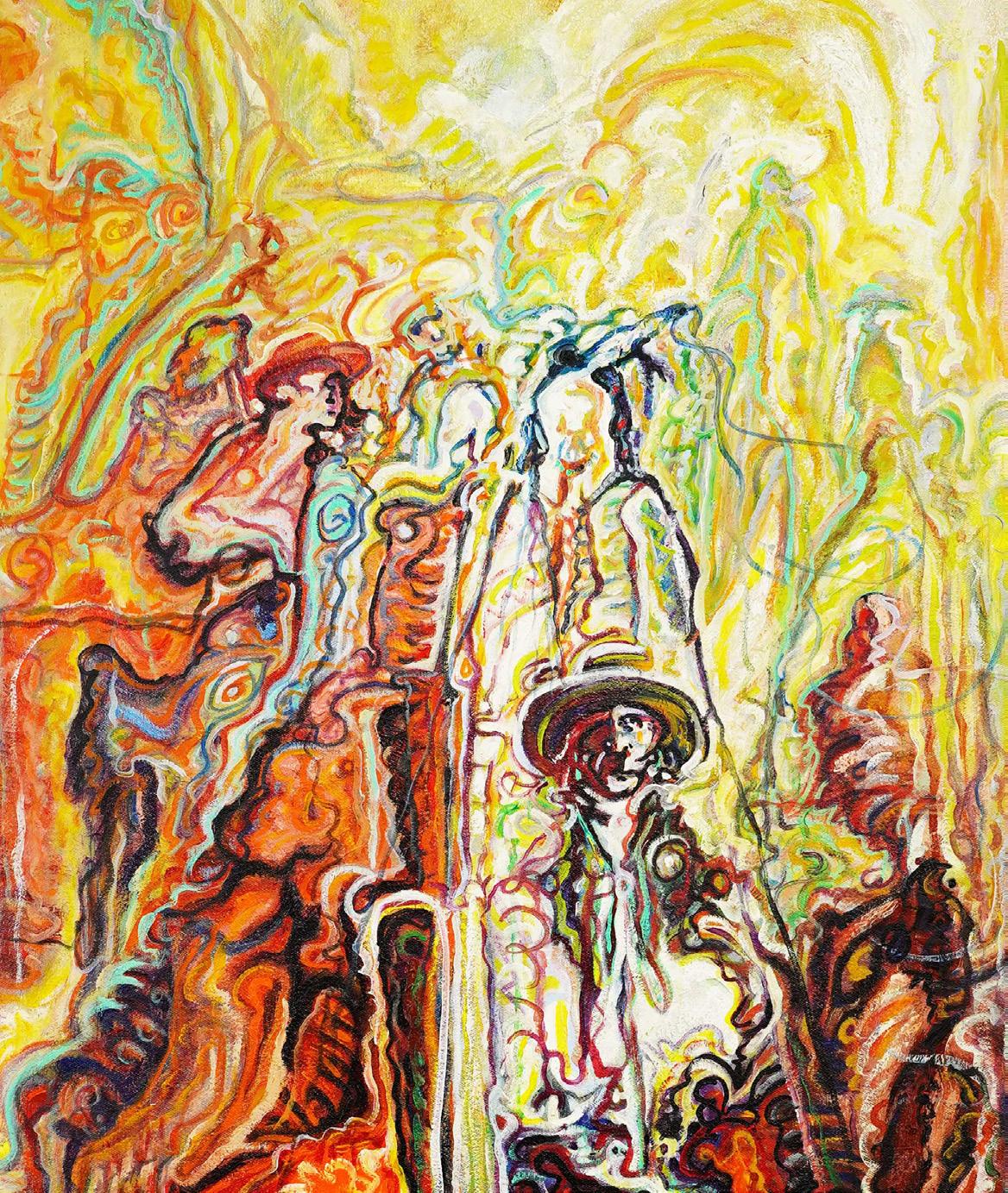
COVER ART
Medicine Woman (oil on canvas, 32x56)
 by Gene Locklear
Cover artist GENE LOCKLEAR was born in Lumberton, NC, raised in nearby Pembroke, and is a member of the Lumbee Tribe of North Carolina. After a career in the Major Leagues, he turned to painting full time. His work has been exhibited widely, and his numerous art commissions have come from the White House, the Pentagon, the Bureau of Indian Affairs, the NFL, prominent sports figures, as well as Turner Broadcasting. Currently, he lives and works in California and maintains a studio and gallery in El Cajon, a suburb of San Diego. In 2004, he helped establish an art academy for young people at UNC Pembroke, where an endowed art scholarship has been established by friends in his name.
COVER DESIGNER
NCLR Art Director DANA EZZELL
LOVELACE is a Professor at Meredith College in Raleigh. She has an MFA in Graphic Design from the Rhode Island School of Design in Providence. Her design work has been recognized by the CASE Awards and in such publications as Print Magazine’s Regional Design Annual, the Applied Arts Awards Annual, American Corporate Identity, and the Big Book of Logos 4. She has been designing for NCLR since the fifth issue, and in 2009 created the current style and design. In 2010, the “new look” earned NCLR a second award for Best Journal Design from the Council of Editors of Learned Journals. In addition to the cover, she designed the feature interview with the podcasters, the North Carolina Literary Hall of Fame story, and the creative nonfiction by Kielar and Memory in this issue.
Produced annually by East Carolina University and by the North Carolina Literary and Historical Association © COPYRIGHT 2023 NC LR
NORTH CAROLINA LITERARY REVIEW
WINTER 2023 ONLINE
NATIVE AMERICAN LITERATURE OF NORTH CAROLINA
6 n Native American Literature of North Carolina includes an interview, poem, and book reviews
Cherry Beasley
Kimberly L. Becker
Mary Leauna Christensen
Brittany Hunt
Mary Ann Jacobs
Chelsea Locklear
Lynn Norris Murray
Jennifer Peedin
Kirstin L. Squint
Ulrike Wiethaus
26 n Flashbacks: Echoes of Past Issues includes poetry, prose, book reviews, and literary news
Anthony Abbott
J.S. Absher
Heather Bell Adams
Malaika King Albrecht
Dale Bailey
Micki Bare
Joseph Bathanti
Barbara Bennett
Jim Clark
Sheryl Cornett
Annie Frazier Crandell
David Deutsch
Judy Allen Dodson
Morrow Dowdle
Janet Ford
Charles Frazier
Philip Gerard
Donna A. Gessell
Rebecca Godwin
Bill Griffin
Jim Grimsley
Janis Harrington
Debra Kaufman
John Kessel
Blaise Kielar
Erica Plouffe Lazure
Patti Frye Meredith
Valerie Nieman
David Potorti
Mark Powell
Glenis Redmond
Maureen Sherbondy
Marty Silverthorne
92 n North Carolina Miscellany includes poetry, prose, and book reviews
Astrid Bridgwood
Cindy Brookshire
Spencer K.M. Brown
Almyr L. Bump
Diane Chamberlain
Sharon Colley
Alana Dagenhart
Joanne Durham
Betina Entzminger
Jo Ann S. Hoffman
Lockie Hunter
Anna McFadyen
n North Carolina Artists in this issue n
Denise Baker
Jody Bradley
Margaret Balzer Cantieni
Brandon Cordrey
Alana Dagenhart
Horace Farlowe
Paul Gemperline
Alex Harris
Krista Harris
Kyle Highsmith
Robert Langford
Chris Liberti
Janna McMahan
Ashley Memory
Patti Frye Meredith
Jamal Michel
Monica Carol Miller
Megan Miranda
Gene Locklear
Tim Lytvinenko
Peter Marin
Lee Nisbet
Dimeji Onafuwa
Ann Roth
Ann Cary Simpson
Bland Simpson
Max Steele
Marsha White Warren
Carol Boston Weatherford
Eric Weil
Leah Weiss
Ross White
Luke Whisnant
Lee Zacharias
Anne Myles
Elaine Thomas
Judith Turner-Yamamoto
Cheryl Wilder
Liza Wolff-Francis
Annie Woodford
Donald Sexauer
Ralston Fox Smith
Leah Sobsey
Theodorus Stamos
Raven Dial Stanley
Carrie Tomberlin
IN
THIS ISSUE
North Carolina Literary Review is published annually in the summer by the University of North Carolina Press. The journal is sponsored by East Carolina University with additional funding from the North Carolina Literary and Historical Association. NCLR Online, published in the winter and fall, is an open access supplement to the print issue.
NCLR is a member of the Council of Editors of Learned Journals and the Council of Literary Magazines and Presses, and it is indexed in EBSCOhost, the Humanities International Complete, the MLA International Bibliography, and the Society for the Study of Southern Literature Newsletter.
Address correspondence to Dr. Margaret D. Bauer, NCLR Editor
ECU Mailstop 555 English Greenville, NC 27858-4353
252.328.1537 Telephone
252.328.4889 Fax
BauerM@ecu.edu Email NCLRstaff@ecu.edu
https://NCLR.ecu.edu Website
NCLR has received 2022–2023 grant support from the North Carolina Arts Council, a division of the North Carolina Department of Natural and Cultural Resources, and from North Carolina Humanities

Subscriptions to the print issues of NCLR are, for individuals, $18 (US) for one year or $30 (US) for two years, or $30 (US) annually for institutions and foreign subscribers. Libraries and other institutions may purchase subscriptions through subscription agencies. Individuals or institutions may also receive NCLR through membership in the North Carolina Literary and Historical Association. More information on our website
Individual copies of the annual print issue are available from retail outlets and from UNC Press. Back issues of our print issues are also available for purchase, while supplies last. See the NCLR website for prices and tables of contents of back issues.
Submissions
NCLR invites proposals for articles or essays about North Carolina literature, history, and culture. Much of each issue is thematically focused, but a portion of each issue is open for developing interesting proposals, particularly interviews and literary analyses (without academic jargon). NCLR also publishes high-quality poetry, fiction, drama, and creative nonfiction by North Carolina writers or set in North Carolina. We define a North Carolina writer as anyone who currently lives in North Carolina, has lived in North Carolina, or has used North Carolina as subject matter.
See our website for submission guidelines for the various sections of each issue. Submissions to each issue’s special feature section are due August 31 of the preceding year, though proposals may be considered through early fall.
Issue #33 (2024) will feature NC Disability Literature, guest edited by Casey Kayser
Issue #34 (2025) will feature NC LGBTQ+ Literature, guest editor TBA
Issue #35 (2026) will feature NC Mysteries and Thrillers, guest edited by Kirstin L. Squint
Please email your suggestions for other special feature topics to the editor.
Book reviews are usually solicited, though suggestions will be considered as long as the book is by a North Carolina writer, is set in North Carolina, or deals with North Carolina subjects. NCLR prefers review essays that consider the new work in the context of the writer’s canon, other North Carolina literature, or the genre at large. Publishers and writers are invited to submit North Carolina–related books for review consideration. See the index of books that have been reviewed in NCLR on our website NCLR does not review self-/subsidy-published or vanity press books.
4 NORTH CAROLINA LITERARY REVIEW Winter 2023
ISSN: 2165-1809
EDITORIAL BOARD
Jenn Brandt
Women’s Studies, California State Unviersity
Dominguez Hill
Gina Caison
English, Georgia State University
Amanda Capelli
Expository Writing Program, New York University
Catherine Carter
English, Western Carolina University
David S. Cecelski
Historian, Durham, NC
Celestine Davis
English, East Carolina University
Kevin Dublin
Elder Writing Project, Litquake Foundation
Editor
Margaret D. Bauer
Art Director
Dana Ezzell Lovelace
Guest Feature Editor
Kirstin L. Squint
Poetry Editor
Jeffrey Franklin
Art Editor
Diane A. Rodman
Founding Editor
Alex Albright
Original Art Director
Eva Roberts
Graphic Designers
Karen Baltimore
Stephanie Whitlock Dicken
Senior Associate Editor
Christy Alexander Hallberg
Assistant Editors
Anne Mallory
Randall Martoccia
Senior Editorial Assistant
Megan Smith
Editorial Assistants
Cassidy Barbee
Keegan Holder
Daniel C. Moreno
Interns
Lauren Cekada
Ashley Mills
Rebecca Duncan
English, Meredith College
Gabrielle Brant Freeman
English, East Carolina University
Jaime Rochelle Herndon
Freelance writer, Philadelphia, PA
LeAnne Howe
English, University of Georgia
Mark Johnson
English, East Carolina University
Kathryn Kirkpatrick
English, Appalachian State University
Celeste McMaster
English, Charleston Southern University
Kat Meads
Red Earth MFA program, Oklahoma City University
Tariq Moore
English, East Carolina University
Amber Flora Thomas
English, East Carolina University
Angela Raper
English, East Carolina University
Dean Tuck
English, Wayne Community College
Susan O’Dell Underwood
English, Carson-Newman University
Robert West
English, Mississippi State University
5 N C L R ONLINE
Spotlighting North Carolina’s Indigenous Voices
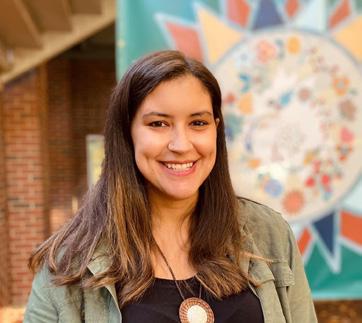 by Kirstin L. Squint, Guest Feature Editor
I was thrilled when NCLR Editor Margaret Bauer asked me to assume the role of the journal’s first guest feature editor, and it is my great honor to introduce the 2023 special feature section on Native American literature of North Carolina. I conduct research and teach graduate and undergraduate classes in this area, particularly work by Southeastern Indigenous authors, so I knew that this was a topic I wanted to explore in NCLR, especially because North Carolina “has the largest American Indian population east of the Mississippi River.” 1 Also, within the broad category of Native American literature, Southeastern Indigenous literatures have been less well-known to the general public and less studied by scholars, despite the long history of oral and written work by the people who have lived on this land for millennia.
We begin the feature section of this first 2023 issue with an interview I conducted in 2021 with Lumbee podcasters and storytellers, Brittany Hunt and Chelsea Locklear, whose Red Justice Project true crime podcast, now in its second season, highlights cases of missing and murdered Indigenous peoples in North Carolina and beyond. This is important work because so often these stories remain untold by mainstream media.
We are also excited to include Mary Leauna Christensen’s powerful poem about the complexity of Indigenous identity, “In Which I am The Sum of Parts.” Christensen, a citizen of the Eastern Band of Cherokee Indians, is a 2022 Indigenous Nations
Poets fellow and attended the inaugural In-NaPo retreat in Washington DC. We look forward to including another of her poems in our forthcoming print issue.
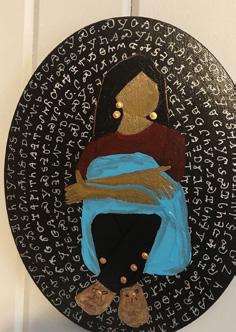
In addition to my interview with Hunt and Locklear and Christensen’s poem, Lynne Norris Murray reviews the collection, Upon Her Shoulders: Southeastern Native Women Share Their Stories of Justice, Spirit, and Community, edited by Cherry Beasley, Mary Ann Jacobs, and Ulrike Wiethaus. In her review, Murray details how the North Carolina tribal women featured in the book tell their stories, illuminating service to their communities, Indigenous spiritual practices, and initiatives for justice. Also reviewed is Bringing Back the Fire by Cherokee-descended author Kimberly L. Becker. In her review of this poetry collection, Jennifer Peedin describes how Becker contrasts imagery of light and darkness and weaves Cherokee language through her work to emphasize themes of pain and solace, especially as they relate to her own Cherokee ancestry. These reviews, as well as the interview and poetry, are punctuated with stunning artwork by Raven Dial-Stanley (Lumbee) and Jody Bradley (Eastern Band of Cherokee Indians).
The winter online issue provides a taste of what is to come in the 2023 print issue,2 which will include creative writing by Cherokee and Lumbee writers, including Annette Saunooke Clapsaddle, Mary Leauna Christensen, and Tanya Holy Elk Locklear. We will also feature literary criticism by

6 NORTH CAROLINA LITERARY REVIEW Winter 2023
2
the
of contents of the 2023 issue here
Find
table
scholars of Indigenous and US Southern literatures about Cherokee, Lumbee, and Catawba texts, and an interview with Cherokee novelist Blake Hausman. And throughout the feature section, artwork by North Carolina Native artists from the Lumbee, Eastern Band of Cherokee, and Catawba tribes will complement the writing. Be sure to subscribe to NCLR, if you don’t already, to receive this historic issue, the first to focus on North Carolina Native American literature.
Finally, I want to share East Carolina University’s land acknowledgment, a way that we recognize North Carolina’s tribal communities at campus events: “We acknowledge the Tuscarora people, who are the traditional custodians of the land on which we work and live, and recognize their continuing connection to the land, water, and air that Greenville consumes. We pay respect to eight recognized tribes: Coharie, Eastern Band of Cherokee, Haliwa-Saponi, Lumbee, Meherrin, Occaneechi Band of Saponi, Sappony, and Waccamaw-Siouan, all Nations, and their elders past, present, and emerging.”
Our 2023 NCLR feature theme is another way of acknowledging the importance of North Carolina’s Indigenous peoples and their continuing contributions to North Carolina literature. n
Native American Literature of North Carolina NORTH CAROLINA
8 The Red Justice Project: An Interview with Brittany Hunt and Chelsea Locklear by Kirstin L. Squint art by Raven Dial-Stanley

20 Taking Up the Mantle and Making it Her Own a review by Lynne Norris Murray art by Raven Dial-Stanley
n Cherry Beasley, Mary Ann Jacobs, Ulrike Wiethaus, eds. Upon Her Shoulders: Southeastern Native Women Share Their Stories of Justice, Spirit, and Community
22 In Which I Am a Sum of Parts a poem by Mary Leauna Christensen art by Jody Bradley
24 Re-membering the Dark and the Light a review by Jennifer Peedin art by Jody Bradley
n Kimberly L. Becker, Bringing Back the Fire
ALSO IN THIS ISSUE
26 n Flashbacks: Echoes of Past Issues poetry, prose, book reviews, and literary news
92 n North Carolina Miscellany poetry, prose, and book reviews
7 N C L R ONLINE
THE RED JUSTICE PROJECT
BY KIRSTIN L. SQUINT
RAVEN DIAL-STANLEY , the artist featured here, is an enrolled member of the Lumbee tribe of North Carolina. She graduated from UNC Greensboro with a degree in consumer, apparel, and retail product design and a minor in new media design studies. She was the president of the Native American Student Association and was inducted into Alpha Pi Omega Sorority, the first Native American sorority in the US. In 2018, she was selected as Miss Indian North Carolina, and in that role, served as an ambassador for all eight tribes and four organizations in North Carolina. Her platform was “Empowered Woman, Empower Women.” She also volunteers for the Indian Education Program in her community. See more of her art on Instagram @artistry_indigenous_angel.
The following is a Zoom interview that took place on November 16, 2021, as part of a lecture series hosted by Kirstin L. Squint, Whichard Distinguished Professor and Native American literature specialist in the Department of English at East Carolina University.1 The conversation focuses on the groundbreaking podcast, The Red Justice Project, co-hosted by Brittany Danielle Hunt and Chelsea Locklear, both citizens of the Lumbee Tribe of North Carolina. The podcast spotlights the issue of missing and murdered Indigenous peoples in North Carolina and beyond. This interview has been edited for reading and style, but carefully, to remain true to the speakers’ voices. Squint’s conversation with Hunt and Locklear focused on the mission of the podcast, which is to bring awareness to the many cases of missing and murdered Indigenous people in North America and the way they are erased in American media. The interview also addressed Hunt’s and Locklear’s choices about how to tell the victims’ stories, particularly from an Indigenous point of view. Season One of The Red Justice Project launched on November 2, 2020, and its twenty-nine episodes aired weekly until June 14, 2021. Season Two, launched on April 24, 2022, and its ten weekly episodes concluded on July 25, 2022. At the time of this interview, The Red Justice Project was on a break between its first and second season.
Brittany Hunt is currently a postdoctoral research associate at Duke University and the owner of Indigenous Ed., LLC, through which she provides workshops, speeches, and consulting around Indigenous education. She is the author of the Lumbee children’s book, Whoz Ya People? and is a graduate of Duke, UNC Chapel Hill, and UNC Charlotte. Chelsea Locklear was raised in Pembroke, North Carolina, and is also a member of the Lumbee tribe. By day, she is a Client Services Manager for a private credit fund, and by night she’s a dreamer and schemer, planning her next passion project. She received her bachelor’s degree from NC State and an MPA from UNC Chapel Hill.
8 NORTH CAROLINA LITERARY REVIEW Winter 2023
1 Watch this interview with the podcasters online here. The transcription that follows has been edited for a reading audience.
: : :
:
AN INTERVIEW WITH BRITTANY HUNT AND CHELSEA LOCKLEAR
KIRSTIN L. SQUINT: I read in the local newspaper in Robeson County, North Carolina, The Robesonian, in January of this year that The Red Justice Project was Chelsea’s brainchild because of your love for the true crime genre, and that Chelsea got Brittany hooked on true crime podcasts as well. Chelsea mentions in the first of the twopart story about Julian Pierce, episodes six and seven, that this was the first case the two of you discussed.2 How did you two meet, and what made you decide to become a podcasting team?

Missing & Murder Indigenous Awareness, 2020 (virtual drawing/painting, 8.5x11) by Raven Dial-Stanley

The premiere guest editor of NCLR, collecting and editing content for the feature section of the 2023 issues, KIRSTIN L. SQUINT is an Associate Professor of English at East Carolina University, where she held the Whichard Visiting Distinguished Professorship in the Humanities from 2019 to 2022. She is the author of LeAnne Howe at the Intersections of Southern and Native American Literature (Louisiana State University Press, 2018), a co-editor of Swamp Souths: Literary and Cultural Ecologies (Louisiana State University Press, 2020), and the editor of Conversations with LeAnne Howe (University Press of Mississippi, 2022). She is also a contributor to Appalachian Reckoning: A Region Responds to Hillbilly Elegy (West Virgina University Press, 2019), winner of the 2020 American Book Award for criticism.
CHELSEA LOCKLEAR: Well, I like to say, like any good love story, we met online, mostly because that’s how I met my husband, also. I think we met through social media. Brittany always shared some really insightful posts, and she has been a voice for Lumbee people for several years via social media. She’s very funny and just a really great energy, and so I reached out to her with my idea, and it kind of took off from there.
Did you want to add anything to that, Brittany?
BRITTANY HUNT: Oh, no. I would just say that she mentioned earlier how we met on social media, and also she met her husband there, and we’re both the two great loves of her life, in addition to her daughter. It’s been an honor to work with Chelsea so far on this journey. I wasn’t into podcasting at all, and now I listen to two to three different shows a day, based on Chelsea’s recommendations mostly, and so she really pulled me into the podcast world. I think it’s a tremendous format through which to share stories, which Indigenous people love to do. It feels very familiar to me, so I’m thankful for Chelsea for that.
9 N C L R ONLINE Native American Literature of North Carolina
2 Julian Pierce was a Lumbee attorney and activist. Episodes 6 and 7 were released 14 and 21 Dec. 2020.
COURTESY OF THE ARTIST
: :
COURTESY OF BRITTANY HUNT AND CHELSEA LOCKLEAR
You describe what you do on The Red Justice Project as telling the stories of the victims. What storytelling techniques do you use to create a compelling experience for your listener? I remember in the Jap Locklear episode you talked about the oral tradition, and you also talked about the way podcasting intersects with that.3
BH: So, one of the things that I think we noticed in doing a lot of our research on the cases is that sometimes the cases aren’t treated with as much sensitivity as they should be given, and so we really like to bring a lot of sensitivity to the work, even though we are describing a lot of graphic content most times. That’s really important for us. We also like to, as much as possible, inject humor into the beginning of the episodes because the topics are really heavy, and so we do like to provide a little bit of comic relief in the beginning for our listeners because even though these stories are traumatic, we know that as Indigenous people we often use humor to deal with trauma in a lot of ways. I think Chelsea and I do that as much as possible in the stories.
So, Chelsea, you got Brittany into podcasting. Is that something that appeals to you as well, that kind of storytelling aspect of it, or the orality of it, I guess?
CL: Yeah, as Brittany mentioned, I think Indigenous people are known for their storytelling and oral history, and through my love of true crime podcasts, I was noticing that a lot of our stories, Indigenous stories, were not being told. Once again, I already knew we weren’t being shown in the media; we weren’t frequently featured on episodes of Dateline, of 48 Hours, of other kinds of true crime shows that you might see, or even just your nightly news. And when I was looking through different podcasts, I thought, we really are not being featured in podcasts, either, of true crime, considering the devastating rates at which we go missing and are murdered. I’m not a storyteller by nature, but I thought, there’s a gap. Why not fill it, or try to?
You know I’m a literature professor, and I think about storytelling a lot, and I got so hooked on this podcast. One of the things that I’m often impressed by is your rapport. You are both so genuine and so funny at times. In the episodes on Julian Pierce, you’re talking about that period in the ’80s when there was so much police and political corruption in Robeson County. You describe how two Tuscarora men took over The Robesonian as an act of political dissidence. I laugh out loud every time I listen to this episode when Chelsea joked that if she had been taken hostage, she would have been happy to have been traded for a
10 NORTH CAROLINA LITERARY REVIEW Winter 2023
3 Jap Locklear was a Lumbee man whose case was discussed in episode 12, released 25 Jan. 2021.
. . . INDIGENOUS PEOPLE ARE KNOWN FOR THEIR STORYTELLING AND ORAL HISTORY, AND THROUGH MY LOVE OF TRUE CRIME PODCASTS, I WAS NOTICING THAT A LOT OF OUR STORIES, INDIGENOUS STORIES, WERE NOT BEING TOLD.
collard sandwich.4 You can pick out moments where you all are really funny, and I often think, “Wow, how did you make me laugh after telling me this terrible story that needs to be told?” But there are also really poignant moments, like during the interview about Marcey Blanks when Brittany is talking to her mother, and she cries with her on the phone because it’s so traumatic.5 I think you’re both really brave to take on this subject matter. Do you think of yourself that way? You know you are taking on really challenging stuff.
CL: I would not call myself brave. I’d say a little bit foolish to begin with because Brittany and I had no idea what we were getting into. We had no idea the conversations that we would be having with people, the depth of the conversations, and the effect that creating a podcast like this would actually have on us and on our community that actually listens to it. So, I don’t know if “brave” is the right word; I’ll throw in some foolery there at the beginning. But what do you think, Brittany?
BH: I agree with “brave” and “foolish” mixed together. Because some of the stories we’re telling are kind of scary to tell, especially cases where there’s not been any suspect that’s been apprehended, but there are rumors around town of who did it. Should we share those rumors? Should we not? How much protection do we need to give the people who we’re talking to, but also protection for ourselves? There is a level of fear, I think, associated with some of the stories that we’ve told in the past. I think it does take a combination of bravery and foolishness together. The interview with Marcey’s mom, Ms. Mary, was the most difficult interview I’ve ever done. I knew Marcey, so that added a whole other layer to it because I hadn’t known any of the other victims. I cried with her in a very genuine way because of something that she said that just broke my heart. That episode and that story is the closest one to me of all. I think it also takes a little bit of gumption, or strength, to be able to even interview family sometimes because some of the things that they’re telling us are so difficult to hear and so beyond what you could even think a human could endure.
I agree. We’ll come back to the Marcey Blanks episode in just a bit. I was researching what other folks had been saying about The Red Justice Project, and I came across some reviews on a website I had never seen before called Podbay. There were thirty-five reviews. They were all five-stars, of course. There was a review that really touched me because it reflected my own experience. It was by a listener called “DoomerVibes” who said, “I’d recommend

11 N C L R ONLINE Native American Literature of North Carolina
4 On 1 Feb. 1998, two Native American men protested “unfair law enforcement” in Robeson County by taking hostages at the office of the The Robesonian newspaper. See Donna Gordon, “American Indians Seize Hostages at Newspaper,” Associated Press 1 Feb. 1998: web
5 Marcey Blanks (1998–2016) was a Lumbee woman whose case was discussed in episode 11, released 18 Jan. 2021.
ABOVE Marcey Blanks
COURTESY OF BRITTANY HUNT AND CHELSEA LOCKLEAR
this to anyone, but for North Carolinians, especially, this is a must listen. The dedicated hosts provide invaluable information about Lumbee culture, which is completely omitted from our education, packaged in a bingeable true crime format.” 6 I think all that is true. When I started listening, I started bingeing, but then there was a moment when I had to stop because some of these stories you’re telling are terrifying just to listen to, let alone to try to put yourself in the shoes of the family members of these victims as you all are doing. I feel like I need to process sometimes. I know there are times when you pause while you are actually doing the podcast, and you say, “I had to pray after I read this,” or “I’m going to have to smudge myself.” How does regularly reading about and researching these cases affect you emotionally? Do you ever take a step back and say, “That’s enough work on the podcast today. I need a break”?

BH: We had initially planned to set our podcast up in the same way that Crime Junkie does.7 For people who aren’t familiar with that podcast, they pretty much air every single Monday. But then over time, Chelsea and I started to realize that it was just too hard on us emotionally because, again, we’re telling stories of people we know. Some of the people Chelsea went to school with, and it’s people who lived on the same street as us or lived in the same community. It’s a whole different type of connection that we have to the cases than a typical true crime podcaster would have. So, we decided to start doing our podcast in seasons instead. We finished Season One in June, I believe, and decided to take a pretty long break, much to the anger of some of our fans, who have been messaging us, asking us for Season Two. But I think that we needed a break – mentally, emotionally – from some of the content that we were sharing. And then again, just as a reminder, we’re not just reading articles. We’re talking to family members, which adds a whole other level of pain, even for us in a second- or third-degree way. We had to take a break for our own mental health. And we’re also thinking of maybe potentially a different format for Season Two for that reason alone.
How has your process changed as you moved through Season One? In episode ten, you said you had to record your first episode so many times. And you were so experienced sounding by that point. I am curious, for example, thinking about the interviews with family, what are some of the things that changed and what did you learn throughout the season?
CL: Each episode we learned something that helped us out with the next episode. When we first started – the Brittany Locklear episode was our very first episode – and Brittany and I probably recorded that six or seven times to try to get it right, maybe even more.8 And

12 NORTH CAROLINA LITERARY REVIEW Winter 2023
1,
2
6
the reviews page of
Project website. 7
is a true crime podcast that debuted in Dec. 2017: web ABOVE
ABOVE BOTTOM
8 Brittany Locklear (1992–1998) was a Lumbee girl whose case was discussed in episode
released
Nov. 2020.
Quoted from
The Red Justice
Crime Junkie
TOP Chelsea Locklear
Brittany Hunt
COURTESY OF CHELSEA LOCKLEAR
COURTESY OF BRITTANY HUNT
WE QUICKLY REALIZED BY EPISODE THREE OR FOUR THAT IF WE WANTED TO COVER MORE STORIES, ESPECIALLY IN OUR COMMUNITY, WHERE THE LOCAL NEWSPAPER OR LOCAL TELEVISION STATION HAD NOT COVERED THOSE CASES THOROUGHLY, WE ACTUALLY HAD TO SPEAK TO FAMILIES.
we actually wrote the script together; whereas, in later episodes we would take turns writing scripts, so it wouldn’t be such a burden on us each week. But I think we realized pretty early on, because of the type of podcast that we had, an Indigenous true crime podcast, where there’s not a lot of media coverage, that it actually was up to us to create that media and that was really through interviews with families. We quickly realized by episode three or four that if we wanted to cover more stories, especially in our community, where the local newspaper or local television station had not covered those cases thoroughly, we actually had to speak to families. That changed our mindset once we learned that we would have to do that. And it really changed the tone of the podcast because we couldn’t just binge newspaper articles and write a quick script. We really had to take our time and think about questions like, Who do we interview? What questions do we ask? How sensitive do we need to be with these family members? What can we cover? What can we not? As Brittany said, some of them tell you things like, “Please do not say this in the podcast,” even though it would be something really interesting to the audience. You have to honor those wishes. I think with each episode in Season One, it was a learning curve for us. But it was a good experience leading up to Season Two for us.
I have been very interested in the craft of it. How much time does it take for you to write an episode? I imagine that’s also changed.
BH: It just depends because sometimes there’s more information about one case than others, and sometimes family members haven’t gotten a chance to talk about their loved ones in a while to anybody, so they’ll talk for longer, maybe, than other interviews where a family member doesn’t want to share so much. But usually if we have, for example, a twenty-five-minute episode, that would be about twelve pages of a script. Writing that does take several hours to do. It is a pretty laborious process. But there have also been times when the way Chelsea and I will do it is we’ll record separately or on Zoom. But there were a few times when her recording didn’t work, so we didn’t know until the end, and we had to do it over and over again. And those were times when I wanted to fight Chelsea, which I never told her until now. But that only happened a few times. Generally, I would say it takes five to six or seven hours to write a story, and then recording it might take another hour or so. Then Chelsea’s husband is the one who edits and cuts and puts our episodes together, so he has to do quite a bit of work on that as well, especially if we mess up a lot while we’re recording. He’ll have to go through and delete.
CL: Which is often.
13 N C L R ONLINE Native American Literature of North Carolina
Do you have the whole season ready before you release it?
CL: We were really working on the fly during Season One. Season Two we are planning out much better. I don’t think we realized how much traction we would get with Season One, and I couldn’t even imagine that we would turn out basically thirty episodes over a six-month period. That’s pretty hefty for one season of a podcast, thirty episodes. Also, that gives my husband a break from editing.

That’s a lot of work, especially on top of your regular jobs. On that note, that Robesonian article I read from January said that your reach was across twenty-five states at that point, but I’m sure it’s much different now.9 Do you know how many listeners you have, or do you measure that by downloads? What do you know about your audience?
CL: I actually had not looked up the stats in a while. I looked them up and shared them with Brittany yesterday. We’ve reached fifty-five countries! Granted, some countries only have ten downloads, but we’ll count it, and forty-four states. It’s gotten quite a bit of a reach across the US now, which is exciting.
That is exciting! Thinking about those early episodes, I love the way that you say, “This is what Lumbee is; this is who we are; you’ll notice our Southern accents.” Even at that point when you didn’t realize the reach you would have, you prepared everybody. I think that’s fantastic. I guess I’m wondering: did you have that vision or that hope that you would get an international reach?
BH: I think we had that hope. And Chelsea didn’t mention, but we also have forty-four thousand downloads total of the podcast, so it’s a lot more than I thought we would ever get. I’m really excited that not only are North Carolinians and Robesonians listening to the podcast, but people all over the world and all over the country as well. I don’t think we had anticipated it, but it was definitely something we hoped for. It’s good to see that it’s realized.
That’s excellent news. In terms of thinking about the content and the way it connects to that reach, The Red Justice Project examines many cases of missing and murdered Indigenous women, especially Lumbee women, but you also discuss missing and murdered Indigenous people more broadly in North Carolina and beyond US national borders. I’m thinking about Canada’s Highway of Tears, which are episodes nine and ten, and episode twenty-eight about the bodies of 215 children that were found on the grounds of the Kamloops Indian Residential School in British Columbia.10 They were found last May, so I think folks will remember that in the news. These were just very powerful. Can you talk a little bit about how you chose the scope of your podcast?
14 NORTH CAROLINA LITERARY REVIEW Winter 2023
10 Episodes 9, 10, and 28 were released 4 and 11 Jan. and 7 June 2021.
9 Tomeka Sinclair, “Hosts of ‘Red Justice Project’ Seek to Raise the Voices of Slain, Missing Indigenous People,” Robesonian 22 Jan. 2021: web
ABOVE Chelsea Locklear’s husband, Dakota Lowery
COURTESY OF CHELSEA LOCKLEAR
CL: I think when we first started, our idea was to be pretty broad, which is why our second episode was about Neil Stonechild, which was based in Canada as well.11 We had several other episodes that were across the US, but we really found that we got more listeners and more engagement, especially on social media, when we talked about cases specific to our community. One, because thankfully we have friends and family who are nice enough to listen to our podcast, but really because these stories had never been told in this format and really had hardly been told in the media. With Marcey’s case, as Brittany can tell you, there were about three or four news articles, very small, and most people wouldn’t have even known about what had happened, so we really found that people were most interested in the cases they had never heard of. There are other bigger cases, like Kamloops, that were really relevant because it did actually make some national media attention.Since then, several more residential schools in the US and in Canada have been investigated. They did ground radar penetration, and they’ve actually uncovered several thousand more bodies of Indigenous children. There has been nothing in the media, which was really sad because at least Kamloops did make national media, but since then none of the other schools have even made a blip really on national news.
BH: And I would just like to add another comment about what Chelsea was saying earlier. I think our listeners have really enjoyed listening to cases that were in our community but they didn’t know about because they’re getting so few articles. There was even one story that we covered of a girl named Casey Young, who I went to school with.12 One of my friends who I was telling about the episode knew Casey and had not known that she had died in 2009. At this point it had been eleven years, and she didn’t even know that Casey had passed away, so finding out that way with me telling her about us covering her story highlights the ways that these stories are covered up or hidden in our communities or in our local news media. They’re not really talked about as much as they definitely should be.
Sometimes you talk about particular roads where several crimes have taken place, and sometimes it’s a revelation to you that so many crimes have taken place in one area. I’m often amazed when you talk about how – and this happened in several different episodes – the victim had just one line in the newspaper. There’s a real honoring of these folks that’s happening in your episodes, which I think is moving, from a listener perspective. I would like to talk some more about Marcey Blanks. This is such a powerful story. It’s so powerful because the victim was a student Brittany knew when she worked at Lumberton High School. Brittany shared firsthand memories of Marcey, as well as the pain she experienced from her loss. I think this episode is also very important because you’ve underscored how murders of Indigenous women are much less publicized than those of
15 N C L R ONLINE Native American Literature of North Carolina
11 Episode 2 about the case of Neil Stonechild was released 9 Nov. 2020.
12 Casey Young was a Lumbee woman whose case was discussed in episode 13, released 1 Feb. 2021.
I THINK OUR LISTENERS HAVE REALLY ENJOYED LISTENING TO CASES THAT WERE IN OUR COMMUNITY BUT THEY DIDN’T KNOW ABOUT BECAUSE THEY’RE GETTING SO FEW ARTICLES.
white women. And this is certainly true of your first episode about Brittany Locklear, which is a truly horrifying case of a very young girl, and you talk about some comparisons to JonBenét Ramsey and some others who made national media. Would you talk about the ways you’re trying to amplify this issue and humanize the statistics around missing and murdered Indigenous women?
COURTESY OF PUBLIC SCHOOLS OF ROBESON COUNTY STAFF

BH: For me, in researching these cases and in talking with families, and also being a person who does consume a lot of true crime media in general, either through podcasts or Dateline episodes, you see the ways the cases in our home communities are almost identical to some of the cases that are really popular, for example JonBenét Ramsey. There’s also a woman named Jessica Chambers, who was murdered in Mississippi, I believe, and her body was burned, but she lived just long enough to name the person who had killed her, and then she died shortly after. Marcey’s case was very similar in that she had been stabbed repeatedly and was burned and then named her assailant. But Marcey’s case got three articles that were maybe five sentences total. And Jessica Chambers’s case ends up getting a special on the Oxygen network that’s eight parts, and now it’s a podcast.
Our issue is not that white women don’t deserve coverage; it’s just that Indigenous women and girls deserve the same level of coverage and that the purposeful covering up of these cases is adding to the problem that’s happening in our community. There’s a common phenomenon called “Missing White Woman Syndrome,” which describes the way our nation, and even the world, becomes captured by the stories of missing and murdered white women. Think of Laci Peterson, JonBenét Ramsey, Natalee Holloway, so many different women’s stories we know in detail. It makes you sympathize and empathize with that family. But then you don’t have that complementary coverage of Native women, so there’s no one who is empathizing and sympathizing with us, which makes the problem even worse. I think that’s why our podcast is so important, not only to us, but to our community, as well.
CL: Another great example of that that’s super recent is Gabby Petito. The whole nation and social media were enthralled with her. She was a young white girl, very pretty, trying to make it as a social media influencer. She went missing in Wyoming, where several hundred Indigenous women have gone missing. And there’s been no blips, no thousands of TikToks or Instagram posts wondering where these Indigenous women are, like you saw with Gabby Petito. What causes America to rise up for Gabby Petito, and how can we get that same rise for Indigenous women, as well?
16 NORTH CAROLINA LITERARY REVIEW Winter 2023
Let’s talk about Faith Hedgepeth because her story does also tie into this issue that we’re talking about right now. Your season finale is just absolutely powerful from beginning to end.13 You have a beautiful song at the end, “Hometown Hero” by Charly Lowry. A lot of folks in North Carolina are probably familiar with the very horrific murder of Faith Hedgepeth. She was a Haliwa-Saponi woman and a UNC student whose body was found in 2012. This case is a rarity because it has had some national attention, and it did make state-wide headlines again in August of this year because a suspect was finally arrested. Your storytelling in this episode is powerful for a lot of reasons, but I think part of it is because you both talked about relating to her: you were similar ages, you had taken similar paths, in terms of going away from your home community to predominantly white institutions, and you felt like you had some similar experiences as Faith Hedgepeth. How did you feel when you heard about the arrest, especially given all of the possibilities that were out there about the suspect?
YEAH, I DON’T THINK THERE’S ANY INDIGENOUS COMMUNITY IN NORTH CAROLINA WHO DOESN’T KNOW FAITH’S NAME AT THIS POINT BECAUSE SHE DID HAVE SUCH AN IMPACT.
BH: I was actually taking a nap when I got the news. And I woke up and had thirty texts and all these notifications, so I think it’s a lot of different emotions. Who is this person? He was never named in any of the other information. It seems so random, almost. So, there’s also a lot of curiosity. How did this happen? But also a lot of relief and such happiness for her family to have one answer among hundreds of questions that they probably have on this case. There are so many different connections that I feel like I had with Faith without actually knowing her. This case has always felt really close to me in a lot of ways. I felt a whole mix of emotions when I found out.
CL: Yeah, I don’t think there’s any Indigenous community in North Carolina who doesn’t know Faith’s name at this point because she did have such an impact. Faith is the exception, she’s not the rule, because she did meet some of those standards. She was smart. She was very beautiful. She was off at a good school, not in her tribal community. In many other ways she was similar to Marcey: she was an Indigenous girl, grew up in her Indigenous community. But she was different in other ways. Marcey wasn’t an honor student heading to Chapel Hill and getting out of her community. So, I think being in Chapel Hill had a lot to do with it. I don’t know that we would see the same kind of coverage if it had happened in Hollister, in her tribal community.
BH: Then you even think about cases like Eve Carson, which I think is kind of similar to Faith’s case, which got even more national attention than Faith’s and which was solved rather quickly in comparison to Faith’s, which took nine years to solve.14 So, even though Faith’s case got much more attention

17 N C L R ONLINE Native American Literature of North Carolina 13 The
One
episode 29, released 15 June 2021,
the
Season
finale,
featured
case of Faith Hedgepeth.
14 Eve Carson was a white female student at UNC Chapel Hill who was murdered in 2008.
ABOVE Brittany Hunt, during this interview
COURTESY OF BRITTANY HUNT AND CHELSEA LOCKLEAR
than most Indigenous women get, she still got less than most of the famous cases of white women being murdered get.
Regarding another case, the Casey Young episode, you talk about how the victim was a part of the LGBTQ community and the ways that LGBTQ people are more vulnerable to violence. You also talk about homophobia and its connection to evangelical Christianity in Robeson County. To what degree do you feel you need to educate your listeners about issues in Robeson County and Lumbee communities, in particular? Obviously, I’m talking about the context of this case, but you could speak to that more broadly.
BH: I was thinking about this question a lot. I think that there are some media that are created for non-Natives to tell them about what Natives are like, and then there’s some media that’s created for Native people by Native people, and Chelsea and I really strive to create something that feels like it’s for Indigenous people but still accessible to non-Natives, as well. We not only want to create a podcast where people can learn more about Lumbee people, and Indigenous people in general, where they can learn more about what our communities face, but also something that provides a space and a voice for Lumbee and Indigenous people and provides a media platform despite us having very little media coverage in general, especially media coverage that’s positive. But on the issue of homophobia in the Lumbee community, more generally, it’s important to think about the impacts of colonization into Indigenous communities. Prior to colonization, Indigenous communities were often very welcoming and accepting of LGBTQ tribal members, and there were protected spaces specifically for those members who were often regarded or respected even higher. Unfortunately, the introduction of colonization, with a particular type of Christianity that has infiltrated into Indigenous communities, has caused a level of homophobia that ends up creating situations like what happened to Casey Young and what happened on other episodes that we shared, as well. These impacts are disastrous, but I still think they’re important for us to talk about. And also, to help Lumbees confront these issues that are in our communities, it’s really our responsibility at this point.
WE NOT ONLY WANT TO CREATE A PODCAST WHERE PEOPLE CAN LEARN MORE ABOUT LUMBEE PEOPLE, AND INDIGENOUS PEOPLE IN GENERAL, WHERE THEY CAN LEARN MORE ABOUT WHAT OUR COMMUNITIES FACE, BUT ALSO SOMETHING THAT PROVIDES A SPACE AND A VOICE FOR LUMBEE AND INDIGENOUS PEOPLE.
I’m wondering what the future of The Red Justice Project looks like. Are you planning to revisit any cases, or do you mainly do that with folks via social media?
CL: I definitely think there are a couple of things that we would like to revisit, especially in the start of Season Two. One is kind of an extended chat around residential boarding schools, especially given the media that, again, hasn’t been quite the same wave of media that we saw
18 NORTH CAROLINA LITERARY REVIEW Winter 2023
with Kamloops. But there have been a lot more bodies found, and we really, in just a thirty- to forty-minute episode did not get to touch on many of the issues that were caused by Indigenous boarding schools, such as loss of language, loss of culture, some of the experiments that were done on Indigenous children, such as malnourishment and its effects on students’ ability to learn. So literally they would starve kids to see if it would affect their ability to learn, which is, of course, if you don’t eat, you cannot concentrate. There are so many things in that episode alone that we didn’t get to touch on that I think we would love to bring back for Season Two. And, of course, with us ending with Faith’s episode, we’re hoping that there will be many more updates since someone has been arrested, so I could see us touching on that as well in Season Two.
What is your engagement like with your listeners? I follow you on social media, and I know you say, “Call us if you have a tip.” Do you get tips? Do you talk to folks just through social media? Are there other ways? When you go to Robeson County, do people pull you aside now and say, “Hey, I heard this thing”? What’s that like for you?
BH: We do get messages from people. We get theories. After the Casey Young episode, her cousin actually reached out to me and told me that it was the first time she felt like she could breathe in eleven years because the way we told the story kind of validated her own perspectives and her own memories of her cousin. There are times like that where it feels so right, what we’re doing, and so purposed.
I really enjoy those episodes when you’re talking to people that are in your family or people that you know, or they’re people that you just met, and they get really comfortable, and then there’s this guy who says, “Chelsea, let me tell you.” I thought, “That’s great. You developed this relationship that makes people really comfortable.”
CL: This was something that I think Brittany was touching on earlier: we might use a thirty-second clip of an interview, but literally we were on the phone with someone for two hours because when you’re talking, especially to people from your own community, you really build that rapport with these families. For them, it’s almost like a therapy session. Here’s someone who actually wants to listen to my story and hear what I have to say about my child, or my cousin, or my niece. And for a lot of family members, even though it’s really hard to talk about in some ways (and this is something Brittany says a lot), it’s kind of a form of justice for some of these families: just to be able to have their story put out there and to know that other people are listening. n
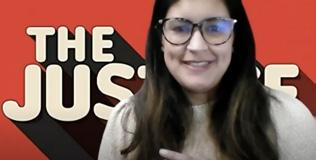
19 N C L R ONLINE Native American Literature of North Carolina
ABOVE Chelsea Locklear, during this interview
COURTESY OF BRITTANY HUNT AND CHELSEA LOCKLEAR
TAKING UP THE MANTLE AND MAKING IT HER OWN
a review by Lynne
Norris Murray
Shoulders:
Upon Her Shoulders: Southeastern Native Women Share Their Stories of Justice, Spirit, and Community, a collection of stories and poems that the editors term “contemplative reflections” (xxii), amplifies the voices of Native women, primarily from the Lumbee Tribe in North Carolina. These editors – Mary Ann Jacobs, Cherry Beasley, and Ulrike Wiethaus – view stories as empowering, weaving past and present together to preserve culture, to maintain community, and to determine how “shared knowledge . . . fits her own needs” (xvi). The book’s dedication to Rosa Winfree, Ruth Revels, and Barbara Locklear honors the elders who preserve a culture that colonialism tried to silence, while also tirelessly continuing a path towards social justice for the women who will come after them. The collection also captures new voices who embrace their collective past and use their knowledge to advance their futures.
The editors divide the book into three themes: community, spirit, and justice. Each editor introduces the theme and writers followed by the stories. Each part ends with “In Closing: Contemplating the Words of Wisdom by Our Women Elders,” a patchwork of voices from notes posted on the walls during conferences and workshops. A list of reflection questions and a short bio of each contributor aid the reader in delving deeper in the stories.
The title of Part I, “Make Yourself Useful, Child,” comes from Mary Ann Elliott’s early life lesson from her grandmother that
everyone, including children, is expected to contribute to the community. For women in this section, usefulness benefits beyond the immediate of day-to-day living, but also the community’s future well-being. Lumbee elder Ruth Revel surmises, “You do not have to do it all, but you can help others do more than you did” (15). Revels took on the challenge of helping others first through persevering discrimination to gain a teaching job. After hearing a racist comment from a fellow teacher, Revels chose to do more to address inequities in her community. Becoming the first executive director of the Guilford Native American Association and member of the North Carolina Mental Health Commission, she utilized her talents to address adult literacy that grew into Native Industries, which provided jobs and daycare to the chronically unemployed.
Learning to serve is a common thread that runs through the stories of teachers in this section, from Mary Alice Pinchbeck Teets using music to teach “self-respect, hard work and good ways of living” (32) to Cherokee Elder Marie Junaluska who translates English into Cherokee language that keeps the culture “thriving” (43). The impetus for learning is to preserve the community’s values and culture and to work toward social justice in the world beyond. Many women describe their purpose as spiritual; the path will be difficult at times, such as facing obstacles of racism and navigating their Native identity within mainstream
20 NORTH CAROLINA LITERARY REVIEW Winter 2023
Mary Ann Jacobs, Cherry Maynor Beasley, Ulrike Wiethaus, Editors. Upon Her
Southeastern Native Women Share Their Stories of Justice, Spirit, and Community. Blair, 2022.
LYNNE NORRIS MURRAY is an English Instructor at High Point University and the Faculty Director of the Community Writing Center. She teaches first-year writing and a course in Southern Gothic literature.
MARY ANN JACOBS, chair of American Indian Studies at UNC Pembroke, teaches courses in American Indian identity, education, and culture. She is a member of the Lumbee Indian Tribe.
CHERRY MAYNOR BEASLEY, a member of the Lumbee Tribe of North Carolina, chairs the Department of Nursing at UNC Pembroke. Her expertise includes minority and rural health.
ULRIKE WIETHAUS developed the religion and public engagement concentration in religious studies at Wake Forest University where she is Professor Emerita in the Department for the Study of Religions and the Department of American Ethnic Studies.
Read about RAVEN DIAL-STANLEY with her art featured in the preceding interview.
societal ones. Barbara Locklear prays that she “will live a good path” (46). From her perspective as an elder she writes, “I now see that what is truly important is not the things that I leave behind, but the path that I make for others to follow” (47). The path is not designed for others to follow lockstep in her footsteps, but to continue making one’s own. Cherokee Madison York, an aspiring medical doctor, stands at the beginning of her own path in her poem, “My Questions for Creator”: “I want to help / but I am not sure I can walk both paths.” York feels the obligation to honor her ancestors and that of her healing call, which requires her to follow the society’s course. She seeks guidance from her Creator to “span . . . the two walks” (11).
Spirituality is explored more fully in Part 2, “Spirit Medicine,” which shares its title with Kim Previa’s essay. In her work as a life coach, Previa embraces the spiritual in her approach called “eyes of my heart” (67). Seeing through the eyes of the heart
allows one to connect with another in a genuine way that disperses loneliness and fear. Previa concludes with “As we trust the divine, then things can change and shift because we are free to be ourselves” (70). The women in this section share how reliance on the spiritual gave them strength to persevere through traumatic experiences and find the freedom Previa describes.
Spiritual entities Clan Mother and Three Sisters respectively provide guidance to Daphine Strickland and Charlene Hunt. In Iroquois culture, the Clan Mother is honored for her wisdom and power. Responsible for the well-being of the tribe, she advises the Chief and oversees ceremonies. The Three Sisters provide sustenance for the tribes. Represented as corn, beans, and squash, they demonstrate the interconnectedness of the community. Corn provides the stalk for the beans to climb, and squash’s shade preserves the moisture for growth.
Strickland assumes the identity of Yellowbird in sharing her suffering from raising a violent child at her mother’s request, grieving her sister’s untimely death, and caring for her mother after a debilitating stroke. Yellowbird relies on the Clan Mother within, who guides her decisions, until she ultimately sees the Clan Mother in herself. For Charlene Hunt, the Three Sisters represent “a deep spiritual connection not only with the Earth, but also with our souls” (90). Caring for her ailing father, she understands the cyclical nature of life. As her father loses strength, she gains strength by becoming corn, “helping to hold my father up” (92).
Gayle Simmons Cushing’s poem “Patchwork Images” opens Part III, “Getting Justice When There Was None,” and provides part of the book’s title. The last stanza likens women’s roles to a patchwork quilt: “The responsibility of being Native woman was placed upon / Her shoulders at birth, / Blanketed –like a patchwork quilt – around her body” (106). Less of a burden and more like a comfort, a patchwork quilt suggests different patterns, colors, and fabrics that represent individual women’s contributions to the whole community. The stories in this section relate what Jacobs describes as “Indigenous restorative justice designed to bring peace and balance to the community” (97–98). An excerpt from Ruth Dial Woods’s dissertation documents her experience at the Alcatraz Occupation in 1969–70, a protest designed to create an autonomous cultural center on Alcatraz in accordance with the 1868 Treaty of Fort Laramie. Kay Oxendine, who as a child was told in history class that “all Indians were dead” (136), dismisses erasure through her writing, radio shows, and Native organizations. Non-violent protests, educating others, amplifying Native voices are the means by which women in this collection seek justice for their communities.
Each woman featured in this volume takes up the metaphorical mantle and adds her unique contribution to the fabric design, providing vibrant images of proud, thriving Native cultures. Olivia Brown poses in her poem, “Native American”: “We are still here, / Hidden by our education and modernisms. / Do you see us?” (56). Yes. Yes, we do. n

21 N C L R ONLINE Native American Literature of North Carolina
Young Healer, 2020 (virtual drawing, 8.5x11) by Raven Dial-Stanley
COURTESY OF THE ARTIST
BY MARY LEAUNA CHRISTENSEN
In Which I Am a Sum of Parts
2 corn seed necklaces hang on the back of my door
along with 2 medicine bags made of tiny glass seed beads
sterling silver & turquoise bolo ties
(nothing crafted by my own hands)
* Another lesson
my ancestors hid in mountain caves & confederate uniforms
my many-greats grandfather was given the English name Nimrod
b/c aren’t we all mighty hunters
& it is likely my blood is altered or diluted somewhere in Oklahoma
b/c not all ancestors were so lucky
(if that is the term we’re using & the fact cannot be ignored –
I am diluted down to the card in my wallet which states my blood as a percentage) *
While I was cleaning my grandmother’s house I found a box of tears
I was barely a teenager the first time I remember visiting the reservation my grandmother left decades prior
her brother & brother’s wife tried to educate me
*
commented on my lack –
how that was the first time I tried & gave up beading –
disillusioned when the belt I made broke *
My first lesson was corn seeds their grey hard form imperfectly round how they were solid manifestations of every Cherokee tear rained along the trail
*
22 NORTH CAROLINA LITERARY REVIEW Winter 2023
This poem previously appeared in Southern Humanities Review
MARY LEAUNA CHRISTENSEN , an enrolled member of the Eastern Band of Cherokee Indians, was an undergraduate at Western Carolina University and is now a PhD student at the University of Southern Mississippi, where she is Managing Editor of The Swamp literary magazine. Her work can be found in New Ohio Review, Puerto del Sol, Cream City Review, Laurel Review, Southern Humanities Review, and Denver Quarterly. She was also named an Indigenous Nations Poets fellow for the inaugural In-Na-Po retreat.
The scientific name for corn seed is many syllables but here we’ll call it Cherokee Tear
it is easy to string onto necklaces but should not be confused with seed beads which come in varying degrees of tiny plastic & glass *
The last time I was on the rez it was not for an introduction but a burial
& I bought beads in colors I found comforting
along with needles
thin strips of leather
waxy manmade sinew *
Tears do not equate mourning but I take the pad of my finger press against a duct & hope to find some hard blockage induce a kind of birth
Cherokee, NC, native JODY BRADLEY, a poet, writer, and artist, is a member of the Eastern Band of Cherokee Indians. She earned a BS in Education at Western Carolina University. Since retiring in 2015 from careers in the fields of education, medical, and public relations, she has turned her attention to her art, which has earned frequent invitations for talks and exhibitions in such venues as CarsonNewman University’s Appalachian Cultural Center, Asheville Art Museum, and Heywood County Arts Council. Bradley owns and operates Legend Weavers Studios in Cherokee, NC, and she still lives on the Cherokee Indian Reservation. See more of her art in the 2023 print issue.

23 N C L R ONLINE Native American Literature of North Carolina
COURTESY OF THE ARTIST
Just As I Am II (acrylic with copper, 8 in. round) by Jody Bradley
RE-MEMBERING THE DARK AND THE LIGHT
a review by Jennifer Peedin
Kimberly Becker’s new volume of poems, Bringing Back the Fire, is a collection of darkness and light, of grief and relief, and is in part a personal journey. On a much wider scale, it is a journey that reflects the exploration that is ongoing in North Carolina and in the South at large as we remember and learn about our Indigenous history. While Becker “re-members,” so do we; as Becker calls home over and over again, so do we, wherever that may be. In the title poem, told from the perspective of the water spider that brought the fire to the world in the Cherokee legend, she writes, “I dream dreams of fire and water / And when it thunders I think of the hollow in the sycamore tree on that / island that once seemed impossible to reach.” This story, like Becker, seems to be calling for a re-memberance and a redefinition of what it means to be from the South, what we hope the South will one day become, though at times it seems impossible to reach.
doing so, Becker divides the collection into two sections, Dark and Light, the former beginning the volume. The Dark section opens with “Affixing the Halo,” her own story of the process of getting a Halo brace before stereotactic brain surgery, but readers find bits of themselves as she describes the painful process: “The halo is heavy as hell / It becomes hard to hold your head up / with the weight / of this unwieldy glory.” We remember the burdens of smiling when angry, holding our heads up when we want to collapse in exhaustion, and Becker embraces those thoughts, too, writing, “Buck up; hold your head high? / But the halo is heavy; you can barely walk / No way you could fly.” She offers permission to let the halo fall and drop our head into the absolute chaos of modern life.
JENNIFER PEEDIN grew up in Eastern North Carolina and is currently a PhD candidate at West Virginia University where she researches southeastern Indigenous and Black narratives that rely on swamps and hurricanes.
KIMBERLY L. BECKER is author of several poetry collections, including Words Facing East (WordTech Editions, 2016), Flight (MadHat Press, 2018) The Bed Book (Spuyten Duyvil, 2020). Her poems have appeared in journals and anthologies, including Women Write Resistance: Poets Resist Gender Violence (Hyacinth Girl Press, 2013); Indigenous Message on Water (Indigenous World Forum on Water and Peace, 2014); and Tending the Fire: Native Voices and Portraits (University of New Mexico Press, 2017).
Becker is assiduous in communicating with the past, memory, and grief, both her own grief and others. Her new poems are frank in their raw emotion and unromantic in the best way possible. Those of us who tire of a romanticized version of the dark places in life and the journey to circumvent them find relief in Becker’s poems. They easily allow us to see ourselves in these situations, in that arduous journey of trying to bring back the fire. In
Other poems reflect Becker’s preoccupation with memory and home. She often writes “re-member,” stressing the reconnection and recollection of the past rather than a simple remembering of what is forgotten. This may be evidence of Becker’s continued explorative journey into her Cherokee heritage with her consistent use of the Cherokee language, seeing and connecting with her ancestors in everyday life and retelling Cherokee stories and legends such as the title poem, “Bringing Back the Fire.” This process of exploration and identifying as a poet of Cherokee descent is present in her other volumes,
24 NORTH CAROLINA LITERARY REVIEW Winter 2023
Kimberly L. Becker. Bringing Back the Fire. Spuyten Duyvil Publishing, 2022.
but in this collection, Becker allows readers to engage with the Cherokee past and how it bleeds into a present-day North Carolina, reminding us of a long ago home. It is natural to think of the past, of home, in the midst of grief or struggle, and in her poem “Heimweh” (German for homesickness), Becker writes, “I am far from / mound and mountain / . . . / but I will face East to sing / my morning song in Cherokee.” Many of us, in the waning days of a pandemic, often look homewards or to a past with more comfort in the known, and though Becker acknowledges this anxious nostalgia, she is also very quick to share that she is not alone in her


journey through the present.
Spirits are scattered throughout the collection, spirits that watch and council and those that have chosen Becker to share their story. They are “Knocking from within barn walls / Spirits saying / we, too, lived with unmet needs / we, too, need attention,” and they come to the surface in a trip to New Echota, the beginning of the Cherokee Trail of Tears, as Becker is overcome with emotion narrating, “from this place of strength and grief, / offering thanks / My tears are for self, but also from deeper source.” In the journey to bring back the fire, Becker reminds us of a time of deep darkness, employing these spirits to narrate in “Missio Mei,” a poem about Native boarding schools. She writes “of a religion that forced baptism / onto heathens / forced innocence / from children.” Though reflecting a dark time in American history, many in the Indigenous community are now active in ensuring the future is different. Becker writes, “This is what happens / when you give away your power / Now my mission is to call it back.”
Offering these words of power and action, Becker calls us into the Light section of her collection. As promised, she brings us through the grief to the other side, a lighter side, made wiser from trauma.
In Bringing Back the Fire, Kimberly Becker’s poems bring life back to a comatose world, to awaken what was forgotten, but she must take us through the fire to get there. Becker takes us back to the lows of the past few years as she describes hospital rooms, COVID chaos in the ER, and the undignified state of death. Her words serve as a reminder that there must be darkness, sometimes significant darkness, before there can be light. When she does return us to the light, brings us back to the fire, we know we’ve conquered the darkness. n
25 N C L R ONLINE Native American Literature of North Carolina
Read about Cherokee artist JODY BRADLEY with the poem that precedes this review.
COURTESY OF
ABOVE TOP Just As I Am (acrylic paint on canvas, 8x10) AND BOTTOM Some Day (acrylic paint on canvas, 8x10) by Jody Bradley (Cherokee Syllabary behind the figures, respectively, “Just as I Am” and “Amazing Grace”)
THE ARTIST COURTESY OF THE ARTIST
Increasing Echoes
by Margaret D. Bauer, Editor
After three decades of feature sections and writers, it is no surprise that our Flashbacks section gets longer and longer. Welcome back to several writers, whether for yet another poem or essay that was a finalist, for having a new book reviewed, or for receiving a new award covered here (looking at you, 2022 Raleigh Award winner, Valerie Nieman). Given our 2006 issue’s focus on children’s and YA literature, we always publish the news of the latest recipient of the NC AAUW Young People’s Literature Award in this section. Congratulations to Micki Bare. Too often, this section includes notice of the passing of one of NCLR’s writers. This time it is my mentor and friend Philip Gerard, who has been a source of support and kindness since I met him in my early years as Editor. During Alex Albright’s editorship in NCLR’s first years, Philip shared a chapter from his provocative novel Cape Fear Rising, a novel that would bring much needed attention to one of the darkest chapters of North Carolina history, the 1898 coup d’etat in Wilmington. I learned about the only successful coup d’etat in American history via this issue of NCLR, sent to me prior to my interview for the job as NCLR Editor. And I remember that I could not wait to read the full novel. Since doing so, I have taught Cape Fear Rising several times, including in an honors seminar on the coup in literature and history, during which my colleague History Professor Karin Zipf and I brought our class to Wilmington. Observing his engagement with our students, as well as at readings and other literary events, I got to see Philip in action, and I know his students are mourning the loss of such a generous, enthusiastic professor. I share their grief, and repeat my condolences to his wife, Jill, and his colleagues at UNC Wilmington. Read more about Philip in our remembrance here.

In 2001, our science fiction feature included an interview with John Kessel, and we published a short story by him in 2006. More recently, Dale Bailey got a little carried away – in a good way – in his effort to review Kessel’s new collection of short fiction. “Keep going,” I said, when he warned me that the review was exceeding our usual thousandword range. I know you’ll enjoy Dale’s essay as much as I did. Now I’m looking forward to reading more of Kessel’s fiction, though I’m still deciding about whether to read the one that “took the top of [Dale’s] head off (not gently) and gave the contents inside a thorough stirring.” But how can I resist after Dale’s description of the effect of that story every time he reads it?.
If you are a writer we have not previously published and are therefore wondering how your essay or poem ended up in this section, it’s something about your work’s focus, which echoes a past issue’s feature section. Our 2011 issue featured environmental writing, and the environment plays an important role in Mark Powell’s novel reviewed in this section. In 2014, we featured war in North Carolina Literature, and here you’ll read a review of a new World War II–era novel by Leah Weiss, who is new to our pages. Our 2017 topic, North Carolina Literature and the Other Arts, brings Morrow Dowdle’s poem “Brow,” inspired by artist Frida Kahlo, and Blaise Kielar’s music-inspired essay into this section.
Enjoy, too, reading about the newest members of the North Carolina Literary Hall of Fame in the pages to follow. And as North Carolina Writers’ Director Ed Southern directed the audience at the induction ceremony, “keep reading.” n


26 NORTH CAROLINA LITERARY REVIEW Winter 2023
28 Celebrating, Finally, the 2020 North Carolina Literary Hall of Fame Inductees
34 A Triumph from Doodle Hill
a review by Rebecca Godwin
n Malaika King Albrecht and Marsha White Warren, eds. Collected Poems of Marty Silverthorne
36 “We’ve all lost a champion”: Philip Gerard (1955–2022)
38 A Very Dark Ride: Three Ways of Looking at the Short Fiction of John Kessel
a review essay by Dale Bailey
46 Cosmic Background Radiation
a poem by Eric Weil
art by Robert Langford
48 The Coming of Wisdom in WWII Eastern North Carolina
a review by Donna A. Gessell
n Leah Weiss, All the Little Hopes
50 NC AAUW Young People’s Literature Award
51 Making Sense of the Sixties
a review by Sheryl Cornett
n Lee Zacharias, What a Wonderful World This Could Be
53 Valerie Nieman Receives Sir Walter Raleigh Award
54 Captain von Trapp in the Surgical Suite
a poem by Maureen Sherbondy
art by Tim Lytvinenko
55 Jubilee
a poem by Janet Ford
art by Carrie Tomberlin
56 Complicated Connections: Young Love in the 1970s South
a review by David Deutsch
n Jim Grimsley, A Dove in the Belly
FLASHBACKS:
Echoes of Past Issues
58 Vocation and Dead Sea Pantoum
two poems by Janis Harrington
art by Horace Farlowe
60 Raised by Hand and Story
an essay and poem by Glenis Redmond

66 Heading West
a poem by Debra Kaufman
art by Ralston Fox Smith
68 Violin Shop: Behind the Velvet Counter
an essay by Blaise Kielar
77 “All come to look for America”
a review by Jim Clark
n Joseph Bathanti and David Potorti, eds.
Crossing the Rift: North Carolina Poets on 9/11 and Its Aftermath
80 Brow
a poem by Morrow Dowdle
art by Peter Marin
82 An Examined Life Through the Lens of Artistic Vision
a review by Heather Bell Adams
n Luke Whisnant, The Connor Project
84 Daylight Savings
a poem by Bill Griffin
art by Chris Liberti
86 “idealist with the big broken heart”
a review by Barbara Bennett
n Mark Powell, Lioness
88 Patient Doe Escapes the Asylum and Goes on the Town
a poem by J.S. Absher
art by Theodorus Stamos
90 “the human heart in conflict with itself”
a review by Patti Frye Meredith
n Erica Plouffe Lazure, Proof of Me & Other Stories
ALSO IN THIS ISSUE
6 n Native American Literature of North Carolina an interview, poem, and book reviews
92 n North Carolina Miscellany poetry, prose, and book reviews
27 N C L R ONLINE
CELEBRATING, FINALLY, THE 2020
NORTH CAROLINA LITERARY
The induction ceremony for the 2020 inductees into the North Carolina Literary Hall of Fame was worth the wait for a safer time to gather to celebrate. October 16, 2022 was warm and clear in Southern Pines, NC, and the crowd sitting under the tent behind the Weymouth Center were in for a treat. The crowd enjoyed stirring speeches as Anthony Abbott and Max Steele were inducted posthumously. Two former North Carolina Poets Laureate spoke about and read from Abbott’s work. Steele was lauded by UNC Chapel Hill’s Director of the Creative Writing program, a position Steele held for twenty years. Carole Boston Weatherford was inducted in absentia by a writer influenced by her and then her work read by her son and daughter-in-law. Family members also inducted Charles Frazier (his daughter, also a writer) and Bland Simpson (his wife and collaborator).
“revered, inspirational, life-changing teacher”
Anthony Abbott
induction remarks by Joseph
Bathanti
Anthony S. Abbott graduated from Princeton, then Harvard, where he received his PhD, and, in 1964, joined the faculty at Davidson College. He was named Charles A. Dana Professor of English in 1990 and served as Department Chair from 1989 to 1996. Recipient of Davidson’s Thomas Jefferson Award and the Hunter-Hamilton Love of Teaching Award, a revered, inspirational, life-changing teacher, he has launched scores of writers and scholars. I do not exaggerate when I say Tony Abbott remains a legend beloved at Davidson College and in the town of Davidson.

In 1976, I, and my not-yet-wife wife, Joan, arrived in North Carolina as VISTA Volunteers, assigned to the same prison project. My post was Huntersville Prison in North Mecklenburg County. Davidson College had a prisoner advocacy group, including Tony. He’d been collaborating with a prisoner named Vernon Rich on a series of columns for a small local newspaper. Tony was one of the very first people Joan and I met upon our arrival, and we place him among a handful of our dearest, oldest friends – and by extension his wife Susan, his sons, and his grandchildren. I lusted to be a writer, and Tony – already established among the
JOSEPH BATHANTI was Poet Laureate of North Carolina from 2012 to 2014 and the 2016 recipient of the North Carolina Award for Literature. He is Professor of English and McFarlane Family Distinguished Professor of Interdisciplinary Education and Writer-in-Residence of Appalachian State University’s Watauga
HALL OF FAME INDUCTEES
In the pages that follow, read excerpts from the remarks of the various presenters. Consider also reading the work of these and the other writers in the North Carolina Literary Hall of Fame. And then, go out and find a writer from your part of North Carolina to read. (We have no doubt you can). Find out why 2004 Hall of Fame inductee Doris Betts described North Carolina as “the writingest state” and why NCLR proudly preserves in our pages the rich literary culture of this state.
writers I would come to know and love across the state – not only modeled what that looked like, but took me, a perfect stranger, under his wing. My initial impressions of Tony continue to characterize him, lo, these forty-six-plus years later: loving, indefatigable, inexplicably in several places at once, privileging everyone ahead of himself, consummate family man, supremely gifted writer and teacher, powerfully committed to social and restorative justice.
It’s obvious from his work, especially the novels, that he lived his boyhood so intensely that he remains, for those of us blessed to have known him, forever young. He had the guts, stamina, and talent to reinvent himself on a whim; and, in perhaps his most dazzling sleight of hand, shape-shifted from a distinguished, very fine poet into a distinguished, very fine novelist. Tony’s linked bildungsromans, Leaving Maggie Hope and The Three Great Secret Things, have the compression and lyric grace, and narrative mastery
Residential College in Boone, NC. The author of nineteen books of fiction, poetry, and nonfiction, his newest book, Light at the Seam (Louisiana State University Press, 2022), received the Roanoke-Chowan Poetry Prize from the North Carolina Literary and Historical Association.

28 NORTH CAROLINA LITERARY REVIEW Winter 2023
COURTESY OF THE ARTIST
COURTESY OF THE NORTH CAROLINA WRITERS’ NETWORK
of the four volumes of poems that preceded them: The Girl in the Yellow Raincoat, A Small Thing Like a Breath, The Search for Wonder in the Cradle of the World, and The Man Who. The novels, like the poems, hint at the life lived behind the work, arresting images of a boy trudging along with nothing but his passion, intellect and abiding faith. They also retain the beautiful language of Tony’s poetry. And therein resides the trick to metamorphosing from poet to novelist: the ability to keep the language precariously jacked up at fever pitch over the course of fifty thousand words rather than two hundred. That deft hand is evident, sentence after sentence, in Tony’s novels that remind us of Dickens, Salinger, even Toni Morrison’s The Bluest Eye – and the parabolic arc of Flannery O’Connor.
Tony also published award-winning poetry volumes, If Words Could Save Us and New & Selected Poems 1989–2009. Of all the things I admire about Tony’s work, his refusal to shy from his spiritual preoccupations intrigues me most. His volume The Angel Dialogues mines with even more profundity and lyric intensity that sacred vein – an imaginative finesse and sense of humor that is at once mystical and accessible – a book-length suite of poems about a played-out, cynical poet. Spiritually fatigued, des-
which the poet has wrought a personal mythology. Unmistakably autobiographical, deeply contemplative, Dark Side of North excludes nothing, its doors flung wide and beckoning to the least of these. To declare a poet’s new volume his best – especially a poet of Tony’s stature, who year upon year consistently dished up his best – risks hyperbole. Nevertheless, Dark Side of North strikes me as that volume, a brimming opus of heart and soul, a primer on the sacramental moments of life, the Muse having toiled overtime to commend to this poet luminous language that issues from another realm.
This glad day, we enshrine Tony Abbott with heraldry and pomp, yes – but more than anything, abundant love – by inducting him into the North Carolina Literary Hall of Fame, a distinction he’s exponentially earned and exemplified with great honor, courage, and supreme generosity since arriving in North Carolina fifty-eight years ago.
Max Steele, “one of the most profound and influential forces in literature in our state” induction remarks by Ross White
Doris Betts called Max Steele “the best teacher of fiction writing, anywhere.” Sam Hodges of the Orlando Sentinel, said, “he was more than a promising writer, he was a delivering writer.” Marianne Gingher called him “elegant, aloof, funny . . . mercurial, mysterious, maxim-delivering Max.” Henry Maxwell Steele, known to just about everyone as “Max” was born in Greenville, SC, in 1922, but once he settled in North Carolina, he established a legacy as one of the most profound and influential forces in literature in our state.
perate for that next great poem, he is visited by an iconoclastic woman angel, the angel of our dreams – who becomes his muse. Tony miters each poem into the next with the precision of a master carpenter, language that moves seamlessly, often floating, from impressionism into quirky vernacular that sounds, in its prayerful simplicity, like ceremony.
Over the years, I’ve read each of Tony’s books, marveled at his trajectory, astonished that he grew wiser, more candid, cannier, more nakedly vulnerable –better and better. Dark Side of North, his last book, published posthumously by Press 53, is of such valence and heft, bravado and elegiac glory, that “saints” “spin their webs around us and wait / to catch us unawares,” and even “the crosses on the dogwood blossoms tremble in terror.” Each poem acknowledges the shimmering, often blinding, world, out of
From the outset of his career, Max recognized the power of literary communities and literary mentorships. His family traded correspondence in packets, bundling together the letters they had received from distant family and friends with letters of their own, and he himself became a prolific correspondent, eventually writing to a wide swath of the most important writers of his day, including many members of the North Carolina Literary Hall of Fame.
Max’s first published work, entitled “Grandfather and Chow Dog: A Story,” appeared in Harper’s in 1944, while he was still an undergraduate. Almost immediately, his work drew major attention, garnering him an agent who would encourage his first novel, Debby,
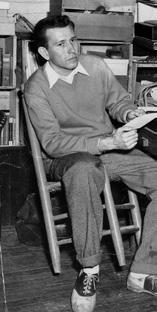
29 N C L R ONLINE Flashbacks:
of Past Issues
Echoes
ROSS WHITE is the Director of Creative Writing at UNC Chapel Hill and of Bull City Press. His book Charm Offensive (Unicorn Press, 2022) won the 2019 Sexton Prize. He also has three chapbooks with Unicorn Press: How We Came Upon the Colony (2014), The Polite Society (2017), and Valley of Want (2022).
OPPOSITE TOP The Weymouth House by Denise Baker, a copper etching with oil base ink on Rives 180 cold press paper (Each 2020 inductee received a framed copy.)
OPPOSITE BOTTOM Anthony Abbott
“ LOVING, INDEFATIGABLE, INEXPLICABLY IN SEVERAL PLACES AT ONCE, PRIVILEGING EVERYONE AHEAD OF HIMSELF, CONSUMMATE FAMILY MAN, SUPREMELY GIFTED WRITER AND TEACHER, POWERFULLY COMMITTED TO SOCIAL AND RESTORATIVE JUSTICE”
ABOVE RIGHT Max Steele
COURTESY OF THE NORTH CAROLINA WRITERS’ NETWORK
which was later reprinted as The Goblins Must Go Barefoot Debby won the Eugene F. Saxon Memorial Award and the Mayflower Cup for best book by a North Carolinian in 1950. He returned to North Carolina in 1956 to begin teaching at UNC Chapel Hill, where he had earned his BA in 1946.
He followed Debby with two collections of stories in the next few decades: Where She Brushed Her Hair and Other Short Stories and The Hat of My Mother: Stories , as well as the illustrated story The Cat and the Coffee Drinkers . Max’s peers have theorized that he published only a handful of books because he was relentless in the pursuit of perfection with those stories, editing them for years on end – but when they appeared, they garnered no end of praise. The New York Times lauded the marvelous juxtapositions and sudden turns that made his stories so distinctive; Kirkus called him “extraordinary” and said his stories know “just where to tread between humor and despair.”
As an editor, Max reveled in the ability of cleanedged prose to reveal the jagged edges of the human heart. He delighted in working with stories by Phillip Roth and Peter Matthiesen in the early days of Paris Review, whose founding Max was present for; he also later edited fiction for the renowned journal Story, where he fondly recalled his “last major line-editing coup” on a story by Joyce Carol Oates.
Without Max, the careers of a host of North Carolina writers – Laurence Naumoff, Randall Kenan, Jill McCorkle, and Melanie Sumner, to name a few – would have looked dramatically different, and might never have happened at all. In 1967, he became the director of the Creative Writing Program at UNC, and under his leadership, he built it into one of the most prestigious undergraduate writing programs in the country. His students lived in a state of both adoration and fear, as Max’s criticisms could be withering. He joked that he had an antique guillotine in his office with a rusty blade, in case he needed to lop off the ambitions of a student whose sentences were already lifeless. But the fact was that he could hardly bear the wait for his talented students to become seasoned and mature writers, and when they did, he reveled in their successes. To this day, his influence over creative writing instruction in this state remains sweeping.
Max once said, “Art is the ability to suggest without underlining.” He retired in 1988 and passed away on August 1, 2005, but his work and the work of the myriad writers he influenced goes on suggesting the broad range of human potentiality.
Carole Boston Weatherford Shines Her Light induction remarks by Judy Allen Dodson
I’m very proud and honored that Carole Boston Weatherford asked me to say a few words about her at this ceremony. I have admired Ms. Weatherford for a long time. She has inspired me to become a children’s book writer and I thank her for that. I admire her not just as a writer but for her character. I place Ms. Weatherford with the likes of other famous North Carolina writers such as George Moses Horton, John Hope Franklin, and Harriet Jacobs.
Carole Boston Weatherford was born and raised in Baltimore, MD, and began writing in first grade by dictating poems to her mother. Her father taught printing at a local high school and published his daughter’s early works. Ms. Weatherford had a career in marketing and public relations before earning a master’s degree in creative writing. She initially wanted to write poetry for adults, but by the time she graduated decided to write historical fiction and poetry for children. Her first children’s book, Juneteenth Jamboree, was published in 1995, and to date, Weatherford has authored over sixty children’s books (with no plans on stopping any time soon) and has found her niche, as she says, “min[ing] the past for family stories, fading traditions, and forgotten struggles.”

Weatherford’s books have received, among many other honors, three Caldecott Honors, two NAACP Image Awards, a Society of Children’s Book Writers & Illustrators Golden Kite Award, and the coveted 2022 Coretta Scott King Author Award for her most recent book, Unspeakable: The Tulsa Race Massacre, illustrated by the late Floyd Cooper, who also won for best illustrator. A teacher at Fayetteville State University for more than thirty years, Weatherford has also received the Ragan-Rubin Award from the North Carolina English Teachers Association. And in 2010, she received the North Carolina Award for Literature.
This is an open letter to Ms. Weatherford to say thank you for her contributions to the literary field, nationally, regionally, locally, but more specifically from our hearts. Thank you for sharing your gift with
30 NORTH CAROLINA LITERARY REVIEW Winter 2023
JUDY ALLEN DODSON is an archivist, children’s book author, and librarian. A member of the Society of Children’s Book Writers and Illustrators, she received their On-The-Verge Emerging Voices Award for her manuscript “Fast Friends.” She earned a BA in Communications from Western Michigan University and an MLS from NC Central University.
“MAX’S PEERS HAVE THEORIZED THAT HE PUBLISHED ONLY A HANDFUL OF BOOKS BECAUSE HE WAS RELENTLESS IN THE PURSUIT OF PERFECTION WITH THOSE STORIES, EDITING THEM FOR YEARS ON END.”
COURTESY OF THE NORTH CAROLINA WRITERS’ NETWORK
the youngest readers and using your family – your daughter, son, and your granddaughter – as your muse to create your well-crafted, creative, colorful, and historical books. Society thanks you, Ms. Weatherford, for shining a light on the “forgotten struggles and the fading traditions of the Black community by telling these stories about historical figures: Moses: When Harriet Tubman Led Her People to Freedom; Be a King: Dr. Martin Luther King Jr.’s Dream and You, Schomburg: The Man Who Built a Library, and The Faith of Elijah Cummings: The North Star of Equal Justice.
North Carolina thanks you for your love of our history and enlightening us with stories like Freedom on the Menu: The Greensboro Sit-ins, Racing Against the Odds: The Story of Wendell Scott, Stock Car
“WEATHERFORD HAS AUTHORED OVER SIXTY CHILDREN’S BOOKS (WITH NO PLANS ON STOPPING ANY TIME SOON) AND HAS FOUND HER NICHE, AS SHE SAYS, ‘MIN[ING] THE PAST FOR FAMILY STORIES, FADING TRADITIONS, AND FORGOTTEN STRUGGLES.’”
Racing’s African American Champion , and Sink or Swim: African-American Lifesavers of the Outer Banks. A lover of music, too, more specifically jazz, her favorite singer is Billy Holiday – hence the Becoming Billie Holiday, The Sound that Jazz Makes, Before John Was a Jazz Giant , about John Coltraine, and Respect: Aretha Franklin, the Queen of Soul.
Not that Ms. Weatherford is done writing – when I say she’s passing the torch, I mean that she has planted the writing seed in many new and up and coming writers in North Carolina, like myself, but also very close to home: she has worked with her son, illustrator Jeffery Weatherford, on books like Call Me Miss Hamilton: One Woman’s Case for Equality and Respect, You Can Fly: The Tuskegee Airmen, and Princeville: The 500 Year Flood.
It is certainly fitting that we induct her into the North Carolina Literary Hall of Fame, after a writing career of nearly thirty years. Again, we say thank you, Ms. Weatherford, for your continued excellence.
The Charles Frazier Most Folks Don’t Know induction remarks by Annie Frazier Crandell
You only need to pick up a book or two of my dad’s to see how deeply connected he is to his home state. Aside from a few brief stints elsewhere, he’s lived right here in North Carolina the overwhelming majority of his life – born in Asheville, raised in Andrews and Franklin, studied in Chapel Hill and later at Appalachian State. Right now, he and my mom live just a stone’s throw from where he was born in Biltmore Village, in a tiny hospital that’s now a boutique hotel.
Today, I’d like to share a little about the Charles Frazier most folks don’t know as well as I do. When I was little, my dad worked hard to foster in me a connection to this place, whether we were at home in Raleigh, visiting family out in Franklin, or camping up at Cataloochee.
When I was first learning to write, around first grade, my dad encouraged me to keep a journal of daily nature observations – weather descriptions, sketches of bugs and leaves. I had a little Hello Kitty notebook for that purpose. Soon, he taught me about haiku, and I began to scrawl fervent little poems about trees and flowers in my notebook. One summer, our big project was to trace the tiny trickle of a stream behind our house as it connected with larger creeks and rivers and finally emptied right into Pamlico Sound. In teaching me to observe the nuances of North Carolina landscape, weather, and seasons, he was sharing with me the kind of reverence for the place that so many writers around here possess.
He taught me too about our family’s roots, especially out in Haywood and Macon and Cherokee counties. The school in Andrews where he grew up and where my grandfather served as superintendent. The paper mill in Canton. The old family farmhouse at the base of Cold Mountain, its grey-boarded springhouse a marvel to me. And Inman’s Chapel, where you can still see portraits of our ancestors with their long beards and piercing blue eyes.
My dad’s deep connection to both the landscape and the history of North Carolina, which he has poured into his work, is an inspiration to so many, and I’m deeply moved to see him honored for his literary contributions to the state today.
This past June marked twenty-five years since Cold Mountain was first published. A whirlwind time, those

31 N C L R ONLINE
Flashbacks: Echoes of Past Issues
ANNIE FRAZIER CRANDELL is an editor, writer, and teacher. Her work has been published in NCLR, Paper Darts, Appalachian Review, and elsewhere. She recieved her MFA in Creative Writing from Spalding University and currently teaches fiction for the Great Smokies Writing Program at UNC Ashville.
OPPOSITE Carole Boston Weatherford
PHOTOGRAPH BY JACK GRUBER; COURTESY OF THE NORTH CAROLINA WRITERS’ NETWORK
ABOVE Charles Frazier
first few years. A deeply literary book, Cold Mountain did seemingly impossible things. It won the National Book Award, the ABBY Award, the Heartland Award, the Sir Walter Raleigh Award, and the Sue Kaufman Prize for First Fiction, among others. It also held the top spot on the New York Times Bestseller List for sixty-one weeks.
In 2003, Anthony Minghella’s film adaptation of Cold Mountain received seven Academy Award nominations and one win – for Renee Zellweger’s incredible portrayal of Ruby Thewes. In 2015, Pulitzer Prize-winning composer Jennifer Higdon tried her hand at opera for the first time with a stunning adaptation of Cold Mountain, which debuted at Santa Fe Opera.
His next three books – Thirteen Moons, Nightwoods , and Varina – were all New York Times Bestsellers. Thirteen Moons won the SIBA Book Award and the Pat Conroy Southern Book Prize, and Varina won the Thomas Wolfe Memorial Literary Award. In 2008, he received the North Carolina Award for Literature – an incredible honor.

But before all that, Charles Frazier was a guy who taught English classes at NC State and waited in the carpool line and then came home to sit in a little onewindow room for a few hours a day in front of a DOS computer, writing a novel based on a sliver of a family story, always working in service of language and history and the narrative of an arduous journey home to the North Carolina mountains. For nearly a decade, hardly anyone knew he was writing a book, but he pressed on, writing when he could.
None of that has changed. From those early days all the way up to this past week, which he spent combing meticulously through page proofs of his fifth novel, he has remained dedicated to the craft. It’s one of the things I admire most about Charles Frazier the Author: every time he sits down to work on something new, his focus is on the language, the history, and the sweep of story. The art of it all.
Bland Simpson’s Lifetime Pursuit Induction remarks by Ann Cary
Simpson
Bland Simpson was raised in a small Elizabeth City neighborhood edging the dark waters of Gaithers Lagoon. And it was here that Bland had his first boating adventure. As a precocious eight-year-old, he and a pal happened upon an old washtub near the edge of a shallow ditch draining into the lagoon. To paraphrase one of my favorite shows, King Mackerel and the Blues are Running, they were pretty sure they could make a boat out of this piece of trash. So, they set about hauling and pushing the tub into the water of the ditch. Then, to the best of their ability, they clambered down the ditch bank and jumped into their new boat –which of course promptly capsized, throwing both of them into the muddy water of the fortunately narrow ditch. And so ended Bland Simpson’s first boating adventure. Even so, two sloshed and soaked boys were having the time of their lives. I don’t know about the other boy, but this is still Bland’s M.O. Happily for all of us, there was much more coastal boating to come.
This early adventure also foreshadowed another defining trait, one that our friend Jim Clark, in introducing us recently at a speaking engagement, pointed out and that stuck with me. Bland Simpson, from day one, has been an enthusiastic and talented collaborator – in writing; . . . in music, theater, film, television; in his teaching; and in our family life. On one of the very early days of our courtship, we were strolling along the Pea Island beach in Dare County, when he suddenly asked, “What are you looking for in a partner.” My answer: “a collaborator.” Why that, I don’t know, but there it was. In front of the perfect person at the perfect time.
ANN CARY SIMPSON is an associate with moss+ross, a Durham firm providing development consulting services. She has previously worked with several nonprofits including Compass Center for Women and Families, the Conservation Trust for NC, the NC Museum of Art, and the UNC Institute for the Enviroment. She is a graduate of the UNC Chapel Hill School of Journalism and Mass Communication. She has contributed original photography to four UNC Press books by her husband, Bland Simpson, including Into the Sound Country (1997) and The Inner Islands (2006), Little Rivers and Waterway Tales (2015), and North Carolina: Land of Water, Land and Sky (2021).
It was in college that he found his musical niche among like-minded friends and later to forming the popular bands Gravyboat and Southern States Fidelity Choir. He went to New York City to seek his fortune as an independent songwriter, but actually found his calling onstage, collaborating again with longtime friends to create the highly successful production Diamond Studs, which launched a new and still thriving genre called musician’s theater. He went on to collaborate on seven more musical plays, exploring pirate life, the Mississippi River, the birth of UNC, coming of age in the South, and the sweet, durable friendship of climate-aware fishing buddies. Out of musician’s theater also came a lifelong association with the Red Clay Ramblers,
32 NORTH CAROLINA LITERARY REVIEW Winter 2023
“IN TEACHING ME TO OBSERVE THE NUANCES OF NORTH CAROLINA LANDSCAPE, WEATHER, AND SEASONS, HE WAS SHARING WITH ME THE KIND OF REVERENCE FOR THE PLACE THAT SO MANY WRITERS AROUND HERE POSSESS.”
ABOVE Bland Simpson
COURTESY OF THE NORTH CAROLINA WRITERS’ NETWORK
the acclaimed Tony Award-winning North Carolina string band that’s now celebrating its fiftieth year. With the Ramblers, Bland also added international travel and movie and Broadway credits to his resume. His literary and academic pursuits are equally collaborative. Bland has absorbed the history and landscape of his beloved North Carolina like a sponge. Whether his writing covers history, the environment, memoir, fiction, nonfiction, or some combination, his prose, like his brain, is wide-ranging, fascinating and always offers a thoughtful new take on our Old North State.
“ WHETHER HIS WRITING COVERS HISTORY, THE ENVIRONMENT, MEMOIR, FICTION, NONFICTION, OR SOME COMBINATION, HIS PROSE, LIKE HIS BRAIN, IS WIDERANGING, FASCINATING AND ALWAYS OFFERS A THOUGHTFUL NEW TAKE ON OUR OLD NORTH STATE.”
Land of Water, Land of Sky is the fourth book he and I have done together with UNC Press since 1997, and it is his tenth volume since his first novel, Heart of the Country, was published in 1983. Other book collaborators have included our talented photographer friends Scott Taylor and Tom Earnhardt and our children. Our youngest daughter, who was born during the creation of Into the Sound Country, frequently awoke from naps to find herself tucked in the bottom of a jonboat looking up at cypress, tupelo, and big blue sky.
In the early 1980s, Bland augmented his music and literary pursuits with a career as a teacher of creative writing at the University of North Carolina at Chapel Hill – thanks to the foresight of fellow inductee Max Steele, who provided that teaching opportunity. Bland is now Kenan Distinguished Professor of English and Creative Writing. During this teaching tenure he has created new courses – lyric writing, songwriting, playwriting, musical theater – in addition to fiction and nonfiction, while developing a reputation as a patient, respectful, and attentive mentor. His newest collaboration with Professor Brent McKee, “The Changing Coasts of Carolina,” is a STEAM course that combines coastal environmental science with handson observation through field trips, and personal essays. An evaluation from a recent student began, “I loved this course!”
Bland’s awards are many, and he is highly honored to be included now in the North Carolina Literary Hall of Fame. I think he would also feel that among his highest honors are the fact that he is loved by his friends and family, appreciated by his readers, and that all of his works, taken together, constitute a deep, strong and resilient current of love for his home state, North Carolina.
As the NCLR editor pulls all these remarks together for this story just a couple of months after the 2020 induction ceremony, Moore County, where the North Carolina Literary Hall of Fame is located, is particularly cold and dark. Someone shot out two power substations, apparently to stop a drag show. So no one is reading by lamplight in Southern Pines this evening, and some people might be having trouble breathing, if they’re on a ventilator, or staying warm this cold December week. Such a violent reaction to fear of something the shooter simply doesn’t understand increases the poignancy of recalling the induction ceremony’s celebration of writers whose art opens the mind and heart.
Ed Southern, Director of the North Carolina Writers’ Network, closed the belated induction ceremony with a somber but perceptive reminder of the audience’s shared enjoyment of and belief in the value of reading to undermine the kind of ignorant animosity that left Moore County in the dark and cold this week:
As divided as we are now, you’d think we all, at least, could agree that everyone ought to read more books, more and deeper stories, whether on the page, the screen, the audio, or whatever other form they’re available in. But we can’t. We’re too fractured even for that.
Some lack the patience for it, some the empathy. Some hate and fear what they find there: hearing someone else’s voice inside your own head, someone with a voice and body, life and faith and desire, much different than your own; someone who, despite their differences, is still just as fully, as recognizably, as worthily human as you are. For those of us who love to read, it’s easy and comforting to say they don’t know what they’re missing. The truth is, though, some of them do.
Southern concluded by reminding the audience of the day’s uplifting festivities:
We should take none of this for granted, nothing about this day, this place, or these people. We should keep reading, and we should keep writing, and we should keep doing them loudly, and proudly, and with as much mind and heart and guts as we can muster. And while we do it, we should – must – keep celebrating. n
“WE SHOULD KEEP READING, AND WE SHOULD KEEP WRITING, AND WE SHOULD KEEP DOING THEM LOUDLY, AND PROUDLY, AND WITH AS MUCH MIND AND HEART AND GUTS AS WE CAN MUSTER.”
33 N C L R ONLINE Flashbacks:
of Past Issues
Echoes
A TRIUMPH FROM DOODLE HILL
a review by Rebecca Godwin
Collected Poems of Marty Silverthorne is the tenth compilation of poetry from a man whose writing supported his own healing as it showed the world a quadriplegic person’s capabilities. Published two years after the poet’s death at age sixtytwo, this volume showcases poems selected from chapbooks as well as uncollected poems composed in grief after his wife’s death in 2018. Writing himself as well as his family into poems, Silverthorne describes a rural eastern North Carolina culture that former state poet laureate Shelby Stephenson taught him to claim. In a candid voice, these poems counter poverty, hard drinking, suffering and loss with the redemptive powers of memory and love.
Granddaddy wasn’t drunk,” yet this woman marries and divorces three men, “each one a drunk just like her daddy.” Section V of “Testimonial of Jars” features
Tight-jawed men . . . careless with their words, too drunk to drag themselves home to wives who kept supper warm on a Wilson wood stove.
In considering the hard lives made harder by liquor’s draw, the speaker especially honors the women who held families together, including Grandma in “Second Serving,” a woman who “cooked in the face of fear / serving supper to soothe sorrow / or warm up celebration” as part of her “recipe for forgiveness,” nourishing not just bodies but souls.
REBECCA GODWIN recently retired as the Elizabeth H. Jordan Chair of Southern Literature at Barton College. She has published essays on Lee Smith, Fred Chappell, and Thomas Wolfe among other writers in journals such as Mississippi Quarterly , Pembroke Magazine , and Southern Quarterly and a monograph, Community Across Time: Robert Morgan’s Words for Home (West Virginia University Press, 2023). Read her interviews with Morgan in NCLR 2014 and NCLR Online 2017
MARTY SILVERTHORNE (1957–2019) received a graduate degree from East Carolina University in 1988 and an undergraduate degree from St. Andrews. His awards include the Bunn-McClelland Chapbook Award, the Sam Ragan Fine Arts Award, the Persephone Press Award, a James Applewhite Poetry Prize Honorable Mention in 2014 and 2015, and the North Carolina Poetry Society Poet Laureate Award in 2015, as well as regional art grants from the North Carolina Arts Council.
Silverthorne’s evocations of the agricultural landscape he knew as a child mark a starting point for his and the reader’s reflections on the effects of place and human decisions. Tenant shacks, mules, tobacco, washhouses, clothes lines, outhouses, and hog pens dot the Doodle Bug Hill, or Doodle Hill, community where he grew up near Williamston in Martin County. In this country setting where motorcycles and alcohol provide a sense of control to men on the lower end of the economic scale, Silverthorne’s male family members drink too much, a reality the poet describes with a hint of sadness. In “Janie Christmas” we learn that Aunt Janie’s “favorite Christmas was the one when /
Silverthorne includes many positives in these poems of memory, music foremost among them. Early radio and television country music stars found their way into family names, signifying the influence of the airwaves on Americans in the 1950s and beyond. “How We Got Our Names” ties his family tree to country stars: Marty Robbins, Loretta Lynn, Gene Autry, Hank Williams, Patsy Cline, Kitty Wells, Lester Flatt, and Earl Scruggs, to name a few.* Fond memories of his daddy “yodel[ing] blue collar blues” to friends’ fiddle and banjo playing in “Shagnasty” join a steel guitar calling his parents from the grave, at least in Silverthorne’s imagination, in “Gettin’ the Holy Ghost at R.A. Fountain.” Beginning with one of my
34 NORTH CAROLINA LITERARY REVIEW Winter 2023
Malaika King Albrecht and Marsha White Warren, Editors. Collected Poems of Marty Silverthorne. St. Andrews University Press, 2021.
* “How We Got Our Names” first appeared in NCLR Online 2015. The poet was a semi-regular finalist in NCLR’s James Applewhite Poetry Prize, and several of his poems were published in NCLR
favorite Silverthorne lines, “Daddy’s dead but not tonight,” the latter poem captures music’s power. Hearing music at the R.A. Fountain General Store triggers Silverthorne’s memories of his parents’ love of country and gospel music, connecting him to his parents’ bond in the imagined scene where Daddy dances and Mama testifies. Tellingly, the speaker observing this gaiety interjects, “If Mama’s heart had windows, / you’d see a house of broken panes.” Happy times seem tempered by a poignant knowledge of the whole of life, where suffering is not erased but sometimes alleviated, by love or by the beauty of art.
Arranging words to make poetry helped Silverthorne to make order of the chaos resulting from his youthful decision to drive a motorcycle while “[s]toned on star-white phenobarbs,” as he says in “Hungover Sun.” Crafting lines about family, he acknowledges the pain he caused. And by putting his physical limitations on the page, he lessens their power and gains intellectual control. The last stanza of “Walking Toward Jesus” illustrates this conversion:
Jesus, my feet ain’t fit to serve you; thirty years paralyzed, numb as a stone, feet scarred by the surgical saw, two toes gone home to meet you, eight drawn into questions.
The fine imagery and rhythm here illustrate Silverthorne’s well-honed craft, and the important last word makes readers stop to ponder the “questions” the poet must have. He draws readers into his physical confinement as well as into his intellectual and emotional space, leaving us to wonder why suffering seems necessary in this world and whether the poet is journeying in his faith or saying he is not fit to do so.

The question of faith, in fact, echoes throughout the collection. In “Pure Baptist,” Granddaddy deems preachers who show up to eat when death or tragedy strikes to be “vermin,” a judgment the poem does not condemn. In another poem, when witnessing Cousin Phil Pea’s baptism in the Roanoke River, the poet wonders if Phil thinks of Granddaddy’s seining herring to feed the family or sees “the sunken pickup with three black boys / lashed together with anchor rope, / eyes huge hollow sockets, mouths sealed with duct tape” when he bobs up from his dunking. The people and horrors of this world concern the poet. In “Graveside Silence,” the poet notes at his brother’s funeral that the preacher who “flaunts his [brother’s] sins like a bedsheet flapping / on the clothesline” does not mention, when he “brags / on how he has saved the whole family,” that Silverthorne “failed to raise [his] hand to summon him and the Lord.” The beautiful poem “Barrel of Prayer,” whose line “Grandmother, if I could bend / myself into your beliefs” encapsulates the dichotomy of their spiritual views, connects to poems clarifying that Silverthorne sees divinity in human love and the natural world more than in his grandmother’s traditional God. “Rainbow Ink” paints evidence:
God took blackboard chalk and colored some clouds, high above the Pamlico River then licked his long index finger, etched MS + SB 4-ever,
a reference to his beloved wife Sylvia Bullock, who taught him to call plants by their names. Poems honoring his caregivers, such as “Bed Rest Blues,” a lovely villanelle without the form’s strict rhyme scheme, and “Black Angel” also highlight
35 N C L R ONLINE Flashbacks: Echoes of Past Issues
ABOVE Past and present North Carolina Poets Laureate Shelby Stephenson and Jaki Shelton Green reading Marty Silverthorne’s poetry at R.A. Fountain, Fountain, NC, 21 May 2022
PHOTOGRAPH BY DAVID WARREN
his sense that the care and humanity people extend represent the truly divine.
The last section, titled “The Widower’s Tongue,” brings these themes together in twenty-one poems speaking directly and painfully of the deep grief that consumes Silverthorne after Sylvia’s death. “Maybe the lightning bug is you,” he says to her, “come back to be with me.” The
blue-gray herons, “winged gods of prayer / and meditation,” look for “the goodness that comes up / from the Earth’s soul.” Cardinals, hummingbirds, Shackleford Bank wild horses, crying crepe myrtles, and especially the butterfly that is Sylvia waiting for Silverthorne to join her in their eternal butterfly dance turn the aching forlornness, the “grief settle[d] in the bones” that Sil-
verthorne so powerfully portrays, into a resurrection.
Following the Sylvia poems, “Hwy 125 North of Doodle Hill & Hwy 33 East of Chocowinity,” reprinted from his 2015 collection Holy Ghosts of Whiskey, shares Silverthorne’s directions to his survivors: “Bury me here / at the end of the stubbled rows / beyond the golden soybeans / and fields blanketed with cot-
Early in November, 2022, sad news began to spread within North Carolina’s literary community. As described by a post from the North Carolina Writers’ Network,
The news of Philip Gerard’s death was the kind of shock that tempts you to think it can’t possibly be true. His vitality was of a kind that seemed irreducible and essential. Philip was indeed essential to North Carolina’s literary community, playing so many fundamental roles for so long that it became hard to remember he hadn’t always been here.

The Network’s posting reminded us that this North Carolina literary icon was “[b]orn and educated in Delaware.” He “came to the University of North Carolina at Wilmington and founded the MFA in Creative Writing program there. His novel Cape Fear Rising was one of the first attempts to reveal the truth of the 1898 Wilmington coup, for which he faced considerable backlash in his adopted state and city.”1
“Write what you really want to find out about,” is one of innumerable writing tips often shared by the much-mourned professor.2 He certainly followed that advice when he began writing Cape Fear Rising , inspired by learning that the North Carolina town he had just moved to was the site of the only successful coup d’etat in US history. As he said on the occasion of receiving the North Carolina Award for Literature, “I believe in the writer as a witness to evil, as a reporter of injustice, as a chronicler of human compassion . . . as one whose skills
illuminate the Truth with a capital T.”3 Illuminating that dark chapter of his new hometown did not make him popular there, but he would not be intimidated by those who would have liked to silence him, maybe even get him out of Wilmington, and he continued to write toward democratic ideals. Read his op-ed essay on removing Confederate monuments from government property as just one fine example.4
36 NORTH CAROLINA LITERARY REVIEW Winter 2023
“WE’VE
1 ”Philip Gerard, Teacher & Friend,” NC Writers’ Network Blog 8 Nov. 2022: web 2 Qtd. from Jill Gerard, “In Memoriam: Revered Author, UNCW Professor Philip Gerard to Be Celebrated This Month,” Port City Daily 3 Dec. 2022: web 3 “Acceptance Remarks by Philip Gerard,” NCLR Online 2020: 85 4 Philip Gerard, “Some Confederate Statues Should Be Taken Down,” StarNews Online 23 June 2020: web COURTESY OF NORTH CAROLINA DEPARTMENT OF NATURAL AND CULTURAL RESOURCES
ALL LOST A CHAMPION”: PHILIP GERARD (1955–2022)
ton,” the poem begins. And after eight more stanzas extolling the specific crops and plants growing in the Down East “obsidian soil,” the last stanza announces his hope for an afterlife: “Let me live in the leaning / frame of the log barn. / Do not carry me to the well-groomed graveyard. / Bring me here, where fire scalds the earth.”
Silverthorne lives in the poems that bring eastern North Carolina and the people that he loved to the world. Going beyond his own personal story that he conveys so poignantly, he delves into memory to portray the everyday lives of working-class folks, such as the many ways they used Mason and Kerr jars – and also the racism they condoned, as in
For the reader new to these pages, perhaps new to North Carolina, we share here an introduction to this prolific writer and pillar of the North Carolina community, given by Mark Cox, Chair of the Creative Writing Department at UNC Wilmington, at a reading a few weeks before his colleague’s untimely death:
As author, Philip published sixteen books of fiction and creative nonfiction, two of which are seminal textbooks used in universities across the nation. He published more than two hundred stories and essays in distinguished venues, amassing a highly respected body of work that only a very driven and committed writer could manage. But it is never just about the numbers. Philip’s work always took on ambitious topics – war, politics, racial injustice, history – contributing substantially to our literature both nationally and in North Carolina. Indeed, in 2019, he was honored with the North Carolina Award for Literature, which is the highest civilian honor conferred by the state. But what may be most amazing is that he accomplished all this while serving dutifully as teacher, mentor, and administrator here at UNCW for thirty-three years.
Philip arrived at UNCW in 1989 and quickly turned a fledgling professional and creative writing curriculum into a well-organized, well administered and very popular concentration within the English major. As the track grew and other creative writing faculty were hired, he subsequently was the chief force behind the planning, establishment, and coordination of our MFA program in 1996. In 1999, he was instrumental in the establishment of creative
“A Lesson in Color,” a poem nodding to his dear friend and current North Carolina Poet Laureate Jaki Shelton Green, whose tribute to Silverthorne is included in this book. Editors Malaika King Albrecht and Marsha White Warren deserve our thanks for reminding us of this intelligent and compassionate man’s crucial contributions to the world of poetry. n
writing as an independent department and in the 2000s served for seven years as department chair. It is no exaggeration to say that Philip was at the core of creative writing’s evolution here from the very beginning and he continued to serve as a voice for progress in the present. His institutional memory was invaluable. His professional instincts were impeccable. And his understanding of academic politics and policy was vast. In truth, no one has contributed more to our department than he did, and we would not be here if not for his efforts.5
It is nice to know that Philip heard his colleague’s expression of appreciation for all he did for their program. On November 8, David Gessner posted on Facebook, “How strange it will be to head into work today, to the department that he built and sustained, and find that Philip Gerard is gone.”
Philip Gerard’s passing is mourned by his beloved wife, Jill Gerard, and their family; his colleagues and students at UNCW; and numerous colleagues and former students across the state and beyond.
“We’ve all lost a champion,” wrote his UNCW colleague and friend Nina DeGramont. And Gessner called his late colleague “a steady friend who always had my back, a great and inspiring teacher, a generous supporter of our young faculty members, a prolific writer who, as a student just emailed me, ‘literally wrote the book on creative nonfiction.’”6
We encourage you to express your appreciation for this beloved professor with a contribution to the Philip Gerard Graduate Fellowship fund at UNCW. n
37 N C L R ONLINE Flashbacks: Echoes of Past Issues
5 David Gessner shared Cox’s introduction via Facebook 11 Nov. 2022, and it was then incorporated into Gerard’s obituary
6 Nina DeGramont, David Gessner, Facebook 8 Nov. 2022: web.
A Very Dark Ride: Three Ways of Looking at the Short Fiction of John Kessel
a review essay by Dale Bailey
It’s not customary to begin a review with a confession. Nonetheless:
In reviewing The Dark Ride: The Best Short Fiction of John Kessel,* I have sinned against the general rule (and personal principle) that one should not review books by people one knows, much less people one knows well enough to shoot an occasional text. But I have occasionally texted John Kessel, and while I would not put him in that inner circle of close friends with whom one shares confessions of a more personal variety, I do call him a friend and believe that he would call me one, as well.
Yet I undertook this review all the same. Why not?
The quality of the work was a foregone conclusion. I began reading John’s fiction – especially his short stories – two decades before I met him, so I knew in advance that in gathering his best short fiction, The Dark Ride would assemble in a single volume some of the finest speculative short fiction written in the last few decades. Re-visiting these stories affirmed that conviction – and vastly enlarged it. When I read Kessel’s stories in aggregate, it became clear to me that far more than a simple review was in order. Here’s why:
The stories in The Dark Ride are not merely among the finest speculative stories of the last few decades. They are among the era’s finest short stories of any kind. Period. That’s a grand claim, and
* John Kessel, The Dark Ride: The Best Short Fiction of John Kessel (Subterranean Press, 2022); quotations from this collection will be cited parenthetically.

I don’t pretend that it’s based on a comprehensive survey. But I’ve read a lot of stories in the last forty years, and I can say with confidence that many of Kessel’s stories stand shoulder to shoulder with the best of them. His work warrants sustained attention, and not alone because of its uniform excellence.
A closer look at the way his stories complicate, challenge, and embrace science fiction has much to say about how our assumptions shape the way we read, misread, and too often fail to read some of our finest writers – which is why the paragraphs that follow comprise not just one, but three reviews of this long-deserved career retrospective. Let’s dispense with the easy one first.
DALE BAILEY ’s third short story collection, This Island Earth: 8 Features from the Drive-In, is forthcoming from PS Publishing. He is the author of eight previous books, including In the Night Wood (Harper, 2018; reviewed in NCLR Online 2019) His fiction has been adapted for Showtime Television, has won the Shirley Jackson Award and the International Horror Guild Award, and has been a finalist for the World Fantasy, Nebula, Locus, and Bram Stoker Awards.
38 NORTH CAROLINA LITERARY REVIEW Winter 2023
Review # 1 (An Exhortation)
See the aforementioned claims about the quality of the stories in The Dark Ride, fork over the cover price, and start reading. Seriously.
Review # 2 (An Anecdote)
I first encountered the fiction of John Kessel when I read his novella “Another Orphan” in The Magazine of Fantasy & Science Fiction all the way back in 1982. The story took the top of my head off (not gently) and gave the contents inside a thorough stirring. They needed it.
Flash forward twenty years or so to the first time I met Kessel in any meaningful way. I’d been introduced to him once or twice, but I’d never really had a conversation with him. Now that I had the opportunity, I was determined to clear some things up. See, I’d read “Another Orphan” two or three additional times over the years; each time the story did exactly the same thing to me: it took the top of my head off and gave the contents inside a thorough stirring. I wasn’t sure why the story always had that effect, but I was pretty sure it had something to do with the fact that I couldn’t fully, or even fractionally, parse the damn thing’s meaning.
I was then under the lamentable influence of an idea that too many English teachers of indifferent quality had knuckle-pounded into me: that stories were mostly about “theme,” and that they could (and should) be decoded like the “secret” messages that used to appear on the backs of cereal boxes of the tooth-rotting variety. All you had to do was lay hands on a secret decoder ring. I didn’t have such a ring handy, but I did have the author, and I was determined to sort this business about “Another Orphan” out.
So I said, “John” (let’s dispense with the pretense that I address John Kessel as Kessel) “I’ve been reading ‘Another Orphan’ since I was a kid, and I was wondering if you’d mind telling me what the story means.”
John said, “I wrote that story a long time ago.”
And that’s all he said.
What I learned that day was that Kessel would not explain his stories. And as you read The Dark Ride, you’ll discover that Kessel’s stories do not often explain themselves either. They are elegant models of mystery and ambiguity, freighted with a significance that can’t be reduced to “theme.” I also learned that good stories can’t be
I first encountered the fiction of John Kessel when I read his novella “Another Orphan” in The Magazine of Fantasy & Science Fiction all the way back in 1982. The story took the top of my head off (not gently) and gave the contents inside a thorough stirring. They needed it.

39 N C L R ONLINE Flashbacks: Echoes of Past Issues
JOHN KESSEL is the author of eight books, including Pride and Prometheus (Saga Press, 2018; reviewed in NCLR Online 2019) and The Moon and the Other (Saga Press, 2017; reviewed in NCLR Online 2018). His work has been adapted for ABC’s Masters of Science Fiction. He is Professor Emeritus at NC State University. Read an interview with him in NCLR 2001, which featured North Carolina science fiction and fantasy.
ABOE John Kessel All images courtesy of John Kessel
Most of these stories are indeed dark rides, but they are also wildly entertaining rides.
decoded like the messages on the back of a box of Cap’n Crunch. Good stories aren’t secret messages. They’re stories. Which brings me to –
Review # 3 (An Analysis)
Another wrongheaded idea those English teachers of indifferent quality infected me with was that writers must be pigeonholed. Surely no one but Linnaeus values taxonomy more than the average literary critic (and even then, it’s a close thing). Too many of us have learned to shove every writer we read into one box or another, even if it requires dismembering them a little. We have also been taught that some boxes are more important than others – and that some boxes are altogether beneath the notice of any right-thinking person. Merely opening such a box is likely to infect the room with a faint miasma.
One such box is science fiction, and science fiction is the box Kessel has been shoved into. There are lots of reasons for this. If anyone was ever built to write science fiction, it is surely Kessel, who holds undergraduate degrees in Physics and English, as well as an MA and a PhD in English; who taught for many years in the MFA program at NC State, which he also directed; and who published more than half of these stories in Asimov’s Science Fiction and The Magazine of Fantasy & Science Fiction.
Ergo: John Kessel is a science fiction writer. Which, okay, he is, nor would he deny it. Except –

Except even the most cursory reading of The Dark Ride will show that many of Kessel’s stories require considerably more than minor surgery if we are going to cram them into the little box called science fiction. Not that the book doesn’t include conventional science fiction stories.
“Clean,” for instance, examines the emotional and philosophical implications of using memory wipes
to treat Alzheimer’s disease. It’s a classic science fiction gambit: literalize the metaphor. The metaphor here is apt – if Alzheimer’s isn’t a memory wipe, what is it? – and the story pays it off with an emotional gut-punch. But it also complicates the dire truth that this person you most love – your mother, your father; your friend, spouse, and lover – is going to forget you utterly. What does it mean to lose someone when they are still very much here? What does it mean to lose yourself? What does it even mean to be “yourself”? The story is a quintessential example of what a great writer can do with the tools in science fiction’s toolbox. But it runs counter to Kessel’s primary mode, for while he often employs science fiction conceits, he rarely plays them straight. Instead, he dives into them
40 NORTH CAROLINA LITERARY REVIEW Winter 2023
with a gonzo enthusiasm that is infectious. Most of these stories are indeed dark rides, but they are also wildly entertaining rides.

For example, “Not Responsible! Park and Lock It!” envisions a future in which families spend their entire lives on a Westbound highway, leaving their cars only to gas up, get repairs, and so on. We never know where this highway is, only that it is separated from an Eastbound highway by a Median seeded with land mines and defended by mechanized watchtowers armed with automatic rifles. When our protagonist, sixteen-year-old David, abandons his family to cross the Median, he meets a robot with whom he has a philosophical conversation about God and free will. By the time David is rescued by his father, the robot has gone full-on Biblical, echoing the perverse God of Job. “Where were you when He laid the asphalt of Westbound?” he asks David. “Who set up the mileage markers, and who painted the line upon it?” (30).
As extrapolation – one of the nails often said to hold the little box called “science fiction” together – this is all pretty ridiculous. Where on earth or off-earth, in the universe or the multiverse, is such a world likely to develop? The answer, of course, is nowhere except in the imagination of John Kessel. Yet the story maps the spiritual terrain of both a culture (our culture) and the human beings trapped inside it (us) with the clinical accuracy of a master satirist who is also (as most master satirists are) a deeply humane writer. Can you reduce this story to a “theme”? I don’t think you can. It’s not a story about any one thing (what great story is?). It’s a story about growing up, about family, about the often-dehumanizing nature of technology, about free will and God and the problem of evil, courage and fear and loss and longing, dreams stifled and dreams fulfilled – among other things. More important, it’s not a story that tells you what to think about any of these things. It’s a story that requires you to think about them for yourself.
In short, Kessel isn’t much interested in putting things – including short stories – into boxes. His primary interest seems to be in smashing those boxes and tossing the shards
out the window, because what little boxes do is constrain the intellect, the imagination, and the human capacity for empathy that we don’t see nearly enough of – by which I mean not even close to enough of, a proposition perhaps more clearly stated as a question: Why can’t we just get our shit together and be kind to one another? This seems to be one of the principal questions, perhaps the primary question, John Kessel asks. Dark? These stories are dark, all right – because the world is dark. But there is also light, and Kessel’s work is very much about helping us find that light.
Kessel describes how he goes about that task in the Story Notes at the end of his Selected volume, which largely (and wisely) adhere to the “I-wrote-that-story-a-long-time-ago” response to questions of meaning. But he does note that his impulse throughout his career “has been to cross the sensibilities of literary fiction with those of pulp fiction” (567) – which is to say that he finds
41 N C L R ONLINE Flashbacks: Echoes of Past Issues
ABOVE An illustration by J.K. Potter for John Kessel’s short story “Not Responsible! Park and Lock It!,” published in The Magazine of Fantasy and Science Fiction Sept. 1981
both boxes cramped. Kessel’s self-awareness is telling, the accuracy of his observation evident throughout the collection. Kessel employs science fiction’s central tropes. The Dark Ride gives us stories of alien invasion (“Invaders”), time travel (“The Miracle of Ivar Avenue” and others), far future space opera (“Events Preceding the Helvetican Renaissance”), alternate history (“Buffalo”), and moon colonization (“Stories for Men”). But he often works against those tropes in complex ways.
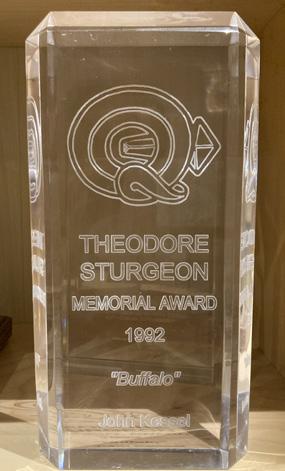
“Invaders,” for instance, weaves multiple narratives into a challenging metafiction that raises, but does not answer, questions about the dangers, rewards, and moral consequences of escapism. One narrative thread depicts in disturbingly realistic terms Pizzaro’s 1532 invasion of the Inca Empire. Another presents in comic terms a contemporary alien invasion in which the would-be invaders seek not earthly dominion, but, as the first alien to stagger out of the flying saucer says, “Cocaine.” Juxtaposed with these two storylines are the firstperson musings of “a tall, thin man wearing jeans” – a man not unlike the very tall, very thin John Kessel – who is “writing a science fiction story” (342). The “tall, thin man” is ambivalent about his craft, noting that “[s]cience fiction may . . . be considered as much an evasion of reality as any minddistorting drug” (360). He qualifies this position three or four paragraphs later: “living in a world of cruelty,” he reflects, “immersed in a culture
that grinds people into fish meal like some brutal machine . . . I find it hard to sneer at the desire to escape. Even if escape is a delusion” (361).
Significantly, the next and final scene opens a new narrative thread, set among the Incas in 1527, five years prior to Pizzaro’s invasion. Into this yetunspoiled world strides a tall, thin man wearing blue jeans, escaped, it seems, into the delusory paradise of his own fiction, where he averts Pizzaro’s brutal invasion by warning the Incas of their impending fate. The Incas, naturally, “slaughter” the invading Spaniards “to the last man, and everyone lived happily ever after” (362) – except, of course, for all the dead Spaniards, many of whom, the story makes clear from the first, are terrified foot soldiers who’d just as soon not be there at all. The irony of that final line is savage.
Kessel’s comic treatment of alien invaders as cocaine addicts is characteristic of the way he subverts core science fiction tropes. In “The Pure Product,” which calls to mind Shirley Jackson’s 1955 classic “One Ordinary Day, with Peanuts,” we encounter a time traveler (or Canadian, or both) who has arrived from the future (or Canada, or both) with no desire to save the timeline from paradox or warn humanity of the imminent ascent of the machines. He is instead an agent of random violence, Charlie Starkweather with a time machine. “Buffalo,” in which Kessel’s father meets H.G. Wells, would be alternate history in a very minor key – except that Kessel acknowledges from the beginning that it “never happened” (389). By revealing himself as the
42 NORTH CAROLINA LITERARY REVIEW Winter 2023
Kessel isn’t much interested in putting things – including short stories – into boxes. His primary interest seems to be in smashing those boxes and tossing the shards out the window.
ABOVE John Kessel’s Theodore Sturgeon Memorial Award for “Buffalo,” 1992
man behind the curtain, Kessel turns a coincidence that wasn’t into a moving meditation on the consolations and constraints of art, the gifts and curses fathers pass on to their sons, and the world of “limitation and loss” that we must all enter into (391).
Many of the stories go further. They resist science fiction’s fundamental assumption that the world can be understood, veering into the slippery territory inhabited by writers such as Karen Russell and Steven Millhauser. “The Lecturer” introduces a centuries-old academic windbag who holds forth – ceaselessly, day and night, in all weather – from atop a “truncated Greek pillar” in front of a university library (364). He is exactly as boring as the worst professor you ever had. No one seems to know who (or what) he is or how he came to be there, and Kessel never explains.
Nor does he explain the fantastic elements of the title story, a meticulously researched novella about Leon Czolgosz, who assassinated William McKinley at the 1901 Pan-American exposition in Buffalo. Leon may or may not travel to the moon on one of the exposition’s rides, “The Trip to the Moon,” in which ticketholders board an airship equipped with “twelve red canvas wings” for their journey (506). The journey itself, however – whether it is real or a product of Leon’s unraveling mind – is not as important as Leon’s adventures among the oppressed Selenites, which enable Kessel to explore the issues of economic inequity, social injustice, and political violence at work in the parallel assassination narrative. Other pieces here – most notably “The Baum Plan for Financial Independence” – work the same way. Science fiction’s postulate that reality makes sense simply isn’t germane.
In his synthesis of literary and pulp sensibilities, however, Kessel does more than critique science fiction’s core tropes and assumptions. He also takes on works long since enshrined in the canon, re-imagining them or situating his own characters within them. “Pride and Prometheus” is an ingenious conflation of Frankenstein (1818) and Pride and Prejudice (1813). “Gulliver at Home” takes on Gulliver’s Travels (1726), focusing on the economic and emotional travails of Gulliver’s
wife as she copes with her peripatetic husband’s eccentricities – and ultimate descent into madness. Both stories are so engaging that it’s easy to overlook how deftly Kessel raises questions of continuing relevance about the ways gender, class, and marriage intersect with economic and intellectual autonomy.
However, the real monster here – the white whale that I’ve been chasing – is “Another Orphan,” Kessel’s take on Melville’s 1851 masterpiece, Moby-Dick. In his tale of Fallon, a Chicago broker who wakes up one morning to find himself aboard the Pequod, Kessel once again refuses to explain the mystery: how is it that Fallon has been transported into a novel, and what can he do about it? As a fourteen-year-old, I found this elision enormously frustrating. It left me in the same existential quandary as Fallon, who compares himself to

43 N C L R ONLINE Flashbacks: Echoes of Past Issues
Kessel does more than critique science fiction’s core tropes and assumptions. He also takes on works long since enshrined in the canon, re-imagining them or situating his own characters within them.
ABOVE John Kessel’s Science Fiction and Fantasy Writers of America Nebula Award for best novelette and The Shirley Jackson Award for Best Rovelette “Pride and Prometheus,” 2008
The story doesn’t tell us how to feel and think. Absent an authorial surrogate, we must sort out the issues in play for ourselves.
the “soldier in the movie [who] always managed, despite the impediments of his amnesia . . . to find the rational answer to his mystery” (418).
Fallon is not so lucky. He soon realizes that “[a]ny logic he brought to bear on his situation crumbled under the weight of [its] absurdity” (422). The reader’s position is even more complex. Fallon believes himself to be a real man who has been transported into a fiction. The reader knows him to be a fictional character who has moved, somehow, from one fictive world into another one. Yet Kessel resists the obvious paths. The story certainly investigates the nature of stories and their significance, but it is not metafiction in the same way that “Invaders” is: Kessel never appears on stage. Nor is it an absurdist exercise in the manner of Beckett or Kafka. Finally, there is no hint that Fallon’s mind is disordered. He has simply fallen into a book, and from that premise the story proceeds with persuasive coherence and tactile detail.
Returning to the story – yet again – forty years down the road, I felt better positioned to handle these complexities. I understood that Fallon’s inability to make sense of his plight – or to escape it – was at least part of the point. And by this time, I had read Moby-Dick. The last thing I expected the story to do was take the top of my skull off and give everything inside a thorough stirring – which is exactly what it did, of course, because at some level, even now, I expect stories to adhere to a set of conventions that domesticate the fantastic. If you want to go to Narnia, you had better find a magic wardrobe. Even Mark Twain’s time-displaced Yankee has the courtesy to take a whack on the head before showing up to mismanage King Arthur’s court into apocalypse.
Kessel’s reluctance to indulge these expectations contributes to the power of “Another Orphan.” This is a story not about solving the problem of the world. It’s about figuring out how to live inside of the problem. “Put aside your fantasy,” Ahab implores Fallon, “and admit that you are alive, and thus may momentarily die” (460). This is the truth that Fallon must face. A broker in futures, he believes himself safely beyond the reach of present perils, emotional, mortal, and existential, “protected, in the final analysis, by that great indifference he held to his breast.” He claims that he’s not a hypocrite because “[h]e said nothing he did not believe in” (433). The problem is, he doesn’t seem to believe in anything. Kessel – whose central question has to do with our manifest failures of empathy, love, and compassion – isn’t about to let him get away with this. The story doesn’t let us get away with it, either. It doesn’t tell us what to believe, but it insists that we believe in something. We, like Fallon, are fallen human beings on a dark voyage into oblivion.
“Another Orphan,” like so many of Kessel’s stories, challenges us to find a light in that darkness, or to make one.
Ergo: John Kessel is clearly not a science fiction writer. Except –
Except he is a science fiction writer, of course. “Stories for Men,” the sprawling novella that anchors The Dark Ride, makes that abundantly clear. This is hard science fiction of the first order, set in a lunar colony imagined with remarkable extrapolative rigor. Its functional reality is never in doubt. I know very little (which is to say nothing) about hydroponic farming, genetic engineering, dome construction, or the dangers of solar flares. I’m convinced that Kessel does. What’s most impressive is how adroitly he manages these issues. The pace of the story never flags for exposition.
That story unfolds among the Society of Cousins, a matriarchal culture established on the moon in explicit repudiation of patriarchal systems. The Cousins value consensus over authority and community over property. Men are exempt from work, but they have little power. They live among – but not necessarily within – extended
44 NORTH CAROLINA LITERARY REVIEW Winter 2023
STEPHANIE WHITLOCK DICKEN began her work on NCLR with the 2001 issue, featuring science fiction and fantasy, so it seemed fitting to invite her to design this layout. She served as Art Director 2002–2008 and has continued since then to design for NCLR
matriarchal families, where they are prized “for their potency” and their skill as lovers. As the narrator points out, “the sex is great” (217) – except when, like the protagonist, Erno, you possess a “clumsy, earnest intensity” that precludes much interest from women (199). When Erno comes into possession of Stories for Men, an anthology of twentieth-century short stories, he finds himself drawn into the circle of a prankish advocate for men’s rights named Tyler Durden. In borrowing Durden’s name from Chuck Palahniuk’s Fight Club (1996), a cult favorite about imperiled masculinity, Kessel opens an illuminating dialogue about what it means to be a man. In both works, the charismatic Tyler Durden’s machinations plunge the world around him into chaos.
“Stories for Men” is very much the examination of gender the title promises. It is also a nuanced and provocative study of art’s unsettling power to shape identity and ideology, of cancel culture, and of political violence. In some ways, it’s not unlike Samuel Butler’s 1872 Erewhon, a thought experiment about how a society works and how it might work differently. Butler’s title, however, acknowledges his story’s status as an intellectual exercise. His characters are instruments of his satirical and ideological aims; they have no existence beyond the page. In a place that is no place, there can be no human cost.

Kessel refuses these terms. His allusion to Erno’s reading of Edwin Abbott’s Flatland (1884) highlights his critique of the utopian tradition and its dimensionless characters. The Society of Cousins is depicted with layered ambiguity. And here, as he does in “Gulliver at Home,” Kessel forces us to reckon with the emotional wreckage of his characters’ lives. Utopias are usually anchored in the perspective of an outsider. Kessel shows us the Society of Cousins from the inside. We share Erno’s confusion, anger, and longing. The story doesn’t tell us how to feel and think. Absent an authorial surrogate, we must sort out the issues in play for ourselves.
It may be – it is likely, I think – that Kessel refuses to explain his stories because they do not fully explain themselves to him. He’s traveling
the same road we are, and it’s a very dark ride. Though he has a clear command of the questions, he doesn’t claim to have the answers. His stories are his assays at finding them, his way of making sense of a world that makes no sense. Like Fallon, like Ahab, like all of us, Kessel is another orphan. In his willingness to admit that truth, he proves himself a vital and necessary writer, the kind of writer who shows us just how cramped and pinched our little boxes are. They are prison cells for the mind and heart. His career is an implicit argument that we’d be better off without them. The stories in The Dark Ride aren’t science fiction stories. Nor are they literary stories. They’re just stories – the very best kind of stories: Good ones. n
45 N C L R ONLINE Flashbacks: Echoes of Past Issues
ABOVE John Kessel’s Science Fiction Writers of America Best Novella award for “Another Orphan,” 1982
2022 JAMES APPLEWHITE POETRY PRIZE SEMIFINALIST
BY ERIC WEIL
Cosmic Background Radiation
In our garage, the cans of drying paint stood like neglected funerary urns on a three-shelf wooden rack some sophomore in shop class had made for his band teacher, my father. I found music in the cans, their varying degrees of emptiness, percussive tings and tonks of tops I whacked with a dowel rod during a Saturday afternoon as he watched a college band marching at halftime on TV, and planned his own band’s program with small lead figures on a cardboard field well before PCs. My concerto for paint cans in D-flat minor filled the garage with random notes and echoes until the den door opened like a jump cut in a horror movie: “What in the hell are you doing out here?” One boy’s music, his father’s noise. I climbed
46 NORTH CAROLINA LITERARY REVIEW Winter 2023
ERIC WEIL earned his BS from Bowling Green State University and an MFA and PhD from UNC Greensboro. Retired from the faculty of Elizabeth City State University, he currently lives in Raleigh, NC. His poems have appeared in Poetry, Greensboro Review , and Southern Poetry Review , among others. He also interviewed Linda Beatrice Brown for the premier issue of NCLR
thirty feet up the backyard sycamore; between hand-like leaves I watched a buddy on his bike delivering the paper on our suburban horseshoe street, first guy I knew that got his hands on a Playboy, showed off delightful Miss July hiding in his trombone music. So I forgot my clarinet practice that day. A girl I had a crush on challenged me later for first chair and won; a comparison was unfair to Miss July. I climbed down the sycamore, its thin bark peeling off like my interest in junior high band, but leaving the solid bole of music. Time for dinner in our Father Knows Best home: meatloaf, mashed potatoes, and peas, listening to Count Basie, chocolate cake for dessert. My father’s been dead for decades; my friend is who knows where; the girl is somebody’s twice-divorced grandma, but tonight I tapped my toothbrush absently on the faucet and sink, then heard, the way cosmic background radiation reveals the galaxies speeding across the early universe, the music trembling in memory’s air.

47 N C L R ONLINE Flashbacks: Echoes of Past Issues
Charlotte-based artist ROBERT LANGFORD was born and grew up in a small East Texas town. After a career in commercial real estate, he transitioned to painting full time in 2000. His work has appeared in group and solo exhibits across the US, and is held in numerous private and corporate collections. His art has been featured at Alan Simmons Art + Design in Dallas and at Pippin Contemporary in Santa Fe, as well as at Red Dot Art Fair/Art Basel in Miami and at Red Dot Art Fair in Manhattan’s Soho district.
COURTESY OF THE ARTIST
Tempo, (acrylic on canvas, 48x52) by Robert Langford
THE COMING OF WISDOM IN WWII EASTERN NORTH CAROLINA
 a review by Donna A. Gessell
Rife with seemingly trivial facts, All the Little Hopes by Leah Weiss imparts great wisdom as the two focal characters come of age during the three years the novel recounts. Lucy Brown and Bert Tucker, thirteen-yearolds in 1943, will have experienced events beyond their years by the end of World War II (and the novel) in 1945. Their experiences transform a typical coming-of-age novel into one that exhibits the coming of not just knowledge but wisdom, revealing the novel’s power to develop universal themes, deepening its significance for readers.
At first, the outside world’s effects seem visible only in the form of Bert’s relocation across North Carolina from her remote mountain family life to that of an agricultural-centered flatland community. Her spatial relocation becomes a philosophical one. She at first clings to her limited worldview, according
to which her move is a fated punishment for actions that have contradicted her Appalachian upbringing. Her need for concrete reassurance over symbolic ones is evident in the small objects she pilfers and keeps as amulets. Embracing Lucy’s world, Bert learns to trust herself as capable, allowing self-determination in complex relationships, including friendship and love, and in war. Learning to read and learning to love reading allow her to embrace the symbolic and appreciate the transformational qualities of a good story read well.
The friends experience relationships of all kinds across complex societal divides. Because readers learn the social norms through the two protagonists, in chapters that alternate first-person narration between the two young women, we become aware of how experience is colored by belief
48 NORTH CAROLINA LITERARY REVIEW Winter 2023
Leah Weiss. All the Little Hopes: A Novel. Sourcebooks Landmark, 2021.
DONNA A. GESSELL is Professor Emerita of English at the University of North Georgia in Dahlonega. She holds two BA degrees from Ohio State University and an MA and PhD from Case Western Reserve University. She has published on such writers as Flannery O’Connor, Gabriel García Márquez, Judith Ortiz Cofer, Lorraine López, and Graham Greene. She is also the co-editor of Graham Greene Studies. She reviews regularly for NCLR
LEAH WEISS was born in eastern North Carolina; at age ten she moved to the foothills of Virginia. Retired from a career as Executive Assistant to the Headmaster at Virginia Episcopal School, she now resides in Lynchburg, VA, and writes full time. Her first short stories, published in The Simple Life magazine, Every Day Fiction , and Deep South Magazine , are set in her birthplace, which is also her mother’s family’s home and the setting for All the Little Hopes. Her debut novel, If the Creek Don’t Rise (Sourcebooks Landmark, 2017), received strong praise for its depiction of its North Carolina location, a small mountain community.
ABOVE
AND OPPOSITE Photographs featuring tobacco harvesting in eastern North Carolina in the 1950s, from ECU Academic Library
Services’ Daily Reflector Negative Collection (#741)
systems. Readers are guided through the nuances of society that color ethical decision making. On her first bus ride, Bert experiences “Coloreds in back behind the white line” (34), and Lucy is mesmerized by Trula Freed, whom she describes as a “voodoo goddess with unknown ancestry. A gypsy queen everybody reveres or fears” (25).
Lucy finds that the etiquette lessons her mother requires only prescribe behavior in general terms, as she and Bert must modulate their behavior to be appropriate for interactions of all kinds, from dealing with a neighborly half-witted man who helps them in large ways, to accepting beauty makeovers from wealthy debutantes who visit from New York and practice haute couture. The makeovers so remove Lucy and Bert from their everyday experience that they become almost unrecognizable.

Lucy’s reading of Nancy Drew books furthers her thinking abilities, enabling her to evalu-
ate facts in ways that cause her to glean the knowledge necessary to solve mysteries, not only those featured in fiction but also those that occur in her life. For instance, with Bert’s help collecting evidence, she creates the case of her “very own Mystery of the Missing Man” when a local man disappears (91). Additionally, reading books focused on the popular female detective subconsciously provides her an empowering worldview, one featuring a commanding role model with two equally, but differently abled, strong friends who all skillfully negotiate varied social settings, equipped to solve problems for themselves, and for others.
Although the novel is mainly set on a tobacco farm that also keeps bees for honey and wax, a wider reality impinges on daily living because of the war. The young women are all too aware of the sacrifices made by the fighting-age men from their area, including an older

brother and a brother-in-law. They see a shift in values as their honey and beeswax production becomes a crucial wartime effort. When German prisoners of war are brought to their farm to increase its production and supply labor that their fighting men cannot now provide, the girls encounter the Nazi enemy firsthand, learning to negotiate good and evil, despite recognizing the ambiguity involved.
The young women witness differing kinds of love, some firsthand, ranging from that of Lucy’s parents and family, to those that are inadequate, including the love of the naive, the lust of a one-night stand, the negation of love through abuse, the inadequacy of heroworship, and the loss of a loved one. As a result, the friends learn from the full range of responses that result from the many forms of love: insanity, illness, sorrow, despair, loss of community standing, recognition of ambiguity, acceptance, joy, and fulfillment. Ultimately, the love they experience transcends the individual and becomes embedded in the community as the
49 N C L R ONLINE Flashbacks: Echoes of Past Issues
PHOTOGRAPHS COURTESY OF EAST CAROLINA MANUSCRIPT COLLECTION,
J.Y. JOYNER LIBRARY, EAST CAROLINA UNIVERSITY, GREENVILLE, NC
Americans – young and old –learn to respect the Germans for what makes each one individual, with values that they share.
The wider implications of the narrators’ interactions with their community, which lead to wisdom and then to truths, keep the book from being a simple coming-of-age story, easily assigned to the Young Adult category. The intensity of the war’s influence on the community members’ daily lives has magnified the process, and the revelations elevate the applicability of the life lessons imparted to become important for readers of any age or stage of awareness. What makes the sophistication of the two narrators’ thinking even more strikingly apparent is their trip to Bert’s mountain home for her father’s funeral. Both friends
at once appreciate and evaluate the differences in culture, values, family rituals, and expectations. They both realize that Bert’s newly-won self makes it impossible for her to live her previously held dreams without a great sacrifice. Her older self is now symbolized only through the concrete objects she has stolen. In recognition of her new identity, as the two young women return to their lives in eastern North Carolina, Bert sheds her talismans while confessing her former weaknesses, becoming even more assured in her choices. All the Little Hopes deftly reveals the universal truths that the two young friends have negotiated, particularly that love overcomes all. The young women have come to ask the question “where is the truth
about right and wrong in all this morality grown-ups preach?” (313). By leaving room for further investigation, the lessons learned fulfill readers.
Perhaps, though, the novel becomes even more satisfying for mystery readers. True to the skills of Lucy’s sleuthing heroine, Nancy Drew, Lucy solves the mysterious disappearances, grown to three over the course of the novel. She does so through her newly-found understanding of the nuances of love and human nature. In true sleuthing style, she creates knowledge from seemingly meaningless and unrelated facts noticed in her own small community in rural eastern North Carolina, to build knowledge that in turn reveals greater universal truths. n
2022 NC AAUW YOUNG PEOPLE’S LITERATURE AWARD

Micki Bare received the 2022 North Carolina AAUW Young People’s Literature Award for Society of the Sentinelia , a book for middle-grade readers, published by Level Elevate, an imprint of Level Best Books in Maryland. At the center of Society of the Sentinelia is Zahra, described on the publisher’s website as “a sprite-like tween no bigger than a loblolly pinecone.” Set in the Birkhead Wilderness of the Uwharrie Mountains in central North Carolina, Society of the Sentinelia is the first of five novels Bare has planned for her Zahra of the Uwharries series. Bare is also the author of the Thurston T. Turtle series of children’s books published by Skippy Creek.
Though Bare grew up in the mountains of New Jersey, her family moved to Raleigh when she was a teenager, and she earned a BA in Speech Communication at NC State University. She is a contributing author and assisting editor for the anthology Writers Crushing COVID-19 (LightSpeed, 2020). She has been a teacher and, for almost twenty years, a columnist for The Courier-Tribune. She has also been published in Thrive Magazine, Piedmont Parent , and Our State. Bare currently lives with her husband in Asheboro, NC. n
50 NORTH CAROLINA LITERARY REVIEW Winter 2023
ABOVE Micki Bare accepting her award, Raleigh, 2 Dec. 2022
MAKING SENSE OF THE SIXTIES
a review by Sheryl Cornett
Lee Zacharias. What a Wonderful World This Could Be. Madville Publishing, 2021.
In What a Wonderful World This Could Be by Lee Zacharias, we meet a colorful cast of midwestern college students, professors, and activists. We first see these players when the novel opens in 1982 (which reads as “present day” timeline in the present tense) and then, in dual timeline shifts from 1960 to 1971.
The first half of the 1960s presented in Zacharias’s novel seems optimistic in some ways as Alex lives a teenage life of unparented freedom. She comes of age more fully in the less innocent but exhilarating, dangerous, chaotic second half of the 1960s. Alex, an only child of a single parent, is the heroine, protagonist, and person most dramatically transformed in What a Wonderful World This Could Be This is her story against the backdrop of a world in tumultuous transition.
when we meet her fifteen-yearold self in 1960.
SHERYL CORNETT was a longtime member of the faculty at NC State University but now writes full time from her homes in North Carolina and south Louisiana. Her poems, stories, critical essays, and creative nonfiction appear in numerous publications including NCLR, Image, Pembroke Magazine, Mars Hill Review, and The Independent Weekly. She holds degrees from Miami University of Ohio, UNC Chapel Hill, and Seattle Pacific University.
LEE ZACHARIAS is Professor Emerita of English at UNC Greensboro. She served as editor for The Greensboro Review for ten years. Her works include a short story collection, Helping Muriel Make It Through (Louisiana State University Press, 1975), and four novels, including Lessons (Houghton Mifflin, 1981), At Random (Fugitive Poets Press, 2013; reviewed in NCLR Online 2014), and Across the Great Lake (University of Wisconsin Press, 2018 reviewed in NCLR Online 2020). Both Lessons and Across the Great Lakes received the Sir Walter Raleigh Award for fiction. Her other publications include essays in NCLR 2004 and 2008.
The novel opens in the “present” with Alex’s radical husband, Ted Neal, turning himself in to the FBI after eleven years in hiding for leftist “crimes” committed during the 1960s. On TV news coverage, he is shot by an angry crazed bystander, left in critical condition, then a coma. The storyline then jumps back to 1960 when Alex is fifteen years old.
Alex’s journey from there to the novel’s end unfolds with compassion and page-turning interest: she raises herself to the cusp of young adulthood, though technically she lives with her neglectful absentee professor-artist-mother until the summer before her junior year of high school when she moves in with her professor-boyfriend of two years, Stephen Kendrick, “Steve” to his friends and colleagues, “Kendrick” to Alex. She is beginning that relationship
Not yet a photographer (Alex’s eventual profession), in the early days of the novel, she has a lens on the world, infused by her sharp, intelligent mind. Her perspective is that of the unloved child whose spirit is both distrusting and hungry for romance, family love, and a nourishing, stable home life. But most especially she needs love. Her natural desire for these basic human needs is bone deep and drives her journey from 1960 to 1982. Before she knows herself well enough to understand her essentially orphaned self’s longing and confusion, she falls in love with photographer Kendrick, who actually does nurture and support Alex, giving her the much-needed domestic stability and intimacy: “It was romantic, she told herself, just like in Romeo and Juliet . . . she was happy. The restlessness that had twitched inside her limbs and soured her voice was gone” (137).
Of course, the Kendrick affair is illegal, Alex being fifteen. But Alex’s mother tacitly approves of her daughter’s cohabitation with him. As Kendrick puts it halfway through the novel, “The truth is – and I wouldn’t say it if you didn’t know – your mother was relieved when I took you off her hands” (166–67). So it is that Alex becomes a “happy hausfrau. At the supermarket she filled her cart with Windex, Comet, and Mr. Clean. She read The Joy of Cooking . . . refinished their yard sale furniture, and stitched Indian bedspreads into pillows and drapes” (184). In short, she’s creating with Kendrick the home she never had. Perhaps she’s even beginning to
51 N C L R ONLINE Flashbacks: Echoes of Past Issues
mother herself, while Kendrick shepherds her into adulthood, including educating her as a photographer. Kendrick encourages her “to finish high school. . . . I’m going to make sure you study and do it right” (167). Alex graduates, and the pair move to New York City. Unsurprisingly, Alex must continue growing up by separating from her mother, but also from Kendrick.
Fast forward to the mid-1960s, and “movements” of all kinds are on fire. Enter Ted Neal, whom Alex meets while living with Kendrick in New York. A handsome and charismatic leader of the emerging American Radical Left, Ted lures Alex away from her stability with Kendrick into the “family” of a collective, and his interests become her own.
In fact, Alex all but gives up on furthering her photography during her years supporting Ted’s causes and the two of them working minimum wage jobs.
A subtle exposé on the mentality of the time, Ted’s likeable but suspicious character selfdescribes his upbringing as “Rich [white boy] . . . I went to prep school and learned how to light farts” (43). He had dropped out of Wallace University, where Alex
grew up as faculty offspring, and once they become a couple they return to Limestone, a college town, so that Ted can embed himself in the university system as a returning student and bring to it all he learned from doing civil rights work during the Mississippi summer of 1964. Ted comes across as someone who can play the radical – vision or no vision – because he can afford to. He likely knows he’s coming into a trust fund.
The core of What a Wonderful Life This Could Be is humanity’s need for the safe harbor and connection of love – for community and purposeful vocation and for some form of family, even if not biological. This poignant topic is rendered through Alex’s journey to a more fully developed self with a purpose and vocation and, by the novel’s end, a strong sense of what she wants in life.
By 1982, Alex can see the truth that one friend tried to tell her back in the day: “Ted couldn’t exist without disciples – he has to be the hero . . . he loves the way you follow him around with the camera” (228).
And true to his nature, Ted abandons Alex (in more ways

than one) when he goes into hiding in 1971. With that event she also loses another “family,” that of the collective. She waits faithfully for Ted for eleven years, using the time to get advanced degrees and a college teaching job, but when she learns he will not recover from the shooting, “for the first time in years she [begins] to feel as if she has a future” (183). By 1982, Alex wishes “she could tell [Ted] . . . what she knows now . . . [that] rare courage is [not] a thing you could bless yourself with” and “how ordinary and therefore more precious is the courage it takes to go on living in a world you discover you haven’t been granted the power to change” (293).
Some readers may find that the core of the novel’s sweeping story is its setting in the most turbulent decade of the twentieth century that included the Civil Rights Movement, the Vietnam War, the New Left, Student Demonstrations and Protests, and anti-establishment venom dressed in “gaudy youth cult” (111). Revolution-in-themaking disguised as “community organizing” shows up in the novel’s packed narrative; topics
52 NORTH CAROLINA LITERARY REVIEW Winter 2023
OF
COURTESY
MALAPROP’S BOOKSTORE/ CAFE
ABOVE Lee Zacharias (right) and NCLR Senior Associate Editor Christy Hallberg talking about their new novels, hosted by Malaprop’s Bookstore, Asheville, NC, 27 Oct. 2021 (Watch here.)
of women’s rights, abortion, and divorce laws make cameo appearances. Add to these plot elements, the paranoia, censorship, police brutality, political polarization, activist bombings, distrust of the Federal Government, and changing sexual ethics, and one comes away from the photographic eye of this visceral, visual novel wondering if that much has changed since the 1960s.
One problematic issue with this novel is Zacharias’s curi-
ous choice, within the dual timeline, to toggle the 1960s chapters forward and backward in time. For the first four chapters, the reader alternates between 1982 and 1960. Suddenly in Chapters Five and Six, we jump to 1964–65. Chapter Seven happens in 1982. Chapter Eight jumps back to 1960. The reader has to work hard to keep up with the timeline. This narrative and structural craft choice may suggest the inner tumult and confusion experienced in
the 1960s that Alex is still sorting out as an accomplished adult in 1982. What a Wonderful World This Could Be can indeed be heavy reading, but I believe the novel’s testimony and vivid rendering of history, both a nation’s and one woman’s, is worth readers’ efforts. What a Wonderful World This Could Be deserves close reading and “remembering” – by those who were and were not present to that defining decade in history. n
VALERIE NIEMAN RECEIVES SIR WALTER RALEIGH AWARD

Asked about her recent honor, Valerie Nieman responded, “I am stunned and absolutely delighted that In the Lonely Backwater was selected for the Sir Walter Raleigh Award. A deeply personal work, this novel was many years in the making. I had inspiration from many sources including Sir Walter Raleigh honoree Fred Chappell, friends, fellow writers, and my editors at Regal House wouldn’t let the book – or me – rest until it was ready. I hope it speaks to the complicated, brave, vulnerable, mutable individuals we all are.”
The Sir Walter Raleigh Award is given by the North Carolina Literary and Historical Association and the Historical Book Club of North Carolina for the best work of fiction published each year. Nieman’s Raleigh Award novel, published in 2022 by Regal House Publishing in Raleigh, is her fifth novel. She is also the author of three collections of poetry and a collection of short stories. Originally from New York state, Nieman moved to West Virginia and then North Carolina, where she worked as a journalist and professor. In 2000, she became a professor at NC A&T to teach Journalism and work with the newspaper before she began teaching creative writing in the English Department. She has received multiple awards such as the Greg Grummer, Nazim Hikmet, and Byron Herbert Reece poetry prizes. Nieman was also a North Carolina Arts Council poetry fellow (2013–2014) and received an NEA creative writing fellowship. According to Susan O’Dell Underwood, who reviewed Nieman’s novel for NCLR Online Fall 2022, In the Lonely Backwater is “a compelling work of fiction for any reader who loves a good mystery.” n
53 N C L R ONLINE Flashbacks: Echoes of Past Issues
PHOTOGRAPH BY MARJORIE HUDSON
ABOVE Valerie Nieman, with her Sir Walter Raleigh Award, Raleigh, NC, 2 Dec. 2022
Raleigh, NC artist TIM LYTVINENKO is a photographer and printmaker. He earned a BS in Computer Science from NCSU and has fifteen years of experience in fine art and documentary photography. His work has been shown at Cameron Art Museum, Anchorlight Gallery, and 21c Museum Hotel in Durham, among others. He was recently commissioned to create work for the 66-foot-tall façade of The Dillion in Raleigh. His work is held in private collections across the East Coast and the South.
2022 JAMES APPLEWHITE POETRY PRIZE FINALIST
BY MAUREEN SHERBONDY
Captain von Trapp in the Surgical Suite
It’s Christopher Plummer in surgical scrubs holding a guitar instead of a scalpel. I tell him his version of “Edelweiss” is a favorite memory from my youth, that every man I later dated was held up to him in that one glowing moment and no one has compared to Captain von Trapp.
My present husband sings karaoke even though he lacks the voice; it takes a certain kind of man to belt out lyrics out of tune and in front of an audience.
Christopher Plummer is about to remove my uterus. I tell him I have terrible doubts about his skill as a surgeon. Just because a person is talented in one arena doesn’t mean that ability spreads to other areas like medicine.
Trust me, he says. The infusion into my veins is a bottle of my favorite gin. Feeling woozy, I shrug, realizing I no longer control either body or life. Before falling under I recall reading that “Edelweiss” was dubbed in by another singer. Is the illusion of talent just as good as the real thing?
Too late to change doctors, I fade in the clean, white room, seeing star-like flowers rising as “Edelweiss” carries across the gurney and my uterus waltzes away from my body.
MAUREEN SHERBONDY is the author of several poetry collections, including, most recently, Lines in Opposition (Unsolicited Press, 2022) and Dancing with Dali (FutureCycle Press, 2020; reviewed in NCLR Online Winter 2022). Her work has appeared in Calyx, Upstreet, European Judaism, Litro, and other journals. She is also a fiction writer, and one of her short stories was a finalist in the Doris Betts Fiction Prize competition and published in NCLR 2007. She lives in Durham, NC.

54 NORTH CAROLINA LITERARY REVIEW Winter 2023
COURTESY OF THE ARTIST
Ravel, 2019 (mixed media, 45x63) by Tim Lytvinenko
2022 JAMES APPLEWHITE POETRY PRIZE SEMIFINALIST
BY JANET FORD
Jubilee
It’s an easy cruise, the ridge we ride. I roll back the throttle and we lean to the turn, your long arm loose across me, the night dividing into clean cool sheets we slide between.
The quarter moon is ahead of us now, a crown on the jaw of dusky hills and we’re heading for it through the crickets and the frogs, our years beneath us purring like a furnace.

In the headlight, grazing ponies look up lazy. There’s the smell of smoke from the fires out west; you’re breathing even at my back, folded close like a pair of wings and we’re somewhere toward an overlook when the darkness thins to the handkerchief a magician lifts, the sun-stunned road now a river of glass closing behind us as though we hadn’t passed.
JANET FORD lives in the foothills of the Brushy Mountains in western North Carolina. A Laureate Finalist in the Pinesongs Awards of 2020 and 2021, she was the recipient of the 2017 Guy Owen Prize from Southern Poetry Review, and her poems have also appeared in Poetry East, Caesura, and NCLR Online. In February 2022, she was featured in Poetry in Plain Sight , and she received the 2022 Susan Laughter Meyers Residency Fellowship Award.
CARRIE TOMBERLIN is an artist and educator based in Asheville, NC. She received her BA in Visual Arts and Creative Writing from Eckerd College and her MFA from Clemson University. Her work is shown regularly in exhibitions throughout the US and abroad. She currently teaches photography and visual culture at UNC Asheville, where she serves as Gallery Director and Lecturer of Art. Prior to her career as an educator, she worked with several non-profit organizations including the National Museum of Women in the Arts in Washington, DC. Her many awards and honors include the 2019 Bronze Award for Environmental Editorial Photography Budapest International Foto Awards and the 2019 Gold Award for Environmental Editorial Photography Tokyo International Foto Awards.
55 N C L R ONLINE
Flashbacks: Echoes of Past Issues
Rearview, 2005 (inkjet print from scanned digital negative, 25x60) by Carrie Tomberlin
COURTESY OF THE ARTIST
COMPLICATED CONNECTIONS: YOUNG LOVE IN THE 1970S
SOUTH
a review by David Deutsch
Jim Grimsley’s most recent novel, The Dove in the Belly, offers a detailed exploration of two young men embarking on their first same-sex romance while attending the University of North Carolina at Chapel Hill in the mid-1970s. Ronny is a quiet but not shy intellectual who helps run the student newspaper, and Ben struggles with controlling his anger as he juggles coursework and playing for the UNC football team. While on some level this is a coming out novel, Grimsley deals lightly with this aspect and focuses instead on the implications of a first gay relationship between two changing individuals who have to deal with their own insecurities, to learn to engage with a partner, and to succeed in an often but not totally homophobic world.
DAVID DEUTSCH is a Professor of English at the University of Alabama and the author of Understanding Jim Grimsley (University of South Carolina Press, 2019; reviewed in NCLR Online 2020).
JIM GRIMSLEY is a native of North Carolina, a graduate of UNC Chapel Hill, and Professor Emeritus of Emory University. He has won the Sue Kaufman Prize for best first novel from the American Academy of Arts and Letters and was a finalist for the PEN/Hemingway Award, also for his first novel, Winter Birds (Touchstone, 1992). The author of several novels, both literary fiction and science fiction, and plays, he received the 2018 Mary Frances Hobson Prize for Distinguished Achievement in Arts and Letters. His most recent book prior to this novel is his memoir, How I Shed My Skin: Unlearning the Racist Lessons of a Southern Childhood (Algonquin Books, 2015; reviewed in NCLR Online 2016).
Grimsley positions Ronny, who the other characters generally recognize as gay, as struggling with a moral sense of honesty regarding his selfpresentation to people around him. Coming from a less affluent background, Ronny supplements his scholarship funds by writing papers for players on the football team. While disliking the cheating and worrying about the institution catching him, Ronny enjoys feeling needed and the subtle pleasures of taking on another voice, as when he considers how an intellectually lazy football player might approach a book review for a history class. Such plagiarism provides an uneasy pleasure, one that counterpoints Ronny’s pleasure in the rigorous if edited honesty required by his professional interest in journalism. These themes reflect Ronny’s struggles with how he
takes on different voices with different friends and associates in his small Southern town, as he slowly comes to terms with a more courageous public sexuality and as he willingly, if unhappily, accepts Ben’s need to stay in the closet so he can play football. Such reticence is certainly understandable for the time period – as it unfortunately still is today in less tolerant regions and in less tolerant families in the US. Ronny’s slow rejection of cheating, though, mirrors his gradual rejection of an internalized homophobia. As he eventually claims more ownership of his voice, he gradually moves from telling Ben, “If you felt like you were gay I probably wouldn’t like you anyway” (125), and a reluctance to attend local gay events, to finally attending a meeting of UNC’s Carolina Gay Association and going out on a quasi-date with Judson, a young man he meets through the group. This trajectory would offer more hope for an open, liberational happiness did we not know from our contemporary perspective that the road would remain so hard and that these young men would still have to face decades of a recalcitrant American political and social conservativism.
Grimsley, of course, never takes an easy or a naïve way through a narrative, and with heartrending honesty he presents Ronny’s and Ben’s progress as far from idealized. Ronny, for instance, uses his date with Judson, who is still in a fragile state of coming out, as a ploy to spark Ben’s jealousy when Ben has cut off their communication. The ploy works and Ben and Ronny reunite, but Grimsley movingly suggests the cost of this to
56 NORTH CAROLINA LITERARY REVIEW Winter 2023
Jim Grimsley. The Dove in the Belly. Levine Querido, 2022.
Judson, who has bared himself emotionally to Ronny, trusting him, if only briefly, which causes Judson to suffer from being used by Ronny and to suffer a threat of violence from Ben. How soon will Judson be able to trust another man? Ben’s aggression remains problematic. Ben begs Ronny to initiate physical contact but scarcely curtails his dominance over Ronny. Grimsley addresses through the couple the ostensible allure of diverse power distributions, which he explored in Boulevard (2002), Mr. Universe (1998), and elsewhere, as he continues his critique of how such aggression might function aesthetically, however problematically, as a means to explore desires that individuals do not want to pursue on their own accord.*
Structurally and thematically, Grimsley counterpoints Ben and Ronny’s relationship with glimpses of other paths. Ronny acknowledges the existence of local gay bars and gay discos, and he notes, albeit briefly, the Carolina Gay Association’s sponsorship of the first Southeastern Gay Conference in April 1976. While Grimsley does not give specifics of the conference, likely because Ronny did not attend, we should consider what he wants us to read into its occurrence. The historical event offered speeches by Loretta Lotman from the National Gay Task Force, Perry Deane Young who wrote for North Carolina newspapers, and Frank Kameny who was well known for battling the US Civil Service Com-

mission. Most importantly for Ben’s storyline, Dave Kopay, a former football player for the Washington NFL team who came out in 1975, suggests a possible path for Ben. The event also brought to Southern students, including those who read about the event in UNC’s student-run The Daily Tar Heel on March 6, 1976, an awareness of a local and national queer community. All the same, many young men and women from the 1970s and unfortunately still today remain understandably wary about coming out in college and specifically of joining campus organizations which might emphasize a specific activist outlook that young people dependent on others find too risky.
Grimsley’s allusions to multiple sorts of 1970s queerness evidence his continued interest in parallel times and in terms that evoke the slippery and shifting interpretations and possibilities in our world, from granular to more comprehensive per-
spectives. Ronny at one point reflects on a “fear” that “took on so many other shapes” (48), as we often fear our own individual desires and how these turn into and away from the desires and ways of living and loving that our parents and society at large shape for us. This emphasis on mutability, on parallel possibilities and unstable narratives, and the opportunities of myriad choices offers, though, a sort of freedom, if only we can catch sight of it. At one point, in “a shaft of light,” Ronny sees “dust motes” that “were swimming, diving, spinning, as if there were a kind of life in them, in the air everywhere, that you could only see from certain angles” (62). The sheer multiplicity of patterns, of bounding and rebounding potentials, gives hope that Ronny and Ben have just as much a chance of ending up moderately happy, at least for a duration, if only they can catch the right glimpse of the right angles at the right time. n
57 N C L R ONLINE Flashbacks: Echoes of Past Issues
* Read Gary Richards’s essay on Mr. Universe and interview with Jim Grimsley in NCLR 2009.
ABOVE From the Carolina Gay Association Records, #40491, a group photo taken during the first Southeastern Gay Conference, held at UNC Chapel Hill, NC, Apr. 2–4, 1976
COURTESY
OF UNIVERSITY ARCHIVES, THE WILSON LIBRARY, UNC CHAPEL HILL
2022 JAMES APPLEWHITE POETRY PRIZE FINALIST
BY JANIS HARRINGTON
Vocation
It’s a mystery, Sister Lou declares, sweeping her wire-rimmed gaze over us, hunched at desks in baggy maroon jumpers. Any one of you could have a calling, a seed God planted, biding time inside you till it blooms. I imagine it like that movie where a pod drops from outer space and develops into your identical twin – body, memories but no emotion or desire. When you fall asleep, you’re swapped. Overnight my wild cousin lost interest in lipstick, miniskirts, kissing, and the Twist, picked convent over college, trading a fraternity ring for a nun’s plain band. I worry one morning I’ll wake up wanting Jesus.
I’m not His type. He watches me pass notes during daily devotion, fib in the confession booth, and in chapel, read romance novels disguised by my missal cover. He sees me break pre-Mass fast with a glazed donut, and still take His body on my tongue. Even so, I don’t feel safe. At night, no one awake
but the black ants tunneling in my sister’s ant farm, her hamster spinning his miniature Ferris wheel, I scan my body. Vigilant as a NASA radio antenna tuned to the Milky Way, I remain alert for an alien spasm, flutter, twitch or ache, a signal that faith is taking root.
JANIS HARRINGTON is a three-time Applewhite finalist; she received third place in 2021. Her second full-length book, How to Cut a Woman in Half, was published in 2022 by Able Muse Press. She won the Lena Shull Book Award, given by the North Carolina Poetry Society, for her first collection, Waiting for the Hurricane (St. Andrews University Press, 2017). Her work appears in several journals and anthologies, including Tar River Poetry, JAMA, and Beyond Forgetting: Poetry and Prose about Alzheimer’s Disease.
58 NORTH CAROLINA LITERARY REVIEW Winter 2023
2022 JAMES APPLEWHITE POETRY PRIZE FINALIST
BY JANIS HARRINGTON
Dead Sea Pantoum
Below sea level, I float on your palm, buoyed up by water denser than oceans or tears. Senior trip to Israel, a year after the Six-Day War. You clown, a magician levitating his lady.
But it is dense water holding me up, not a boy in a peace sign t-shirt and aviator glasses, clowning, imitating a magician’s trick. Red pillar on a high ledge, Lot’s wife pities us:
girl slender as a reed, boy in a peace sign t-shirt. Sheer cliffs pocked with caves, scrolls hidden in clay jars, guarded by Lot’s wife, pillar of grief. War’s swinging door stirs parched air.
Cave-pocked cliffs. The future a hidden scroll. My Instamatic snaps a tank, soldiers on our bus –war’s swinging door stirring parched air –a vacated bunker, a man’s jacket draping a stool.
I snap a tank, soldiers on our bus, you posing in a ditch below the marker: Earth’s Lowest Point, blue windbreaker draping your shoulder. Reckless. The sand a cache of landmines.
A letter marks our life’s lowest point: when we return home, you’re drafted for Vietnam. Cautious. Rice paddies a cache of landmines. I mail photos of us, eighteen, immortal.
Drafted, you didn’t come home from Vietnam. Decades later, downsizing, I find a yellow box: color photos of us, eighteen and immortal. Film now a relic, but we haven’t aged
inside the yellow box, still young, decades later. Desert sun. Salt, white as linen, on my skin. Your grin on film, a relic, but you didn’t age. Don’t look back at what was lost.
Desert sun, salt like linen on my skin. Our senior trip, a year after the Six-Day War. Don’t look back at what was lost. Once, below sea level, I floated on your palm.
Robbins, NC, native HORACE FARLOWE (1933–2006) joined the US Navy and served in Korea before returning stateside in 1957 to begin his study of art at NCSU. He earned a second bachelor’s degree in painting from Atlantic Christian College and enrolled at ECU in the master’s program in sculpture, graduating in 1964. From that point on, he was an active artist and held no fewer than five professorships. His public sculptural commissions include the NC Zoological Park in Asheville, the Complex Esportiu Municipal in Barcelona, Elon University, and the Museum of Texas Tech University. His sculptures are in numerous permanent collections, including the NC Museum of Art, Mint Museum, and the Greenville Museum of Art. See more of his art at Gallery C in Raleigh and on the gallery’s website.

59 N C L R ONLINE
Flashbacks: Echoes of Past Issues
COURTESY OF GALLERY C
Time Shift, c. 1995 (oil on canvas, 19.5x24) Horace Farlowe
HONORABLE MENTION, 2022 ALEX ALBRIGHT CREATIVE NONFICTION PRIZE
Raised by Hand
by Glenis Redmond
photographs courtesy of the author

I talk with my hands. Picture me as a girl, a deepmahogany, full of joy, ruling recess and outdoor play. Picture my hands, masters at hopscotch, hula-hoop, and handclap games. I took on handclap games wholeheartedly and incredibly seriously. I believe these games were my early understanding of poetry: rhythm, rhyme, and timing:
A sailor went to sea sea sea
To see what he could see see see
But all that he could see see see
Was the bottom of the deep blue sea sea sea or

Miss Mary Mack Mack Mack
All dressed in black, black, black
With silver buttons, buttons, buttons

All down her back, back, back
She asked her mother, mother, mother
For fifty cents, cents, cents
To see the elephants, elephants, elephants
Jump over the fence, fence, fence.
They jumped so high, high, high
They reached the sky, sky, sky
And they didn’t come back, back, back
’Til the Fourth of July, ’ly, ’ly!
You would be hard-pressed to find anyone who could outplay or out-dance me in those days. I lived in the moment as the hula-hoop went from neck to waist, to knees, to ankles. This is how I embodied “Be Here Now.” I was full of sass and kinesthetic wonder, like many Black girls. This is where I expressed my fullest self, and I did not
need anyone to judge, teach, or correct me. Talking with my hands did not begin with me on the playground, but for the longest time that is what I was concerned with, my singular self.
As I grew, I learned that I was made up from what my South Carolina–born parents poured into me with their handiwork, my father with his play-by-ear music and my seamstress and amazing homemaker mother. Then, my ancestors, the griots who told stories in West Africa, joined the line of humble people who were field hands who knew the intricacies of working the red clay soil.
I talked with my hands as a woman, especially as a poet. It is partly why people categorize me as a performance poet. I move. I practically dance while performing poetry. I never took an acting class. My work is not stylized. Though I won poetry slams in the ’90s, my poetic delivery harkens back much further than a poetry slam or even the beat poets. It reaches back to my ancestors of West Africa and lineage in the Black South. These confluences of expressive storytelling traditions are woven within me. When I read my poetry, it is much less a performance and more of me being my truest self. It is not a persona. I am a griot, a traveling poet imparting stories, information, and knowledge of my history.
How I am was handed to me.
60 NORTH CAROLINA LITERARY REVIEW Winter 2023
ABOVE The author’s parents
“ I was raised by my father ’ s musical ear and my mama ’ s know - how . f rom them, i learned steadfastness, timing, and rhythm.”
I was raised by my father’s musical ear and my mama’s know-how. From them, I learned steadfastness, timing, and rhythm. My father knew how to phrase a song and how to tell a story. My mom cooked by scratch and always knew how to make something out of the bits and ends, whether food or fabric. Though we lived around the world on military bases, we ate mostly Southern food. Mom had a musicality and timing in the kitchen, knowing when to stir and when to take the food out so all the dishes were hot when all were ready. She was always very relaxed in her preparation and serving, whether it was for the seven of us or when twenty-five people gathered at our house for the holidays.
She was also a magician when it came to sewing. She often made my sister Velinda’s outfits without patterns. If we saw it in the magazine, she could make it. My sister was fond of the “Make It Tonight” patterns and that is just what our mother did.
My parents were my first poetry school. They gave me the foundation to be an Afro-Carolinian griot and make and deliver poems of my lineage, musings, and understandings of the world.
Dad, as an Air Force enlisted, gave our family a pathway out of the racist South in 1957. During the day,
he worked on the flight line in Supply and though he took his duties seriously, his heart belonged to music. Before my dad was anything, he was an artist, a musician who played the piano by ear. He was a self-taught wunderkind, who started playing the piano at age three. Like many Black artists, he began playing in the church. When we lived in the South, he was always the church pianist. When we moved from base to base, he oversaw music at the chapel for the monthly gospel service. His music turned the service into a down home gospel experience. We sang spirituals and contemporary gospel songs of the day like “Oh Happy Day” or “Just a Closer Walk with Thee.” The music radiated throughout the sanctuary. This was my father at his best, leading and connecting the community through song and our cultural histories.

Church I loved because there was so much art, theater, and music. The preacher at the center, my father off to the side providing a musical through line. When the preacher needed emphasis, he just looked my father’s way; he knew how to set the tone and mood of the moment. As a child I took it all in. I absorbed what sometimes looked like chaos to outsiders of the Black church experience. I relished the structure and drama. I loved the rise and fall of the preacher’s voice. I loved the pacing. My favorite was the call and response embedded in how the preacher interacted with us along with the cadence, humor, and storytelling. This too, taught me how to give and take delivery of my poems, how to leave space for the audience to answer back. Church too, was
“ a wonderful piece of literature that reads like dance and music. in lyrical prose, the author, an african american woman, tells who she is and where she is from and what made her who she is. and embraces it all.”
—DAVID CECELSKI, FINAL JUDGE
61 N C L R ONLINE Flashbacks: Echoes of Past Issues
ABOVE The author’s father
one of my first poetry schools. This rich artist/religious/ritualistic experience trained me as a poet. By night, Dad played with his blues/jazz band wherever we lived. It wasn’t until after my dad died in 2003, when I saw the movie Ray, that I realized how dad had patterned himself after Ray Charles. Secular music was taboo in his childhood home, but he snuck and listened to the radio as much as possible. He had instant recall. If he heard a song, he could play it. His instant recall made him curious. Though he could not read music, he was so talented that he was offered a position in the Air Force band. He turned it down, because he did not want to keep a rigorous touring schedule and be away from the family six months out of the year. Our household was always filled with music and song. Dad played as soon as he got off work until well into the night. We would gather around singing our favorites: “Hit the Road Jack” or “Chain of Fools” and many others. We were a musical household. My four siblings and I loved to dance as children. We were drawn to dance-off and talent shows. Also, we had choreographed dance routines when we went to school dances. If we showed up, we showed out. We won every talent show or dance contest we ever entered. I was a teenager when I learned from a friend that our household was unusual. I thought everyone was immersed in music the way we were.
The other thrum in our household was much quieter. Mom and her resourceful loving ways were woven through our everyday life. She held us together at every turn. From food to home décor and to making and putting clothes on our backs. Mom’s ever-present handiwork was taken for granted in its steadfastness. I remember being five years old and understanding and feeling the firmness of her hands
when she cornrowed my hair. When she zipped me in my jacket or laced me in my shoes, I felt put together with an inarticulate love. I cherished the homemade outfits she made for me. I was one of the best dressed girls in my class with her homemade jumpers, rompers, smocks, and dresses. I always wore one-of-a-kinds, dreamt up by me and made by my mother’s hand. For one school dance – I think I had been watching one too many Solid Gold Dancer episodes – I wanted a gold lame outfit. It had a long V-neck top with drawstrings on the arms. The pants had drawstrings down the legs. When I walked into the door of the Raritan club on Highway 25, the party began. Saturday Night Fever had nothing on my mood or my threads.

In my household, creativity was born of make do and improvisation. I am sure it is why, even today, I look for eclectic, unique, colorful fashion. Mom also made my brother’s prom suits in the ’70s. She outfitted the house with her original curtain and tablecloths. We joked she made everything but our shoes, but if she had the tools, she would have made them as well.
Her food was enviable too. She cooked Southern recipes: cornbread, pintos, and collard greens. Her cooking and sewing skills were indeed market ready, but that was not her dream or mission. Her goal was to be a wife and mother. We ate a lot of fried food, as that was the tradition she came from: porkchops, chicken and green tomatoes. She learned to cook and sew from her mother on a wood stove. So, modern conventions felt like child’s play to her.
I come from a rich heritage of can-do, make-a-way-out-of-no-way women. The quilts of my grandmother and great-grandmother are in my possession. When I hold these relics, they make me understand what led me to where I am today. The lay of land, the swatches of fabric held together by prayer and tight stitches.
62 NORTH CAROLINA LITERARY REVIEW Winter 2023
ABOVE The author as a teenager, wearing one of her mother’s creations
“i come from a rich heritage of can-do, make-a-way-out-of-no-way women.”
After my father died, I was asked to be the keynote speaker at the Arts Northwest in Tacoma, Washington, one of the many places we had lived. My mom wanted to visit Tacoma one last time. We went to see where we had lived on base, but one subdivision had been leveled. This was completely disheartening. The house was smaller than I remembered. As we drove up, the car radio started playing Dobie Gray’s “Drift Away.” I cried, as it is a song that reminds me of my dad, from an album he gave to me for Christmas when I was twelve.
The next day we went to see the Gee’s Bend quilts at the museum. I marveled as I was surrounded by the quilts of these Black women from Alabama. Their work looks like the women of my family. The video interviews of the Black quilters talking mesmerized me. When I looked over, I saw my mom sitting on a bench, crying. I asked her what was the matter, and she said, “This is not art. I lived this hard life.”
“ these humble make-do women left me a strong line to follow . . . the lore stitched by their own hands.”
As a poet and woman, I follow the way: the stitches Rachel Cunningham (my great-grandmother), Katie Latimore (my grandmother) and Jeanette Redmond (my mother) sewed. These humble makedo women left me a strong line to follow. I follow them not with stories written down by them but by the lore stitched by their own hands.
I am filled with longing when I hear of others who have written journals from their ancestors. The loss I feel is incalculable. The deepest angst resides in the fact that my grandmother and greatgrandmother did not have access to education due to laws forbidding them to be
educated as Black women. My great-grandmother was born in the late 1800s and could not read or write. My grandmother was born in 1901 and she was only functionally literate with her third-grade education. Our stories from them had to be told. The oral tradition was grounded in necessity. I had to glean their lives not by what they wrote, but by what they did. I pick up their quilts and I read between their stitches to understand their stories.

Once I told my mother, “When you die, I only want your great-grandma’s quilt and her churn.” I was being truthful, not morbid. I want my mom around as long as possible – hopefully, at least the 109 years that her mother lived. Yet, these items held meaning. My wish just rolled out of my mouth with an earnest plea. A few months after this declaration my mom showed up to my home in Asheville, North Carolina. When I opened the door, she was holding the red and white quilt.
My foremothers also made clothes, curtains, and tablecloths to adorn their homes, but it was their handmade quilts that spoke to me the most. She told me she wanted me to have them right away. She knew that I would cherish them. Those quilts tell of how these women took care of us. Quilts made when all their other labors were done. I revere how they took a threaded needle in hand and stitched the cloth together, pieced together with resourceful intention. They did not throw anything away. They made use of scraps, castoffs and remnants of cloth, outgrown clothes, tablecloths, and sheets. They made quilts, not for decoration, but for utility, to put on beds. They made quilts for warmth and security with their work-worn hands. They covered us with their home hewn heft.
To hear my mother tell it, her mother and grandmother quilted in a circle with other women of the family and on quilting frames. They stitched and stitched until they had a
63 N C L R ONLINE Flashbacks: Echoes of Past Issues
ABOVE Redmond’s grandmother, Katie Latimore
whole quilt. Many hands make light work, goes the saying. They would help each other complete one for each other’s home. Mama speaks of this time with a longing. She told me she was not allowed to quilt with the women because she was left-handed, and her stitches went the wrong way. She made a few quilts on her own (on the sewing machine), but I am sure that is why she gravitated to making clothes as an adult.
In their quilts there’s both beauty and struggle. That’s why they speak to me. Quilts always find their way into my poems as metaphors, but their literal presence made an impression on me as a child and as a woman. My foremothers would never call themselves artists. They were doing what women of the land did for centuries. As a poet, I read their hand-stitched quilts like maps. They take me to the back country of South Carolina that taught me about place.
Both of my parents had their areas of passion. From the make-do household, we were held together by both of their resourcefulness. My father’s ear for music taught me to listen and move to the mood of the music. My mama’s hand taught me to make what I dreamed up. They taught me essential craft elements of patterns, rhythm, pacing, and timing. Their improvisational (make-do) ways shaped how I looked at the world and what stories were important for me to tell.

I am not a quilter like my foremothers, but during 2021, when I almost died from cancer, I

made a quilt. Though my hands were feeble from neuropathy due to the multiple myeloma medication I took to beat cancer, I took a needle in hand and made a Legacy Quilt. As if I was trying to document our lineage with pins and needles this time instead of the pen. I wanted to physically join the women in my family. I could feel their hands on mine. I made unwieldy stitches, but they steadied me, and my hands danced across the cloth.
“ my hands are part of an unchoreographed dance. they extend my poems. they compose. they direct. they summon. they conjure. they beckon. i am a one-woman symphony of hands , arms , hips , head , and legs , but mostly hands.”
I am not a quilter like the women who came before me, but I talk with my hands. From as early as I can remember, my hands have led – in conversation and even while I perform poetry. My hands are part of an unchoreographed dance. They extend my poems. They compose. They direct. They summon. They conjure. They beckon. I am a one-woman symphony of hands, arms, hips, head, and legs, but mostly hands. When I speak, when I write, I pray. I move to a music that I have made in verse. When I perform, I realize I am not singular. I am made up of a collective of the women who stitched me into being. I am made up of my father’s playby-ear music. His hands on black and white keys laid a path for me to follow. Hands have been laid down before me. They provide a clue and traces of my ancestral line from West Africa, disrupted by the Trans-Atlantic Slave Trade. I do my best to follow. They all claim me, so when I speak with my hands as a daughter, a mother of twins, and now a grandmother (Gaga) of two, it is with many hands that I speak most fluently. It is with my hands that I talk back to myself, others, and the universe. n
64 NORTH CAROLINA LITERARY REVIEW Winter 2023
ABOVE The author’s family KAREN BALTIMORE has been one of NCLR’s graphic designers since 2013. For this issue she designed this layout, the Hunter essay in the next section, and the poetry throughout the issue. See more of her graphic design work on her website
BY GLENIS REDMOND
Story

Some hate the stories I tell, say, Don’t go back as if my mouth is connected to their hearts. My head bowed, my eyes intent on the stitch, not busy with blame, I work the pieces, render the trade I learned at my mother’s and my grandmother’s hand. We call it make something out of nothin. These stories are useful things – stitches I follow They guide me clear And help me stand.
GLENIS REDMOND , a long-time resident of Asheville, NC, is a performance poet, a Kennedy Center Teaching Artist, and a Cave Canem alumnus. Since 2014, she has served as the mentor poet for the National Student Poets Program through Scholastic Art and Writing Awards. In this capacity, in 2014–16 she prepared youth poets to read at the Library of Congress, the Department of Education, and for First Lady Michelle Obama at The White House. She is the author of three published poetry collections,
and her poetry has been showcased on NPR and PBS and has been most recently published in Orion Magazine, storySouth and The New York Times. In 2020, she received the highest arts award in her home state of South Carolina, the Governor’s Award and in 2022 was inducted into the South Carolina Academy of Authors. Read her poems and essays in NCLR Online 2014, 2019, and 2021, and NCLR 2012, 2014, and 2019, the latter of which includes an interview with her.

65 N C L R ONLINE
Flashbacks: Echoes of Past Issues
2022 JAMES APPLEWHITE POETRY PRIZE FINALIST
BY DEBRA KAUFMAN
Heading West
Raised on fairy tales and country air, the sisters expected buffeting winds, kept their not-knowing minds open, expected to somehow prevail. They mapped the fine points of their astrology charts and set out on a fair day – not chasing a dream but drifting along one, hitchhiking always west, a quiet dare buzzing in their souls.
In Kansas, when the money ran out, a kindly couple invited them to the farm –meals and prayers in exchange for light chores. At The Way we share everything. Soon the sisters were filled with goodness and light that shone through them and made their hair shine. They lit campfires, did laundry, swept floors, planted beets and turnips in the dry, spare earth.
66 NORTH CAROLINA LITERARY REVIEW Winter 2023
DEBRA KAUFMAN is a previous winner of the James Applewhite Poetry Contest for her poem “To Be Emma Bovary,” which won in 2015. She has published several poetry collections, including three from Jacar Press: God Shattered (2019), Delicate Thefts (2015), and The Next Moment (2001), as well as monologues, short plays, and four full-length plays. She produced Illuminated Dresses, a series of monologues by women, in 2019, in Raleigh, NC, and recently adapted Johnny Johnson, Paul Green’s 1936 antiwar play.
So much to do! Bees hummed, Come get our honey. Chickens muttered, Here’s another egg. So much to learn! They combed through the blessed study guides, chanted with the Reverend, We care as He cares. They spoke in tongues, sang songs of praise, practiced the nine manifestations of the holy spirit. God is here and everywhere. One sister stayed a year. The other is still there.
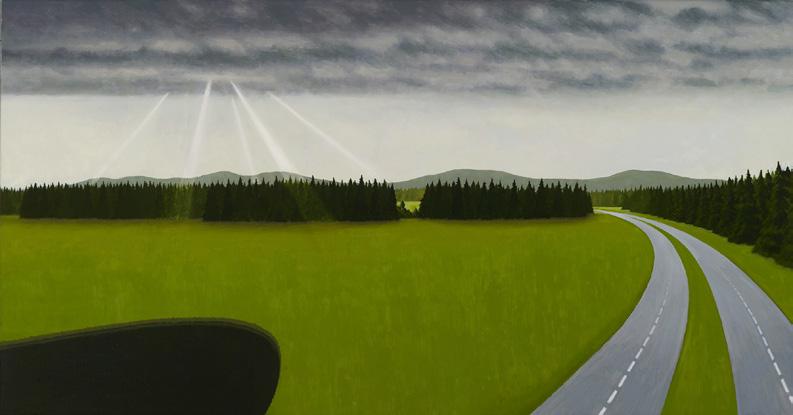
67 N C L R ONLINE Flashbacks: Echoes of Past Issues
Asheville, NC resident RALSTON FOX SMITH grew up in New Hampshire. He earned a BFA and MA at Amhurst College. He continued his studies at the Santa Monica College of Design, Art, and Architecture. His artwork
has been exhibited widely and is held in private and public collections nationally and internationally. He is represented by Tracey Morgan Gallery in Asheville and Mahler Fine Art in Raleigh, NC.
COURTESY OF RALSTON FOX SMITH
Westward (24x46, oil on linen) by Ralston Fox Smith
FINALIST, 2022 ALBRIGHT CREATIVE NONFICTION PRIZE
violin SHOP : Behind

the Velvet Counter
by the proprietor of a violin shop and a repairer of violins
by Blaise Kielar
BLAISE KIELAR opened Chapel Hill’s first violin shop in 1978 and later started Music Explorium and Electric Violin Shop. He retired from a music retail career by transitioning Electric Violin Shop to become America’s first worker-owned co-op music store. He is an improvising violin and clarinet player, leader of the Bulltown Strutters, Durham’s community New Orleans brass band, as well as a poet and writer of nonfiction, currently working on a memoir of which this essay is a part.
Selecting this essay for Honorable Mention, final judge David S. Cecelski praised its “lovely evocation of a master craftsman’s world and of little moments of great beauty written by the proprietor of a violin shop and a repairer of violins and bows.”
ABOVE 113 North Columbia St., Chapel Hill, NC, 1980
Photographs courtesy of the author.
(All photographs courtesy of the author.)
“A lovely evocation of a master craftsman’s world and of little moments of great beauty written
and bows.”
—David Cecelski, 2022 Final Judge
As the glass entry door closes,


the noise of downtown fades. I clomp up timeworn wooden stairs to the new Hillmusic space in the heart of Chapel Hill. Franklin Street marks the northern boundary of the University of North Carolina campus, packed with stores, places to eat, and two movie theaters. Where it crosses Columbia Street is with our varied and functional crossroads of town and gown. Our shop is a half block downhill at 113 North Columbia Street, upstairs above a highend stereo store. We share the garret with a leather craftsman named Stu Martell, and in some weird synchronicity, we all use European style one-word names –Soundhaus, Leatherworks, Hillmusic. In 1978, Chapel Hill still called itself a village, even as national chains began to encroach on the local shops. I loved having the Record Bar and the Intimate Bookshop half a block away.
Stu’s door is already open, a whole skin of deep brown leather draped over a worktable that almost fills his room, wedged under the steep original roof, and lit by two small dormer windows. Take away two incandescent bulbs and it could be 1850, or even 1750 – just hand tools and a master of his craft.
“Good morning,” scissors in hand, he smiles and keeps cutting. I return the greeting and step in for a moment – the alluring smell of fresh leather rings me like a Zen bell. What a great way to begin my work week.
Key in the padlock, I open the black raisedpanel door and light up my domain. Antique display cabinets and a brass hand-cranked cash register add a little elegance to the garret vibe of the town’s first violin shop. Only I can see the slate roof shingles behind our storage shelves. Six of our nicer violins rest side by side on green velvet, inside a glass display, probably once in a general store out in the country.
69 ONLINE LEFT 113
1980
North Columbia St., Chapel Hill, NC,
ABOVE Blaise Kielar and his mother at Hillmusic shortly after the Chapel Hill shop opened, Oct. 1978
[Nowell] enticed me with the prospect of opening my own branch of Hillmusic in Chapel Hill. This rekindled my dream of escaping bustling Northeast cities to the more laidback South, place of my birth.
Other violins peek out of open cases or hang from rawhide loops on the wall. Cellos are cradled on stands. My bow rehairing bench in front of a large window is strewn with an assortment of knives and hand tools far more delicate than Stu’s.


I had abandoned an academic career in musicology, happy to give up writing exhaustive inquiries into some obscure aspect of music history. I liked working with my hands, mind engaged at a physical level, attending to the details of how to return a bow to being a fresh tool for an accomplished player.
Pinch me. How did I get here? Less than two months ago I rehaired and repaired bows for the most prestigious violin shop in Philadelphia. Despite working all day in a small room with one craftsman who smoked cigars, the other cigarettes, and being a militant non-smoker myself, I enjoyed my work. I had abandoned an academic career in musicology, happy to give up writing exhaustive inquiries into some obscure aspect of music history.
I liked working with my hands, mind engaged at a physical level, attending to the details of how to return a bow to being a fresh tool for an accomplished player. Problem was, I never interacted with those who owned the bows. My place was upstairs in that tiny space, at my workbench. Until, on vacation, I spotted a violin-shaped sign under a huge Daniel Boone statue in Hillsborough, lettered with one word, Hillmusic. Curious, I found a music store tucked between antique shops – half violin shop, half guitar and banjo store – with a charming owner in round wire-rim glasses, who slowly saw an opportunity. His name was Nowell, and he regaled me with stories of classical violinists and mountain fiddlers. Our conversations continued at
his house, and by Saturday he enticed me with the prospect of opening my own branch of Hillmusic in Chapel Hill. This rekindled my dream of escaping bustling Northeast cities to the more laidback South, place of my birth.
After Nowell found a place to rent, I gave my notice and planned the move. On my first morning in North Carolina, I went to the DMV to replace my Yankee license plate, also proud to have my born-in-Virginia status on a new Southern driver’s license. We painted the retail space a color like aging parchment to highlight the beautiful wood of old instruments. While painting the long brick wall, I stepped off the ladder right into the tray of paint. We laughed, knowing that commercial-grade carpet would soon cover my footprints. Remnants of that carpet were later glued to the walls to cushion fretted instruments hanging from nails. Certainly not what you would expect in a fine violin shop, yet fitting for a Southern shop that sold all types of stringed instruments. Back through a doorway, the fretted instruments hang on the walls or on floor stands: new C.F. Martin guitars; Gibson and round-back “tater bug” mandolins; and open back banjos, some looking as old as the hills they came from. Nowell taught me just enough to demonstrate for a customer. I learned to strum two chords on guitar and the beginning of “Old Joe Clark” in clawhammer style on the banjo. On mandolin, I could easily find a tune, with strings the same pitches as violin, but I never got comfortable with frets, which seemed like obstacles to me. On hammered dulcimer, I used “Golden Slippers,” an old minstrel song long a favorite in Philadelphia at the Mummers Day Parade, where hundreds of four-string banjos strummed their way down Broad Street every New Year’s Day in the freezing cold. The wood steps serve as my doorbell; I can hear customers coming long before they step through the open door. With our varied inventory, I am alert to their first words, so I know which “hat” to put on.
ABOVE Hillmusic, Chapel Hill, NC, 1980
“Need some finger picks.” Most likely for a guitar or bluegrass banjo player, certainly not for old-time banjo played clawhammer style (solely with fingers and thumb).
“What do you have in steel guitars?” This eliminated the nylon-string classical guitars and could prompt a search for an old Silvertone or Gibson, or even the newly reissued scallop-braced Herringbone HD-28 from Martin.
“I’m looking for a fiddle,” was harder. Either be laid back and ready to talk mountain fiddling or establish my credibility when faced with a professional classical player using that affectionate term – even Itzhak Perlman refers to his beloved Stradivarius as his fiddle.
If they brought their current violin, it was easier for me to help them step up in quality. If not, I’d get them talking about what they wanted, then encourage them to pick out a violin by looks or maybe price range. After tuning it, I would cradle it in two hands, presenting it to the player as if it was a precious baby, which it was. Some would immediately play a fast, technical passage, or a scale. Others asked for a stand to prop up some sheet music.

The shy ones asked me to play it first. If so, I would play a slow scale from the lowest open string up the fingerboard far into the treble range, letting each note resonate fully. Then a faster arpeggio starting on the same bottom note, so they could hear the tonal qualities change as the pitch rose. It was desirable for each register to have a distinct tone quality, but not too different. The tone needs to blend from low to middle to high notes. If you play hard and dramatically, does it “go with” how it sounds when sweet and soft? Next, I’d play something familiar and short, either a fiddle tune or a classical excerpt, depending on the customer, to help them relax a bit before I handed it to them.
What they liked or didn’t like about the instrument guided my choice of which violin was next. Sometimes their words and my ears did not match. I can’t forget the time someone asked for our darkest sounding violin. I immediately bragged about my personal favorite, rhapsodizing about its deep, rich velvety tone. The player hated it. He quickly handed it back with a look of disgust that hit me in the gut. I offered progressively brighter sounding violins and was perplexed when he chose the opposite of his request. At least he persevered past my apparent mismatch. That interaction helped me remove my personal opinions from those highly charged moments when I took down a violin, tuned it, and presented it to a player. I began to give
I began to give more silent space to the patron’s optimistic anticipation, kept my mouth shut, and let the visual beauty and voice of each instrument speak for itself. Stepping back to watch and listen, I sought clues. Were they being carried away, or distracted? Did their eyes close in reverie, or just concentration? Was magic happening?
ABOVE
1978
Blaise Kielar at Hillmusic, Chapel Hill, NC,
more silent space to the patron’s optimistic anticipation, kept my mouth shut, and let the visual beauty and voice of each instrument speak for itself.
Stepping back to watch and listen, I sought clues. Were they being carried away, or distracted? Did their eyes close in reverie, or just concentration? Was magic happening? I was amazed at how many players climbed our stairs just to check out the new “bow guy.” Some had no intention of buying anything, just came to see what I had to offer. I did not impress the guitar and banjo players, but violinists who brought a bow needing attention were glad to find someone who offered expertise and prompt service. For those not ready for a rehair, I could replace a worn eyelet or leather thumb grip or glue a simple crack. One by one, my satisfied customers spread the word among both classical and traditional players that I knew what I was doing. I did not mind being called the bow guy. What my technical expertise bought me was priceless.
The isolation I felt in the big-city violin shop was dispelled and any remaining childhood fear of inadequacy dissolved as I helped my customers. With Nowell tending the Hillsborough store, this Hillmusic became “my” shop. My confidence rose as I became a valued member of the community, sought after for advice, whether someone needed a guitar, strings, or a violin. No longer a student or an apprentice, I had found a profession that satisfied my hands and my soul – and it even encouraged the spread of music in the world.
My transformation from Yankee Classical violinist and music historian to laid-back Southern retailer and fiddler continued with a buying trip to the mountains. I had already observed how smooth Nowell was with customers, always warm and easy going. He could charm almost anybody into buying an appropriate instrument, without them feeling pressured. Unseen, there was quite a strategy session going on behind his wire rims. He could come across as the trusted father figure, your best pal, an innocent hippie businessman, or an expert in just the area you happened to love. His relaxed playing style focused on the tone of the instrument, whether it was banjo, guitar, mandolin, or violin. No one ever felt threatened by a showy demo. As a veteran of old-time music festivals and winner of some blue ribbons on clawhammer banjo, Nowell knew many folks in the Appalachian Mountains. He knew which players collected instruments and which would sell some if they got their price. As we pulled off the Blue Ridge Parkway into the dirt driveway of one such violin collector in the North Carolina mountains, he cautioned me to say very little and, if I played a violin I really liked, not to verbalize my interest. Only after we were back in his van did Nowell explain the method behind what I observed. He introduced me as his new bow guy. The collector then laid

ABOVE 113 North Columbia St., Chapel Hill, NC, 1980
No longer a student or an apprentice, I had found a profession that satisfied my hands and my soul – and it even encouraged the spread of music in the world.
down a passel of bows, which kept me busy over on the side, looking for nice workmanship and silently testing them for straightness and strength.
Most of the violins were hanging sideways at eye level, the bridge of one close to the back of the next. Through the dim light in that country living room, Nowell scanned for certain traits. If he spotted something interesting, he’d take a violin over to a table lamp for a closer look. Hints of the expertise of the maker or country of origin could be found in the volute of the scroll, the height of the arching, the shape of the corners, even the overall length of the body. Fake labels were so common that peering through the f hole to the left of the bridge to read the scrap of paper glued inside was one of the last steps. Any major flaw could spur a rejection: a crack under a foot of the bridge, a repaired neck joint, signs of refinishing. The collector watched Nowell’s face intently.
“What’s the story on this one?” Nowell finally broke the silence.
“My neighbor’s daddy played that one for Saturday dances.”
“Any idea how it got this crack?” By bringing up a flaw he knew he could easily repair, Nowell was setting himself up for later price negotiation. He was careful not to disparage any instrument, especially after the asking price was revealed. He hung each one back up reverently, keeping his poker face intact.
The ritual continued down the line, occasionally interrupted when Nowell asked me to play one. This served several purposes. I’d get to try out a bow I was interested in; he’d get to hear the tone from across the room. And both men could search for a “tell” on the other’s face. How much did the collector value this violin? How much did Nowell want it?
After close to an hour, there were six violins on the table, along with four bows. Individual prices were spoken, confirmed with a nod, nothing written down.
“Fifteen hundred dollars for the bunch.”
A scrunch of his face conveyed Nowell’s response. He did not make a counteroffer. After a brief pause to seem nonchalant, he removed two violins from the table, grabbing another from the wall. He had planned this maneuver. Taking away
two he knew the collector valued, he slid into the mix the one he really wanted all along (without ever closely examining it). As an added distraction, he took out of contention the least interesting bow I had chosen.
“I can go nine hundred for these.” His outstretched palm swept leisurely over the table.
I imagined wheels in the collector’s brain spinning, trying to recalculate after the switch.
“I’ll take a thousand even.”
“Done.”
After paying and indulging in some pleasantries about fiddle music in North Carolina, we stowed our purchases safely and headed down the driveway. Nowell explained that, only ten minutes into our visit, his eye was caught by that last violin. Even on the shadowy wall, the soft quality of the varnish and the elegant corners spoke to him of a fine Italian maker. It was by far the nicest violin in the room, and he slowly formed his strategy for not revealing that secret to the collector. The less the collector knew about masterful European violin making, the better chance Nowell could again strike gold in these hills. This particular violin did not turn out to be Italian, but still could be sold for several times what he had paid for the whole lot. And we had some nice instruments we could fix up and sell to fiddlers or violinists for four hundred to a thousand dollars each. Add in the bows and we did very well indeed.
Our next stop was in Round Peak, at the home of the banjo maker Kyle Creed. Nowell
After close to an hour, there were six violins on the table, along with four bows. Individual prices were spoken, confirmed with a nod, nothing written down.
was a different person. It was clear he honored this man thirty years his senior. And Kyle appreciated Nowell’s years of efforts to preserve traditional playing styles, both banjo and fiddle. While teaching economics at Davis & Elkins College in West Virginia, Nowell sought out nearby older players to learn their tunes and their styles. When he discovered that some local women in the fabric arts were planning a gathering to help preserve mountain traditions of weaving and quilting, he suggested including music as well.
At the first Augusta Heritage Arts Workshop in 1973, crafters and musicians studied with top practitioners of fading traditions. That success led to years of summer workshops.
In 1981, the college took over the management and began to expand the offerings, later adding a year-round Augusta Heritage Center to the campus. Thousands of musicians have benefited from these annual gatherings, now in many styles beyond the original old-time.
Kyle and Nowell sat in two old cane-bottom chairs and played tunes. Both were equally comfortable on banjo and fiddle. They switched instruments occasionally, going from tune to tune without a word. This was far beyond my playing level, so I listened from a sofa. I relaxed into enjoying my private concert, when I realized I was witnessing the ancient tradition of a master passing on his art. Nowell adjusted his playing to reflect Kyle’s phrasing, absorbing this
local dialect of Appalachian folk music. When Kyle slipped an obscure tune among the familiar ones, I saw a change in Nowell’s face. He cocked his ear just a bit, mind trying to encode it into his memory, to be shared with others at a future jam.
Kyle sometimes passed a different banjo into Nowell’s hands to play. His earlier career as a carpenter and sawmill owner inspired the use of local woods in his banjos. After proper aging, maple, cherry, and walnut produced a variety of different looks and tones. Kyle also experimented with dogwood and apple, unusual woods for instrument building. I already appreciated the quality of his open-back banjos and now had the privilege of watching a craftsman show off the fruit of his labors, knowing full well that Nowell and I would find his babies good homes. And I had a story to tell. Customers in the know were shocked when I mentioned I had met Kyle Creed in his home workshop. After all, he is credited with popularizing the short-scale banjo fretboard now preferred by clawhammer banjo players around the world. By slightly reducing the vibrating length of the strings from nut to bridge, he could set the bridge closer to the center of the head. This encouraged the head to vibrate more purely as a unit, accentuating the lower overtones for that mellow tone desirable for old-time. In contrast, bluegrass banjos position the bridge a bit closer to the rim, strengthening the upper overtones for that bright penetrating tone so crucial to bluegrass. After witnessing such reverence for craft and playing, I was silent as we headed to our last stop, humbled by Nowell’s social, musical, and negotiating expertise. We entered a roadside antique shop. As he snagged a couple of pocketknives, I looked at old oak furniture. In my time in North Carolina, I had come to appreciate the grain and figure of oak almost as much as the curly maple favored by violin makers. I looked at a fiddle, found it badly cracked, and put it gently back down in its old wooden case. Nowell was playing a mahoganyback Gibson guitar, which sounded nice to my ear despite a couple of noticeable top cracks. He reached through the sound hole to see if the cracks had been properly repaired with wood cleats. Yes. This would make an inexpensive and great-sounding first vintage guitar for somebody.

After witnessing such reverence for craft and playing, I was silent as we headed to our last stop, humbled by Nowell’s social, musical, and negotiating expertise.
We also left with a prewar Gibson mandolin, an “A model” with a round sound hole, its mellow tone a perfect complement to an open-back banjo. We both had plenty of repairs and set-up work to do on our new finds once back in the shop. It was an immensely satisfying day, and a lesson in mountain ways. I doubt any big city violin shops had such a colorful way of acquiring inventory.
The quality and variety of instruments in my shop beckoned an interesting assortment of customers. Sometimes an old-time jam would break out, bringing business to a halt, or a singer-songwriter would preview an untested song with a new guitar. I loved when I got a visit from Dr. Philip Bromberg, a medical doctor at UNC Hospital and a very expressive violinist. One day he played a complete movement of the Sibelius Violin Concerto, from memory, while I sat at my workbench. Nobody else came up the stairs. The phone was silent. An audience of one, I felt like royalty with a command performance in my palace.
The shop was a community message board for all kinds of musical events. When someone mentioned that Itzhak Perlman would be playing the Tchaikovsky Violin Concerto on National Public Television’s Live from Lincoln Center, I scrambled, since I did not own a TV. A record of this piece started my path as a musician and remained my touchstone of expression. I just had to see the program. I asked everybody. A local violinist named Michael Platt, who was also a master of many fiddle styles, suggested we commandeer the projection TV at The Station, a bar in Carrboro, the other side of the tracks from Chapel Hill. He had some clout since he bartended there. He knew the evening crowd would talk right over a classical concert, so, just before airtime, we grabbed the television from its bracket on the ceiling, took it to their back room – a railroad car – and set it upside-down on a beer keg. As a projection television, the image was reversed and mirror image. To us, he played lefthanded, but at least he was not upside-down. Very odd, but soon, all that mattered was the music.
Perlman impressed us with his passionate playing in the opening Allegro. I held my breath for the slow Canzonetta. Since childhood, I cherished the expressive depth of this movement
and had not yet heard any recording rise to the level of my expectations. Most players seemed to hurry through it to get to the virtuosic final movement. Perlman, however, dug deep into the essence of Tchaikovsky and won me over. Magic happened. We were transported far beyond that small television in a train car behind a bar. The dramatic finale further convinced us of his wizardry; we hooted and hollered at the end. I had found a new violin hero.
The TV had a whole different aura about it as we hoisted it back onto its perch, ready for the next ACC basketball game. Some expressive corner of my soul could now relax, having finally witnessed someone swept away at the highest level of musical passion, live on television.

The magic of expression sometimes collided with history in my shop. I felt privileged to help local players like the everfriendly Earl Wolslagel, an original member of the North Carolina Symphony back in 1932. And when Giorgio Ciompi came up my stairs, I knew I was in the presence of a true maestro. He played under the famous conductor Arturo Toscanini in the NBC Orchestra, also in the 1930s. When he joined the Duke University Music Department in 1965, he raised the resident string quartet to new levels, so that when he passed away, far too young, the quartet kept his name. The Ciompi Quartet still performs widely, to great acclaim.
 ABOVE Blaise Kielar at a jam session at Hillmusic, Chapel Hill, NC, 1978
When the touring virtuoso Elmar Oliveira was in the area to perform, someone from Duke told me that he played a Stradivarius, a violin so rare I had only seen one behind glass in a museum. When he came to visit (there were benefits to being the only violin shop in the area), he made it a point to play all of our better violins. As he was playing “my” violins, I kept staring at his case sitting against the brick wall I had painted about a year earlier.
I finally got up my nerve, and asked, “You’re playing mine; can I play yours?”
“Sure!” He smiled, and immediately walked over to his case.
As he handed the Strad to me, I fell silent, surprisingly not nervous at holding an instrument worth many times the value of my whole shop. I could never call this a fiddle. The beautiful, flamed maple seemed to glow through the lustrous oil varnish. I marveled at the grace of the body shape, the points of the crisply inlaid purfling, and the smooth volute of the scroll.
As he handed the Strad to me, I fell silent, surprisingly not nervous at holding an instrument worth many times the value of my whole shop. I could never call this a fiddle. The beautiful, flamed maple seemed to glow through the lustrous oil varnish. I marveled at the grace of the body shape, the points of the crisply inlaid purfling, and the smooth volute of the scroll. And to think the hands of the greatest violin maker of all time had carved this, over 250 years ago. All eyes were on me, so I grabbed my favorite bow and played one long note. I was shocked at how easy it was to play, how effortless to draw a big sound. It was as if I went to sing a lullaby and Pavarotti came out in full voice. The sound filled the room – and my soul. I was swept away, lost in a time capsule of precious fine art that also made sublime music. Time collapsed. I have no idea how long I dwelled there.

Returning the violin to Elmar in awed slow motion, I had no words other than “Thank you.”
An absolute calm washed over my body as my spirit continued to soar. A deep gratitude arose for my brief visit to a world far beyond my reach, yet completely familiar. That golden tone did not spoil me for the everyday violins I set up and sold. Rather, even today, it inspires me to seek the soul of every instrument I play. Somewhere inside each of these nicely varnished wooden boxes is hidden a treasure of expression, patiently waiting to ask a player to reach for that
76
place where the human and the divine meet.
ABOVE TOP Blaise Kielar at Hillmusic, Chapel Hill, NC, 1979
n
“ALL COME TO LOOK FOR AMERICA”
a review by Jim Clark

Joseph
Having tried, unsuccessfully, some years ago to put together an anthology of Appalachian poetry for a respected university press, I have nothing but admiration for editors of anthologies. The reasons for my lack of success were many, but one was certainly the fact that I seriously underestimated the complexity of such a project and its demands on an editor’s time and energy. And when the anthology’s focus is as potentially fraught as that of Crossing the Rift: North Carolina Poets on 9/11 & Its Aftermath, it’s a tribute to the skill, perseverance, and even-handedness of editors Joseph Bathanti and David Potorti that we have this valuable document at all. Bathanti and Potorti are each particularly suitable for this work as both have spent much of their lives working for social justice and fostering understanding and community. Bathanti’s tireless work with prisoners and veterans is exemplary and oft noted, while Potorti has served as an effective ambassador for and champion of North Carolina writers and writing in his various roles with the North Carolina Arts Council, and he is co-founder of September 11th Families for Peaceful Tomorrows, having lost his brother, Jim, when the North Tower fell on 9/11.
The book is a medium-sized, handsome grayscale production featuring one poem each by 116 different poets. The cover design features a photograph of French aerialist Philippe Petit literally “crossing the rift” on a tightrope strung between the two towers on August 7, 1974.
In his Preface, Bathanti provides some insight into both the book’s title and its cover illustration: “The great Samuel Beckett reminds us that ‘Words are all we have.’ The aspiration of this volume is to brave the rift, the breach, that only words can begin, however precariously, to mend” (xii). Bathanti also gives an account of the book’s genesis, and, importantly, touches on the real value, the raison d’etre, of such an anthology of occasional poems focusing on a historical event. Speaking of “the vast collateral fallout associated with 9/11,” Bathanti writes: “These poems give moving and powerful testimony to what Carolyn Forché calls ‘the poetry of witness’ – a ritual act of reconciliation through language; a renewed sense of shared humanity and righteous resistance; and, perhaps most importantly, a sacred vow to never forget” (xii). Speaking of the poets whose works are included, Potorti writes in his warm and personal Introduction: “Most of all, I hope their words make it safe to remember: to remember my brother and all those who perished; to remember who we were, and aspire to be; and to remember the world we lived in, not
Bathanti and David Potorti, Editors. Crossing the Rift: North Carolina Poets on 9/11 and Its Aftermath. Press 53, 2021.
JIM CLARK is a Professor Emeritus of English at Barton College in Wilson, NC, where he was the Elizabeth H. Jordan Professor of Southern Literature from 2007 until 2019 and served as Dean of the School of Humanities. Some of his honors include the Randall Jarrell Scholarship, the Harriette Simpson Arnow Short Story Award, and the Merrill Moore Writing Award. He served as the President of the South Atlantic Modern Language Association in 2015 and the Chair of the North Carolina Writers Conference in 2017.
Former Poet Laureate of North Carolina
JOSEPH BATHANTI teaches at Appalachian State University in Boone, NC. The author of several books of poetry, fiction, and nonfiction, his most recent book, Light at the Scene (Louisiana State University Press, 2022), received the Roanoke Chowan Award for Poetry from the North Carolina Literary and Historical Association. A review of this collection is forthcoming in NCLR Online Fall 2023.
DAVID POTORTI is a writer and reporter, who has contributed to a variety of media outlets including The Nation, Independent Weekly, Adbusters, Spy Magazine, New Times LA, Philadelphia City Paper, Old Time Herald, and Bluegrass Unlimited.
RIGHT Joseph Bathanti at Bookmarks in Winston-Salem, NC, 12 Sept. 2021
PHOTOGRAPH BY BILL GRIFFIN
through some sentimental filter, but with a renewed sense of our connectedness and shared future” (xiv).
As for the poems, free verse unsurprisingly predominates. Some, like Cathy Smith Bowers’s “For Okra,” are classic, simple, imagistic poems. In four spare quatrains, elegant and personal, the poem describes that moment when, after fearing for the safety of someone, one receives the good news the person is all right, and one can seemingly breathe again and the world seems vivid, refreshed. The okra of the title (“I’d never seen so green a green / before”) is an offering of thanks for the safety of a loved one: “I’ve dredged and / fried it. Just the / way you like it.”
At the other end of the free verse spectrum one finds “Before and After the AfterMATH: 9x11=23,” by Earl S. Braggs, a multi-page experimental poem that uses mathematics as its organizational principle. Featuring an epigraph by Walt Whitman – “The United States themselves are essentially the greatest poem” – the poem juxtaposes major events of American history (the Revolutionary War, the Civil War, Pearl Harbor, the assassinations of Abraham Lincoln, John F. Kennedy, Robert Kennedy, and Martin Luther King), with ordinary people going about their daily routines on the morning of September 11, 2001. The use of mathematics gives the poem’s focus on the 9/11 attack an awful sense of inevitability: “AK47 + 1 = AK 48 + 2 = 50 United States of confusion lower at half-mast or mass
greater than and/or equal to the sum of static in the pockets of 19 boys.”
Whitmanic in its own way, with its many apostrophes and allusions and its long lines continuing beyond the right-hand margins, Irene Blair Honeycutt’s “Song for the Hours” begins with images of ruin, sadness, death, and mourning – “O railroad spike . . . next to the splintered tracks . . . / O train whistle of woe . . . / Opossum – cold by the roadside . . . / O mourning stars . . . “ – then quotes from John Donne’s “No Man Is an Island” – “Any man’s death diminishes me” – to make the point of our human interconnectedness. The poem ends with the biblical Abraham’s statement of witness: “I am here.” Finally, just as some have criticized Whitman’s verse as too prosaic, several of the pieces included here take the form of what one might call prose poems.
Robert Morgan’s brief “A Sickness in the Air” looks back on a business flight to New York City on September 10, 2001 from the vantage point of twenty years. That day “There seemed to be a sickness in the air . . . a dread and menace” presaging the next day’s cataclysm, which set in motion “two wars abroad that never end, and one at home to rip the fabric of our nation apart.”
Somewhat similarly, Alan Shapiro’s slightly longer “Manhood” examines the toxic fallout from 9/11 that often set neighbor against neighbor, “as if what tumbled down with the towers were the civic Babels of our separate lives, as if we had been blown by the explosions backward to a pre-Babel nearly
Edenic understanding, speaking the same tongue inside the same body politic that flexed its outraged muscle through the words we spoke, no matter who we spoke them to.”
Co-editor David Potorti’s piece, “Jim,” takes the form of a segmented essay consisting of seven numbered paragraphs. The focus is Potorti’s brother, Jim, who died when the North Tower fell on 9/11. References to the experimental film Koyaanisqatsi, which his brother took him to see, and to Japanese survivors of Hiroshima and Nagasaki evoke the tragedy and malaise of a contemporary “life out of balance.” When Potorti rings the New York Fire Department bell “for the person you lost,” “The big sound swelled and went off among the buildings, returning empty-handed.”
Of the handful of formal poems included in the collection, Anthony S. Abbott’s finely crafted pantoum “This Innocent Sky” does a marvelous job of juxtaposing the aerialist Phillipe Petit as he “floats beyond time, here in this innocent sky” of “a beautiful summer morning” in 1974, with a later “beautiful autumn morning, sky clear” in which “bodies hurtle through the air between the towers.” It’s a bravura performance.
Former North Carolina Poet Laureate Fred Chappell contributes “The Attending,” a somber but uplifting celebration of “the ancestral choir / Of prophets, sages, founders of the state, / Who lend us strength and solace when the world is rent / And everywhere besieged with fire.” The poem consists of four sestets with lines roughly iambic
78 NORTH CAROLINA LITERARY REVIEW Winter 2023
pentameter rhyming abcbac. Chappell is a master of many styles, including the lofty, highminded public voice on display here, which doubtless owes much to his master’s degree studies in eighteenth-century literature at Duke.
Sarah Lindsay’s “Nachtmusik,” a portrait of an old German couple who are preparing to play classical music for their own enjoyment, is interesting, formally, in that the middle three quatrains rhyme (either abab or abba, mostly slant), but the first and last quatrains do not. As they tune their instruments, the hair of the woman’s violin bow “falls loose from the frog” prompting her to observe, “How we play such fragile things, I don’t know, / they could fall apart in our hands.” The man, meanwhile, remembers a night in Berlin when “a bomb / buried the bridegroom and all but one of his friends,” and, huddled outside his own home, he “heard the grand piano fall five floors – / heard its last five monstrous chords / that blot-
ted out for years all the Bach he knew.” And yet, the concluding line of the poem suggests their resiliency, and the strength and solace they find in their music, “‘Mozart, then,’ he says, and so they play.”
Diana Pinckney’s “Fallen Gardens” is another poem containing formal elements. The poem is composed of quatrains with each line roughly the same length, but only the first and the fifth quatrains can be said to feature rhyme, which is mostly slant. Perhaps the imperfect form mirrors the Edenic notion of “the fall” in the poem’s title. The poem features a father during wartime, who is apparently being forced to execute his own son, “a young informer broken / to the ground at his father’s feet.” The father “pleads for Allah, for any god / to grant him Abraham’s deliverance,” but the sky is “Bereft of angels” and the “stinging wind” offers no answer to his plea.
My own memories and impressions of 9/11 consist mostly of the familiar terrible
images from that morning – an airliner, flying much too low, seemingly disappearing into the tower, gleaming in the sun, followed by an orange ball of fire (watching it on my office mate’s computer screen, I first thought it was imagery from a video game), and well-dressed people appearing to take flight from impossibly high windows. About a month later, though, I was watching the television broadcast of The Concert for New York City at Madison Square Garden. The audience was clearly emotional, and the musicians, many of them British, seemed genuine in their empathy and consolation. Good will abounded, and it seemed possible that something positive might ultimately come from such a horrific tragedy. David Bowie, wearing a gray overcoat on the dark stage, illuminated by a single spotlight, began playing a simple waltz-time figure on a tiny keyboard. The words to Paul Simon’s “America” eventually swelled into the vast arena, to the rising and falling cheering of the crowd: “They’ve all come to look for America,” Bowie sang. “All come to look for America.” Sadly, it was not to be. Within a year the US Congress would grant President George W. Bush authority to decide whether to launch a military attack on Iraq, and the Iraq War would begin on March 20, 2003. And yet, reading these poems of witness to 9/11 and its aftermath, I can still hear an echo of that voice, ringing out in one of the great civic spaces of one of the greatest cities on earth, “They’ve all come to look for America.” n

79 N C L R ONLINE Flashbacks: Echoes of Past Issues ABOVE David Potorti with his brother Jim
COURTESY OF DAVID POTORTI
2022 JAMES APPLEWHITE POETRY PRIZE SEMIFINALIST
BY MORROW DOWDLE
Brow
“I am my own muse, the subject I know best.”—Frida Kahlo simplistic image on a bookmark the artist’s head a quote beneath meant to inspire freedom then why is she not free face stripped of its integrity eyebrows divided by a clean gap edited without her consent reviewed against her preference she alone has rights to the dream of herself emblazoned with that long brush of black
MORROW DOWDLE has been published in numerous journals and anthologies and was a Pushcart Prize nominee in 2018 and 2020, as well as a Best of the Net nominee in 2020. She edits and critiques poetry for Sunspot Literary Review and is an organizer of the Living Poetry collective based in the North Carolina Triangle. She works as a physician assistant in mental health and lives in Hillsborough, NC.
80 NORTH CAROLINA LITERARY REVIEW Winter 2023
talisman against convention so much lost she would not give one hair more goddess-creator of your own conception i vindicate you with this pen aim between your eyes and stroke stroke stroke you back into place
PETER MARIN was born and raised in Mexico City. He received a BA from UC Berkeley and an MFA from Hunter College. His work has been exhibited throughout the world and appears in public and private collections and foundations including Boys and Girls Club, The City of Raleigh, and SAS. He received the 2019 Latino Diamante Inc. Award for Arts and Culture given by North Carolina’s first Latino arts organization. He is an adjunct Assistant Professor with Wake Tech Community College and Living Arts College. He also works with the North Carolina Museum of Art, Arts Together, Pullen Arts Center, and Seratoma Arts Center. He is the owner and founder of
Marin created this 30-foot ofrenda placed at the entrance to the NC Museum of Art’s 2020 exhibit Frida Kahlo, Diego Rivera, and Mexican Modernism. The altarlike structure refers to the Mexican holiday Day of the Dead, which occurs in late fall, in memory of those who have died. Such ofrendas appear in public places, as well as in homes, as a way for Mexicans to celebrate the dead and invite them into the Land of the Living by placing offerings on the altar. Artists Frida Kahlo and her husband, Diego Rivera, celebrated Dia de los Muertos to honor their loved ones and this ancient Mexican tradition.

81 N C L R ONLINE
Flashbacks: Echoes of Past Issues
Peter Marin Artworks, and his studio is located in Artspace in downtown Raleigh.
COURTESY OF NORTH CAROLINA MUSEUM OF ART
ofrenda (mixed media, 34x16x8) by Peter Marin
AN EXAMINED LIFE THROUGH THE LENS OF ARTISTIC VISION
Luke Whisnant’s new novel, The Connor Project, centers around the character of David Connor, a television journalist and visual artist. In some ways a winsome romantic and in others a prickly curmudgeon, Connor has been unlucky in love. Or he’s shied away from commitment. Or he’s resisted following in his father’s footsteps. Perhaps all of the above. The reader is invited to speculate about the source of Connor’s discontent by assembling pieces of the puzzle from artfully arranged vignettes told in Whisnant’s crisp, muscular prose.
motorcycle “like something running fast had been shot down” (46). Although he looks for the missing rider in an attempt to help, he’s also struck by the artistic value of the scene and begins filming the wreckage.
HEATHER BELL ADAMS is the author of the novels Maranatha Road (West Virginia University Press, 2017; reviewed in NCLR Online, 2019) and The Good Luck Stone (Haywire Books 2020; reviewed in NCLR Online Fall 2022 ). The author is a recipient of the Doris Betts Fiction Prize, Rose Post Creative Nonfiction Award, Carrie McCray Literary Award, and James Still Fiction Prize. Her work has appeared in Still: The Journal, Raleigh Review , Parentheses , Atticus Review, The Thomas Wolfe Review , Broad River Review , NCLR , and elsewhere. Currently serving as North Carolina’s 2022 Piedmont Laureate, she lives in Raleigh where she works as a lawyer.
LUKE WHISNANT is a Professor of English at East Carolina University. His previous books include the story collection Down in the Flood (Iris Press, 2006; reviewed in NCLR 2007, which also includes a short story by him) and In the Debris Field (Ad Hoc Fiction, 2018), which won the 2018 Bath Flash Fiction International Novella-in-Flash Award. He has served on the staff of Tar River Poetry since 1985 and as editor since 2006.
One such vignette reveals that Connor’s father stole one of his girlfriends. In another, Connor encounters his sister’s girlfriend in the middle of the night and ends up kissing her. “Sure he was sleepwalking” (85), he acknowledges with little shame, only a newfound tenderness for his girlfriend of the moment sleeping nearby. The Connor Project spends significant time with the protagonist’s girlfriends and sexual partners. In addition, the novel probes Connor’s relationships with his sister and parents, as well as his role as an artist.
In his earlier novel, Watching TV with the Red Chinese (1992), Whisnant interpolates the narrative with a documentary film transcript. Here, he uses a similar structural device by including the transcript of an oral interview between Connor and the artist documenting his life. In the chapter entitled “On the Street,” Connor comes upon a wrecked
When the cops find the rider’s body, Connor “swore that he had looked, he had looked for a solid five minutes” (50). Bearing some modicum of guilt for not locating the driver in time to save him, Connor nonetheless remains preoccupied with the artistic image of the yellow light on the wet street. Wishing to discuss his horror and “his human failing” (51), despite the late hour, he calls his sister and the woman he’d dropped off earlier after a lackluster date. This scene encapsulates Connor’s personality and artistic ethos while speaking to both his loneliness and his tendency to burden others rather than shoulder responsibility for himself.
In this chapter and elsewhere in the novel, Whisnant’s sparse setting details suggest a universal landscape and a sort of “everyman” reading of Connor’s life. At one point, Connor marries a woman named Hope. Their marriage ends in a poignant candlelit bathtub scene, but otherwise Hope plays a relatively small role in the novel. However, when Connor specifies how long the marriage lasted (two years, four months, and eight days), one wonders if, in his putative nonchalance, he is an unreliable narrator and the loss affected him more deeply
82 NORTH CAROLINA LITERARY REVIEW Winter 2023
a review by Heather Bell Adams
Luke Whisnant. The Connor Project. Iris Press, 2022.
than he has admitted. Given his father’s betrayal, Connor is at his most relatable as he grieves his father’s last days. Even as he recognizes the futility of art when it comes to life or death, Connor imagines that if he can finish a film project about his father, then his father won’t die.
Due to the narrative’s nonchronological construction as a series of stories or vignettes, some readers may disagree with calling The Connor Project a novel. However, by the end, the well-designed narrative presents a full picture of a life and operates as a cohesive and meaningful whole. Thus, it is reasonable to think of The Connor Project as a novel, particularly since such a classification seems to comport with the author’s intent. And the closer one examines these carefully crafted pieces, the more treasures they reveal.
There has been much discussion in recent years about whether a protagonist needs to be likable. See, for example, the spirited debate about Claire Messud’s The Woman Upstairs (2013), another literary novel involving an artist.* In this vein, one might ask whether David Connor (a white male) is likable. Despite his faults, Connor succeeds as a main character because he is compelling and interesting. His life story remains consistently relatable and, as Whisnant reminds us, Connor’s trip down memory lane is not merely for his own benefit but rather in furtherance of another artist’s project. At various points

in the narrative when Connor questions whether he has been a “scumbag,” his self-awareness engenders empathy.
Although the novel is not told in a strictly chronological format, a sense of forward movement emerges as the story progresses. Far from an aimless exploration, the author takes the reader on a purposeful journey. Ultimately, the destination centers around an art project called “The Connor Project,” the exhibition notes for which comprise the novel’s epilogue. These notes catalogue each piece in the project, ranging from an acrylic on canvas depicting Connor in utero to a mixed media presentation of lettered tiles and photographs of fortynine of his former girlfriends and lovers, which the viewer can manipulate to arrange alphabetically, chronologically, or by criteria such as eye or hair color. Interspersed with the photographs are blurred shots of mannequin heads. The exhibition notes ask, “is it a comment on his misogyny?” (154). On this question, it bears mentioning that the artist behind “The Conner Project” is revealed to be Connor’s current girlfriend, Boo. The fact that she chooses him for her subject lends an added layer of validation, perhaps confirming that the reader’s time with Connor has been well-spent.
Another piece in the exhibition, entitled “So Why
Did They Kill Socrates?” (155), raises the specter of Connor’s departed father. The reference to Socrates also brings to mind the philosopher’s warning that the unexamined life is not worth living. As both art project and novel, The Connor Project examines David Connor’s life: wryly humorous and bittersweet everyday moments across the decades, representative of his all too human foibles and indefatigable perseverance.
The reader may question whether Connor’s journey arrives at some sort of redemption. Although the epilogue certainly hints at a happy ending, the answer remains unclear and perhaps beside the point. In the chapter entitled “Blue Blue Windows,” a bus driver says to Connor, “Maybe your movie is about looking instead of finding” (137), a sentiment that applies equally to the novel itself. n
83 N C L R ONLINE Flashbacks: Echoes of Past Issues
ABOVE Luke Whisnant reading from The Connor Project at ECU’s Joyner Library, Greenville, NC, Apr. 2022
COURTESY OF JOHN HOPPENTHALER
Emotion:
Publishers Weekly 29 Apr. 2013: web
* See Annasue Wilson, “An Unseemly
PW Talks with Claire Messud,”
2022 JAMES APPLEWHITE POETRY PRIZE SEMIFINALIST
BY BILL GRIFFIN
Daylight Savings
Behind me ticking, Einstein’s serene gaze decoupaged on a clock with no numbers, only sooner and later:
this weekend we pretend the sun has decided to raise itself sooner. Outside our kitchen window
the last yellow leaves shiver with excitement; the wind has arrived to carry them around the block;
my coffee cools and the universe warms, system approaching equilibrium. You and I arrive as well,
another morning’s Lagrange point in our mutual orbits, more like two different daylights
BILL GRIFFIN is a naturalist and retired family doctor who lives in rural North Carolina. He features Southern poets, nature photography, and microessays at his blog. His poetry has appeared in NCLR, Tar River Poetry, Southern Poetry Review, and elsewhere. He has published six collections including Snake Den Ridge , a Bestiary (March Street Press, 2008), illustrated by Linda French Griffin, and Riverstory: Treestory (Orchard Street Press, 2018).
84 NORTH CAROLINA LITERARY REVIEW Winter 2023
of early riser & late night reader, yellow clock & blue clock. I hear you upstairs begin to stir –soon our two cycles will Venn, blue & yellow intersect: green clock, your first cup of tea, my second coffee.
For the moment wind settles to reassure the leaves. It is suddenly quiet. Einstein ticks. Why not staple the calendar to now, one single season of us? Why not put off ticking’s later too quickly sooner come to shiver some solstice morning only yellow;
why not never no one left upstairs to yawn, clump down in sock feet behind me, touch my shoulder, save the day.
Charlotte-based artist CHRIS LIBERTI was born in Buffalo, NY, and raised on the East Coast. His early interest in illustration led to study in graphic design before he transferred to Buffalo State College, where he earned a BS in Fine Arts/Painting and Urban Design. While working as a telecommunication design engineer, he continued to exhibit his art in New York, Virginia, and California. He and his family lived in Charlotte, NC, for a time, where he maintained a studio. He exhibits extensively throughout North Carolina, as well as nationally. He is represented by Blue Spiral 1 Gallery in Asheville, Thomas Deans Fine Art Gallery in Atlanta, Meibohm Fine Arts in East Aurora, NY, and Tregony Gallery

85 N C L R ONLINE Flashbacks: Echoes of Past Issues
in Cornwall, UK.
COURTESY OF THE ARTIST
Autumn (oil on canvas, 11x14) by Chris Liberti
How far would you go in defense of your beliefs? Would you write a letter? Protest? March? And what if your child were a victim of a betrayal of that belief? Would you seek retribution? Break the law? Start a fire? Set off a bomb?
WITH THE BIG BROKEN HEART”
a review by Barbara Bennett
BARBARA BENNETT is a Professor at NC State University. She is the author of five books including Understanding Jill McCorkle (University of South Carolina Press, 2000) and Comic Visions, Female Voices: Contemporary Women Novelists and Southern Humor (Louisiana State University Press, 1998). She is a frequent contributor to NCLR, including an interview with Lee Smith and Jill McCorkle in NCLR 2016 and a memoir essay in 2022.
MARK POWELL directs the creative writing program at Appalachian State University. He has received fellowships from the National Endowment for the Arts, from the Bread Loaf and Sewanee Writers’ Conferences, and twice from the Fulbright Foundation to Slovakia and Romania. He has a BA from the Citadel, an MFA from the University of South Carolina, and an MAR from Yale Divinity School.
OPPOSITE The Eastern cougar, now considered by the US Fish and Wildlife Service an extinct species in North Carolina
Mark Powell’s newest novel, Lioness, asks these powerful questions and more. The two main characters, Mara and David, have always been environmentally conscious, but Mara is the “idealist with the big broken heart” (7) when their nine-year-old son Daniel dies of non-Hodgkin’s lymphoma. David is a journalist and struggling playwright who works on a story about the RAIN! waterbottling plant in southwest Virginia, where they live. The water is officially found to be pure, so David ends his research and brings home gallons of water, which is drunk by the family. Much later, David finds evidence that the company had falsified documents and the water is full of dioxins. When Mara finds out, nine months after Daniel dies, she leaves her husband, builds a bomb, and blows up the bottling plant. Whether Mara has survived the blast is unclear from the beginning. Powell holds that information close to the vest.
All of this is told in the first eleven pages, the first eight showing Mara living in the wilds of Florida with a young boy. Is this real? Did Mara survive and escape? Who is the boy? It’s a long road to find out as David tries to reconstruct the past to figure out how he got where he is. But is it the truth? He claims that “[w]hat you have to do is construct an alternate life. Your life, but not quite” (11). Is that what he’s doing, or is he telling
a story to help him cope? Powell takes David deep into the past to find the answers – where there are answers. Many times Powell gives us conjecture, hope, and plain fabrication.
As young adults, Mara and David believe that “everything’s mixed up these days” (5), and the “country was dying, the entire planet. . . . The world being not nearly as hard to take apart as put together” (286). They are frustrated that protesting in the streets accomplishes nothing: “They are still leveling mountains not a hundred miles from here. They’re still poisoning our water, our soil” (69). But what can turn two frustrated environmentalists into ecoterrorists? It turns out it’s not what but who
Enter Chris Bright, a man who has been fighting for ecological justice since he was a child. He felt a great affinity to animals, recognizing that it was the animals “that kept silent counsel, emerging and disappearing back into the world, and it was the animals, he realized, one day, who were dying” (96). His first ecoterrorist act, if it can be called that, was dismantling a deer stand he found in the woods – twice. As he grows into an adult, he becomes obsessed with “our dying planet. Climate change. Rising seas. The Sixth Extinction” (24). He commits several acts of ecoterrorism during his young life, some with success, some with failure.
Once Chris meets David and Mara, he begins to tutor them in his ecoterrorist philosophy. He tells them to stop wasting time and act rather than complain. Chris seduces both David and Mara, in every way conceivable, but it is Mara who becomes the
86 NORTH CAROLINA LITERARY REVIEW Winter 2023
“IDEALIST
Mark Powell. Lioness: A Novel. West Virginia University Press, 2022.
true believer. The couple live with him on his farm in a kind of environmental paradise, talking and drinking and making plans that they never seem to carry out. Finally, Mara asks, “What if we did something?” (159), and she and Chris make a plan to free the caged and mistreated wild animals in a roadside zoo. David is not ready for this kind of action and leaves for home. When the plan ultimately fails miserably, it puts a hold on Mara’s fervor until years later when she is back with David, and their son dies.
It is at the roadside zoo that Mara has a close encounter with the animal in the title of the novel, a mountain lioness. As Mara peels back the fence to free the lioness, she finds herself “looking in at the golden eyes of the mountain lion” (217). It is a seminal moment for Mara because throughout the novel, she has been connected to this endangered animal. Powell has used the lioness as a symbol for all the destruction people are causing to the planet, which is now slowly dying. But the lioness is also a symbol for Mara, who continues to fight despite knowing it is a lost cause. We see – or sense – mountain lions throughout the novel. In the first chapter, Mara in Florida finds a dead and gutted deer on her porch and knows the kill was done by a lion. She is told by the Fish and Wildlife officer that the cat “represents one thirtyseventh of the remaining population” (7). Like Mara, the lioness may be dead soon – may already be dead. And like the lioness, Mara is a hunted being. The lioness shows up many times in the book: at the North Carolina home of Mara and David, in an

encounter with Chris when he is a child, as a stuffed relic of the past. In all cases, the lioness is ephemeral, spiritual, and a reminder of the damage we are doing to the planet.
The novel is a manifesto of the people who still care, who still want to turn things around before it is too late. The book is harsh in its depiction of Americans. In a tense conversation between David and the wife of the CEO of RAIN!, the woman surprises David with her opinion: “My theory is that you become American not by birth but by dint of will, by your rapacity, by your willingness to eat the world because why else were you put here? You are American. You are entitled” (303). Bad things keep happening, and Powell suggests that no one responsible ever pays for their sins, especially those with money and power, like the wife of the CEO.
Powell’s descriptions of place are quite lyrical. He obviously knows the landscape he gives us in western North Carolina and southern Virginia. He has a way of taking the readers right to the spot and immersing us in the culture, landscape, and people.
He writes about difficult things in a beautiful way, reminiscent of Cormac McCarthy, who wrote violence with exquisite prose. Powell’s love for his native turf comes through tangibly. He is the author of six previous novels, which have planted him deeply within the Appalachian literature tradition. His eighth novel, he claims, is a response to the 2016 presidential election. It is also set in the mountains.
With Lioness, he attempts to remind us of the damage we all do just by living the selfish American lifestyle. It’s not an optimistic novel, more of a cautionary tale. In his previous novels, Powell has dealt with the loss of innocence in America and the loneliness and isolation of the twentieth and twenty-first centuries. While he dealt with the environment in his novel The Dark Corner (2012), he has never delved quite so deeply into the ecological disaster we have created on the planet. Lioness offers little hope, and in the end we are left with David’s dark words: “Everything you have loved, everything you have known – it cannot, it will not last” (314). n
87 N C L R ONLINE Flashbacks: Echoes of Past Issues
COURTESY OF NORTH CAROLINA WILDLIFE RESOURCES COMMISSION
2022 JAMES APPLEWHITE POETRY PRIZE FINALIST
BY J.S. ABSHER
Patient Doe Escapes the Asylum and Goes on the Town
With apologies to al-Farazdaq (d. 730)
After the husband of Genghis Khan’s daughter was killed at Nishapur in 1221 by a Muslim border guard, Genghis Khan ordered the death of all in the city; as many as 1.7 million were killed, and the skulls of men, women, and children were piled in pyramids by the Mongols.
Doe is in a café. He’s not sure when. (He distrusts a man who knows “when.”) Enter a felt suit with no head, a pencil and sharpener riding his hip like a six gun.
Doe is drinking a cup of joe poured from a copper cezve (He likes the aroma: nose is the hieroglyph for joy). No-head announces: I am Jacobi. Arrived on La Paloma.
In the crook of his arm, wrapped in a towel, is a bundle the size of a noggin. He lays it on the table, unmasks its mouth, orders an Old Fashioned.
“Are you smuggling the nut?” asks Doe, “or are you a saint lugging your head like a ripe gourd to ventriloquize through? For I will not drink with the dead:
We must separate the living from the zombie and cephalophore, order the disorderly, dig the fire line, isolate contagion. I guard the border between real and fake.” When I visited hell, Jacobi says, I met the border-guard whose arrow killed at random the Great Khan’s son-in-law. O the tears of the Khan’s daughter! O
J.S. ABSHER has been a finalist in this contest numerous times, and, as a result, NCLR has published several of his poems since 2016. His first full-length book of poetry, Mouth Work (St. Andrews University Press, 2016; reviewed in NCLR Online 2017) won the 2015 Lena Shull Book Contest. The second, Skating Rough Ground, was published by Kelsay Press in 2022. His chapbooks are Night Weather (Cynosura, 2010) and The Burial of Anyce Shepherd (Main Street Rag Publications, 2006). He lives in Raleigh, with his wife, Patti.
88 NORTH CAROLINA LITERARY REVIEW Winter 2023
the silence of Nishapur, after the Khan’s daughter had ordered them all killed, every man, woman, and child, and in pyramids stacked their skulls.
“But most would have died; it was the Mongol way.” Nonsense! says Jacobi. “Fool!” Hater! Both in a snit, in the post-modern way, they argue not facts and reason, but snark and ipse dixit.
They share a drink. Doe says, “Speech was once a mighty horse. Its rider cantered like a hero. Then, one day, it was slaughtered. Demosthenes carried off the head, Cicero
the legs, Lincoln the withers, Churchill the hooves, King the iron stomach. There remained the offal, bitterly fought over by pols on the make.
The butcher said, ‘Nothing’s left but the blood and excreta. I claim them as mine.’
He cooked and ate and voided them, then in the dark he saw how they shine.
This is something we’ll remember, No-head, into the future:
What we write and what we say is but the excrement of a butcher.”
Native New Yorker THEODOROS STAMOS (1922–1997) was the son of Greek immigrants. At thirteen, he enrolled in the American Artists School. An abstract expressionist and close friend of Mark Rothko, Stamos received early recognition with showings at the Whitney Museum of Art in 1945 and the Phillips Gallery in 1950. That same year marked the first of four summers as a member of the fine arts faculty at Black
Mountain College in the Blue Ridge Mountains of North Carolina. In 1955, he began a twenty-three year career on the faculty of the Art Students League of New York and continued to build his reputation as a highly influential member of the first and second generation avant-garde New York School. His work was shown widely in his lifetime and is in the collections of prestigious art museums worldwide.

89 N C L R ONLINE Flashbacks: Echoes of Past Issues
COURTESY OF JASON SAVOS; FROM THE BLACK MOUNTAIN COLLEGE MUSEUM + ARTS CENTER; GIFT OF GEORGIANNA STAMATELOS SAVAS
Deserted Garden, 1950 (oil on masonite, 14 1/8x48) by Theodoros Stamos
a review by Patti Frye Meredith
Proof of Me by Erica Plouffe Lazure, winner of the New American Fiction Prize 2022, proves itself with dead-on details and a pitch-perfect voice. These loosely linked stories make you gasp or laugh or both, but this collection goes further. Lazure’s people break your heart. Not in any kind of cuddly way. Lazure takes no sentimental short-cuts. Her people hurt, and you feel their hurt because you’re no innocent bystander. Lazure pulls you in.
I read the first story, then googled Lazure and found the introduction she wrote for her story “Heirloom” in the July 2021 edition of The Dead Mule School for Southern Literature. “I am not a native Southerner, but I can tell you that the eight years I lived in eastern North Carolina gave me what I needed to become one.”
She absolutely became one. How else to explain Uncle Andy’s Charger painted up for a demolition derby, or Kitty Ingram Lanford’s difficulty lining up convertibles for the Fourth of July parade. (Surely, I don’t have to tell you what for).
But this writer is a shapeshifter. She doesn’t only nail being Southern. She nails being human with all the angst that entails.
The home base of this collection is down east. Mewborn, NC, a partly fictional town on the Neuse River, but her people migrate. To Nashville, San Francisco, Boston. No matter where they go, Lazure captures the vibe. Her world is the real one and her people are flesh and blood.
One of my favorite stories, “The Ghost Rider” features Quinn, a side-player in a Nashville cover band. His girlfriend, Sage, may or may not be pregnant. Here they are at his gig at a Broad Street Bar:
I could feel her smolder as I walked my fingers up and down the neck of my Telecaster, taking my cues from Billy Dice. The melody is predictable enough on these old standards that your fingers do all the work, leaving time for your brain, when it wasn’t contemplating the likely arrival of a swaddle-clothed tot drooling on the fringe of your favorite Western shirt and the angry musician it would one day call Mama, to take in the crowd –a flirty band of Brazilian dudes; road trippers fresh off a blues night on Beale Street, assessing the two cities and their sounds as though they were in charge of them; a few regulars and a handful of tourists who actually eat those godawful fried baloney sandwiches; the overeager divorcée first dates, overdressed and sitting way up front like teenagers, hell-bent on having a good time; the line-dancing retirees clumsily keeping rhythm with their twists and turns. Say what you will about this gig – and Sage had a lot to say about it, that I was wasting my time on these old hat standards and this two-bit band – it makes people happy. We’re not fifty steps from the Ryman but if you can throw basically the same party almost every night and folks still show regular as the tide, you’re doing something right. (19)
Hearing Quinn defend his “twobit band” makes me sympathize with this guy who can’t get out of his own way. He’s kind of a mess, but you feel for him. That’s how these stories play with your affection.
90 NORTH CAROLINA LITERARY REVIEW Winter 2023
“THE HUMAN HEART IN CONFLICT WITH ITSELF”
Erica Plouffe Lazure. Proof of Me & Other Stories. New American Press, 2022.
PATTI FRYE MEREDITH is the author of South of Heaven (Mint Hill Books, 2022; also reviewed in this issue). She holds an MFA in Creative Writing from the University of Memphis. Her stories have appeared in Appalachian Review, Still, and Mulberry Fork Review. She and her husband live in Chapel Hill.
ERICA PLOUFFE LAZURE is the author of two flash fiction chapbooks Sugar Mountain (Ad Hoc Press, 2020) and Heard Around Town (Arcadia, 2015), and a fiction chapbook, Dry Dock (Red Bird, 2014). She is a graduate of the Bennington Writing Seminars and holds an MA in creative writing from East Carolina University and a BA from the University of Massachusetts at Amherst. She has taught English at ECU, Phillips Exeter Academy in Exeter, NH, and at School Year Abroad in Viterbo, Italy.
In “Shad Daze,” we’re back in Mewborn at the Shad Festival, which Lazure describes right down to the t-shirt booth. Noah has brought his Philadelphia girlfriend, Wendy, home to meet his family. What he tells Wendy about his sister, Sissy, had me expecting the worst, and Sissy delivers. But then, just when I was totally comfortable with my assumption, Lazure flipped it and made me not only give Sissy a second chance, I saw her heartbreak. That same flip occurred at the end of “The Shit Branch” when we see what Wylie’s father carries in his pocket.
In “Spawning Season,” Ted Murphy, a biology professor at Mewborn College, goes out to the Neuse River to record the mating language of fish. Who knew fish talked? Lazure. It’s my belief she’s heard them because she has evidently heard everything else. Or as the story says, “Something is always there to keep you company, Murphy believed, should you care to listen” (32). Lazure cares to listen. These stories are linked in a way that makes you have to think about it. Sometimes you wonder, what’s the point? But the little bit of backstory and

history make each person more complete.
If I’ve made you think this book should only be read while listening to YoYo Ma playing something serene on the cello, think again. People catch on fire, freeze in snowdrifts, burn the fingerprints off their fingers, get stabbed multiple times by pencils. Physical pain comes into play and leaves not only superficial wounds.
But, back to the heartbreak. I appreciate Lazure’s incredible talent, but I’m in awe of her respect for human nature. Here’s what a spurned wife says in the story “Annealed”: “Wholeness exists in the creation and the ruination. And I have never failed to create my own ruin” (114).
Erica Plouffe Lazure could write about anything. She could capture any time, place, person. That she chose to write about people in North Carolina is a gift and a reminder that it’s empathy and compassion that matter. Clear-eyed, unbiased, honest appraisal that sees beyond stereotypes beats insider adoration anytime. While other reviewers have compared her to Flannery O’Conner, I’m going to go with William Faulkner, who said, “The only thing worth writing about is the human heart in conflict with itself.”*
On the difficulty scale of writing, I put the short story right up there with poetry. North Carolina is blessed with masters of the form. Jill McCorkle. Ron Rash. Elizabeth Spencer. How lucky are we that Lazure chose us, North Carolina, for her Southern home. n
91 N C L R ONLINE Flashbacks: Echoes of Past Issues
ABOVE The first page of “Spawning Season,” as first published in NCLR 2007
COURTESY OF NCLR * Quoted from Faulkner’s 1950 Nobel Prize acceptance speech
Miscellaneous Contests, Prize Winners, Artists, Book Reviews, and More!
by Margaret D. Bauer, Editor
In this section, we welcome several new poets and prose writers to our pages. I believe 2022 might have been a record year for the number of finalists and semifinalists we selected to publish from our creative writing competitions. Look for fiction finalists in the fall issue, and of course, subscribe to read the contests’ winners in the print issue, coming out this summer.
Thank you to the artists who agreed to allow us to feature their work with the creative writing throughout this issue. One of our initiatives as we entered our fourth decade has been to budget an honorarium, albeit modest, from our annual funding from the North Carolina Literary and Historical Association to pay artists for allowing us to feature their work. I encourage readers to click on the artists’ names in the bio notes to go to their websites and see more of their work. Thanks as well to the galleries and museums that provided art files. It is such a pleasure to work with these representatives of North Carolina’s artists. We hope you, our readers, will be inspired to show support for your local art gallery or museum: purchase original art for your home or office and attend exhibit openings.
Find in this last section, too, book reviews by writers who have not been published in our pages – yet. We invite them to subscribe and submit their writing to our contests. As this issue is released, we are accepting prose submissions for the Alex Albright Creative Nonfiction Prize, with not one but two poetry contests coming up in April: we have

added the Jaki Shelton Green Performance Poetry contest to our repertoire, with funding from the North Carolina Poetry Society. Also, I note a couple of mystery writers reviewed this round, and I encourage readers to consult the announcement in the front matter of the feature section on North Carolina mysteries and thrillers planned for 2026. Perhaps you would be interested in interviewing one of these authors for that issue.
As always, I am grateful to the reviewers here and in the previous sections, several who have reviewed often for us, others occasionally, some for the first time. Reviewing is a valuable service to your fellow writers. I attended a webinar in the fall on the importance of writing reviews (led by Melinda Thomsen, whose poetry we’ve published). Reviews are a way to give back to your writing community, of course, but also, Melinda reminded her audience, delving into another’s work might very well positively influence your own. And as an editor, I will tell you, I remember who writes reviews, and I will work that much harder to make sure their books get reviewed. I believe in that kind of giving back.
Speaking of reviews, we invite you to check our new website every Saturday to find a featured review of a book by a North Carolina writer. We hope you will purchase that book at your local independent bookstore or at our new affiliate site at bookshop.org, which gives a portion of each sale to us and to an independent bookstore. n

92 NORTH CAROLINA LITERARY REVIEW Winter 2023
118 Hard Tailed
a poem by Almyr L. Bump art by Donald Sexauer
119 Interference
a poem by Joanne Durham art by Brandon Cordrey
120 Any Adjectives for Divorce
a poem by Jamal Michel art by Dimeji Onafuwa
122 Fading into Reflection
a review by Sharon Colley
n Spencer K.M. Brown, Move Over Mountain
123 Living on Shifting Ground
a review by Monica Carol Miller
n Judith Turner-Yamamoto, Loving the Dead and Gone
125 Draft Animal
a poem by Annie Woodford art by Alex Harris
126 Family Secrets and Amazing Grace
a review by Elaine Thomas

n Patti Frye Meredith, South of Heaven
128 Cross-cut
a poem by Astrid Bridgwood art by Leah Sobsey
129 When Worlds Collide
a review by Janna McMahan
n Diane Chamberlain, Big Lies in a Small Town
n —, The Last House on the Street
93 N C L R ONLINE
A Private History of Deviled Eggs
Gas Station Hat
What Survives of Us
94
an essay by Ashley Memory art by Krista Harris 104
a poem by Cindy Brookshire art by Kyle Highsmith 105 Nest a poem by Liza Wolff-Francis art by Ann Roth 106
a review by Anna McFadyen
n Alana Dagenhart, Yellow Leaves
That Happens
Horizons
n Cheryl Wilder, Anything
110
a poem by Anne Myles art by Lee Nisbet
How to Support your Daughter When She Moves to San Francisco an essay by Lockie Hunter photography by Paul Gemperline 116 A Right of Passage Toward Acceptance and Understanding
review
Entzminger
The Last to Vanish
112 Divine Miss Hitchins a poem by Jo Ann S. Hoffman art by Margaret Balzer Cantieni 114
a
by Betina
n Megan Miranda,
photography by Paul Gemperline
ALSO IN THIS ISSUE 6 n Native American Literature of North Carolina an interview, poem, and book reviews 26 n Flashbacks: Echoes of Past Issues poetry, prose, book reviews, and literary news
Miscellany NORTH CAROLINA
HONORABLE MENTION, 2022 ALEX ALBRIGHT CREATIVE NONFICTION PRIZE
OF
 by Ashley Memory
with art by Krista Harris
HISTORY A PRIVATE DEVILED EGGS
ASHLEY MEMORY is the author of a novel, Naked and Hungry (Ingalls Publishing Group, 2011), and a poetry collection, Waiting for the Wood Thrush (Finishing Line Press, 2019). This Randolph County resident has published in various venues, including Poets & Writers, WIRED, and Real Simple; has been nominated for a Pushcart Prize; and has won the Doris Betts Fiction Prize twice.
A native of Virginia, KRISTA HARRIS resides in Southwest Colorado. She earned her BFA at ECU. Her works are represented in galleries across the country; in North Carolina, she is represented by Hodges Taylor Contemporary Gallery in Charlotte, NC. She has exhibited her art in numerous solo and group exhibitions, and her work is widely held in private and corporate collections, including Duke Memorial Medical Center in Durham, NC; the historic Westory Building in Washington, DC; the Colorado Governor’s Mansion; the Ritz Carleton Hotel on Grand Cayman Island; and the Ingenious Group based in London. Her art also appeared in NCLR Online in 2019
94 NORTH CAROLINA LITERARY REVIEW Winter 2023
In the South, it is a truth universally acknowledged that a platter of deviled eggs is the one dish welcome at any gathering, from weddings to funerals. Unlike the soggy remnants of coleslaw or macaroni salad, or that one dry brownie, there are never any leftovers. Who doesn’t have room for just one more golden tsunami of tang in a spongey little white boat?
Every good Southern cook hails their own recipe, and the formula is as hotly debated as the one for sweet tea or hummingbird cake. But what does it mean to “devil” an egg? According to Kristin Donnelly, who wrote “6 Dishes to Devil Other than Eggs” for Food & Wine in May 2017, “[t]o ‘devil’ food means to season it aggressively, perhaps with a bit of chile or black pepper heat.”
My aunt Susan, a retired flight attendant with a fondness for exotic cuisine, concurs. She swears by a teaspoon or two of Dijon mustard. “I love a little kick,” she says. On the other hand, my friend Lenton, a watercolorist, pooh-poohs unnecessary spices. “Call me a traditionalist, but nothing should compete with the texture and taste of the almighty egg.”
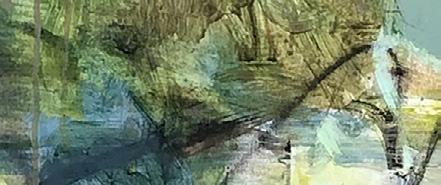
When the pandemic hit, my church, Science Hill Friends Meeting in Asheboro, North Carolina, ceased hosting events with food. I missed these gatherings, the fare as much as the fellowship, especially the array of deviled eggs. In the summer of 2021, I frequently prepared them at home, just for my husband J.P. and me. Nothing beats the heat like a cold supper.
95 N C L R ONLINE North Carolina Miscellany
“Then Jesus was led by the Spirit into the wilderness to be tempted by the devil.”
–Matthew 4:1
“A lovely personal essay about good and evil and deviled eggs – what could be better? At turns funny, thoughtful, and a little heartbreaking, the story revolves around a strange and prophetic soul who shows up at a local church in search of help.”
—David Cecelski, final judge
I love making these tasty little tidbits as much as I enjoy devouring them, and I find the act of halving and popping out the yolks particularly satisfying. I mash those golden demilunes with two forks, and for some reason that old folk saying – “speak of the devil and he’ll appear at your elbow” – always circles through my head.
“Better be careful,” said the homeless man who turned up on our church porch in July. “Helping someone like me might invite Satan into your life.”
My heart beat a little faster as I handed him a turkey sandwich, uneasy by his inability to look me in the eye. I grasped the rail of the meeting house as I spoke, grateful that J.P. stood beside me. “We’re not worried.”
When we asked, he mumbled his age, twenty-eight, and his name, Gabriel. I wondered if he found irony in the fact that he shared a moniker with one of the seven archangels in the Bible, a messenger known for delivering good news rather than fear.
He didn’t touch the sandwich, although he did pop open the cold Coke. Someone else had dropped off a pair of jeans and two new shirts, but he had left this bundle unopened. He preferred his own attire: ripped canvas pants over long underwear and a sleeveless black hoodie, which he frequently adjusted to cover his hair, already thinning. His nose veered a little to the right, perhaps the sign of an injury or deviated septum. I examined his arms and was relieved to see that they
were free of needle marks. Given his discomfort with our presence, I wondered if he was autistic.
J.P. retreated to the safety of the mechanical world, the world of the fixable. “Do you need those to see?” he asked, gesturing toward Gabriel’s glasses. One of the fuzzy and scratched lenses lay at a nearly forty-five-degree angle. He handed them to J.P., who tried unsuccessfully to pop the lens back into position.
Gabriel wouldn’t tell us where he came from, but he brightened when we asked him about where he was headed. “Maine.”
He had arrived at Science Hill on a kiddie bike, which he had leaned against the rail. A flashlight had been crudely tethered to the handlebars with duct tape. My heart surged with pity.
“On that?” we both cried. Your faith, I wanted to say, is stronger than you know. Still, I bristled at the prospect of what our aid might entail. We were knee-deep in the renovation of a 1969 Airstream with spare parts strewn all over our garage. I didn’t have time for a new project.
“We’ll be back to check on you,” I offered lightly, as we walked away and drove back to the comfort of our to-do list.
People have been spicing eggs since the days of the Romans. Medieval cooks in the fifteenth century added cheese and raisins to the yolks, and, curiously, dusted the egg halves with sugar. Today, the act of “deviling” an egg varies widely, according to individual tastes and traditions. For my friend Ruth, deviled eggs wouldn’t be deviled eggs without the smooth backdrop of mayonnaise. Specifically, Duke’s. None of that Miracle Whip or low-fat stuff.
96 NORTH CAROLINA LITERARY REVIEW Winter 2023
“Better be careful,” said the homeless man who turned up on our church porch in July. “Helping someone like me might invite Satan into your life.”
My childhood pal Sarah Beth adds a tablespoon of hot pickle relish to her eggs. My writing buddy Pat offers the ultimate naughtiness: a dribble of caviar on top.
My late grandmother Wilma abided by the classic method in her dog-eared 1968 edition of Better Homes and Garden’s New Cook Book. With yolks from six hard-boiled eggs, she’d add a quarter cup of mayo, one teaspoon each of white vinegar and prepared mustard, one half-teaspoon of salt, and a dash of pepper. She’d pulverize the final concoction with her handheld mixer and spoon it neatly into the whites.
I am always riffing off this time-worn recipe, often using soy or Worcestershire sauce instead of salt. Sometimes I use pickle juice instead of vinegar and add a sprinkle of red pepper. The devil for me comes with peeling the eggs, a process that invariably results in shredding one or two, enough to make Wilma tsk-tsk in her grave. But the taste is all that matters, that sweet-sour-slightly peppery flavor of the seasoned yolk, and the comforting lump of an egg in my belly.
Membership in the Missions & Outreach Committee didn’t come with a recipe. We aimed to serve as the “hands” and “feet” of God since, according to a prayer by St. Teresa of Avila, “Christ has no body now on earth but yours.” As Chair, I took the lead and organized our efforts, usually centered around easing sickness, hunger, and death in the community. Last year, we collected funds – what is known as a love offering among Quakers – for a local woman who lost her son in a car accident, and I helped care for her youngest children after school while she finished her nursing degree.
To my knowledge, no one had ever camped out on our porch, an event that flummoxed the entire congregation. Everyone who drove by and spotted the destitute young man sent an email to our listserv. The messages teetered between
concern – I have clothes that might fit him. . . . Does he need toiletries? Should someone tell him about the outdoor spigot? – and tongue-clucking – On drugs, I bet . . . Someone should call the sheriff.

Someone did, and a deputy stopped by, callously offering to drop Gabriel off at the Guilford County line, something we had never thought of, but which I suspect is standard practice. Yet another round of emails. Remember last year how someone stole the air conditioning unit at the Fellowship Hall? We can’t be too careful. . . . Spending the night on our porch is not breaking the law. . . . What would Jesus do?
Our new friend didn’t make it easy to help him. Save a mysterious voucher for food stamps from Buncombe County, Gabriel lacked any identification. My fellow committee member Ann, retired from the county records office, convinced a former co-worker to locate a copy of his birth certificate so that he could secure a temporary I.D., which he would need to get a job. That’s how we learned he had been born in Texas. I thought of my
97 N C L R ONLINE North Carolina Miscellany
Everything & Nothing, 2019 (acrylic, oil stick, graphite, glazes, plaster on canvas, 60x48) by Krista Harris
COURTESY OF THE ARTIST
own adult son, Dashiel, who had once struggled to find his footing in New York City. If he had fallen on hard times, I hope that someone would have helped him in the same way or, at the very least, reached out to me. On the second day, we swung by the church to check on Gabriel and I asked him if he had any family whom we should contact.
“That would be invoking the Devil,” he said, fixing dark, inscrutable eyes on mine, and then I suddenly understood I had crossed a boundary. As I slid back into the car, telling J.P. to drive on, I suspected we might never see him again. By dawn the next morning he was indeed gone, having peddled away on that kiddie bike with those blurry and rickety glasses.
I admit to feeling a tiny wave of relief. We had indeed done all we could. More than enough, I thought, as I folded mailers advertising Bible School. I must, I noted, pick up some new labels – thirty labels per page rather than just fourteen. Next, I assembled a notebook with photos of the various designs of meat, cheese, and fruit we could use as a reference when creating food trays for receptions. These preoccupations steered away any thoughts of Gabriel.
The work of our committee was celebrated at every turn, and I felt a tickle of gloat after hearing someone say: What would we do without Ashley? Then I remembered a former boss who made it a
practice to publicly commend the lowest performers at staff meetings in an effort to shore them up, and my smugness evaporated immediately.
The next morning, I woke up thinking about Gabriel. I remembered all those times when I couldn’t reach Dashiel. Just a quick text, I would beg him, just to let me know you’re okay. Gabriel had left Science Hill on a kiddie bike, and if he planned to go to Maine, he would traverse major highways with blurry glasses and only a backpack. And of course, that demon. He had been charging a smartphone on our porch, although he claimed to lack the app for calls or texts and could accept only emails. Where did you go? I wrote and was relieved to hear back by lunch: I rode out, a week’s a little long to be on your porch. I wouldn’t recommend you help that much. Satan has it out for people, humans here on earth or anything that’s considerably beneficial towards God’s will.
His words – that odd mix of prophecy and pessimism – led me to believe that he must have come from a fundamental Christian background, the kind that spoke more of evil than goodness. His diction also confirmed his intelligence. He had resisted
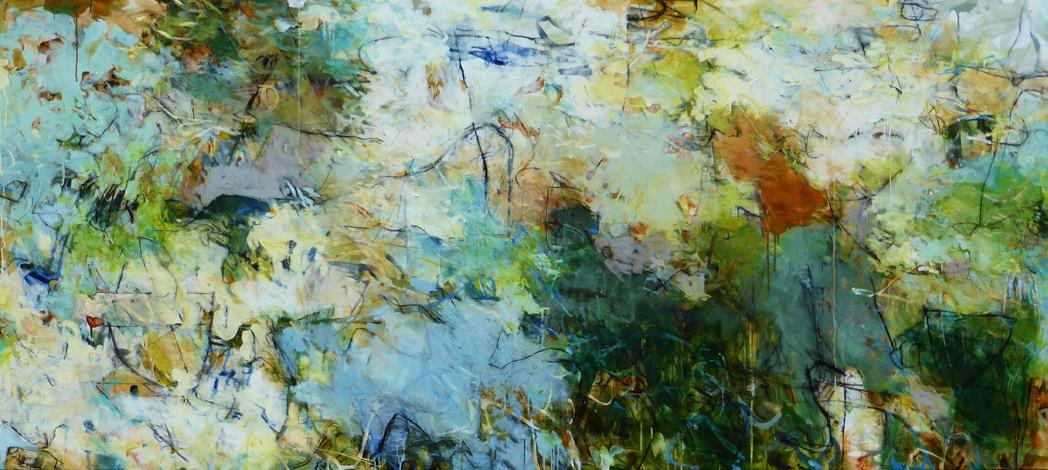
98 NORTH CAROLINA LITERARY REVIEW Winter 2023
COURTESY
ARTIST
Leap of Faith, 2014 (acrylic, crayon, graphite, glazes on canvas, 54x120) by Krista Harris
OF THE
our charity, but he lingered under our roof for two nights, feeling safe enough to sleep on a bedroll someone brought him. Helping him wasn’t going to be easy. It would take something I didn’t know if I had – not a tool or a recipe or a to-do list.
I breathed and offered up an old Schwinn, a twenty-one-speed green and white touring bicycle donated by my friend Tammy. Much more suitable for a trip to Maine, I wrote, not knowing where he was or how we would get it to him. Let us know if we can help. But this time he didn’t respond. So I just prayed –for him and for me.
I recently streamed a televised adaptation of Margaret Atwood’s The Handmaid’s Tale starring Elisabeth Moss and Joseph Fiennes. The handmaids, forced to submit to the male hierarchy for the purposes of bearing children in this totalitarian state, are encouraged to eat eggs for fertility. On Episode Three of Season Four, “The Crossing,” the Commander allows the girls to eat from a buffet usually reserved for the elite, not young “maids” with sinful pasts. “The deviled eggs,” he says, with a malicious glint in his eye, “are delicious.”
“What’s the one ingredient you must have in your deviled eggs?” I asked a woman in purple tie-dyed overalls, young enough to be a handmaid herself. We were both pumping gas, and I imagined that anyone in such a whimsical outfit wouldn’t mind an odd question from a stranger.
“Humm. . . .” she said, before suddenly uttering “Paprika!”
Of course, I thought, trying to quash the little comparison with my father’s wife, Vickie, who always added an extra syllable to the middle of the world, making it sound like “pap-per-ica.” My angst at my parents’ divorce and Dad’s decision to marry a woman just three years older than me had long passed, but minor vestiges popped up occasionally, such as when my educated father began
mispronouncing words the same way Vickie did. Such as the word “balsamic,” which he now utters as “balslamic,” a veritable vinegar to my ears.
The last time I made deviled eggs for them, I boiled more than I needed, setting aside four extra egg white halves. That way I ended up with a generous wave of filling in each one, and as a final flourish, I topped it with an olive slice. “There you go again,” J.P. whispered, “trying to show up Vickie.”
While I believed in the Devil, I wasn’t afraid of him. At fifty-four, I knew I had far more to fear from the evil that brewed in my own heart, those insidious snarky
thoughts I had fought all my life. Deep down, I knew my irritation at Dad’s mispronunciations stemmed from envy at his closeness with Vickie, when I should have been grateful for the happiness she gave him. Then there was my neverending annoyance at J.P.’s clutter and my own – old books, old typewriters, old clocks – yet how privileged we were to suffer from an abundance of prosperity! And how I regretted my own prattle in the stream of church gossip – who pulled their weight and who didn’t. My judgment of others, no doubt, flowed from my own insecurities.
I also lacked patience, a fact borne by my failure to peel cooked eggs cleanly. Did my friend Pat understand how much her recommendation rubbed against my nature? I wanted an easy fix.
99 N C L R ONLINE North Carolina Miscellany
While I believed in the Devil, I wasn’t afraid of him. At fifty-four, I knew I had far more to fear from the evil that brewed in my own heart, those insidious snarky thoughts I had fought all my life.
“Cover the cooked eggs with cold water,” she said. “Change it out again. Crack the eggs against the bottom of the pan. Let them sit for a while.”
But I did it. I made myself wait after boiling a batch of eggs, and not only did I not burn my fingers, for the first time in my life, each egg slipped as easily from its shell as a tangerine from its skin. “Would you look at this – ” I marveled to J.P., holding up a glossy white oval. A new frontier for me.
“Guess what?” J.P. shouted to me from the living room, not having heard me. “They say that William Shatner is going into space.”
“Good for him,” I said. “Good for him.”
Sensitive to our current tribulation, our pastor, John Porter, preached a sermon that seemed made to order.
“A certain Samaritan,” John said, quoting Luke 10:33, “as he journeyed, came where he was: and when he saw him, he had compassion on
“Why do you think Gabriel keeps warning us of the Devil?” I asked.
“I don’t know,” admitted our bespectacled pastor. “But in my experience, some people use the Devil as an excuse.”
Aha. I hadn’t thought of this. A defense mechanism. Maybe Gabriel was afraid of us. He very well may have sensed my irritation at how his presence interrupted the easy pace of my life. Throwing up the Devil might save him from rejection.
Retired after a long career in the Quaker ministry, John served Science Hill in an interim capacity. His gentility and good humor had helped heal our church after the chasm created by the departure of our last pastor. After counseling our community on deep matters such as forgiveness and grief, he was caught off guard, I’m sure, by my next question.
“What do you make of the connection between churches and our fondness for deviled eggs?”
He tilted his head for a moment, letting the query sink in. “You’ve stumped me. To be honest, I’ve never thought about it.” He shrugged guiltily. “But I do love them.”
Of course I asked him. I had to. “Vinegar,” he said. “You have to use vinegar.” But ever the peacemaker, John grinned and quickly added: “And a little bit of sugar.”
him.” He then related the parable I had heard long ago, but the words resonated more deeply. This Samaritan not only bound up a stranger’s wounds, he set him on his very own donkey, brought him to an inn, and paid the keeper in advance for future expenses.
“You’ve given me a lot to think about,” I told John afterwards. And my face burnt with shame. A true Good Samaritan didn’t just do what was convenient.
Just one week after Gabriel’s flight, I received a rambling email. My bicycle broke, the right pedal has been having some problems for a while now. I could’ve been hurt really bad, the bike and most parts are just really old and rusted too bad.
I was glad to hear from him, but again, a little flustered at the timing. Today we planned to break down the bathroom area of the Airstream and tear out the damaged subfloor. With my hair, pinned
100 NORTH CAROLINA LITERARY REVIEW Winter 2023
“I don’t know,” admitted our bespectacled pastor. “But in my experience, some people use the Devil as an excuse.”
messily on the top of my head, my holey T-shirt and lack of makeup, I looked like a demon myself.
I thought of John’s sermon, and the words of Jesus in Luke 9:23. “If any man will come after me, let him deny himself.” Could I give up a sunny day we’d devoted to our own project? The weather was indeed perfect, albeit hot. There wasn’t a chance of storms anywhere. It was also the ideal day to pack up the bike in the truck and carry it to Gabriel. A Schwinn for a donkey. I just prayed he wasn’t too far away.
Where are you? I wrote back. As it turned out, he had made it only as far as Graham, less than fifty miles away. And he told me that he’d been sleeping under the porch of a Presbyterian church.

“He’s in Graham!” I announced to J.P. “Let’s take the bike to him!”
“Not before I make a little platform for the cargo rack,” J.P. replied. We’d kept Tammy’s bike in our garage, hopeful that we’d hear back. “The front basket is too wobbly. A little piece of plywood would be a much better rack for his backpack.”
I emailed to say we’d be there as soon as we could. For once, there was no talk of the Devil. There was also a glimmer of gratitude in Gabriel’s final reply. I really would appreciate the help.
“He needs a new pair of glasses,” I told J.P. on the way.
“I was thinking the same thing.”
This surprised me. I’m far more likely to give to the homeless than my conservative husband, who, the last time we passed a panhandler holding a sign that said “I’ll take anything,” muttered: “How about a lecture in economics?”
Glasses would be a big expenditure, but I didn’t worry about the money. I worried more about whether Gabriel would accept them. Would he cite the Devil again?
The concept of the “Devil” is not limited to JudeoChristian traditions. All major world religions bestow a name on the destructive force that thwarts humanity from a greater purpose. In Islam, he is Iblis and in Zoroastrianism, he is Ahriman, which is traditionally written upside down to underscore his repulsiveness. In Buddhism, the antagonist is Mara and Hinduism offers several classes of demons, including the man-eating rakshasa
In the Old Testament of the Bible, we encounter the title “ha satan,” which in Hebrew means simply “the adversary” or “the accuser.” Ancient texts from the Book of Numbers even refer to God’s helper, the angel who blocked the path of Balaam on his way to curse the Israelites, as “a satan.” In the Book of Job, the figure of Satan shows up with the angels who present themselves to the Lord and dares God to challenge the faith of Job, his most loyal follower. In this role, curiously, Satan functions almost like an associate, consulting with God and dialing up the torture. In fact, the words between the two sound very similar to the conversation among co-workers after a long holiday, were it not for the ominous subtext. “Where have you come from?” asks God. Satan’s reply: “From roving about on the earth, and from walking back and forth across it.”
The “Devil,” sometimes addressed “Satan,” emerges as a consolidated character representing
101 N C L R ONLINE North Carolina Miscellany
I Remember This, 2018 (acrylic, oil stick, graphite, glazes, plaster on canvas, 62x58) by Krista Harris
COURTESY OF THE ARTIST
the ultimate evil power only in the New Testament. The word “devil” comes to us from the Greek word diabolos (from dia-bollein) which means to “slander,” “attack,” and “throw across.” I don’t believe it’s a coincidence that this wicked being is personified with particular gusto in the New Testament because here God is also personified, in the figure of Christ. In the Gospels of Mark, Matthew and Luke, God actually leads Jesus into the wilderness to face Satan. The adversary offers the fasting Christ food and riches, and does indeed “throw” his words against the power of God.
Gabriel’s appearance in my life seemed to be my own walk through the wilderness. This mumbling young man with the tattered pants and crooked nose gave me the opportunity to do better. To liberate me from complacency and inspire me to keep evolving. “Not quite right,” I pronounced after tasting my latest batch of deviled eggs. It was the dill pickle juice, I decided. “Too sour.”
When we found Gabriel waiting outside the Sheetz station in Graham, he wore a different pair of glasses, lenses that only magnified rather than corrected, something he’d picked up at the local Goodwill. When J.P. brought up the idea of a new pair, he shuffled his feet and looked away.
“That would be most welcome,” he said stiffly. I didn’t fret about the money. The difficult part was finagling an eye exam and a pair of glasses in the same day. We first drove to the local Walmart, where the technician informed us that such a request was out of the question. She suggested another optometrist. This one referred me to another one. Eventually, I found an eyeglass center in the nearby city of Burlington and they had an opening, although they couldn’t see us right away, and now J.P. turned testy.
“I’m going to Harbor Freight,” he said, wheeling into the parking lot of a shopping center. “I need to get a set of numbered drill bits.” Then he stopped. “Do you mind? I’ll just be a minute.”
“Sure,” I said, but as I watched him walk away, I thought of the crumpled backpack in the seat beside Gabriel. What if he carried a knife? What if the Devil told him to use it on me? I gripped
the door handle just to be safe, knowing I could open it and scream, if nothing else.
We sat in silence for several minutes, what felt like hours, and sweat greased my hand. How do you make small talk with a man who spoke so often of the Devil? Yet I knew he was smart, which gave me an opening.
“I bet you like to read,” I said. “Who is your favorite author?”
He paused. “Who wrote that book about 1984?”
“George Orwell,” I said, and for the first time I felt a spark of connection rather than pity or fear. The gloom in the truck lifted. 1984 remains one of my most favorite novels. The character of the doomed Winston captivated me, particularly his courage to rebel against his own devil, Big Brother, and his brief union with Julia. A glimmer of hope in a bleak world.
“That was a great book,” he said, before mumbling a few words about the relevance of a totalitarian state. Yes, we shared an appreciation of dystopia, but then I realized that this free spirit must have felt oppressed.
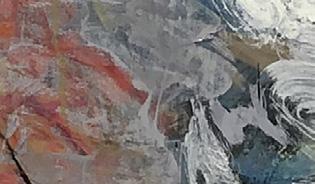
“You could write a book!” I exclaimed. “Think of the adventure ahead of you.”
“Mumm,” said Gabriel thoughtfully, and we were both quiet. I let go of the door handle, and exhaled, no longer anxious. But I was grateful to see J.P., who bounded back to the truck, practically sprinting. At some point I suspected he had worried about me, all alone with a virtual stranger.
“Found my drill bits!” he announced, dangling a bag in his hand, and then we drove to our appointment.
After Gabriel’s exam, a technician led us to a rack of discount frames with a pair by Armani that seemed to suit his rectangular-shaped face. Because his prescription was fairly basic, his glasses were ready within the hour. And there was a certain cosmic justice to a homeless man in threadbare pants and a hoodie wearing Armani. Walking out into the sunshine with his new glasses, he almost danced.
102 NORTH CAROLINA LITERARY REVIEW Winter 2023
“The world looks so different now,” he said, turning in a circle. “This is great!”
When we took him and his new bike back to Sheetz, J.P. spent a few minutes showing him how to adjust the gears. They worked together to fasten the flashlight on the Schwinn, and with a gasp, I saw Gabriel remove a pocketknife from his bag and use it to cut a new piece of duct tape. He could have indeed used that knife on me, I realized, had the Devil told him to. But no one had heard from his demon today.
“Do you know how to get to Maine?” J.P. asked.

He nodded. “I have GPS on my phone.”
Gabriel then pedaled away from us, simultaneously cruising and braking as he mastered his new wheels.
He was indeed a free spirit. He might never hold down a regular job, and for whatever reason he preferred to be alone. I took comfort knowing that however circuitous his path to Maine, he knew he would be safe sleeping under the eaves of a church. He also knew that the Devil wouldn’t frighten people from helping him.
Was this goodbye? I wondered, watching him get smaller and smaller. But no, he circled back for one final lap, slowing by us to hold two fingers in a peace sign. My heart lurched, and tears stung my eyes. The world felt different to me now, too.
“Goodbye!” we shouted. “Take care of yourself!”
“If the Missions Committee doesn’t pay you back,” said J.P. on the way home, “I will. I just won’t tithe this month.”
I didn’t stress about it. Science Hill didn’t lack for money. What we lacked was the willingness to give our time, to help a lost soul find his way again. Today I felt something far better than pride; for the first time in weeks, I felt content.
“You old softie,” I said to J.P.
“Share your blessings,” he said, repeating the words on the marquee board of a church we drove by.
When Jesus says to his followers “You are the salt of the earth” (Matthew 5:13), he wasn’t comparing
them to salt only because of the flavor. He praised them for the value they brought to the world, for in ancient times, salt was highly prized, as both a seasoning and preservative. So valuable that Roman soldiers were sometimes paid in salt, hence the word “salary.”
As an epicure, I’ve always sought the best variety of flavors – Vietnamese cinnamon, Madagascar vanilla, Hungarian paprika – but no recipe for any dish, including deviled eggs, would ever completely satisfy me. How can it be better? I would perpetually wonder. What should I add next time? Such is the piquancy of being human. We’re always questing for ambrosia on earth. I may strive to emulate Christ and to be better, kinder, humbler, but the Devil will forever rove through the earth, sometimes as close as my elbow.
“Deviled eggs are intended to be eaten with the fingers . . . using the three-finger rule, ladies – the thumb, the index finger, and the middle finger,” writes Miss Janice, a self-described prissy Southerner, in a post on her etiquette blog. “If some of the stuffing falls onto your plate, you would use a fork to eat that part.”
Miss Janice would definitely raise an eyebrow at J.P., who pops the whole egg half into his mouth all at once. Instead, I just nibble, savoring those fleeting moments of bliss. Such as watching Gabriel cycle away from us with confidence and grace. The memory of his delight in a new view of the world. And the budding hope that along his journey to Maine he would let other people help him. I would think of Gabriel for a long time after that summer, especially on the last bite of a deviled egg: the silky yolk, a perfect balance of sweet and sour, followed by the yield of that tender pillow. n
103 N C L R ONLINE North Carolina Miscellany
How can it be better? I would perpetually wonder. What should I add next time? Such is the piquancy of being human. We’re always questing for ambrosia on earth.
2022 JAMES APPLEWHITE POETRY PRIZE SEMIFINALIST
BY CINDY BROOKSHIRE

Gas Station Hat
The sale rack by the door of the Duck In Blossomed with colorful gas station hats One to fit every traveler’s perception of self: Leather witch hunter. Oilskin river guide. Buffalo plaid, like Catcher in the Rye. Straw beachcomber. Camo boonies or buckets. Construction worker Gloware.
I went for the southern belle: Wide brimmed and floppy with a pink bow. I turned this way and that, trying to fit The whole of my reflection into the tiny pole mirror. I wore that twelve-dollar impulse buy Every day at the beach. It was the crown Of my vacation happiness.
Once home, it cloistered on a closet shelf for years Until one day I placed it on the yard sale table, Thanking it for the memories of my happiness. A little girl eyed it carefully, Producing two quarters from her pink purse. She put it on and rode away on her bike, Streamers from the pink bow trailing.
by Kyle Highsmith
KYLE HIGHSMITH was born in Greenville, NC, and earned a BS from NC State University’s College of Design. He left his architectural practice and began painting full time in the 1980s. He travels widely to paint en plein air throughout Europe, the US, and the Caribbean. His work is in the permanent collections of the North Carolina Museum of Art and the Greenville Museum of Art, in private collections, as well as in many corporate collections, including GlaxoSmithKline, Duke Hospital, and Northwestern Mutual. See more of his art at City Art Gallery in Greenville.
CINDY BROOKSHIRE is a regional representative of the North Carolina Writers’ Network in Johnston County and a member of Triangle East Writers. Her writing honors include grand prize in the 2021 Carolina Woman magazine writing contest. Her poetry and prose appear in the 2023 edition of County Lines. In 2021, she self-published two books: A Heart for Selma: 12 Stories of Activate Selma NC and Little Towns. She currently resides in Pine Level, NC.
104 NORTH CAROLINA LITERARY REVIEW Winter 2023
Charming Waves, Atlantic Beach (oil, 30x36)
PHOTOGRAPH BY SARA HECKER; COURTESY OF CITY ART GALLERY, GREENVILLE, NC
2022 JAMES APPLEWHITE POETRY PRIZE SEMIFINALIST
BY LIZA WOLFF-FRANCIS

Nest
Every three months, my husband hangs a wreath on our front door to welcome a new season. He says it brings him joy.
Just a few weeks ago, he hung a spring wreath of fake Buddleia, purple corn cob shapes atop green leaves along with some other white flower, possibly meant to be Heliotrope.
Twice, I walked outside and a bird seemed to fly out of me. I looked around, saw nothing. Then, coming home before dusk, about to climb the porch stairs, I saw the bird fly into a nest, its escape disclosing its location inside the wreath where four sky-colored eggs lay small as candied almonds. Even with the door opening and shutting, the pulse of the nest is steady still, tucked into the wreath.
Love your round egg world, little birds to be. Eggs to hatch in a round nest held by a round wreath, made home at my door. Hidden at the threshold, let the intimate details of your life entwine with mine.
LIZA WOLFF-FRANCIS has an MFA in Creative Writing from Goddard College. She was chosen to write in Tupelo Press’s 30/30 poetry challenge for the month of September 2020. Her writing has been widely anthologized; she has a chapbook, Language of Crossing (Swimming with Elephant Publications, 2015); and her work has most recently appeared in Wild Roof Journal, SLAB, and eMerge magazine
Raleigh, NC, resident ANN ROTH earned an MFA in Textile Design at the University of Kansas. Her varied career includes arts management and administration, commercial and non-profit galleries, museum curatorial positions, and teaching, including thirteen years at Meredith College, where she was also the gallery director. Primarily a loom weaver, she recently discovered the possibilities of hand weaving Tyvek, a material typically used in construction. In 2004, she was diagnosed with Parkinson’s Disease, which led to her selection in June 2022 as the Universal Access Artist in Residence at Artspace in Raleigh. Her work was featured in the Leadership Exchange in Arts and Disability (LEAD) Conference in Raleigh in August 2022.
105 N C L R ONLINE North Carolina Miscellany
COURTESY OF THE ARTIST
Wings, 2021 (acrylic on Tyvek, cut apart and interlaced, 27x45) by Ann Roth
WHAT SURVIVES OF US
a
review by Anna McFadyen
Alana Dagenhart. Yellow Leaves: Poems. Redhawk Publications, 2022.
Cheryl Wilder. Anything That Happens: Poems. Press 53, 2021.
Raleigh native ANNA MCFADYEN has reviewed for NCLR since 2018, as well as for EcoTheo Review . She previously served as a chief coeditor of The Colton Review . She earned her MA in English Literature from NC State University and her BA from Meredith College, where she received the Norma Rose and Marion Fiske Welch scholarships in English and in Creative Writing. Her graduate research focused on English Romantic poetry in the context of natural history, and she continues to explore connections among art, literature, and the natural world in her work. In 2020, she was a semifinalist in the James Applewhite Poetry Prize contest.
ALANA DAGENHART is a poet, artist, and teacher residing in North Carolina. She is the author of a chapbook, Blood (Finishing Line Press, 2016), and her poems have appeared in several literary magazines, including Pinesong, Kakalak, and Tar River Poetry. In her creative work and literary studies, Dagenhart focuses on global citizenry, Latin American poetics, and the intersections among science, art, and poetry.
In their debut poetry collections, Alana Dagenhart and Cheryl Wilder survey death, tragedy, and family bonds with unwavering frankness. As the dust of memory continually stirs and resettles, both writers pick through the debris fields that litter individual human histories. In the aftermath of grief, their poems’ speakers discover what is left of themselves, what remains of forebears within their own bodies and spirits, and how their personal decisions have impacted others. Dagenhart’s Yellow Leaves and Wilder’s Anything That Happens share many specific similarities, whether describing tragic car accidents, the loss of parents to esophageal cancer, unexpected joys of pregnancy, burdens of motherhood, deep love for sons, or the complex stages of sorrow. However, in the act of “Continuing,” to borrow Dagenhart’s term, these books’ personas rearrange the shards of their identities with vastly different degrees of hope and anguish.
Because both poets use snapshots and recurring flashbacks to shape their narrators’ dispositions, these collections bring to mind Kathryn Stripling Byer’s declaration, “I walk among photographs / wondering who it is these people think / I am.”1 Dagenhart, whose poetry is
openly autobiographical, writes as if turning yellowed leaves in a family album, capturing portraits of her parents, children, ancestors, and cherished places, page by page. Her book’s cover features a childhood photograph of herself on the knee of her father, whose remembrance fuels much of this nostalgic collection. Yet her voice is never oversentimental. Her graphic descriptions of the dying process are as unvarnished as Wilder’s depictions of the car wreck that drives her collection’s narrative. Wilder’s poems read like a series of crime scene photos, by comparison. Unbearable flashbacks recur throughout her book, gradually revealing the tragic outcome and building suspense up to the final page. In several poems, Dagenhart and Wilder create a heightened sense of drama by arranging words spatially. For example, Dagenhart uses line breaks in “My Father was Nineteen” to describe a woman barreling toward a seven-year-old boy on his bicycle. The driver blew her horn, the scared child swerved into her path.
In the moment it takes to shift one’s eyes to the next line,
106 NORTH CAROLINA LITERARY REVIEW Winter 2023
CHERYL WILDER is the author of a chapbook, What Binds Us (Finishing Line Press, 2017), and her work appears in Prime Number Magazine, Verse Daily, and other publications. She lives near the Haw River in North Carolina. She gives talks and workshops on art and writing, chairs the Burlington Writers Club student writing contest, and owns a web development company. She earned her BFA from UNC Wilmington and her MFA from Vermont College of Fine Arts. She has served as writer-in-residence at SistaWRITE and held a residency at Sundress Academy for the Arts. She is also a founder and editor of Waterwheel Review
1 From “In the Photograph Gallery” by Kathryn Stripling Byer, Catching Light (Louisiana State UP, 2002).
Dagenhart leaves readers unsure of the direction the boy will swerve – in front of or away from the car – and the lines swerve on the page, too. After surviving critical miles in an ambulance, “The boy lived / ten days,” we are told. Between these two spare lines, the hope of life dangles again, and the final shift feels devastating.
In this manner, both poets use staggered line indentations to mirror their poems’ motions. Wilder uses this technique in three connected poems to imitate different types of “slipping” that change the narrator’s life. In “Slipped I,” the back-and-forth positioning of line breaks mimics the drunken dancing of the narrator and her friend. It then mirrors the tossing of keys back and forth between them, as they decide who will drive. By the end of the poem, this motion turns into the swerve of their car, which wrecks both friends’ lives:
I swayed my shoulders
and you shimmied your feet to the pop harmony until the rain-slick curve
took the car took the wheel and we slipped
until laughter was slapped from our bodies.
“Slipped II” creates further visual disorientation as the speaker flutters into consciousness at the steering wheel, only to see her friend slipping in and out of life, next to her. Even the lamppost they hit flickers “on / and off” across the page. In “Slipped III,” which relates the wreck’s aftermath, the speaker says, “I lost the last moment / of a person that was me.” She slips into a life of guilty grief and is arrested for her crime.
Dagenhart uses this technique in “I Dream My Father,” as well, to create disoriented motion. In a dream, the speaker believes her father is alive again:

I am so excited I bolt from sleep
to see him. I run into the room, and he has moved into the next room and when I round the corner he is gone through another door to the next room,
and each time I advance, he’s escaped me, gone ahead
Readers must chase the father’s ghost with her around the page, through a maze-like house. Although these collections differ in tone and theme, such as their explorations of happy or unhappy families, each poet’s craft achieves a similar sense of animation, and both personas’ grief moves toward the possibility of closure.
107 N C L R ONLINE North Carolina Miscellany
COURTESY OF THE ARTIST
Before the Crash (acrylic & mixed media on canvas) by Alana Dagenhart
NORTH CAROLINA WRITERS: Submit your books to the annual North Carolina book awards, given by the North Carolina Literary and Historical Association and affiliates. Find eligibility and submission guidelines here. Due annually by July 15.
Alana Dagenhart’s Yellow Leaves explores a close and loving relationship with her deceased father. The collection’s poems relate not only the pain she feels in his loss, but also the evergreen nature of their shared memories. Her descriptions of literary trips, natural wonders, and her own body reveal a sense of her father’s continued presence. She believes she has inherited his instincts and even the rhythm of his heart, as she grapples with the darkness of bereavement. In “Blind,” Dagenhart’s metaphor for this phenomenon uses imagery of Table Rock (an area of Linville Gorge, NC) in springtime:
Monarchs crown her head fluttering braids to Mexico –
they don’t even know to where none will survive the trip south with no map only genetic memory flying dark: black on edges of wings.
Naturalists have observed that Monarch butterflies give birth to more than one generation along their continental migration, dying so that their offspring may keep flying to where they are meant to go, to a place they have never seen. Dagenhart uses this wild miracle to embrace the beauty of the father-child relationship, which exceeds the grave, invisibly piloting offspring along their journey. She says the “rhythms” she feels in her heart “are just your / heart, Dad, winged / retinas in mine,” still guiding her. Moreover, during celebrations of Día de Muer-
tos (Day of the Dead), in some regions of Mexico, Monarch butterflies are welcomed back each fall as the souls of departed relatives. Thus, Dagenhart’s beautifully complex allusion reflects her interest in Latin American cultures, which she expresses throughout Yellow Leaves.
In a Shakespearean or Vergilian turn, Dagenhart’s speaker often feels as if she is seeing or conversing with her dead father and other ancestors, such as “Grandfather Clyde,” whether in her waking imagination or in dreams. She even encounters the ghost of one of her literary forebears, Thomas Wolfe. In this way, her poems drift confusedly in and out of reality, hovering between death and life, past and present.
Dagenhart’s reference to maps in “Blind” points to another recurring theme: cartography. Her poems create maps of the world and of bodies, but the speaker cannot always find the proper key to read them. In this section, she alludes to such recent global troubles as the pandemic, Ukraine, and the border crisis. She memorializes our collective disorientation and mourning, as we have sought a map to locate our former sense of safety and normalcy. Her poem “Pandemic” even expresses relief that her father died of cancer before Covid-19’s advent, “a crisis avoided / a near miss somehow,” despite her grief.
Dagenhart often writes about her love of the Appalachian Mountains, but she, like Byer, is also a traveler and a wanderer in her collection. Dagenhart

soars away from home across the maps she imagines, whether on pre-pandemic trips or in her dreams. She writes about places as remote as Santiago, Chile, a city so beautiful she “could not believe it to be true.”
At home or abroad, Dagenhart’s poetic language is full of rich, elemental imagery, hopeful realism, and joy in nature’s beauty. The cairns she erects to loved ones in Yellow Leaves, whether to family or beloved Carolina poets like Byer and Robert Morgan, seem to turn the “untruth” of Philip Larkin’s line “What will survive of us is love” into a maxim of deep sincerity.2
Cheryl Wilder’s collection Anything That Happens tells the story of an irrevocable choice. The Haw River poet opens with her young persona’s sense of invincibility: “Until I was twenty, I believed anything / wouldn’t happen to me.” The worst does happen, however, when her drunk driving leaves a friend wavering between a coma and death. In “Autopilot,” the speaker laments, “I don’t know how to grieve / for a tragedy I have
108 NORTH CAROLINA LITERARY REVIEW Winter 2023
2 From “An Arundel Tomb” by Philip Larkin, Collected Poems (Farrar, Straus, and Giroux, 1988). 53
COURTESY
OF PRESS
ABOVE Cheryl Wilder reading from her new book for its online launch, hosted by Press 53, 23 Mar. 2021 (Watch reading here.)
caused.” Later, in “For What It’s Worth,” she finally admits, there is no end to the price of crashing. A car into a pole. A friend’s skull into a windshield. My longing to reach for a hand . . . What is left but a future where I am not worth saving. In the long aftermath of this event, she feels an isolating and inescapable guilt.
Wilder’s speaker admits full responsibility for the accident, saying, “[W]ho am I / if not my actions?” Nevertheless, she is unable to forgive herself and sees little possibility of redemption for her mistake. Standing before a judge in “He Called Me the Devil,” she thinks, “[P] enance began / after I opened my eyes in the car / when the devil realized she could breathe.” Declaring, “I don’t want to be absolved,” in “No Contest,” she never allows herself to walk away from the scene of the crime emotionally. The poem “Bailed Out” finds her ruminating on the impossible “what if,” calling it “a crossroad so difficult to leave / I built a roadside bench.” As a permanent spectator to tragedy, the narrator suffers flashbacks for years, illustrated in the poem “No Contest.” She says, “Then a mirage takes shape // and I’m on the same road, beside the same car, / asking the same question: What have I done?” Wilder’s collection reverberates with this “howl” of regret. In “Note to Self,” we learn that she has had to live “decades since // the jaws of life pried [her] open,” still sit-
ting at this crossroad. However, the collection’s persona encounters a different turning point in “Speak of Crossroads,” where the birth of her son gives her the love and belonging she has craved. She states, “[O]ur baby / would carry my heart / in his tiny clenched fist,” and she strives to give him a good life. She finds partial grace in motherhood but still worries that “karma” might take away her son. This woman fears the impartial scythe of chance, as well – that the worst can happen to anyone, any day, as the collection’s title implies. These fears are reminiscent of “Sunflowers,” by North Carolina poet Patricia Hooper, describing the death of a toddler who slipped over a cliff: “His father / had turned away only for a moment / and then looked back – the sunny path was empty.”3 Whether describing chance or the persona’s past crime, Wilder’s poems contain the same sinister dread found in “Whoever You Are: A Letter” by Lisel Mueller: “Someone who does not know you / somewhere is cleaning his rifle, / carefully weighing the bullets / that will put you out of his life.”4 Anything that Happens reads like one long act of “looking back” too late –never seeing the cliff or the gunman.
Although the automobile accident is the focus of Wilder’s collection, her book’s persona struggles with a different kind of wreckage during her lifetime:

the effects of an absent father, an abusive partner, and an emotionally unavailable mother, who later has cancer. Poems in the book’s second half explore how illness brings the daughter closer to her mother, as a caretaker, and how she copes with bereavement. In “Resemblance,” Wilder writes, “I see her everywhere / in me more than ever / after a lifetime / of focusing on Dad.” The speaker eventually becomes as haunted by her mother’s death as by the wreck.
As time passes, she works toward a psychological clearing, regarding all these tragedies, but she is not entirely successful. In “Emotional House,” the speaker announces, “I reclaim this house / where doors divide grief in the bedroom // from guilt simmering in the kitchen – even trauma has to eat.” She eventually finds the possibility of “salvation” in “Home Safe,” as Wilder ends the collection on a note of tentative hope. n
109 N C L R ONLINE North Carolina Miscellany
4 In Lisel Mueller’s Alive Together (Louisiana State Press, 1996).
COURTESY OF PRESS 53
ABOVE Wilder signing preorders at Scuppernong Books, Greensboro, NC, 8 March 2021
3 In Patricia Hooper’s Wild Persistence (U of Tampa Press, 2019).
2022 JAMES APPLEWHITE POETRY PRIZE FINALIST
BY ANNE MYLES
Horizons
1. In the Middle
What was my destination? Vast blue, then nothing but the limit where sky meets earth.
Around me the prairie long ago plowed under; fields an unrolling sameness, turned and subject.
I wondered, why should a cloud be lonely, composed of everything that surrounds it?
In the foreground, the day’s labor. In the distance, that line where two immensities touch,
and I thought, yes, there it is, exactly that –my life always ahead of me, always further away.
2. In Transit
Twenty years fell back in my rear view: razed fields, a bright sign glowing in gray sky.
At a rest stop in West Virginia, I met a woman with three dogs and a pickup, headed the same way.
Everything felt loose, liquid. I didn’t understand what might be waiting but it pulsed with hope –my old horizon lost, its pure austerities. The land around broke open, deepening
into some ragged green remembrance. No more was what was granted the same as what I chose.
110 NORTH CAROLINA LITERARY REVIEW Winter 2023
ANNE MYLES is the author of What Woman That Was: Poems for Mary Dyer (Final Thursday Press, 2022). Her work has appeared in many periodicals, including North American Review. A recent transplant to Greensboro, NC, she is Professor Emeritus of English at the University of Northern Iowa and received her MFA from the Vermont College of Fine Arts in 2021. She has been nominated for a Pushcart and was co-winner of the 2022 ellipsis… Award, judged by Carolyn Forché.
3. At the
Where the piney flatlands run out to an end in glitter and expanse. Where I have no craft

to sail out towards the distance, blue-misted. Sand wrestles my feet down. The waves roll in in whispered repetition, urging us to live by moments in their breaking. What waits beyond earth’s curve?
Two women I loved once rode these swells together while I hung back on shore. Earthbound by my fear
of the rogue wave I pictured far out, gathering to drag us under, expel us shattered – or else not.
Durham, NC, artist LEE NISBET moved to the Triangle after graduation from art school. She has worked in multiple creative jobs while continuing to study and practice art. Currently employed by the Nasher Museum of Art at Duke University, she was an inaugural artist of the Golden Belt Artist Studios in Durham. Her work appears in many private collections and has been included in exhibitions throughout North Carolina, most recently in the exhibit Make//Take in Raleigh’s Block Gallery, as well as in Peel Gallery in Carrboro, NC. The exhibit was part of the annual Click Photography Festival.
111 N C L R ONLINE North Carolina Miscellany
Edge
COURTESY OF THE ARTIST
#merging #nightdrives 26, 2022 (archival pigment print, 30x40, edition of 5) by Lee Nisbet
2022 JAMES APPLEWHITE POETRY PRIZE FINALIST
BY JO ANN S. HOFFMAN
The Divine Miss Hitchins
Beauty and authority radiated from the lipsticked, spike-heeled spinsterhood of Miss Dorothy Hitchins, children’s librarian at Kent Branch library through the 1950s.
I was devoted disciple tethered as tightly by the creed of Summer Reading Club and the Famous American series of orange-bound biographies as by the perfect halo of pin-curls that crowned my idol’s head.
She fed me books like ambrosia on hot Ohio afternoons and I feasted at the children’s tables inside cool marble walls that echoed with the tiny taps of the elegant Miss Hitchins’ heels.
JO ANN S. HOFFMAN’s publications include a children’s book, a narrative nonfiction book, short fiction, and numerous poems in literary journals, including Pinesong , New Verse News , Kakalak , Red Clay Review , Broad River Review , and Flying South. Her honors include recognition from Palm Beach Poetry Festival contests and a Pushcart nomination. A native of Toledo, OH, she and her husband now live in Cary and Beaufort, NC.
112 NORTH CAROLINA LITERARY REVIEW Winter 2023
One summer I filled my little booklet neck and neck with Robert Radkiewicz who always read the most and she praised my second prize while we summer readers hovered near the altar of her desk.
I wonder what heaven Miss Hitchins inhabits, beaming angel of the cosmos of books. Each time I inhale the incense of library air or kneel to search a bottom bookshelf, I breathe out thanks to Dorothy Hitchins who gifted me with this religion.
MARGARET BALZER CANTIENI (1914–2002), born in Newton, KS, grew up in the Midwest. She graduated from Carleton College in Minnesota in 1936. The following year, she attended the School of the Arts, as well as the New Bauhaus, both in Chicago. In 1937, she joined the faculty of Berea College in Kentucky. In further pursuit of Bauhaus theory, she attended summer classes at Black Mountain College in North Carolina in 1945, and studied under Josef Albers. Married in 1946, she and her artist husband relocated to New York where she joined a group of some one hundred women artists affiliated with Atelier 17, an avant-garde printmaking studio in Greenwich Village. Eventually the couple settled in Pennsylvania, where both continued to teach. She actively created art until her death.

113 N C L R ONLINE North Carolina Miscellany
COURTESY OF THE COLLECTION OF BLACK MOUNTAIN COLLEGE MUSEUM + ARTS CENTER; GIFT OF THE ESTATE OF MARGARET BALZER CANTIENI
Three Lights Falling on a Surface (exercise in transparency), 1945 (colored paper and glue, 12x9) by Margaret Balzer Cantieni
2022 ALEX ALBRIGHT CREATIVE NONFICTION PRIZE FINALIST
How to Support Your Daughter When She Moves to San Francisco
Begin by calling her at five in the morning. Every day. When she answers the phone in a groggy voice, claim you forgot the time change. Enlist help from all of your family members. Start a morning phone call rotation schedule and keep it in a spreadsheet. Ask MamaSligh to call Monday at five a.m., Aunt Jan to call on Tuesday at five a.m., and so forth. If your daughter becomes too sleepy to go to work, perhaps she will get fired and return to North Carolina.
Tell her that you heard on Fox News that parts of San Francisco are going to fall into the ocean. Any day now. It’s true. You think it was the Sean Hannity show. Regardless, it’s one of those news shows. She should be careful.
Tell her that you heard that there is no clean water in San Francisco. It’s true. She should be careful if she drinks any water in the city limits.
Tell her you heard on Fox News that in addition to Covid and the AIDS epidemic, which is rampant out there, Hepatitis C and even the chickenpox are making a comeback in San Francisco. It’s a city full of disease. It’s true. You would not be surprised if the Black Plague resurfaces in California.
When she says she has something important to tell you, tell her you have something important to tell her. Tell her about your garden. She needs to know about the wandering daylilies! They are propagating on their own, jumping to new beds, running away, invading the marigolds. Decide to visit her.

When she picks you up at the airport, ask her if people don’t wear bras in San Francisco. Ask her if they sell hairbrushes in the stores.
LOCKIE HUNTER had three essays make it to the final round of consideration for the 2022 Alex Albright Creative Nonfiction Prize. Read the other two in the fall 2022 and 2023 issues of NCLR Online. The author serves as associate producer of the poetry and prose radio program Wordplay on 103.3 FM in Asheville and is a past recipient of a North Carolina Arts Council grant. She holds an MFA in creative writing from Emerson College in Boston and has taught creative writing at Warren Wilson College. Her work has appeared in many periodicals, including Brevity, Christian Science Monitor, McSweeney’s Internet Tendency, and Blue Mountain Review
114 NORTH CAROLINA LITERARY REVIEW Winter 2023
PAUL GEMPERLINE retired from East Carolina University in 2022 after a career there, beginning in 1982 as a tenure-track professor of Chemistry, advancing through the academic ranks, and then, serving as Dean of the Graduate School from 2008 to 2022.
with photography by Paul Gemperline BY LOCKIE HUNTER
Ask her if she misses North Carolina.
Ask her if she misses the luxurious green of spring and the dogwood petals that litter the sidewalk in front of your house.
Ask her if she lost her razor and thus can’t shave her legs properly or if it is the water shortage that Glen Beck warned you about. You knew he was right! Fair and balanced!
Take her to lunch at her favorite place. When the server arrives, with a pierced eyelid, speculate loudly as to whether the server had an unhappy childhood. Refuse to eat your meal, as you saw the sanitation license in the bathroom and you think someone hand-changed the score, from 30 to 90.
Ask her if she misses North Carolina. Ask her if she misses the luxurious green of spring and the dogwood petals that litter the sidewalk in front of your house. Tell her that speaking of litter, San Francisco is full of it. Awfully dirty. Point to a trash bag and shake your head in disgust. When she tells you that it is trash day on that side of the street, tell her you think that probably every day is trash day in San Francisco. Speaking of trashy, your daylilies are taking over.
She tells you the lilies should be divided and moved every four years. If they are not moved, their blossoms diminish, their roots become tangled and matted.

Tell her you know perfectly well how to care for your own garden.
Ask her why she prefers living among gay men.
Quote Leviticus.
Quote Leviticus again.
Tell her if she comes home you will help pay for her master’s degree.
Tell her if she comes home you will help pay for a deposit on a house.
Tell her if she comes home you will pay for a new razor.
And a bra.
And a hairbrush.
When she points out the Golden Gate Bridge, she tells you it is constantly being painted, every day, like Sisyphus rolling a boulder up the hill. When the painters reach one side of the bridge they return to the other side where the paint has already begun to peel. Tell her that you have Sisyphean tasks as well. Why, the amount of weeding needed in the flower bed alone! The daylilies are taking over. It’s a conspiracy. You keep dividing them, and giving them away, but part of you feels sad every time you give away a flower because you remember they were her favorite. These trashy little flowers. Not boastful like stargazer lilies, not polite like tulips, who simply turn their heads to follow the sun. Daylilies are gaudy orange. They could grow anywhere. Even in this ever-present San Francisco fog. n
115 N C L R ONLINE North Carolina Miscellany
“
A RIGHT OF PASSAGE TOWARD ACCEPTANCE AND UNDERSTANDING
a review by Betina Entzminger
BETINA ENTZMINGER earned her PhD at UNC Chapell Hill and is a Professor of English at Bloomsburg University in Pennsylvania. She is the author of The Belle Gone Bad: White Southern Women Writers and the Dark Seductress (Louisiana State University Press, 2002) and Contemporary Reconfigurations of American Literary Classics (Routledge Press, 2017). Her latest book is a memoir, The Beak in the Heart: True Tales of Misfit Southern Women (Rivercliff Books, 2021).
MEGAN MIRANDA has authored six Young Adult novels and seven psychological thrillers, including The Last House Guest (Simon and Schuster, 2019) and The Perfect Stranger (Simon and Schuster, 2017), which were New York Times bestsellers. She grew up in New Jersey, attended MIT, and then pursued a career in the biotech industry in Boston before moving to North Carolina, where she pursued her writing career in earnest.
A small town with a big secret buried in its past. A young female narrator digging for the truth. These are staples in Megan Miranda’s mystery thrillers, ones we find again in her latest novel, The Last to Vanish. Like Miranda’s 2016 novel, All the Missing Girls, this latest book is set in a fictional town in North Carolina, Cutter’s Pass in this case. One of the best aspects of the novel is this strong, believable, and fully developed female narrator, Abby Lovett, who is not seeking, nor does she find, a romantic partner. The candid, journallike voice in which she speaks directly to the reader makes her likeable and engaging. The novel also features other strong women characters, including Celeste, hotel owner and Abby’s mentor, and Rochelle, the sheriff’s right hand. In addition, the natural-sounding dialogue and accessible, lively writing make the book an enjoyable read.
Cutter’s Pass sits near the Appalachian Trail, which makes the scenic Passage Inn, where Abby has lived and worked for the past ten years, a stopover

for hiking enthusiasts. The town is not best known for its views, though. Rather, it is notorious for the mysterious disappearances of six people at intervals over the last twenty-five years. The first to vanish were a group of young men, dubbed the fraternity four, who set off from Cutter’s Pass on a hiking adventure in 1997 and were never seen or heard from again. In 2012, college student and experienced hiker Alice Kelly also disappeared without a trace after a last siting at the local tavern. Two others, Farrah Jordan in 2019 and Landon West in 2022, go missing, the last one seemingly from the inn itself. The novel begins when Landon’s brother, Trey, checks in to the Passage Inn looking for clues, drawing Abby and the reader into his quest.
Of course, the disappearances had been investigated by the police, but to no avail. Trey West and, increasingly, Abby can’t help feeling that the locals are hiding something. This tension between insider and outsider serves as a key theme and driving force throughout
116 NORTH CAROLINA LITERARY REVIEW Winter 2023
Megan Miranda. The Last to Vanish. Simon and Schuster, 2022.
PHOTOGRAPH BY PAUL GEMPERLINE
the novel. The hotel’s name itself, The Passage Inn, is at once a kitschy reference to the nearby Appalachian Trail sought by tourists and a subtler suggestion of Abby’s passage beyond the community’s protective social boundaries. Even though she has lived there for a decade, Abby still feels that she has not been accepted into the community’s trust: “I’d realized that Cutter’s Pass would only exist for you in the parts you were here for, and the rest would remain an impenetrable history. I’d learned that I’d find more camaraderie and friendship in those that were like me – not from here” (125). Abby discovers, though, that even the locals leave much unspoken among themselves.
Abby’s desire for acceptance competes against her desire for truth. Secrets are kept for a reason, and the possibility of exposing what others want hidden provides the novel’s sense of danger. Yet at times, rather than organically developing this suspense, the novel works too hard to tell us there is something sinister about the town, and the suspense seems unearned: “Something was wrong. Of course something was wrong. Something was very wrong here. I understood that. We must’ve all understood that, on some level, whether we wanted to face it” (62).
Another important theme the novel develops, which makes it feel more like a Southern novel despite its author’s New Jersey origins (she now lives in North Carolina), is the con-
nectedness of past and present. Cutter’s Pass, Abby tells us, is a “place where the present slipped effortlessly into the past” (105) and where “[t]he past had a thousand ways in” (243) to the present. A recurring plot device throughout the book is the inn’s capricious internet and phone connections, which suggests its isolation from the modern world. The novel’s figurative ghosts, however, overcome these obstacles and adapt to social media, computer, and cell phone technology. Miranda expertly conveys the past’s collective haunting of both long-time locals and would-be insider, Abby.
The novel also inevitably touches on the beauty and danger of nature. The mountain location, its streams and views, draws hikers to Cutter’s Pass, but it can also trap them. Near the novel’s close, Abby describes the trail leading from the Inn in this way: “We’d just passed the curve, where you turn around, and the trees and rhododendron have already closed around you in a tunnel of shadows, and you can’t see your way

back out” (318). The author could have made even more use of the beautiful natural setting; only a few scenes take place on the mountain itself. Instead, it focuses mainly on the human structures, both physical and social, which can be an even greater danger.
The resolution of The Last to Vanish is complex and largely satisfying. The best mystery endings are surprises that ultimately feel somehow inevitable. The reader thinks, Of course! It all makes sense now. Why didn’t I see it? For the most part, this mystery’s solution felt right in just that way. Yet, a few more breadcrumbs along the way would have made the ending nearly perfect. n
117 N C L R ONLINE North Carolina Miscellany
PHOTOGRAPH BY
GEMPERLINE
PAUL
2022 JAMES APPLEWHITE POETRY PRIZE SEMIFINALIST
BY ALMYR L. BUMP
Mules pull plows, small hooves, eat less than horses. Sterile.
I plowed an acre, peanuts, with a Joe Harrow and bridle.
Son, keep him straight.
Sharp backbone and huge muscles drive mules built for field work.
Pull tobacco sleds from field to barn, fresh and ready to haul.
You got to keep him straight. with a “Git Up” and a “Gee Haw” pin eyes to that line, the harvest in mind. In the field hoeing, weeds dug down.
Wear sleeves cuttin okree.
Wake up, momma; turn the lamp down low. Y’all come eat and see
that my grave is kept clean.
DONALD SEXAUER (1932–2003) was born in Erie, PA. He studied at William and Mary in the early 1950s, received a BFA from Edinboro State College in 1957, and received an MFA from Kent State University in 1960. Shortly after, he was appointed Professor of Printmaking at ECU where he helped develop the printmaking and art programs. In 1971, he volunteered as an Army artist in Vietnam. He retired from ECU after more than forty years of teaching in 2002. His work appears in numerous private and public collections, including the Mint Museum in Charlotte, the National Museum of American Art at the Smithsonian in DC, and the North Carolina Museum of Art. See more at Gallery C in Raleigh.
ALMYR L. BUMP is a native of Dobson in Surry County, NC, and an infantry officer with both enlisted and commissioned service. He currently works as a regional response planner for NORTHCOM Homeland Region I. His work appeared most recently in Proud to Be: Vol. 9; Consequence, and Free State Review.

118 NORTH CAROLINA LITERARY REVIEW Winter 2023
Baca Barn Icon (etching, 28x23) by Donald Sexauer C
COURTESY
OF GALLERY
Hard Tailed
2022 JAMES APPLEWHITE POETRY PRIZE SEMIFINALIST
BY JOANNE DURHAM
Interference
I can still trace the crinkles around the wise eyes of Robert Young, the father in Father Knows Best, who never lost his temper, arrived home after work
eager to settle each family crisis. Wednesday nights, late 1950s, Mom, Dad, my sister, and I watched on our black and white TV with its stiff rabbit ears.
Almost every scene took place inside the home, teenage daughter flung across her bed in tears, mother aproned in the kitchen. If the camera strayed
as far as the malt shop, we only saw vanilla faces, able bodies, pony-tailed girls in shirtwaist dresses. No shadow of polio or the hydrogen bomb.
Jim Crow held the camera steady, not even a glimpse of Black kids playing tag on the other side of town. Those images hovered behind
horizontal lines called interference that would suddenly distort our view. My father fiddled with the antenna, unscrewed the pressboard
back and tightened tubes, until Father and son Bud came strolling out of the garage, wiped grease off their hands, and smiled. Relieved, we all settled
back on the couch. It took me years to learn to adjust the signals I received, to clear the static, the white noise, to listen with open ears.
JOANNE DURHAM is the author of To Drink from a Wider Bowl (Evening Street Press, 2022), which received the Sinclair Poetry Prize. Her chapbook, On Shifting Shoals, about the North Carolina beach town where she lives, is forthcoming from Kelsay Books. She was a finalist for the North Carolina Poetry Society’s Poet Laureate Award and the NC State Poetry Contest. Her poems have or will appear in Poetry East, Flying South, Poetry in Plain Sight, Calyx, Kosmos Quarterly, among other literary magazines
Rutherford, NC, native BRANDON CORDREY is a mixed media collage artist living in Raleigh, NC. He earned his BFA in painting and drawing from East Carolina University and during his time at ECU worked at the Greenville Museum of Art. As an arts administrator, he has worked with three galleries, two museums, and multiple arts nonprofits and was most recently the Executive Director of VAE Raleigh.

119 N C L R ONLINE North Carolina Miscellany
Electrical Outlet (mixed media on collaged paper, 23x29.5) by Brandon Cordrey
COURTESY OF THE ARTIST
2022 JAMES APPLEWHITE POETRY PRIZE FINALIST
BY JAMAL MICHEL
Any Adjectives for Divorce
There’s no more Carolina Wrens in the backyard.
Their old bath, a small divot of dried leaves, impregnating space. There’s green coming soon, on the edges of that old divot.
I lost an hour of my 31st birthday to some 19th-century asshole.
But here, in my father’s backyard, nothing looks completely dead yet.
The faucet, a hoseless respite for the few thirsty coal skinks.
JAMAL MICHEL’s Afro-Caribbean roots inform his writing, which include representation in politics, film and television, and video games. He’s the former video game editor for The Nerds of Color blog and has been covering gaming and pop culture news for the last few years. He received his MFA from NC State, and his work has been published in The Missouri Review , the minnesota review , Apogee Journal , and Linden Avenue Journal. He has also written commentary for The Miami Herald and The News & Observer and has served as a columnist for Duke and NC State.
120 NORTH CAROLINA LITERARY REVIEW Winter 2023
I read a synonym for the adjective blue is vulgar, or obscene.
My mother said all she ever wanted was my father to leave, pack his indiscretions in a leather case.
But he only carries oil paintings in them now, one of two twisted faces he says is a self-portrait.
Like mom, I know when he’s lying: there’s no paint blue enough for our obscenities.

Like all children, I never asked to be made in the image of my parents’ crusades.
Nigerian-born and Seattle-based DIMEJI ONAFUWA is an artist, designer, researcher, educator, and speaker. He earned a BA with honors in Advertising/Design and Studio Art from Concord University, an MBA in Management from UNC Charlotte, and a PhD in Design from Carnegie Mellon University. He has been invited to speak at conferences and on podcasts and to facilitate workshops globally on topics as varied as art, alternative economics, transition design, diversity and inclusion in design, the commons, allyship, and algorithmic bias. In North Carolina, he owned the Charlotte-based visual communications firm Casajulie, and he also worked with the Harvey B. Gantt Center in Charlotte. His art is held in private and public collections and have been exhibited widely in the US and Nigeria.
121 N C L R ONLINE North Carolina Miscellany
COURTESY OF THE ARTIST
Introspection (Ironu), 2022 (oil on canvas, 36x36) by Dimeji Onafuwa
FADING INTO REFLECTION
BY AMANDA BROWN
Present day for Spencer K.M. Brown’s debut novel, Move Over Mountain, is October 2053, but the book is not fantasy or science fiction. The sixty-eightyear-old protagonist, John Underwood, says of the year, “You never think those far-off dates will ever arrive, and if they do, one imagines them to be far-fetched sci-fi Jetson-esque times – not some boring continuation of yesterday. Not a time where your spouse gets sick” (2).
Move Over Mountain is a text that does not strain to appear “Southern.” While Underwood has a deeply meditative attachment to North Carolina mountains and forests, his culture does not seem uniquely Southern. Underwood’s early years and his high school girlfriend’s life suggest the Grit Lit of Dorothy Allison, Kaye Gibbons, or Connie Mae Fowler, but those books couch the stories in specifically Southern aesthetics.
Move Over Mountain could be set in many regions of the US. By utilizing a Southern setting reminiscent of many American spaces, the novel somewhat radically stresses the similarities rather than the differences between the South and a broader culture.
The plot focuses on the interior life of Underwood. His exterior life is drama enough, as
his comatose wife is slowly dying. Underwood reacts by withdrawing into reflection, as many do in moments of crisis. His meditations are especially poignant because of his lifelong difficulty connecting with others. While he finds meaning in his relationship with his wife, he is estranged from his daughter and seems to have difficulty connecting with those around him. This detachment makes his wife’s impending death even more terrifying, and Underwood spends much of the novel reflecting on his past familial and romantic relationships.
Underwood’s early life did not prepare him for human connections. His mother struggled with substance abuse and suffered domestic violence at the hands of her boyfriend. Underwood’s father, a psychiatrist at a mental hospital in Asheville, NC, kidnapped his son from the mother. The father cares deeply for his son, though he also struggles with depression and alcoholism.
Throughout his life, Underwood suffers with seizures, which he refers to as “episodes”; these sudden physical crises often cause blackouts and contribute to his sense of isolation. Underwood’s only friend as a teen is Aliza, a girl whose homelife is worse than his. Underwood explains, “We were not outcasts, because outcasts would mean that at one point in time you were part of something in order to be cast out from it. Instead, Aliza and I were the forgotten. The unrecalled and unremembered. We came to relish in this” (141). The reader can see emotional parallels between his sudden loss of Aliza and his impending loss of his wife.
The novel is not only about Underwood’s past, however. While it focuses on the narrator’s attempts to sift through his life for

122 NORTH CAROLINA LITERARY REVIEW Winter 2023
a review by Sharon E. Colley
Spencer K.M. Brown. Move Over Mountain: A Novel. J. New Books, 2019.
SHARON E. COLLEY is a Professor of English at Middle Georgia State University. Her most recent article, “Kaleidoscopic Swirls of Lee Smith,” was featured in NCLR 2021.
SPENCER K.M. BROWN is the recipient of the 2016 Penelope Niven Award and the 2018 Flying South Fiction Prize, and a finalist for both the 2019 Doris Betts Fiction Prize and the 2019 Thomas Wolfe Fiction Prize. His short fiction has twice been nominated for a Pushcart and has appeared in Scalawag, Parhelion, Empty Sink, Prime Number, Flash Fiction Magazine , and others. He lives in Winston-Salem, NC.
PHOTOGRAPH
ABOVE Spencer K.M. Brown reading from his debut novel at Scuppernong Books, Greensboro, NC, 15 Feb.
2020
meaning as his wife dies, the novel also captures with painful honesty his lonely trips home while his wife is in the hospital. Time seems to freeze, for both character and reader, as Underwood encounters interminable waiting. Early on, he states, “This silence is killing me” (30). In this time of crisis, Underwood ponders his childhood, marriage, God, nature, and the future, working to figure out the puzzle of his life.
Reflecting on the past and meditating on the meaning of life are understandable responses to a present crisis. In this novel, however, the reflection sometimes overwhelms the event or idea explored, as in this early passage:
I am of this habit, of telling myself that nothing is to happen right now, right here; in fact, nothing will ever or could ever happen right now, in this moment. No, it is better left for another time, another moment. I will not die today, not right now, but perhaps tomorrow. Tomorrow, the world will come to a quiet end. Tomorrow is when it will all come to a halt, when the soft song of autumn will let its last chords ring out, when the rooster will cry its last dawn into being, when the rivers will no longer bend with the earth and will slow and slow until they remain motionless at last and fall in love with the earth beneath.
(1–2)
While Underwood communicates here his aesthetic, he also takes the reader down a dense, meandering trail that obscures the destination. Meditative moments like this can be in keeping with the novel’s tone, but they can also be overwhelming at times.
Move Over Mountain tells the story of a man who struggles to relate to the people in his life. By the end, the character weaves together a variety of personal and spiritual concepts to help him understand life and the connections he wants to make. n
LIVING ON SHIFTING GROUND
a review by Monica Carol Miller

Judith Turner-Yamamoto. Loving the Dead and Gone Regal House Publishing, 2022.
MONICA CAROL MILLER is the author of Being Ugly: Southern Women Writers and Social Rebellion (Louisiana State University Press, 2017), editor of Dear Regina: Flannery O’Connor’s Letters from Iowa (University of Georgia Press, 2022), and co-editor of The Tacky South (Louisiana State University Press, 2017). An Assistant Professor in the English department at Middle Georgia State University, she reviews regularly for NCLR
JUDITH TURNER-YAMAMOTO is an art historian who grew up in a small mill town in rural North Carolina. Her award-winning writing has taken her around the world, interviewing luminaries such as Annie Leibowitz and Frank Gehry, and winning awards, including two Virginia Arts Commission fellowships, an Ohio Arts Council fellowship, and the Thomas Wolfe Fiction Prize, among others. She has taught fiction at the Chautauqua Writers’ Center, Chautauqua Institution, the Danville Writer’s Conference, and the Writers’ Center, Bethesda, MD.
Loving the Dead and Gone by Judith Turner-Yamamoto is a haunted and haunting account of two generations of North Carolina women whose lives intersect and collide through two tragic deaths: the suicide of one woman’s secret beloved and the senseless fatal car accident of another woman. The novel begins with a fatal car accident in 1963 and the ripples of trauma that ensue from this death, trauma experienced not only by Darlene, the wife of the late Donald Ray, but also by Clayton, who discovers the accident, and his wife, Berta Mae. Their stories are interspersed with flashbacks from forty years earlier, when we learn the story of Berta Mae’s mother, Aurilla, and gain insight into why she seems so hateful to her daughter, with whom she frequently clashes. The anguish reverberates throughout these relationships as well as their relationships with their families and even their larger communities.
The plotlines intertwine and circle back on themselves. We are introduced to an embittered Berta Mae, alienated from her husband, daughter, and mother in the present-day of 1963, and then we flash back forty years to her mother’s life, learning about the emotionally barren life that Aurilla endured in a loveless marriage, living
123 N C L R ONLINE North Carolina Miscellany
in a crowded
ABOVE Judith Turner-Yamamoto at a book signing at Quail Ridge Books, Raleigh, 15 Sept. 2022
PHOTOGRAPH BY TEE FALCONE;
COURTESY OF QUAIL RIDGE BOOKS
house with her husband’s extended family. Throughout, these characters grab at brief glimpses of joy and love, learning that – even in the best of circumstances – happiness is fleeting and love is difficult.
There are no easy answers in this novel. Its preoccupation with grief and regret is rooted in its examination of a myriad of types of love: romantic, parental, and friendship, and the ways that death and distance can skew, damage, and even trap people in these relationships, threatening what once looked like true love. The plotlines between these characters reach soap opera levels at times, as death and loss draw together unlikely pairs into clandestine romance and connection. These connections emphasize the Faulknerian theme of Southern literature that the past is never fully gone. As past decisions and tragedies continue to reverberate, the very landscape contains a history of trauma.
One of the strengths of the novel is the description of nature, which provides an undercurrent of the inescapable past, such as within this description of Aurilla’s mother Leonora’s house:
The neighborhood was an oasis of green. Ivy covered the frame walls; yellow roses ran up the trellis behind the swing on the front porch. The
bushes and trees were as old as the house itself, built before the Civil War. Twisting scuppernong vines covered the grape arbor out back. The flowers in the cutting garden grew so thick you had to turn sideways to get between the rows. In the middle of it all was the vegetable garden with an herb border. (97)
In this scene, Aurilla is becoming aware of the lush vegetation of her childhood home, lushness she was indifferent to until leaving home for the emotionally barren, physically demanding married life at her mother-inlaw’s house, where the closest to a garden she has is raking designs in the dirt. In Aurilla’s life – and in the lives of many of these characters – nature reflects the emotional life of the people who live there, the history of the region, and even the brevity of life. In this description, even historical events and manmade structures are susceptible to time and nature; twisted vines and trees endure even as houses and relationships decay.
And yet, nature responds to human cultivation, as the vegetable garden reflects. The characters in Loving the Dead and Gone do persist and persevere, whether together or apart. The novel opens with Clayton alone, discovering the body of Donald Ray, who has been killed in a car accident after a day of fishing: “A man couldn’t work on a spring afternoon like that.
Hot, like the first day of summer, the sun made everything green come up looking brighter than you ever mentioned. You wanted to sleep the earth was working so hard, and I didn’t know a better place to do that than at the end of a fishing rod” (1). And the novel ends with Clayton, too, alone in his car, coming home to his wife Berta Mae, also interacting with nature in significant ways:
The tough yet supple branches swayed together with a clattering sound like the twilight chatter of birds, then parted to reveal the open sweep of the pasture, and beyond, the fields newly-planted with fescue. I got out of the truck, knowing I would smell grass or cow dung, depending on which way the wind was blowing, and that the thin crust of ground would give beneath my feet as I crossed the bare yard that led to home. (245)
All of the characters in Loving the Dead and Gone must navigate their own difficult ground, affected by the direction the wind is blowing at any given moment, more or less aware of how their environment has brought them to their current circumstances. Through these characters, we learn that “loving the dead and gone” may be painful, but it can sometimes be less painful and complicated than engaging with those still here and alive. n
124 NORTH CAROLINA LITERARY REVIEW Winter 2023
2022 JAMES APPLEWHITE POETRY PRIZE SEMIFINALIST
BY ANNIE WOODFORD
Draft Animal
Percherons restrain their strength, quivering against the rein, metal welded to hooves and clamped against their mouths. Brown velvet and sweat. They hold back and then they give –like all good beasts of burden – with the massive muscle of their hearts. Deep in the steepest coves, where hemlocks bend bewitched white limbs, such horses still haul timber on slopes too slanted for roads, heaving logs even the railroads missed – patrimony of red oaks, of hickory trees, of poplars dropping orange flowers – chained to their flanks. I would like to be a nineteen-hand mare, and drag those crowns shaking with sky behind me.
ANNIE WOODFORD is the author of Bootleg (Groundhog Poetry Press, 2019), which was a runner-up for the Weatherford Award for Appalachian poetry. Her second book, Where You Come from Is Gone (Mercer University Press, 2022), is the winner of Mercer University’s 2020 Adrienne Bond Prize. Her poetry has recently appeared in Beloit Poetry Journal, Asheville Poetry Review, and Smartish Pace. A recipient of scholarships to the Appalachian Writers’ Workshop as well as Bread Loaf and Sewanee, she was awarded the Jean Ritchie Fellowship in 2019. Originally from a Virginia mill town near the North Carolina border, she now teaches community college English in Wilkesboro, NC.
Transylvania County, Summer 1972 (photograph, 12x16) by Alex Harris
Born in Atlanta, GA, ALEX HARRIS grew up in the South, lives in Durham, NC, and is an Emeritus Professor of the Practice of Public Policy and Documentary Studies at Duke University. He taught at Duke for four decades, and he is a founder of Duke’s Center for Documentary Studies and of DoubleTake Magazine His work appears in major collections such as the Museum of Modern Art, the High Museum of Art in Atlanta, and the North Carolina Museum of Art. His numerous awards include a Guggenheim Fellowship in Photography and a Rockefeller Foundation Humanities Fellowship. His most recent book, with Margaret Sartor, is Our Strange New Land: Narrative Movie Sets in the American South (Yoffy Press, 2022).

125 N C L R ONLINE North Carolina Miscellany
COURTESY OF THE ARTIST
FAMILY SECRETS AND AMAZING GRACE
a review by Elaine Thomas
Even if Tolstoy’s assertion that every unhappy family is unhappy in its own way resonates for you, you will no doubt find at least one familiar source of trauma with which to identify in Patti Frye Meredith’s South of Heaven. The characters in this engaging first novel face all sorts of miseries, some torn straight from contemporary headlines, others known well throughout the history of the human heart: emotional scars from the loss of parents at a tender age, the generational costs of alcohol abuse, Alzheimer’s and creeping dementia at the declining end of the age spectrum, infidelity, homophobia, guilt and shame, secrets and lies. And one that we all feel acutely these days, destruction caused by unpredictable weather patterns.
Meredith’s characters may be challenged, even damaged, but they are also funny and lovable, and, while they don’t always realize it themselves, they are struggling toward self-acceptance and peace. None of us is perfect “south of heaven.” We all make mistakes. We all have to learn to forgive ourselves and those around us. This unhappy family’s story is
ultimately a story of learning to live in and accept grace and, through that acceptance to bring into the light the secrets they have worked so hard, for so long, to hide.
South of Heaven is told in chapters from the consecutive individual perspectives of three main characters – Fern McQueen, her sister Leona Thomas, and Fern’s twenty-sixyear-old son Dean. Meredith does not aim for literary pyrotechnics but uses a straightforward, conversational style familiar to anyone who understands life in small Southern towns. Think of Clyde Edgerton’s intimate knowledge of smalltown North Carolina and his easygoing storytelling style. The result is warm and respectful, even as the family in Meredith’s novel wrestles with the burdens of their personal and collective demons. The reader just wants to sit a spell on the porch with these people to listen to their stories and maybe hug a neck or two. For those who hail from similar smalltown backgrounds, these voices ring with authenticity.
Fern has settled into a toosafe middle-aged life. Her days consist primarily of taking care

126 NORTH CAROLINA LITERARY REVIEW Winter 2023
Patti Frye Meredith. South of Heaven: A Novel. Mint Hill Books, 2022.
ELAINE THOMAS is a hospital chaplain who holds an MDiv from Duke and a BA from St. Andrews Presbyterian College (now University). She grew up in Richmond County, NC, and now lives in Wilmington. She won the North Carolina Writers’ Network’s 2018 Rose Post Competition, recently received second prize in the 2022 short story contest for Living Springs Publishers’ Stories Through the Ages, and has published in numerous small magazines.
PATTI FRYE MEREDITH lives in Chapel Hill, NC. She has worked in commercial and public television, including North Carolina Public Television. A native of Galax, VA, she has deep family roots in the North Carolina Sandhills. She holds an MFA in creative writing from the University of Memphis. Her stories have appeared in Appalachian Heritage, Still, and Mulberry Fork Review.
ABOVE Patti Frye Meredith (left) talking with publicist Hannah Larrew on the Charlotte Readers Podcast, 30 Aug. 2022
COURTESY OF CHARLOTTE READERS PODCAST
of her grown son and an aging aunt and working in the office of the local bureau of a countywide newspaper. She judges herself harshly for what she views as past indiscretions and has withdrawn into herself for fear of seeing similar judgment in the eyes of others in her community and the church she no longer attends. From page one, we feel Fern’s guilt about her young husband who never returned from the war in Vietnam: “Mac’s going missing was a misery dealt by the hand of God.” Worse, to her it is a “misery she’d brought upon herself” (1). She holds tight to her deep belief that falls from grace mark a life, asking, “Who could recall a single thing Adam and Eve did before that apple got picked?” (8).
Fern’s sister has built a life that seems the exact opposite. By external appearances, at least, Leona is polished and perfect, married to a successful doctor, living in a beautiful home, with a happy family life as a mother and grandmother. But she and Fern share the same traumatic childhood, and each has adapted in her own way to the scars as each sought the security of feeling in control. When things gone awry bring Leona back to the family home for a while, the two sisters must
readjust to one another and learn to face the damage they are doing themselves through the secrets they carry.
Fern’s son Dean wishes to be viewed as a grown man but knows he is somehow different. He talks often in his mind with his lost father, whom he never knew, having been born after Mac went missing in the jungles of Vietnam. A gifted mechanic, Dean longs to be a serious businessman. His entrepreneurial attempts to become an emu farmer offer some of the book’s livelier scenes. The openness and purity of Dean’s heart help the entire family progress beyond the secrets they have held onto
for far too long. Words he delivers in a significant culminating scene may draw tears from readers who feel as humbled as his own mother does witnessing Dean’s courage and capacity to forgive. Set in the North Carolina Sandhills, in the upper Moore County town of Carthage during the 1990s, South of Heaven vividly captures its time and place. Even the names of Dean’s two emus convey the political climate of the day (those names withheld here so as not to spoil that for the reader). Fern and Leona’s family goes back generations in upper Moore County, where longtime citizens all seem to know one another well. They live in the historic family home, complete with a grandmother’s prominent portrait and in need of a bit of updating. Meredith captures well the simultaneous suspicion and affection held for the southern part of the county, with wealthy outsiders who flock to Pinehurst to play golf and the comparative affluence and resources of Southern Pines. She understands the important role of smalltown newspapers in that time and place. And she knows the central influence a church can hold within smalltown communities, a place where both gossip and grace can be sought and found. n


127 N C L R ONLINE North Carolina Miscellany
COURTESY OF PATTI FRYE MEREDITH
ABOVE TOP AND BOTTOM Patti Frye Meredith reading at McIntyre’s Books, Pittsboro, NC, 21 June 2022
COURTESY OF PATTI FRYE MEREDITH
2022 JAMES APPLEWHITE POETRY PRIZE SEMIFINALIST
BY ASTRID BRIDGWOOD
Cross-cut
I am on all fours on the floor of your dorm room
Which is like church. Dreaming of my father
Wearing four faces, taking me apart with a knife. I am walking home on all fours like a dog
Aching like a gate rusted shut. I am kneeling
Waiting for the crosswalk. Sky white-hot above Me like your hand over my mouth. A man offers His hand. A man carries a bag the size of a body. A man holds his hands like prayer before me, says Shit, girl. You look small. I am found and tagged Wearing my mother’s face, which you called angry My mother could eat you alive. In some dreams
You deserve to be swallowed. I am locked-hollow Holding your hand over my mouth. I am missing

You. I am holding my tongue, which is to say I cannot let you in. Your mother wears the face
Of the woman she wishes I was. I am on all fours
In front of your mother, waiting to be beaten. There is a bag the size of a body on the floor
Of your dorm room. You will not raise your hand
To stop her. Your mother rests her hand on my Back, feels blood through the tablecloth. I am shrunken-cowed. Dreams are like church: a place Where everything is half-whole and unmade. I Am bound and quartered hoping you can hear me
Over your mother’s open mouth. I am drawn
And devoured. I am on all fours teaching myself How to love you. This is the part where you kill me.
LEAH SOBSEY grew up in Chapel Hill and Durham, NC. She earned a BA in Anthropology and a minor in Studio Arts from Guilford College and an MFA from the San Francisco Art Institute. She is an Assistant Professor of Photography at UNC Greensboro. She has also taught at the San Francisco Art Institute, Duke University’s Center for Documentary Studies, and the NC Museum of Art. She exhibits nationally, and her work is held in private and public collections, including the NC Museum of Art and Duke University Medical Archives. She is the co-founder of the Visual History Collaborative. She has received numerous honors and awards, and her work has appeared in national publications such as the New Yorker, Paris Review Daily, and Audubon Magazine
ASTRID BRIDGWOOD’s poetry has appeared or is forthcoming in Olney Magazine, Not Deer Magazine, Corporeal Lit Mag, and Ink Drinkers Poetry
128 NORTH CAROLINA LITERARY REVIEW Winter 2023
COURTESY OF THE ARTIST
Here We Are #10 (platinum palladium print, 5x4) by Leah Sobsey
WHEN WORLDS COLLIDE
a review by Janna McMahan
It would be challenging to read Diane Chamberlain’s work and not think, I never knew that Her reflective stories expose impactful, yet often overlooked, connections between our past and how we live today. Such is the case in her recent novels, The Last House on the Street and Big Lies in a Small Town, both critical and commercial successes. Generally, Chamberlain’s work isn’t classified as historical fiction; rather, she uses history to elevate the genre of domestic suspense. A hallmark of domestic suspense is characters caught in uncomfortable situations like bad marriages, unhappy work lives, and houses or towns where they feel threatened. Check. Other elements are a fast-paced timeline and rising tension right up to the denouement. Check and check.
In both The Last House on the Street and Big Lies in a Small Town, Chamberlain once again proves herself the master of dual timelines. Readers wonder at how the disparate storylines, set decades apart, will collide. Chamberlain deftly blends multiple narratives to reveal a larger worldview. The Last House on the Street, for example, will resonate with those concerned with disenfranchisement and the current push for voting restrictions. Perhaps this is one of the reasons this book was chosen for the Goodreads list of most popular historical novels of 2022 – a true compliment as Goodreads members are dedicated and discerning readers.
In The Last House on the Street, Kayla Carter is a successful architect, grieving widow, and dedicated mother to her three-year-old daughter. Her husband is tragically killed
in a freak accident in their nearly completed modern home at the end of a lonely road. Kayla must decide if she can endure the heartache and raise her daughter there. It had been their dream home and she’s hesitant to let go, but common sense dictates she sell and move to a more manageable house in a populated area.
This novel opens in 2010 in Kayla’s Round Hill, NC, architecture firm. An aggressive older woman with bright red hair and sunglasses that obscure her face shows up unexpectedly. Thinking she could have simply forgotten the woman’s appointment, Kayla graciously lets her in, but the meeting quickly takes a threatening turn. The woman brings up Kayla’s husband’s death and suggests their young daughter shouldn’t be raised in such an isolated house. When the woman threatens physical violence Kayla demands she leave.
Kayla’s house is new construction at the end of an old established street. It backs up to dense woods and the floor to ceiling windows that were meant to bring in natural light and provide a view now make Kayla feel exposed and vulnerable. When vandals target her house, Kayla is so rattled she asks her father to stay with her. He seems to have some latent knowledge of the woods and lake behind her home, but tightlipped on the subject, he leaves Kayla to wonder if he knows why her property has the reputation of being haunted.
Kayla befriends her next door neighbors, the Hockleys, an established Round Hill family still living in the only original house on the street. They are holdouts who won’t sell their property to developers, and
129 N C L R ONLINE North Carolina Miscellany
Diane Chamberlain. Big Lies in a Small Town. St. Martin’s Press, 2020.
—. The Last House on the Street. St. Martin’s Press, 2022.
JANNA MCMAHAN earned a BA and MA in journalism from the Universities of Kentucky and South Carolina, respectively. She is the author of three novels and a novella selected for the New York Times , USA Today, and Publishers Weekly bestseller lists. She’s also an award-winning short story writer and personal essayist, with work included in numerous literary journals and anthologies. McMahan moved to Raleigh in 2015 and currently lives in Historic Oakwood with her husband.
DIANE CHAMBERLAIN, A New Jersey native, received both her BA and MA in social work from San Diego University. She focused on medical social work in San Diego and later Washington, DC, before establishing a private practice where she worked with adolescents.
The New York Times, USA Today and Sunday Times bestselling author has lived in Raleigh, NC, for decades and sets many of her twentynine novels in her adopted state, including The Dream Daughter (St. Martin’s Press, 2018; reviewed in NCLR Online 2020).
readers ponder their potential animosity toward those moving to their formerly secluded street. Kayla also makes a stronger connection when she meets Ellie Hockley, who has come from California to care for her mother and brother.

Readers are introduced to a young Ellie in a parallel narrative set in 1965. She’s a pharmacology student at UNC Chapel Hill planning to follow her father into his pharmacy business. She’s all but engaged to a handsome bank manager. But Ellie is itching for more. Spurred by a civil rights protest on the UNC campus, Ellie becomes interested in volunteering to register black voters in anticipation of the passage of the Voting Rights Act, ignoring warnings from family and friends about the potential for violence her volunteering could inspire. Her family is also concerned about how her support for voting rights for black folks could socially impact their standing in the community. Ellie believes in “the rightness” of what she wants to do, but she runs into a roadblock when she learns the policy of The Summer Community Organization and Political Education Program (SCOPE) is to bus students from Northern uni-
versities, not to take Southern students.
Ellie appeals to a local AME preacher who reluctantly backs her application. She slips away from her summer job at the pharmacy and leaves behind her romance to attend training. It is possible Ellie is using this experience more as an adventure than as a passionate social gesture, particularly when she is disappointed to be sent back to her home county to canvass rather than to the Deep South to register voters as she had anticipated.
The program pairs her with a local black family, and while living with these people Ellie realizes that her life, though only a short distance down the road, is a world away. She experiences a reality of sleeping multiple people to a bedroom and how to make do without conveniences she had always taken for granted. When violence visits her host family she is terrified and realizes her presence might be detrimental to her hosts. At every turn, SCOPE students are thwarted by anger and violence and the black families brave enough to be hosts often pay a high price. As Ellie awakens to the disparities and challenges these families face in her own town, she becomes truly committed to the cause, even as her heart urges caution. She’s learned she is an idealist when she needs to be a realist.
Race relations is an issue Chamberlain visited in previous novels (Necessary Lies, 2013
and The Stolen Marriage, 2017). When the author was fourteen, she was horrified watching the news about the brutal murders of three young civil rights workers, two white and one African American, in Mississippi. As a New Jersey native, Chamberlain attended an integrated junior high school at the time of the murders. She realized these “freedom fighters” working with SCOPE were no different than her school friends: “It was the first time their work had an emotional and intellectual impact on me,” Chamberlain explains of the SCOPE program.* This opened her eyes to the injustices faced by people who looked like her classmates, but she also realized students could be a force for positive change.
As Kayla and an older Ellie form a tenuous friendship, strange things begin to happen in Kayla’s life. Kayla is frantic when her daughter disappears. When construction workers from a nearby site identify a woman with bright red hair walking into the woods with the little girl, Kayla knows it is same woman who threatened her. Who is this woman and why is she obsessed with Kayla, her daughter, and their home? As Kayla figures out the mystery, readers question if her husband’s death was an accident after all. What lengths would this woman go to in order to keep secrets buried?
More than half of Chamberlain’s novels are set in her adopted state of North Carolina. While The Last House on the Street is set in a fictional town, Big Lies in a Small Town is set in
130 NORTH CAROLINA LITERARY REVIEW Winter 2023
COURTESY OF QUARTER MOON BOOKS
ABOVE AND OPPOSITE Diane Chamberlain (left) with bookstore proprietor Lori Fisher at Quarter Moon Books, where she read and signed, Topsail Beach, NC, 25 June 2022
* Quoted from the Author’s Note published in The Last House on the Street (339).
picturesque Edenton, located in the northern part of the state along an inland sound inside the Outer Banks.

It’s 1940 and alone in the world after her mother’s untimely death, Anna Dale enters a WPA mural contest. Desperate for money and purpose, Anna is delighted to be selected. Her enthusiasm is dampened when she learns she will be painting a post office mural in a tiny North Carolina town. Born and raised in New Jersey, Anna has common prejudices about the South and is hesitant to visit a place she might not fit in.
But go she does and immediately senses something amiss in Edenton, a tension that goes deeper than a suspicion of outsiders or the fact that many residents thought the mural should have been awarded to their local male artist. Anna wants to make the town proud and spends her early days delving into local history looking for subject matter. The men who run Edenton pressure her with suggestions for themes for the mural. Wanting to complete the project as quickly as possible, Anna employs the assistance of three local high school students. As two volunteers step away, only a young black man stays to help. This seems to be the last straw with locals who don’t cotton to a young white woman being alone, often at night, with a black student.
In a seemingly unconnected narrative, it is 2019 and Morgan Christopher is doing time for a crime she didn’t commit. She’s had a rough life growing up with dismissive alcoholic parents. Even her love interest who had been driving drunk left her to take the fall for an accident that
paralyzed someone. Although Morgan wasn’t behind the wheel, guilt that she could have done more to prevent the crash gnaws at her. With a couple of years left on her sentence, Morgan is surprised when two strangers offer her an out. She had been an art student before prison, and they explain that if she will come to Edenton to oversee the restoration of a mural she will gain her freedom and earn fifty thousand dollars. Morgan gladly accepts the assignment. With an ankle monitor to track her, she sets up shop in what is to be Edenton’s stunning new art gallery. She is to restore an uncompleted mural from the WPA program by an artist named Anna Dale, which will be prominently featured in the gallery’s lobby. Since Morgan has no background in art restoration, she learns as she works. As she meticulously repairs and cleans the painting she sees the mural’s story develop with mystifying images incongruent with what one would expect. What was the story that Anna Dale was trying to convey? Morgan doesn’t perceive the uplifting, productive themes common with other WPA murals emerging. In fact, the more paint Morgan uncovers the more disturbing the story becomes – violence, mental illness and collusion – clues to secrets Edenton has hidden for decades. Morgan’s benefactor turns out to be a nationally recognized African American artist who wanted those images uncovered and displayed in time for the gal-
lery’s opening. His posthumous largesse would expose truths about Edenton and the disappearance of Anna Dale, who was rumored to have lost her mind during the project. Morgan becomes obsessed with finding out what happened to Anna Dale, but with time ticking down to the gallery opening, she can’t get distracted. And more personally, why was Morgan selected to do this restoration work? Is there a connection she’s not seeing?
Chamberlain’s characters are ordinary people in extraordinary circumstances. Her female protagonists solve mysteries while pushing back against established systems of oppression. Her characters balk at state-sanctioned social ills like entrenched expectations of marriage and motherhood, obstacles to interracial relationships and the ever-present inequality women and minorities face. She writes of women discovering their voices while finding their paths, of families and friendships, and foremost, of accepting mistakes and moving toward peace when the world isn’t kind or even reasonable. n
131 N C L R ONLINE North Carolina Miscellany
COURTESY OF QUARTER MOON BOOKS
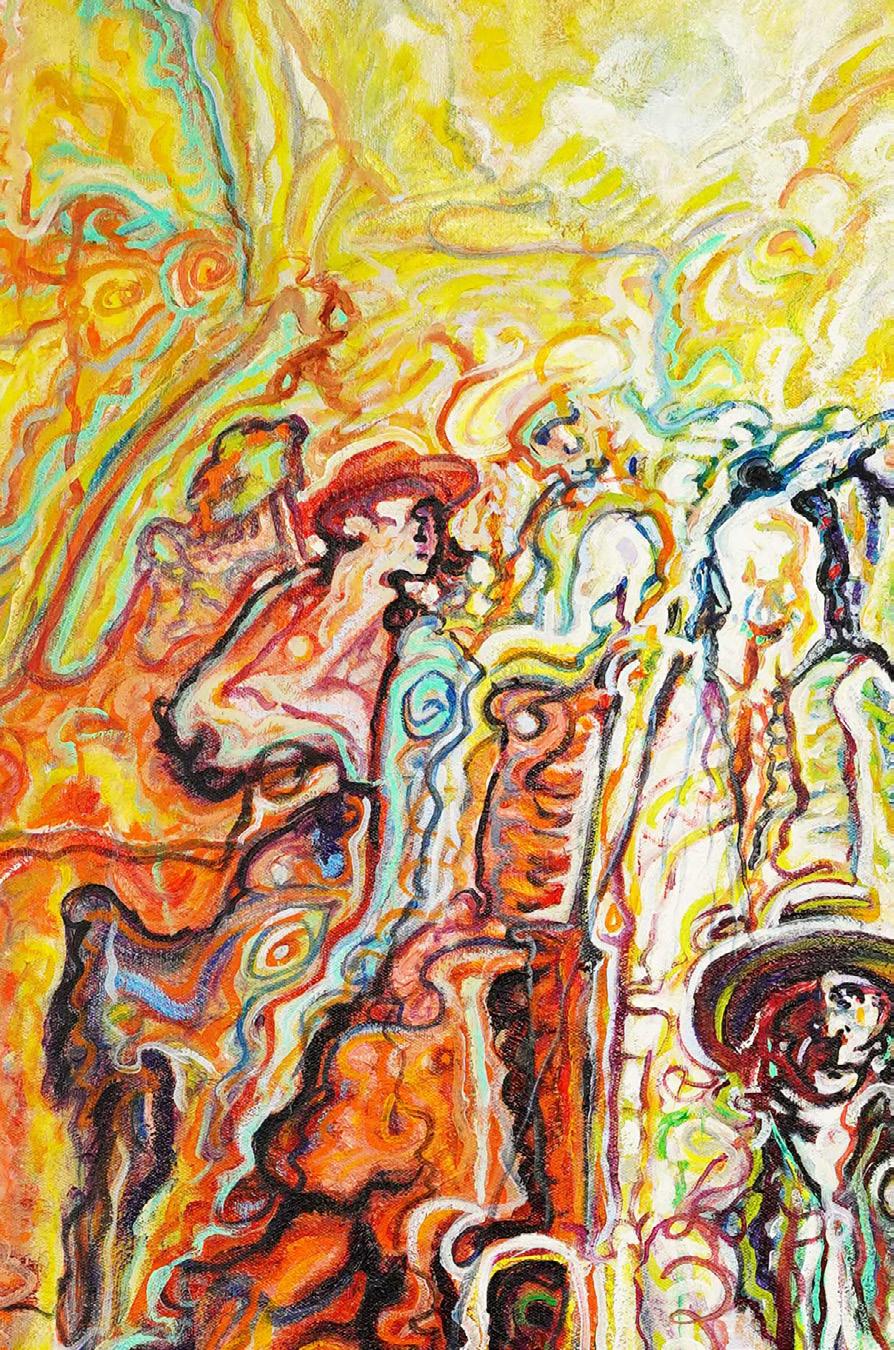
NORTH CAROLINA LITERARY REVIEW NC LR 2023 ONLINE ISSN: 2165-1809 PRODUCTION NOTES Design Adobe Indesign CC 2023 on Macintosh computers Type Families Museo Sans, Adobe Caslon Pro HELP NCLR TODAY HOW MIGHT YOU Yes! I’d like to support another 30 years of this award-winning publication for North Carolina writers and readers everywhere. Click here to see a list of NCLR’s Friends. WINTER 2023 PUBLISHED BY North Carolina Literary and Historical Association

