NORTH CAROLINA L I T E R A R Y RE V I E W ONLINE
2017
NORTH CAROLINA LITERATURE AND THE OTHER ARTS
IN THIS ISSUE Fiction by Michael Parker Robert Morgan Book Reviews
n
n
n
Poetry by James Applewhite, Kathryn Stripling Byer, and
James Applewhite Poetry Prize Finalists
Literary News
n
And more . . .
n
Alex Albright Creative Nonfiction Prize Finalist
n
COVER ART Evening Radiance (oil on canvas, 20x20) by Jane Desonier JANE DESONIER moved to Asheville in 1998 from Louisiana, where she had lived since the age of ten. She received her BA in Fine Arts from the University of New Orleans. She went on to study at the New Orleans Academy of Fine Arts. Since then, she has studied with nationally known artists including Ted Goerschner, Charles Sovek, Julyan Davis, Gay Faulkenberry, and Thomas Buechner. She participated in the Scottsville Artists’ School “The Best and The Brightest Art Show and Sale” for two years. She won Wickwire Gallery’s Best in Show (in 2002) and first place (in 2005) for Wickwire Gallery’s “City of Four Seasons in Two Dimensions” annual juried competition in Hendersonville, NC. She is a member of the Oil Painters of America and participated in its 11th Annual National Juried Exhibition in Chicago, IL. She was a member of the Asheville Gallery of Art coop until moving back to Louisiana in 2016. See more of her work on her website.
Published annually by East Carolina University and by the North Carolina Literary and Historical Association © COPYRIGHT 2017 NCLR
COVER DESIGNER NCLR Art Director DANA EZZELL is a Professor at Meredith College in Raleigh. She also currently serves as the Interim Head of the Art Department. She has an MFA in Graphic Design from the Rhode Island School of Design in Providence. Her design work has been recognized by the CASE Awards and in such publications as Print Magazine’s Regional Design Annual, the Applied Arts Awards Annual, American Corporate Identity, and the Big Book of Logos 4. She has been designing for NCLR since the fifth issue, and in 2009 created the current style and design. In 2010, the “new look” earned NCLR a second award for Best Journal Design from the Council of Editors of Learned Journals. In addition to the cover, Dana designed the Parker fiction, Kirkpatrick poem, and Cornett interviews in this issue.
ABOVE and BACK COVER Summer Sunset (oil on canvas, 18x24) by Jane Desonier
NORTH CAROLINA L I T E R A R Y RE V I E W ONLINE
2017
NORTH CAROLINA LITERATURE AND THE OTHER ARTS IN THIS ISSUE 7n North Carolina Literature and the Other Arts includes poetry, fiction, creative nonfiction, interviews, and a book review James Applewhite Peg Bresnahan Nic Brown Kathryn Stripling Byer Kristi Carter Russell Colver
Rebecca Godwin Paul Jones Suzy T. Kane Kathryn Kirkpatrick Nilla Larsen Susan Lefler
Gina Malone Leslie Maxwell Joan McLean Robert Morgan Fred Moten
Michael Parker Diana Pinckney Nicole Sarrocco Susan Schmidt John Steen
45 n Flashbacks: Echoes of Past Issues includes interviews, book reviews, and literary news
J.S. Absher Elisabeth C. Aiken Rhonda Armstrong Gerald Barrax Joseph Bathanti Michael K. Brantley Taylor Brown Teresa Bryson David Cecelski Fred Chappell
Sharon E. Colley Sheryl Cornett Jan DeBlieu Clyde Edgerton Philip Gerard Rebecca Godwin Miriam Herin Scott Hicks Janet Joyner Randall Kenan
John Lang David S. Lee Peter Makuck Margaret Maron Jill McCorkle Susan Laughter Meyers Ruth Moose Robert Morgan Ron Rash Terry Roberts
Warren Rochelle Carl Sandburg Alan Shapiro Bland Simpson Lee Smith Shelby Stephenson Sheila Turnage Timothy Tyson Randall Wilhelm Marly Youmans
Al Maginnes Peter Makuck Holly Sullivan McClure Kelly Michels Alice Osborn Scott Owens Laura Sloan Patterson
David E. Poston Gibbons Ruark Joan Romano Shifflett Kirstin L. Squint John Steen Jennifer Whitaker
91 n North Carolina Miscellany includes book reviews and literary news
Sam Barbee Aaron Belz J. Scott Brownlee Catherine Carter Jim Coby Michael Colonnese Noel Crook
Eric Ekstrand Rebecca Foust Matthew Griffin Michael Keenan Gutierrez John Hoppenthaler Jeanne Julian Mary Kratt
n
Art in this issue n
Paris Alexander Murry Handler Cristina Cรณrdova Ellen Hathaway Jason Craighead Herb Jackson Jane Desonier Hanna Jubran Sondra Dorn Paul S. Kelly, III Melinda Fine Margaret Sartor Barbara Fisher Jacqueline Herrmann Gourevitch
4
2017
NORTH CAROLINA L I T E R A R Y RE V I E W
North Carolina Literary Review is published annually by East Carolina University with additional funding from the North Carolina Literary and Historical Association. NCLR Online, established in 2012, is an open-access supplement to the print issue. Address correspondence to Dr. Margaret D. Bauer, NCLR Editor ECU Mailstop 555 English Greenville, NC 27858-4353 252.328.1537 Telephone 252.328.4889 Fax BauerM@ecu.edu Email NCLRuser@ecu.edu NCLRsubmissions@ecu.edu http://www.NCLR.ecu.edu Website Subscriptions to the print issues of NCLR are $15 (US) annually or $25 (US) for two for individuals, or $25 (US) annually for libraries and foreign subscriptions. Libraries and other institutions may purchase subscriptions through subscription agencies. Individuals or institutions may also receive NCLR through membership in the North Carolina Literary and Historical Association. Find membership information on the website. Individual copies of the annual print issue are available from retail outlets (listed in the back of our issues and on our website) or from NCLR. Back issues of our print editions are also available for purchase, while supplies last. See the NCLR website for prices and tables of contents of back issues. Advertising rates $250 full page (8.25”h x 6”w) $150 half page (4”h x 6”w) $100 quarter page (3”h x 4”w or 4”h x 2.875”w) Advertising discounts available to NCLR vendors.
Cover design by Dana Ezzell ISSN: 2165-1809
Submissions NCLR invites proposals for articles or essays about North Carolina literature, history, and culture. Much of each issue is thematically focused, but a portion of each issue is open for developing interesting proposals – particularly interviews and literary analyses (without academic jargon). NCLR also publishes high-quality poetry, fiction, drama, and creative nonfiction by North Carolina writers or set in North Carolina. We define a North Carolina writer as anyone who currently lives in North Carolina, has lived in North Carolina, or has used North Carolina as subject matter. See our website for submission guidelines for the various sections of each issue. Submissions to each issue’s special feature section are due August 31 of the preceding year, though proposals may be considered through early fall. Issue #27 (2018) will feature writing about what puts North Carolina On the Map and In the News. Read more about this topic on page 109 of this issue. Please email your suggestions for other special feature topics to the editor. Book reviews are usually solicited, though suggestions will be considered as long as the book is by a North Carolina writer, is set in North Carolina, or deals with North Carolina subjects. NCLR prefers review essays that consider the new work in the context of the writer’s canon, other North Carolina literature, or the genre at large. Publishers and writers are invited to submit North Carolina–related books for review consideration. See the index of books that have been reviewed in NCLR on our website. NCLR does not review self-/subsidy-published or vanity press books.
N C L R ONLINE Editor Margaret D. Bauer Art Director Dana Ezzell Poetry Editor Jeffrey Franklin Fiction Editor Liza Wieland Art Editor Diane A. Rodman
Founding Editor Alex Albright Original Art Director Eva Roberts
Graphic Designers Karen Baltimore Stephanie Whitlock Dicken Assistant Editors Christy Alexander Hallberg Sally F. Lawrence Randall Martoccia Editorial Assistants Teresa Bryson Cameron Green Interns Josephine CariĂąo Jasmine Cruz Ellen K. Franks Seth Thomas Gulledge Jacqueline Nelson Sarah Quinn Dominique Reyes-Hildel
EDITORIAL BOARD James Applewhite Professor Emeritus, Duke University
Gene Hyde Ramsey Library Special Collections, UNC Asheville
Laurence G. Avery Professor Emeritus, UNC Chapel Hill
Donna Kain English, East Carolina University
Christina Bucher English Rhetoric and Writing, Berry College
Anne Mallory English, East Carolina University
Amanda Capelli English, University of Louisiana Lafayette
Joan Mansfield Art and Design, East Carolina University
Paula Gallant Eckard College of Liberal Arts and Sciences, UNC Charlotte
Dominique Marshall English, Communications, and Humanities Lenoir Community College
Peter Franks English, East Carolina University Brian Glover English, East Carolina University
Kat Meads Red Earth MFA program, Oklahoma City University
Rebecca Godwin English, Barton College
Monica Miller School of Literature, Media, and Communication, Georgia Tech
Jaki Shelton Green SistaWRITE
Virginia Nickles Osborne Academic Planning, University of South Carolina
Jim Grimsley English, Emory University
Hugh Ruppersburg English, University of Georgia Mary Ann Wilson English, University of Louisiana at Lafayette
5
6
2017
NORTH CAROLINA L I T E R A R Y RE V I E W
Insight and Inspiration Across the Arts by Margaret D. Bauer, Editor Just over a year ago, I made a New Year’s resolution to write everyday. Just that – no specifications beyond putting words together toward writing something other than an email. I began with freewriting on a theme, then personal essays, and even some poetry. These are new genres for this literary scholar. The challenge of exercising different writing muscles has been rejuvenating, and I look forward to my daily writing time after work. It occurs to me now as I introduce our 2017 special feature topic that this new writing allows me a glimpse of the satisfaction a writer like Clyde Edgerton must feel as he picks up a paintbrush and tries his hand at still another medium (as NCLR readers know, Clyde is as talented a musician as he is a writer). Perhaps he too was looking for a new challenge. You can read more about this multi-talented writer in our 2017 print issue that will feature an interview in which Clyde talks about his painting (and in the meantime, see this issue’s Flashbacks section for more from Clyde). In the online issue’s special feature section, you will find the usual but always fresh juxtaposition of literature and art – certainly one of the qualities that has distinguished NCLR for a quarter century now. Its unique design caught my eye immediately when I reviewed the first four issues before my ECU interview just over twenty years ago. This state’s variety of talent makes my job as NCLR editor both easier – I don’t see us ever running out of material – and more difficult – because finding the evocative images to go with every piece we publish is so challenging and time consuming. In the case of the fine art that complements the poetry, fiction, and creative nonfiction in NCLR issues, I have for a decade now, been able to rely upon the aesthetics of Art Editor Diane Rodman, whose master’s thesis examined “The Visual Elements of Art and Cubist Structure” in a literary subject. She has just the right expertise for her role on the staff, and I am so grateful for her dedication to NCLR and to North Carolina artists.
Also in this special feature section on Literature and the Other Arts, you will find interviews in which one of North Carolina’s internationally known literary stars, Robert Morgan, and a newer voice on the scene, Nic Brown, talk about how their writing has been inspired by music. Music is also an inspiration for a poet who for a time made North Carolina home – Fred Moten, whose 2015 poetry collection is reviewed here. Another way that literature and music come together will then be explored in the 2017 print issue, due out this summer, in which we are publishing an essay about the adaptation of Charles Frazier’s Cold Mountain into an opera, news of which was another source of inspiration for this year’s theme. At the time of this writing, the latest news is the opera’s two grammy nominations. My appreciation of the arts is inspired largely by my parents. My father’s tales gave me my love of story and are now finding their way into my new writing; and while I inherited none of my mother’s talent in the visual and textile arts, I do believe she influenced my aesthetics. So for my twentieth print issue as editor (and for this online supplementary issue), I agreed to the NCLR Art Editor’s selection of my mother’s paintings for the covers. When my mother moved to Western North Carolina, I admit I was jealous. After six years of attending summer camp in the North Carolina mountains as a child, I had determined that some day I would move here, and as I’ve said in earlier issues, I was surprised to find that the eastern end of the state looked more like my home state, Louisiana, than the North Carolina I remembered. While I am now quite enamored with Eastern North Carolina and cannot imagine a more fitting home for myself, still I enjoyed visiting my mother for the almost twenty years that she lived on the other end of this very long state. During that time, she painted the mountains that have awed me since childhood. She has now returned to Louisiana, and it is probable her future canvases will feature swamp scenes similar to what I see as I drive around Eastern North Carolina. But “her” mountains will, I am certain, add to your enjoyment of this issue, cover to cover. n
PHOTOGRAPH BY SETH GULLEDGE, NCLR INTERN
LEFT NCLR Editor Margaret Bauer, Art Director Dana Ezzell, and Art Editor Diane Rodman at the 25th issue launch party, East Carolina University Joyner Library, 22 Oct. 2016
N C L R ONLINE
7
NORTH CAROLINA LITERATURE
and the Other Arts 8 Babble a poem by Nicole Sarrocco art by Margaret Sartor
30 Misadventure in Montclair creative nonfiction by Suzy T. Kane art by Melinda Fine
9 Alone on the Holiday Campus a poem by James Applewhite art by Paul S. Kelly, III
35 Do you know a poem by Joan McLean art by Melinda Fine
10 Acceptable Losses: A Refrigerator Note to My Daughter a poem by Russell Colver art by Barbara Fisher
36 Cave of Hands a poem by Diana Pinckney
12 “Music of the Spheres” Heard as
“world was opening onto world”: An Interview with Robert Morgan by Rebecca Godwin 20 Resourceful and Urnfield two poems by Robert Morgan art by Hanna Jubran 22 sun – rising, – downing a poem by Kathryn Kirkpatrick art by Jacqueline Herrmann Gourevitch
art by Paris Alexander
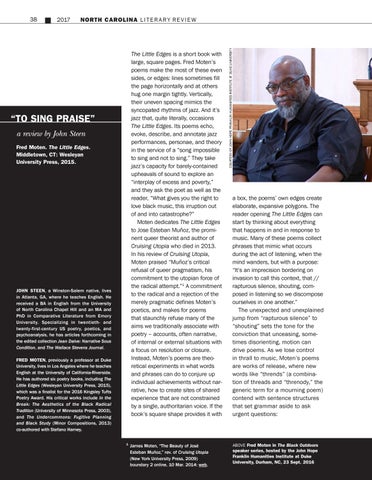
37 Basketball is a Kind of Poetry a poem by Paul Jones art by Murry Handler 38 “to sing praise” a review by John Steen Fred Moten, The Little Edges 40 The Cosmology of the Daughter Who Emerged from an Unrecognizable Place a poem by Kristi Carter art by Cristina Córdova
23 Recruitment
41 Getting from Here to There a poem by Susan Lefler art by Cristina Córdova
26 Auricles
42 You Used to Greet Trees a poem by Nilla Larsen art by Sondra Dorn
27 Communion
43 Yesterday’s Snow a poem by Gina Malone art by Sondra Dorn
fiction by Michael Parker art by Jason Craighead a poem by Peg Bresnahan art by Ellen Hathaway a poem by Kathryn Stripling Byer art by Ellen Hathaway 28 1970/1670
a poem by Susan Schmidt art by Herb Jackson
44 “part of a little counterculture”: An Interview
with Musician Turned Writer Nic Brown by Leslie Maxwell
ALSO IN THIS ISSUE 54 n Flashbacks: Echoes of Past Issues interviews, book reviews, and literary news 110 n North Carolina Miscellany book reviews and literary news
8
2017
NORTH CAROLINA L I T E R A R Y RE V I E W
FINALIST, 2016 JAMES APPLEWHITE POETRY PRIZE BY NICOLE SARROCCO
When a word gets taken away from her it’s the worst she says every time you let go of one the whole world shrinks up like a cheap t-shirt it doesn’t matter how it goes
COURTESY OF THE ARTIST
Babble
away it could turn into a product or just a rock in her pocket hardened out of sense invisible and blunt but deadly it hurts too much to hear it like that song playing that day at the Skate Ranch like the wreckage of her first car and like every dish her mother ever cooked for her father it turns to dust in her mouth
The Impossible Knife of Memory, 2015 (paper on paper collage, 12x15.5) by Margaret Sartor
NICOLE SARROCCO lives in Raleigh. She teaches English and History at the North Carolina School of Math and Science. Her published works include a collection of poems, Karate Bride (Arundel Books, 2004), and two novels, Lit By Lightning (Chatwin Books, 2015) and Ill-Mannered Ghosts (Chatwin Books, 2016).
MARGARET SARTOR was born and raised in Louisiana, graduated from UNC Chapel Hill, currently teaches courses in memoir writing and documentary photography at Duke University, and lives in Durham, NC. Her memoir, Miss American Pie: A Diary of Love, Secrets, and Growing Up in the 1970s (Bloomsbury, 2006) was a New York Times best-seller, and a Chicago Tribune Best Book of the Year. Her book What Was True: The Photographs and Notebooks of William Gedney (Norton, 2000; co-edited with Geoff Dyer) was chosen by the Village Voice as one the “Top Ten Photography Books of 1999.” Images from her photographic project Close to Home have been published in numerous books and periodicals, among them Aperture, The New Yorker, and A New Life: Stories and Photographs from the Suburban South. Her work has been exhibited widely, including at the Nasher Museum of Art in Durham, NC; the North Carolina Museum of Art in Raleigh, NC; and the Center for Photography at Woodstock, New York. Her work is in a number of private and museum collections, including the Museum of Fine Arts in Houston, and the Ogden Museum of Southern Art in New Orleans. See more of her work on her website.
North Carolina Literature and the Other Arts
N C L R ONLINE
9
BY JAMES APPLEWHITE
Alone on the Holiday Campus The airliner arrows an urgent aspiration its idea elsewhere my slow walk a circuit. A winterward willow-oak engraves the silvering air with infinite particularity its stasis like motion.
COURTESY OF THE ARTIST
Bound into a diurnal round I pass with gifts and regrets – many students, colleagues, flights that poetry still brightens my mindscape this horizon a calligraphy, a history, my heights and depths, the regrets not paramount, the mind’s delight I helped ignite around me like stars discerned in a day that’s not yet ready to dim, not quite while these winter trees ink light.
Untitled, 2016 (digital/mixed media, 10.5x10.7) by Paul S. Kelly, III
JAMES APPLEWHITE is Professor Emeritus of Duke University and a regular NCLR contributor. His numerous honors include a National Endowment for the Arts Award, the Jean Stein Award in Poetry from the American Academy and Institute of Arts and Letters, the Associated Writing Programs Contemporary Poetry Prize, and the North Carolina Award in Literature. In 1996, he was elected to join the Fellowship of Southern Writers, and in 2008 he was inducted into the North Carolina Literary Hall of Fame. Read more about the poet in Rob McDonald’s interview with him in NCLR 2016 and read more of his new poetry in NCLR 2017.
Durham native PAUL S. KELLY, III is pursuing a BFA with a concentration in graphic design in the School of Art and Design at East Carolina University. This piece was created for the NCLR / Student Art Collaboration Competition, organized by NCLR Art Editor Diane Rodman and ECU Art Professor Joan Mansfield. From thirteen submissions in response to this poem, Rodman selected Kelly’s for publication because “It made me look at a poem I thought I knew very well and see so much more. Now I am thinking as deeply about the image as I am about the poem; each illuminates the other. I’m paraphrasing an art critic who once said about art if it doesn’t take me anywhere, if it doesn’t tell me something new, it’s not art. Paul’s work is art.” Interested in art and design from an early age, Kelly notes that he hopes to use his “ability in art as a vessel to speak for and to a generation and culture of people who don’t usually get an opportunity to express themselves.” Post graduation, he aspires to a career as a creative director, with plans to eventually start a design agency of his own.
10
2017
NORTH CAROLINA L I T E R A R Y RE V I E W
HONORABLE MENTION, 2016 JAMES APPLEWHITE POETRY PRIZE BY RUSSELL COLVER
Acceptable Losses: A Refrigerator Note to My Daughter
Left open cupboard doors swoop in – they go for the eyes – while legos reshape as punji stakes and a single grape in perfect camouflage waits somewhere on the floor. Here are the consequences of your liberation of this space, back now with your husband and boys, big dogs and relaxed ways. Except for one sprawling fall across a fire truck, and your puncturing the sole of your right foot on the legs of an upturned Calico Critters table, we have remained remarkably injury free. No one can live permanently at Defcon 1. Heaven knows we tried. In the world of your childhood shelves were dusted, books platooned by type, CDs by number (there was a directory), and nothing spillable crossed the oriental. Food was never placed on the teak buffet, untouched and lustrous in afternoon’s still light. Plans were handed down. We honed our vigilance on the razor wire of each new day.
RUSSELL COLVER is a current resident of Durham, NC. She is a certified professional Co-Active Coach who has worked in a variety of teaching fields; her specialty is working with adults with Executive Function Impairment. Her recent publications include poems in Blue Heron Review, Kakalak, and Rattle. Her poem “Commencement” won the 2016 James Applewhite Poetry Prize competition and will be published in the 2017 print issue.
North Carolina Literature and the Other Arts
N C L R ONLINE
11
COURTESY OF THE ARTIST
Clarity (oil on birch panel, 36x36) by Barbara Fisher
There have been casualties. The gleaming teak is scored where someone carelessly dragged away a paper plate of stale birthday cake, its plumage of frosting fossilized, its crumbs a spray of tiny shards. The oriental went to Craigslist, and one late evening on a loading dock we bought an acrylic stain resistant carpet we’re pretty sure was hot. But food is plentiful, upholstery expendable, and every plan is frangible. Boys playing hide-and-seek secret themselves behind the undrawn curtains that hang on either side of smudged dining room windows. They stand open now. Dust and honeysuckle blow through.
New York native BARBARA FISHER now lives in Asheville, NC. Her work has been exhibited in solo shows throughout the country, including the de Saisset Museum and the Bank of America World Headquarters in California, the National Institutes of Health in Maryland, and the Washington (DC) Cancer Center, and in group shows at such venues as the Asheville Art Museum, the Alexandria (LA) Museum of Art, the Sun City (AZ) Museum of Art, and the Chicago Cultural Center. See more of her work on her website.
12
2017
NORTH CAROLINA L I T E R A R Y RE V I E W
“MusicTHE OF
Spheres ” HEARD AS
“world was opening onto world ”
An In ter vi e w w i t h Rober t M organ
by Rebecca Godwin
Robert Morgan calls Thomas Wolfe the “presiding genius of North Carolina literature.”1 At least at first glance, Wolfe’s urgent outpouring of words in manuscripts thousands of pages long contrasts with Morgan’s own tightly controlled language.In both prose and poetry, this North Carolina native focuses on plain style, with concise, unadorned diction providing easy access to universal mysteries and truths. But in reality, Morgan’s own outpouring of words rivals Wolfe’s: the artist born forty-four years after his predecessor has simply divided his thousands of pages among genres. Morgan has now added drama to his list of literary achievements in fiction, nonfiction, and poetry. In 2014, his play Homemade Yankees won the John Cullum Civil War Playwriting Competition sponsored by the East Tennessee Civil War Alliance and the University of Tennessee. Despite stretching to master new forms, Morgan has never neglected the genre in which he started. Since Zirconia Poems appeared in 1969, Morgan has published poetry collections at a steady pace, winning acclaim for lucid lines capturing human history as well as the fascinating movement of nature’s cycles that he saw as a child on his Green River mountain farm. Among the admirers of his poetry is Polish Nobel laureate Czeslaw Milosz, who included two of Morgan’s poems, “Bellrope” and “Honey,” among the three hundred that he selected for A Book of Luminous Things: An International Anthology of Poetry, published by Harcourt in 1996. This honor from one of the world’s most respected poets confirms the excellence of Morgan’s craft. His attention to line pulls us to explore with him the meaning of the smallest and the largest facts of existence, as illustrated in “Coriolis Effect,” which appears in his PHOTOGRAPH BY TERHUNE PHOTOGRAPHY
“I wanted to write a symphony or oratorio as grand as the Cicero Mountain across the river from our house. . . . When I discovered that I lacked sufficient talent for music, I turned to the next best thing, poetry, music in language.”
RIGHT Robert Morgan giving the
Thomas Wolfe Prize lecture, Chapel Hill, NC, 2 Oct. 2008
1
This quotation is from Rebecca Godwin’s interview with Robert Morgan, which follows. The interview was conducted via email in August 2016. It has been only slightly edited for clarity and style.
North Carolina Literature and the Other Arts
N C L R ONLINE
13
“Poetry is language that cannot be forgotten.”
latest book of poems and remarks on the tilting of the earth that keeps us all askew: There is no straight and narrow way, just swerving routes, and twisting paths. The place you aim for will be gone before you reach there, for the world we know, the only world we know, is warped and sprung and devious and turns its face away and throws us off the chosen course and off the goal, into the arc of gravity.2
REBECCA GODWIN is currently a Professor of English at Barton College in Wilson, NC. She served as the president of the North Carolina Literary and Historical Association from 2011 to 2013 and as chair of the North Carolina Writers Conference in 2007. Her scholarship on such writers as Fred Chappell, Lee Smith, and Robert Morgan has been published in Mississippi Quarterly, Pembroke Magazine, and Southern Quarterly, and she has reviewed poetry for Appalachian Heritage, Asheville Poetry Review, and NCLR. Her interview with Robert Morgan about his historical fiction appears in NCLR 2014.
Here, the facts of the physical world mirror the hard realities of human striving. As usual, Morgan makes this straightforward articulation of scientific and spiritual truth look effortless. The cadence and letters’ sounds that move his poems with ease create a pleasurable musicality that critics of Morgan’s poetry often note. Speaking of his early ear for music in Dark Energy, the poet remembers in “The Road to Arcady” the “magnetism” of his mother’s singing luring him to naptime in her lap. With his “cheek against her chest” he could “feel the notes through air and flesh, / the measure of the heart itself.” In an unpublished memoir of his childhood years titled “Mountains, Machines, and Memory,” Morgan describes his first recognition of music’s power. Remembering a 1947 memorial service for local men killed in World War II, he describes the band’s soothing harmony: “even at that age [nearly three], I sensed the way music worked by bringing unlikely things, harsh outlines, clutter, together in a pattern. Music gathered up and resolved differences. I would never learn anything more reassuring.” He considers the music he made up in his head, influenced by hymns as well as gospel and symphonies emanating from his Grandpa Hamp’s radio, “a kind of grammar for [his] feelings,” his metaphoric tying of verbal and musical expression capturing his passion for both.3 Time and again, Morgan speaks of writing in musical terms. In “The Cubist of Memory,” the essay’s title evoking the early twentieth-century visual art style made famous by Picasso, Morgan explains that “the tune of poetry comes . . . from what is said, and how quickly it is said. . . . Economy tends to create melody.” “Some Sentences on the Line” also shows that Morgan’s penchant for music supports his talent for verse. One example illustrates the point: “Long lines read faster than short because the line, like a pendulum swing, tends to have the same duration no matter how many words it contains.” One thinks of a metronome, its pendulum strokes counting
2
Robert Morgan, Dark Energy (New York: Penguin, 2015) 75.
3
Robert Morgan, Mountains, Machines, and Memory, 2014, MS 5, 73.
14
2017
NORTH CAROLINA L I T E R A R Y RE V I E W
COURTESY OF ALGONQUIN BOOKS OF CHAPEL HILL
time in a piece of music, where each measure has the same duration no matter how many notes it contains. That Morgan earlier on the same page uses a scientific metaphor to conceptualize the poetic line – “Line length is a way of speeding or slowing the poem’s current, as with resistors and condensers” – reflects his understanding that universal patterns interrelate.4 In his work, the languages of science, music, and poetry form a chorus, harmonizing what most consider discrete elements of our world. We learn much about the universe from reading his poetry. REBECCA GODWIN: Your sixteenth poetry collection, Dark Energy, came out in 2015, followed by your seventh novel, Chasing the North Star, in
2016. You’re working now on your fourth book of nonfiction, a book tentatively titled “Women of the West,” a companion to your 2011 sketches of men important to America’s westward expansion, Lions of the West.5 How have you managed to keep your hand in both poetry and prose so successfully? How has writing prose fiction and nonfiction influenced your verse writing over the years? ROBERT MORGAN: Working alternately on poetry and prose has
helped sustain me as a writer. When I have finished a project in one genre, or just run out of steam, I have switched to the other form and moved on. But most of my poems and prose are cut from the same cloth, the same preoccupations with memory, family, history, the natural world. While researching history for nonfiction I seem to stumble on many good ideas for poems. Poetry has given me opportunities to explore my interests in science and technology, tools, and the history of science. I do feel that writing prose has helped me evolve as a poet and that writing poetry has influenced the way I write prose, both fiction and nonfiction.
“poetry is still the essential literary genre.”
When I began writing poetry I was most influenced by translations of Chinese poetry of the T’ang era, especially the translations by Ezra Pound. It was the images that I concentrated on, images and metaphors, and the compression and economy of language. I sought a clear, natural cadence in the sentences, and tried to make something happen in each line to move
4
Robert Morgan, Good Measure: Essays, Interviews, and Notes on Poetry (Baton Rouge: Louisiana State UP, 1993) 9, 3.
5
Robert Morgan, Chasing the North Star (Chapel Hill: Algonquin, 2016); reviewed in this issue of NCLR Online; Lions of the West (Chapel Hill: Algonquin, 2011).
COURTESY OF PENGUIN BOOKS
Your poetic style has evolved, from free verse to syllabics. Many of the poems in Dark Energy present, for instance, unrhymed tetrameter, eight syllables with four stresses. At what point in your career did you decide to focus on meter? Did particular poets influence that move?
North Carolina Literature and the Other Arts
N C L R ONLINE
15
the poem forward. It was only after coming to Cornell in 1971 that I became interested in using rhyme, syllable count, and repetition to strengthen the sound of poems. I became more and more aware of the voice in poems. And in 1973 I became excited about the use of an incantatory style, which led to the longer poem called “Mockingbird.”6 It’s a style I’ve always meant to go back to, but so far never have. In the 1980s I began to write poems in syllabics, usuAugust the creek goes rabid and froths at ally in eight- syllable lines. I found that measure flexible the slightest ripple, builds a head on the enough to use in longer meditative and narrative poems. backwater whipping a tough meringue Having the consistent syllable count began to free the voice of the poems, relieving the heavy burden on the below the falls going out an eye line breaks in irregular free verse. To add the arbitrary at a time. . . . mathematical element to poems was a breakthrough. —from Mockingbird (9) Gradually I began to realize that the modern axiom that “form is nothing more than an extension of content” was exactly wrong. There is, in fact, no necessary connection between content and form. You can write a good sonnet about any subject, in any voice. Part of the pleasure of a poem may come from the way the natural cadence of a sentence can contrast with the arbitrary form it passes through. That way we have the natural flow of language and the crystalline exactness of the form at once. You don’t have that subtle counterpoint in prose. But form can be part of the statement in some cases. When Frost puts “Desert Places” in the form of a terza rima sonnet, the form, associated with the high idealism of Dante and Shelley, adds an ironic element to Frost’s tough confession. Do you usually focus on accents in a line as well as on the number of syllables? I think that the terms might be “syllabic” and “accentual-syllabic.”
COURTESY OF BROADSTONE BOOKS
In the 1990s I began to think more in terms of accents in lines of poetry and gradually wrote more and more in iambic lines of four stresses or tetrameter. We know the four-stress line, common meter, ballad meter, is the norm in poetry of many languages. It has been theorized that the four-stress line is the increment of sound and information the brain can process at once. In my case, I just seemed to find that line worked best for me. Some of my recent poems are written in the more assertive trochaic meter, and a few are in pentameter. I know that you have a passion for music and allude to it in many poems, for instance
6
Robert Morgan, Mockingbird (Frankfurt, KY: Broadstone, 2015).
16
2017
NORTH CAROLINA L I T E R A R Y RE V I E W
Like staves of music they are flung from pole to pole outstretched across the valley, up a hill, and swung along the ridge. . . .
“Time’s Music,” “Tail Music,” “Mountain Dulcimer,” “The Music of the Spheres.”7 Perhaps your ear for music – you do play piano, I understand – influenced your movement to a metered line in your poetry?
As a teenager I wanted to be a composer. I studied piano and some music theory. I wanted to write a symphony or oratorio as grand as the Cicero Mountain across the river from our house. Why would anyone write in words if they could compose music, which is the mother art? The small infant responds to and delights in music. When I discovered that I lacked sufficient talent for music, I turned to the next best thing, poetry, music in language. I’m sure my love of the cadence of sentences and the metrical line is related to my pleasure in classical and baroque music.
—from "High-Tension Lines" (Dark Energy 73)
You have lived in New York State for forty-five years now. How has living in the Northeast, and perhaps teaching at Cornell, influenced your poetry?
COURTESY OF LOUISIANA STATE UNIVERSITY PRESS
Like most people who have teaching careers, I have learned a good deal from my students. Sometimes it has been a challenge to stay ahead of them. I have had to be a better scholar and thinker because of the opportunity to formulate my thoughts in the classroom and in conferences. And I have had the chance to carry my thoughts further because of the give and take of discussions with colleagues and students. Also, living eight hundred miles from my home in North Carolina caused me to become a student of the Southern Mountains and their history in a way I might not have had I remained there. Out of homesickness and nostalgia I concentrated on memory and on the uniqueness (and universality) of that one place. But since I have lived away from my native place, more of my writing is set in the past, and inspired by memory, rather than contemporary Appalachia. Poetry has never been dominant in popular culture in the United States, but certainly our contemporary era might be seen as an age of prose and film. What do you see as the function of poetry in our time? It is indeed a challenge for the contemporary poet to gain a sense of his or her audience. Film is the dominant narrative form of our time, and the novel has dominated our literary life. Autobiography, biography, and memoir are also extraordinarily popular. Yet poetry is still the essential literary genre. No one has ever found a language or culture that did not include poetry. Some think that the instinct for poetry is the very source of language itself, our delight in sound, in lyricism, in wordplay such as repetition and onomatopoeia. Children do not have to be taught to delight in nursery rhymes. We are born loving anapests and iambs.
7
“Time’s Music” is in The Strange Attractor (Baton Rouge: Lousiana State UP, 2004); the other poems listed here are in Topsoil Road (Baton Rouge: Lousiana State UP, 2000); reviewed in NCLR 2001.
North Carolina Literature and the Other Arts
N C L R ONLINE
17
COURTESY OF ROBERT AND NANCY MORGAN
When great national tragedies occur, such as the assassination of President Kennedy, or 9/11, it’s the poetry of Walt Whitman or Emily Dickinson that the leaders and memorialists fall back on. The public may not feel the “need” for a lot of poetry, but when the occasion calls for it, they are grateful the significant words are there to draw on to express our grief or sense of unity. For poetry is ceremonial, ritualistic, elevated, in all cultures. What Walt Whitman does in “When Lilacs Last in the Dooryard Bloom’d” can’t be done in any other way. Poetry is language that cannot be forgotten, that can be said no other way. People often forget that they need poetry, and then are surprised to discover that they do. My dad was a farmer who had left school after the sixth grade. He loved to read history but was not literary in the least. Yet from time to time, when moved, he loved to recite Tennyson’s “Crossing the Bar” or John Burroughs’s “Waiting.” He was a little embarrassed to do so, but could not resist repeating the lines he had learned in his youth. You see that poetry can accomplish what prose (fiction or nonfiction) – or even film – cannot, then? Poetry carries magical power? Is it essential, or at least useful, for education? In the schools I attended in the mountains of North Carolina we were required to memorize poems and recite them before the class. Poems you learn in your youth are never forgotten. Remembered poems are a pleasure to call up and recite, even in fragments. Poems become wired into the brain. It is more difficult to memorize free verse, but we never forget “Whose woods these are I think I know.” One test for good poetry is whether it is memorable or not. We don’t memorize novels and films, but for the rest of your life you can carry a poem with you. No one can take away from you, “Tyger tyger, burning bright” or the seventy-third sonnet of Shakespeare.
The air is clean, immaculate and nothing moves but time itself, a cool delicious element.
Do you consider yourself a political poet in any way? I think of your poems that recall the ancients, for example, often implying that we need their wisdom. Many poems suggest that our modern consumer society falls short when compared to earlier civilizations. Your new poem “Urnfield” ends with a strong punch, the imagery of “our age of rust and warming” conveying dismay, certainly consciousness of our negative effects on the world.8 Would the label eco-poet apply? Your concern for the environment, for instance your worry that Green River soil is going to “decorate the cities” in your poem “Atomic Age,” published in Topsoil Road, might allow critics to place you in that category?
—from “Silence” (Dark Energy 80)
I am certainly interested in environmental issues, and a number of my poems touch on degradation of land and resources. But prose essays are more effective for direct statements about political and environmental concerns. A poem such as “Jaguar,” published in Dark Energy, ABOVE The cat in the snow that inspired
“Resourceful,” the other of Morgan’s new poems published in this issue (both following this interview)
8
“Urnfield” appears in this issue of NCLR Online.
18
2017
NORTH CAROLINA L I T E R A R Y RE V I E W PHOTOGRAPH BY EDWARD C. MCIRVINE
surprised me by questioning the legend that jaguars once roamed the Southern mountains and then connecting with the heavy traffic in the Smokies and highways of the region. The poem began as playful speculation and swerved to that conclusion. I am personally divided about the rapid development of Western North Carolina. As someone raised on a struggling subsistence farm, I appreciate the new affluence brought into the region. Still, it saddens me to see the mountains carved out for retirement communities, as family farms disappear, and the rise of crime and drug culture among the young in my native highlands, in the once breath-taking hunting ranges of the Cherokees. When I worked in the fields as a child and turned up arrowheads and pieces of pottery, it seemed to me the very ground was haunted by the Indians who had been there so long. I wonder whether you’re conscious of any connection between your poetry and Ted Kooser’s. It seems to me that you share with him a view of the natural world, one perhaps influenced by the Romantics or perhaps by your upbringing. Both of you also write a fairly plain-style verse that is quite accessible. I remember that Kooser selected your poem “Living Tree” for American Life in Poetry when he was US Poet Laureate and called you one of his “favorite American poets.”9
“Some think that the instinct for poetry is the very source of language itself.”
I have always admired Ted Kooser’s poetry, for its realism and naturalness, and its love of rural life and landscape. His poems are also models of the craft that hides craft, seeming so deceptively plain. As an editor and Poet Laureate of the United States, he has had a significant and healthy influence on contemporary poetry. Much of your poetic output revolves around science, the mysterious workings of the universe. Can you talk about the influence of scientific knowledge on your poetry? It certainly seems more dominant in your poetry than in your fiction. Do you continue to study science to gather ideas for poems such as “Dark Energy” or “Neutrino,” both appearing in your latest collection? From an early age I loved the articles in the National Geographic about science and technology. Through those articles on nuclear energy, rockets, astronomy, geology, I found a thrilling connection to a much larger world, ancient, futuristic, and timeless. Science promised new ideas, beyond the limited world I knew. I went off to college to study
ABOVE Robert Morgan reading at
Malaprop’s Bookstore in Asheville, NC, 6 Sept. 2009
9
Read Morgan’s poem “Living Tree” on Ted Kooser website American Life in Poetry, Column 418: web.
North Carolina Literature and the Other Arts
N C L R ONLINE
19
“Most great novels seem different when you read them at different points in your life; ‘Look Homeward, Angel’ is a little bit that way. . . . This time reading it, what I see is a great poetic catalog, this epic urge to be inclusive, to include the whole wide world in your poetic vision.” —Robert Morgan, on the occasion of receiving the Thomas Wolfe Prize (Cornell Chronicle 9 Sept. 2008)
COURTESY OF THOMAS WOLFE MEMORIAL
COURTESY OF ALGONQUIN BOOKS OF CHAPEL HILL
ABOVE TOP Robert Morgan on the Wolfe
house porch in a rocking chair he donated in memory of Thomas Wolfe, Asheville, 7 Feb. 2015
science and mathematics, then got sidetracked by writing. I still read everything I can find in Scientific American and elsewhere about current discoveries and theories. Many of my poems reflect that interest, but little of the fiction. In many ways science has been our language for understanding who we are. It would be hard to overstate the thrill of discovering Darwin, Einstein, and Newton as a teenager. The more I learned, the more mysterious the world became. It was as though world was opening onto world. I hope my poems show some of that awe and wonder.
A last question involves Thomas Wolfe, North Carolina’s famous writer from Asheville. You’ve credited Wolfe with inspiring you, as a teenager, to think that you, too, might become a writer. You’ve commented on Wolfe’s influence on your fiction – for instance his triggering the idea of writing from a woman’s point of view. I see a correlation between his fascination with time and the same concern in your poetry. Have you thought about that connection?10 It was reading Look Homeward, Angel when I was about fifteen that first made me think seriously about becoming a writer. I was intoxicated by Wolfe’s sweeping language and by his ability to make the everyday so vivid and memorable. I never was able to write in his sweeping rhetorical style, but even so he inspired me. And his novella The Web of Earth gave me the idea of letting a woman character tell her own story in her own voice. Wolfe is the presiding genius of North Carolina literature. His fascinations with the mystery of time, with the power of memory, are connections I feel with Wolfe, as well as the October 3rd birthday we share. n
ABOVE BOTTOM Novel for which Robert Morgan
received the Thomas Wolfe Memorial Literary Award from the Western North Carolina Historical Society
10
Read Rebecca Godwin’s article on “Thomas Wolfe and Robert Morgan: Influence and Correspondences,” Thomas Wolfe Review 38.1-2 (2014): 54-70.
20
2017
NORTH CAROLINA L I T E R A R Y RE V I E W
BY ROBERT MORGAN
The black cat in the snow soaks up the winter sun with its thick fur and moves again, again, to stay in the best light in this sub-zero cold, its coat a multiplier of elusive heat in air that has few calories, its fur a solar sponge. This hairy feline’s like a scruffy artist or philosopher who draws a sustenance from air, through contemplation and extended stillness to make the most of less, to amplify what warmth and inspiration can be salvaged from afar, the meager drooping sun, by shifting with the hour, before the dark returns.
COURTESY OF THE ARTIST
Resourceful
Sunburst (cast iron, 14x11x11) by Hanna Jubran
ROBERT MORGAN was born in Hendersonville, NC, and is now living in Ithaca, NY. He is the Kappa Alpha Professor of English at Cornell University. His numerous honors include the North Carolina Award for Literature, the North Carolina Literary and Historical Association’s R. Hunt Parker Memorial Award for significant contribution to North Carolina literature, and induction into the North Carolina Literary Hall of Fame. Morgan has been featured regularly in NCLR, including interviews with him in the 2001 and 2014 print issues and an essay about his work in NCLR 2010. Read more about him in the interview that precedes these poems in this issue.
North Carolina Literature and the Other Arts
N C L R ONLINE
21
BY ROBERT MORGAN
Urnfield
COURTESY OF THE ARTIST
For several hundred years the Celts of northern Europe placed their dead, the ashes of their dead, in urns of finest pottery, and laid them down in consecrated ground. The ashes must have seemed a kind of essence of the loved ones gone, the bodies purified by fire, the souls refined to be contained in earthenware, perhaps a grail from which the thirsty future drank the health of generations past and to come, urns sown like bulbs for some hoped-for flowering and release of spirits from the dust, as bronze gave way to iron, so long before our age of rust and warming.
Crystallization of Elements (cast iron and bronze, 36x36x12) by Hanna Jubran
HANNA JUBRAN is a Professor and the Sculpture Area Coordinator in the School of Art and Design at East Carolina University. Born in Jish in the Upper Galilee region of northern Israel, he received his MFA from the University of Wisconsin-Milwaukee. His work has been commissioned for private and corporate collections nationally and internationally, and his solo exhibitions have enriched North Carolina from Nags Head to Fayettevile to Brevard. Together with his wife Jodi, he has also completed many commissions of large bronze sculptures for colleges and universities in the state. See more of his work on his website.
22
2017
NORTH CAROLINA L I T E R A R Y RE V I E W
FINALIST, 2016 JAMES APPLEWHITE POETRY PRIZE BY KATHRYN KIRKPATRICK
sun – rising, – downing I wake to the nerve’s heat, my body a shock of dawn, and as if my sheepdog knows, feels the pulse of consciousness change, he wakes too. Though he’s a floor below, and we’ve hardly stirred, Cuig starts his yodel, his sun-rising, his call to the pack, his pulling at the light, as he does each morning, a regular rooster of a dog, dead certain this is the way a new day is greeted. We call. He comes. We gentle him quiet as no one did the wheel-chaired woman last week in the dementia wing who howled at the failing light. Urgent and needful, she rose up to deliver those notes. Sun-downing. Music and mania. She heralds dusk, Cuig dawn. They take up the ritual of turning the day. I listen to the dance of voice and light. To sing the sun up or down is hard work. Hard to make that sound, harder to hear it. As I wake to the nerve’s heat, my body a shock of dawn, I know again that shift from sleep to light, that ancient fear of night. COURTESY OF THE ASHEVILLE ART MUSEUM
Window and Sun, 1951 (oil painting, 34x28) by Jacqueline Herrmann Gourevitch
KATHRYN KIRKPATRICK holds a PhD in Interdisciplinary Studies from Emory University and is now a Professor of English at Appalachian State University where she teaches environmental literature, creative writing, and Irish studies. Her poetry collections include three Brockman-Campbell award volumes: The Body’s Horizon (Signal Books, 1996), Her Small Hands Were Not Beautiful (Clemson University Digital Press, 2014), and Our Held Animal Breath (WordTech, 2012); Roanoke-Chowan Poetry Prize winner Beyond Reason (Pecan Grove Press, 2004); Out of the Garden (Mayapple Press, 2007), a finalist for the Southern Independent Booksellers Association poetry award; and Unaccountable Weather (Press 53, 2011, reviewed in NCLR Online 2013). She has also received an Academy of American Poets poetry prize. She has held writing residencies at Norton Island in Maine and the Tyrone Guthrie Center in Ireland. Her long poem about Maud Gonne in six voices was performed in 2013 as part of the Yeats Summer School festivities in Sligo, Ireland. Read another one of her poems, also a finalist in the 2016 Applewhite Poetry Prize competition, in the 2017 print issue.
JACQUELINE HERRMANN GOUREVITCH was born in Paris, France. She attended the High School of Music and Art in New York and, in the summer of 1950, Black Mountain College in Asheville, NC, followed by studies at the University of Chicago and the Art Institute of Chicago and the Art Students’ League in New York City. Gourevitch taught painting at Wesleyan University from 1978 to 1989 and drawing at the Cooper Union from 1989 to 1992. She currently lives in New York City where she continues to paint and exhibit her work. In 2000, Gourevitch was awarded a Studioscape Residency, sponsored by the Lower Manhattan Council, on the 91st floor in Tower #1 of the World Trade Center. Her work has been exhibited widely and is in major collections in the US.
North Carolina Literature and the Other Arts
N C L R ONLINE
23
fiction by Michael Parker with art by Jason Craighead
R EC RU ITMENT THAT EVENING SHE DROVE DEEP INTO THE southern end of the county, where the soil turned sandy and thick and then disappeared under black water. Swamps stretched to the ocean, forty miles south. These were the hardest kids to reach. The bus drive to the high school was forty-five minutes for those who lived off these backroads. Dirt roads with clusters of mailboxes, six or seven families living off a rutted two track in mostly trailers onto which they had built wings, lean-tos really, additions, listing on stacked blocks, half-walled, half windowscreened. Sleeping porches for the summer months, she guessed. The screens were always bowed out and rusty and many were studded with cotton balls to ward off flies. She had given her boys a bag of carrots. That was all that was left for them to snack on. She groceryshopped on Thursday afternoons, and for years she had hidden things from her children – there were five in all, the three youngest with her that night, the two boys in back and her daughter reading in the passenger seat – so that they would not eat everything by the weekend. But when all the trouble started at work (and at home, but she couldn’t really say where it started, given the nature of the conflict) she gave up. Have at it, just know that if you drink all the milk and eat all the cookies that’s it. Ice
cream and potato chips went first. The flat of Chek colas and lemon lime sodas she bought at the Winn Dixie for ninety-nine cents never lasted past Sunday. Then the breakfast cereal, which they ate out of the box when the milk was gone, savagely clutching the boxes to their bony chests. Her older brother, now a minister in Little Rock, had a peculiar way of eating a carrot when he was young. He would bite carefully around the core. Did everyone but her know that a carrot had a core? These days it seemed likely, given all she’d missed, all that had gone on, all she was now being blamed for. The core of the carrot is stark, spindly. It has these little limbs; it resembles a tree scorched by a forest fire. Her brother taught her how to core a carrot and she passed the skill onto her children. In the back seat at that moment her two youngest boys were loudly and competitively at work. The final product they would lean forward to thrust in her face. She was to judge the most most perfectly cored. The other two children were old enough to stay home. She had left them there after dinner. Her husband did not come home from work. It was Tuesday, and the paper he owned and ran almost single-handedly came out on Wednesday, so she rarely saw him on Tuesdays, but since the trouble
MICHAEL PARKER is the author of six novels and two collections of stories. A third collection of very short stories like this one, called Everything, Then and Since, is due out from Bull City Press in 2017. His short fiction and nonfiction have appeared in various journals including Five Points, The Georgia Review, The Washington Post, The New York Times Magazine, Oxford American, Shenandoah, The Black Warrior Review, and Men’s Journal, and they have often been selected for the best of volumes like New Stories from the South and The O. Henry Prize Stories. An excerpt from his new novel, All I Have in This
World (Algonquin, 2014) was published (and the novel reviewed) in NCLR Online 2015. He has received fellowships in fiction from the North Carolina Arts Council and the National Endowment for the Arts, as well as the Hobson Award for Arts and Letters, and the North Carolina Award for Literature. He was the honoree of the North Carolina Writers Conference in 2015 (watch tributes here). A graduate of UNC Chapel Hill and the University of Virginia, he is the Vacc Distinguished Professor in the MFA Writing Program at UNC Greensboro. He lives in Greensboro, NC, and Austin, TX.
2017
NORTH CAROLINA L I T E R A R Y RE V I E W
started she saw him hardly at all. He was the one who broke the story about the community college where she was Dean of Students. There were discrepancies in the numbers of students enrolled and those who actually took classes. Dummy enrollments. Someone was skimming the money. She knew it was the president of the college, whose doctorate was in Physical Education and who would soon quit to start a Toyota Dealership with the money he stole, but she could not find proof of it, and nightly she fought with her husband who she thought should never have written the story in the first place, since of course suspicion fell on her, no matter that enrollment was the province of the Registrar. Yet she was in charge of recruitment, and since her husband had gone all Woodward and Bernstein, why would her coworkers not think she was his Deep Throat. Because of her they may well lose their jobs. And yet, her husband was all the more adamant about what he called his ethical responsibility to write the truth. He knew she did not have anything to do with it, but if he chose not to write about it (even though clearly there was a conflict of interest), it would seem all the more as if she were guilty. He took it all so seriously, his duty to afflict the comfortable, while she drove, more and more, nights and Saturdays, deep into the county to attempt to comfort the afflicted. She knew all the guidance counselors in the county, and she had them keep lists of kids who were smart but had no encouragement at home to do anything other than go to work in the fields or the blender factory or the chicken processing plants. Some of them had kids themselves. They thought their lives were over and it was her job to offer them a way out of these woods. She loved this part of her job the most. The more people assumed she’d made up students, the harder she scoured the countryside for kids who needed a chance, needed her to save them. Sometimes she spoke to her brother the preacher in Little Rock. I worry about the children, she said. You worry about everyone’s children, he
COURTESY OF THE ARTIST
24
the need, 2012 (mixed media on canvas, 50x60) by Jason Craighead
They thought their lives were over and it was her job to offer them a way out of these woods. She loved this part of her job the most.
North Carolina Literature and the Other Arts
said in a way that made her think her recruiting was more important to her than the well-being of her own kids. It was true in a way. Her own children had options. She had options. She could quit and get her old job back at the high school teaching Latin to the overachievers and civics to those who would end up at the slaughterhouse, the blender factory. She didn’t do anything wrong. Except this: all these people off down in the country kept dogs. She was terrified of dogs. Dogs, of course, knew of her terror. She couldn’t very well leave the three youngest alone nights when she went out recruiting, was what she told herself, but in fact the oldest could keep them from burning the house down. She placated them with carrots and coring contests, but really she needed them to get out of the car and knock on the door if there were dogs. That night they came to a place at the edge of a river, The Black River. They were in an area called Six Run. Hardly anyone from this part of the county went on to the community college. Most of them, rumor had it, were intermarried. Never mind all that: they deserved a chance. But she needed bodies, real students. She needed to prove to everyone that the numbers might have been tampered with before, but no longer. Her husband could fend for himself. Have another carrot, she said, passing the bag back to the boys. See who can make the prettiest tree. They pulled up to a house covered in lattice. The lattice was covered in vine. On the way in they had passed five or six cars abandoned in the woods. Someone had cut down trees to make little driveways for these abandoned cars, but the trees had come back, growing through the engine block of hoodless Fords. This place is scary looking, said her daughter, looking up from her book. She heard the dogs before she saw the house. The guidance counselor had told her about the girl who lived here, Bettina. She’s shy as all get out, but she’s smart. Her parents won’t let her speak to you, though. You might as well not bother. But she bothered. The barking dogs greeted them as they pulled into the clearing around the house. She
Raleigh resident JASON CRAIGHEAD grew up in Florida where he studied art at Gulf Coast Community College and Florida State University. He has been an active participant in the Raleigh arts community for many years. He is a member of the City of Raleigh Arts Commission and serves on the Grants Committee. He is co-founder with Dave Green of Switchhouse, a working studio space and gallery. His work has been featured in numerous solo and group exhibitions throughout the Southeastern US and is included in many private and public collections throughout the US and internationally. See more of his work on his website.
N C L R ONLINE
25
The barking dogs greeted them as they pulled into the clearing around the house. She saw that they were chained.
saw that they were chained. Still, what if they broke the chains? The way they snarled, their hatred, their hunger. Get out and go knock on the door, she told her boys. They liked dogs, but these dogs? They pushed their faces against the window, staring. Go on, she said, give them a carrot. I’ll give them mine, said the youngest. And they got out, clutching their carrots. Two of the dogs were somehow placated by her boys, but there was a third. Her daughter had put down her book and climbed in her lap to look. The boys held hands as the dog yanked at the end of his chain. That dog, she would tell her husband later. He knew what was going to happen when he took off for my babies. He knew it was going to hurt. She didn’t tell him how the youngest boy had held up his carrot and how she thought she’d seen, in the last light filtered through the leaves, the tiny limbs on the scorched tree. She told him only about the dog knowing its fate, throwing himself over and again at her brave little babies, the chain tightening the collar, nearly strangling him each time. n
26
2017
NORTH CAROLINA L I T E R A R Y RE V I E W
FINALIST, 2016 JAMES APPLEWHITE POETRY PRIZE BY PEG BRESNAHAN
Auricles
thump its warning. We don’t have conversations the way we once did. No longer do I ask a question from another room, talk with my back turned. Now, it’s face to face. When the phone rings for you, I walk rooms, hallways, rap on closed doors. Absurd to be annoyed when I cannot imagine you gone, the house an echo, your office a space for guests. Do you know at night, when I round the corner into our room, the first thing I look for is the hill of your feet beneath the sheet?
PHOTOGRAPH BY TONI TRONU; COURTESY OF THE ARTIST
When the cat hid one of your hearing aids in my hiking boot, I walked down the trail with its rub. My big toe heard a mole tunnel among sassafras roots, a rabbit
To Feel, 2016 (acrylic on canvas, 10x8x2) by Ellen Hathaway
PEG BRESNAHAN’s second book of poetry, In a Country None of Us Called Home, was published by Press 53 in 2014. Recently her poems have appeared in Kakalak, The Southern Poetry Anthology, and The Great Smokies Review. Bresnahan’s poem “The Presence of Wonder” was a finalist for the 2015 James Applewhite Poetry Prize and was published in NCLR Online 2016. She moved to Cedar Mountain, NC, from Sturgeon Bay, WI, twelve years ago.
Raleigh resident ELLEN HATHAWAY was born in Washington, NC. She earned a BA in Media from UNC Chapel Hill and her Master’s in Teaching from the Curry School of Education at the University of Virginia. She later worked in sales and in the classroom before pursuing classes in painting. She completed residencies in Masters Directed Independent Study with Steven Aimone in 2015 and 2016. She has exhibited widely in solo and group shows, including the annual James Applewhite Poetry Invitational sponsored by City Art Gallery in Greenville and NCLR. Her works are in numerous private and corporate collections, including Martha Jefferson Hospital and the Battle Building at the Children’s Hospital, UVA, both in Charlottesville, VA, as well as Winchester Hospital in Winchester, MA. See more of her art on her website.
North Carolina Literature and the Other Arts
N C L R ONLINE
27
BY KATHRYN STRIPLING BYER
Communion
Come evening the earth lifts her spirits, freed from the workaday odors of gasoline, motor oil, sweat, and the inexorable coil of exhaust from the highway beyond her breath’s provenance.
PHOTOGRAPH BY DOUG PITTS; COURTESY OF THE ARTIST
She breathes forth the truth of her burial grounds where her potsherds have waited for lifetimes to be found, her snake skins, the bones of her numerous deer slain, the bloodbath of hogs I, her daughter, watched butchered each fall from the safety of back porch. Her veins, varicose as my grandmother’s, pulsate with origins, season by season becoming the wild native yeast of her landscape, its kneading of weather and soil bringing increase or famine. Come evening I stand on my side of the barbwire, inhaling her risings, my hands lately lifted from oats I tossed into the cattle trough, hands I raise up with her dirt in their lifelines. The dusk deepens. Startle of crickets around me. The farthest cow lows. The mourning doves’ silences drawing me closer. A woman’s voice calling. Don’t tarry too long. Now her kitchen light kindles. The gone faces waiting around her spread table. The glow of her fire in the hearth. Deeply Rooted V: Life Within, 2015 (acrylic mixed-media, 12x12x3) by Ellen Hathaway
KATHRYN STRIPLING BYER served as the North Carolina Poet Laureate from 2005 to 2009 and was inducted into the North Carolina Literary Hall of Fame in 2012. She is the author of nine poetry collections including Black Shawl (Louisiana State University Press, 1998; reviewed in NCLR 1999), which won the 1998 Roanoke Chowan Award for Poetry; Catching Light (Louisiana State University Press, 2002), which won the 2003 SIBA book award; and Descent (Louisiana State University Press, 2012; reviewed in NCLR Online 2013), which won the 2013 SIBA book award. Her poetry has been featured in several issues of NCLR, including the 2008 issue, which also features an interview with her. Read more about her in Tara Powell’s appreciation (published in NCLR Online 2015) on the occasion of Byer being the 2013 honoree of the North Carolina Writers Conference.
28
2017
NORTH CAROLINA L I T E R A R Y RE V I E W
FINALIST, 2016 JAMES APPLEWHITE POETRY PRIZE BY SUSAN SCHMIDT
1970/1670
Wistful I climb to the sun above mist and fog. When I was young I would stride straight uphill to the clouds. I pause in the wind and look out to sea. On my twenty-first I climbed Snowdon three hundred years after my ancestor left Northern Wales. The mountain’s copper, coal profit lies underground but I could never work in the dark. The summit to me means being closer to the sky. Descending I traverse steep bluebell slopes as I read slant-slab orogeny. Layer-cake rocks speak Welsh named after ancient tribes – Cambrian Ordovician Silurian.
SUSAN SCHMIDT works as a freelance developmental editor, polishing science and history books, novels, and memoirs. She has an MS in Environmental Science, an MA in British literature, and a PhD in American literature, with postdoctoral studies in bioethics and conflict resolution. She has worked as a professor of literature, sailboat captain, and science-policy analyst. She is a contra-dance caller, bass fiddler, and gardener. Her homeplace is the Chesapeake Bay, and her homeport is Beaufort, NC, where she walks beaches with her Boykin Spaniel. In 2006, Johns Hopkins University Press published her narrative nonfiction, ecological history book, Landfall Along the Chesapeake: In the Wake of Captain John Smith. She has won the Guy Smith Poetry Prize, and her poems are included in Literary Trails of Eastern North Carolina (University of North Carolina Press, 2013). In 2015, Kakapo Press published her novel Song of Moving Water and poetry collection Salt Runs in My Blood. Read another of her poems selected as a finalist for the James Applewhite Poetry Prize in the 2017 print issue.
North Carolina Literature and the Other Arts
N C L R ONLINE
29
In the high sheep pasture fat lambs butt mamas’ bellies. Here, with a view of the estuary – did Job Meredith live in these stone walls? – thatch roof long gone. Below in the forest I feel doubly at home recognizing tree species. On the beach I pick stones worn so smooth white veins show their structure. Sleeping at sea level each wave rolls the stones and lambs baa all night long.
COURTESY OF THE ARTIST
Running Deep, 2016 (acrylic, 60x108) by Herb Jackson
Raleigh native and Professor Emeritus of Art at Davidson College, HERB JACKSON earned his MFA degree at UNC Chapel Hill. In 1999, he received the North Carolina Award, the state’s highest civilian honor, for Lifetime Achievment in Fine Arts. He has had over 150 one-person exhibitions and has been featured in numerous group exhibitions in the US and abroad. His work is in the permanent collections of over a hundred museums, including the North Carolina Museum of Art, the Museum of Fine Arts in Boston, the Whitney Museum of American Art in New York, and the British Museum in London. See more of his work on his website.
30
2017
NORTH CAROLINA L I T E R A R Y RE V I E W
HONORABLE MENTION 2016 ALEX ALBRIGHT CREATIVE NONFICTION PRIZE
erutnevdasiMMisadventure i
in
i
MontclairrialctnoM with art by Melinda Fine A friend of mine put it this way: Sometimes a part on your car breaks – say, the mirror, and when you replace it, the car looks as good as new. Sometimes something more serious happens – say, the transmission goes. The repair is costly and may take time, but it puts the car right again. But if you open the hood and slam a sledgehammer down on the engine over and over again, you will most likely
My mother became a sledgehammer-to-the-engine kind of drinker. damage your car permanently. My mother became a sledgehammer-to-the-engine kind of drinker. Although twice widowed, my mother didn’t want any of us children at her house. As the oldest, I was busy raising my own children, and when both of them were in school full-time, I went back to school, too. I kept in touch with my mother by telephone, imagining the line stretching for miles between our houses like an umbilical cord. One time checking in on her by telephone, when she answered, I said, “Hi, I just wanted to see how you’re doing.” “Oh, fine, I guess,” she answered in a normal voice, “except I’ve been pretty annoyed by all the singing in the neighborhood.” In another life, SUZY T. KANE was a copywriter at LIFE magazine. She now lives and writes in Wilmington, NC. Kane has an MA in the Humanities and her poems have appeared in various publications, including two anthologies published by The New School. Her published prose and public radio audios are available on her website. Her new memoir is “A Little In Heart” about growing up in a three-culture household.
by Suzy T. Kane “What do you mean?” I asked. “It’s a group,” she told me, “and they apparently get together at various houses in the neighborhood” – I’m wondering what singing group could be practicing at someone’s house – “and they either sing until three a.m. or chant.” Three a.m.? “What do you mean by ‘chant’?” “Oh, they take a word like ‘peanut butter,’ and they chant it over and over.” Peanut butter? I tried to keep her talking as the trouble she was in sank into me. “Any other words?” I asked. “Sometimes ‘sauerkraut’ or ‘wiener’ or ‘ham ’n’ eggs.” “What kind of songs do they sing?” “All kinds. Oldies, some folk songs; I expect they’ll be getting into Irish songs this week,” she said, sanely acknowledging the upcoming St. Patrick’s Day. “But one song they sing all year.” “What is that?”
I kept in touch with my mother by telephone, imagining the line stretching for miles between our houses like an umbilical cord. Final judge Jim Grimsley said of “Misadventure in Montclair,” “There is something wonderful about the honesty of this piece and something immensely blind about it at the same time.” Grimsley explained that the author “presents the fullness of a mother’s dissolution into alcohol, the decay of her life into rotting groceries and garbage, and then closes the door on it, as though that settles the issue.”
North Carolina Literature and the Other Arts
“‘Jingle Bells.’” “I can see where that would annoy you,” I said, frantically trying to think of what I could do to help. “No, I don’t mind; it’s just the chanting that gets annoying. One time the bass singer did scales up and down until I thought he would never quit. It drove me crazy.” My mother was all alone in a world in her head, and I could not think of anything to do about it. I had already learned from my research into the possibility of hospitalizing her to dry out that the alcoholic has to give her own consent to go to the hospital.
N C L R ONLINE
31
I was moved another time I called when she said, “You know that streetlight in front of my window? That seems to be where everybody stops to fix their cars. Two fellows stopped there the other night, working on their car, and I could hear them talking. The next thing you know, two more fellows joined them, and guess what?” “What?” “They all had Ozark accents! I almost yelled, ‘Where are y’all from?’ But it was three or four in the morning.” “What were they saying?” “I didn’t get out of bed, so I couldn’t tell. But I could hear them talking. They must have been from that group on the hill because what do you suppose they started singing?”
It was one of those times when she had not been answering her phone at all. I went through the phase of letting it ring, not fifteen times but fifteen minutes. When she did not answer after fifteen minutes, I went through the torment of a kind of paralysis. If she were dead, I guessed it would not matter, except dead for how long? But what if she were injured and could be helped? Should I call the police? But if I called the police, and she was only drunk, she would be madder than hops Mother Had a Secret (mixed media, collage on antique paper, 20x12) by Melinda Fine and never forgive me. Or should I just get in the car and go see for myself what’s going on? “I don’t know.” This time, after fifteen minutes, she answered, “‘That Ozark Smile.’ Why, I haven’t heard “Hello.” that song since I was a girl! Neosho was the county “Mom! I’ve been trying to get you at different seat, you know, and the Ad Club – that was like times all day and night. I was worried about you.” the chamber of commerce – used to have contests “You always suspect the worst.” for ‘That Ozark Smile Girl.’ They’d take the girls “Mother, I let the phone ring fifteen minutes around and bring them on stage at the Orpheum each time.” so you could vote. They’ve been singing ‘That “Well, I could be out in the backyard.” Ozark Smile’ up there all week now. That and “At 10:30 at night?” Christmas carols, but they sing those, I’ve told you, “I could be looking at the moon.” all year.” There was something about her answer that It made me so sad to listen to my mother’s detouched me. There was a certain innocence, even lusions because they revealed things she genuinely beauty, in thinking of looking at the moon. But loved – music and her Missouri hometown. it did nothing to make me feel better about her downward trajectory.
COURTESY OF THE ARTIST
There was a certain innocence, even beauty, in thinking of looking at the moon.
32
2017
NORTH CAROLINA L I T E R A R Y RE V I E W
Thankfully, no longer attempting to drive herself, my mother would call a taxi to take her to the bank, to buy booze, and sometimes to make a stab at selecting groceries at Kings Super Market, which she then had delivered. If I had been a stranger walking past her down one of the store’s aisles,
If I had been a stranger walking past her down one of the store’s aisles, would I have had a clue about the universe of singers and chanters that inhabited her?
COURTESY OF THE ARTIST
would I have had a clue about the universe of singers and chanters that inhabited her? Tormented by hallucinations, how did she function? Who could comfort her? Maybe her need for comfort was my own projection. Each time the operator reported that my mother’s telephone had been disconnected, I always panicked that this was it. The telephone bill
Bite Your Tongue (mixed media, collage on antique paper, 20x12) by Melinda Fine
was usually the first bill my mother paid when she came to after a siege of letting her mail mount unopened. One time, neglecting her oil bill too long, she ran out of heat and the pipes had burst. How long had water been pouring through the downstairs ceiling into the hall and living room? How long had she been without heat? She told me that a cup of water in her bedroom had frozen.
“Now don’t get all excited,” she said that time. “The insurance man has been here already, and they are going to pay to have the damage repaired. They are even going to pay for painters who are coming next week, and a man came yesterday to take the rugs away. Tend to your own business. I’m managing fine.” But I worried. Had a reputable rug dealer picked up her rugs for repair, or had someone ripped them off? Would they disappear as all her jewelry had vanished? Or the silver dollars her great-grandpa Shearer had given her every birthday as a little girl? Or Carlton’s prize Revolutionary War musket he had mounted on the dining room wall? After two days and two nights of letting the phone ring for fifteen minutes at a time, I had been unable to rouse her. Then her last friend in Montclair, a woman she knew from church, called me to say my mother had not telephoned her in an oddly long while, and she, too, had been unable to reach her. Maybe this time, she suggested, I had better come to Montclair. After the hour drive from our house, when I entered Montclair, I stopped at a deli and bought coffee and Danishes for my mother and me. I parked in front of her house, leaving my purchase on the floor of the car until I could see what was what, walked down the steps of the front sidewalk to the porch, and rang the doorbell. What if my mother did not answer the bell? I still would not know if she were acting out of peevishness or if she were unconscious or dead. I tried the front door, but it was locked. All the windows were fitted with combination storm windows and screens. Fat chance I would get in one of those unless I broke the glass, which I did not want to do. I walked down the driveway. Both the back door and basement doors were locked. I walked back up the driveway and, parting the ivy, pushed one of the basement windows, but it seemed sealed. I tried another, and, hinged at the top, it easily swung open. So much for the impenetrable fortress, I thought, and wondered who else had been in and out. I stuck my head in to size up the situation. With my purse slung over my shoulder and wishing I had
North Carolina Literature and the Other Arts
worn jeans instead of a skirt, I backed in through the window. Wriggling on my stomach, feet first, I touched down on a bookcase, from which I
If I found her alive, I didn’t want to be accused of scaring her to death. hopped to the floor. I frantically rifled my purse for a tissue to put over my nose. The smell of decomposition was overwhelming. At least I thought it was decomposition. I had never smelled a dead person before, so I couldn’t be sure. Everything in the basement was ruined – the few volumes in the bookcase trimmed in mildew, the bookcase itself buckled, the ping pong table warped, the studio couch steeped in dankness – the flotsam of a now receded tide. As I made my way to the stairs, I reckoned I had better announce myself. If I found her alive, I didn’t want to be accused of scaring her to death. “Mother!” I called loudly, as I ascended the basement stairs to the kitchen, hoping the door at the top, which was closed, would not be locked. It opened. But as I stepped into the little back hall by the broom closet, the stench and the sight of the kitchen propelled me backward. “Mother!” I called again, breathing through the tissue I held to my face. The front hall was packed with bulging brown paper bags from the supermarket, crowded together like a stand of tree stumps. She had apparently not taken out the garbage in months, yet there was an eerie logic to the bags I could not grasp. “Mother!” I called again, as I slowly rounded the banister and faced up the stairs. Where was her tomcat? What if my mother were dead and the cat had not been fed in days? Mounting the stairs, I called one more time, “Mother!” When I reached the open doorway of her bedroom, the cat bounded off my mother’s body under the rumpled spread and thumped to the floor, slinking under her dressing table. Had it been gnawing on her face? My peripheral vision took in her room, a shamble of beer cans and bottles, a compost of dirty cups and crumpled paper bags. I tried to get my breath as I started for the bed and hoped I could keep from fainting.
N C L R ONLINE
33
“Mother.” As if in rigor mortis, my mother’s torso reared up stiffly. “Who’s there?” she demanded, looking stunned and trying to focus her eyes. I gasped, incredulous at the phoenix arising from its ashes. “Hi! It’s me. Suzy. Your daughter, Suzy.” “How dare you come into my house like this? Her eyes flared and her chin jutted out. It was such a relief to be on familiar ground again. “I’ve been trying to get you on the phone for two days, but you didn’t answer.” “You have no right to come barging in here like this.” She swung her legs around to the side of the bed and dropped her feet to the floor where they searched futilely for her slippers. “Go downstairs. I’m coming down. Go on.” She swept the covers back. “Listen,” I said, “I brought us some coffee and Danishes so you wouldn’t have to fuss. (Was I nuts?) I’ll go get them. They’re out in the car.” I ran down the stairs, and let myself out the front door, leaving it ajar so I could get back in. I brought in the bag from the deli and set it down on the coffee table in the living room. And then I just stood there, waiting for my mother to come down. Next to the couch, cat feces were piled on a stain on the floor, but they were pretty dried up. Small pools of water stood in the creases of the plastic sheets that covered the grand piano and Hammond organ. The ceiling had been recently plastered and painted. The Persian rugs, rolled up and tied in brown paper, leaned against the wall and had apparently been cleaned and returned. I peered in the paper bags crowding the hall. Their content
The bags seemed proof that my mother wanted to take care of herself but just couldn’t. was not garbage but groceries: putrefied chicken and pork chops still neatly wrapped from the meat counter; broccoli and lettuce, decomposing in their packages; groceries she ordered and had delivered to the front door, but which never made it to the kitchen. The bags seemed proof that my mother wanted to take care of herself but just couldn’t. But
34
2017
NORTH CAROLINA L I T E R A R Y RE V I E W
COURTESY OF THE ARTIST
what could I do to save her? The house was cold; I was freezing and nervously shaking. “How did you get in the house?” my mother demanded, coming down the stairs in her bare feet and filthy robe. I explained about the basement window as I took the paper cups out of the bag. She planned to have the window repaired right away, she said. She unsteadily approached the table and stirred her coffee with the plastic stick but then left the cup on the table and took a seat on the piano bench, pulling one of her bluish feet up under her. I sat in the wing chair and took one sip of coffee, which was stone cold, but it gave me something to do. I quickly became conscious that the upholstery underneath me was soaking wet and leapt to my feet.
Chaos to String (mixed media, collage on antique paper, 20x12) by Melinda Fine
“I feel like we’re in a Bette Davis and Joan Crawford horror movie,” I blurted. My mother laughed and nodded. “I know what you mean,” she said.
KAREN BALTIMORE, a graphic designer and illustrator, designed this essay as well as the Robert Morgan interview and most of the poetry in this issue. A graduate of Meredith College, she has recently completed the fifth children’s book in a series for the NC Department of Agriculture for their Farm to School program. Examples of this and other work can be found on her website.
I did not have enough skin to keep from flowing out of myself or to keep my mother from flowing in.
Huh? She knew what I meant. She knew the difference. Then why didn’t she do something about it? “I choose to live the way I please,” she continued. “I sleep late if I want, read or watch television whenever I want. I don’t interfere in your life,” she pointed out. “I’m independent. I don’t ask anything of you.” I found her words confusingly true. “Yes, but – ” And so, picking the card she had chosen, I entered her world. “Well, I was worried about you. I just wanted to see if you were all right.” “I’m fine.” When I left, I was glad to have the long drive ahead of me. I had seen the world so thoroughly through my mother’s eyes, suffered so keenly the pain she fended off from experiencing herself, that I was disoriented, doubting from her reactions what I had seen and felt myself. I did not have enough skin to keep from flowing out of myself or to keep my mother from flowing in. Driving north up the Garden State Parkway, it dawned on me that the whole time I had been downstairs with her, I had not held a tissue to my nose. I had gotten used to the smell. n
Read about the artist, MELINDA FINE, on the facing page.
North Carolina Literature and the Other Arts
N C L R ONLINE
35
FINALIST, 2016 JAMES APPLEWHITE POETRY PRIZE BY JOAN MCLEAN
Do you know
COURTESY OF THE ARTIST
that I carried your little boy last night through the crowd at the annual Christmas party – the party you had thrown for years, the one the whole town turned out for. Oysters-on-the-half-shell served in the parking lot, barbecue at the loading dock, bottles of expensive champagne sunk to their shoulders in pails of shaved ice – just as you had always done. Could you see how everyone’s expression changed – that shift around the eyes, the inhale – as they realized whom I held. Your little boy reached for the cookie tray, and as we passed what had been your office, could you see him turn and point his chocolate finger.
Threnody (acrylic on canvas, 24x24) by Melinda Fine
JOAN MCLEAN is an ecologist who lives, works, and writes in Silk Hope, NC. She holds degrees in Botany from UNC Chapel Hill and in Wetland Ecology from Duke University. She is a founding member of the Pittsboro Poets, a group of writers who emerge on Wednesday evenings from the woods of Chatham County to read poems in the kitchen at the Piedmont Biofuels Plant. She is the 2014 winner of the New Millennium Writings Prize for Poetry, and her poems have appeared recently or are forthcoming in Third Wednesday, Via Regia Journal, Verdad, and Spillway. She has been a finalist twice before in the James Applewhite Poetry Prize competition; those poems are in NCLR Online 2014, NCLR Online 2016, and NCLR 2016.
Boston native MELINDA FINE grew up in Greensboro, NC. She earned BA degrees in English and psychology, followed by an MFA in creative writing at UNC Greensboro. She pursued her interest in art and later was accepted into the graduate program in graphic design at North Carolina State University’s School of Design. She taught for nearly ten years at Meredith College, while also working as a freelance graphic designer. Since 1997, Fine has designed and illustrated for commercial clients, including Nortel, W.W. Norton, University of Florida Press, Copernicus Group, and Cornell University. Currently, she works out of Trifecta Studio in Raleigh. Her art has been exhibited widely throughout North Carolina and in Florida, and she is a member of the Durham Art Guild, Visual Artist Association, and Artspace Artist Association. See more of her art on her website.
36
2017
NORTH CAROLINA L I T E R A R Y RE V I E W
FINALIST, 2016 JAMES APPLEWHITE POETRY PRIZE BY DIANA PINCKNEY
Cave of Hands
What I saw in the moment my granddaughter launched her shot senior’s last game tournament’s last
COURTESY OF THE ARTIST
Cueva de las Manos, Patagonia
seconds one point behind coach sidelined the air burning above the basket where the ball floated over a sink or a miss all players reaching each with her own hopes rising like Stone Age artists who stenciled hands on rock walls of caves fingers and palms spread like wings longing to lift. The Tower (fired stoneware, oxide stains, and steel stitching, 35x5x5) by Paris Alexander
In 2013, DIANA PINCKNEY received the Irene Blair Honeycutt Lifetime Achievement in the Literary Arts Award. She has also won the 2010 Ekphrasis Prize and Atlanta Review’s 2012 International Poetry Prize, as well as honors from Cream City Review, Crucible, and Persimmon Tree. Her poetry has been published in several other venues, such as RHINO, Cave Wall, Arroyo Literary Review, Green Mountains Review, Tar River Poetry, The Pedestal Magazine, and Iodine, and she has been nominated for a Pushcart Prize five times. Pinckney has five books of poetry, including The Beast and The Innocent (FutureCycle Press, 2015).
PARIS ALEXANDER was born and raised in New York City where he studied art from early childhood. Since establishing himself in North Carolina, his work has been exhibited widely in galleries, universities, and museums, with numerous public and private commissions. His art is included in the collections of Wake Med in Raleigh, Duke University in Durham, UNC Chapel Hill, Saks Fifth Avenue, the R.C. Kessler Collection, SAS Institute, former President Bill Clinton, and Senator Bob Dole, among others. He is also a well-known instructor in sculpture, drawing, and anatomy. Besides teaching privately, he has been an instructor for several NC Arts Councils, the Lucy Daniels Center, the Artspace Arts and Outreach Programs, and the NC Museum of Art Outreach Program. See more of his work on his website.
North Carolina Literature and the Other Arts
N C L R ONLINE
37
HONORABLE MENTION, 2016 JAMES APPLEWHITE POETRY PRIZE BY PAUL JONES
Basketball is a Kind of Poetry
Basketball, the round ball, the brown ball, the rock, in an alley oop, an air ball, an assist, one on one for a one and one off the backboard to the hotshot, the ball hog, the pistol, to the big man with a baseball pass, off the bench and to the baseline out of the box and one for a buzzer beater, a bonus from the bricklayer; double dribble, double double, double nickel, double team, double bonus, finger roll for a field goal, a floater to the forward for a four point play after that flagrant foul, that break away on a fast break followed by a fade away; the guard guns a granny shot the center pivots when he’s hot, half court jump shot heating up; lay up, lay-in, then laid out in overtime, in extra minutes;
PAUL JONES is a Clinical Professor on the faculties of the School of Information and Library Science and the School of Media and Journalism at UNC Chapel Hill. He is also the director of a nearly twenty-five-year-old project, ibiblio.org, dedicated to sharing free information and open source software. In his spare time, he has been a strategic advisor on Informatics for an international health group. He has published poems in a cookbook, in two travel books, in an anthology of love poems, and in The Best American Erotic Poems: From 1800 to the Present (Scribner, 2008). Another of his poems from the 2016 competition was selected for second place and is published in the 2017 print issue of NCLR.
COURTESY OF THE ARTIST
Apologies to Dana Gioia and credit to Rasheed Wallace Stevens
A Nod to Thelonious #2 (acrylic on raw linen, 47x45) by Murry Handler
palming in the paint when he should be posting up over the rainbow for a rim shot after a run and gun against the man to man; up and down for a turn over; then a swish, a swat at the air; a trey, a travel, a turn over, a slam dunk, then on the rim a tip in, another nailed from the perimeter; nothing but the net then drop the dime, the whistle says we’re out of time.
A native of Bangor, ME, MURRY HANDLER settled in New York City as an art student eventually achieving a career as an award-winning illustrator and designer while continuing to pursue his fine art. He studied at the Franklin Institute of Art, figure drawing with Joseph Kelly at Pratt Institute, and painting at the Workshop School under the late Joe Hirsh. His teaching credits include the Fashion Institute of Technology and Parsons School of Design, both in New York City. His work is exhibited nationally in both solo and group shows, and it appears in national and international juried competitions. His work is in private and corporate collections around the country and is being noticed and collected in Europe and Scandinavia. He is a member of the Society of Illustrators in New York; FRANK Artists Collaborative in Chapel Hill, NC; Allied Artists of America in New York; and The Durham Art Guild. His work is represented by FRANK Gallery in Chapel Hill. Currently he works from his Pittsboro, NC studio. See more of his work on his website.
2017
NORTH CAROLINA L I T E R A R Y RE V I E W
The Little Edges is a short book with large, square pages. Fred Moten’s poems make the most of these even sides, or edges: lines sometimes fill the page horizontally and at others hug one margin tightly. Vertically, their uneven spacing mimics the syncopated rhythms of jazz. And it’s jazz that, quite literally, occasions The Little Edges. Its poems echo, evoke, describe, and annotate jazz performances, personae, and theory in the service of a “song impossible to sing and not to sing.” They take jazz’s capacity for barely-contained upheavals of sound to explore an “interplay of excess and poverty,” and they ask the poet as well as the reader, “What gives you the right to love black music, this irruption out of and into catastrophe?” Moten dedicates The Little Edges to Jose Esteban Muñoz, the prominent queer theorist and author of Cruising Utopia who died in 2013. In his review of Cruising Utopia, Moten praised “Muñoz’s critical refusal of queer pragmatism, his commitment to the utopian force of the radical attempt.”1 A commitment to the radical and a rejection of the merely pragmatic defines Moten’s poetics, and makes for poems that staunchly refuse many of the aims we traditionally associate with poetry – accounts, often narrative, of internal or external situations with a focus on resolution or closure. Instead, Moten’s poems are theoretical experiments in what words and phrases can do to conjure up individual achievements without narrative, how to create sites of shared experience that are not constrained by a single, authoritarian voice. If the book’s square shape provides it with
“TO SING PRAISE” a review by John Steen Fred Moten. The Little Edges. Middletown, CT: Wesleyan University Press, 2015.
JOHN STEEN, a Winston-Salem native, lives in Atlanta, GA, where he teaches English. He received a BA in English from the University of North Carolina Chapel Hill and an MA and PhD in Comparative Literature from Emory University. Specializing in twentieth- and twenty-first-century US poetry, poetics, and psychoanalysis, he has articles forthcoming in the edited collection Jean Daive: Narrative Sous Condition, and The Wallace Stevens Journal. FRED MOTEN, previously a professor at Duke University, lives in Los Angeles where he teaches English at the University of California-Riverside. He has authored six poetry books, including The Little Edges (Wesleyan University Press, 2015), which was a finalist for the 2016 Kingsley Tufts Poetry Award. His critical works include In the Break: The Aesthetics of the Black Radical Tradition (University of Minnesota Press, 2003), and The Undercommons: Fugitive Planning and Black Study (Minor Compositions, 2013) co-authored with Stefano Harney. 1
James Moten, “The Beauty of José Esteban Muñoz,” rev. of Cruising Utopia (New York University Press, 2009) boundary 2 online, 10 Mar. 2014: web.
COURTESY OF JOHN HOPE FRANKLIN HUMANITIES INSTITUTE AT DUKE UNIVERSITY
38
a box, the poems’ own edges create elaborate, expansive polygons. The reader opening The Little Edges can start by thinking about everything that happens in and in response to music. Many of these poems collect phrases that mimic what occurs during the act of listening, when the mind wanders, but with a purpose: “It’s an imprecision bordering on invasion to call this context, that // rapturous silence, shouting, composed in listening so we discompose ourselves in one another.” The unexpected and unexplained jump from “rapturous silence” to “shouting” sets the tone for the conviction that unceasing, sometimes disorienting, motion can drive poems. As we lose control in thrall to music, Moten’s poems are works of release, where new words like “thrends” (a combination of threads and “threnody,” the generic term for a mourning poem) contend with sentence structures that set grammar aside to ask urgent questions:
ABOVE Fred Moten in The Black Outdoors
speaker series, hosted by the John Hope Franklin Humanities Institute at Duke University, Durham, NC, 23 Sept. 2016
North Carolina Literature and the Other Arts
N C L R ONLINE
39
the long poem, “jaki byard, blues for smoke,” Moten makes an abstract juxtaposition and then elaborates, calling back to the closing phrase above, “We couldn’t wait”: “blues for smoke. the velocity of waiting, which is right next to the philosophy of waiting, most famously / articulated in a blues called why we can’t wait.” The last four words refer, of course, to Martin Luther King, Jr.’s book of the same title, which refutes the argument, made by white segregationists, that civil rights would come in due time and without the disruptions of civil disobedience.2 Having shown that “the velocity of waiting” is far too slow, the poem breaks into a sprint. Half-rhyme and consonance test the limits of sense and again rely on neologism, but seem to compare the legal battles of the civil rights era with the travel of a jazz musician before reflecting on the place of the individual in all this hectic movement: “the ensemble of particulate articulation, between black and flew, // razing and cantwaite, all the way to court and spark and flynt, is still on tour. i’s a slow train you can look at // from beside the track.” If “i’s a slow train,” it highlights the importance The Little Edges places on the interpersonal, the shared, the collective: “our engine is that continual propulsive chant that can’t be said alone.” The book’s dedication names some of its goals to this end:
aw, just appreciate/the little things I do. the unusual threads and thrends are like doves. are you every day and I really do love you every day for a long time in another tongue?
If Moten speaks “another tongue,” it’s one that invites the reader to experience sound and meaning anew, and perhaps uncomfortably. Moten’s sentences accumulate clauses to such an extent that their ends don’t always predicate their beginnings. Instead, a repeated word or phrase can drive the sentence. In the following passage from the long sequence, “hard enough to enjoy,” the repeated word “everybody” gives weight to the aspects of a shared experience that’s never explicitly described: . . . Everybody fell in love with everybody hollering, everybody waiting on everybody whining, everybody tapping and wobbling, the kettle whining, everybody struggling to play, everybody staying while everybody come and go. We couldn’t wait . . .
As a result of this method, summarizing Moten’s poetry is impossible. The poems are as far from narrative as the blues are from Top 40, and they demand a different kind of reading than poems that start at the beginning and end at the end. In one section of
to frequent, to gather, to solemnize in joy, to enjoy, to sing praise,
COVER ART BY ARTHUR JAFA;COURTESY OF WESLEYAN UNIVERSITY PRESS
to practice, to assemble in disassembly, to be quietly populous, to publish intimately.
Fred Moten grew up in Las Vegas, attended Harvard, and has taught and held residencies at universities across the country. Before accepting a position at the University of California, Riverside, Moten was professor of modern poetry at Duke University and lived in Durham, NC. The Little Edges isn’t a book of North Carolina poems, but its form and message – that daring articulations of shared experiences help us transcend the limits of our ability to think about and bring about social change – may be just what North Carolinians today need to hear and feel. n
2
Martin Luther King Jr., Why We Can’t Wait (New York: Signet, 1964).
40
2017
NORTH CAROLINA L I T E R A R Y RE V I E W
FINALIST, 2016 JAMES APPLEWHITE POETRY PRIZE BY KRISTI CARTER
Not many can comprehend what it is to stare into the knot of the yew darkened by its hollow, without memory of emerging. This is the beginning of the muscle in my neck sculpted by a lifetime of looking back. These are the sinews of aspiration: the ligament wishes it could be the eye of God, the only organ that can remember things with neutrality.
COURTESY OF THE ARTIST
The Cosmology of the Daughter Who Emerged from an Unrecognizable Place
After a youth under the canopy of dying trees, I emerged from the forest without an age. People surrounded me but left on sight, mistaking me for stone. If I could remember what I was cleft from, perhaps I would shatter into my base elements: iron and clay and silt from a river that doesn’t run through this part of the country. Not many can comprehend what it is to turn and find the path you started down is not the paved myth of adulthood, but some gravel anonymity unmarked by man. Not many can stand at the mouth of discovery without the slim flume of lightning that travels down the spine, the fear that something new could be known.
KRISTI CARTER, a native of Stokes County, NC, received a BA from Appalachian State University before going on to earn an MFA from Oklahoma State University. Currently a PhD student in creative writing at the University of Nebraska-Lincoln, her poems have appeared in So to Speak, PMS poemmemoirstory, CALYX, and Hawai’i Review.
Aquí Siempre Hay Más Sol, 2015 (ceramic, metal, resin, 63x35) by Cristina Córdova
CRISTINA CÓRDOVA received a BA from the University of Puerto Rico in Mayagüez and an MFA in Ceramics from the New York State College of Ceramics at Alfred University. In 2002 she entered a three-year artist residency program at Penland School of Crafts where she later served on the board of trustees from 2006 to 2010. She has been the recipient of numerous awards, including the 2015 USA Artist Fellowship, an American Crafts Council Emerging Artist Grant, a North Carolina Arts Council Fellowship, a Virginia Groot Foundation Recognition Grant, and several International Association of Art Critics Awards. Her work is in the permanent collections of the Renwick Gallery of the Smithsonian American Art Museum, the Fuller Craft Museum in Brockton, Massachusetts, the Mint Museum in Charlotte, the Museum of Contemporary Art of Puerto Rico, the Museum of Art of Puerto Rico, and the Joseph-Schein Museum in New York. She currently lives and works in Penland, NC. See more of her work on her website.
North Carolina Literature and the Other Arts
N C L R ONLINE
41
FINALIST, 2016 JAMES APPLEWHITE POETRY PRIZE BY SUSAN LEFLER
Getting from Here to There
line of a map. Think of a woman walking in dead leaves, how they crunch to mark her steps, how she smells decay and loss, remembering
COURTESY OF THE ARTIST
Consider the snail that leaves its silver trail by dragging its flat foot across a stone; imagine following it, as if along the thin
deep roots beneath, bulbs that swell and break, push through the very dirt the leaves become. She sees spikes jumbled amid rotted railroad ties, remembers rails that traced the country once, imagines trestles, rivers, arid plains, barricades of mountains – then at last, a desert where she walks for miles from nothing into nothing yet her mind expands to fill it, where every living thing grows spines. Rocks strew the ground as if they sprouted up from seed to take on form and color. No mud here, nothing putrid, only the scorched and purified, until the rains. Consider mud and the one who first took mud in her hands, made a shape and set it in the sun, who saw it dry and hold, knew she could make a cup, a bowl, vessels of earth to hold what she might offer, brushed with her breath, fired in the earthen kiln of her, soul of the maker out of emptiness.
SUSAN LEFLER’s poems have appeared in numerous journals, among them, Pinesong, Asheville Poetry Review, The Lindenwood Review, and First Things, as well as in several anthologies. She was nominated by editors for a Pushcart Prize in 2014 and 2015. Her first collection of poems, Rendering the Bones (Wind Publications, 2011), won honorable mention for the Oscar Arnold Young Award. Her poem “The Gravedigger’s Wife Ponders” won the 2013 North Carolina Poet Laureate Award. In 2016, she received her MFA from Queens University in Charlotte, NC. She lives in the mountains of western North Carolina. Her poem “Cleaning the Maple” was also a finalist in the 2016 Applewhite competition and will be published in the NCLR 2017 print issue. Read more poems by Lefler in NCLR 2015 and NCLR Online 2015.
Colonia, 2014 (ceramic, resin, steel, 61x12x8) by Cristina Córdova
42
2017
NORTH CAROLINA L I T E R A R Y RE V I E W
FINALIST, 2016 JAMES APPLEWHITE POETRY PRIZE BY NILLA LARSEN
You Used to Greet Trees
COURTESY OF THE ARTIST
Cumulous clouds buffer slowly like videos. At the park, it’s lunchbreak. Your forehead prickles from the day’s buzzing texts and fluttering tabs. You walk to the lake where a weeping willow hunches over the water. You’ve come to empty yourself of thought, but you remember walking in the forest with your parents. How you gripped branches and patted bark. Hello Thirsty. Hello Crooked. Hey You with the Red Dot. You were taught names – salutations changed: Pine fine mine . . . That’s Maple! Old, old Oak. They showed you growth rings, pointed to their own lined skin for comparison. You learned nature had bad manners too. The word ‘invasive,’ they explained, and it wormed your mind for years to come. Creeper vines who hadn’t thought to knock before the climb. Gypsy moth caterpillars who munched through leaves to a new body. You wondered why they didn’t ask before: May I please have some more?
Hidden Path, 2015 (mixed media on panel, 40x30x2) by Sondra Dorn
A Denmark native, NILLA LARSEN currently lives in Copenhagen. She earned an MFA in poetry from UNC Wilmington, and she received the 2016 poetry fellowship to attend Martha’s Vineyard Institute of Creative Writing. Her poems have been published in Nimrod, Crab Creek Review, and elsewhere.
You lie on the grass. Close your eyes. A bit of wind picks up, and the willow sweeps its streamers above the lake, never interrupting the surface. You have no questions now. Water. Dust. Air. Over and over you think this, hoping your mind will eventually quiet and the willow brush your shivering body.
SONDRA DORN is a studio artist living in Asheville, NC. She received her MFA from the University of Washington in 1996. Following graduate school, Dorn went on to a one-year artist residency at Arrowmont School of Arts and Crafts in Gatlinburg, TN, and then a three-year artist residency at Penland School of Crafts in Penland, NC. She was also a CORE fellowship student at Penland between the years 1992 through 1994. Dorn shows her work in numerous juried and invitational exhibitions and has taught workshops at Penland School of Crafts and Arrowmont School of Arts and Crafts. She is a member of the Southern Highlands Craft Guild. See more of her work on her website.
North Carolina Literature and the Other Arts
N C L R ONLINE
43
FINALIST, 2016 JAMES APPLEWHITE POETRY PRIZE BY GINA MALONE
Yesterday’s Snow
That house is unfamiliar now, the yard, the view across and up and down the road. There’s a business highway across that field where we played, where I stepped on a Coke bottle’s broken bottom, the scar on my foot to this day. The store is gone, and the mill, that beautifully ugly iron trestle bridge across Lawson’s Fork Creek. Only now do I know the name of that rocky waterway.
A South Carolina native, GINA MALONE received her BA in English with a minor in journalism from Rutgers University. She is a freelance writer with a background in reporting and editing, but her first love is creative writing. She recently retired from nineteen years as owner of a bookstore in Western North Carolina to devote herself to writing. She now lives in Asheville, NC.
COURTESY OF THE ARTIST
Here at February’s end there is yesterday’s snow melting, with more said to be on the way, and when I talk to my father he speaks his remembrance, in sad tones now that he is seventy-six, of snows that fell when my sister and brother and I were little. Twice now in phone conversations he has brought up those days, how one of us, my sister, I think, wore his hunting cap, the snow up to our knees. I recall the photographs more than the actual day. Bundled, I smiled big beside the snowman taller than I was.
The Way Inside – three, 2015 (mixed media on panel, 18x12x2) by Sondra Dorn
I don’t remember a sign – I don’t remember ever asking, ever knowing as a child that places had to have names so that when everything else changed you could find your way back there again; or knowing that there should be snapshots and scars so that remembrances spoken would not be like flakes that float down on the cold air, only to disappear when the next day’s sun crosses a fresh blue sky.
44
2017
NORTH CAROLINA L I T E R A R Y RE V I E W
PHOTOGRAPH BY GINNY DIGUISEPPI
“part of a little counterculture”: An Interview with Musician Turned Writer Nic Brown
by Leslie Maxwell In 2008, writer Nic Brown, a Greensboro native, was the director of communications for the Ackland Museum of Art in Chapel Hill. I was working in communications, too, but I wanted to change my career path. I was applying to MFA programs in creative writing. Nic had already completed an MFA at the Iowa Writers’ Workshop, so hoping to learn from his experiences, I met him for lunch at the now-closed Pepper’s Pizza on Franklin Street in Chapel Hill. Just a year after that lunch, his first book, Floodmarkers, would be published.1 Set in the fictional Piedmont town of Lystra, Floodmarkers is a collection of linked stories that take place during Hurricane Hugo in 1989. Hugo brings the problems and situations of the characters into relief: kids get into trouble; adults struggle with their marriages, their lives, and themselves. The destruction of Hugo is, in some ways, no match for the destruction the characters themselves cause. A year after this first book, Brown’s first novel, Doubles, came out. Doubles, set in North Carolina and New York, is about a professional tennis player struggling in his personal and professional life. In the novel, the main character, Slow Smith, has a wife who is in a coma. Slow tries to understand her and their marriage in the Polaroid photos she took daily, photos he continues to take of her in her hospital bed. At the same time, he tries to re-start his tennis career, but things don’t go as he expects. In 2015, Brown added another novel, In Every Way, to his publications.2 This most recent novel is about Maria, a college-age woman who finds herself unexpectedly pregnant and learns that her mother has been diagnosed with cancer. Maria gives the baby up for adoption, but when she and her mother go to Beaufort for an extended stay, she becomes a part of the lives of the couple who adopted her baby. When I met Nic, back in 2006, he was working at a record label with the man who would soon become my husband. Nic and his wife had just moved back to Chapel Hill after some time away. He’d previously lived in Chapel Hill in the late 1990s when he was in the band Athenaeum, left the area to attend school and live in New York City, and moved again to Iowa City to attend the Iowa Writers’ Workshop for graduate school. He and his wife stayed in the Triangle area until 2010, when he began teaching creative writing at the University of Northern Colorado. He returned to the South for a year when he was the Grisham Writer-in-Residence at the University of Mississippi in Oxford. During that year, he returned to the Triangle area frequently, including to read a very short story at my husband’s and my wedding.
Notes contributed by NCLR staff
LESLIE MAXWELL teaches writing at Duke University and creative writing at Duke’s Center for Documentary Studies. Her work has previously appeared in Rappahannock Review and The Fourth River, among other journals, and is forthcoming in Fourth Genre.
ABOVE Nic Brown
1
Nic Brown, Floodmarkers (Berkeley: Counterpoint, 2009).
2
Nic Brown, Doubles (Berkeley: Counterpoint, 2010); In Every Way (Berkeley: Counterpoint, 2015).
North Carolina Literature and the Other Arts
N C L R ONLINE
45
COURTESY OF NIC BROWN
Now, Brown is back in the Carolinas teaching creative writing at Clemson University in South Carolina. Both of his novels have been optioned for films, with David Burris, North Carolina native and a former producer of Survivor, working on Doubles.3 Brown generously set aside some time for me to talk with him on the phone – him in Clemson, me in Durham – about the influence of North Carolina on his writing, small towns, writing workshops, and what’s next for him. The interview has been edited for clarity and focus, while remaining true to our original conversation.
“When you’re writing
LESLIE MAXWELL: Your latest novel, In Every Way, is set in Chapel Hill, Carrboro, and Beaufort. Why did you want to write about these places?
about a place that’s special to you,
NIC BROWN: Well, I’ve spent a lot of time in all three of those places.
I grew up in Greensboro, but moved to Chapel Hill in ’96 and was there until 2000, and then came back and was there for another four years, from 2006 to 2010. My wife is from there, and it seems like half of Orange County is in-laws. Chapel Hill and Carrboro feel like home to me. As for Beaufort, I was in this amazing situation in 1999 when I was living in Chapel Hill and working as a musician. We had a record deal with Atlantic Records, and we were between albums. I was a drummer, and we were writing the songs for the new record, which means the songwriter was writing the songs, and I was showing up and
the prose also improves.”
ABOVE Atlantic Records promotional
photograph of Athenaeum, 1990s
3
Burris also produced the 2015 film adaptation of Ron Rash’s novel The World Made Straight.
46
2017
NORTH CAROLINA L I T E R A R Y RE V I E W
DESIGN BY KARA DAVISON FACEOUT STUDIO; COURTESY OF COUNTERPOINT PRESS
helping him arrange them, and then sitting around Chapel Hill for the rest of the time. During that time, a friend moved from Chapel Hill to Beaufort, and I started spending a lot of time in Beaufort because I had the time to spend. I was amazed and beguiled by the town. I thought I was going to the beach, but it’s not the beach. I remember this moment when I was driving down Front Street. I looked out, and there was a dolphin in the water in front of me, and an island where there were wild horses. When I started working on my new novel, I had just finished reading Rosecrans Baldwin’s first book, You Lost Me There. A lot of it was set in Maine, where he had lived. I remember talking to him about the sections set in Maine because it felt so wonderful. When he was writing about that landscape, the sentences just jumped off the page. It made me realize that when you’re writing about a place that’s special to you, the prose also improves. And Chapel Hill is a special place for me. I needed a secondary location, and that’s why I chose Beaufort. I thought maybe I would conjure some of that same sentence-level magic that Rosecrans conjured when he was writing about Maine. Also, neither of the towns is too large. They’re manageable and easy to navigate, both in my imagination and in the real world, which solved some logistical issues. That’s how those places became the settings for In Every Way.
“‘Let’s go to Beaufort,’ Maria says. . . . The only thing keeping them in Chapel Hill has been treatment, and the most recent run of chemo has now ceased. They should go, Maria tells herself, not for her, not for the child, but for her mother. She tries to convince herself that this is the real reason she wants to leave. She can almost believe it.” —In Every Way (55)
One of my professors in graduate school said to not be afraid of letting your characters get in trouble –like your character Maria in In Every Way. Even though Maria seems to be aware that her decisions – such as becoming the nanny to the infant daughter she gave up for adoption – are not the best ones, she makes them anyway, and sometimes, it even seems that she can’t help herself. Is it difficult for you to allow your characters to get into trouble? How do you approach this trouble? Do you ever have to get them into more trouble than you initially wanted? It’s something I think about a lot, about getting my characters in trouble. I feel like when a character is making a poor decision, and especially making a poor decision knowingly, that’s one of the moments when the reader becomes most engaged in the page. That’s something I’ve thought about for a long time. Jonathan Ames, who I studied with at Iowa, said, “Torture your protagonists!” That’s one of the ways I torture them – having them knowingly make bad decisions. Often when we write characters, we write them like us. Writers are the ones watching other people make bad decisions, so I’m often trying to push my characters into the event itself. Something I tell my students is a Vonnegut quote. Something like, no matter how nice and kind your characters are, do terrible things to them so we can see what they’re made of. That’s what creates forward momentum in the narrative. Is it hard for me to do that to my characters? Absolutely not. It’s really sort of easy for me because I know that’s what creates energy for me. I joke that I have a heartless editor inside me. I do think of it primarily on a craft level, sketching out these problems
North Carolina Literature and the Other Arts
N C L R ONLINE
47
that characters get themselves into. It’s not hard for me because I’ve found that device so useful in creating scenes and complications. If I find myself at a dead end in a scene and something isn’t really coming to me, it’s useful for me to write something crazy on the page, no matter how ridiculous it is, just because it’s injecting some energy into the writing. Lots of times, I don’t keep it, but it forces my characters to start doing something. It’s not that I’m worried about it being too bad, but it’s usually so ridiculous that it would never work for the story. I do that with dialogue, too. If I can’t figure out what the character is going to say next, I have them start saying crazy stuff, and sometimes that makes the cut. That made the cut in In Every Way. The character Jack just started saying nonsense, and it ended up being the perfect thing for him to be saying at the moment.
“She hears her daughter’s name and knows she will keep her secret forever, or at least until a later date, a time at which it will be, of course, even more shocking than it might have been now. She says, ‘Wow,’ and can think of nothing else that might cut the tension except for a heinous joke. ‘What if she’s mine?’ she says, smiling wildly.” —In Every Way (105)
Speaking of In Every Way, how did you come up with Maria’s character – a teenage girl dealing with the fatal illness of her mother, struggling in relationships, and struggling in life and school? How did you develop her? In different bits and pieces. I’d been working on a draft of the book told from the point of view of the adoptive father. There wasn’t a lot going on with that, so I took a break from that and wrote a short story using some of the secondary and tertiary characters. Those characters were inspired by some of the students I was working with at the art museum in Chapel Hill. They were art students, and they were telling me some great stories about their life drawing class. At the same time, I’d been thinking of this novel about parenting. That’s how I ended up having a young art student protagonist. As for whether it would be a young woman or a young man, the story of a mother at that point was going to be more interesting and useful than that of a father. Again, it was really a craft decision. I was writing from the point of view of a man, but it wasn’t that good. It wasn’t that interesting. Most of the students I was hearing stories from were young women. Maria is definitely, of any of the major characters I have written, the one that is the most fictional. I have not spent a lot of time with young, pregnant teenage women. She wasn’t drawn on a person, more inspired by students telling me stories. You mentioned that you had started writing In Every Way from the point of view of Phillip, the adoptive father of Maria’s baby. At what point did you realize that it wasn’t working? It was very unclear what I was working on. They were like practice chapters. I’d written a few chapters, and there wasn’t a lot of energy, and then when I tried the short story from the point of view of Maria, there was so much more happening on the page on a sentence level. It was much easier, and if I can find the easiest way to write, usually that’s the way to create the good content for me. The chapters I’d started did show up about halfway through the book but with the point of view changed.
48
2017
NORTH CAROLINA L I T E R A R Y RE V I E W
“Evelyn went to almost all the funerals in Lystra, whether she knew the people or not. She lived alone, was still in good health, and she had a lot of free time, so she filled it up with funerals. She wasn’t the only one; there were others who went to see and be seen, to feel like they were still part of the community. To Evelyn and the others, these funerals were social events whose invitations were printed daily in The News & Observer obituaries.”—
DESIGN BY SILVERANDER COMMUNICATIONS; COURTESY OF COUNTERPOINT PRESS
Floodmarkers (65)
In some ways, In Every Way is about the difficulty of accepting our circumstances, whether they are circumstances that we’ve had a hand in (like Maria and her baby) or not (like Maria and her mother’s illness). It’s also about the difficulty of controlling our lives and our circumstances, even when we have a hand in them. Did you set out wanting to write about control and circumstance? Why do you think that’s something worth exploring in writing? I did not set out to write about that explicitly, although that’s built into the complications. The first step for me was to write about parenthood in some way, which touches on everything you just mentioned. Also, I was interested in the place I was putting Maria, where she’s a daughter and a caretaker for her mother and a mother herself. It’s a very useful place to put a character in this extreme multi-part change in identity. In trying to find her role in her family, while also coming to terms with being a parent or a caretaker, those issues are going to arise, especially when you put them on stage with a young woman who, with Maria, is figuring out her college and career path and choices, making decisions about what you’re going to do with your life, and which of those decisions you have control over. Your books tend to feature small towns in North Carolina, whether they are small towns near bigger ones (Beaufort, Chapel Hill, and Carrboro) or small, rural towns (the fictional Lystra, in Floodmarkers). Why do you think you write about these small towns? How is writing about small towns different from writing about cities? How is writing about rural life different from writing about city life? I haven’t self-diagnosed myself with that before, but you’re right, and I think that as I mentioned earlier, writing about a small town makes some of the structural decisions in the writing process easier. It narrows some of the choices that have to be made; it narrows the cast, and with regard to Beaufort and Chapel Hill, they are places I know; and in North Carolina, there aren’t a lot of places that I feel like I know very well – Chapel Hill, Carrboro, Beaufort, and Greensboro, where I grew up. Writing about where you grew up has a whole different set of complications. While I think of Chapel Hill as home, it doesn’t have the same baggage as the place I grew up. Lystra in Floodmarkers is a fictional town – the only town in the book that’s fictional. I was trying to find a way to make the writing of the book as easy as possible. I made this town that had a few elements of Greensboro and a few elements of Chapel Hill. It was a strategic choice, a tactical one. I drew a map of Lystra – I know every inch of it. For me, when I’m writing, it has to be a place I’m confident about – mostly North Carolina or New York. Chapel Hill and Beaufort and Carrboro are small towns but have a very sophisticated atmosphere. The people that I’m envisioning have a real access to culture and society, regardless of the size of the town. Especially in In Every Way, they’re going to the theater, talking about the university. The geographic footprint is tiny, but not the cultural access.
North Carolina Literature and the Other Arts
N C L R ONLINE
49
COURTESY OF NIC BROWN
You were a drummer in the North Carolina–based band Athenaeum in the 1990s and 2000s. Aside from the fact that music and writing are both creative endeavors, what relationship do you see between the two? Does your music career influence your writing?
“When I think about the structure of a story or the structure of a novel, it’s so similar to the way I thought about the first verse going into the chorus of a song and how that would go into the bridge.”
ABOVE Nic Brown on his drums playing in
the band Athenaeum, 1990s
This is something I think about more and more. When I first started writing, I was really resistant to the idea that there was any relationship between the two. But there is a really profound relationship between the two that I am increasingly seeing as I get used to the form of writing. As a musician, I started out playing really young. I was thinking about the structure and form of music, and as a drummer in particular, one of my best assets as a musician was that I understood structure well for arranging songs. It was so relaxing to feel like I had an understanding of the complexity of how songs could be arranged. When I first started writing short stories, I didn’t have that same level of understanding. It was a bit of faith, thinking that if I kept on writing and reading, I would figure out some different storytelling forms, and that has increasingly become the case. When I think about the structure of a story or the structure of a novel, it’s so similar to the way I thought about the first verse going into the chorus of a song and how that would go into the bridge. For me, an awareness of structure makes thinking creatively about music and thinking creatively about writing a lot easier to manage. I feel like I’m not looking at the blank page anymore. I can see a structure appearing on it. Especially when I’m talking to my students, I spend a lot of time trying to give them some of those tools. It’s hard to figure out how to approach the structure of a story or a novel, but there are structural understandings. I don’t know what it is about me that is drawn to both music and writing, but I love music, and I love reading. I think that goes for most musicians and/or writers. We read a book and think, “I want to do that!” It’s being a fan of something. One other thing I’ve noticed
50
2017
NORTH CAROLINA L I T E R A R Y RE V I E W
PHOTOGRAPH BY OH! DARLING PHOTOGRAPHY
between writing and music is an aesthetic similarity. The rhythm of the sentences and the prose writing somehow resembles the way I like my drum parts in my arrangements in my bands. I like more basic drum parts. My sentences are a little more declaratory. That’s not necessarily something that would be apparent to anyone else, but I can feel it. A few years ago, I was asked to write a treatment for a music video for Ben Folds Five – “Sky High,” off their reunion record, The Sound of the Life of the Mind.4 I’d never made a music video in my life, but it was so easy. I understood all the parts. I graphed it all out. I brought my storytelling in. To have the understanding of storytelling with the song, it was really fascinating to see. When you watch it, remember that the first thing I said in my treatment was that the actors should be the oldest possible people. Imagine if the two people in the video were like a hundred years old. Aside from the finished product, what kinds of things does music offer you that writing does not or cannot, and vice versa? There’s the visceral aspect of music that of course writing doesn’t offer me. What I mean is just the physical feel of a great song, the thing that makes you want to dance. Of course, there’s the explosive performance aspect of music happening in real time in front of other people. That’s a thing you don’t get from writing. Another thing is the collaborative element, which can happen with writing, and has with me on a few things, but it’s very different in music. In music collaborations, it’s like a séance half the time – you don’t even understand how you’re communicating with the other people. The last group of musicians I was working with in New York was very collaborative, and I do miss that. In writing, the stylistic element brings so much energy to the page, but it’s so different from music. What sound am I going to use? What am I going to wear on stage? There’s a lot of strange energy surrounding it, which spoke to me. The stylistic element offers something different than just the page. There’s also a different kind of attention. In music, I was only a drummer, so I was a sideman. Even in the bands I was in for a long time, I was a supporting player of a larger project. I helped arrange the songs, but I didn’t write them. That’s a different artistic place than being the sole artistic creator of a universe, which is the role I’m in when I’m writing a story. They both offer real artistic rewards. Being a sideman is just as rewarding as being the captain of the ship, but it is a very different artistic role. Writing is more satisfying to me over the long haul. As silly as it sounds, there’s something great about thinking about writing as an art form that will age well with me. Something that is really wrapped up in my feelings about performing was always embarrassment. I think part of the magic of performance with music is that part of it is thinking, “This is sort of stupid, and I’m going to do it anyway.” I guess I still get embarrassed talking about writing, talking about any art I create. But I don’t get as embarrassed thinking about writing as I
ABOVE Nic Brown reading at the wedding
of Leslie Maxwell and Steve Gardner, Durham, NC, 2012
4
Watch the video, directed by David Burris (mentioned in this interview’s introduction).
North Carolina Literature and the Other Arts
N C L R ONLINE
51
COURTESY OF WABASH COLLEGE
do thinking about getting up on stage and playing a rock show. I think the best musicians embrace that embarrassment and put on a show. In what ways, if at all, do you continue with your music career today?
“Even in the bands I was in for a long time, I was a supporting player of a larger project. I helped arrange the songs, but I didn’t write them. That’s a different artistic place than being the sole artistic creator of a universe, which is the role I’m in when I’m writing a story.”
ABOVE Nic Brown as visiting writer,
teaching at Wabash College in Crawfordsville, IN, 2012
My drum set is set up in my eight-year-old’s bedroom. Teaching her to play every now and then is the extent of my music career today. That is very much by design. I actively turn down all offers to further my music career. I don’t necessarily understand why. When I left New York to go to Iowa, I thought I would miss it, but I realized almost immediately that I didn’t miss it at all. Now, if I’m not in the classroom, I want to be writing or spending time with my daughter. I don’t continue with my music career in an active way. When did you want to write more than play music? There are a few answers to that. I definitely started getting interested in it in a real way in 1999 when the band I was playing with was between records. I had basically a year off, and I found it rewarding to spend time writing, and coming off a long, hard year touring, it was exciting to be touching a different form of art. But it was really getting into grad school and going to grad school, which was the first vote of confidence I got from the outside for my writing. It was the first time I started to see it as an equal possibility of an art form. When I left New York, I left the studio to go to Iowa. I told everyone, “I’ll be back in two years.” It wasn’t a week that we’d been in Iowa when my wife turned to me and said, “You know we’re not going back to New York.” It wasn’t as clear-cut as that, but I did realize that this art form was going to speak to me moving forward over the years in an increasingly profound way. Once I got to Iowa, my artistic identity switched quickly. Although I dreamed about being a rock star when I was a kid, I also totally dreamed about being a professor and writing books. All my magazines in high school came to “Professor Nic Brown” because I thought it would be funny.
52
2017
NORTH CAROLINA L I T E R A R Y RE V I E W
You also worked outside of academia in between your graduate degree and your teaching jobs. How did these non-academic jobs influence your writing and your writing life?
"Being away from North Carolina, or being away from your home, anywhere, gives you a better perspective on it."
It was a real gift that I had those years. It really put the pressure on me to find a way to prioritize writing in my life. At the time, that was a life that had a nine-to-five job. I had to think of it as two jobs. And it worked. Waking up really early in the morning, 4:30 or 5:00, and writing till 7:00 – that’s how I wrote my first two books. I had great jobs and worked with great people, but I didn’t like the schedule, and that gave me momentum to make my writing dreams come true. I learned a lot about being in the world that maybe I didn’t have access to when I was working as a musician or as a professor. Now, I appreciate my job so much. I feel like I won the lottery. I can’t believe I have this office and get paid to teach creative writing.
DESIGN BY SILVERANDER COMMUNICATIONS; COURTESY OF COUNTERPOINT PRESS
Your novel Doubles is set partially in North Carolina and partially in New York. How is writing about North Carolina different from writing about another place – New York, for instance? When I wrote about New York, I approached it as writing about one block in Hell’s Kitchen and one tennis stadium in Queens. For the rest, I basically approached New York as a fictional town. I wasn’t trying to capture the essence of the New York City streets. I gave myself leeway to get it wrong. That is not leeway I would give myself with Chapel Hill, but I also wouldn’t need to give it that leeway. I spent no time making sure facts were right about New York City stuff. To tell you the truth, I don’t care if I get facts wrong about New York, or Chapel Hill, or Carrboro, or Beaufort. But I try to write it so that someone who knows that town would recognize it. I didn’t feel that with New York. There’s a scene in Doubles that takes place in the United Nations building, and I’ve been waiting for years for someone to tell me that it makes zero sense. I’ve never been in the U.N. building, and I made up rooms. That’s one of the beauties of writing fiction. You’ve lived outside of North Carolina for several years now. How do you think living outside of the state alters your perception of the state? The way you write about the state? Being away from North Carolina, or being away from your home, anywhere, gives you a better perspective on it. I haven’t had a lot of epiphanies about it, except that I just feel that I don’t live there anymore. When I go back to Chapel Hill or Greensboro, I can feel that they are different places. It’s becoming part of my past. Of course, anyone’s past is a part of that person’s identity, but I am becoming aware of the fact that it’s not current. The thick, lush vegetation, whether it’s North or South Carolina, feels like part of my make up. After living in Colorado, not seeing all of the sky all the time is so comforting to me.
North Carolina Literature and the Other Arts
N C L R ONLINE
53
PHOTOGRAPH BY OH! DARLING PHOTOGRAPHY
North Carolina is a very cosmopolitan state in a lot of ways, but I enjoy being an artist in the South, whether in North Carolina or South Carolina or Mississippi. As an artist, there’s a kind of energy around you – that there are not a lot of other people like you or that you’re a little weird. That energy of being an outsider, or not part of the generally accepted wider mainstream culture, is really energizing to me. Being an artist in the South makes me feel like I’m part of a little counterculture. I also enjoy that feeling when I’m outside the South. My Southern accent is never as strong as it is when I’m in New York City. You earned your MFA in creative writing at the Iowa Writers’ Workshop, and now you teach creative writing. What role do you think creative writing classes and workshops play for writers and for the writing community? We have hundreds and hundreds of years of wonderful writers who never heard of a writers’ workshop. But I think writing workshops, if you’re interested in writing, are an accelerator for you to improve your writing. What I mean is, if you want to be a writer, there’s no reason that you need to take a workshop to be a writer. But it’s so hard to gain perspective on your own writing, and workshops, where you look at other people’s writing, are a good way for you to learn to look at your own writing critically. I have a lot of friends who are very successful writers who never got their MFAs. We’re all sort of figuring out how to write in different ways. The workshop format is one that worked for me though they are profoundly weird social situations. You write this thing, and sit in a room silently and watch people talk about it. A lot of what I endeavor to do is make my students as comfortable as possible. What are you working on now? STEPHANIE WHITLOCK DICKEN has been designing for NCLR since 2001 and served as Art Director 2002–2008. For this issue, she designed this interview and the page-length news articles. Her designs of the book reviews and sidebars in back issues of NCLR Online are now used as models for the student staff members to have the opportunity to work on layout. She teaches graphic design at ECU and Pitt Community College.
I’m working on a new novel that is set in Mississippi and North Carolina. That’s about as much as I can say with absolute confidence. I’m just now working on it, just now sort of figuring out where it’s going. n
ABOVE Nic Brown, Leslie Maxwell, and her
husband, Steve Gardner, Durham, NC, 2012
54
2017
NORTH CAROLINA L I T E R A R Y RE V I E W
Reviewing the Writingest State’s Writers by Margaret D. Bauer, Editor As has become usual for the Flashbacks section of our online issue, you will find many book reviews by writers familiar to NCLR readers from previous issue content. We are happy that these online issues allow us to review so many more books than we used to in the print issues. This is, after all, the writingest state. (Do I still need to attribute this phrase to Doris Betts after all these years?) Books are sent out for review in the spring, so to the North Carolina writers among our readers (and remember, we do define that broadly to include those who have moved here from elsewhere and those from here who have moved away), please have your publisher mail us your new book. We can’t promise to review every book we receive, but we do promise to send your book out for review consideration if it meets our review criteria. While on the subject of book reviews, let me take this opportunity to thank our reviewers. In my early years as an editor, my colleague Peter Makuck shared his review philosophy with me: he writes at least one review a year (this year a review for NCLR Online of two poetry collections), conscious of his own wish to have his books reviewed. I have never forgotten the generosity and self-awareness in that philosophy. You will also find a review of Peter’s two new books in this issue, written by Marly Youmans, whose books we’ve reviewed in the past – another writer who gives back to our literary community. If you are interested in reviewing for us – published/reviewed writer wanting to give back or new scholar seeking some publication experience (which I talk about in the introduction to the next section of this issue) – please contact me with either your genre of interest or particular suggestions of books you would like to review.
Usually, you’d also find in the Flashbacks section creative writing by authors who have appeared in our pages before, but since our special feature section is on Literature and the Other Arts, all of the creative writing, paired, as usual, with samples of North Carolina’s riches in the fine arts, is in that section of this issue. So I’ll take this space to remind writers to check the submission periods of the competitions in your genre. By the time this issue is published, for example, the Doris Betts Fiction Prize competition deadline is probably just a week or so away. For an opportunity to have your fiction published in NCLR, please submit by February 15. Find out more about submissions in other genres here. In our twenty-fifth issue, we published an essay by Anna Dunlap Higgins-Harrell, who revisited all of the subjects of the interviews she conducted during my early years of editing NCLR. I’d also asked Sheryl Cornett to revisit her interviewees, but she was traveling, so we were unable to get the completed set from her until it was too late for that issue. You will read her compilation of return visits here, while I am putting together my twentieth print issue and feeling nostalgic and amazed by all we have done in the past twenty years, including so many interviews like Sheryl’s (and Anna’s). I thank Sheryl and the writers she interviewed for the 2003–2006 issues for bringing back such wonderful memories as they reconnected, revisiting their earlier interviews. And I know our readers will enjoy the updates on their writing and honors since those earlier interviews. Congratulations to these writers and the other award-winners you will also read about in the literary news stories in this section (and the next). The writingest state, indeed. n
RIGHT Jan DeBlieu speaking about
environmental writing on a panel with Ron Rash and David Gessner, moderated by Liza Wieland, at the Eastern North Carolina Literary Homecoming, East Carolina University Joyner Library, Greenville, 24 Sept. 2011
N C L R ONLINE
55
FLASHBACKS:
Echoes of Past Issues 56 The Art of Becoming an Author a review by Sharon E. Colley Michael K. Brantley, Memory Cards: Portraits from a Rural Journey Lee Smith, Dimestore: A Writer’s Life
59 The Arts and Sciences of Tar Heel Waters a review by Scott Hicks David S. Lee, Gulf Stream Chronicles: A Naturalist Explores Life in an Ocean River Bland Simpson, with photography by Ann Cary Simpson, Little Rivers and Waterway Tales: A Carolinian’s Eastern Streams 62 Light and Dark, Dark, and Light a review by Warren Rochelle Fred Chappell, A Shadow All of Light 64 Minding the Gaps: Necessary Scholarship on the Works of Ron Rash a review by Elisabeth C. Aiken John Lang, Understanding Ron Rash Randall Wilhelm, ed., The Ron Rash Reader 67 Jill McCorkle Receives 2016 Thomas Wolfe Prize 68 Hooks Like Question Marks: New Poetry and Fiction
from Peter Makuck a review by Marly Youmans Peter Makuck, Mandatory Evacuation and Wins and Losses
76 Collaborators Become Co-Recipients of the 2016 Christopher Crittenden Memorial Award 77 The Allegiances of Strangers a review by Rhonda Armstrong Taylor Brown, Fallen Land Philip Gerard, The Dark of the Island
80 Margaret Maron: First Mystery Writer in the North Carolina Literary Hall of Fame by Bland Simpson 82 Murder, with a Side of Green Beans a review by Teresa Bryson Ruth Moose, Wedding Bell Blues: A Dixie Dew Mystery 83 Sheila Turnage: Third Time Lucky 84 Poems of the Elemental: Heart and Home a review by Susan Laughter Meyers J.S. Absher, Mouth Work Janet Joyner, Waterborne 88 Four North Carolina Poets Honored 90 Northeast to Down East: Four Diverse North Carolina Authors Revisit Their NCLR Interviews interviews by Sheryl Cornett 109 Call for submissions: NCLR 2018 special feature section
71 Historical Truth in Fictional Form a review by Rebecca Godwin Miriam Herin, A Stone for Bread Robert Morgan, Chasing the North Star Terry Roberts, That Bright Land
ALSO IN THIS ISSUE 6 n North Carolina Literature and the Other Arts poetry, fiction, nonfiction, interviews, and a book review
110 n North Carolina Miscellany book reviews and literary newss
2017
NORTH CAROLINA L I T E R A R Y RE V I E W
THE ART OF BECOMING AN AUTHOR a review by Sharon E. Colley Michael K. Brantley. Memory Cards: Portraits from a Rural Journey. Castroville, TX: Black Rose Writing, 2015. Lee Smith. Dimestore: A Writer’s Life. Chapel Hill, NC: Algonquin Books, 2016.
SHARON E. COLLEY is an Associate Professor of English at Middle Georgia State University in Macon. Her publications include “Crossing Boundaries, Shifting Selves: Lee Smith’s On Agate Hill” for the Ellen Glasgow Journal of Southern Women Writers. Her PhD dissertation for Louisiana State University explored social class and status in Smith’s works. LEE SMITH is Professor Emeritus of English at North Carolina State University. She is the author of twelve novels and four collections of short stories. Her novel Oral History (G.P. Putnam’s, 1998) is discussed in essays in NCLR 1998 and 2008, and The Last Girls (Algonquin, 2002) is discussed in NCLR 2014. Read Barbara Bennett’s interview with her and Jill McCorkle in NCLR 2016.
schoolteacher and her merchant husband, Smith felt both warned away from and drawn toward mountain culture in her hometown of Grundy, VA. Smith depicts recent recognition of Appalachia as “culture” through Carnegie Hall performances from the soundtrack of the Coen brothers’ Oh Brother, Where Art Thou?. Smith recalls hearing Ralph Stanley provide entertainment at the local drive-in when she was a child, then watching him masterfully belt out “O Death” to a stunned New York crowd. As thrilled as she is that Appalachian culture, whether through music, festivals, literature, or film, is receiving deserved attention, Smith remains ambivalent about its commercialization and availability to the larger culture. Smith reiterates her ambivalence about change in “Dimestore.” Grundy, which had been routinely decimated by floods, was literally relocated across the Levisa River and higher above the river bank. Smith returns to Grundy to take pictures of her late father’s dimestore, which, along with dozens of Main Street businesses, were
The essay collection/memoir Dimestore: A Writer’s Life by acclaimed author Lee Smith and Memory Cards: Portraits from a Rural Journey by newly published Michael K. Brantley follow the model of Eudora Welty’s One Writer’s Beginnings (1983). Both collections reflect on the authors’ development as writers; Smith’s volume features a mature author looking back over her life, while Brantley’s book traces the emergence of a new writer. Both writers mix ambivalent nostalgia and quiet courage as they examine how their home communities influenced their identities as artists. Lee Smith’s Dimestore begins, appropriately enough, with an epigraph from Welty’s celebrated literary memoir, One Writer’s Beginnings. Smith includes a story of hearing Welty read at Hollins College, where, “[w]ith the awful arrogance of the nineteen-yearold” (68), she realizes that her materials of small town and rural Southern life are not that different from Welty’s. Smith’s own fiction is best known for texts centered in Appalachia, such as Oral History (1983) and Fair and Tender Ladies (1988); her canon includes books with significant North Carolina settings, such as On Agate Hill (2006; reviewed in NCLR) and Guests on Earth (2013; reviewed in NCLR Online 2014). Mountain culture and small town life have remained staples of her work. Smith’s preface, “Raised to Leave: Some Thoughts on ‘Culture,’” explores how Appalachian culture has expanded into American culture and Smith’s mixed feelings about this phenomenon. The only child of an eastern Virginia
COURTESY OF LEE SMITH
56
ABOVE Infant Lee Smith with her mother,
Virginia Marshall Smith
Flashbacks: Echoes of Past Issues
57
PHOTOGRAPH BY SUSAN WOODLEY RAINES; COURTESY OF LEE SMITH
to be destroyed in 2005. Asked her thoughts, with typical directness and humor, Smith explains, “Of course I felt sentimental and nostalgic, but then I hadn’t been driving thirty-five miles one way to buy a shower curtain.” As “a merchant’s daughter,” she recognizes the need for quality of life along with aesthetics (23). Yet, the new Walmart complex called “Grundy Town Center” includes no local stores and none from the old downtown. Smith concludes the essay with a memory of helping in her father’s dimestore as a child, suggesting what most people actually miss when nostalgic about the old days: the people associated with the places. Following the preface, Smith’s memoir examines, in roughly chronological order, how events and settings have helped shape her aesthetic. For example, in “Dimestore,” she talks about watching customers from behind a one-way security mirror at her father’s store. Smith states, “I learned the position of the omniscient narrator, who sees and records everything, yet is never visible. It was the perfect early education for a fiction writer” (4). Fans of Smith will recognize some stories, such as the Welty and one-way mirror anecdotes, from earlier interviews and articles. Dimestore includes previous published material, such as “Driving Miss Daisy Crazy; or, Losing the Mind of the South,” originally published as the introduction to New Stories from the South (2001) and “Good-bye to the Sunset Man” a touching portrait of her late son that first appeared in Independent Weekly in 2004. The volume also includes useful new writing; the most striking is the discussion of her parents’ mental illness in “Kindly Nervous.” Smith has talked about mental illness in her family in previous interviews but
N C L R ONLINE
focuses directly on the topic in this ten-page essay. Smith’s fiction has typically portrayed the mentally ill as complex characters who contribute meaningfully to the text; examples include Ivy’s sister Silvaney in the critically acclaimed Fair and Tender Ladies, musical genius R.C. Bailey in The Devil’s Dream (1992), and protagonist Eveline Toussaint in her most recent novel, Guests on Earth. Dimestore is heartbreakingly honest and empathetic in her discussion of parents who may have regarded recurring bouts of depression and mental illness as personal failures rather than sickness. Frequent readers of Smith’s fiction will recognize personal details that were translated into her work. In “Blue Heaven,” she mentions that the band, Doug Clark and the Hot Nuts, performed at a fraternity party she attended, just as they did for a fraternity party in her fictional “The Bubba Stories.” Though Smith rightly maintains that her fiction is not autobiographical, those familiar with her work will note intriguing connections between the memoir essays and her fiction. Despite the personal insights, the volume seldom strays far from Smith the writer. Literary influences include Eudora Welty and James
Still, though experiences such as teaching at the famed Hindman Settlement School are highlighted, emphasizing the experiential element in a writer’s education. Notable is the story of Lou Crabtree, who writes with great talent but “no thought of publication” (89); Crabtree, who Smith does help get published, becomes a personal friend and a model for Ivy Rowe in Fair and Tender Ladies. “A Life in Books” reveals Smith using writing as Crabtree and Rowe do, as therapy to cope with tragedies such as her mother’s and son’s deaths. She concludes that “[w]riting cannot bring our loved ones back, but it can sometimes fix them in our fleeting memories as they were in life, and it can always help us make it through the night” (181). The volume ends with a focus on another artist, the relatively unknown Katharine Butler Hathaway and The Little Locksmith (1943; reissued by Feminist Press, 2000). Smith praises the talent and bravery of the young disabled writer who, in the 1920s, yearned for a full, well-lived life, something many Smith heroines fight for. Smith seems to both take and offer Hathaway as a model of what an artist and a person can be. As for ABOVE Lee Smith with her son Josh Seay,
circa 1970
2017
NORTH CAROLINA L I T E R A R Y RE V I E W
COURTESY OF MICHAEL BRANTLEY
Hathaway’s book, “Writing it meant everything to her . . . its publication seemed almost irrelevant” (199). Though Smith clearly values publication, her memoir stresses the importance of the writing process to her personal life. While Smith’s book reveals a mature artist reflecting on her artistic development, Michael Brantley’s Memory Cards offers an emerging writer considering his growth as an author. Brantley began writing for newspapers in high school but ran a small photography studio for approximately fifteen years before committing to writing as a vocation. The collection offers brief essays of varying length, some previously published, that explore Brantley’s past as a writer and a son of rural North Carolina.
ABOVE Michael Brantley age five, 1974 ABOVE RIGHT James Brantley, Sr., the
author’s father, in family tobacco fields, Nash County, NC, 1964
Brantley’s view of the past is also nostalgic, but his is more heavyhanded than Smith’s. In his opening celebration of “Barbecue with Kent,” Brantley tells his son “how good the food was then, and how we only went out to eat a few times a year and that it was usually a big deal, a much different lifestyle than his” (14). He offers the familiar complaint that “regional foods are at risk for losing their authenticity” (15), and some early descriptions of tobacco farming seem a bit picturesque. The text perks up, however, when Brantley admits that, as a nineyear-old who did not enjoy hard farm labor, he was pleased when the family farm was sold. Brantley clearly admires farmers and farming, even as he wonders if a traditional rural life is a fit for him. While Brantley has rediscovered a “homesteading and whole foods movements” (25) kind of farming as an adult, his complex feelings about his rural origins interject a note of freshness in the volume. For instance, “I overheard one of my sisters talking to someone at a family function about a year ago. ‘I never thought I’d see Michael, of all people, ever farm.’ None of my siblings, the ones who sat at the table that night 30-some years ago, upset and sad that the farm life was over, even has so much as a garden box today. Only I do” (26). His relationship to the rural life is real, though complicated by idealism, practicality, and nostalgia.
Similar to Smith, after the opening, Brantley’s book follows a loosely chronological order. Within chapters, however, the narrative often flips between the past and present. For example, chapter thirteen alternates between the story of Brantley courting his wife and their more recent struggles with infertility. This technique can be effective but is sometimes clunky and predictable. While the book includes chapters on stock topics of rural life, such as hunting, cooking, and family, unexpected narratives give the volume depth. Brantley’s experience as a photographer and his transition to writer become more prominent as the volume unfolds; his work and decisionmaking process provide humor and drama. Chapter twelve surprisingly focuses on an amateur North Carolina hockey team Brantley joined as a young man; the team is diverse, featuring members from Russia, Canada, Sweden, France, and the American South. Brantley explains, “There is basically no sportsmanship in Beer COURTESY OF MICHAEL BRANTLEY
58
MICHAEL K. BRANTLEY is a Visiting Assistant Professor of English at North Carolina Wesleyan College. He founded the literary journal What the Fiction and is a freelance writer and photographer. He earned a BS in Communications from Barton College in Wilson, NC; an MFA in Creative Writing from Queens University of Charlotte, NC; and an MA in English from East Carolina University in Greenville, NC. During his MA program, he served as an NCLR editorial assistant. He has also been awarded the Master of Photography Degree, Craftsman by the Professional Photographers of America. His creative nonfiction, fiction, and poetry have been published in such venues as The First Day, The Dunes Review, Wordriver, Bartleby Snopes, and Stymie. Brantley lives with his wife and three children in Eastern North Carolina, down a rural road, on a plot that used to be part of his family’s farm. Memory Cards is his first book.
Flashbacks: Echoes of Past Issues
League hockey. Teams run up the score and talk trash. So, we started taking penalties. Hard ones. We had roughnecks and rednecks and probably a chemical imbalance of testosterone” (99). The humble bravado and manly embrace of sport in this section are reminiscent of Rick Bragg and indicate how good ole boy/twenty-first century man coexist in Brantley’s psyche. One of the more moving narrative threads is his father’s struggle with Post Traumatic Stress Disorder. Acquired in Korea, his father’s PTSD was undiagnosed for years and contributes to a complicated father/son relationship. The author hopes his children will have positive memories of his father, fears becoming too much like him, and uses the wisdom he has gained to become a better man. Brantley’s memoir contains bright promise. One hopes that Brantley will continue developing his writing and have as much to show when looking back over his career as Smith does. n
59
“Nature writing in North Carolina is a literary tradition that has evolved over a span of three hundred years,” Richard Rankin notes in his introduction to North Carolina Nature Writing: Four Centuries of Personal Narratives and Descriptions, a collection that includes writers from John Lawson, William Bartram, and John Muir to Laurence Earley, Jan DeBlieu, and Bland Simpson.1 Since the arrival of European colonists, North Carolina nature writing has reflected and grappled with loss, devastation, and disappearance, Rankin asserts, describing the clearcutting, blighted forests, polluted waters, and shrinking species populations that followed contact and European settlement. It is in this vein that Bland Simpson and Ann Cary Simpson’s Little Rivers and Waterway Tales: A Carolinian’s Eastern Streams and David S. Lee’s Gulf Stream Chronicles: A Naturalist Explores Life in an Ocean River exist. These engaging books celebrate the places that define North Carolina and the relationships that North Carolinians have with those places and call for the protection and conservation of those places in the face of change that is no longer merely localized, but planetary, in cause and impact.
THE ARTS AND SCIENCES OF TAR HEEL WATERS a review by Scott Hicks David S. Lee. Gulf Stream Chronicles: A Naturalist Explores Life in an Ocean River. Chapel Hill: University of North Carolina Press, 2015. Bland Simpson, with photography by Ann Cary Simpson. Little Rivers and Waterway Tales: A Carolinian’s Eastern Streams. Chapel Hill: University of North Carolina Press, 2015.
SCOTT HICKS is associate professor of English at the UNC Pembroke, where he teaches environmental literature, African American literature, and first-year composition. His writing on environmental literature appears in such venues as NCLR, Callaloo, Environmental Humanities, and Interdisciplinary Studies in Literature and Environment (ISLE).
N C L R ONLINE
1
John Rankin, ed, North Carolina Nature Writing: Four Centuries of Personal Narratives and Descriptions (WinstonSalem, NC: John F. Blair, 1996) ix.
60
2017
NORTH CAROLINA L I T E R A R Y RE V I E W
PHOTOGRAPH BY ANN CARY SIMPSON; COURTESY OF UNC PRESS
In Little Rivers and Waterway Tales, Bland Simpson’s words and Ann Cary Simpson’s photographs capture life on the streams, estuaries, and swamps that define North Carolina’s coastal plain. As a North Carolinian who lives in the Lumber River watershed, I turned first to the Simpsons’ chapter on the Lumber River. In “Sweetheart Stream,” Simpson tells the story of paddling down the river much loved by the
early-twentieth-century poet John Charles McNeill. Surrounded by the cries of pileated woodpeckers, yellow prothonotary warblers, and kingfishers, the Simpsons stick to the powerful channel of the river as it threads its way through overspreading swamps. Along the way, the chapter sticks to the stories that testify to the river’s significance to the people who have lived alongside it or traversed its wilderness: the crossing of US General William Tecumseh Sherman in the waning months of the Civil War, the refuge the river and its swamps provided Henry Berry Lowrie and his fellow resistance fighters against Confederate conscription and the white slaveocracy that had long oppressed the Lumbee, and the whimsical concrete castle commissioned by Margaret French McLean, widow of former Governor Angus McLean, on a river bluff a few miles from Lumberton. The chapter ends in Fair Bluff, where the river meanders as an aptly put “wilderness riverswamp jungle” (154) a few more miles before joining the Little Pee Dee River in South Carolina, where three men fish and a couple walks their dog on the town’s boardwalk. Throughout, Ann Cary Simpson’s images of blackwater framed by cypress and Bland Simpson’s well-
ABOVE Adams Creek, one of Ann Cary
Simpson’s photographs in Little Rivers and Waterway Tales
The photographs of ANN CARY SIMPSON, interim director of North Carolina Catch, a consultant with Moss + Ross of Durham, and member of the board of the North Carolina Coastal Land Trust, also appear in The Inner Islands: A Carolinian’s Sound Country Chronicle (2010) and Into the Sound Country: A Carolinian’s Coastal Plain (1997), both published by the University of North Carolina Press.
BLAND SIMPSON, Kenan Distinguished Professor of English and Creative Writing at UNC Chapel Hill, is the author of numerous books set in Eastern North Carolina. An award-winning teacher, performer, and composer, his work celebrates the state of North Carolina, its people, and the natural world. He has been featured regularly in NCLR.
chosen words get the Lumber River right: a place hidden in plain sight, as it were, shaped by history yet persistent into the future. Likewise, it seems to me that the Simpsons get every other river they paddle, photograph, and narrate right as well, from the Upper Pasquotank River and memories of the James Adams Floating Theatre, to the Scuppernong River and sighting a bald eagle, to the White Oak River and fish on ice at Clyde Phillips’s seafood market, to the Black River and its ancient cypress trees. Little Rivers and Waterway Tales testifies to their love of Eastern North Carolina, its places, its people, and its nature, and it celebrates all who live and work there. In the same breath, the book challenges those who appreciate the Simpsons’ lifelong dedication to Eastern North Carolina to “keep our little rivers healthy, and holy, and hold them close in the deepest chambers of our hearts . . . [to] make our many waters living models to the world” (191). As we all live in one watershed or another, I say it is the least we can do. The Simpsons also call on readers to “turn our vision ahead, clearly, toward what the sea’s steady rise will mean, especially to those streams on the outer coastal plain
Flashbacks: Echoes of Past Issues
and the people near them, in this century and beyond” (191) – and it is the Atlantic Ocean as but one part of the planet’s incredible ecology that Lee’s Gulf Stream Chronicles helps us understand and appreciate. David S. Lee, now deceased, served as curator of birds at the North Carolina Museum of Natural Sciences, contributed regularly to Wildlife in North Carolina, and authored dozens of articles detailing his research. In Gulf Stream Chronicles, he describes the significance of the Gulf Stream in the migration and survival of dozens of species of seabirds, taking the reader in Part I inside the Sargassum ecosystem that nourishes life on the open seas, above and below water. In Part II, Lee focuses on pelagic birds – birds of the open seas like loons, Bermuda petrels, shearwaters, and gulls – drawing on his many research expeditions with charter boat captains setting off from Hatteras and Oregon inlets. Significantly, Lee documented the existence of seabirds thought not to inhabit the waters off North Carolina. In Part III, Gulf Stream Chronicles discusses the many connections between land
and sea: the land as breeding grounds for seabirds, freshwater rivers as spawning locations for fish, the transit of seeds from continent to continent. Last, Part IV takes us into the deep ocean, revealing a world of glowing flora and fauna as well as mysterious loggerhead turtles and whales. Like the Simpsons, Lee calls on us to do our part to sustain life in and alongside the Gulf Stream, to reject proposals to drill for oil in a “biological hot spot . . . of such global significance that it would be in our best interest to not develop it” (251). He points to research that finds plastic in the digestive systems of dozens of species; “our river basins are storm drains that run to the sea,” he writes, and “the world’s oceans have become dumping grounds” (250). Moreover, he reminds us that acid rain is changing the pH of the world’s oceans and thus will impact the life of coral reefs (137). With good humor throughout, and with a knack for explaining with clarity and precision what scientists know about our oceans and what they have yet to learn, Lee invites us to care, and he gives us the knowledge we need to know why we care.
61
Together, these books tell entrancing stories of people and places, open a window into new worlds, and entreat us to do what we can to stem the tide of climate change that will forever alter the rivers and seas we treasure. Put simply, David Lee, Bland Simpson, and Ann Cary Simpson embody the exhortations and life work of B.W. Wells, a pioneering ecologist of North Carolina’s diverse landscape. In concluding his biography of Wells, James R. Troyer finds Wells’s vision thus: “Make progress . . . for the betterment of humankind, but respect the meshwork of the earth. Stride purposefully ahead, but stride softly: hear the trees, the grass, the flowers; read the land, the air, the waters; honor all nature, of which we are but part.”2 I find Troyer’s summation an apt encapsulation of the work of these writers and photographers. In celebrating the women and men who make their lives in harmony with our state’s waterways and in focusing our senses on the wealth of life that engulfs us, these books exemplify striding softly and knowing our place in the world in a way that preserves it for the many generations to come. n 2
PHOTOGRAPH BY MARY K. CLARK; COURTESY OF UNC PRESS
N C L R ONLINE
James R. Toyer, Nature’s Champion: B.W. Wells, Tar Heel Ecologist (Chapel Hill: U of North Carolina P, 1993) 198.
LEFT David S. Lee holding an adult tropicbird during a bird survey in the Caribbean
DAVID S. LEE (1943–2014) served as curator of birds at the North Carolina Museum of Natural Sciences, where his work expanded the museum’s bird collection into one of the most significant seabird holdings in the US. He founded and directed the Tortoise Reserve, a charitable conservation fund based in White Lake, and authored numerous scholarly articles in addition to frequent contributions to Wildlife in North Carolina and local newspapers.
62
2017
NORTH CAROLINA L I T E R A R Y RE V I E W
LIGHT AND DARK, DARK, AND LIGHT a review by Warren Rochelle Fred Chappell. A Shadow All of Light. New York: Tor, 2016.
A Durham, NC, native, WA R R E N ROCHELLE earned his BA in English from UNC Chapel Hill. After working as a librarian for over a decade, he continued his studies at UNC Greensboro, earning both his MFA in creative writing and a PhD in English. Rochelle, currently a professor of English at the University of Mary Washington in Fredericksburg, VA, has had his short fiction and poetry published in such periodicals as GW Magazine, Charlotte Poetry Review, and Asheville Poetry Review. Additionally, his essays have appeared in Presidential Studies Quarterly, Foundation, and in the essay collection More Lights Than One: On the Fiction of Fred Chappell (LSU Press, 2004). Rochelle’s “North Carolina Science Fiction and Fantasy Writers: A Bibliographic Essay” opened NCLR 2001, which featured North Carolina science fiction and fantasy. A prolific author of poetry, fiction, and literary criticism, FRED CHAPPELL served as North Carolina’s fourth poet laureate from 1997 to 2002. Born in Canton, NC, Chappell received his bachelor’s and master’s degrees from Duke University, and later became a professor of English at UNC Greensboro. Now retired, Chappell (who is the recipient of numerous literary honors, including the North Carolina Award for Literature and Yale University Library’s Bollingen Prize in Poetry) has written more than twenty-five books. Chappell’s poetry and prose have been featured often in both NCLR and NCLR Online.
Time proved her right. But, when I visited UNCG in the spring of 1989 and sat in on his fiction workshop, I found him more than a little intimidating. I read Dagon (1968), thinking that somehow that would help. Of all of Chappell’s books, this is my least favorite. Never mind that it won Best Foreign Novel in France and is considered by critics to be among the best horror novels written. I’m not a fan of horror. This dark, dark novel, described in an Amazon review as “an H.P. Lovecraft story written by [William] Faulkner,”2 I found disturbing and disquieting, feelings not alleviated by its beautiful prose. The rest of Chappell’s fiction I have enjoyed and loved (especially the Kirkman tetralogy), and his latest novel, A Shadow All of Light, is no exception, although its shadows can indeed be dark. Unlike much of Chappell’s fiction, often deeply rooted in the Appalachian mountains of Western North Carolina where he grew up, Shadow is set in “the Italianate, medievalesque city of Tardocco,” in the province of Tlemia.3 Shadows, their uses and procurement, as the key element of the fantastic, are at the novel’s center. As Chappell explained in his introductory remarks before a reading at UNC Greensboro, the novel has one core premise: “detachable shadows” that can be removed from the caster. Shadows become commodities; they are bought and sold and collected. And they can be and are stolen, often with a “quasilune knife,” a favorite of shadow thieves.4 Shadows are taken by
For someone born and raised and pretty much educated in North Carolina, I didn’t know much about Fred Chappell when I first heard about him, other than he was a Big Deal. Readers of the North Carolina Literary Review are, no doubt, much better informed than I was. I am sure many, if not most, nay, all know who Fred Chappell is – one of North Carolina’s most celebrated writers – and that his fame extends far beyond the state line. As novelist Lee Smith famously once said, “Anybody who knows anything about Southern writing knows that [Fred Chappell] is our resident genius, our shining light, the one truly great writer among us.”1 His list of accolades, awards, and honors is long, and includes the Bollingen Prize, the T.S. Eliot Award, the North Carolina Award for Literature, and the World Fantasy Award. He was North Carolina Poet Laureate from 1997 to 2002. I wince now at my ignorance. Granted, some of the accolades came after I met him, but still. It was my decision to go to graduate school for an MFA degree that allowed me to actually meet Chappell and study with him at UNC Greensboro. I decided to talk over the pros and cons of MFA programs with Doris Betts, who had been my freshman English teacher at UNC Chapel Hill. She suggested I apply to UNCG. She thought Chappell and I would get along. I am sure she was thinking we would find some common ground in our shared affinity for genre fiction, particularly science fiction and fantasy. 1
Quoted in Suzanne U. Clark, “He Still Haunts Us: Contemporary Southern Writers and Biblical Faith,” Faith for All of Life, Dec. 2000: web.
3
Faren Miller, “Locus Looks at Books,” Locus Apr. 2016: 17, 42; subsequently cited parenthetically.
2
“An H.P. Lovecraft Story Written by Faulkner,” rev. of Dagon by Fred Chappell, Amazon 12 Nov. 1988: web.
4
Fred Chappell Fiction Reading, UNC Greensboro, Greensboro, NC, 14 Apr. 2016.
one of four methods: severing, sundering, surrendering, and seduction. Sciomancy (divination using shadows) is practiced, and in secluded valleys, one can find sciophagic or shadow-eating plants. The story opens with its narrator, Falco, a young would-be bravo from the country, or as Chappell describes him, the “male ingénue.” He is trying to persuade the “Maestro Astolfo of the shadow trade, the most highly respected dealer and most knowledgeable appraiser of shadows in the city of Tardocco” to take him on as an apprentice (9). Falco finds his powers of observation and attention to detail tested. What color, Astolfo asks, are the shoes of his manservant, Mutano? Falco acquits himself in this Socratic-styled questioning, and so his adventures begin. The novel’s episodic structure, particularly in Parts One and Two, precludes a narrative arc, except that of Falco’s training as apprentice and his growth from callow youth to manhood. This structure may come from six of the chapters in the first two parts having been published previously as short fiction. In each chapter or episode, Falco has a particular assignment or mission, such as collecting those sciophagic plants, discovering why a noblewoman’s diamond has a shadow within, seeking the model for a shadow drawing as the owner of the art has a “great, an overweening, desire to know what woman cast this shadow and where she is” (76), or determining why the twin children of a certain family cast only one shadow and not two. Parallel to these tales is the quest for Mutano’s missing shade, whose theft leaves him bereft of human speech and “oddly linked to felines” (Miller 17). When Mutano does speak it is “cattish” (150). Somehow the loss of Mutano’s shadow has resulted in an exchange of voices, his
for that of Sunbolt, a great orange beast who may or may not be the King o’ the Cats. Such strains of whimsy, wit, and satire, of dangerous adventure in the shadow trade, and the various felines – as Miller says, “Everything (characters, plotlines, local legends)” – all become part of the “escalating tension in the new Part Three, ‘A Feast of Shadows’” (Miller 17). This section, which does have a narrative arc, is centered at first around the Feast of the Jester, a time of revelry and masks akin to Carnival. The city itself is threatened by invasion and a monster rising from the darkness of the sea’s depths. In the end, there is the miraculous encounter with the paradox of the title, “the shadow all of light,” which is perhaps one of the most beautiful passages in the novel. I hear again, as I have heard often in Chappell’s fiction, Platonic echoes. These in particular seem to come from the Cave and its allegorical examination of the nature of reality, and how we come to know what is truly real, knowledge only revealed in the light, and what are just shadows on the wall. This is Falco’s journey, and the journey of the reader. It is also Astolfo’s journey that he resumes when he retires from the shadow trade: “‘I intend to seek for a certain ideal entity I have long conjectured of. I seek the purest and most spiritual of objects that ever existed, the physical thing that is itself wholly, or almost wholly, a spirit’” (368–69). As this richly nuanced and detailed fantasy novel reminds us, both light and dark are necessary for
N C L R ONLINE
63
COURTESY OF TRIAD CITY BEAT, RALEIGH, NC
Flashbacks: Echoes of Past Issues
knowledge: “The shadow reveals by concealing” (303). What is brightly revealed often has to be understood in the safer darkness of shadows, and sometimes it is the search, or rather the quest, that matters the most. In his essay, “Chappell’s Continuities: First and Last Words,” Peter Makuck asserts that Chappell has an “abiding concern with Ultimates, with faith and art, love and war.”5 Makuck writes of Chappell’s poetry, but this assertion is no less applicable to his fiction. These Ultimates are here as well, love and war, faith – or rather belief – and art, and what is true. But one cannot forget Chappell is a storyteller, a spinner of a tales, a poet. I believe that for Chappell, the tale comes first. Thanks, Fred, for another tale that both reveals and conceals, for a tale that is true. n 5
Peter Makuck, “Chappell’s Continuities: First and Last Words,” Virginia Quarterly Online 68.2 (1992): web. ABOVE Fred Chappell at his home in Greensboro, NC, 2014
64
2017
NORTH CAROLINA L I T E R A R Y RE V I E W
MINDING THE GAPS: NECESSARY SCHOLARSHIP ON THE WORKS OF RON RASH a review by Elisabeth C. Aiken John Lang. Understanding Ron Rash. Columbia: University of South Carolina Press, 2014. Randall Wilhelm, ed. The Ron Rash Reader. Columbia: University of South Carolina Press, 2014.
ELISABETH C. AIKEN was born in Pittsburgh, PA, and was raised largely in and around Winston-Salem, NC. She has a BA from James Madison University, an MA from Western Carolina University, and a PhD from Indiana University of Pennsylvania and is an Assistant Professor of English at Saint Leo University in Saint Leo, FL. Much of her scholarship is focused on the works of Western North Carolina writers such as Ron Rash, Fred Chappell, and Kathryn Stripling Byer. She currently lives in Clermont, FL, with her husband Peter and sons, Jack and Tucker. Parris Distinguished Professor in Appalachian Cultural Studies at Western Carolina University, RON RASH is the author of seven novels, six short story collections, and four poetry collections. His writing has been featured regularly in NCLR: poetry in 1997 and 2000, interviews in 2004 and 2014, an essay in 2008, and essays about his work in 2010 and 2011.
As accolades and awards for the various works by North Carolina’s Ron Rash pile up, both popular and what might be deemed more staid, “scholarly” appreciation for his writing continue to accumulate in the form of interviews and articles. However, this body of secondary sources surrounding his oeuvre has been, up to this point, absent of two foundational types of scholarship that signal the longevity and relevance of an influential writer’s career. Enter the 2014 releases from the University of South Carolina Press. This publishing house brings Rash aficionados and critics alike two works that will provide the foundations for further Rash studies: Understanding Ron Rash by John Lang and The Ron Rash Reader edited by Randall Wilhelm. While the first text is a critical study that explicates most of Rash’s key works and the second is an anthology from which representative pieces are culled from his overall canon, these publications work in concert to propel the body of scholarship on Ron Rash’s work ahead for further discussion and insight. Throughout his career, John Lang’s scholarship has established his position as a prominent and thoughtful scholar and supporter of writers, not just from North Carolina, but throughout the southern Appalachian region. With Understanding Ron Rash, Lang enters the subject into a critical book series that includes authors from his specific geographic locale (such as fellow North Carolina writer Fred Chappell, also
written by Lang), his broader Southern background (placing Rash in company with Eudora Welty and Anne Tyler, for example), and those who share similar themes or concerns (here Gary Snyder, Flannery O’Connor, or perhaps Cormac McCarthy come to mind). Heralded as the first booklength study on Rash’s works, Understanding Ron Rash is a detailed and critical look at Rash’s work, from his first collection of short stories The Night the New Jesus Fell to Earth (1994) to Nothing Gold Can Stay (2013). In the first, eponymously titled chapter, Lang opens an overview of Rash’s career with a discussion of his focus on southern Appalachia, an essential component present in each of Rash’s works. As Lang notes, Rash’s fiction and poetry “testifies to his fierce allegiance to Appalachia – its people, it landscape, its vernacular, its history, its folklore” (2). This allegiance is supported with a detailed discussion of Rash’s upbringing, from his childhood in Boiling Springs, NC, to summers spent on his grandmother’s farm in Watauga County, close to Boone and in the heart of what is known as the High Country. Lang brings the narrative of Rash’s background full circle with a complementary discussion of Rash’s career as a writer, much of which is focused on “combating erasure, combating amnesia,” which Lang identifies as the “major aims of Rash’s fiction and poetry” (4). Having defined the pieces that will provide the structure for the remainder of this study, Lang moves on to address Rash’s works in
JOHN LANG was a Professor of English at Emory and Henry College in Emory, VA from 1983 until he retired in 2013. He edited The Iron Mountain Review for just over two decades. He has also authored Understanding Fred Chappell (University of South Carolina Press, 2000) and edited Appalachia and Beyond: Conversations with Writers from the Mountain South (University of Tennessee Press, 2006). Read his essay on Fred Chappell in NCLR 1998.
Flashbacks: Echoes of Past Issues
RIGHT John Lang (right) interviewing Ron Rash at the Decatur [GA] Book Festival, Sept. 2014
and satisfactions of agrarian life, the wonders and terrors of nature” (29–30) – appear elsewhere in this study, and again Lang sketches out parallels between individual pieces and larger works while also noting geographic ties – most frequently, between Scotland or Wales and southern Appalachia. Those physical connections are fitting, given Rash’s own study of and experimentation with the forms of traditional Welsh poetry. In this chapter, Lang draws heavily upon interviews with Rash, historical contextualization, and Rash scholarship, though the poems remain the anchors of his discussion. Rash’s first three novels, One Foot in Eden (2002), Saints at the River (2004), and The World Made Straight (2006), are the focal point of Chapter Four, while Chapter Five addresses Serena (2008)and The Cove (2012). In these chapters, Lang continues the balance between summary and analysis, and in doing so looks critically at Rash’s use of the traditional elements of prose, from the plotting of each novel’s action to character development and contextual background. These chapters provide a careful discussion of each work, though importantly, the discussions are not exhaustive and leave much room for further discussion and exploration.
65
The final chapter is devoted to Burning Bright (2010) and Nothing Gold Can Stay (2013). As Lang notes, these short story collections mark a prolific and remarkable point in Rash’s career: Burning Bright won the international Frank O’Connor Short Story Award, while Nothing Gold Can Stay garnered Rash some of his strongest reviews to date. In this chapter, Lang again identifies the inspiration for several stories within earlier poems or novels and turns his attention to discussing the stories in great detail with enthusiasm and an eye for the writer’s skills and craftsmanship. Understanding Ron Rash will appeal to scholars of Ron Rash’s work as well as general interest readers eager to discuss the intricate craftsmanship of one of the most talented writers publishing today. Lang’s experience in the college literature classroom shines in this study, which can fairly be considered equal parts synopsis and explication, as he takes pains to educate readers on what to expect when reading Rash’s work. For example, Lang writes, “As a short story writer, Rash generally produces traditional narratives, eschewing the fabulations of magic realism and the self-consciousness of metafiction as well as the vapid style and attenuated characterization of much of literary minimalism” COURTESY OF JOHN LANG
the following chapters, which are organized not only chronologically but also by genre. Chapter Two is a detailed discussion of The Night the New Jesus Fell to Earth, Casualties (2000), and Chemistry (2007) – all early collections of short stories. Lang provides a careful synopsis and explication for many of the stories from each collection, at times contextualizing them within a literary influence. In his discussion of “Raising the Dead” from The Night the New Jesus Fell to the Earth, Lang notes the connection between this story and Fred Chappell’s I Am One of You Forever.” Lang underscores literary connections, both within the world of Ron Rash’s works and outside of it: “Readers familiar with Rash’s first novel, One Foot in Eden, will note some significant similarities between events in that novel and Randy’s situation” (14), he points out at one point; at another, he notes that “like the old men of ‘Their Ancient, Glittering Eyes’ and like the figures on Yeats’s piece of lapis lazuli, Rash’s characters in these stories generally confront life’s challenges and disappointments with dignity and courage” (28). Chapter Three focuses on Rash’s four collections of poetry: Eureka Mill (1998), Among the Believers (2000), Raising the Dead (2002), and Waking (2011). Lang identifies early the influence other poets have on Rash and identifies accessibility as one of his poetic goals. The subjects of Rash’s poetry – “family ties and family conflicts, love, death, the challenges and exploitation experienced by working class people, the difficulties
N C L R ONLINE
2017
NORTH CAROLINA L I T E R A R Y RE V I E W
while noting that Rash’s “prose style is usually simple and direct, with few of the baroque rhetorical flourishes that mark Faulkner’s fiction or that of Cormac McCarthy, despite Rash’s admiration for both authors” (7–8). John Lang’s nearly encyclopedic knowledge of Ron Rash’s works provides enough detail and depth to use this study as a supplemental text in the classroom as well. In discussions of individual works, Lang’s frequent references to other texts draw out similarities in structure, characterization, plot, or theme as skillfully as a tailor might stitch together two pieces of cloth. Lang succinctly concludes his study by claiming, “Rash’s fiction and poetry have that honesty and edge and merit the quality of attention they will surely receive from general readers and critics alike in the years ahead” (127). Indeed, in Understanding Ron Rash, John Lang is an explorer, sketching out a map that future scholars will follow and further embellish. For The Ron Rash Reader, Randall Wilhelm has mined Rash’s estimable writings for pieces that are representative of whole, individual works; the result is this collection, which, according to Wilhelm, “provides an illuminating map of Rash’s work over the years [and] allows readers access in one edition to his development as a writer and craftsman and to the themes and concerns that run obsessively throughout his poetry and fiction” (4–5). The Reader
RANDALL WILHELM holds a BFA from Winthrop University, an MA in English from Clemson University, and a PhD in American literature from the University of Tennessee. He is currently an Assistant Professor of English at Anderson University in Anderson, SC.
successfully achieves its goals, and in doing so casts a remarkably wide net with its scope while still managing to plumb the depths of Rash’s writing. The collection opens with an essay by Wilhelm titled, appropriately, “Blood Memory.” This not only introduces the works included in the Reader, but also serves as a combined biography and critical discussion of Rash’s writing. Identifying Rash as a “fierce triple threat in contemporary literature” (8), Wilhelm proceeds to explicate much of Rash’s work with great detail, explaining along the way the intention of each selection – drawing upon connections between pieces, for example, so that readers may trace a theme or motif through Rash’s career. Wilhelm’s analysis of selected poems drills down to specific sounds and word choice while still maintaining an eye on the place of such details within the larger discussion: “This interweaving of sound and sense is the stuff of poetic genius and shows the subtle, startling, and powerful complexity of Rash’s work as a poet of the ‘first order’” (10). Wilhelm continues on to address each publication, individually holding them up to a light as a jeweler might with a collection of precious stones, and discusses the structure and strengths of each one, marveling at their beauty both technically and aesthetically. Organized by genre, and within genre, chronologically by publication, Wilhelm has included significant pieces from each of
RIGHT Randall Wilhelm with North Carolina writer, Ron Rash, at the Emory and Henry College’s 25th Annual Literary Festival, Emory, VA, Sept. 2006
Rash’s publications. Each of Rash’s five short story collections is represented by three stories, and readers can easily refer back to Wilhelm’s introductory discussion for a careful close reading of each short story. The stories, from “The Night the New Jesus Fell to Earth” to “Their Ancient Glittering Eyes” and “Where the Map Ends” offer readers new to Rash’s writing an entrée to his use of humor combined with somber themes, his use of place to invoke memory, and his frequent drawing upon historical events with new light and understanding. The novel excerpts are, without exception, the first chapter or chapters. This provides readers with enough of a taste of a work to tantalize them to continue reading the novels in their entirety; it also provides readers with context and prevents disorientation from picking up a selection in medias res. The Reader concludes with two important sections: “Selected Nonfiction, 2006–2011” and “Uncollected Stories, 1998–2013.” While much of Rash’s work is drawn from his life experiences, it is refreshing to see a section of essays wherein the readers know that the first person is Rash himself. In these four essays, Rash discusses his early COURTESY OF RANDALL WILHELM
66
Flashbacks: Echoes of Past Issues
N C L R ONLINE
PHOTOGRAPH BY GRAHAM TERHUNE PHOTOGRAPHY
JILL MCCORKLE RECEIVES 2016 THOMAS WOLFE PRIZE The Thomas Wolfe Prize recipient for 2016 is Lumberton, NC, native Jill McCorkle, author of ten novels, most recently, Life After Life (Algonquin Books, 2013; reviewed in NCLR Online 2014). She made literary history when her first two novels were both published in 1984, the first two books published by Algonquin Books of Chapel Hill. The author was twenty-six. McCorkle has a BA from UNC Chapel Hill and an MA from Hollins College (now University). Her other honors include the New England Booksellers Award, the John Dos Passos Prize for Excellence in Literature, the R. Hunt Parker Award for significant contribution to North Carolina literature, and the North Carolina Award for Literature. She is also a member of the Fellowship of Southern Writers. Currently she lives in Hillsborough, NC, and teaches at North Carolina State University. Read an interview with her and Lee Smith in NCLR 2016. The Thomas Wolfe Prize is offered to recognize notable contemporary international writers; it was established in 1999 in honor of Look Homeward, Angel author Thomas Wolfe who graduated in 1920 from UNC Chapel Hill. Recipients of the Thomas Wolfe Prize receive a medal and monetary award and give a lecture at UNC Chapel Hill. n ABOVE Jill McCorkle wearing her Wolfe medal and
delivering the Prize lecture, Chapel Hill, 4 Oct. 2016
relationship with language and literacy in “The Gift of Silence,” recounts anecdotes about the basketball career of David Thompson, recounts the music career of Gary Stewart, and reflects on the art of writing the short story. The “Uncollected Stories” include the “The Harvest,” a prime example of Rash’s use of minimalistic writing, which balances suffering with the healing power of kindness, and “White Trash Fishing,” which Wilhelm calls “unique in the Rash canon” (26). The Ron Rash Reader will appeal to readers who are seeking a thorough introduction to the body of Ron Rash’s writing, whether through general interest or through the high school or
67
college classroom. It represents a thoughtful culling of representative works that demonstrates, in Wilhelm’s words, “an intensity and immediacy that promises a longevity beyond the temporary whims and fads that flash and fade in trendy fashion” (28). In Understanding Ron Rash, John Lang ends his discussion of Rash’s poetry by lamenting the lack of national recognition it has received outside its region, pointing out that it “will likely take a volume of collected poems or of new and selected poems to overcome the relative obscurity his remarkable poetry has tended to experience outside the American
South” (55). Lang may well have been writing with the poetic selections of The Ron Rash Reader in mind. It is an uncanny coincidence that this text answers a need that Lang identifies in his 2014 study: in the Reader, Randall Wilhelm offers readers several poems from each of Rash’s four volumes, enough to get a strong sense of the themes, motifs, and structures that Rash plays with in each publication. It is important to note that in grouping the selected works together by genre, readers can easily trace a theme from an early text like Eureka Mill through the next several volumes and conclude with poems from his most recent volume, Waking. n
68
2017
NORTH CAROLINA L I T E R A R Y RE V I E W
Some writers love to make up almost everything, while others prefer to work with the landscapes and milieu made familiar by upbringing, home, and travel. Peter Makuck tends toward the latter. To introduce and consider the relations between two new books by Makuck, Mandatory Evacuation and Wins and Losses is to discover how rooted a narrator can be in his own times and places.
HOOKS LIKE QUESTION MARKS: NEW POETRY AND FICTION FROM PETER MAKUCK
The persona emerging from the poems of Mandatory Evacuations observes and is allied to the “hunched figure with his hook, / shaped like a question, poletossed” into the shiny blackness of the Tar River. The bright metal hook in that wet darkness asks an unknown question and waits for a tug on the line in response. The poet is attentive to place and to signs of the spirit and to the changing weather of his own life (including hurricanes that put a home at risk and lead to the mandatory evacuations of the title). Long past Romanticism, though loving the richness of “Renoir-time” and foreign color and image, the poet finds words and landscape to be uneasy partners. He often feels the inadequacy of language. Often, nothing can touch the powers and vividness of nature: “the sky / was blue / beyond the help / of any words.” After all, nature is a subject that also writes and speaks itself in “the repeated phrases of
a review by Marly Youmans Peter Makuck. Mandatory Evacuation. Rochester, NY: BOA Editions Limited, 2016. —. Wins and Losses. Syracuse, NY: Syracuse University Press, 2016.
PETER MAKUCK grew up in New London, CT, receiving his BA from St. Francis College in Maine where he studied French and English. He received his PhD from Kent State University. He is a Harriot College Distinguished Professor of Arts and Sciences Emeritus, and, during his tenure at ECU, founded Tar River Poetry, which he edited until his retirement in 2006. The author of seven poetry collections, he was interviewed in NCLR 2007 and his poetry has appeared in both the 1995 and 1996 issues.
RIGHT Peter Makuck reading at
Scuppernong Books, Greensboro, NC, 19 Oct. 2016
PHOTOGRAPHS BY STEVE MITCHELL
MARLY YOUMANS has written thirteen books, including Glimmerglass (Mercer University Press, 2014; reviewed in NCLR Online 2016. Her poetry collections include The Foliate Head (Stanza Press, 2012), The Throne of Psyche (Mercer University Press, 2011), and Thaliad (Phoenicia, 2012). Read an interview with Marly Youmans in NCLR 2004.
waves.” Although he speaks of the risk of “becom[ing] blind to the place / where you live,” he is an observer sensitive to the beauties of the natural world, particularly of the sea: “White barnacles speckled / a black back dashed with scars”; “dozens of shrimp flash in all directions / like a starburst”; shrimp reveal “a green moon on each tail blade”; a motel spotlight catches “gulls in its long beam / glittering like confetti.” Living in an era past Christendom, his hold on spirit is uncertain. Mystery has drained from his life, the foreign priest reduces in strangeness to become “just like me,” and the “granite church” of his childhood sinks into an unlovely black lake, not hellfire but asphalt. He gives the nod to mindfulness and presence, and is self-conscious and intellectual about spiritual practices: “Tell yourself you need / no more than you have.” Drawn to beauty, he observes wisteria “like light-blue lanterns left / by someone who knows we need them.” Where is this someone? From time to time, he is stirred by such questions: “My yes-no argument came alive again.” When posed as a man “waiting for a sign” in darkness, the only yes for him is the natural world’s yips and howls. Past childhood, he looks backward and forward, “trying not to” talk about himself and yet talking about himself in a world where the past is never dead and never even past. He repudiates the parish school of his childhood: “to let X equal all the
Flashbacks: Echoes of Past Issues
bitter images / ever developed in this room.” As a son, he struggles “to fix things with a eulogy / that kept breaking down,” though he values stray memories, and “the music and voices” heard from his childhood’s bedroom, “keeping the dark / at a distance.” He even disapproves of and repudiates his earlier self, as he has moved a world away from the child he was – a nature-loving boy with guns and traps he does not wish to imagine, though he does picture the boy imagining himself as Crockett, for what else could explain the desire to hunt and trap that he no longer possesses? Aging now, he has a flash of sentiment, glimpsing a woman and son, and is reminded of his own wife and child. Illness leads him through Bogart films to an image of “everything gone,” black as windows, “those previews of The Big Sleep.” Words and lives depart together, with a hat tip to W.D. Snodgrass, in “this last aunt, gone with family / stories that should have more deeply / needled his heart.” As he thinks of his aunt and then an uncle, a woman in a wetsuit appears “as if sent by a deity;” he watches her struggle past the breakers and move westward into “a field of sun sparks.” The cost of living in the yes-no uncertainty of a twenty-first century America is evident, a kind of shadow on his days. Repeatedly he looks to a flower or “something bright” to come forth from the dark or “hold the day” a little longer. It is hard for the persona in these poems to affirm, hard to make a judgment, and hard to feel a part of community, although he feels cobweb connections to people he observes. A man of his times, if he
reproves a teen for his behavior to his mother on a long flight, his words are not couched in terms that focus strongly on morality. Nor do they convey what must be a mother’s bitterness at having other people recognize her child’s failings. Instead, they occupy a middle register where something else is given as the reason the boy should behave – “I / and others around him / had not paid to listen / to this disrespect for his mother.” If he finds himself in a technological, unnatural world “quiet with people / staring at laptops,” he is in a crowd but also alone, just as he is “here” and also “there,” his mind roving from machines to nature. “Winter” may appear to be the most curious poem in the book because the speaker rambles far from himself. Yet there he may be himself “more truly and more strange,” as Stevens wrote.1 The “I” makes no appearance at all. Nevertheless, Makuck maintains his ongoing concerns for the link between humankind and nature, the searching spirit, and the place where life intersects with death. The poem sends out tendrils to Wyeth’s own words about his father and about his painting, Winter (1946), his first mature work, shaped in the winter after the tragic death of N.C. Wyeth and a small grandson, Andrew Wyeth’s nephew. Wyeth talked of the painting as a portrait of his father as a hill, with muted and “No Frenchy” colors, and with the figure of the neighbor boy, Allan, as self-portrait in a disconnected time – “that hand drifting in the air was my free soul, groping.”2 Motion, metaphor, color, and opposites order the lines. The
1 2
N C L R ONLINE
69
movement in the poem springs from the boy’s shape spilling down the hillside and from sounds: “pitched down the steep mound of earth” gives us the thrust of initial accent, the rich slant rhymes of “down” and “mound.” The lines delight in comparison – “a geranium like an ember in the woodstove dark” – and sound-weaving with consonance and assonance, as in the boy’s “long shadow / stuck like flames to his fleeing heels,” and “where trains still wail without warning.” The palette of the mature painter emerges from the kenning, “earthdark,” a name for what his father has become. Opposites held in tension tighten the poems: grief and the need to overcome it; a child’s motion, “earflaps wild,” and the stillness of the earth; Allan running and Christina sprawled; winter light and shadow. Such collisions – accident, light in winter, the soul groping against blunt reality – are also the conditions that shape the speaker of these poems. Like the hunched man, he throws out a line, barbed with a hook like a question mark. Makuck’s poetry has much in common with his short fiction in Wins and Losses, and not just because many of his poems have a narrative bent and reveal fragments of a larger story. The concerns and the narrative voice in each are kin. The first story in the collection, “Gamesmanship,” is a collagestyle story that works by juxtaposition, without spelling out in full how disparate events relate – and that’s a good thing in a tale that contrasts “some people [who] are condemned to remain in high school forever” (25) with those
Quoted from “Tea at the Palaz of Hoon,” collected in Stevens’s Harmonium (New York: Knopf, 1923).
Quoted in Richard Merryman, “Andrew Wyeth,” Life 14 May 1965: 110.
70
2017
NORTH CAROLINA L I T E R A R Y RE V I E W
who hew to what the narrator, Mr. Adomsek, feels is more important. He is a sort of cousin to the speaker in Mandatory Evacuation; he wins (and perhaps loses) through word choice, he easily discerns the nature of others, and he credits the Catholic Church with brainwashing. One element to especially admire, as it is rare: the story manages to muse about some serious things (recovery of equilibrium after a child’s suicide, say, or the tension between those who “remain in high school” with those who grow up) without ever losing its sense of humor. A complex weave of likenesses informs these stories, strengthening their obsessive concerns, leading us deeper into a very particular setting: the milk route, the Shell station, the Dugout. Catholic parents and the son who thinks the afterlife only a fairy story, fast-running cars, death in traffic accidents, resentment of childhood’s religious instruction, and the uneasy attitudes toward guns recur. The result is a highly unified group of stories. Far more than most collections, this one deals with the interaction between figures risen in the world because of education and those left behind or sometimes encountered unexpectedly. The author’s interest in this intersection of realms is constant, but attitudes portrayed vary wildly, from the stance of young men who don’t want to be snobbish with old high school friends to the unleashed anger of Beth, stressed by the burden of being a caretaker and by a divorce, who verbally assaults an easy target, perhaps causing the death of a man she
believes to be grotesque in appearance and beliefs. Like an O’Connor character who suddenly sees her inner self flash into view as in a mirror, Beth is shocked into tears and prayer. On a related note, the volume shows us more of the world of work that we usually see in contemporary short stories, an aspect of the book that is satisfying. Blue-collar workers mix with teachers and professors. We even see some of those curious made-up jobs that are found so often in rural areas, as when we meet Trapper, who is “a lot cheaper” and “works for himself,” trapping “raccoons, hornets, snakes, rats, bats” (2). Characters often seem close kin, another feature that strengthens the unity of the book. The Hank of “Luck and Love” is congruent with Jim of “Gamesmanship,” right down to the fact that both liked to race cars in high school and were arrested as a result. (And like Peter Makuck, Hank seems to have attended St. Francis College in Maine.) This look at the educated young adult returned home is a lighter piece, a warmer look at parent and son. In “Beyond March Madness,” story is tilted toward a mother’s point of view. The accident and the loss of a father haunting a character like Nick in “Detention and Delivery” become the loss of a husband and the worry over a rootless, unmotivated son – another young man at risk of never quite growing up. Meanwhile, protagonist Nick is in high school, putting up with Bug Dolan and his buddies, the sort of kids who become the adults who “remain in high school” from the
prior story. Nick scorns snobs and Catholic schoolteacher nuns and lazy nurses’ aides and his boss, but in the course of his evening delivering meds for Wanek’s pharmacy, he takes a large step into a life that is richer and stranger and more empathetic. Not that he has shown no signs of being headed that way. Intensely affected by his father’s death, a reader of poetry with his girl, and sensitive to his dreams and the sufferings of the women at the nursing home, Nick is already on the brink of seeing that the world is not as it seems. A recent dream, a fox, Mrs. Farias the sympathetic fortuneteller, and even Mr. Wanek all are beacons that lead Nick forward into a new season of his life, one where he will be more open to the mysteries of life, language, and the enigma of others. A great deal happens in a small space in this fine story. Peter Makuck’s short stories, like his poems, deal with “here” and “there,” often moving back and forth between present and the past that still lives in and shapes his narrators. The poems sweep across the world, evoking a wild variety of landscapes and the people who belong to them. The stories focus more tightly around the people of “there” and “here,” of past and present. “When I read poetry or fiction,” Makuck says, “I want to feel the setting and atmosphere, want to feel a connection between speaker and place, not just look at some arbitrary background as is often the case in films.”3 Here are no arbitrary backgrounds, but a strong umbilical line running from narrator to landscape and milieu. n
3
“An Interview with Peter Makuck,” Sewanee Review Winter (2010): web.
Flashbacks: Echoes of Past Issues
71
HISTORICAL TRUTH IN FICTIONAL FORM a review by Rebecca Godwin
In accomplished literary voices, three North Carolina writers draw on history in their latest novels, portraying the ravages of war and human cruelty as well as resilience and the healing effects of love. Robert Morgan’s Chasing the North Star, Terry Roberts’s That Bright Land, and Miriam Herin’s A Stone for Bread take us to dark days. Antebellum American slavery, post– Civil War murders in the North Carolina mountains, and a Holocaust death camp bring us face-to-face with “the worst humankind has to offer,” as Roberts’s protagonist judges what he saw during the Civil War (281). Yet humor in Morgan’s and Roberts’s narratives and references to the literary arts’ significance in all three books mitigate the anguish to some extent. Sharing motifs such as dreams and religion, these fine novels shape our sense of history, creating the “community across time” that Morgan articulates as a special purpose of his work.1
Miriam Herin. A Stone for Bread. Livingston: University of West Alabama Livingston Press, 2015. Robert Morgan. Chasing the North Star. Chapel Hill, NC: Algonquin Books, 2016. Terry Roberts. That Bright Land. New York: Turner Publishing Company, 2016.
Read more about reviewer and NCLR editorial board member REBECCA GODWIN with her interview with Robert Morgan, published in the special feature section of this issue. ROBERT MORGAN was born in Hendersonville, NC. He is the Kappa Alpha Professor of English at Cornell University, but he has returned to his native state over the years to teach as a visiting professor in various North Carolina universities. The author of numerous books of fiction, poetry, and nonfiction, his work has been featured often in NCLR.
Chasing the North Star is Robert Morgan’s seventh novel and his first dealing with American slavery. One inspiration for this fictional
1
Tal Stanley, Interview with Robert Morgan, Appalachian Journal 29.4 (2002): 497.
escaping slaves’ journey northward comes from Morgan’s family history, as recounted in his short story “Little Willie,” published in The Balm of Gilead Tree: New and Selected Stories (1999). In the 1850s, his great-grandfather’s family gave food to four slaves who traversed the Pace farm in Henderson County while fleeing, probably from Georgia or South Carolina owners. They left with the Pace family a crippled child who could no longer run. To avoid charges of harboring an escaped slave (the Fugitive Slave Act had passed in 1845), the Paces pretended that they had bought Willie, who died not many years later when hit by a falling tree. Hearing the story and seeing Willie’s grave marker in the family cemetery brought slavery’s realities home to Morgan, driving him to put himself into the place of individuals running toward freedom. Morgan writes from both male and female slaves’ perspectives but gives more chapters to the young man, who at eighteen sets out from the South Carolina foothills after his owner, wrongly accusing him of stealing a bible and Dickens’s David Copperfield from the white
ABOVE Robert Morgan (second from left)
with writers Wayne Caldwell and Ron Rash and Malaprop’s Bookstore owner Emöke B’Racz, at Malaprop’s, Asheville, NC, 17 Apr. 2016
PHOTOGRAPH BY EDWARD C. MCIRVINE
N C L R ONLINE
2
2017
NORTH CAROLINA L I T E R A R Y RE V I E W
family’s library, whips him brutally. As did many slaves, Jonah Williams learns to read by listening to white children’s lessons, and the deception the white mistress practices when she keeps Jonah’s literacy secret from her husband reflects the moral miasma that human ownership created, as slave narrators such as Frederick Douglass and Harriet Jacobs make clear. Morgan comments in a Bookwatch interview that Jonah’s ability to read people aids his successful escape, for he must determine how to manipulate individual whites, many of whom consider themselves fair-minded in their upholding of legal and social institutions.2 While still in the South, Jonah knows to speak in dialect, countering the Standard English Morgan uses to convey the runaway’s thoughts in his third-person limited omniscient chapters. Jonah’s keen reading of the natural world also facilitates his movement, with Morgan’s lyrical descriptions of physical landscape reminding fans of his poetry and earlier Appalachian fiction that he is a master at detailing nature’s wonders and power. Jonah gains a helpmate in his escape efforts when a stout female slave follows him from North Carolina’s mountains. Worldly-wise Angel, tired of being her master’s sexual playmate, is often hilarious in her putdowns of Jonah’s posturings. When he covers himself in clay, hoping that people seeing him float in a stolen boat on the French Broad River will think him a white man, Angel thinks, “a colored boy covered with clay didn’t look like anything but a colored boy covered
with clay” (112). Her six chapters of first-person narration and her witty comebacks provide a counterpoint to serious-minded Jonah’s accounts of their travails, adventures they sometimes experience separately, for Jonah leaves Angel four times, sure that he can travel more quickly and safely alone. Their private getaway-and-pursuit escapades parallel their more serious flight from bondage and slowly evolve into a love story as well. While the runaways’ episodic encounters lend a picaresque aspect to the book, Morgan does not diminish the dangers Jonah and Angel face as they steal food to avoid starvation, work wherever they must (including in a Virginia whorehouse, where horrific scenes occur), break out of jail, and drop through the trapdoor of a train boxcar. The humor and adventure simply make the grim story of fleeing the American South of 1851 more bearable. Jonah’s nightmares of being pursued by dogs and daydreams of having the rights of a white man, Angel’s sexual use, their dodging of bullets, and the methodical pacing of sentences that Morgan uses to portray Jonah’s careful movement when detection seems imminent make Chasing the North Star an authentic portrayal of this turbulent period. The book’s richness includes as well religion’s ambiguous role in antebellum America. Jonah, for instance, throws away a precious penny because the $6.66 that he stole from his mother represents the Mark of the Beast, according to Revelations. Yet he knows that God’s plan makes no sense and
D.G. Martin, Interview with Robert Morgan, North Carolina Bookwatch, 15 July 2016.
RIGHT Terry Roberts receiving his second Sir Walter Raleigh Award for Fiction for That Bright Land, Raleigh, 18 Nov. 2016; presented by Judith Williams, representing the Historical Book Club of North Carolina
questions, as have other slave narrators, “If Jesus loved everybody the same way, why had he made some masters and some Negroes?” (47). Morgan nods to Christianity’s positive impact when a white minister working with the Underground Railroad befriends Jonah, printing a false document saying that he has paid five hundred dollars for his own freedom. And along the way of his journey, Jonah claims several different biblical names as he shifts his identity. Terry Roberts’s second novel tells of violent times in Madison County, NC, where Roberts grew up and where Morgan’s runaways might have camped as they headed north. That Bright Land takes its title from the nineteenth-century American song “Wayfaring Stranger,” a lament that could describe Morgan’s escapees’ travels through “this world of woe” on their way to “that bright land” of freedom. That Bright Land encompasses the Shelton Laurel massacre that Ron Rash depicts in his novel The World Made Straight (2006) but goes beyond those true Civil War killings to later fictional murders. Roberts’s historical references flow beautifully into his storyline that, PHOTOGRAPH BY LINDA FOX; COURTESY OF NC DEPARTMENT OF NATURAL AND CULTURAL RESOURCES
72
like Morgan’s, counters violence with humor as well as a love match showing humans’ need for home. Roberts’s story comments not just on the past but also on the demons facing soldiers of every war. Former Union soldier Jacob Ballard, twenty-four, arrives in the Southern Appalachian towns of Barnard and Warm Springs in 1866, sent there by his uncle, North Carolina governor Zebulon Vance, to investigate the continuous killings of local men who fought for the North. On the pretense that his main task is to investigate federal disability claim fraud, Ballard interviews Yankee veterans in the home of clerk of court Obadiah Campbell, a man whose two sons served in the 64th North Carolina Regiment. In 1863, this Confederate troop murdered at Shelton Laurel at least thirteen males thought to be Union sympathizers or military defectors, the youngest a lad of thirteen. Ballard, assuming that the current violence might relate to those civilian killings, learns the true story, beginning with the reality that many mountain men went off to war on a lark, just to see the world, and left the battlefield without considering themselves deserters. Readers learn historical fact along with Ballard, including the real names of Confederate colonels and the horrific events that led to and resulted from orders to quell the insurgency that Shelton Laurel outliers represented to Confederate leaders. In the Northern army, Ballard himself had been on the same kind of firing squad that 64th soldiers found themselves on, ordered to murder acquaintances, neighbors, even kin.
He concludes that the shooters will “spend the rest of their lives hating the men they shot,” for that is “the only way to survive with your mind in one piece” (72). But the unraveling of this detective story proves that hatred cannot necessarily keep soldiers’ minds intact. War and firing squads might just as readily “[eat] the soul out of a man” (216), leaving him fighting after the peace is signed. Roberts complicates the murder mystery when Ballard finds lingering sentiment for the Lost Cause of the Confederacy and quickly recognizes its ties to religion. Obadiah Campbell considers his son killed by Yankee enemies a “Christian martyr” (34) and in fact feels that the Unionist murders are “the playing out of God’s will” (157). When Campbell shares the death letter’s assurance that his boy “was not afraid to die, because he had made peace with God above and was ready to ascend to his maker,” Ballard thinks of the many such letters he wrote on battlefields and in Union hospitals, “for men who died cursing God and screaming in pain. I had heard the chaplains natter on about a good death so many times that it made me sick in my stomach” (34). The Campbell family’s ties to Abednego Rogers, Shepherd of the Mountains, represent Southern religion’s links to Lost Cause ideology, and Ballard’s initial mispronunciation of the evangelist’s name as “Abedbug Rogers” (35) reflects the book’s negative assessment of religion as it introduces the humor that lightens the murder and intrigue. Rogers’s camp meeting late in the novel draws people continuing to
TERRY ROBERTS was born in Asheville and raised in Weaverville, NC. He is the Director of the National Paideia Center at UNC Chapel Hill. His debut novel A Short Time to Stay Here (Ingalls Publishing Group, 2012) won the Millie Morris award for Southern fiction and both that novel and this second novel won the Raleigh Award for best new fiction by a North Carolina writer. Read an interview with Terry Roberts in NCLR 2014
N C L R ONLINE
73
COURTESY OF NORTH CAROLINA COLLECTION, WILSON SPECIAL COLLECTIONS LIBRARY, UNC CHAPEL HILL
Flashbacks: Echoes of Past Issues
use Christianity to rationalize their evil deeds. Rather than institutionalized religion, nature reflects the baptism of Jacob Ballard into a new identity as saved man when he and young war widow Sarah Freeman consummate their love on a creek bank, feeding each other water from cupped hands. Ballard falls in love not only with Sarah but also with the natural beauty of these mountains where he was born. This place that he earlier thought as savage as Obadiah Campbell describes it becomes the home that Ballard wants to save from carpetbagging opportunists by the novel’s end. Dreams, humor, and literary references in That Bright Land show ABOVE Flyer for the Warm Springs Hotel in
Madison, NC, circa 1880
2017
NORTH CAROLINA L I T E R A R Y RE V I E W
Roberts to be a deft weaver of action, characterization, and local culture. Ballard’s recurring nightmare of the wartime surgery that saved part of his mangled left hand paints a true portrait of Civil War medicine, and Sarah’s secretly “eating” that dream nods to folklore, an aspect of the novel complementing the convincing portrayal of setting in every way: dialogue, landscape and townscape, moonshining, fiddle-playing, foodways, poke tonics, sheep-shearing, attitudes toward law and wives and neighbors – all hit a perfect note of authenticity. Like Morgan in his escaping slaves’ story, Roberts injects humor to create character, make suffering tolerable, and keep readers engaged with the full range of human emotion the story depicts. Sarah’s young son Sammy adds a delightful element to the narrative, as he presses Ballard for a position as his investigative assistant and naively fails to understand the sexual attraction that develops between his mother and this young man who urges him to stop cursing and saying “ain’t.” Sammy’s grief for the loss of his soldier father also parallels Ballard’s confrontation of his own sorrow for his father’s death. And Roberts’s many literary references – to Shakespeare, Whitman (as war nurse), Dickens, Faulkner (in the character of Tom Boon, who smells like the bear grease lubricating his rifle) – join connections to American history, such as references to Lincoln’s assassin, to situate this place and time within the larger world. A Stone for Bread, Greensboro writer Miriam Herin’s second novel, successfully intertwines time
periods extending from 1917 to 1997 to create complex historical fiction that is as much detective story as Roberts’s That Bright Land. Chapters weave back and forth in time, with three third-person pointof-view narrators experiencing or learning about the sad cruelties of war and their aftermath in continued political upheaval. With parallel imagery creating smooth transitions from Paris to a Nazi death camp in Austria to Chapel Hill or Shelby, NC, Herin reinforces the commonality of human emotions across time and space. She also highlights the role of the spoken and written word in the long arc of history, with memory and the impossibility of truly knowing other people forming additional thematic threads. Beginning with World War I’s effects on four-year-old Rene, who innocently buries in his French village a grenade that kills his older brother, Herin establishes the violence, guilt, and self-confrontation that form, along with poetry, the novel’s core. The second chapter shifts to 1997 North Carolina, with English graduate student Rachel Singer learning of Henry Beam, a former Duke University student and teacher who becomes the book’s third narrative consciousness. Shifting then sequentially from Henry to Rene to Rachel, Herin reveals the story of the Holocaust poetry that connects these three people. Ironically, the poetry of A Stone for Bread links this book to Robert Morgan, whose fifteenth poetry collection appeared in 2015. And readers familiar with Morgan’s “Go Gentle,” a reply to Dylan Thomas’s “Do Not Go Gentle” appearing in Terroir (2011), wonder whether
MIRIAM HERIN received a PhD in English Literature from the University of South Carolina and has taught at a number of universities and colleges across the country. Her first novel, Absolution won the 2007 Novello Press Literary Award. Currently, she and her husband live in Greensboro, NC.
PHOTOGRAPH BY TOM HERIN
74
Henry Beam’s poem “Going Gentle” nods to Morgan as well as the Welsh poet. Dreams and religion come into play, reminiscent of Chasing the North Star and That Bright Land, as Rene realizes that his brother’s death was not strictly a wartime accident, as the local notary recorded, but his own fault. Dreams of his brother standing armless and bleeding correspond to those Roberts’s Ballard and Morgan’s Jonah endure, but Rene’s having them as a child portends that the earlier books’ nineteenth-century horrors will culminate in darker brutality in A Stone for Bread. Rene’s ange noir, or black angel, makes him turn for solace to both reading and religion. Obsessed with death, he studies anatomy and chloroforms small animals before gently cutting them open. But he turns from science when he senses Christ’s arms reaching to him from a church crucifix and connects this sign to priests’ assurance that his brother’s death was God’s will. Rene’s time in seminary results
Flashbacks: Echoes of Past Issues
in institutionalized religion’s coming off as badly as it does in That Bright Land: church leaders decide that Rene’s detached personality makes him unfit for the priesthood, and they conspire to throw him out of school. Their mistake becomes painfully evident as Rene’s life unfolds. When France falls to the Third Reich, Rene is arrested for unknowingly transferring messages among resisters as he works at a Paris hotel. Comforting fellow victims of the Nazi regime, he takes on a pastoral role, giving his morsels of food to others packed into train cars or starving in the Mauthausen slave labor camp in Austria, holding dying men in his arms. Rene concludes that he has been “chosen for this dark journey” (141), and after toiling in Mauthausen ’s horrific rock quarry, he uses his earlier scientific study in its hospital, operating on sick prisoners not yet murdered with the camp’s famous phenol injections. That he is “willing to pay” (98), obviously for his brother’s death, makes a poignant, complicated comment on religion, especially as it relates to the Holocaust.
N C L R ONLINE
75
Rachel, who also has confronted truths of her own past and present while learning of Henry’s story and Rene’s, decides to search for more truth concerning the poems’ composition, even if she discovers additional human degeneracy along the way. Herin’s research into the Mauthausen death camp as well as into 1950s political unrest in Europe and Great Depression rural Cleveland County creates an impressive novel whose portrayal of deeply felt human connection makes tolerable the insufferable evil it recounts. Vivid descriptions of place and convincing characterization draw readers into each plot strand, and her characters’ realizations that people recast their identity in response to events deepen readers’ understanding of the world’s complexity.
A Stone for Bread focuses particularly on the role of artist as historical witness, with narrator/ writer Henry Beam changing his youthful belief that “the artist . . . observes history, comments on it, perhaps reveals history,” but does so apolitically (79). Escaping a childhood of poverty in Cleveland County, NC, through a Duke University education, Beam goes to Paris on a fellowship in the 1950s, when the Communist party is gaining power. He gets involved with a political movement led by a man many consider a fascist, falls in love with a French shop girl devoted to the revolutionary group, and confronts his own capacity for violence during a riot. Skillfully bringing plot lines together, Herin slowly reveals the connection of the 1950s neofascist leader to poetry written in the Mauthausen death camp, poetry that Rene recites to Beam not long after stopping him from killing a boy. When Beam publishes that poetry in 1963, he does so with a political purpose, as “witness to human depravity and the murder of souls” (299). The cycle of literary witness continues when
Henry Beam’s conviction that he must use his art to tell truths of the past applies to Herin, Roberts, and Morgan. Bringing history to life, they instruct as well as entertain in firstrate storytelling style. n
PHOTOGRAPH BY TOM HERIN
ABOVE LEFT AND ABOVE Miriam Herin reading and signing books with Gregg Cusick (his last book reviewed in NCLR Online 2016), at Quail Ridge Books in Raleigh, NC, 15 Jan. 2016
76
2017
NORTH CAROLINA L I T E R A R Y RE V I E W
COLLABORATORS BECOME CO-RECIPIENTS OF THE 2016 CHRISTOPHER CRITTENDEN MEMORIAL AWARD adapted from the presentation remarks North Carolina Literary and Historical Association meeting Raleigh, NC, 18 November 2016
PHOTOGRAPH BY LINDA FOX; COURTESY OF NC DEPARTMENTOF NATURAL AND CULTURAL RESOURCES
ABOVE David Cecelski giving his award acceptance remarks while ABOVE RIGHT Timothy Tyson waits his turn
PHOTOGRAPH BY LINDA FOX; COURTESY OF NC DEPARTMENT OF NATURAL AND CULTURAL RESOURCES
NCLR does not typically cover the Christopher Crittenden Memorial Award since it recognizes significant contributions by an individual or organization to the preservation of North Carolina history, and NCLR is a literary magazine. However, this year’s co-recipients, David Cecelski and Timothy Tyson, have both written for NCLR, so we do want to share news of their honor and express our congratulations. It is appropriate that the award was given to both of these recipients in the same year as they are friends, collaborators, and historians who excel at taking history beyond the classroom. They are the authors of several award-winning books and scores of articles about history, race, and culture. After co-editing Democracy Betrayed: The Wilmington Race Riot of 1898 and Its Legacy (1898), for example, they helped to organize a conference in Wilmington on the centennial anniversary, which was highlighted by a keynote address by John Hope Franklin. A native of Craven County, David Cecelski was educated at Duke and Harvard. His most recent book, The Fire of Freedom: Abraham Galloway and the Slave’s Civil War (2013; reviewed in NCLR Online 2013), was the product of over a decade of historical detective work. His other books include The Waterman’s Song and Along Freedom Road, and a collection of environmental history essays, A Historian’s Coast. He also co-edited (for Archives and History) a slave narrative, William Henry
Singleton’s Recollections of My Slavery Days. His oral history series, “Listening to History,” had a ten-year run in the Raleigh News & Observer. David has held several distinguished visiting professorships, including joint appointments in Documentary and American Studies at Duke University and UNC Chapel Hill and the Whichard Chair at East Carolina University. Timothy Tyson, raised in Oxford and the son of a Methodist minister, received his BA from Emory and his PhD from Duke. He is the Senior Research Scholar at the Center for Documentary Studies, Visiting Professor of American Christianity and Southern Culture at Duke Divinity School, and adjunct professor of American Studies at UNC Chapel Hill. For several years he, along with Mary Williams, has offered courses in Durham that bring to the community at large a colloquy about how Southerners, black and white, have interacted across the centuries. He is the author of the memoir Blood Done Sign My Name, and Radio Free Dixie. In 2006 he prepared an insert contextualizing the work of the Wilmington Race Riot Commission for newspapers across the state. In 2017, his latest book, The Blood of Emmett Till, appears. He serves on the executive board of the North Carolina NAACP. David Cecelski and Timothy Tyson have both won the North Caroliniana Award for the best book about North Carolina. Their work, imbued with a sense of social justice, informs, challenges, and sets a standard for those who follow behind. n
Flashbacks: Echoes of Past Issues
THE ALLEGIANCES OF STRANGERS a review by Rhonda Armstrong Taylor Brown. Fallen Land. New York: St. Martin’s Press, 2016. Philip Gerard. The Dark of the Island. Winston-Salem, NC: John F. Blair, 2016.
RHONDA ARMSTRONG is Associate Professor of English at Augusta University in Georgia, where she teaches American literature and literature of the American South. Her recent publications include articles on Lee Smith, Barbara Kingsolver, and Bobbie Ann Mason. TAYLOR BROWN is the author of a collection of short stories, In the Season of Blood and Gold (Press 53, 2014). His fiction has previously appeared in storySouth, Chautauqua, The Rumpus, and NCLR Online 2015, among other journals. His short story “Rhino Girl” won 2nd place in this year’s Betts Prize competition, sponsored by the North Carolina Writers’ Network and managed by NCLR, and was published in The Rumpus. Brown grew up on the Georgia coast, and lived in Buenos Aires, San Francisco, and western North Carolina before settling in Wilmington. His second novel, River of Kings, is forthcoming from St. Martin’s Press in 2017. PHILIP GERARD teaches in the Creative Writing Department at UNC Wilmington. He is the author of eight books, including the historical novel Cape Fear Rising (John F. Blair, 1994), an excerpt from which appeared in NCLR 1994. For a sample of Gerard’s short fiction, see NCLR 2005. His collections of essays, The Patron Saint of Dreams, and Other Essays (Spartanburg, SC: Hub City Press, 2012) and Down the Wild Cape Fear: A River Journey through the Heart of North Carolina (Chapel Hill: University of North Carolina Press, 2013), were reviewed in NCLR Online 2014. A musician as well as a writer, in 2015, he released his first CD, American Anthem, which includes the single “Under Hatteras Light.”
Two new historical novels, both by Wilmington writers, take the old plot line of “a stranger comes to town” in wildly different directions, using the outsider’s perspective to muse on Southern land and community and how one belongs to either. Taylor Brown’s debut novel, Fallen Land, sets a young Irish immigrant in the midst of the Civil War, sending him on a desperate journey through a diverse Southern landscape. In his latest novel, The Dark of the Island, Philip Gerard returns to the Hatteras Island community he created in his 1986 novel Hatteras Light, hopscotching back and forth from World War II to 1991 in an intricately plotted literary thriller. Through their different genres, both novels ponder themes of loyalty and belonging, questioning to whom one owes allegiance and when one is obligated to break those bonds. Taylor Brown’s Fallen Land has already garnered comparisons to Cormac McCarthy and Charles Frazier. Those comparisons are apt, and they are to Brown’s credit, but his novel is also a fresh take on the themes and characterizations for which McCarthy and Frazier are known. Fallen Land is the story of Callum and Ada, two teenagers who make their way through the ravaged landscape of the Civil War South, seeking safety on the Georgia coast. Callum is a fifteen-year-old immigrant from the Tipperary workhouses, who ends up on a blockade runner and subsequently washed up on a Southern beach. He joins up with the Confederate army not because of ideology or loyalty to the South, but because his rescuer was joining the Confederate army. Like Callum, the other men of his unit are motivated by 1864, if not
N C L R ONLINE
77
earlier in the war, by their fidelity to their colonel and their own hunger: “They had long ago forsaken the war of newspapers for the one they carried everywhere with them, and which had no colors, no sides, and which could be fit neatly to any new opportunity that presented itself: ambush, pillage, torture” (42). Brown’s Civil War novel, then, takes little interest in the national politics of war, the ideology subsumed to personal allegiance and moral duty. The question of the war for young Callum is how to survive and, if possible, how to do right by the people he encounters. When the colonel betrays Callum’s allegiance, Callum abandons his unit and flees with seventeen-year-old Ava. His single-minded focus is to protect the girl and get both of them safely to the Georgia coast, where his relatives, he hopes, will take them in. Their journey takes them through the Blue Ridge Mountains and on to the burning remains of Atlanta, where they fall in behind Sherman’s army, following the Union soldiers on their own march to the sea. As they travel from high in the Appalachian Mountains down through the wasted fields and plantation houses of Georgia, Brown conjures up characters who could hold their own in any mythic tale. Callum, for all his youthful naiveté, is also an accomplished horse thief and an expert at pistol tricks. Ava, forming a neat complement for Callum, is a remarkably clear-headed young woman, philosophical and well-educated in scientific theories, and of course physically beautiful, tall with long, dark hair and striking blue eyes. Their love story builds slowly. When Callum first sees Ava, he is struck by her beauty and her calm, and
78
2017
NORTH CAROLINA L I T E R A R Y RE V I E W
PHOTOGRAPH BY WILL PAGE. COURTESY OF THE BOOK BETTY
when he saves her from a rape, he develops a compulsion to protect her. But he fails, and it turns out that Ava has as much to offer him as he can offer her. Instead of the instant attraction of heroic savior and grateful maiden that Callum may have imagined, we get a delicate, naturally growing attachment. As they travel together, Ava and Callum develop increasing respect for and trust in one another, tempered occasionally by their individual secrets and misunderstood motivations. They are, above all, a team, completely interdependent. Along the way, the pair meets a host of indelible characters. There is Lachlan, the old moonshiner who aids them on their way, and the ferryboat operator who brings Callum to a crisis of conscience. Among the most memorable is the old woman outside Atlanta, calmly knitting on her porch as chaos swirls around her, waiting for her son to return. With her, Brown reveals again the personal stakes of war, the familial loyalty that supersedes all else. Of all the characters, though, it is Clayburn who stands as Brown’s most mythical creature. The colonel’s escaped-slave-hunting brother, Clayburn is nearly supernatural, with heightened senses and an uncanny ability to home in on the exact object of love and loyalty that he can use to force compliance. He carries with him the severed fingertips of those he has tortured, in what Brown describes as “a small pouch, draw-strung, which the men had watched him worry between his fingers as he rode. It made a soft rattle in his hand, like stones maybe, or the toyed satisfaction of rosary beads” (72–73).
He strides through the novel as a nearly perfect and unstoppable villain, characterized by specific, clearly described details that make him linger in the reader’s mind. In Clayburn and so many others who populate Fallen Land, readers will recognize echoes from McCarthy’s Border Trilogy and the Greek epics, and yet each time we feel we have found a recognizable trope, Brown shifts it slightly, reminding us of the very particular nature of this and every war story. In Fallen Land, Brown has succeeded in narrowing the sweep of the Civil War to a pinpoint focus on two young people caught up in events they can neither control nor understand. He takes them past scene after scene of death, distrust, and destruction, but he also finds, in this ruined landscape, moments of beauty and hope. With its careful pacing and vivid characters, Fallen Land is a compelling read and a very promising beginning to Brown’s career as a novelist.
ABOVE: Taylor Brown reading from Fallen Land at Bourgie Nights
in Wilmington, NC, Jan. 2016
Philip Gerard also explores themes of allegiance to community, family, and country in The Dark of the Island, a mystery set against the backdrop of both World War II and a 1991 oil exploration. In this new novel, Gerard returns to the community he created in his first novel, Hatteras Island. Set during World War I, that earlier novel introduced the founders of the families that now populate Gerard’s island, which he tells readers in his Author’s Note to The Dark of the Island, he has freely altered and populated with entirely fictional characters. Though this Hatteras does not match up with the actual Hatteras off the North Carolina shore, Gerard brings its geography and community to life in this densely plotted novel. The primary plot of The Dark of the Island centers on Nick Wolf, a public relations operative for a small oil company. In true public relations form, Nick styles himself as the “company storyteller,” and he sells that story not only to the
Flashbacks: Echoes of Past Issues
In Nick Wolf, Gerard has created a dashing central character, earnest and trusting, smart and likable. Nick has spent his adult life traveling the world for the company, gathering as much information as he can about a community, packaging it neatly in internal memos and slick brochures, and then moving on to the next place. Nick has no home, nor is he seeking one. His parents died when he was a teenager; his elderly grandmother is his only remaining family, but the family history is clouded by the questions surrounding his missing grandfather, the one who left Chicago intending to fight for his native Germany but is somehow supposed to have died fighting for both the Americans and the Nazis. Nick identifies, then, primarily with the company whose stories he tells, but when he arrives on Hatteras Island to fulfill his corporate duties, he finds that identity, too, is shaken. Nick has not even made it off the bridge to the island when the
COURTESY OF NATIONAL ARCHIVES
public, but also to himself. “There was an advantage to telling a good story about yourself to the right people. They didn’t just want to invest in a company or a product – they wanted to invest in your story . . . [Nick] believed in the story and was good at telling it” (14). But when his oil company sends him to suss out the local politics on Hatteras Island, where they are planning to establish a drilling site, his loyalty to the company becomes complicated by other loyalties: Nick’s grandfather, Nicholas Wolf, had died at Hatteras Island during World War II. He was claimed both by the United States as a Merchant Marine and by Germany as a crew member of a U-boat sunk off the North Carolina coast and lost at sea. Nick arrives at Hatteras Island having promised his grandmother to search for clues to his grandfather’s true fate, but it seems his very name raises suspicion among the islanders who seem to know more about him than they will admit.
ABOVE Allied Tanker Dixie Arrow burning off the Outer Banks coast
after being hit by a German U-Boat in 1942
N C L R ONLINE
79
first accident occurs, sending his automobile careering, brakeless, into a shrimp stand. This inauspicious beginning is followed by a boating accident, a burglary, an attempt to run him down with a pickup truck, a series of mysterious notes, and a notable coldness from the local ruling families. On top of this ominous reception from the island, Nick begins to lose trust in the oil company, sensing that this exploratory expedition is not exactly what his colleagues make it out to be. With no one telling him the truth, Nick cannot figure out which story – or which people – he can trust, and without a story he can believe, package, and sell, Nick does not seem to know who he is. Interspersed with Nick’s story is the story of what happened to the young men of Hatteras Island during World War II, a story that eventually leads to Nick’s grandfather’s fate. Gerard switches quickly between time periods and places: each chapter is divided into as many as fifteen sections, some only a few lines long. In this quick pace, readers have to keep track of the five families of Hatteras Island and all their members, both in the 1940s generation and the 1991 generation. There are also all the players of the oil company, Nick’s grandfather’s story, and the stories of the Hatteras Island men as they go off, separately, to war. This makes for a densely packed novel, and some of the threads inevitably get lost along the way. Yet, when Gerard takes the time to linger on single characters, he also writes some indelible scenes. His writing is perhaps most compelling when he is describing
80
2017
NORTH CAROLINA L I T E R A R Y RE V I E W
the Hatteras Island men at war, drawing out the personal details that show how these young men, also caught up in events beyond their control or comprehension, are made into the old men Nick encounters in 1991. Likewise, the story of Caroline Dant, hinted at in the early pages of the novel and then realized as Gerard brings the
story full circle at the end, is a tragedy worthy of more space. In the course of his time on the island, Nick meets and is fascinated by Julia Royal, the granddaughter of the community’s most successful founder. Having left the island but then returned to take care of the family’s businesses there, Julia is in many ways Nick’s contrast. Where-
as he is always leaving places, she is rooted in hers, and she identifies in their contrast what she most wants: “Two things impossible to have at once . . . To stay . . . And to leave” (250). In the end, both Julia and Nick find their loyalties have been shaken and their allegiances shifted, and as Nick finds
MARGARET MARON: FIRST MYSTERY WRITER IN THE NORTH CAROLINA LITERARY HALL OF FAME induction presentation remarks by Bland Simpson Weymouth Center for the Arts, Southern Pines, North Carolina, 16 October 2016
Not too many years ago, when the North Carolina Writers Conference meeting in Smithfield celebrated Johnston County native-daughter Margaret Maron as our honoree, I was moved to draft a chorus lyric based upon the thoughtful, homophonically admonitory name of her well-known and much-loved leading lady, Judge Deborah Knott: Judge not, Not unless you want to be judged Not like you want to be judged By Judge Knott
Drawing upon the New Testament chapter and verse of Matthew 7, Margaret Maron, surely one of the most prolific high-quality and high-profile authors in our state’s literary history, is also one of its most deeply empathetic. She certainly has shown great empathy for us, her readers, as she has kept us well supplied with almost a new book a year. For even the most inspired of scribes, this is a very demanding pace of writing and revision, followed by the many details of book-production and bookpromotion, all while the next work is in the making. The only way Margaret could have done this work and involved readers the way she has, with Deborah Knott and kith and kin, including her friend, Beau, and
husband Dwight (he who passes judgments with such comments as “Sweet like a buzz saw”) – is for her to have had an ingrained, river-deep, mountain-high empathy and love both for her characters and for the real and varied people of North Carolina they are drawn from and represent; a deep, downhome feeling for the lives her characters lead (some by choice, some by force of circumstance so strong it may as well be called fate) and the predicaments her characters get or are gotten into. In both her Sigrid Harald and Deborah Knott series, Margaret Maron follows a great and honored tradition. Edgar Allan Poe wrote mysteries, so did Dorothy Sayers, and so, too, did William Faulkner – Faulkner’s Knight’s Gambit tales feature a central character who, like Margaret’s Judge Knott, is also a member of the legal world: Yoknapatawpha County attorney Gavin Stephens. Margaret employs an extraordinarily clever point of view, a narrator who as a visiting, special-assignment judge can be positioned in whatever community the author wishes to explore through the riddles of crime – (smalltime carnival life, a judicial conference near the seaside, migrant Hispanic farmworkers, the turners andburners of our Piedmont pottery tradition, for example). In this way, she has created a social and geographical map overlaying the real North Carolina, one that, though fictional,
Flashbacks: Echoes of Past Issues
answers to some of his questions, he is left with new ones. In the end, though, he is on his way to recognizing a new identity and new place in the world. The Dark of the Island can be overly complicated at points, but its core themes of allegiance to family, place, country, and community
N C L R ONLINE
will resonate with readers. The mystery keeps the plot moving, and several of the characters are vividly drawn. Gerard is at his best writing scenes that bring his characters to moments of crisis, whether they occur on a torpedoed ship in the Pacific Ocean or in the dark of night on the Hatteras Island beach. n
for the Land of the Longleaf Pine and all of its people, and who with her life’s work has proven it magnificently. My friends, as its most honorable next witness, the North Carolina Literary Hall of Fame calls 2016 inductee Margaret Maron. n
PHOTOGRAPH BY ALICE OSBORN
is so close and so varied in its dramatic depictions of the real that the sitting Secretary of State tells newcomers the best and quickest way to get to know North Carolina is to read our contemporary native writers, starting with Margaret Maron’s Deborah Knott series. While trying to see and cipher her way through the perplexities of the case at hand, Judge Knott often turns her gaze upon herself, in internal dialogues and weighings not between an angel and a devil but between portions of herself she calls “the preacher” and “the pragmatist” as in this moment from Southern Discomfort (second in the series): As Tracy laid out the charges, Jerry Dexter Trogden drummed his fingers on the tabletop before him and kept a sneer on his face. “That sneer could be a mask of apprehension,” the preacher reminded me. “Yeah,” agreed the pragmatist. “Fear that he’s finally going to get what’s coming to him.” “You are honor-bound to listen to both sides before you judge.” “Fine with me. Give the bastard enough rope so we can hang him in good conscience.”*
Margaret Maron’s dedication to Sand Sharks (the one about district court judges at Wrightsville Beach) reads: “To North Carolina, which has given me more than I can ever repay.” If it please the court, the state begs to differ, for Ms. Maron’s ledger in this province shows a great credit, one comprising neither quick dimes nor slow dollars but rather the full faith and gratitude of our people. What a great honor and pleasure it is for me to present to you one who, though known widely as a Sister in Crime, in fact has a perfectly unblemished heart, one full of affection and deep, abiding, empathetic love
*
81
Margaret Maron, Southern Discomfort (New York: Warner, 1994) 196.
ABOVE Margaret Maron speaking at the 2016 North Carolina
Literary Hall of Fame induction ceremony, Weymouth Center, Southern Pines, 16 Oct. 2016
2017
NORTH CAROLINA L I T E R A R Y RE V I E W
COURTESY OF THE COUNTRY BOOKSHOP
82
MURDER, WITH A SIDE OF GREEN BEANS a review by Teresa Bryson Ruth Moose. Wedding Bell Blues: A Dixie Dew Mystery. New York: St. Martin’s Press, 2016.
TERESA BRYSON, a Pennsylvania native, received her BA in English with a concentration in writing from Shippensburg University. While an undergraduate, she was a fiction editor for the university’s literary journal, The Reflector, and a national spokesperson and educator for the American Beekeeping Federation. Currently, she is working on her MA in English at East Carolina University where she is serving as an editorial assistant for the NCLR and the Donne Variorum, while writing her thesis, which is a mystery novel. A native North Carolinian, RUTH MOOSE taught creative writing at UNC Chapel Hill for fifteen years and now lives in Pittsboro, NC. She has a BA from Pfeiffer University and an MLS from UNC Greensboro, and she did post-graduate work at the Universities of Virginia and Massachusetts, Shenandoah University, and Oxford University in England. Moose has published three collections of short stories: The Wreath Ribbon Quilt (St. Andrews Press, 1987), Dreaming in Color (August House, 1989), and Neighbors and Other Strangers (Main Street Rag, 2010). Read her short story “Playing Baby Dolls with the Girls” in NCLR 2002.
ABOVE RIGHT Ruth Moose reading at The Country Bookshop, Southern Pines, NC, 18 May 2014
In Ruth Moose’s second novel, Wedding Bell Blues, a sequel to Doing It at the Dixie Dew (2014, reviewed in NCLR Online 2015), murder returns to Littleboro, NC, and the Dixie Dew Bed and Breakfast. Beth McKenzie, owner of the Dixie Dew and Littleboro native, has her hands full with trying to revive her B&B, preparing for Littleboro’s First Annual Green Bean Festival, and making a seven-layer cake for Juanita and Ossie’s garden wedding. With a dwindling income and the gazebo Juanita requested not even started, Beth’s problems are just beginning. Wedding Bell Blues opens with Beth receiving a call from Crazy Reba, a harmless, childlike Littleboro resident, who claims that she killed her fiancé, God. Beth is skeptical to say the least. “For a month Reba had been talking about being a June bride. Pure imagination, but with Reba you didn’t argue” (3). The town went along with the idea and even made a wedding dress and cake for Reba. However, when Beth arrives at Motel 3 by “the four lane road” called an interstate, she finds Reba leaning over the body of a man with a large green bean colored stain on his shirt (3). Beth is stunned to
discover not only that he exists but also that Reba’s engagement ring is on his lifeless finger. Ossie DelGardo, Littleboro’s chief of police, has one suspect: Reba. Beth, convinced of Reba’s innocence, takes it upon herself to discover what really happened and who was sharing champagne and KFC in the hotel room with Reba. Later, Beth receives a threatening phone call, and a famous food writer and festival judge suddenly becomes ill. When the judge is found dead in her room at the B&B, suspicion shifts to Beth, and no one in Littleboro is safe. Beth struggles to prove Reba’s innocence as the killer closes in and Littleboro is visited by an arsonist. In terms of plot, Moose excels at keeping her reader guessing. As Beth tries to balance her obligations at the B&B with looking for Robert Redford (her neighbor’s missing rabbit) and discovering the identity of Reba’s fiancé, small events begin to connect and paint a vivid and complex picture of Littleboro and small-town life. Seemingly unrelated events – late night airport trips, an empty tractor trailer, a green bean fight, a “trashion” show – all meet to enhance the suspense. In this sense, Wedding Bell Blues keeps the reader guessing and avoids being predictable. The misdirection and red
Flashbacks: Echoes of Past Issues
herrings Moose employs provide entertaining and engaging subplots. Like the iconic Agatha Christy in her Miss Marple novels, Moose uses humor and clever dialogue to allude to violence without describing it in detail. As engaging as the plot are the characters. Ida Plum, the only employee at the B&B and longtime friend of Beth’s grandmother, Mama Alice, is a driving force in keeping the B&B running. Her dialogue and small gestures, such as ironing the linens, bring a sense of tradition to a town that is being forced into the future – yet Beth resists by not having any televisions in the B&B. Mama Alice, though deceased, also has an important role. Throughout the novel, Beth repeats the wisdom and sayings passed down to her by
her grandmother. Beth measures events by how Mama Alice would react to them and remembers simpler times: “Ida Plum brought a stack of fresh, warm sheets from the ironer to the linen closet. ‘Wait,’ I said. . . . ‘I just need one good smell to remind me of Mama Alice and sweet childhood dreams on sun-dried sheets and summer and Littleboro when all was right with the world’” (195). Beth, and Moose, recognize how small towns have been forced to change and adapt in the name of progress. To encourage more people to stay at the Dixie Dew, Beth had Scott, her handyman and maybe boyfriend create a website for the B&B and her tea room, The Pink Pineapple. But Beth is resistant to modernizing the B&B;
N C L R ONLINE
83
she wants it to be a retreat for people to escape the pressures of life and relax in a small town. Much like Beth and Mama Alice, Moose adds insights throughout the novel on small Southern towns, their unique culture, and how town members help their neighbors come together in moments of crisis, whether it be a death or the destruction of a town icon. As someone who grew up in a small town, I recognized and appreciated many aspects of Wedding Bell Blues, such as the town newspaper that always has the latest gossip, church bells on Sunday mornings, parades down Main Street, and baked-good judging. I will be eagerly awaiting the next installment in the Dixie Dew Mysteries series. n
SHEILA TURNAGE: THIRD TIME LUCKY PHOTOGRAPH BY MATTHEW WAHNER; COURTESY OF NC DEPARTMENT OF NATURAL AND CULTURAL RESOURCES
Sheila Turnage received the 2016 American Association of University Women Award for Juvenile Literature for her novel The Odds of Getting Even (Kathy Dawson Books, 2015). Third in her Mo and Dale Mysteries series, Odds joins Turnage’s Newberry Award–winner Three Times Lucky (2012) and The Ghosts of Tupelo Landing (2014), both New York Times bestsellers. Set in the fictional town of Tupelo Landing, NC, the series follows young protagonist Moses (Mo) LoBeau and her sidekick Dale on their detective adventures. The Odds of Getting Even picks up Mo’s story as the Desperado Detectives prepare for the long awaited conviction of Dale’s father, which links this latest story to the crimes he committed in the first novel of the series. As events unfold the team is forced to take the case and rush to find Dale’s brother and his recently-escaped father. The AAUW NC Award recognizes this book for Turnage’s signature richness in characterization. A native of Eastern North Carolina and a graduate of East Carolina University, Turnage is also the author of two nonfiction adult titles and a picture book. Turnage was presented the award, sponsored by the North Carolina Literary and Historical Association and the AAUW of North Carolina, at the 2016 annual “Lit & Hist” meeting. n
ABOVE Sheila Turnage accepting her award, Raleigh, NC, 18 Nov. 2016 (During her acceptance remarks, she noted that the awards “from her own people” are “the sweetest.”)
84
2017
NORTH CAROLINA L I T E R A R Y RE V I E W
POEMS TITLE OF OFREVIEW THE ELEMENTAL: GOES IN THIS BOX HEART USE SOFT ANDRETURN HOME CREATE aTO review by Susan Laughter Meyers LOGICAL LINE J.S. Absher. Mouth Work. BREAKS Laurinburg, NC: St. Andrews University 2016. Name a reviewPress, by Reviewer
First Joyner. Name Last Name. Book Title. Janet Waterborne. City: Publisher, Year. House / Wayne City, NE: Logan Wayne State College Press, 2016. First Name Last Name. Book Title. City: Publisher, Year.
SUSAN LAUGHTER MEYERS is the author of two full poetry collections: My Dear, Dear Stagger Grass (Cider Press Review, 2013; reviewed in NCLR Online 2014) and Keep and Give Away (University of South Carolina Press, 2006). She has reviewed for NCLR numerous times and her poetry has appeared in several issues. In 2013, she won of the James Applewhite Poetry Prize, and her prize poem is in NCLR 2014. J.S. ABSHER has been a records manger, consultant, freelance editor, offset printer, missionary, bank teller, janitor, and teacher. He co-hosts the monthly Second Thursday reading series at Flyleaf Books in Chapel Hill, NC. His poetry has been published in two collections, Night Weather (Cynosura Press, 2010) and The Burial of Anyce Shepherd (Main Street Rag, 2006), and has won various prizes, most recently from Kakalak, the North Carolina Poetry Society, and Big River Poetry Review. He was selected as a finalist in the 2015 James Applewhite Poetry competition for his poem “Biscuits,” which was published in NCLR Online 2016. He lives in Raleigh, NC with his wife, Patti.
Placed side by side, the books Waterborne by Janet Joyner and Mouth Work by J.S. Absher look vastly different. The first is glossy and dreamlike with its color-filled font, its darkish cover art of tree trunks up close, most likely cypress and tupelo in a swamp. The second book is matte, oversized, and unadorned: pale green with a monotone cover photo of what appears to be a rural family of father and four ragtag children. One gives us place; the other, character. What could be more different? Yet these first-impression contrasts begin to converge and dissolve when one opens each book and reads the poems. Yes, Joyner’s approach is largely lyric, whereas Absher’s is mostly narrative; however, in the poems themselves each author offers us place and character, music and story. Both collections contain sonnets and other forms. In fact, both books, against the odds, include a similarly titled poem about beech trees: Joyner’s “November Beeches” and Absher’s “Winter Beeches.” Janet Joyner’s Waterborne, not to be confused with poet Linda Gregerson’s 2004 volume with the same title, won the 2014 Holland Prize. In the collection (her first), Joyner makes full use of water as both a setting and theme throughout. A native of the Pee Dee region of South Carolina, land of rivers and swamps, she never forgets home and her childhood ties to the natural world: “I sing of a river the
color of tea, / fringed with greenery cloaked / in grey-bearded oak or cypress,” she says in “A River the Color of Tea,” referring to water darkened by the tannin from decayed leaves and other vegetation. Her heart is with the small waters of the region more so than the wide open sea, as she indicates in “On the Little Pee Dee”: “No sound will ever rebound over any water / like the putter of a Johnson Evinrude / kicking all its power from only one horse.” In such a setting it is only fitting that her poems brim with small, typically unnoticed flora and fauna – peepers, algae, and tadpoles – as well as larger and more-heralded herons, oaks, and marsh rabbits. Joyner’s poems draw upon a broad foundation of knowledge, from quantum mechanics to geology to myth to music. The intelligence of her poems is by no means stuffy, though, as it readily mixes with wit. “Botany for the Gods,” for example, is a humorous contemporary retelling of myth, most likely that of Daphne and Apollo, in which Daphne asks to be saved from Apollo’s desire and is turned into a laurel tree. In the colloquial retelling there is the supposition that the circumstances could have been abbreviated: OK, maybe this is how it went down. She just decided she was supposed to be a tree to start with, to just go straight for the tree, you know, skip the girl part. . . .
From the very first line, this is a funny poem. Humor recurs throughout the book. Another poem that joins
JANET JOYNER grew up in the South Carolina Low Country and currently lives in Winston-Salem, NC. Until her retirement, she was professor of French Language and Comparative Literature at the UNC School of the Arts. In 2010, she won the Dubose and Dorothy Heyward Poetry Prize, given by the South Carolina Poetry Society, and in 2010 and 2011, she had multiple poems place in contests sponsored by the Poetry Council of North Carolina. She has published poetry in such venues as Pembroke Magazine, Cincinnati Review, Comstock Review, Emyrs Journal, and she is among the writers included in the North Carolina volume of The Southern Poetry Anthology. She was a featured poet in the April 2013 edition of The Dead Mule School of Southern Literature and a James Applewhite Poetry finalist in 2014 (the poem, “Women’s History Month,” appears in NCLR 2015). She is also a fiction writer and translator.
Flashbacks: Echoes of Past Issues
American washerwoman who counsels the neighborhood and who reappears in several poems. The third section turns to the world at large to provide portraits of strong women of historical significance who were overshadowed professionally by men who took credit for the work or never acknowledged the woman’s contributions: geologist Maria Tharp, classicist scholar Alice Kober, and scientist Rosalind Franklin. Section four contains the book’s most moving poems, in which the poet takes a stand, with clarity and will, against wrongs committed concerning sexuality and LGBTQ issues. Included are poignant poems on gender, AIDs, experiences of queer teens ridiculed and shunned by peers and family. “What the Egg Knows,” for example, links genetic happenstance to sexual orientation, moving from the sheer chance that results in “making you / instead of me” to the well-known, heartbreaking image of “the kid hung on a fence / post to watch dawn die over Laramie.” Section five, with its epigraph about this present moment of “hard time” and the desire to return home, brings the book full circle with its focus on water and the natural world. The craft of these poems provides the music. Occasionally Joyner turns to form, as in the sonnet “Alice Kober.” More often, she makes use of sound play, including internal rhyme, sometimes as slant rhyme. An example is the opening of “Little Carolina Nile”:
RIGHT Janet Joyner reading “Women’s History Month,” which was a
finalist in the 2014 James Applewhite Poetry Prize competition, at the North Carolina Writers Conference, Fletcher, NC, 26 July 2014 (Listen to the reading here.)
85
Water is the form Time takes in this backwater, blackwater river, in the shapes it makes as it snakes by Yauhanna town to curve around dune from some Pleistocene sea, by this mound for my dead, for my dead’s dead at Little Bless Gospel’s burial ground.
Working together musically in this poem are assonance and consonance, the repetition of vowel sounds and consonant sounds. Joyner is bold in the frequency of that repetition. Whether it’s too much internal rhyme can depend on the reader’s ear and appetite for rhyme. In at least one poem the sounds are bold in another way, ramping up the repetition close to hip-hop, with the rhyming of multisyllabic words: “beat to colonize, to solemnize plunder” and, in another poem, “one helluva vulva.” Bold, yes, but only occasionally (to my ear) does the sound play go entirely overboard, as these liquid l sounds PHOTOGRAPH BY MARGARET BAUER
it with mythical allusion is “Big Willie’s Penis,” which looks back on the narrator’s first glimpse of male anatomy. The little girl’s attention is not only on “his thing” but also “the fly button next to it,” which prompts the narrator to call what she sees “the Medusa’s head in the eye.” As both of these poems indicate, understatement as humor is one of Joyner’s strengths. One of the funniest poems uses wit from the get-go, starting with the title: “Decoherence as My Way Out of the Quantum Mechanics of Underpants.” Waterborne is divided into five sections, beginning with three poems that introduce broad, overarching themes of place, time, and water – both its presence and absence – gender, sustenance, and more. Water is ubiquitous, it’s the feminine, it’s home. Time in these three poems is historical and cyclical; note the changing tide, the swamp “annually shedding its own watery skin,” the woman who goes at least weekly to the chicken yard to kill a chicken for sustenance. The ground is laid for themes that will recur in later poems – imagery, too, such as the egg, in this case that of the chicken: “the egg that is dumb to the zero / it shapes in acting out // number and counting / in the accounting of fate.” The second section contains poems of childhood and growing up, poems in which Joyner’s narrative strengths are most apparent. Tough, illiterate, non-communicative river woman Ma Caulder first appears – along with Anna Greene, the wise African
N C L R ONLINE
86
2017
NORTH CAROLINA L I T E R A R Y RE V I E W
better understanding of his own life. In “Sticks and Straws” two siblings trade memories of the houses they grew up in, the way siblings often do. In poem after poem, Absher rolls out colorful details and colloquial language that reveal much about the poem’s time and place, but also much about the narrator, the “mouth work” that gives him away as delightfully provincial, as in “Two Things That Don’t Matter”:
do: “liltingly, like stitched quilting, telling.” Varied and complex syntax, too, contributes to the craft of these poems. This poet has a penchant for complex syntax, a strength in her poems. But in a few instances the sheer length of a syntactically interesting sentence, the piling on of clause upon clause or phrase upon phrase, hampers clarity and causes the reader to lose the thread of thought. Luckily, that’s not the norm in this book. More common in these poems are clarity, varied diction, and telling details. More common, too, is strong closure: “What, indeed, are any of us doing here?” she asks in “Sonnet for Marsh Rabbits at Sunset Beach.”
RIGHT J.S. (Stan) Absher reading at Flyleaf
Books in Chapel Hill, NC, 11 June 2015
as the chalky pearls secreted in crawdad heads. Daddy gets Mama to lie topless in the back yard. In the pine woods I step on mushrooms and pump out their spores in dense brown clouds.
The middle section, “What You Ask For, What You Get,” is the most puzzling and, to me, the least satisfying in terms of the book’s unity. It departs from local stories of the familiar and shifts to other places, other ways of seeing, other ways of telling. The opening poem, “The Depot,” sounds like a dream or a morality tale. In other words, the shift occurs immediately at the beginning of the section. Following this opening poem are three short ones that apparently are translations of poems from Greek antiquity. All three have to do with death and, in different ways, warding off its sting. All three center on children, as sacrifice to death or as agents of comfort for the dead. Continuing with the focus on children, “The Boy Who Waved,” which resembles a fairy tale, pays tribute to the Brothers COURTESY OF J.S. ABSHER
J.S. Absher’s Mouth Work won the North Carolina Poetry Society’s 2015 Lena M. Shull Poetry Competition, judged by Virginia poet Ann Garbett. It’s a treasure of narrative poems told mainly in first person, usually by everyday rural folk. Voice rings true in these poems, hitting all the right notes in claiming a Southern past. The book is divided into three sections, preceded by three introductory poems that provide hints of how ephemeral and mutable life is and how the past spills over into the present. Its title comes from “Two Ways of Damming the Eno,” the third poem, about the river in North Carolina’s Orange and Durham counties: “The beaver’s paw – and mouthwork – a scrounger’s / delight of sticks and bark, of rocks and mud / and pulpy stalks engineered for use – / is also provisional. Floods will wash it out.” The first section, “Quick Tongues, Hot Tempers,” tells of hardscrabble small-town and rural lives from the 1940s to the 1970s. These lives belong to ordinary families that go through ordinary circumstances. Colloquial and tough, the narrator often looks back to the years when he was young – to childhood or later when he is just starting out on his own. In “What I Knew and When,” for example, the narrator looks back to when he was almost sixteen and hanging out in a locked shed, where he played poker with guys who would pull out knives and guns if they thought someone was cheating. He ends up on a bus heading west and meets a girl; but when her daddy finds them, he’s off again, drinking for days and hopping a freight train for home. In hindsight, the narrator realizes that back then, when young, he thought he knew more than he did: “So who are you? She’d asked me on the bus. / I don’t know, I should have said. I never knew.” The years have brought self-reflection and a
I’m going on thirteen, when life’s as mysterious
Flashbacks: Echoes of Past Issues
Grimm. The last poem to veer from the local narratives and look to earlier centuries is “Verdigris,” a reminder of the ephemeral – in this case, the green that was once scrubbed from copper and used for paints, a green that often didn’t last. These poems work well as a group, but coming upon them after the colloquial, more local narratives is somewhat jarring; and the shift is fleeting. They feel tangential rather than expansive. After six of them, three of which are short, one just five lines, we’re suddenly back to the fully developed narratives and lyrics of a landscape more related to the rest of the book, more apt for broadening its scope. The section’s final shift is to the Civil War, to Alaska in the 1960s, and ultimately to a dreamlike atmosphere that leans toward the contemplative, foreshadowing the book’s third section. This third section, “Wet Water, Falling Trees,” is meditative, featuring poems that revere the natural world. It starts with a poignant Civil War narrative about a Confederate soldier returning home, which further ties this section to the previous one. After this initial narrative comes a mix of narrative and lyric poems, including two haiku-like poems. Both contemplate the self, as well as the natural world. Both echo earlier poems that reflect on self-doubt, growth, and maturity that come with age. In “A Day in the Life,” which moves from morning to noon to night in its brief stanzas, here is the middle stanza: “noon / crow caws in the cedar / I am not / who I thought I was.” In a poem that begins with hope and light, and ends mysteriously – and perhaps even ominously – with an open door and dark breaking in, the middle stanza moves to the interior in order to see into the heart with those clear-sighted words: “I am not / who I thought I was.” Like Joyner, Absher revels in sound play, though he chooses more sublte forms of repetition, opting more often for echoes of vowel and consonant sounds rather than full rhymes. Consider, for example, the third section of Mouth Work’s last poem, “Two Springs, Two Falls,” where there is such sound play. The four-part poem begins with a spring and fall that are described Biblically and symbolically. The last two parts turn to the personal to offer another fall and spring. Here is the fall:
N C L R ONLINE
87
iii. Fall with Oak and Locust (1982) We walked through a drizzle of willow oak. We could see riverward the light that curled the edges of riffles, but not the sweetness the locust was secreting in its pod. There was no child and not much money. You bit back words till your lips were red. We went inside without touching or speaking. The honey locust filled its pods with honey.
In the first stanza, above, the short i sound of “drizzle” reappears in “willow,” “riverward,” and “riffles.” The long e of “sweetness” reappears in “secreting.” There are numerous liquid l sounds; but, again, they are subtle. All these repetitions are interwoven throughout the stanza. The sounds are soft and quiet, fitting for the weather and the circumstance. Not until the tension of the second stanza do the hard b sounds of “bit back” and p sounds of “speaking” and “pods” occur. One of the finest poems in the book is “How to Write a Thank You Note,” an inspired, odd mix of a gratitude list and quotations from a book on letter writing. It’s not only a song of thanks for a host of plants and animals (and more), but also a celebration of words and sounds: “For these I am thankful: for cara-rayada and mirikina, / for schmalschnauzige and potto and cuchumbi, and for all / milky plants, dandelion, milkweed, and sow-thistle: shuhshuk! bhulan!” The poem continues with its list, building and gathering emotion until it ends with a triplet of exclamatories. True to its title, Mouth Work ends up being a testament to language, a salute to words. I came away from these two books appreciating not only what differentiates them, but also what they share. As both titles suggest, Waterborne and Mouth Work contain within their covers poems of the elemental. Ultimately, these poems lead the reader to consider fundamentals that matter to the two poets and, in turn, to the reader: among them, language, nature, time, the other, the body, even work – and most important, all incarnations of heart and home. n
Editor’s note: Both of the poets reviewed here have been finalists in NCLR’s James Applewhite Poetry Prize competition and had their poems published in our pages. Submit your poems during our new submission period: April 1 through May 15. Read the full guidelines here.
88
2016
NORTH CAROLINA L I T E R A R Y RE V I E W COURTESY OF NATIONAL PARK SERVICE
FOUR NORTH CAROLINA POETS HONORED From the North Carolina Literary Hall of Fame to the North Carolina Award for Literature, four beloved bards have received high honors in 2016 COURTESY OF NATIONAL PARK SERVICE
Carl Sandburg (1878–1967) was posthumously selected as one of three 2016 inductees into the North Carolina Literary Hall of Fame. Sandburg was a native of Galesburg, IL, before moving to Flat Rock, NC, in 1945.
ABOVE The Carl Sandburg House, Flat Rock, NC ABOVE TOP The study in the Sandburg House
Two of his poetry collections, Corn Huskers (1918) and The Complete Poems of Carl Sandburg (1950) as well as his biography, Abraham Lincoln: The War Years (1939), received Pulitzer Prizes. Including his Pulitzer-winning collection, he published over a dozen books of poetry; and, in 1952, he received the Robert Frost medal, awarded to poets for a lifetime of prominent service in the field of poetry. Sandburg was a war veteran and an advocate of civil rights, and he is regarded to this day as one of the major literary voices of his time. His former home in Flat Rock is now maintained as the Carl Sandburg National Historic Site, which features tours, a bookstore, and a three-week writer’s retreat to help commemorate the life and literature of Carl Sandburg. North Carolina native Shelby Stephenson’s 2016 book, Elegies for Small Game, published by Press 53 of Winston-Salem has been awarded the Roanoke-Chowan Award for Poetry. Stephenson received his BA from UNC Chapel Hill where he studied law, then went on to earn his PhD in English from the University of Wisconsin Madison. He was an English professor at UNC Pembroke from 1978 until he retired in 2010, during which time he served as editor of Pembroke Magazine. In 2014, he was
PHOTOGRAPH BY LINDA FOX; COURTESY OF NC DEPARTMENT OF NATURAL AND CULTURAL RESOURCES
named the ninth Poet Laureate of North Carolina. The author of numerous collections, his honors include the 2001 North Carolina Award for Literature, and in 2014, induction into the North Carolina Literary Hall of Fame.
Poet Gerald Barrax adds the R. Hunt Parker Award to his collection of accolades, which also includes the 2009 North Carolina Award for Literature and induction into the North Carolina Literary Hall of Fame in YEAR?. Born in Attalla, AL, and raised in Pittsburgh, PA, Barrax served in the US Air Force for several years before leaving to earn a BA at Duquesne University and an MA in English at the University of Pittsburgh. Barrax is Professor Emeritus of English at North Carolina State University where he taught for over twenty-five years, from 1970 to 1997, during which time he served as poetry editor for Callaloo (1984–1986) and Editor of Obsidian II: Black Literature in Review (1985–1997). Barrax is the author of five collections of poetry, including most recently From a Person Sitting in Darkness: New and Selected Poems (Louisiana State University Press, 1998). Read some of his poems in NCLR 2011.
ABOVE TOP Shelby Stephenson receiving
the Roanoke-Chowan Award for Poetry, Raleigh, 18 Nov. 2016
N C L R ONLINE
89
Joseph Bathanti is the recipient of the 2016 North Carolina Award for Literature. Administered by the North Carolina Department of Natural and Cultural Resources, the North Carolina awards were established in 1961 to recognize noteworthy contributions in fine art, literature, public service, and science, both in the state and across the nation. Bathanti, who has written a short story collection, three novels, and ten volumes of poetry, including two Roanoke-Chowan Award winners, teaches creative writing at Appalachian State University. He is also the recipient of such awards as the 2001 Carolina Novel Award, the 2006 Novello Literary Award, and the 2014 Irene Blair Honeycutt Award for Lifetime Achievement in the Literary Arts. Additionally, Bathanti served as the GilbertChappell Distinguished Poet for the Western Region for the North Carolina Poetry Society from 2011 to 2012 and as North Carolina Poet Laureate from 2012 to 2014. Bathanti received a BA and an MA in English literature from the University of Pittsburgh, and an MFA in creative writing from Warren Wilson College. Through the anti-poverty program of Volunteers in Service to American (VISTA), a corporation for national and community service, Bathanti has come to interact with both the incarcerated and with war veterans in an effort to tell their personal stories. His position as chair of the North Carolina Writers’ Network Prison project from 1989 to 1994 propelled his endeavors to tell such stories of hardship and trauma. PHOTOGRAPH BY MATTHEW WAHNER; COURTESY OF NC DEPARTMENT OF NATURAL AND CULTURAL RESOURCES
PHOTOGRAPH BY LINDA FOX; COURTESY OF NC DEPARTMENT OF NATURAL AND CULTURAL RESOURCES
Flashbacks: Echoes of Past Issues
Bathanti has said that he couldn’t “imagine there being a better place to be a writer in the United States.” It is likely the other three poets would agree that North Carolina is an inspiration for writers. NCLR sends our congratulations to all of them and our gratitude for the pleasure of reading their work and for their participation in the community of North Carolina writers. n
ABOVE LEFT Gerald Barrax (right) receiving
his Parker Memorial Award, presented by John Blythe, Raleigh, 18 Nov. 2016
ABOVE RIGHT Joseph Bathanti after
receiving the North Carolina Award for Literature medal, Raleigh, 22 Sep. 2016
90
2017
NORTH CAROLINA L I T E R A R Y RE V I E W
NORTHEAST TO
DOWN EAST: FOUR DIVERSE
NORTH CAROLINA AUTHORS REVISIT THEIR NCLR INTERVIEWS BY SHERYL CORNETT NOTES CONTRIBUTED BY THE NCLR STAFF
A full circle revisit to the evolving creative productivity of the North Carolina writers I interviewed for the North Carolina Literary Review is decidedly a journey in amazement. The conversations that follow with four of North Carolina’s beloved literary all-stars bring home to the state’s literary landscape the serendipitous common ground that is also increasingly, stunningly diverse. Is it serendipity – or that great Southern comfort called grace – that the writers re-interviewed have such common ground concerns and strong stances for social justice? For individual spirituality as part social and part artistic inquiry? For the role of social media on the American mind and imagination? For the inevitably poignant human themes of love and loss? For the passion for community? Serendipity, coincidence, a sign of the times, grace – call it what you will, but as one listens to what Clyde Edgerton, Alan Shapiro, Jan DeBlieu, and Randall Kenan have to say in the pages to follow, it unfolds that these artists’ insights provide a feast of ideas and experience.1
1
These interviews have been edited for clarity, flow, and format while remaining true to the voices and intentions of the authors and interviewer.
Flashbacks: Echoes of Past Issues
COURTESY OF NCLR
CLYDE EDGERTON,
COURTESY OF NCLR
One of the 2016 inductees into the North Carolina Literary Hall of Fame, long established and much awarded North Carolina writer and Durham native son Clyde Edgerton has authored ten novels, a memoir, dozens of short stories, essays, articles, and a humorous book of advice for dads of all ages. Edgerton has taught university English and creative writing for most of his prolific writing career and is currently the Thomas S. Kenan Distinguished Professor of Creative Writing in the MFA program at UNC Wilmington, where he lives with his wife, Kristina, and their three children (he also has a grown daughter from a previous marriage). I have thought of Clyde Edgerton as a Renaissance Man since I first read his hot-off-the-press 1985 novel Raney. Not only does Edgerton write break-your-heart and make-you-laugh stories of humanity’s enduring human-ness (dark shadows and all), he writes and sings music, plays in a band, paints and shows his art in galleries, and creates a vibrant daily life with his young family. He’s also been a hunter, fisherman, aviator, and he served in the US Air Force during the Vietnam War. So what’s up with Renaissance Man fifteen years since our last interview for NCLR.2 He has been not only making art in many modes, making a new family, writing up a storm, teaching graduate creative writing workshops, but also following his intellectual and imaginative interests into the world of such cultural topics as racism in our time and the dangers of technology to the life of the mind. In the following interview, put together from an email exchange between September and December 2015, Clyde Edgerton details the ongoing invention of a fascinating and far-reaching career. SHERYL CORNETT: Since our last interview a number of years ago, you have four new books, in addition to Lunch at the Piccadilly, which was then in progress: two novels, The Bible Salesman and Night Train, and two nonfiction, Solo: My Adventure in the Air and Papadaddy’s Book for New Fathers: Advice for Dads of All Ages. Talk to us about how these books are
PHOTOGRAPH BY ALICE OSBORN
interview with Edgerton, as well as an interview with him in the special feature section celebrating the centennial anniversary of the first flight
ABOVE BOTTOM Clyde Edgerton, 2016 inductee
into the North Carolina Literary Hall of Fame, Weymouth Center, Southern Pines, 16 Oct. 2016
91
REINVENTING THE RENAISSANCE MAN
different from your earlier works.3 CLYDE EDGERTON: Both novels seem to be thematically connected to race and religion, two topics I seem to be destined to write about. Both novels are connected to my childhood in some way – as are several other novels. These last two novels were edited by Pat Strachan rather than Shannon Ravenel because I changed publishers just after Solo. I hated to lose Shannon’s expertise, yet I was happy to work with Pat. A difference from the earlier novels, especially in The Night Train, is a looser point of view. The reader can decide if this becomes distracting. Another difference is that I wrote The Night Train without quote marks. I won’t do that again. 2
ABOVE TOP NCLR 2003, which included Cornett’s
N C L R ONLINE
Sheryl Cornett, “Like a Brother: Profile of a Literary in NCLR 2003 was another interview with Edgerton, Friendship,” an interview with Tim McLaurin and conducted by Tonita Branan for the special feature Clyde Edgerton,” NCLR 12 (2003): 160–73. section of the issue commemorating the centennial anniversary of the first flight, after which Edgerton 3 Edgerton’s Lunch at the Piccadilly (Algonquin, wrote Solo: My Adventures in the Air (Algonquin, 2003) is featured on North Carolina Humor: The 2005). Since Papadaddy’s Book for New Fathers: Old Mirth State with Mirth Carolina Laugh Tracks, Advice to Dads of All Ages (Little, Brown, 2013), the CD companion to NCLR 2008. The Bible Edgerton has been writing a column that appears Salesman (Little, Brown, 2008) and The Night simultaneously in North Carolina writer James Train (Little, Brown, 2011) were reviewed in NCLR Dodson’s Salt (Wilmington) Pine Straw (Southern 2009 and NCLR Online 2012, respectively. Also Pines) and O. Henry (Greensboro) magazines.
92
2017
NORTH CAROLINA L I T E R A R Y RE V I E W
Our last NCLR interview included a joint conversation with the late Tim McLaurin, a North Carolina author who was your writing comrade and close friend. He passed away in 2002, before the issue came out in 2003. What would you say his legacy to you in your writing and storytelling has been (if any)? Can we know yet what Tim’s lasting influence is on the ever-changing landscape of North Carolina/Southern Literature? Tim’s legacy is as a friend. His friendship continues to bolster my belief that human contact with land and dirt and animals is useful to the body, mind, and spirit. Reading his narratives and poetry show how this might work. As we gain distance from normal life on small farms, his memoir, Keeper of the Moon, will become more and more appreciated.4 PHOTOGRAPH BY MARGARET BAUER
Your stories and writing voice and strong sense and use of place include both the tragic and the comic elements of Southern culture and history. One reviewer says of Night Train and Bible Salesman that your style and plots are a cross between Dave Barry and Flannery O’Connor shedding warm light on the dark things of life, which of course the titles overtly call forth.5 I like to make people laugh. Where that comes from and what it means I’m not sure. But in addition to having characters do funny things, I hope to get to the “dark things” that I’m convinced we all carry somewhere in one room or another of our hearts. I’m sure that’s part of what your readership – including me – responds to: the way your stories make us laugh and also stir the dark rooms in our hearts. Now, tell us about your “Crossroads Project.” What set it in motion? Will you teach the course again? Will it become a book or collection of essays beyond the website? In the fall of 2014, I taught a course called “Crossroads: Culture, Race, and Community in Southern Literature, Media, and Beyond.” 6 We read books by Lewis Nordan, Toni Morrison, Randall Kenan, and another book or two, and then we read from about fifty other books. We had eleven guests come to our class. There were writers, preachers, teachers, and historians. As the class started, Ferguson, Missouri, was in the news. All of our work was aimed toward the production of a significant essay, film, poem, or piece of fiction by each student. With the help of one of the students I’ve added a section to my website that is an outgrowth of that class. I’ve not spent the time I need to on the website because the class kind of burned me out – examining the complicated issues of race in America. I can’t help but think of the people it burns out every day, not as an academic topic but as real life. We decided that the topic was terribly complicated and that a dire need in our culture, or anywhere, is for people to talk about it. We hope the website will eventually offer a framework for a course on race, community, and culture in police departments, Sunday schools, schools, homes, and other workplaces.
ABOVE Clyde Edgerton at the Turnage
Theatre in Washington, NC, 16 March 2008; sponsored by the Friends of Brown Library (where NCLR recorded the reading included on CD component of NCLR’s 2008 humor issue)
4
5
Tim McLaurin (1953–2002), Keeper of the Moon: A Southern Boyhood (Norton, 1991).
6
Read more about Edgerton’s “Crossroads Project” on his website.
From a Raleigh News & Observer review quoted on the paperback edition of Where Trouble Sleeps (Algonquin, 1997); reviewed in NCLR 1998.
Flashbacks: Echoes of Past Issues
“I’M HAPPY TO SEE YOUNG PEOPLE TODAY WHO KNOW THAT IN CREATIVE WRITING AND READING THEY ARE DEPENDING ON THE IMAGINATIONS OF TWO PEOPLE TO DO THE HEAVY WORK OF SEEING AND HEARING A STORY – THE WRITER AND THE READER.” —Clyde Edgerton
N C L R ONLINE
93
“Crossroads” sounds like a vivid example of experiential learning that takes new knowledge and connections beyond the ivory tower! That’s an inspiring vision. Speaking of websites, what do you say about the digital publishing world as it has evolved in the last fifteen years since our first interview? And what about social media? It all can be frightening in ways that we know, and also helpful in ways that we know. I hate to see my paperbacks no longer available to readers. I avoid social media, so it’s hard for me to talk about it. I can’t get a clear view of the social media world since I don’t look at it often – I have a Twitter account, which I contribute to once a month or less. I’ve been unable to get going on Facebook. As to digital publishing, I believe any publishing revolution gives us media that works like a mirror: when a monkey looks into a book or computer a monkey looks back out. So much depends on our individual response as readers to art and written stories and poems. I can’t figure if my paperbacks are out of print because of ebooks or because people started reading a 1985 bashing of my first novel, Raney. (The reviewer, speaking of monkeys, never read the novel, or at least that’s what he claimed in the review, or so I heard). But if ebooks are the reason my early books are out of print, then one day my paperbacks may have a comeback like pencils did, not too long after the advent of the ballpoint pen. Along those lines of social media, how do you see university and MFA students changing over your teaching career? I’ve not seen a big change. I’ve heard a lot of talk from people who say they’ve seen a big change. We get people who are interested in writing stories in our Creative Writing Department MFA program. And somehow they seem to me to be very interested in how sentences are strung together, regardless of where they are strung together. I’m happy to see young people today who know that in creative writing and reading they are depending on the imaginations of two people to do the heavy work of seeing and hearing a story – the writer and the reader. Director, cinematographer, set director, lighting director, etc. are not needed. I’ve read elsewhere that you have returned to church with your wife and family. In our 2002 interview, I believe you said something about (at that time) being a member of the “bedside Baptists” and not really having time and place in your life for organized religion. Can you talk about this shift? I go to church, though not as regularly as I did as a youngster. I like to listen to and sing the traditional hymns and also hear my preacher who likes to preach about loving your neighbor and racial reconciliation. The hymns remind me of my childhood in a good way that is hard to explain but that a lot of people can relate to – people who grew up feeling safe in a church-going community. Thank you for sharing, Clyde. What a vibrant and varied literary life you live. Kudos!
94
2017
NORTH CAROLINA L I T E R A R Y RE V I E W
PHOTOGRAPH BY MATHEW WAHNER; COURTESY OF NC DEPT. OF NATURAL AND CULTURAL RESOURCES
ALAN SHAPIRO, A NOT-SOUTHERN NORTH CAROLINA WRITER
DESIGN BY MARY HATCH THIESEN; COURTESY OF NCLR
Alan Shapiro has lived in North Carolina for more than thirty years – longer than he has lived anywhere. Yet the prolific poet, memoirist, cultural and literary critic, essayist, and – since 2012 – novelist stands by the belief expressed in our interview twelve years ago: he’s a diaspora writer and not particularly from anywhere, but at home many places, especially in North Carolina’s literary community. In our 2004 NCLR interview, Shapiro stated that his sense of place in North Carolina is rooted in the writing world: “What has mattered to me enormously is the literary community here, which is unlike anything I have ever seen.”7 He says this continues to be the case. It’s been great fun to renew our conversation from twelve years ago, to pick up where we left off and note some milestones along the way including his joy to be a finalist for the 2012 National Book Award and The Griffin Prize for Night of the Republic; the 2014 North Carolina Award for Literature; and being a 2015 Pulitzer Prize finalist for his book of poems Reel to Reel, among other honors, awards, and prizes. Shapiro sees his work published in many journals and magazines, including The New Yorker. Shortly after our last interview, Alan Shapiro married sculptor Callie Warner, rooting him in the South even more by marriage if not by birth and mentality – and they set about raising their blended family on the edge of the University of North Carolina in Chapel Hill where Shapiro is a Kenan Distinguished Professor of English and Creative Writing and where the twenty-first century literary community is indeed visibly in residence. The poet graced our recent epistolary exchange with his artistic vision, dry wit, and incisive mots justes. Our correspondence, which resulted in the interview below, took place between September and December 2015, during which he kept his interviewer amused with moments of insight and irony.
COURTESY OF NCLR
SHERYL CORNETT: Since our last interview a number of years ago, you have published four books: Tantalus in Love, Old War, Night of the Republic, and Reel to Reel.8 All this while you’ve been teaching full time at UNC Chapel Hill and launching your children into college and adulthood. What’s your secret to such productivity? ALAN SHAPIRO: The short answer to this question is that writing
is more fun than fun. So it’s something I want to do more than just about anything else, which may be a sanitized way of saying I’m monomaniacal when it comes to writing. It’s just what I do now, who I am. Beyond that, there’s no secret. Your last two memoirs, The Last Happy Occasion and Vigil, were well received. Any plans for another memoir? Do you have thoughts on the differences in form and genre? 9 Because you have written so much about your personal
ABOVE TOP Alan Shapiro just after receiving
his North Carolina Award medal, Raleigh, 13 Nov. 2014
ABOVE BOTTOM NCLR 2004, which included
Cornett’s interview with Shapiro
7
Sheryl Cornett, “Out of the Diaspora: Alan Shapiro on Poetry, Community and Life in the South,” NCLR 13 (2004): 90–98; Shapiro’s novel is Broadway Baby (Algonquin, 2012).
8
Alan Shapiro, Tantalus in Love: Poems (Houghton Mifflin, 2005); Old War (Houghton Mifflin Harcourt, 2008); Night of the Republic (Houghton Mifflin Harcourt, 2012); Reel to Reel (U of Chicago P, 2014).
Flashbacks: Echoes of Past Issues
N C L R ONLINE
95
COURTESY OF ALAN SHAPIRO
history and culture, particularly in your recent poems, some would say this is poetry and nonfiction blended together. What do you think of that notion? For me, as I get older, genre distinctions mean less and less. Writing is writing, and the better it is, the closer it gets to being poetry whether it’s in lines or not. I refer to creative nonfiction as creative non-poetry. I have a book of essays forthcoming from the University of Chicago Press in fall 2016. It’s title is taken from an Elizabeth Bishop comment: “What one seems to want in art . . . is the same thing that is necessary for its creation, a self-forgetful, perfectly useless concentration.” My book is That Self-Forgetful Perfectly Useless Concentration: it’s part memoir, part literary criticism; all the essays are a mix of both.10 The title pretty much sums up why it is I write – to inhabit that Zenlike state of total immersion in language, self-forgetful even if you’re writing about the self because the self’s become an aesthetic problem (not a self), which the writing is an attempt to solve; useless because the value of the exercise is intrinsic to the exercise itself; and concentration, which for me is always heavenly just as distraction is always hellish. I like art forms that are impure and mongrel (like we all are). In a noticeable departure from Tantalus in Love and Old War, your poetry evolves from close knit intimate spaces of family love and romantic/erotic relationships, into the wider world of history (including the personal history of growing up in the 1950s and ’60s), current events, and American culture in general. To what would you attribute that evolution? Just getting older and acquiring a keener and keener sense of how interrelated self and world, personal experience and public life, the one and the many, are. Not identical but not entirely distinct. The wider context for understanding self arises from wider reading. Also, as one gets older one becomes acutely aware of how little time we have and how that
ABOVE Alan Shapiro and his wife, Callie Warner
9
Alan Shapiro, Vigil (Chicago: U of Chicago P, 1997); The Last Happy Occasion (Chicago: U of Chicago P, 1996).
10
Alan Shapiro, That Self-Forgetful Perfectly Useless Concentration (U of Chicago P, 2016); the Bishop quote comes from a letter from Bishop to Anne Stevenson, dated 8–20 Jan. 1964 (in Robert Giroux: One Art: Letters [New York: Farrar, Straus, Giroux, 1994] 261).
ON CONVENTION AND SELF EXPRESSION by Alan Shapiro
from That Self-Forgetful Perfectly Useless Concentration
We’re born into dense tangles of ongoing, ever changing stories or plots that together form a heterogeneous mix of chemical, biological, cultural, and linguistic subplots; some of these subplots we share with all matter everywhere in the universe, some with everything that’s ever lived on earth, some with just the members of our species, or our sex, or our country, or the region of the country we were born in, or just the people we live next door
to, our friends and families. The stories comprising these elements are telling themselves through the stories we spend so much of our lives devising and refining in hope of leaving behind some trace of who we really are. They displace us even while they make us possible, even while we struggle to impose on them, or tease out from them, a record of ourselves that resonates with others while remaining distinctly if not uniquely ours. (25)
96
2017
NORTH CAROLINA L I T E R A R Y RE V I E W
time is running out; and if you’re in any way curious about this universe we’ve been born into, you want to learn as much about it in the little and quickly diminishing time you have. It’s for me an inexhaustible source of wonder that there’s something rather than nothing. Before I return to that nothing, I want to study that something while I can. In our last interview, we focused a bit on you as a “transplant” to North Carolina from New England and how that was influencing your writing at the time. As we speak now, in 2015, you have lived and worked here for twenty years. Has it become “home” in any sense of that word? Do you consider yourself a North Carolina writer? Are you a New Englander who lives in North Carolina? How has this landscape and subculture contributed to your body of work as it evolves? COURTESY OF ALAN SHAPIRO
Let me put it to you this way, I will never be inducted into the Fellowship of Southern Writers. Nobody regards me as a Southern writer. I certainly don’t regard myself as a Southern writer even though I’ve lived here since 1986, longer than I’ve lived anywhere else; I’m married to a Southern woman; my kids were born and raised here. But my imagination and deeper history is much more fragmented. I’m a diaspora writer, a writer without place, or whose place is always changing. I’m sort of Jewish by default – having been raised by Jews. But I don’t identify myself as such. I mean I don’t practice the religion. I know almost nothing about my grandparents and less than nothing about my great-grandparents. And beyond that is a total blank. No sense of ancestry reaching back generations as so many Southern writers have. So, no, I ain’t from around here. And no one from around here thinks I am.
Thank you for that clear directness. I appreciate what you say about being a writer of the diaspora and not Southern. It reminds me that such a position – like that of expatriates and third-culture children (those born of one nationality but raised in the culture of another) can mean we are at home in many places or at home in none. I include myself here as the daughter of a diplomat and as one who has taught abroad – including some years in Africa. Does your writing constitute a “home” of some kind for you – given your “Zen-like” work habits? Or do you have another definition? Writing is certainly a way of being happy, even if what you’re writing about is how unhappy you are. For me, it’s a way of converting what off the page I may have suffered passively into something on the page I can actively make. It’s a source of continuity insofar as it is something I’ve been doing consistently since about age sixteen. In the midst of two marriages falling apart, the death of my entire biological family, lost friendships, health problems, through all the vicissitudes of an ordinary life, writing has been a constant, a consolidation of identity, and source of stability. As John Keats once remarked, in times of difficulty, our objects of desire become “a refuge as well as a passion.”11
ABOVE The combined family of
Alan Shapiro and Callie Warner
11
Quoted from a 10 May 1917 letter from Keats to Benjamin Haydon (in Sidney Colvin, Letters of John Keats to His Family and Friends [Macmillan, 1891] 13).
Flashbacks: Echoes of Past Issues
N C L R ONLINE
97
A consolation and reminder I can relate to. And speaking of continuity, you have lived in North Carolina for thirty years. I know you joined the faculty at UNC Chapel Hill in 1995. What observations do you have about the changing nature of higher education, especially here in North Carolina? Any noticeable changes in your creative writing students? I have taught (somewhere) pretty much every year since 1976. I have loved teaching at UNC. The average student here may not be as talented as the average student at Stanford or Northwestern (the two other universities where I’ve taught), but the best students here have always been better, more interesting, and hungrier, less entitled than the best students at any other elite private institution. I have noticed, though, in recent years a shrinking attention span in almost all my students, and I can’t help but think this has a lot to do with social media and the devices that seem to mediate every aspect of their lives. As Thomas Friedman has written, more and more we live in a culture of partial attention.12 Perhaps this explains the shrinking audience for poetry, our oldest technology of feeling, since poetry more than any other verbal art requires slow, careful, loving attention in order to be fully experienced. My students have a hard time slowing down enough to take in the poems they read. I’ve noticed that too, among North Carolina State students, which makes it all the more wonderful when they do take in poems and stories and respond. And this leads me to the next question: do you have any thoughts on the role social media plays in our writing world today? I wasn’t able to locate you Facebook or Twitter. I am not on Facebook or Twitter. I did get on Facebook briefly a few years ago when I published a novel with Algonquin and the marketing people insisted I join Facebook. I immediately got addicted to scrolling through the news feeds of other people’s accomplishments and pleasures, and while I was happy for all these friends, the majority of whom I never met, I tired of the narcissistic echo chamber: “I just had two poems accepted in ‘Screw You Review’ by their wonderful editor, Gertrude Blab. I’m so humbled by this. I plan to celebrate tonight with a dry Chablis.” I also became appalled at how primitive a form of communication Facebook and Twitter are: I mean, someone posts that their father was killed in a train wreck or died of a colonoscopy gone awry, and the post garners 345 likes! I think someone who gets his or her news from Facebook news feeds will see their sense of the past, their sense of history, their connection with anything that happened last week or even yesterday, atrophy to practically nothing. That loss of a sense of connection to the past is a terrible and dangerous thing.
“WRITING IS MORE FUN THAN FUN . . . SOMETHING I WANT TO DO MORE THAN JUST ABOUT ANYTHING ELSE. . . . IT’S JUST WHAT I DO NOW, WHO I AM. BEYOND THAT, THERE’S NO SECRET.” —Alan Shapiro
I love the Elizabeth Bishop phrase as title, That Self-Forgetful Perfectly Useless Concentration, for your new book of essays “part memoir, part literary criticism” and “creative non-poetry,” as you mentioned earlier. Thank you so much for your thoughtful responses to this second interview, and congratulations on your new books! I know our readers will enjoy seeing your work’s evolution.
12
Thomas L. Friedman, “The Age of Interruption,” New York Times 5 July 2006: web.
98
2017
NORTH CAROLINA L I T E R A R Y RE V I E W
PHOTOGRAPHY BY ANN EHRINGHAUS; COURTESY OF NCLR
JOURNEY BEYOND GRIEVING: FEMINIST, SPIRITUALIST, ENVIRONMENTALIST JAN DEBLIEU FINDS NEW VISION FOR HER WRITING VOCATION
COURTESY OF NCLR COURTESY OF JAN DEBLIEU
Jan DeBlieu has told a lot of different kinds of nonfiction stories: journalistic, memoir, investigative science tales, and plenty of scientific observation reports. Until recently, her writing has been evocatively set on and/ or about North Carolina’s Outer Banks. A native of Delaware, transplanted to North Carolina thirty years ago by way of Atlanta and Oregon, DeBlieu has sounded, through her books and essays, the clarion call to Carolinians in particular and to Americans in general to wake up and pay attention to the extraordinary (and federally protected) natural world of the Outer Banks, especially around Cape Hatteras National Seashore’s endangered barrier islands and ecosystems. This hasn’t been her only topic of literary and conservationist discussion, but it is what has to date been her best known. I came to know the Outer Banks about the same time Jan DeBlieu moved there back in the 1980s, through what was then a free weekly circular for the Research Triangle region, The Spectator, where I found an ad for a threebedroom Pamlico Sound–front vacation bungalow renting for three hundred dollars a week. It was love at first sight, and Ocracoke and I have been intimate ever since. Soon after my discovery, Jan’s writing about the Outer Banks, rich with natural history and human and environmental drama deepened my knowledge and appreciation, as have our many conversations over the years. Jan DeBlieu’s passionate and lyrical writing is “focused on landscape and place and the incredible complexity of nature,” as she states on her new website.13 And “now, in addition [she is] drawn to stories of people in need, and how their pain might be alleviated by small, everyday acts born of kindness.” Why this shift in her writing focus? Jan notes, “I am a writer and a woman seared by grief [the death of her sixteen-year-old son, her only child, in a car accident] and who has emerged from the fire believing in the wellspring of human goodness.”14 Jan DeBlieu shares the story of how the healing power of nature (and nature writing) expands to include the healing power of seva, the art of selfless service to others, and how they are intertwined. SHERYL CORNETT: So much has happened since we last met together to dis-
cuss your first three books, and a bit about your fourth.15 Would you talk about the philosophy behind the book you’re working on, Searching for Seva: The Path to Selfless Service. Can you name influences or other thinkers that have led you to this, beyond your personal experience and tragedy? JAN DEBLIEU: You’re right – so much has happened that our conversation seems like a lifetime ago. One professional twist that was completely unexpected. I continued to work for a grassroots envi-
ABOVE TOP NCLR 2005, which included
Cornett’s interview with DeBlieu ABOVE BOTTOM Jan DeBlieu
13
Read more about DeBlieu, her books, and her commitment to serving others at her website, where she writes that seva “is a Sanskrit term that describes the kind of service that’s wholehearted and completely selfless.” The important aspects are “Careful listening. Trust. Patience.”
14
This quotation is from the following interview, which was conducted via email between Sept. and Dec. 2015 and a faceto-face conversation on 19 Nov. 2015.
15
Sheryl Cornett, “‘in Wilderness is . . . preservation’: An Interview with Jan DeBlieu,” NCLR 14 (2005): 83–95.
Flashbacks: Echoes of Past Issues
N C L R ONLINE
99
COURTESY OF JAN DEBLIEU
ronmental group, the North Carolina Coastal Federation, until the beginning of 2012. I never intended to stop writing while there, and I did manage to finish Year of the Comets.16 But it was such a demanding job that I had very little creative energy for anything else. By not working on my own writing most of that time, I felt like I’d cut off part of my body. When our son, Reid, was killed in a car accident in 2009, the people with whom I worked were wonderful to me, and the job helped me get through each excruciating day. Unless you’ve suffered a sudden loss, I don’t think it’s possible to describe the state of mind into which I was thrown. People kept saying to me, “I can’t imagine,” and they were right. I could have conjured up a slight taste of it, but I never could have dreamed how deeply life-changing it would be. One day about two months after Reid was killed, it occurred to me that the only thing that might bring meaning back into my life was to find a way to help other people, really help them in lasting ways. The environmental work I was doing was interesting, challenging, and important. But I’d been feeling for some time that it wasn’t enough, especially given the increasing disparity between the rich and poor in this society. Nature has the capacity to heal itself; humans are a just a blip on its radar screen. I don’t say that lightly. The environmental travesties going on all around us are deeply dispiriting to me. But with each piece of bad environmental news, I kept reminding myself that nature is going to win this battle. Even if humans reduce the world to a radioactive trash heap, nature will find a way to come roaring back. The author Barry Lopez had sent me a book he deeply admired called Blessed Unrest by Paul Hawken. Its premise is that there are hundreds of thousands of nonprofit organizations in the world working for peace and justice. They’re so numerous, in fact, that no one can count them. Hawken sees these groups as serving as an immune system for the Earth, like the red blood cells in our body. They become especially powerful when they work simultaneously for social justice and environmental justice. Here’s an excerpt from the last page: There is no question that the environmental movement is critical to our survival. Our house is literally burning, and it is only logical that environmentalists expect the social justice movement to get on the bus. But it is the other way around; the only way we are going to put out the fire is to get on the social justice bus and heal our wounds, because in the end, there is only one bus.17 I think this is absolutely true. After we lost Reid, I began to feel strongly that to regain peace in my life I needed to help people, in addition to speaking out for nature. I had hoped to find a service project here on the Outer Banks that would fulfill me. I didn’t. And you know, it’s interesting: lots of people I’ve met have a deep longing to help others, but they can’t find a way to live out that passion – without quitting their jobs and moving to Africa or somewhere impoverished.
ABOVE Reid, son of Jan and Jeff DeBlieu, 2008
16
Jan DeBlieu, Year of the Comets: A Journey from Sadness to the Stars (Shoemaker & Hoard, 2005).
100
2017
NORTH CAROLINA L I T E R A R Y RE V I E W
I decided to start collecting stories about people who had found meaningful ways to help others. I took part of the money we’d saved for Reid’s college education and began traveling to blighted communities and poor countries, looking for examples of selfless service – seva. I discovered that, yes, it’s possible to help others through charity programs. I found wonderful stories about people who are doing just that. But I also learned that it’s just as possible to help others in everyday encounters, by noticing the needs around us and responding to them. I expected I would finish the book within a few years, but I’m still working on it. I think losing Reid was so traumatic that it’s taken me seven years to sort through the emotions enough to write about them well. And because losing Reid was what inspired me to embark on this quest, he’s very much a part of the story. That’s so brave. Before we move on, let me say again I am so sorry for the loss of your son. Thank you. In your blog (and other articles), your current writing reflects a shift from environmental activism concerns to advocacy and deep desire for selfless service in hopes of alleviating others’ suffering through seva.18 Can you elaborate on how that shift is an evolution that embraces your previous focus rather than one that completely departs from it?
“THOSE WHO HAVE SUFFERED RECOGNIZE IT IN EACH OTHER, AND THEY RESPOND TO IT. IT DOESN’T MATTER WHY SOMEONE IS BROKEN. THE CHALLENGE IS TO FIGURE OUT HOW TO REACH OUT TO THEM AND HELP.”
In the years right after we lost Reid, when I first started looking into ways to help the poor and suffering, it did seem like a big shift. I’ve only recently started to understand how it extends the trajectory of my work. Losing our son cast us into deep grief. Of course it did. Because I walked through that fire and have started to emerge from it, I am now particularly well qualified to help people who are somehow broken. Those who have suffered recognize it in each other, and they respond to it. It doesn’t matter why someone is broken. The challenge is to figure out how to reach out to them and help. Poverty and despair often grow from the exploitation of nature. Working to help people cope with them, and shed them, is not a departure for me as much as an extension of the work I was doing. Also, there are certain kinds of pain that grow directly from our alienation of nature. Here’s an example: in a society like ours, where we no longer place much value on the landscapes and communities where we live and work, family and social networks break down. If, say, I love living on the Outer Banks (which I do), and my husband gets a great job offer in Dayton (not to pick on Ohio, but I’m not particularly drawn to that place), society expects us to abandon the place where we’ve built a great life and a wonderful support network. Let’s say Jeff takes the job, we move to a suburb where we know no one – and I become miserably homesick for the Outer Banks. This actually happened in 1986 when we briefly moved to Atlanta. Jeff said it was like
—Jan DeBlieu
17
Paul Hawken, Blessed Unrest: How the Largest Movement in the World Came into Being, and Why No One Saw It Coming (Viking, 2007).
18
Find Jan DeBlieu’s Seva blog on her website.
Flashbacks: Echoes of Past Issues
N C L R ONLINE
101
COURTESY OF JAN DEBLIEU
watching a colorful bird confined to a cage: I faded; I lost my sparkle. We moved back to North Carolina after five months, when a great job miraculously opened for Jeff here. What if Jeff hadn’t gotten that opportunity and we’d stayed in Atlanta? I would have lugged myself through my days with a big hole in my heart until I’d somehow fashioned a kind of life there. I doubt seriously that I would have gotten much sympathy or understanding from other Atlanta residents. I would have found myself among those unfortunate souls who for seemingly trivial reasons are deeply unfulfilled. I’m hoping that my personal experiences, and all the thought I’ve given to the importance of landscape, will help me remember that there are brands of unhappiness and suffering that have subtle causes. I don’t have the right to dismiss someone else’s suffering just because I don’t understand it. Some years ago I read a book called The Healing Power of Doing Good, by Allan Luks with North Carolina writer Peggy Payne.19 Your advocacy of service to others, as seva defines it, reminds me of this theme. I also believe in the healing power of actively engaging the natural world – as your earlier books and articles so powerfully discuss and explore. How is it the healing empowerment of nature was no longer enough (if that is the case) since Reid’s passing?
ABOVE Jan and Jeff DeBlieu
19
Allan Luks with Peggy Payne, The Healing Power of Doing Good: The Health and Spiritual Benefits of Helping Others (New York: Fawcett Columbine, 1992).
FROM SEARCHING FOR SEVA – THE PATH TO SELFLESS SERVICE by Jan DeBlieu
One gorgeous spring morning a few years ago, while my friends back home were settling into their day and perhaps thinking at spare moments of their children, as parents do, I sat on a tiny wooden chair in a dirt yard, looking up into twenty or more caramel-colored faces. Behind the group the yard ended in a sheer slope that became the side of a mountain. At my back was a simple cinderblock house with a tin roof and a chicken coop on one end. A mother sat on the front stoop, picking lice from her small son’s shaved head. I tried not to think about that going on so close behind me. I tried not to wonder if lice could jump, and how far. Instead, I studied the people around me: young, curious women with beautiful skin, and older, more reserved women with creased brows and thick black braids wound tightly around their scalps. Their faces were shy, but also kind and patient, intent and hopeful. Mayan faces that very few outsiders would ever see. They had been embroidering their clothing, they told me, since their world was
made, since the beginning of time. A dozen yards away, the mountain wind clattered through the leaves of an oak. I had come to Chiapas, a state in southern Mexico, to see if lending small amounts of money to impoverished women could change their lives. But that was just my cover story. I had really come looking for meaning and purpose. I badly wanted to regain the happiness that had been wrenched from me three years earlier by the death of my son in a car accident. Without him, neither my husband nor I had known what to do with ourselves. We’d been untethered, viciously cut loose from any semblance of normal life. We were sliding through space with no sense of up or down and no solid ground in sight. But perched among the women’s woven skirts and looking up into their smiles, I sensed that I was finally regaining my equilibrium. The earth beneath my feet felt firm and trustworthy. I was somewhere I had never expected to be, carrying a gratefulness that was equally unforeseen. I was beginning to heal.
102
2017
NORTH CAROLINA L I T E R A R Y RE V I E W
COURTESY OF JAN DEBLIEU
You know, this is a very interesting question, and one I’ve thought about a great deal. I think it’s because I felt so alone after Reid’s death. It wasn’t enough to take walks anymore, or to spend days studying an interesting natural phenomenon. It was too solitary. It gave free rein to the demons in my head. Also, nature is under such attack now. There are so few clear victories. Successes can be elusive in service work too; you’ll help someone take a step forward, and then he’ll slide back. Still, I seem to be able to see more lasting results from working with people. Talking with them, examining whatever troubles them and helping them find solutions – all that draws me out of myself. It helps me forget the sad fact that I no longer have a child, and that I will never have grandchildren. It’s imperative that I find ways to take the focus off myself and channel my energy toward improving the world. Working with people in need seems to be the way that most feeds me. And it has helped heal me. I don’t quite understand why. I’m still working out the reasons. I think perhaps it’s because I’ve approached it as a spiritual practice. All my experiences with people who are masters of seva have underscored one point: before I can really help anyone, I need to cultivate particular qualities within myself, especially patience and humility, the willingness to admit that I don’t have all the solutions and that I can’t wave a magic wand and make things better. I would still like to be involved in protecting nature. So much environmental advocacy is driven by a single emotion: anger. That’s anything but healing. How might we fight social and environmental injustice with open hearts instead of vitriol? I know it’s possible; I’ve seen examples. I believe it’s vital to start using a more open, collaborative approach to diffuse the intense political polarization that is crippling the US. This is something I’m exploring in the book and elsewhere. Can you talk about how – if at all – the writing process has changed for you since Year of the Comets? How the worlds of digital publishing and social media impact the writing itself, storytelling, and/or marketing? Blogging, tweeting, and using Facebook have profoundly altered the writing landscape. I really enjoy blogging about selfless service, more so than I ever imagined I would. Using social media hasn’t really changed my daily process of writing. But I do need to take constant care that these instant publishing opportunities don’t erode the quality of my work. Writing is showcased on a much more populist stage now. Until the advent of the Internet, and especially blogging, the many, many good writers who couldn’t break into the rarefied world of publishing were simply shut out. I think this shift to a more open market is wonderful. Until quite recently, if you self-published you were considered ABOVE Jan DeBlieu tutoring children
Flashbacks: Echoes of Past Issues
“AS LITERARY ARTISTS, HOW DO WE CONTINUE TO PUSH OURSELVES SO THAT WHAT APPEARS ON LINE AND ELSEWHERE IS OUR ABSOLUTE BEST WORK?. . . HAVING THE INSTANT ABILITY TO POST ONLINE IS A TEMPTATION FOR MEDIOCRITY.” —Jan DeBlieu
N C L R ONLINE
103
second rate. That’s no longer the case. Indy publishing is now quite acceptable, and it’s much more lucrative for authors – if they can manage to get their books in stores. You can conceivably earn more by self-publishing than by following the traditional publishing route. It’s really astounding. But you have to spend great amounts of time self-promoting, which is something I’ve always hated. Publishers expect authors to market their own books, too, of course, and they often don’t give them much help. If you have a big publisher behind you, though, it’s much easier to get stores to accept your books. There are three alarming aspects to this brave new internet world. First, the sheer volume of material available is staggering. How do you wade through the mediocre to find the lyrical and important? And how do you get your own work out to the right audience? Sometimes I have the feeling, especially with my blog, that I’m merely feeding a black hole. Second – and this is the most interesting and challenging to me – as literary artists, how do we continue to push ourselves so that what appears on line and elsewhere is our absolute best work? Writing is always a process for me, and often a long one. I have to peel back the layers, going deeper and deeper, honing and polishing ideas and images – and then deftly cutting out all those that aren’t exactly right for the piece. The clarity of idea is just as important as the beauty of the language. Both suffer when I rush. Both need to ripen. I often don’t realize how unripe my material is until I’ve left it alone for a time. I need to push myself past that self-satisfied first or second or third draft. That’s difficult. It’s always humbling. I’d really rather skip it. I don’t think I’m alone in this. Having the instant ability to post online is a temptation for mediocrity. The challenge is to hold my own feet to the fire, by revising and revising, letting my work sit for a while, and by seeking editing advice. I’m praying that I’ve been diligent enough in this – so that in a decade I don’t look back at my blogs and think, Oh God, I can’t believe I put that out for people to see! Third, I’m frightened by the current emphasis that periodicals and publishers place on how many “Likes” each article or essay receives. Feel-good pieces and, sadly, vitriol tend to get lots of Likes. They’re winning the popularity contest, hands down. In the process we’re burying many thoughtful, important pieces. These are the pieces that require reflection; they ask the reader to think, reflect, draw sometimes difficult conclusions. They’re by far the most valuable – and the least “Liked.” Because the number of Likes often determines where an article is placed on the page – the more Likes, the more visibility – important articles aren’t getting the notice they deserve. In a world where sound bites make up so much of what’s offered to us, we need to be the artists who feed the public intellect, who make people think and feel, and who intelligently fight injustice. And we need to be the artists who help move public discourse away from the ugly polarization that marks our time, toward a more charitable middle ground. That’s very hard to do in a tweet. It is possible, but it’s unusual.
104
2017
NORTH CAROLINA L I T E R A R Y RE V I E W
Can you talk about the spiritual practices that accompany seva for you? Do you have anything you’d like to add on the topic of the religious/spiritual angle of your journey through grief and into helping others? Your “Angel at the Quick Stop” piece in Huffington Post prompts me to ask this.20 Also, coincidentally, the other writers I’m interviewing for this piece have mentioned their spiritual shifts in the last ten to fifteen years.
“IN A WORLD WHERE SOUND BITES MAKE UP SO MUCH OF WHAT’S OFFERED TO US, WE NEED TO BE THE ARTISTS WHO FEED THE PUBLIC INTELLECT, WHO MAKE PEOPLE THINK AND FEEL, AND WHO INTELLIGENTLY FIGHT INJUSTICE.” —Jan DeBlieu
I’ve developed a saying: Above all else, selfless service is a spiritual practice. I came to this realization as I read about helping others and visited people who are true masters of seva. It really surprised me. It seems a little counterintuitive. Shouldn’t there be some kind of formula or manual for helping others? But that’s because of who and where we are. Most of us approach the question of how to help others from our perspective as Americans, citizens of the can-do nation. We are taught to be efficient above all else, and to behave as if we have answers to problems – even when we don’t. We’ve been raised to think that every problem has a solution. We like to swoop in, identify the source, remedy it, and move on to something else. But true service comes from working alongside people in need, helping them craft their own solutions and put them in place, and sticking with them for as long as it takes. This is labor-intensive and time-consuming. It’s messy. It’s chancy. It doesn’t always work. It requires us to abandon our convictions that we know how to fix things. Instead, we must go into each new situation with open minds and hearts. That’s really difficult to do. The only way to truly help is to cultivate patience and compassion – in other words, our spiritual sides. It’s really interesting that the people I know who have managed to avoid burnout in the helping professions are those who remain completely open and willing to relinquish control. Some of them seem to have a direct line to God, although they assure me that they’re as mixed up and muddled as the rest of us. They definitely have calmer minds, smaller egos, and greater tolerance for uncertainty. And they don’t care about receiving credit. One of them told me that his favorite brand of service is walking into a new place, doing something kind for someone in need, and walking away before anyone can thank him. This is spiritual depth. I could go on about this at great length. It’s the theme of the entire book. Working with these kinds of everyday saints and trying to cultivate such selfless depth in myself have fed me and helped me heal from losing Reid. I can’t really explain why. When I manage to quiet my mind and open my heart, though, it feels as if I begin speaking and acting from the best part of myself – my true self. Thank you for that! And for all these richly layered thoughts.
20
Jan DeBlieu, “The Angel at the Quick Stop,” Huffington Post 3 Oct. 2015: web.
Flashbacks: Echoes of Past Issues
N C L R ONLINE
105
PHOTOGRAPH BY DONNA KAIN
RANDALL KENAN COMING THROUGH THE FIRES THAT ARE THE POSTMODERN WORLD
ILLUSTRATION BY KAREN LEE; COURTESY OF NCLR;
I came across Randall Kenan’s short story “When We All Get to Heaven” a year or so after the Virginia Quarterly Review published it in 2013.21 As I relished the voice, music, cadence, and Southern presence of the main character, who has a day’s pedestrian odyssey around New York City, I got to thinking about catching up with the author. So I did what we do these days: I searched him out on social media – and discovered he is indeed still Professor of English and Comparative Literature at UNC Chapel Hill and teaching creative writing there as well as at workshops around the country. As we worked at finding time for this exchange, Randall noted, “Students’ final paper[s are] due . . . and I am getting emails from conscientious freshmen at the rate of one every thirty minutes!” Kenan remains passionately engaged in his teaching as well as his writing, and he confirms my own long-standing view of his spiritual imagination’s interplay with art and mystery. Kenan writes, as he told me during our interview for my NCLR essay a decade before, “out of a tension between rational and irrational ways of understanding, and how hard it can be to reconcile a rational view of the world with the irrational reality of lived, hands-on experience.”22 In addition to his own award-winning books, which were out by the time I spoke to him for my earlier essay, Kenan recently also edited and wrote the introduction for The Cross of Redemption: Uncollected Writings of James Baldwin and The Fire This Time, which continues and expands the conversation on “racial nightmare” started by James Baldwin in his book The Fire Next Time.23 He is the recipient of a Guggenheim, a Whiting Writers Award, the Rome Prize from the American Academy of Arts and Letters, the North Carolina Award for Literature, a Lannan Foundation Residency, and he has been inducted into the Fellowship of Southern Writers. The following conversation took place by email in the early summer of 2016.
COURTESY OF NCLR
SHERYL CORNETT: Since our last interview ten years ago, congratulations on your induction into the Fellowship of Southern Writers. Since that conversation, too, you have a new collection of essays, The Fire this Time, in addition to other works in progress. I understand there is a novel in the making and another collection of short stories. Will your readers-in-waiting be able to enjoy it soon? RANDALL KENAN: Has it really been ten years? That astonishes me.
Difficult to process. The novel I’ve been working on is actually entitled There’s a Man Going Round Taking Names. It’s a rather long, historically inflected novel, and it’s taken me much longer than I expected, but I
21
22
ABOVE TOP Randall Kenan at the Eastern
North Carolina Literary Homecoming kickoff dinner, Greenville, NC, 22 Sept. 2012
ABOVE BOTTOM NCLR 2006, which
included Cornett’s interview with Kenan
Discovering the Story: A Film Adaption of Randall Kenan’s ‘The Foundations of the Earth’,” NCLR 21 (2012): 94–107.
Randall Kenan, “When We All Get to Heaven,” Virginia Quarterly Review 89. 2 (2013): web.
Sheryl Cornett, “Smitten by Victoriana: Randall Kenan’s Down East Boyhood with Books, Storytelling, and the Power of Language,” NCLR 15 (2006): 11–17. See also in NCLR, Harry Thomas, “‘a wanderer on the earth’ and ‘a son of the community’: Place and the Question of Queers in the Rural Souths of Lee Smith and Randall Kenan, NCLR 17 (2008): 117–30; and Elisabeth Benfey,
23
Randall Kenan, The Fire This Time (Melville House, 2007); The Cross of Redemption: Uncollected Writings, ed. Randall Kenan (Pantheon, 2010). SInce this interview, Kenan has edited The Carolina Table: North Carolina Writers on Food (Eno, 2016).
106
2017
NORTH CAROLINA L I T E R A R Y RE V I E W
hope to deliver a draft later this year. I’ll be doing a five-week residency at Marfa, Texas, through the Lannan Foundation, next month and pray I’ll complete it there. I have a quantity of uncollected stories and hope to come out with those after the novel is published. The word on the street is that fiction is harder and harder to publish through traditional channels, but nonfiction seems to have a burgeoning market and readership. You edited the 2010 collection of James Baldwin’s unpublished writing The Cross of Redemption, and then there’s Walking on Water and The Fire This Time. This seems like its own kind of nonfiction project. Can you talk to NCLR about the differences in writing fiction and nonfiction? Do you have a preference?
COURTESY OF ENO PUBLISHERS
I deeply mistrust all these generalizations about whether or not publishers are more eager to publish nonfiction over fiction. From a publishing standpoint it’s a tradeoff, which most people don’t consider. Nonfiction can be more topical and current and take advantage of what people are talking about and worrying about. This also means that most nonfiction has a sell-by date. Publishers live by their backlist, and for a general publisher, the better fiction tends to last and sell over years and years. Think of all those copies of Light in August, To Kill a Mockingbird, and Fahrenheit 451 sold each year. Think of those early bestselling biographies of J.F.K. that have been long out of print, or all those books about O.J. I find nonfiction much more challenging than fiction. Narrative demands structure. “Facts” and ideas don’t necessarily lend themselves to a beginning, middle, and end. With fiction, you can move the war or change the winner if need be. You are in total control, which means more responsibility, but an unlimited budget also. Plus, you can discover meaning in fiction more easily than in “facts” and ideas. A woman was born, a woman lived, a woman loved, a woman died – not so very easy to find the meaning in that, or why one should pay his taxes. Fiction can fly on feeling, and feeling is not always easy to locate in an essay or recounting events. I subscribe to Eudora Welty’s idea that feeling is meaning. I remember well your earlier nonfiction work, a Young Adult biography of James Baldwin,24 which is still widely used in middle school reading programs. Have you ever thought of writing again for young readers or young adult readers? We discussed this subgenre richly in our earlier interview for my essay in NCLR. I have thought about it, but haven’t figured out how I’d like to approach the thing. Steampunk appeals to me right now. I might try to write a steampunk novel for young adults, or I might not. Or a pirate story. I keep going back to Treasure Island and think it reads pretty adult to this middle-aged man. But my understanding of what constitutes Young Adult might be out of whack with the current Hunger Games vision of the Young Adult novel.
24
Randall Kenan and Amy Sickels, James Baldwin, Gay and Lesbian Writers series (Chelsea House, 2005).
Flashbacks: Echoes of Past Issues
NONFICTION CAN BE MORE TOPICAL AND CURRENT AND TAKE ADVANTAGE OF WHAT PEOPLE ARE TALKING ABOUT AND WORRYING ABOUT. ... FICTION CAN FLY ON FEELING. —Randall Kenan
N C L R ONLINE
107
Let the Dead Bury Their Dead is a book I come back to again and again as I get older, and the longer I teach college, the funnier it is to me, though of course it is darkly challenging as well.25 The satire and faux academic, researched folklore with footnotes, MLA citations, and in-text quotes taps into a tragicomic minefield (in my view) of how, in the world of universities, we can take ourselves too seriously. And yet, the corporatizing of higher education makes this (taking ourselves too seriously at times) something of a “non-choice” on the part of faculty. How do you see (and feel) about this novel-in-stories twenty-four years after publication in the face of the changing nature of universities in general and the UNC system in particular?
I am averse to re-reading my stuff after it’s published. And when I give readings I always try to read new stuff. Every now and again I’m trapped into reading from the early stuff or have to discuss it with a class, and some days it strikes me as holding up. Some days I wish I could have another go at it. Those stories are very personal to me, and are so associated with an age for me – “age” as in the time they were written. I can see all my influences, influences I doubt are obvious to readers – books I was reading, movies I was seeing, my goals at the time, my anxieties. I’m glad they can be read as funny. That pleases me. When we published our interview in Image, then-Managing Editor Mary Kenegy asked if you wanted to comment on being gay and Christian.26 Nothing ever came of that query, but times have changed and I wonder if you would like to address it now? The others I’m interviewing for this article have each happened to mention some aspect of religion or spirituality. For a good number of years now, I’ve been enjoying the work of St. Kassia, a Byzantine abbess who is considered to be one of the first female composers. Her hymns and music are truly ancient, foreign, but somehow deeply human and touching. Her take on Christianity is so very alien to our modern-day, more casual approach. I’m talking a sense of sin so very dark and an absolute dependence upon a higher being and mercy. For example, “O Thou who gatherest the waters of the oceans into clouds / Bend to me, to the sorrows of my heart / O Thou who bendest down the heavens in Thy ineffable self-emptying” – from “Hymn for Holy Wednesday.” I say all that because I consider myself an apostate these days. One of Kassia’s most beautiful pieces to me is: “Using the Apostate Tyrant as His Tool.” (Kronos Quartet does a version I listen to at least once a week.) An apostate is neither an agnostic nor an atheist. To me this is a much more active and theological stance, wrestling with God, if you will. Maybe I can still be of use regardless. Ultimately Christianity is about what you can do for others, not what God can do for you. Or as my grandfather used to say, “You can’t out-give God.” Christianity is too much a part of my background and a way of viewing the world for me to completely divorce it from
25
Randall Kenan, Let the Dead Bury Their Dead and Other Stories (Harcourt Brace Jovanovich, 1992).
26
Sheryl Cornett, “An interview with Randall Kenan,” Image 48 (2006): 57–69.
108
2017
NORTH CAROLINA L I T E R A R Y RE V I E W
my being. I might pretend otherwise, but it is an unavoidable truth. Therefore, matters of sexuality, to me, are independent of the scriptures. Before I turned away from Christendom, I certainly did not see it as a conflict – there are far too many intelligent and clever theologians who’ve weighed in convincingly on the matter. Dealing with the Church, on the other hand, remains problematic, even now, this far into the twenty-first century. Christianity remains for me a hauntingly beautiful theology. The very idea of turning a symbol of torture and death into a sign of hope and life is alarmingly poetic. The philosophy of Jesus remains one of the most powerful approaches to life I’ve encountered. Certain theologians like Reinhold Niebuhr and Dietrich Bonhoeffer remain near and dear to my heart, as do the writings of Karen Armstrong and James Baldwin (whom I consider one of the great theologians). I am reminded of an editorial cartoon about John D. Rockefeller from the turn of the last century: Rockefeller is standing on a high stool over a vat, the top of the vat is clear, and marked Water, the bottom is black and marked Oil. Rockefeller has a big stick and is stirring, stirring, stirring the vat; and a man on the ground is tugging at Rockefeller’s coat tails, saying, “They won’t mix, John, they won’t mix!” Thank you for that perspective, Randall. I’ll make a note to look up St. Kassia. And I already know the Kronos Quartet so will look for their rendition of that hymn. Any thoughts on the digital publishing world? Facebook, Twitter, social media in general? I truly adore social media.27 Wasting time has never been so instructive or so colorful. I can spend all morning on Pinterest thinking I’m actually accomplishing something important when I’m only looking at pretty pictures. What a world, what a world. So true! Randall, it’s been great to be in touch! Thank you so much for taking time to catch up. I continue to wish you well in your writing and teaching and your vision for telling hard truths through rich, powerful storytelling and essays. Looking into the life and work of North Carolina writers is like looking into a landscape kaleidoscope: cultural reflections on color, class, spirit, place, and mystery. It’s seeing the light in the act of creative process, of life lived wrestling with mystery in art, writing forward well into the twenty-first century, full steam. Readers are grateful to Clyde Edgerton, Alan Shapiro, Jan DeBlieu, and Randall Kenan for their vision and presence in this land and beyond. These writers make North Carolina stories, poems, essays, and memoir a global literature that holds its own at home and abroad. n
SHERYL CORNETT teaches at NC State University, where she is the 2014–2017 University Honors Program Author Scholar-in-Residence. Her recent poems, stories, criticism, and creative nonfiction appear in Art House America, Southern Women’s Review, Independent Weekly, Image, Pembroke Magazine, Mars Hill Review, as well as NCLR among other journals and magazines; and in anthologies such as In a Fine Frenzy: Poets Respond to Shakespeare, The Global Jane Austen, and Christmas Stories from the South’s Best Writers.
27
Follow him on Twitter.com at @buckarooBZ.
N C L R ONLINE
Call for Submissions
109
NOR T H CAROLINA L I T E R A RY REVIEW
2018 issue SPECIAL FEATURE SECTION North Carolina, on the Map and in the News SUBMIT interviews with . . . essays on . . . critical analyses of relevant works by . . .
North Carolina Authors who have written about North Carolina people, places, events, and movements that have – famously or infamously – shaped the Old North State.
Submission Deadline: August 31, 2017 Fiction, Poetry, and Creative Nonfiction for the special feature section must be submitted for the Doris Betts Fiction Prize, Alex Albright Creative Nonfiction Prize, and James Applewhite Poetry Prize (although submissions to these competitions do not have to be related to the special feature topic).
Fiction DEADLINE: February 15, 2017 Creative nonfiction DEADLINE: March 15, 2017 Poetry DEADLINE: May 15, 2017
For more information, writers’ guidelines, and submission instructions, go to:
www.nclr.ecu.edu/submissions
110
2017
NORTH CAROLINA L I T E R A R Y RE V I E W
Expanding the North Carolina Literary Community by Margaret D. Bauer, Editor One of NCLR’s missions is to introduce new writers, and in this North Carolina Miscellany section, you’ll read reviews of books by some of those, including Matthew Griffin, whose debut novel is about two men who committed their lives to each other just after World War II, when they had to Hide (the book’s title) the nature of their relationship from their community. The novel’s tensions remind us of how far we’ve come now that gay couples can legally marry – and of a time we do not want to go back to, when some Americans were denied the right to marry whomever they love. The 2017 print issue will include Jim Coby’s interview with Griffin, so don’t forget to subscribe. Here I encourage North Carolina writers not yet covered by NCLR to send us your book for review consideration. And repeating myself (because I don’t think you can say thank you too often), I again express my appreciation of book reviewers and of professors who have recommended their graduate students for these reviews. I relish the opportunity to work with these young scholars, and I encourage other professors to direct their graduate students to my attention. Sometimes these reviews are a step to writing an interview for us, as in the case of Jim Coby. One of my missions, as many know, is to publish new writers – scholars as well as creative writers. Of course, new writers are also excited when their work is reviewed by one of North Carolina’s literary stars. Fred Chappell, for example, has reviewed some of our newest writers over the years. I hope others will follow his example. If you would be willing to review for us – new scholar seeking some publication experience or established writer wanting to give back – do not hesitate to contact me with either your genre of interest or particular books you would like to review. And I welcome interview suggestions, too.
Remember that this section of the print issue is where we publish interviews that do not fit the current or a past special feature section. Usually, you’d also find creative writing by writers new to our pages in this section, but all of the creative writing, since it is paired with samples of North Carolina’s riches in the fine arts, is in the special feature section of this issue. So I’ll take this space to call attention to the new reading period for the Alex Albright Creative Nonfiction Prize competition, which has been moved from summer to spring. (Read one of the finalists in the 2016 competition in this issue’s special feature section.) Our student staff members gain important experience managing the competition submissions, and they are not here in the summer. Working on these competitions, the students witness how excited we are on our end as the number of submissions increases, as finalists are selected, and when a judge sends us the titles of the winner and other submissions to be given special recognition. I think our enthusiasm inspires the student staff members to begin submitting their own writing to appropriate competitions, especially when they see how often finalists – and sometimes even the winner – have never published before. Working with student staff members and new scholars and creative writers, meeting the writers of old and new favorite books – how fortunate I am to have served these past two decades as editor of the North Carolina Literary Review. I will take this opportunity to remind you here that we have launched efforts to raise an endowment to secure the future of this important record of the literary history of the Old North State. Find out how you can become a Friend of NCLR. Every donation amount helps. Thank you for your support. n
Sciences Advancement Council member Judy Whichard (center), hosting an event launching NCLR’s fundraising campaign; pictured here with guest speaker Jill McCorkle (left) and NCLR Editor Margaret Bauer (right), Greenville, 23 Sept. 2016
PHOTOGRAPH BY CLIFF HOLLIS; ECU NEWS SERVICES
RIGHT ECU Harriot College of Arts and
N C L R ONLINE
111
NORTH CAROLINA
Miscellany 112 A Little Mercy Left in the World After All a review by Jim Coby Matthew Griffin, Hide Michael Keenan Gutierrez, The Trench Angel
126 What the Owl Knows a review by John Hoppenthaler Noel Crook, Salt Moon Kelly Michels, Disquiet
115 Fathers, Villians, Heroes a review by Laura Sloan Patterson Alice Osborn, Heroes Without Capes Jennifer Whitaker, The Blue Hour
128 Raiders of the Lost Cherokee Ark a review by Kirstin L. Squint Holly Sullivan McClure, Conjuror
118 “a seeker among seekers”
a review by Joan Romano Shifflett Rebecca Foust, Paradise Drive
120 Restoring Faded Glory a review by Jeanne Julian David E. Poston, Slow of Study 121 2016 Hardee-Rives Dramatic Arts Award 122 Family Business and “non-stupid optimism” a review by Catherine Carter Sam Barbee, That Rain that We Needed Scott Owens, Thinking About the Next Big Bang in the Galaxy at the Edge of Town
130 Chosen Vocations a review by John Steen Aaron Belz, Glitter Bomb Eric Ekstrand, Laodicea 134 The Power of Place a review by Peter Makuck J. Scott Brownlee, Requiem for Used Ignition Cap Mary Kratt, Watch Where You Walk: New & Selected Poems 138 Time Spent a review by Al Maginnes Michael Colonnese, Double Feature Gibbons Ruark, The Road to Ballyvaughan
ALSO IN THIS ISSUE 6 n North Carolina Literature and the Other Arts poetry, fiction, nonfiction, interviews, and a book review
54 n Flashbacks: Echoes of Past Issues interviews, book reviews, and literary news
112
2017
NORTH CAROLINA L I T E R A R Y RE V I E W There’s a well tread comment from Kurt Vonnegut’s novel God Bless You, Mr. Rosewater in which his protagonist blesses a pair of infants at their baptism with the words “Welcome to Earth. It’s hot in the summer and cold in the winter. It’s round and wet and crowded. At the outside, babies, you’ve got about a hundred years here. There’s only one rule that I know
A LITTLE MERCY LEFT IN THE WORLD AFTER ALL
of, babies – : “God damn it, you’ve got to be kind.”1
It’s a simple and affecting statement, an irreverent take on the Golden Rule as only Vonnegut could. But during increasingly turbulent and polarizing times, these words continue to ring true, that kindness and love are, above all, what make life fulfilling. Comes now a pair of eloquent and engaging books from first time North Carolinian novelists Matthew Griffin and Michael Keenan Gutierrez, each tackling the subject of love in his own unique voice.
a review by Jim Coby Matthew Griffin. Hide. New York: Bloomsbury, 2016. Michael Keenan Gutierrez. The Trench Angel. Fredonia, NY: Leap Frog Press, 2015.
JIM COBY teaches English at the University of Alabama in Huntsville. He received his PhD from the University of Louisiana at Lafayette, where he focused his studies on literature of the American South. His work has been published or is forthcoming in such venues as South Central Review, Arkansas Review, The Explicator, and Paste Magazine.
Matthew Griffin’s Hide revolves around the romance between Wendell, a taxidermist, and Frank, a World War II veteran, who appears outside of Wendell’s business in an unnamed rural Appalachian town one day. When Frank introduces himself, Wendell, seeing Frank’s “wide and earnest” smile, thinks he could “be struck down by it, the way it struck down mortals to behold Zeus in his full, blazing divinity, reduced them to ash, the painful glory of him” (21). From that moment, the pair becomes inseparable, and we observe as they navigate both their personal and public lives in a region that doesn’t understand them and doesn’t seem particularly interested in trying to. Hide’s narrative oscillates between
MATTHEW GRIFFIN was born and raised in Greensboro, NC. After graduating from The Iowa Writer’s Workshop, Griffin relocated to the South to teach at the University of Louisiana at Lafayette. Hide is his first novel. He and his husband currently reside in New Orleans. Read more about him on his website and in Jim Coby’s interview with him forthcoming in the NCLR 2017 print issue. MICHAEL KEENAN GUTIERREZ is a graduate of the University of Massachusetts and University of New Hampshire. He has held fellowships from the University of Houston and the New York Public Library, and his screenplay The Granite State was a finalist of the Austin Film Festival. He and his wife currently reside in Chapel Hill, where he teaches at UNC Chapel Hill. Read more about him on his website.
1
Kurt Vonnegut, God Bless You, Mr. Rosewater: or Pearls Before Swine (New York: Holte, Rinehart, 1965) 129.
scenes of Wendell and Frank’s early, awkward courtship during the 1950s and their comfortable, if a little lonely, lives in rustic seclusion sixty years down the line. As cultural mores trouble the couple in the early narrative, the perils of aging present themselves in the couple’s later life when Frank suffers a stroke that affects both his physical and mental capacities, rendering him incapable of taking care of himself. What follows is a lucid and endearing portrait of deep, genuine love in the face of seemingly insurmountable odds. It’s to Griffin’s credit that he so skillfully balances the parallel narratives. During the scenes set in present day, readers might be moved toward frustration at Frank’s inability to control his life with the same skills he did previously, or toward an uneasiness with the sardonic, and at times, abrasive lens through which Wendell views the world. Any irritation that we might feel toward the characters is quickly remedied, however, by Griffin’s portraits of the two men in their younger, more vibrant lives. We understand that they have been irrevocably shaped by years of isolation and that, at the very root of their relationship, is an indestructible, and beautifully rendered bond. When one thinks about Carolinians who write about gay characters, Randall Kenan and Dorothy Allison immediately spring to mind. Whereas Kenan and Allison tend to explore their characters’ earlier lives through a hyper-violent lens, Griffin’s novel is far more subdued. The loneliness that pervades the writings of Allison and Kenan is found in Hide, but violence is substituted with tender, quiet moments of questioning and fear. When the
RIGHT Matthew Griffin (right) and his
husband, Raymie, at a surprise wedding ceremony given by friends at Lake Hartwell, 11 July 2015
North Carolina Miscellany
2
Gina Webb, “Hide: A Love Letter To Gay Couple Living In ’50s Era South,” rev. of Hide by Matthew Griffin, Atlanta Journal Constitution 15 Apr. 2016: web.
couple’s later life, when exhaustion and fifty years of cohabitation have rendered each man keenly aware of the other’s ticks, Frank and Wendell’s conversations are at once humorous, revealing, and occasionally quite devastating. I would wager that anyone who grew up in the South will easily identify their own grandparents when reading Wendell and Frank’s playfully bickering conversations in the contemporary scenes. As serious and occasionally devastating as Hide is, moments of levity are frequent and serve to relieve some of the anxiety leveled against the couple by a society that refuses to understand them. And so, we get laugh out loud moments, such as when Wendell discovers Frank crawling through an alley on his hands and knees toward the taxidermy shop “so nobody can establish a pattern” (76). These moments are touching and humorous because we have all experienced a love that would drive us to such absurd lengths; but they are also heart-wrenching, because these men are driven to these lengths.
113
If Matt Griffin’s novel attempts to reshape our conceptions of love and community in the South during the past sixty years through ruminations on quiet dignity, then Michael Keenan Gutierrez’s fever dream of a novel celebrates the cacophonous noise of war and labor dissonance in the post-World War I American West. Set in the fictional mining town of New Sligo, CO, The Trench Angel follows Neal Stephens, a former war photographer and current denizen of local watering holes, as he stumbles in and out of bars and museums, attempting to scrape together something resembling a respectable life. His already complicated life becomes increasingly more so when Clyde O’Leary, the town’s sheriff, is shot in the head, ostensibly from the gun of someone he was attempting to blackmail. The problem is, O’Leary had dirt on pretty much everyone in New Sligo, and of those whom he didn’t, he still managed to make enemies. “To O’Leary’s murderer,” toasts Lazy Eye Norris, the town’s bartender and one of the novel’s most intriguing characters, upon hearing of the sheriff’s demise. “May they bronze COURTESY OF MATTHEW GRIFFIN
characters embark on a trip to the farmer’s market or grocery store, they might as well be preparing for a journey to a foreign country for all of the careful planning and choreography necessary to ensure that neither runs into the other, a scandal that could provoke citizens of the community to “talk.” One of the major strengths of this novel is its pacing. Griffin evinces a skill in building tension that a crime novelist strives for. Of course, there’s no mystery to unravel, no violent crime in this novel, so the tension accumulates during instances of everyday life, particularly those instances of Frank and Wendell’s budding romance. For example, a scene early in the novel finds Frank visiting Wendell at the taxidermy shop. After a brief conversation, Frank nervously asks, “Can I stay?” (58). Rather than immediately providing Wendell’s response, Griffin skillfully interrupts the dialogue with a paragraph of exposition. The prose equivalent of a pregnant pause lingers in the air, effectively relocating some of Frank’s anxiety within the reader, until Wendell finally replies, “Only if you relax. You’re making me nervous” (58). The reader feels the same. In reviewing Hide, Gina Webb proclaimed, “Griffin . . . has created two characters so endearing, infuriating and real they could be your own Southern grandparents crossed with the Odd Couple.”2 I agree wholeheartedly, and I think that this emotional capacity is rooted in the novel’s use of language. Griffin possesses an adroit ear for dialogue. Whether in the courtship scenes where openended questions birth pregnant pauses, or in the scenes of the
N C L R ONLINE
114
2017
NORTH CAROLINA L I T E R A R Y RE V I E W PHOTOGRAPH BY MELISSA GEIL
his likeness in the town square, so the generations can admire a true god-damn hero” (25). When the dust settles, Neal and his sister, Tillie, are named suspects. What follows is a McCarthy-esque reimagining of Western tropes, as Neal navigates saloons, train yards, and labor strikes in an attempt to clear his and Tillie’s names, while also quelling the discord that arises from the re-emergence of Jesse Stephens, Neal’s anarchist father, whose desire to destroy financial institutions and museums through explosive pyrotechnics led him around the world, before returning to New Sligo. As is clear from this sparse plot description, this is a complex and busy novel. It certainly cannot be said that Gutierrez in an unambitious writer. Condensing all of the narrative threads running throughout The Trench Angel into a single discernable statement proves quite challenging. Needless to say, the disorientation and confusion that plagues Neal is contagious, and the reader, too, will at times wonder what precisely is going on, which serves the novel quite well. In fact, given the moral ambiguity
so prevalent in the novel, it only makes sense that we should see some malleability within the plot. And, as with so many aspects of Neal’s life, we have to be patient and wait for all of the narrative threads to unspool before we are able to glimpse a completed picture, which, even then, is messy. As Cormac McCarthy did with his Border Trilogy and Blood Meridian, Gutierrez is remapping the American West as a realm where easy dichotomies are nowhere to be found. Although Seamus, the town’s founder, believes he has “built his own city on the hill, where right and wrong was as clear as the rivers before coal” (237), New Sligo quickly devolves into a town of miscreants and ne’er-do-wells, through a charming cast, who thrive in life’s grey areas. Gutierrez clearly took great pleasures and pains in composing this neo-Western yarn. The pain comes through exhaustive research, which is cited at the end of the novel. A bibliography of numerous academic histories of World War I, Colorado, and the mining community demonstrate the careful planning behind Gutierrez’s novel and serves to emphasize the point that an event need not have actually happened to be true. These historic details are never burdensome, however, and enhance the overall tone of the novel. The converse to the historical aspects rests in the creation of several memorable characters. In particular Jesse Stephens, the town’s resident anarchist, shines. Jesse’s monologue chapters, where sentences are often punctuated with the nickname “Cowboy,” a pet name of sorts for his estranged son, are a pure pleasure to read. Perhaps even
ABOVE Micheal Keenan Gutierrez reading from his new novel at Fly Leaf Books, Chapel Hill, NC, 27 Oct. 2015
more enjoyable than the dialogue, however, are Jesse’s tall tales about his anarchist exploits across the world, which serve to make the narrative ever more engaging. For example, when in the middle of dynamiting a target, Jesse is instructed by his partner in crime and life, Mattie, that they “might need another [stick of dynamite]. Remember Budapest” (229), we catch a glimpse of the unspoken history that underlies their nihilist tendencies. While we never learn what happened in Budapest, we certainly wish that we did. Rarely do we see so vital and fascinating a secondary character that he stands to overshadow our protagonist, but that is precisely who Gutierrez created in Jesse Stephens. Similar to Hide, Gutierrez predicated his novel on a passionate love that must be concealed. The information for which O’Leary was blackmailing Neal lies in his marriage to Lorraine, a black woman, while he was living in France. Although the couple is ultimately separated by the cruelty of war, Neal, a white man, remains steadfastly devoted to his bride, an act that, if uncovered, would land him in prison for miscegenation. Gutierrez presents brief snapshots of Neal and Lorraine’s romance through short flashback chapters, glimpses of the war-torn front lines where death and hunger are the norm, and friends disappear at a moment’s notice, never to be seen again. As with Griffin’s novel, Gutierrez’s ultimately points toward the realization that in a place where every living thing exists under a persistent blanket of threat, love, whether between romantic partners or between family, might well be the only quality that can make life bearable. Amidst the ravages and pressures of modern existence, love, these authors suggest, is the only thing worth saving and the only thing that can save us. n
North Carolina Miscellany
FATHERS, VILLAINS, HEROES a review by Laura Sloan Patterson Alice Osborn. Heroes Without Capes. Charlotte, NC: Main Street Rag, 2015. Jennifer Whitaker. The Blue Hour. Madison: University of Wisconsin Press, 2016.
LAURA SLOAN PATTERSON is originally from Raleigh, NC. She earned a BA in English literature from Princeton University and a PhD in English from Vanderbilt University, where she specialized in nineteenth- and twentieth-century literature, Southern literature, women’s literature, and feminist theory. Her writing has appeared in Southern Quarterly, The Chronicle Review, and Mississippi Quarterly, and she has a poem forthcoming in NCLR 2017, which was a finalist in the 2016 James Applewhite Poetry Prize competition. She is currently a Professor of English at Seton Hill University in Greensburg, PA. ALICE OSBORN received a BS in finance from Virginia Tech and an MA in English from NC State. Author of three other poetry collections – After the Steaming Stops (Main Street Rag, 2012), Unfinished Projects (Main Street Rag, 2010), and Right Lane Ends (Catawba, 2006) – Osborn has had her work published in the Raleigh News & Observer, Soundings Review, and Pedestal Magazine. She has taught English at Charter High School in Raleigh and now teaches creative writing in various school and community settings. Learn more about Osborn on her website.
Both The Blue Hour by Jennifer Whitaker and Heroes Without Capes by Alice Osborn begin and end with poems about fathers. In Whitaker’s opening poem, “Last Poem about My Father,” a portrait of a deceased father and a prolonged grieving process emerge: “He died, and ten years later / I left his bedside.” The speaker’s grief is complicated by dysfunction, by a feeling of having been marred by her father’s vision of her: If I am a puzzle, the picture I kept making was his: victim, conspirator, mirror, slut, secret, tunnel-to-get-lost in.
Osborn’s opening poem, “Movies with My Father,” paints a more mundane scene of a fatherdaughter duo in a video store, yet here too, there is discord, albeit in a lighter form. She hopes to find Return of the Jedi; he wants to rent Spring Break III and Hot Girls XXX. Between the opening and closing father poems, each collection develops its own tone, content, and style. They have in common, however, a thread of the fantastic, or perhaps even the older French literary genre of the fantastique – a blended genre that may include horror, science fiction, and fantasy embedded within a generally realistic narrative style. Whitaker imbues many of her poems with the atmosphere of a dark fairy tale forest, and some lines read as if Sylvia Plath, in her most controlled voice, were rewriting Angela Carter’s fairy tales. But beyond the fairy tale woods, a picture of abuse and its aftermath emerges. Osborn, in a much different vein, offers new perspectives on heroes and anti-heroes – the Virgin Mary, Road Runner, Dick Cheney, Bruce the Shark, Princess Diana, Boba Fett – often through
N C L R ONLINE
115
persona poems. If there are implied questions behind these collections, Osborn’s might be “What do we want from our heroes?” and Whitaker’s might be “What does it mean to survive abuse in the context of a family?” Jennifer Whitaker creates a powerful arc in The Blue Hour, edging readers closer and closer to what we hope we’ve misunderstood: a childhood descending into a relentless pattern of sexual abuse at the hands of a father. Whitaker takes the catastrophic topic of incest and reveals emotional responses to specific incidents of abuse, the global effects of abuse, and a variety of ways to approach the subject – some direct, others subtle. Yet it would be dismissive to call this a collection of poems about incest because the larger topics are the triangulated relationship of mother, daughter, and father, as well as the ongoing narrative relationship between humans and the nonhuman natural world. Flora and fauna aren’t veiled metaphors to soften the abuse or to allow readers a brief respite from it; instead the animals’ own stories intersect with the ongoing family drama, even when they function symbolically. In “Mother’s Foxes,” a list of foxes (“fox of envy, hollow fox with black punched eyes”) implies a mother’s many moods and distractions, all of which pulled her away from her daughter’s suffering, but the foxes are far from paper cut-outs. They have “laid-back ears” and “whiskers / tasting the air”; they are as real as family members. Whitaker also broaches the secrecy, love, and hope for change that linger long after the abuse has ended and even long after the death of the father. Mother, father, and daughter morph frequently
2017
NORTH CAROLINA L I T E R A R Y RE V I E W
PHOTOGRAPH BY SARAH BARTENSTEIN
116
in their roles; Whitaker refuses to allow them the flat consistency of enabler, abuser, and victim/ survivor roles. The malleability of these family roles is reflected in the poems’ titles: “Mother as Blossoming Vine,” “Father as Map of the World,” “Father as Ribbon in my Hair.” Throughout these shifts, Whitaker maintains control of the poems’ narrative voices, and we hear tonal changes across poems, such as the daughter’s deepening resignation with age in the poem “Habit”: “I didn’t fight. I was older then. I wasn’t scared; / I was tired. – Back at home, I brushed my hair, / put on my clean dress.” Two poems in particular, “The Look of It” and “Aubade,” are not afraid to make comparisons between the abuser leaving the site of abuse and a lover leaving the bedroom, pointing to the contrasts and similarities between the traditional romance narrative young girls often consume and the reality of rape and incest as first sexual experiences. The Blue Hour’s greatest strength is its refusal to separate scenes of abuse from the typical fabric of childhood and adolescence. In some poems we find Whitaker embedding the abuse or
ABOVE Jennifer Whitaker reading for the
St. Stephen’s Poetry Reading Series at Small Fellowship Hall, Richmond, VA, Oct. 6, 2016
its effects into a common outing, such as a fishing trip or a birthday party, and in others she performs a sustained examination of a common childhood moment by showing its darkest mirror image. Whitaker’s imagery and poetic structures are impressive. She takes the common themes of destruction and redemption and cloaks them in dead bats, plucked birds, shafts of light that cut, and glass that is broken or shattered or soon will be. While many poems employ traditional block stanzas or couplets, Whitaker also uses blank space purposefully, particularly toward the end of the volume, when imagery becomes distant in memory. Here, more open, scattered forms align with the fragmented nature of memories. The opening up of forms creates a sense of movement from poem to poem. We understand that we are watching a narrator put the scene of the abuse, as well as some of its devastation, behind her. There is no self-pity and almost no self-consciousness in these poems, creating a matter-of-fact theme of survival. Whitaker demonstrates that there are many ways to survive: through willed self-sacrifice, through acceptance that the feared thing has already happened, even through love of language. Both “In the Sick Room” and “Daughter as a Collection of Words” reveal a daughter analyzing language in an attempt to understand her abuse. A focus on individual words – their valences, violence, and soothing rhythms – becomes a form of therapy. Within the theme of survival, Whitaker explores the idea that pain constructs as well as warps the growing
self, sometimes as an increased ability to numb oneself for the next blow, and sometimes as the ability to create an alternate universe, if only for a moment. The theme of Heroes Without Capes, not surprisingly, is heroism, but it is heroism broadly conceived. In the introduction to her book, Alice Osborn offers a particular definition of heroes as those who “did what they said they were going to do.” Overarching moral goodness is not necessary because follow-through is everything; however, as stated in the book’s introduction, Osborn’s subjects do “the right thing when no one is looking.” Within the collection we find both the likely and the unlikely heroes of history, politics, cartoons, movies, as well as heroic (or antiheroic) inanimate objects such as airplanes and houses. The book’s most striking feature is a nine-poem Star Wars–themed sequence with a focus on Boba Fett. This closing section of the book reads as a kind of internal microchapbook paean to a fictional warrior and to the quotidian warrior in all of us. Boba Fett arrives on earth burnt-out and washed up, but he perseveres by trying out life in New Orleans, followed by a stint in North Carolina, where he contemplates his state of affairs in the wine aisle of Raleigh’s Cameron Village Harris Teeter. Alcoholics Anonymous is the next stop, followed by tentative steps toward renewal in the Hickory, NC, Chick-fil-A parking lot and at a networking event that morphs into a dating meet-up for married folk, much to his chagrin. While this section of the book will delight Star Wars fans, its voice,
JENNIFER WHITAKER earned her MFA from UNC Greensboro where she now directs the University Writing Center. Her work has been published in such venues as New England Review, Beloit Poetry Journal, and Four Way Review. The Blue Hour won the 2016 Brittingham Prize in Poetry.
North Carolina Miscellany
house itself – “I’m a good house for the money” – not just the split foyer, as the title would have us believe. These slight slips out of character create a break in the reading experience, and it seems that Osborn is less confident when she shifts away from the personae of people and pop culture characters. Osborn makes the interesting choice to include a number of poems that, at first glance, do not seem to fit with the hero theme at all. “My Parents’ Wedding Day,” “Ode to Hamburger Helper,” and “Southern Ice Storm,” among others, sketch de-romanticized, messy domestic scenes. So why include them? A closer look reveals that these speakers fit Osborn’s definition of hero as someone who gets the job done, whether that job is studiously avoiding weddings, getting an affordable and tasty meal on the table, or negotiating household priorities during an ice storm. These less obviously hero-oriented poems also create variety and tonal variations. Without them, the collection’s dominant mode – sardonic observations of an unlikely hero or a hero in an unlikely setting – would lose some of its charm. The domestic poems create points of connection for many readers and offer variety, while arguing that overcoming traditional domestic expectations or practical domestic challenges can be heroic. Rooted in popular culture, Heroes Without Capes presents poetry as a genre for everyone, not a high-art form that requires years of education to decode. Osborn has created poetry for the people and maybe even poetry for readers who hate poetry. Beyond the use
RIGHT Alice Osborn reading from Heroes Without Capes at her book
launch at So & So Books, Raleigh, NC, Sept. 20, 2015
117
of relatable topics, she constructs highly readable poems with narratives broken into mostly short stanzas. Her line breaks seem guided by the rhythms of speech rather than a desire to draw attention to particular features of the language. Nonetheless, there is plenty for the experienced reader of poetry to admire. In an offbeat love poem entitled “I Slept with Boba Fett,” a Princess Leia persona describes the transition from being Boba Fett’s stalker to being his lover, how she “memorized the strange symbols on his light green armor, / studied the tilt of his bucketed head.” Even when she is deep in pop culture fantasy territory, Osborn retains her ear for language and imagery, nudging readers to question the line between high culture and pop culture. Heroes Without Capes might find a productive home in the college classroom as a text used to draw the uninitiated into the world of poetry. It would provide an excellent jumping-off point for student writing exercises. Students could harness their pop culture knowledge to put their favorite characters into new and improbable settings to see what happens. These are the kind of poems that make the reader say, “I would have never thought you could write a poem about that,” opening up other reading and writing possibilities. PHOTOGRAPHY BY SADIE L. HARPER
themes, and social commentary are rich enough to attract other readers as well. Boba Fett works as a bounty hunter until Hurricane Katrina, when he has a change of heart and begins a slightly gentler career as a repo man. “What Katrina Taught Boba Fett” offers biting insights such as “Get the white people on the roof of your building if you want / water and food dropped” and “You know you’re fucked when the police tell you, ‘Good luck,’ / and hand you their boat keys and uniform jackets.” Boba Fett may be a fighter, but he is also a teacher in the mode of the alien anthropologist constructing an ethnography from personal experience. What emerges is one snapshot of contemporary life in the South, complete with blonde realtors, UPS trucks, Braves hats, and the wrong kind of barbeque sandwich (Boba Fett craves a sweet mustard base, not vinegar). Inanimate objects can also be heroes in the Osborn universe. “Dina, the Delta 70-seat Jet,” in a poem by the same name, launches into a rant that sounds like the voice of a passenger over fifty, not the plane itself. Dina complains of having to see “butt crack” and bemoans the loss of ladies who travelled in cream-colored suits from Bloomingdales. She briefly rants about being dirty because of budget cuts that don’t permit cleaning crews, then launches into another sustained rant about travelers’ apparel. In short, passengers need to size up, get a tailor, get Spanx, do something. Similarly, Osborn creates Nolan, a home’s split foyer under stress. Yet here the poem seems to be in the voice of the
N C L R ONLINE
118
2017
NORTH CAROLINA L I T E R A R Y RE V I E W
Osborn’s bookended father poems, one set in a video store, the other in a bookstore with a comics section, provide a kind of genesis narrative for all this hero worship, for the tendency to look for heroes at all. The opening poem hints that the father’s anti-heroism (and poor taste in film) may have created the speaker’s desire to search for heroes elsewhere and everywhere. Yet the final poem, “Always on Sundays,” reads as a form of thanks to a father for offering the daughter a religion of used book stores with “fresh comics out every Wednesday.” In this broad definition of heroism, the father qualifies for not one poem but two and becomes a version of what Osborn depicts best: the imperfect hero. Whitaker’s final father poem, in contrast, is fragmented in imagery and syntax, evoking flashes of memory (“fish-pale moon / an evening storm – ”) that dim with time. Whitaker writes with a fire of putting ugly truths on the page and describing what most people don’t even want to think about. Osborn, on the other hand, crafts lighter fare, but still offers edgy social commentary. Both poets explore what it means to survive under duress, whether the stress of daily living or long-term abuse. In this way, both emphasize that adaptation and survival may be the most heroic acts of all. n
“A SEEKER AMONG SEEKERS” a review by Joan Romano Shifflett Rebecca Foust. Paradise Drive. Winston-Salem: Press 53, 2015.
JOAN ROMANO SHIFFLETT is an instructor and writing specialist at the US Naval Academy. She has a PhD from the Catholic University of America, and she is working on a book on Southern American poets, including North Carolina’s Randall Jarrell. REBECCA FOUST’s other books include God, Seed: Poetry & Art About the Natural World (Tebot Bach, 2010), a collaboration with artist Lorna Stevens that received a 2010 Foreword Book of the Year Award; All That Gorgeous Pitiless Song (Many Mountains Moving, 2010), which received the 2008 MMM Press Poetry Book Prize; and two chapbooks, Mom’s Canoe (Texas Review Press, 2009) and Dark Card (Texas Review Press, 2008), both winners of the Robert Phillips Poetry Chapbook Prize. Foust earned an MFA from Warren Wilson College in Swannanoa, NC, and is the recipient of fellowships from The Frost Place and The MacDowell Colony. Her poems have appeared in journals including Hudson Review, Massachusetts Review, Narrative, North American Review, and Sewanee Review, and her prose has appeared in American Book Review, Chautauqua, Poetry Flash, The Rumpus, Tikkun Daily, and other journals. Her essay, “Venn Diagram,” won the Constance Rooke Creative Nonfiction Prize from The Malahat Review in 2014. Foust lives and works in the San Francisco Bay Area as a writer, freelance editor, teacher, and Marin Poetry Center board member.
ABOVE RIGHT Rebecca Foust at her book launch party, Brookstown Inn, WinstonSalem, NC, 24 Apr. 2015
Rebecca Foust has published two award-winning chapbooks, two award-winning poetry collections, and, most recently, Paradise Drive, named the Winner of the 2015 Press 53 Award for Poetry, and surely destined for additional honors. This compelling, sensory-rich narrative, heightened by masterful structure, both external and internal, unfolds in a sonnet sequence about “Pilgrim,” a modern female protagonist on a universal quest for self-discovery. Foust’s description of Anne Bradstreet, “a seeker among seekers,” also applies to Pilgrim: “in love with the world and struggling to maintain the piety demanded by her faith.” Pilgrim’s faith may not be religion-based, but it is a faith in values and goodness, a faith that leads her to a “silent fasting retreat,” a faith that inspires her, while she is at a pretentious charity ball, to think “about Darfur / and God, all that food” even as she is harshly judged for “getting shitfaced / on the Veuve.” It is within this lovable, flawed character, who occasionally has too much champagne and routinely escapes parties to read behind a locked bathroom door, that we discover a modern-day Dante, a soul seeker who yearns to yield the truths of this world. Foust’s genius is in drawing from the traditions of literary history to create a contemporary quest narrative that speaks on multiple levels. In particular, she draws from William Blake for her section titles and chooses the name Pilgrim to invoke John Bunyan’s The Pilgrim’s Progress, thereby creating a valuable framework. Blake’s The Marriage of Heaven and Hell, the title of Foust’s first section, mocks theologain Emanuel Swedenborg’s orthodox view of good and evil. Essentially, Swedenborg is to Blake what
North Carolina Miscellany
N C L R ONLINE
119
COURTESY OF PRESS 53, WINSTON-SALEM
could call her meter iambic. Foust undertakes the time-honored tradition of writing poems about poetry in order to explain her approach to the sonnet form. Ironically, Pilgrim quotes Sloth: “You could say I sonneteer like some sail: . . . Sure, I could outrace the fleet when in front of the wind, but tacking? Tedious, too technical. My sestets and octets – prolapsed. My sail – slack. But what is wrong with simply being, I think, in irons? Why not drop the sheet, lie back, and bask – ah – in sunset’s last heat? Twilight’s pied beauty. An ebb tide rocking the hull. An eddy. The cry of a lone osprey and gull.”
Bunyan is to Foust: fodder for satire. All four authors depict spiritual journeys, but Blake and Foust question the oppressive rules that, for Swedenborg and Bunyan, determine the impenetrable distinction between heaven and hell. Whereas Bunyan’s Christian reaches the Celestial City, Foust’s Pilgrim finds “herself determined to burn” in “Party On.” Foust further highlights the inadequacies of the parochial rules that dictate Pilgrim’s behavior in back-to-back poems containing purposefully contradictory single-track messages. The first message originates in her meager Pennsylvania “childhood home” to “better yourself. Work hard. Save. Pay the bills” (in “The Prime Mover”).The second is the equally myopic motto of wealthy Californians: “Remain Upbeat and Polite” even when Pilgrim learns first-hand “what brick does, / on contact, to [her autistic son’s] perfect face” (in “Party Etiquette”). In the same way that common literary tropes provide structure for Pilgrim’s far-reaching quest of the self, Foust’s sonnet form imposes order on difficult topics in Paradise Drive, from Pilgrim’s child whispering “I wish I were dead, Mom” (in “Don’t Talk about This”) to a Muslim friend (in “War”) who is “used to biting her tongue / when Americans presume to blame / her and her kin for the regime / that keeps them gagged and veiled.” Just as Foust skillfully alters the traditional quest narrative and the mode of allegory to suit current subject matter – as in her encounter with the Seven Deadly Sins, Lust admiring the “fit parking valet[’s]” “pants riding low” – she is able to loosen the strictures of the sonnet to let it breathe with life. Though most of her sonnets remain true to the classical turn of the Shakespearian final couplet, she opts for occasional near-rhymes and internal rhymes rather than a traditional rhyme scheme. Also, while her lines often run around ten syllables, nobody
In boating terminology, to be in irons describes the trapped condition of a ship when the bow is headed into the wind, stalls, and is unable to maneuver, therefore leaving the ship at the mercy of the sea. This extended metaphor implies that Foust could abide by “tacking” perfect iambic pentameter and strict rhyme scheme, but she would rather be free to capture the sensory images of “heat,” “rocking,” and the “cry” of a bird. She embraces the way the sonnet form relieves some of the burden of navigation, but she also relishes the results of breaking free from that form when appropriate. As Foust often references Augustine, her narrative serves as an exegesis of Pilgrim’s world, a critical interpretation to reveal deeper truths. In this enthralling page-turner, Foust answers the fundamental question of Paradise Drive, “How Then Shall We Live?” by taking cues from Blake, his named works functioning as companion pieces. As Blake did in Marriage, Pilgrim identifies the shortcomings of society’s skewed morality. For example, she invokes Blake’s “The Fire is Falling” by issuing a wake-up call to the harsh reality of suicide, PTSD veterans, despair, religion that has been “outwitted,” and the tragedy of 9/11. And finally, in “O Earth Return,” Foust echoes Blake’s famous proclamation, “Hear the voice of the Bard!” and “Turn away no more,” and declares that the way to live is not numbed by Prozac or bourbon or religion, but instead by carving oneself “wholly open / from mouth to crotch” to be vulnerable and therefore “alive” to pain, pleasure, and everything in between, “bearing witness” rather than shielding one’s eyes. May we all be as brave as Pilgrim to ultimately meet our maker not with a “clenched core against death,” but instead “rise[n] up en pointe,” to eternally seek and search the self. n
120
2017
NORTH CAROLINA L I T E R A R Y RE V I E W
RESTORING FADED GLORY a review by Jeanne Julian David E. Poston. Slow of Study. Charlotte, NC: Main Street Rag, 2015. JEANNE JULIAN is the author of the chapbook, Blossom and Loss (Longleaf Press, 2015). Kakalak, Naugatuck River Review, Poetry Quarterly, and other journals have published her poems. Her poetry has won awards sponsored by The Comstock Review, the North Carolina Poetry Society, the Asheville Writers’ Workshop, and Carteret Writers. She has an MFA in fiction from the University of Massachusetts–Amherst and has reviewed books for The Historical Journal of Massachusetts.
PHOTOGRAPH BY PAUL REALI; COURTESY OF CHARLOTTE CENTER FOR THE LITERARY ARTS
DAVID E. POSTON lives in Gastonia, NC, and taught for thirty years in public schools and at UNC Charlotte. His work has been widely anthologized and has appeared in various journals, including Asheville Poetry Review, English Journal, and Iodine Poetry Journal. He is the author of My Father Reading Greek (Union County Writers, 1999) and Postmodern Bourgeois Poetaster Blues (North Carolina Writers’ Network, 2007), which won the 2007 Randall Jarrell /Harper Prints Chapbook Competition.
ABOVE David E. Poston reading at the Charlotte Center for the Literary Arts, Charlotte, NC, Jan. 2016
David E. Poston’s third poetry collection, Slow of Study, pays homage to his North Carolina roots. Landscapes in the poems are derived from real places familiar to many Tarheels: Looking Glass Mountain in the Blue Ridge in “Frost,” Bryson City in “Road to Nowhere, Bryson City, NC,” Highway 7 in “Fartlek,” “the Charlotte banking towers” in “Dear Grandma.” Poston explores not only North Carolina’s literal landscape, but also the figurative, in the ongoing tension between Old South values and New Age culture. Scanning Poston’s titles, you immediately detect, if not a vacillation, then a waltz, between the sacred and the profane. The first poem, after all, is “What Would Jesus Drive?” And he begins another poem, “Loosely Translated from a Japanese Movie, or So I Thought,” with the line “last name Zilla, first name God.” Poston gracefully dances between narrative poems that lead to meditations and lyrics that melt into questions. In four sections, his religious references do–si–do with pop culture. He honors both poetic forebears (William Carlos Williams, Edna St. Vincent Millay, Shakespeare) and tragic ironies in “May 35th”: “at the very moment I began to speak / the tanks were rolling through the Gate of Heavenly Peace.” There is irony, too, in the title of the book. Being “slow of study” is typically considered a negative trait – in school (the cover illustration is a photograph of a classroom in 1964) and beyond. However, for writers, being slow of study is an asset. The careful poet takes his or her time, slowly examining detail, nuance, mystery, relationships, ideas, before interpreting them in words. This approach is positively Poston. And yet, the first three
sections of Slow of Study convey an urgency that is far from slow: fleeing, driving, running, spinning. In the last poem, the poem of the book’s title, the reader finally is asked to “remain.” The book’s first section is haunted by images of gospel and family, redolent of a Southern boyhood and a Southern literary tradition. Poston evokes the claustrophobia of small-town life. Here there is “the ragged possum boy”: drops of his blood, from an unknown affliction, shine on the “palm–smooth floor” of the church on Sunday morning. The luminous spirit of a wise Granny appears to teach the boy in “Water Lily” “a song for walking.” In “Lightning”a man struck (unconscious or dead, it’s not clear which) by lightning is surrounded by an almost ghoulish congregation, a crowd with “fever in / their eyes.” Poston alerts us to the exaltation and fear inherent in the promise of salvation in “The Word”: “not knowing as I felt that glory tide / course through me once again / how I would miss it / when it ebbed away.” But ultimately, it is humans who abandon the glory, not vice versa. The first section ends with two poems on the theme of departure, and one of those is distinctly inglorious: a teacher absconds with sixty thousand dollars of “the deacon’s money” in “Four Ways to Leave Town.” And so we are launched from childhood reminiscence into the second section, which naturally moves into an exploration of coming-of-age – or, as it is phrased in “All Over America,” the process of “becoming” throughout our lives. The poem “Uses of Infinity” ends in suspense: “as our lives spin, / spin, outward and outward / and” – and with that last word, the poem ends, with no period. What is to become of us, in our experiences on both
North Carolina Miscellany
sides of the lifelong teaching and learning, the studying, process? It’s unlikely we’ll find redemption, the poet implies. In “Tongue, Not a Word,” “the ignorance and bliss” of the young pull the too-wise observer into wistfulness. “The Word” of the first section – the holy word of God – becomes, in “Lamentations 2.1”, the hard “Word” of Microsoft. That virtual, programmed “Word . . . goes on saving,” but “actions we’ve taken cannot be undone” – this being the refrain of this wry villanelle. Like the first, this section ends with escape, but also in playfulness. The wordplay of “I Tell You What” steers us into section three with a three-word, ultra-American phrase: “Drive, baby, drive!” The subsequent poems arrive at a more settled state. There is a sense of home here, with the world outside. The “Friday night beer joint” of “Jesus Will Be There When You’re Loaded” is an imagined bar, at one remove from the homeward-bound speaker. There is also a wistful sweetness and intimacy in “Mona Lisa,” “Dear Grandma,” “Tango,” and “The Kiss.” Even a poem expressing
bitterness over a mother’s death (Asked to Contribute to the Button Chair)is rich in intimacy and sings of place, using assonance: “in Pardee Hospital / not sleeping in the hallway deeply as St. Peter.” The fourth section is perhaps the most reflective – in two senses of the word: meditative as well as mirroring. Here the speaker is definitely a poet, if not the poet, trying to reconcile a sense of wonder – the glory of the first section – with bleak realities. And so, beginning with “Postmodern Bourgeois Poetaster Blues,” the speaker is self-conscious about the poet’s role as observer and chronicler. For instance, in “Road to Nowhere, Bryson City, NC,” a comfortable stroll with family takes a grim turn when the observer fantasizes himself as the victim in a horror movie. “Poetaster” introduces a line that strives to be poetic: “Dawn’s pink spill.” But the introduction is performed ironically, for the phrase leaves its wry inventor “nineteen lines away / from that World of Poetry prize” and far from gritty reality. Yet, the spirit of the line persists, and so
N C L R ONLINE
121
the does the line itself, popping up in “Ghosts, Ashes, Fly Away”: “Dawn’s pink spill was blotted / across the sky / by a vast black crowd / of starlings.” It’s as if the poet says, “Darn it, I do believe in wonder, in beauty.” That is the tension in many of these poems: “giving up / on the idea of design” versus maintaining “some grain of faith” (“R & B”). And so it is almost with a sigh of relief that the final poem, “Slow of Study,” returns us to the prayers and possibilities of the first section. The poem is arranged on the page like a broken incantation. It ends with the words “praying for / happiness / on / earth.” The prayers aren’t for a heavenly happiness, and the need for prayer assumes that, here on earth, “the grass ain’t greener at all” (“What Would Jesus Drive?”). But still – still, a sense of wonder arises, unbidden: “What could you call it but wonderful?” Poston writes about the recurrence of springtime in “Wonderful.” His poetry helps us share that state of earthbound awe, restore that faded glory. n
This year’s recipient of the Hardee-Rives Dramatic Arts Award is the National Black Theatre Festival, which is the international outreach program for the North Carolina Black Repertory Company based in WinstonSalem. Founded in 1989 by Larry Leon Hamlin (who also founded the repertory company a decade before), the National Black Theatre Festival is a biennial, six-day event showcasing the best in African American theater by featuring over a hundred theatrical performances, as well as poetry slams, theatre workshops, colloquia, and reader’s theatre. The Hardee-Rives award is given to recognize exceptional work and involvement in the dramatic arts of North Carolina. It has been awarded to individuals and groups since 2009 and was endowed by the late Ralph Hardee Rives of Enfield, NC.
PHOTOGRAPH BY LINDA FOX; COURTESY OF NC DEPARTMENT OF NATURAL AND CULTURAL RESOURCES
2016 HARDEE-RIVES DRAMATIC ARTS AWARD
ABOVE Nigel Alston, Executive Director of the North Carolina Black Repertory Company, accepting the Hardee Rives Award from Margaret Bauer, Ralph Hardee Rives Chair of Southern Literature at ECU, Raleigh, NC, 18 Nov. 2016
122
2017
NORTH CAROLINA L I T E R A R Y RE V I E W
a review by Catherine Carter Sam Barbee. That Rain We Needed. Winston-Salem, NC: Press 53, 2016. Scott Owens. Thinking About the Next Big Bang in the Galaxy at the Edge of Town. Charlotte, NC: Main Street Rag, 2015.
Born on the eastern shore of Maryland, CATHERINE CARTER lives with her husband in Cullowhee, NC, near Western Carolina University, where she teaches in the English Education program. Her latest full-length collection of poetry is The Swamp Monster at Home (Louisiana State University Press, 2012; reviewed in NCLR Online 2013); her first, The Memory of Gills (Louisiana State University Press, 2006; reviewed in NCLR 2007), received the 2007 Roanoke-Chowan Award from the North Carolina Literary and Historical Association. Her chapbook Marks of the Witch won Jacar Press’s 2014 chapbook contest. Her work has also appeared in Best American Poetry 2009, Orion, Poetry, Asheville Poetry Review, and Ploughshares, among other venues, including NCLR 2001, 2008, and 2011.
ABOVE RIGHT Sam Barbee at the Winston-Salem Writers’ Poetry in Plain Sight Live! reading, Winston– Salem, NC, 27 Aug. 2016
The preoccupation with familial ties (or shackles) is most apparent in Sam Barbee’s second collection. That Rain We Needed revolves largely around literal family, moving from the speaker’s adoptive parents, grandparents, uncles, and aunts (the first section) into the world of his own children (the second), and finally (in the third section) into love poems to a spouse. Barbee begins with two poems about the adoption of the speaker, who sees in himself the “reincarnation” of a biological child lost to stillbirth. The speaker of “Our Father’s Son” finds that even though the father “has loved me well, / and to his ends – nothing wrong here,” he himself, replacing the dead child whom he acknowledges as a “sibling fantasy,” must “improvise in the void.” Improvisation in the void threads the three sections together; the phrase offers a description of family life with which many readers will be able to identify.
PHOTOGRAPH BY ALICE OSBORN
FAMILY BUSINESS AND “NON-STUPID OPTIMISM”
“Destined to never have ample answers, / or honor every promise made in passion / or pretending, we go about family business,” writes Sam Barbee, a poet and public servant from WinstonSalem, NC, in “Love Letter to My Wife.” Family business, the kind from which few people ever get to retire, is a central concern both of Barbee’s That Rain We Needed and of Hickory poet Scott Owens’s Thinking About the Next Big Bang in the Galaxy at the Edge of Town. Literal families and larger families extending even beyond humankind shape the course of both books in clear, accessible poems, mostly in free verse, which resist the temptation to be cryptic, pretentious, or self-pitying.
More, though, this poem also introduces leitmotifs of Christianity, which span the volume’s trinity: the poem is set at Easter, when the lost son’s grave is polished. The family stands beside the tomb, but the resurrection is embodied only in the adopted son, “heir / apparent to it all.” Many poems are marked by signposts of the liturgical year; dogwoods, the tree on which legend has Christ crucified, appear frequently; the final third of the volume draws imagery from the (literal) garden; the volume ends as well as begins around Easter. The struggles of father and son suggest a more metaphysical Father and Son (in the early sections of the book, mothers and female relatives are present but largely silent). Poems’ titles include “Covenant,” “Communion,” and “Palm Sunday,” and their language often includes such weighted words as grace, faith, sacrifice, and vision. This should not discourage readers of a more secular bent, however; there are no unearned miracles here. In “Soft Spots in the Stream,” while
North Carolina Miscellany
the speaker’s rural childhood is “baptized with solutions,” his father lacks answers “once home,” and can only advise, “Keep with it”; in the poem’s present, the speaker can offer his own son little more: “Now, I escort my son / off to sleep, with his unresolved / problems and prayers, and at times I shrug, / unable to help him add things up.” As children in “Drip Line” “scurry within the shadow” to harvest cherries, youthfully certain that they can safely reap “bounty” from even the most precarious branches – images of fertility, optimism, fulfillment – the older, heavier speaker gathers the fallen fruit below, “cull[s] what worms / would shred by night.” This garden is rich not only in flowers and fruit, but in worms, vultures, mold and rot. Keeping, then, their difficult balance between steadfast hope and painful acknowledgement of mortality and failure, Barbee’s poems explore the connections handed down from the prior generation of parents, predominantly the father, through the speaker to his own children; but the connections are not sentimental. The older parents are adoptive, the biological parents never met. Heritage is fraught. Marriage is “affection’s seed,” and it is the place where “Evasion can be the better part of valor” (in “Favorite Things”). The speaker is rightly concerned as to whether his children can trust him and to what extent he can “jot only the positive word, / sidestep tragic matters, take the high road” (in “Keeping a Journal”). The acts of documenting, recording, and preserving become a matter of “accepting which victories / I must live without.” One poem that particularly rewards close scrutiny is “Palm Sunday,” the first poem in the second section, written in nine unrhymed triplets that move from feminine endings toward more masculine ones. Palm Sunday is rainy; spring robins hide beneath lily blooms, which suggest both the coming Easter and the ceremonies of death. The father/speaker relies “on little more from you, my child, yet // in secret hope[s] for more.” Instead, he gets a fight with his son in which
A graduate of UNC Wilmington, SAM BARBEE is the current President of Winston-Salem Writers. His poems have appeared in such venues as The Best of the Asheville Poetry Review, The Southern Poetry Anthology VII: North Carolina, Crucible, Pembroke Magazine, and an earlier collection, Changes of Venue (Mount Olive Press, 1997). He was awarded an “Emerging Artist’s Grant” from the Winston-Salem Arts Council, was a featured poet on the North Carolina Public Radio Station WFDD, and received a Poet Laureate Award from the North Carolina Poetry Society for his poem “The Blood Watch.” His poem “December” was a finalist in the 2016 James Applewhite Poetry Prize; read it in the NCLR 2017 print issue.
N C L R ONLINE
123
“I . . . strike back with my awkward / roaring,” leaving the son “struggling with desire to trust me again.” It’s tempting to read the roaring father as persecutor of an innocent akin to Christ, as he goes on to wonder, Can we wash our hands of one another so easily, even with the silver rain? .... . . . Will life allow me to cushion your journey with fresh-cut palms . . . .... . . . exult your victories as saints sleep, their tombs intact in distant mountains?
Love connects and binds father and son, but it does not solve their conflicts. The tombs of saints remain intact, not open. As in the Christian story, in which the mother is often reduced to a silent vessel, no mother is present to mediate or illuminate. It is Palm Sunday, but it remains uncertain whether the family will ever find the redemption of Easter. I find it appealing, however, that the book’s final segment is composed primarily of love poems, mostly to a wife more active than the mothers and aunts of an earlier generation. Many of these poems, while grappling with the challenges of long marriage, also resound with what, in another context, Australian educator Erica McWilliam has called “non-stupid optimism.”1 Under the ominous omen of a “Solar Eclipse” (the poem’s title), the speaker is able to say, This is not an Easter morning, yet the flaxen moon guarding my tomb of guilt has rolled back . . . Strike your candle: illuminate my dim crossing Offer wine that douses more than thirst. Be flint to fuse the gilded light in our cupped palms.
1
Erica McWilliam, “Schooling the Yuk/ Wow Generation,” Australian Principals Centre Monograph 17 (2005): web.
124
2017
NORTH CAROLINA L I T E R A R Y RE V I E W
In a meditation on “Fealty,” the speaker gardens, impatiently, among blood and thorns, and dances, clumsily (“I master the misstep”), but can at last still pledge, “I will follow. I will lead. I will, I will,” naming the spouse as fellow gardener and partner in the dance in which both spouses both lead and follow.
instinct and ability to defend herself even if it means leaving her father behind. In “Sawyer Gets Her Orange Belt,” as Sawyer wins a bout in a martial arts tournament,
Scott Owens’s shorter volume, Thinking about the Next Big Bang in the Galaxy at the Edge of Town (surely a respectable contender for Best Title Ever) also grapples repeatedly with family business. For instance, “Con-spic-u-ous,” a poem very close to the book’s numerical center, recalls the speaker’s father demanding that his son tell him whether he is gay or straight, a dichotomy the speaker, at fifteen, rejects by refusing to answer at all. Preserving this indeterminacy, he says, wasn’t always easy, requiring him to keep his girlfriends secret and his mother silent.
And Sawyer becomes the “stranger on the mat.” Overall, however, the book’s focus is broader, encompassing a family that includes the nonhuman and even the cosmic. In contrast to Barbee’s framework of Christian narrative, for Owens, the “Something Certain Above Us” is the silhouette of trees against the sky, “inverted tributaries fanning out / into sky, ornate, intricate, / complicated things in a world / we try to keep simple.” Conversations with the divine are expressions of defiance that implicitly evoke Milton and directly invoke at least one martyr to religious frenzy. “Forbearance,” foregoing the pathetic or sentimental, lists all that could not keep an abused child from believing in and addressing God: abandonment, poverty, hunger, battery, sin. But when the child speaks to God, what does he say? “More weight, he said, shaking a fist at God.” These are, of course, the final words of Giles Corey, pressed to death in Salem in 1692 for refusing to enter a plea to an accusation of witchcraft. His refusal meant that he could not be tried and thus
But it was worth it keeping him off balance unsure if he could dismiss a whole group of people without condemning his own son.
Further along, several poems center around a daughter, Sawyer. Focusing on the mysteries of difference and individuality rather than on struggle and anxiety, the poet recognizes and celebrates young Sawyer’s demands upon God, which reflect the speaker’s own attitude of challenge, and her
The look on her face is not exactly cruel, not exactly proud, but still something I never thought I’d see there.
Writing, teaching (at Lenoir Rhyne University), reviewing, editing (Wild Goose Poetry Review), running a coffee shop (Taste Full Beans) in Hickory, NC, where he hosts Poetry Hickory, the reading series he founded in 2007, SCOTT OWENS has done much to promote poetry and expand the North Carolina poetry community. His poetry has received and been nominated for awards from numerous institutions, including
died still master of his estate, leaving it to be passed on to his family. Corey stands in these poems as an icon of fortitude and of resistance; what he says to his torturers, the poet says to humankind and to God. “More weight” also appears later in “Manifest,” a statement of belief “in the world” and a condemnation of “any doctrine received whole.” Accused of blasphemy and heresy, the speaker accepts the accusation wholeheartedly: More weight, he said, wanting all of his sins heaped upon his head, as much of the world as he could take.
This gallant defiance sometimes becomes prosy or didactic, as in a poem about cuts to writing programs (“After Reading of Yet Another Cut in the Visiting Writers Program”) or a litany of acts of war (“Articles of War, or Why I Write Political Poems”). The latter lists some of the many American acts of violence – some literal, some with more subtle effects – followed by the refrain, “It was an act of war,” and ends, “still, I will take up these words, / and will not let anyone take this country, / my country, without a fight.” After a lengthy denouncement of war, ending on a promise to fight, even with words, seems problematic. However, many more of the poems ring with music, conviction, and surprise. For instance, in the title poem the Galaxy supermarket becomes, via an act of imagination, an actual
the North Carolina Writers Network, the North Carolina Poetry Society, and the Academy of American Poets. He is the author of thirteen poetry collections, including Paternity (Main Street Rag, 2010; reviewed in NCLR 2010) and Something Knows the Moment (Main Street Rag, 2011; reviewed in NCLR 2011). He has published more than twelve hundred poems, and over a hundred essays and reviews.
North Carolina Miscellany
N C L R ONLINE
125
COURTESY OF SCOTT OWENS
step is death, “puts everything / on sale, then walks out / turns toward the river / and just keeps going.” As the hobbit said to the wizard, “Well, that isn’t so bad.” And the penultimate poem, “Ever,” rich in internal music, declares the same dogged affection for a deeply flawed world: the speaker would not leave it willingly for anything although I know it’s never easy and so full of sadness it makes tracks in our faces, so full of pain it wrecks hands, back, neck . . . . . . routines of labor and failure.
This poet has more reason than most to know how true that is, and yet, “even reduced / to carcass or compost, mere elements, / or rising again in the veins of limbs / I would not leave it willingly, or ever.” After reading it, readers too may feel that they would like to stick around a little longer.
galaxy, offering a vision of equity (“light is spread evenly everywhere”), diversity (“seven languages are spoken”), and compassion (“A homeless man seeks shelter . . . orbs of eyes concealed beneath the rings of his hat’s brim.” The hat’s planetary rings turn the eyes themselves to planets). “Potentialities, polarities, cosmic / design are all worked out / in the commerce of heavenly bodies . . . one day, decisions won’t matter.” The denizens of the Galaxy at the edge of town may be walking into nothingness, but they go bravely: “At closing time they walk / toward the black hole / of windows, afraid of no / gravity but their own.” If this book has a leitmotif, it may be this sort of undramatic and intractable courage, its own kind of non-stupid optimism. Perhaps for Owens, as for Alice Walker, resistance is the secret of a joy that both clings to the world as it is and renders “the last day of the world” something to celebrate. On the last day, people eat chocolate. The speaker sits under a tree, digging his fingers into the elements of life and remembering that this is “everything we were made from / and everything we made.” His mother “finally sits down to rest,” the end of the world being what it takes to make that happen; and the Dollar General clerk, finally free even if the next
ABOVE Scott Owens reading at the Lazy Lion bookstore, Fuquay-Varina, NC, 2011
Despite their divergent approaches to family business and spiritual business, both books are notable for their clarity at the literal level. As an aesthetic virtue, accessibility is generally undervalued, perhaps because it can so easily slide over into prosiness. Many a poet – whether in pursuit of originality, or to undermine the transparency of language, or perhaps in the touching faith that willful obscurity whets readerly desire – is willing to wring language so far out of its common use that even basic sentence structure collapses as the poet nominalizes, verbalizes, fragments, and de-punctuates with giddy recklessness. Wandering among the entanglements of intimate relationship, however, this reviewer at least is inclined to appreciate more accessible poets’ willingness to give readers the tools necessary to follow the literal level. As Frost remarked in “Revelation,” “all who hide too well away / Must speak and tell us where they are.”2 Barbee and Owens are sufficiently aware of, and generous to, their readers to do just that. n
2
Robert Frost, The Poetry of Robert Frost: The Collected Poems, Complete and Unabridged, ed. Edward Connery Lathem (New York: Holt, Rinehart and Winston, 1969) 19.
126
2017
NORTH CAROLINA L I T E R A R Y RE V I E W COURTESY OF SCUPPERNONG BOOKS
WHAT THE OWL KNOWS a review by John Hoppenthaler Noel Crook. Salt Moon. Carbondale: Southern Illinois University Press, 2015. Kelly Michels. Disquiet. Durham, NC: Jacar Press, 2015.
While reading Noel Crook’s wonderful debut collection, Salt Moon, I hit upon – and could not let go of – the descriptor “naturalistic lyric.” These poems exist where the domestic overlaps with the bestial. The drama created by the clash of home and hearth versus that which would prey upon our tender fictions of safety provides the volume its thematic underpinning. Crook’s calculated move to keep the poems from merely echoing late–nineteenthcentury naturalistic writing is to confront and embrace what lies outside the door in a manner that seems Whitmanic. The first poem, “Big Sky,” sets the tone: Give me sun-stunted scrub oaks rooted in rock and shaped like bad hearts; the summer a mountain lion ambushed an appaloosa colt by the barn and two bottle-fed backyard deer, their bones dragged to the dump to be picked clean and sun-whitened.
JOHN HOPPENTHALER is a Professor of English at East Carolina University. His poetry collections include Lives of Water (Carnegie Mellon University Press, 2003), Anticipate the Coming Reservoir (Carnegie Mellon University Press, 2008), and Domestic Garden (Carnegie Mellon University Press, 2015; reviewed in NCLR Online 2016). In addition to his poetry collections, he has written numerous essays, interviews, and reviews for journals. He has also received many grants and residencies, and he has served as the Gilbert-Chappell Distinguished Poet for the Eastern Region of North Carolina for two terms. He was the Poetry Editor for Kestrel for eleven years and currently edits a column for Connotations Press: An Online Artifact. NOEL CROOK is a poetry editor for Sun Editions. She received her MFA from North Carolina State University. She has had poems featured in Crazyhorse, Best New Poets, New Letters, and Shenandoah. She has previously published the chapbook Canyon (Red Dragonfly Press, 2010). Salt Moon is her debut full-length collection. KELLY MICHELS is an English instructor at Campbell University. She received her MA from George Mason University and her MFA from North Carolina State University. Her poems have been featured in Best New Poets and Green Mountain Review. She has previously published the chapbook Mother and Child with Flowers (Finishing Line Press, 2013). Disquiet is her first fulllength collection.
ABOVE RIGHT Nicole Crook reading at Scuppernong
Books in Greensburo, NC, 20 Oct. 2016
FAR RIGHT Kelly Michels at the Writer’s Abroad Conference in Lismore, Ireland, 20 Dec. 2013
Crook takes on the dual role of detached observer and implicated subject. Like Whitman, she seeks understanding that takes into account not only her own desires and imperatives but also those of the creatures who share the stage upon which these longings are played out. Always hovering nearby is “the lone buzzard wheeling and waiting.” The speaker’s life is seen unfolding in a secluded farmhouse, situated within the thrum of hard life; at night, “the dog cocks his ears / for what we can’t hear: rustle of small atrocities / in the moon-silvered fescue.” These atrocities can be those of the animal world, but the mother knows other predations happen where we live: where gloved hands might push back branches and the spark of a lit porch would catch the eye of any wayward soul. The girl shifts and sighs on the sofa, pink bra strap slipping to her to her elbow, and the dog whines, locks his eyes on mine and will not sit.
The struggle is not only to survive but also to rationalize the baser instincts of survival in a way that allows for faith and humanity, those things we hope somehow set us apart. The speaker is well aware of her own “black capacities . . . / the cool handle / of the butcher knife
North Carolina Miscellany
that fits the palm like an answer,” but it is the selfconscious distance she strives to maintain – one foot in and one foot out of the woods – that shapes the farmhouse as a place of human agency and free will that is not illusory. It is Crook’s close observation of wild things (and what she is able to glean from it) that allows such a space to be created, as in these lines from “Coyotes”: Last summer, a neighbor’s retriever took off into the bald hills with a shadowy pack. We have called and called. They are a godless crowd, but from them we could learn a thing or two about devotion: how one should own the indelicacies of desire, the dragged belly, the rough gutturals of real begging.
In his 1898 volume Reveries and Recollections of a Naturalist, Oliver Davie wrote scathingly of Whitman: Leaves of Grass “is a glorification of nature in her most unabashed forms, an audacious protest against all that civilization has done to raise men above the savage state.”* Pre–Trump-for-President, Davies’s self-righteous bluster might have seemed dated. In today’s landscape, however, a mature and reasoned consideration of nature, of survival of the fittest, and of human will seems particularly valuable. To celebrate that which is at stake, in all its forms, to “protest” that which seems an affront to what is natural, the time for such singing seems upon us. “Watch, watch, watch,” call the crows. “Shadows of wings, / they say, and gather the seeds. / Count the children again.”
*
Oliver Davie, Reveries and Recollections of a Naturalist (Columbus, n. p., 1898) 38.
127
I cannot escape the suffering, no one can – though one can try to keep the clocks ticking backwards, to find the children baptized in the shadows, the empty basin, a long white scar unraveling, turning what little of the light is left into flesh.
Science, too – even God seems at a loss for the skill or language to provide anything useful to a human looking for the way forward, a reasoned way to sidestep darkness. The speaker of “The Weatherman” says, I think of how life emerged from methyl, from a poisonous sea to discover the flexibility of carbon, like a pale hand reaching from dark water to grasp the face of that anonymous moment in which God was seated at the piano in silence, wishing to have learned how to play.
Even if the fortune teller is confident enough to claim, “You will arrive where you need to be safely,” it will not be “before you see / hundreds of villages burned / and then reborn.” The owl is a creature ensnarled in conflicting myths and associations, good and bad. Its proclivity for darkness, haunting calls and vicious hunting skills led early clerics to consider the owl a seeker after vain knowledge, the Bible to detest it as an animal that often makes ruins its home. Both Salt Moon and Disquiet, as it happens, feature key poems about an owl. Rather than vain and detestable, these owls are gifted with naturalistic knowledge. He “knows the shadowy speech of the earth / by heart” (Disquiet), can “tell how he knows death as swoop / and smack of beak, the crush of small bones, / the kick of the whole mouse in the craw” (Salt Moon). In their own way, each of these volumes is after what the owl knows. n COURTESY OF KELLY MICHELS
Like Salt Moon, Disquiet, a collection of poems by Kelly Michels, concerns itself with human struggle. At times the poems border on the post-apocalyptic (think Traci Brimhall’s Our Lady of The Ruins). If in Salt Moon close observation yields revelation tangible enough to survive by, in Disquiet it tends to yield only more questions, not much that one might use to shore up against “weather [that] is something like a run-on sentence in sign language.” Here, history provides no answers. The speaker of “The Historian” claims, “The bridge between cause and effect collapsed long ago,” that
N C L R ONLINE
128
2017
NORTH CAROLINA L I T E R A R Y RE V I E W
RAIDERS OF THE LOST CHEROKEE ARK a review by Kirstin L. Squint Holly Sullivan McClure. Conjuror. Macon, GA: Mercer University Press, 2015.
KIRSTIN L. SQUINT is an Associate Professor of English at High Point University, where she specializes in teaching US multiethnic literature. She has published articles and interviews on American Indian and US Southern literature in Mississippi Quarterly, Studies in American Humor, and MELUS. Read her interview with Monique Truong in NCLR 2015. HOLLY SULLIVAN MCCLURE is an Atlanta, GA, resident but was raised in the Great Smoky Mountains. She is inspired by the Cherokee heritage of her mother and the Scottish heritage of her father. Read more about her on her website.
development of Cherokee lands, including sacred sites. Most of McClure’s characters are complex and likeable, even the elder who is the novel’s antagonist. The author makes sure that the reader understands his ambivalence about his actions, even when he is overtaken by an ancient evil spirit. Conjuror also displays McClure’s knowledge of Western North Carolina geography and Cherokee traditions. The book contains references to a number of locations, individuals, and objects that suggest the author’s consultation of ethnologist James Mooney’s Myths of the Cherokee (1902), widely acknowledged as a classic collection of Cherokee traditional stories. Mooney’s stories are still popular, as Tallulah, a character in Oklahoma Cherokee author Blake Hausman’s recent novel Riding the Trail of Tears claims, “Today Cherokees around the world learn about their culture from the Mooney book.”* Hausman notes the influence of Mooney on Cherokee author Robert Conley whose Mountain Windsong: A Novel of the Trail of Tears (1995) depicts the purification ritual of “going to water” similarly to McClure’s portrayal. Despite the compelling Cherokee cultural elements in McClure’s novel, its serious rendering of contemporary Native life is undermined at times by superficiality and a reliance on dominant cultural tropes. For example, in a conversation about the tacky tourist elements of Cherokee, NC, elder Walker Copperhead says, “This crap brings in enough tourism money to finance a lot of good
Holly Sullivan McClure’s novel Conjuror takes its reader on a twisty thrill ride through the Blue Ridge Mountains of Western North Carolina’s Qualla Boundary, home to the Eastern Band of Cherokee Indians (EBCI). McClure’s novel braids together ancient Cherokee lore in a contemporary story of murder and betrayal resulting from a struggle for power surrounding sacred tribal artifacts. McClure shows her mastery of the suspense genre by creating believable characters and withholding just enough information at every switchback to keep her readers turning the pages. Though the author notes that she is Cherokee through her mother’s lineage and the novel does contain a significant knowledge of EBCI history and contemporary culture, its overt references to the Indiana Jones movies and glossing over of certain contemporary issues facing American Indians suggest that it is designed to interest fans of the action/adventure genre more so than readers of literary fiction by contemporary Native authors such as Leslie Marmon Silko, Sherman Alexie, or LeAnne Howe. The most appealing qualities of the novel are its solid characterization and plotting. John McLeymore is the protagonist, a white man who has married into the Copperhead family, living with them on the Qualla Boundary. Along with his Cherokee family and friends, McLeymore winds up battling a tribal elder who has gone against the will of other elders to use ancient artifacts to save the Cherokee people from what he views as a greater danger than Indian Removal: continued
*
Blake M. Hausman, Riding the Trail of Tears (Lincoln: U of Nebraska P, 2011) 57.
North Carolina Miscellany
to hate snakes more than Indiana Jones (231); snakes are central to the plot of Conjuror since the evil spirit of the novel is that of Uktena, the great snake of Cherokee legend. The other, more egregious dominant cultural trope that mars Conjuror is its reliance on the “white savior” narrative, ubiquitous in American literature and film from Dances with Wolves (1990) to The Last of the Mohicans (1992) to Avatar (2009). There is nothing wrong with John McLeymore marrying a Cherokee woman or practicing Cherokee religious rituals with his family; what is unfortunate about McClure’s portrayal of his character is that he, and only he, can save the tribe from the evil it faces because he is white, or according to the novel, an “outsider.” Granted, another white man attempts to take this role, but he is too corrupt, and not the right outsider for the job. Even more shocking is McClure’s portrayal of McLeymore as “[no] longer an outsider who was married in” but that he “was Cherokee” as a result of his white savior actions (304). Clearly McClure is suggesting that McLeymore’s role in defeating evil
RIGHT Swimmer (A ‘YÛÑ`INI), the medicine man whom James Mooney credits for many of the stories in Myths of the Cherokee (published 1902)
129
and returning the artifacts to their rightful places makes him culturally Cherokee; yet such a suggestion flies in the face of the actual EBCI tribal enrollment requirement of one-sixteenth blood quantum from relation to an ancestor on the Baker Rolls. One cannot simply “become” Cherokee because being Cherokee means being a citizen of a tribal nation, regardless of whatever romantic notions one might have of Indianness. Holly Sullivan McClure’s novel Conjuror is a powerful story in many ways. It keeps its reader invested with non-stop action and believable characters. Yet, it also makes some missteps that ultimately turn off readers interested in understanding some of the most meaningful issues of contemporary American Indian life. n FROM JAMES MOONEY, MYTHS OF THE CHEROKEE (WASHINGTON: GPO, 1902) 228
things. Long as we can educate our kids about who they are, we can live with it” (97). This pragmatic approach is not uncommon, particularly among Appalachian American Indians who endure a double marginalization as a result of region and ethnicity, as Choctaw author LeAnne Howe depicts in her 2006 documentary of the EBCI, Indian Country Diaries: Spiral of Fire. Yet we are told this same elder is opposed to the casino and given no reason why (254). Casinos are certainly divisive elements in contemporary Indian nations, but the casino in Cherokee provides a significant amount of money to the community; simply voicing antagonism toward the casino without an explanation is distracting and, at best, tangential to the plot. My claim that McClure’s novel is more about providing a highaction thrill ride for her readers than effecting a complex depiction of contemporary American Indian life is supported by the plot’s focus on the theft of a number of sacred artifacts, which ultimately prove to be magical, including one called the “Cherokee Ark of the Covenant,” a name given by white people (29). Oddly, McClure continues to call this object the “Cherokee Ark of the Covenant,” despite the author’s sustained use of Cherokee names for other sacred objects and locations such as the Ulunsu’ti and Degal gun’yi. In addition to its Biblical implications, this reference certainly calls to mind the Indiana Jones movies, especially Raiders of the Lost Ark. The Indiana Jones allusion is made explicit when one character claims
N C L R ONLINE
130
2017
NORTH CAROLINA L I T E R A R Y RE V I E W
CHOSEN VOCATIONS a review by John Steen Aaron Belz. Glitter Bomb. New York: Persea Books, 2014. Eric Ekstrand. Laodicea. Richmond, CA: Omnidawn, 2015.
Eric Ekstrand’s first book of poems, Laodicea, is a study in balanced contrasts. Its influences and allusions range from Marcus Aurelius to Lucinda Williams; its lexicon juxtaposes “hispid” and “euphuism” with “New Hope Baptist Church”; and its poems take as their subject matter the alternately mundane and historical exploits of capital-F Friend and Foe – or “Nemesis,” as Laodicea refers to them. The book’s opening section pays homage to this figure, a god, we are told through an epigraph from Henry Fielding, who “was thought to look with an invidious Eye on human Felicity.” (The mood of these lines is dark, but don’t worry, the book isn’t.) Fielding goes on, “The Antients used to sacrifice to the Goddess Nemesis,” and the poems of Laodicea engage in a similar ritual. By their vigilance, their search for language equal to the “extent of the land,” as well as the comforts and threats of everyday life, the poems celebrate and memorialize “human Felicity.” By transforming a human, mortal acquaintance into a haughty divinity, “The Nemesis that Causes the Evening to Smudge” works as a vehicle for elevating otherwise petty resentment onto a cosmically viable platform: Nick is great at parties. You could think of Nick As a virgule as well
JOHN STEEN, a Winston-Salem native, lives in Atlanta, GA, where he teaches English. He received a BA in English from the University of North Carolina Chapel Hill and an MA and PhD in Comparative Literature from Emory University. Specializing in twentieth- and twenty-first-century US poetry, poetics, and psychoanalysis, he has articles forthcoming in the edited collection Jean Daive: Narrative Sous Condition and in The Wallace Stevens Journal.
As you could the sky An interpenetration. The way Evenings are described As “secretory” or “lavender” Or “chemesized” all refer To techniques established By Nick . . .
The poem is self-conscious about the lengths it goes to malign Nick, but its indictment is as serious as its
form, which is a good-faith effort to find a way to speak about unpalatable forms of personhood that don’t, like Nick’s work, make “Its own retort like a lid.” Part of Laodicea, then, is given over to indictments. The title refers to the church addressed by God in the third chapter of the biblical book of Revelation: “So, because you are lukewarm, and neither cold nor hot, I am about to spit you out of my mouth.” In keeping with this articulation of divine disgust, the collection’s title poem takes Washington, DC – and the “Land” it represents – to task for its ambivalence. The city was willing to etch a portion of Walt Whitman’s “The Wound-Dresser” above the Dupont metro station, but unwilling to include a section of homosexually-charged verse, which it simply dropped from the inscription. The omitted lines read, “Many a soldier’s loving arms about this neck have cross’d and rested, / Many a soldier’s kiss dwells on these bearded lips.” Whitman’s bearded lips, the poem implies, spit out the half-hearted homage of a city more in thrall to its “fashionable / young” than to any honest reckoning with the past. Ekstrand does something with this anger that a simpler poetic screed couldn’t: he doesn’t address the object of his discontent directly, but couches the complaint in a loving call to the Land that the American capital’s layers of construction have left trapped in “A little triangular garden.” He laments, “That I can’t have You . . . is one unconscious / consternation I have kept.” Considering the country as a friend or potential lover fits with a major theme of Laodicea, friendship. It’s rare for a younger poet to write poems that take friendship both as playfully and as seriously
North Carolina Miscellany
N C L R ONLINE
131
COURTESY OF FORSYTH COUNTY PUBLIC LIBRARY PHOTOGRAPH COLLECTION
distance the self-generated grace of which she is unaware: Parties like this one where Hannah, in her shift skirt patterns, considers a barrette, smoothing down her hair over the thought of a boyfriend. .... Hannah, when I see how you give the barrette a troubled soul, I become an animist.
as these do. Two of the standout poems in the book, “Legend of the Musk Deer” and “Hannah’s Strong Features,” feature poetic speakers willing to witness and report back on the singular qualities of friends. In these poems, as in those that identify a Nemesis, the poet observes and articulates how persons function in relation to the surrounding world. Here, however, their subjects come in for exquisite praise, and in poetic forms just as inventive as their counterparts. “Legend,” for example, devotes its first twenty-one stanzas to a retelling of a Native American story in which the musk deer searches in vain for the source of its own cloying scent. Ekstrand’s description of the deer’s search for the scent riffs on Queen Mab with the precision of A.R. Ammons:
liliputian violets, avocado, roses’ satire, behind the roses flax, seclusionist sage plants, daffodils’ shockability, first rite plum vines, musty inner of a haystack, mostly flowers, though, reaching out of himself into the condensed heart instructions of flowers . . .
As the musk deer dies, finally aware that his own body is the source of the beautiful scent, Ekstrand pivots: “This will be a poem / about how parties are like that.” The previous stanzas have prepared us for a playful set piece about watching a friend at a party and seeing more clearly from a
ABOVE Winston-Salem’s downtown skyline showing, from left, the Robert E. Lee Hotel, the First Baptist Church, and the R.J. Reynolds Building, 1959
In the service of full disclosure, I should note that Eric and I grew up a few blocks away from each other in Winston-Salem, NC. Eric returned to Winston-Salem a few years ago, and one of the pleasures I take in Laodicea is the evocation of places – or moods – of North Carolina. One section of the book is devoted to reflections on Harold Hayes, the Wake Forest University alumnus and editor of Esquire in its 1960s heyday. A gut-wrenching anecdote about a 1936 Easter celebration at the RJR Tobacco headquarters is worth the price of the book, especially for anyone considering a meal at the recently-opened restaurant in the renovated Art Deco building. But Ekstrand represents today’s North Carolina with the generosity and ambivalence that the rest of Laodicea displays. Two of its finest poems, “The Extent of the Land” and “A Few Creams,” show both sides of this coin. In the first, the expanse of a reindeer farm in a
ERIC EKSTRAND lives in Winston-Salem, NC, and teaches creative writing and composition at Wake Forest University. His work has appeared in Poetry, jubilat, Indiana Review, Black Warrior Review, and Bat City Review. In 2009 he received a Ruth Lilly Fellowship awarded by the Poetry Foundation and in 2010 earned an MFA in creative writing from the University of Houston. Laodicea was selected for the Omnidawn 1st/2nd Book Prize.
2017
NORTH CAROLINA L I T E R A R Y RE V I E W
COURTESY OF WAKE FOREST MAGAZINE
132
state that “has land / even still, super abundant” provides the backdrop for a meditation on intimacy. In the second, it’s the continued lack of a public sphere in our mid-sized hometown that lends itself to “unblushing banality.” The poem describes a “spineless,” business- and body-obsessed resident as, in part, a product of a place where “the only / inner lavishment / is the bar, occasionally.” The verdict isn’t pretty, but it isn’t cruel, either: “She / isn’t wicked; but, also, / she destroys the art of her life.” Laodicea isn’t explicitly political, but inasmuch as it describes the landscapes that make the people of our state, it isn’t apolitical, either. For a book that exults in some of the most lavish and unexpected metaphors in contemporary poetry, it’s also true that Ekstrand is, as one poem has it, “just telling you the facts.” Wry may be the adjective that best describes Aaron Belz’s sense of
ABOVE Eric Ekstrand at the Words Awake!
Conference, which features Wake Forest University alumni, 24 Mar. 2012
humor, and the poet’s humor is on full display in Glitter Bomb. These poems are very funny, especially poems like “Seven Habits of Highly Infective People” and “Michael Jashbery.” The former, perhaps the most brief and effective indictment of Stephen R. Covey’s best-selling self-help book, The 7 Habits of Highly Effective People (1989), grows increasingly grotesque after the “Jesus wept” brevity of its opening feint: “1. Be infected.” Putting Belz’s satire briefly aside, there’s something adjacent to humor happening in these poems, something that’s easy to miss. At readings, poets generally dislike following “the funny poet”; they shouldn’t feel this way about following Belz. The poems in Glitter Bomb don’t just shimmer for themselves; they make poetry’s untapped potential more visible and legible. After all, glitter reflects light, adding to its illumination. Take, for example, the RIGHT Eric Ekstrand at a place in a city, volume’s first poem. It announces state, date. itself as “A Novel,” not even a poem, and it ends with the words, “I want to make things wonderful for both of us but wouldn’t know where to start – .” For Belz, poetry is a way of finding out what it’s still possible to say in poems, language that falls in the cracks between what simply isn’t poetry, on the one hand, and what the poet himself or herself ends up not knowing how to accomplish. It’s a poetry in which individual failure and collective possibility remain simultaneously on the horizon: When you emailed me with news of my failure in my chosen vocation it left me confused but also rather sexy-looking.
When the laughter dies down, “My Chosen Vocation” is a poem about what’s recoverable from and redeemable in our everyday ashes. It’s about who accompanies us in those moments: “I looked like Walt Whitman / after he had walk’d along / the beach under the paling / stars of morning.” The next poem, “Song of Myself,” is aptly titled because no such song is actually possible: Whitman’s always there, singing alongside every poet who joins him for a posthumous shoreline stumble. Even when a poem begins, “As usual, I dined alone,” signs of impossible communication amidst brokenness fill the space: I went to pay the bill and saw a printed sign: “We don’t split checks.” I told the woman at the till that the sad and happy parts of me wanted to go Dutch today.
The conversation with the woman at the till continues, and even when it ends unhappily, “Song of Myself” becomes, again, about something more than “myself.” Its last lines, “I stole / the toothpick dispenser,” depict a speaker taking what’s left for him to take, making sure that the experience of dining alone can’t stick in his teeth. The poem is slight, but for Belz, poems can only exclude slightness, self-deprecation, and cheap shots at their own expense. They miss something luminous that language makes available, and that it makes available within the work – addressing
RIGHT Aaron Belz (center), inducted as
Poet Laureate of Hillsborough, NC, 2014; pictured here with Mayor Tom Stevens and the former Poet Laureate, Barbara Kenyon,
North Carolina Miscellany
example, consists of six sections named (or containing the name) Howard. One of the sections is a single line, while another is a nearly nonsense rhyming couplet. One section is an ersatz elegy for Howard Cosell, another pseudo-philosophical meditation on “everything / That isn’t Not-Howard.” What’s amazing about poems like this, and for every hilarious poem there’s one of these, is that their strangeness is inviting: there’s a mind at work here, but it’s working the way many of us do. That is, it looks more like flailing than being productive. Belz isn’t afraid to spend time messing around, swerving away from sense before landing safely back in high-intellectual slapstick. He’s confident without being a confidence man. I appreciate the deliberate untimeliness of Belz’s poems. Puns, deadpan, slapstick, and poems about “Thomas Hardy the Tank Engine” don’t play faddish games. They don’t evoke ghosts, mirrors, or tidal cycles because everyone at AWP last year did. They are, instead, brash and male, but in a way that comic, revelatory poets like Frank O’Hara and Charles Bernstein would (or do) find enchanting: “We channel mayonnaise / With cocktail umbrellas; / So I keep a diary / And sleep on my back.” So, after this laughter, what knowledge, what forgiveness? In “A Horse, Oh Gross,” Belz considers some of the perils attendant on a poem that’s a “one-trick pony.” True to Belz’s form, the poem is about such a one-trick pony, at least until the pony’s name, “Alice in Chechnya,” allows the speaker “to see / The downside of having
AARON BELZ lives in Hillsborough, NC. He earned a BA from Covenant College, GA, an MA in creative writing from New York University, and a PhD in English from Saint Louis University. He is the author of two chapbooks, and four full-length poetry collections,. His poetry has appeared in Boston Review, Gulf Coast, Painted Bride Quarterly, Exquisite Corpse, Mudfish, Jacket, Fine Madness, Fence, and several anthologies.
133
only one trick” and in turn to consider how “we as Americans really have no idea / What’s gone on over there.” When the poem concludes, “It’s the price we pay, and it seems reasonable / When it’s peace of mind that’s at stake,” the tone has shifted from comfortably arch to uncomfortably sarcastic. The danger of humor, the poem reminds us, is that it can encourage single-mindedness. Its value, or its sometimes-unrealized promise, is that it can inoculate us against a virus of ignorance. After laughter, we’re better primed for more, rather than less, of the world, both here and “over there.” Maybe poems like these keep the mind from becoming a one-trick pony and encourage it to explore more effective ways to be mercifully, reflectively, poetically ineffective. To adapt lines from William Carlos Williams, it’s difficult to get the news from Glitter Bomb, but men die every day for lack of what is found in its beatific shrapnel. n COURTESY OF TOM STEVENS
others, animating the unanimated world – that poems set out to do. Again, like glitter, Glitter Bomb gets into places nothing else can. Belz’s poems fill in gaps in the fossil record of contemporary poetry. Like Wallace Stevens’s Harmonium (1923), with its “Invective Against Swans” and “Apostrophe to Vincentine,” Glitter Bomb introduces subgenres of lyric that poetry needs in its repertoire: the poet-on-poet insult (“I have so ruined myself / reading your bad poems – ”), the acronyms generator (“Tuberculosis Day”), the wedding registry (“A Yoking of them Together”), the overheard credo (“Starbucks”), and what can only be called the annotation. “Team” reads in its entirety: “There’s no I in team, / but there’s one in bitterness / and one in failure.” In one sense, the poem functions as a footnote-in-waiting; whenever we come across the word, Belz’s observation is there to disabuse us of its motivational poster connotations. In its own way, though, “Team” spruces up its cliché by a flanking maneuver. A team can succeed by renouncing individuality; individuality, however, is yoked to bitterness and failure by default. Rah, rah, sis boom bah? I’ve discussed what I consider to be the serious epicenter of Glitter Bomb, but I don’t want this to distract readers from the pleasures that inhere in the poems’ inescapable strangeness. Nothing expected ever happens in a Belz poem; it’s also difficult to know what something expected could be, since many of the poems situate themselves in otherwise poetically uninhabitable spaces. The poem “Howard,” for
N C L R ONLINE
134
2017
NORTH CAROLINA L I T E R A R Y RE V I E W
THE POWER OF PLACE a review by Peter Makuck J. Scott Brownlee. Requiem for Used Ignition Cap. Asheville, NC: Orison Books, 2015. Mary Kratt. Watch Where You Walk: New & Selected Poems. Davidson, NC: Lorimer Pess, 2015.
PETER MAKUCK grew up in New London, CT. He received his BA from St. Frances College in Maine, where he studied French and English. After teaching French for two years, he earned a PhD in American literature from Kent State University. He has been a Fulbright Exchange Professor at Université de Savoie in Chambéry, France, and a Visiting Writer at Brigham Young University. He is an East Carolina University Harriot College Distinguished Professor of Arts and Sciences Emeritus. During his tenure at ECU, he founded Tar River Poetry, which he edited until his retirement in 2006. He is the author of eight poetry collections and four short story collections (the latest ones of each are reviewed in this issue). Read more about him in his 2007 NCLR interview and on his website. J. SCOTT BROWNLEE was born in Texas and received his BA in English from the University of Texas at Austin, an MLS from UNC Chapel Hill, and his MFA from New York University. Currently, Brownlee lives in Philadelphia and teaches poetry workshops. He received the 2015 Orison Poetry Prize for Requiem for Used Ignition Cap, and his work has been published in many journals, including Tar River Poetry, South Dakota Review, and Greensboro Review. MARY KRATT, a native of West Virginia, has lived most of her life in Charlotte, NC. Her poems have appeared in numerous literary magazines and anthologies. She is a winner of the Brockman-Campbell Poetry Book Award, the Oscar Arnold Young Poetry Book Award, the Peace History Book Prize, St. Andrews Writer in Community Award, and the Irene Blair Honeycutt Legacy Award. Her nonfiction books feature the Piedmont region of the Carolinas. She taught English and American Studies at UNC Charlotte and currently lives in Charlotte with her husband, Jim.
The poets under consideration here share some common ground. Both use narrative to write about death, parents, religion, the haves and the have-nots, and especially place. Mary Kratt writes about a West Virginia coal town, North Carolina mountains, waters of the Chesapeake, and a few of the countries she has visited. J. Scott Brownlee focuses exclusively on Llano, TX, the small town where he grew up. I think both poets would agree that place educates us, shapes our thoughts and emotions, provides us with a lens to see and evaluate the world. There’s a saying, Tell me where you’re from, and I’ll tell you who you are. I’m not sure I’d go that far, but to some extent place does give us an identity, or tells us what not to identify with. The second poem in J. Scott Brownlee’s first fulllength volume, Requiem for Used Ignition Cap, is “Plunge,” a requiem for a drowned boy, written in the imperative mood. The speaker tells himself and the reader what not to identify with or believe: Empty the casket of the other boy who drowned and his mother’s Bible where she wrote her son’s name in the margins a thousand times. Empty the parable where Jesus walks on water in a storm and revise it. Write: Jesus drowns. Everyone does. Empty the disappearing town I’m both a part of and depart from with its George Bush and its Baptists and its single-mindedness. “There is only one way,” its preachers say, “and our President knows.”
Brownlee writes vividly about his hometown and deeply etches certain moments in a reader’s memory. Llano is a place where men and boys love guns, hunt for deer, fish for catfish, swim, get drunk, go to Baptist revivals, shoot pool, play football, score drugs, and where “poor Tejanos / jump in old Ford trucks, waiting to melt // thick pools of asphalt for new roads.” Guns play a major role in the male culture here, and in the first poem, “Llano River, Sunset,” Brownlee introduces the volume’s pervasive theme of death: I’ve heard the river is a portal to the next world: looking in it you enter the body you’ll be after skin’s departure. JonMichael slid the gun off safety,
North Carolina Miscellany
N C L R ONLINE
fired two rounds into his chest,
135
. . . If I believe
& then said nothing to the river. McCreary got back from Iraq six months before that, did the same . . .
With soldiers returning from Iraq, place is not only local; it becomes global. In the powerful title poem, “Requiem for Used Ignition Cap,” we have another suicide. Brownlee, though he has rebelled against his Baptist upbringing, begins with an angry prayer of his own, telling us,
in anything, it’s the slow pull of that. Who’s to say the soul isn’t a destination we approach gradually in an empty pasture? I have a kind of ritual – you might call it praying – that involves listening to a mockingbird’s call on the far fence line’s edge & then following it into oblivion. Sundown obscures her perch from me, the nest she tends in a live oak’s branches. Even so, she is there. & I am here. & neither of us needs a hymnal to take turns singing.
Give God no dead with their brains busted out, no black shotguns beside them . . . the boy’s suicide explained as an accident . . .
Here the speaker belongs to the human family as much as he belongs to the people of Llano and asks that they be joined by more than lamentation. Though subtle, what follows could be implicitly taken as a nudge for gun control: . . . Seeing the evidence of it we cannot be blameless: casing intricate, green on the boy’s bedroom floor . . . smooth shell thick with buckshot meant to enter the flesh of a dangerous man or an animal. Please, we say prophesying, take no children from us. Give us no miracle today – .... except him, Lord – that shattered boy back in our fold still praying . . .
Throughout this volume, Brownlee is obsessed with narrow-minded preachers and is intent on re-defining the sacred, removing it from within the Baptist church, or any church. He gives his own spin to and challenges words like sin, vice, soul, Christ, God, prayer, communion, homily, Prime Mover, miracle, incarnation, heaven, salvation, redemption, repentance, and more. What he is about can best be seen at the end of a poem like “Ritual”:
One of Joseph Campbell’s aphoristic lines quickly comes to mind, “Your sacred space is where you can find yourself again and again.” Brownlee would likely agree. One sees so many navel-gazing poems about poetry in books and journals that I’ve grown over the years to think there should be a moratorium on such. Fortunately, there is only one in this book, but a good one. In “Ars Poetica with a Dead Dog in It,” Brownlee gives us his own aesthetic while trashing another lately grown popular (jabberwocky that even sometimes appears in The New Yorker): I find his body in a ditch more compelling than any abstract argument. He smells sour as hell, & the flies buzz from him in a black choiring I acknowledge as real – & true – making me crave my own poetry not some cleverness lost down postmodern drainage. . . .
Also “compelling” is his lovely poem “The Dead Speak of Herons,” which again reveals Brownlee’s gift for closely looking and seeing. It is the real, the physical world that draws his attention and reveals its natural beauty, albeit fleeting. The second section of the book gives us a suite of poems, remarkable for their originality, about wildflowers. Brownlee personifies “Indian Blankets,” “Bluebonnets,” “Indian Paintbrushes,” and “Winecups.” He gives them voice and lets them tell us about themselves and see the world from their viewpoint. Here is “Indian Paintbrushes,” with a fine first line: Our scent is sweet, but we will poison you. Selenium-filled, we’re metallic creatures. You wouldn’t think it at first glance. With our red petals rising up from Texas dust you can’t see that beneath them we’re pure parasite feasting on spear grass roots. We require a host to turn
2017
NORTH CAROLINA L I T E R A R Y RE V I E W
COURTESY OF MALAPROP’S BOOKSTORE
136
our bodies into what all beauty is at its source: illusion. Call us greedy. The flawed fiends we always have been, and forgive our natures. We have wanted to bloom and bleed and be honest guides here despite hundred-plus days of heat where a nap beneath live oak shade might just kill you. Here we have stolen but also given. Here our bodies’ rot blooms other wildflowers. Here in this landscape of the damned where drought plagues rattlesnakes, even, we await your visit.
Given Brownlee’s repeated indictment of religion and the Baptist mindset – which itself comes close to preaching – it is not surprising that there is little humor in his book, except perhaps, for one section of his long poem “Disappearing Town”: At the store people walk up to me out of nowhere and ask if I need salvation. “Trust in God,” one man says in the aisle where I buy condoms, “and you will not need them.” I tell him, “Thank you, sir, for your candor,” and then, “Bless you for that.” At 20, sex is strange to me so I cannot imagine love without Trojans, but perhaps this man feels the same strangeness as me – albeit in reverse. He can’t imagine love made to his wife with latex between them.
Just two pages into Mary Kratt’s Watch Where You Walk, we learn that her mother was a “country preacher’s daughter” who spent “long Sabbath afternoons / with no comics, cards, or radio,” and urged her own daughter to “Sing, child, sing. / You can’t think
ABOVE Scott Brownlee reading at Malaprop’s Bookstore, Asheville, NC, 19 Nov. 2015
dark thoughts / while you are singing.” In subsequent poems, she sings and celebrates her parents, both teachers, as she herself would be. Stricken with childhood polio, her mother taught high school English and Latin; she also told good stories that were “true . . . but stretched.” Mother and father endured the death of Mary’s brother to the “creeping horror” of ALS. In the beautiful “Trees of the Southern Forest,” we learn her father had been a “fisherman, teacher, principal, / and after the Great Depression, / a newspaper man.” He managed to buy twenty acres of mountain forest where, before entering “the wide cave of the hospital,” he walked with Mary around their “hilly yard / hemlock, white pine, pussy willow, / the red stalks of rhubarb, silky corn. / And stalwart hives of bees.” Suffering appears early in the book when her mother enters an assisted-living home where she quotes Bible verses and Shakespeare and sings hymns in the hallways. Then dementia worsens, and she becomes slowly more silent, finally not even recognizing her daughter, just “waiting on salvation.” In another section, thinking about her father after his death, Kratt watches a heron in green-water shallows spear “something shiny”: If I take my eyes away, then look back, he is not there. But he is there like this ache for you who will no longer gaze at sails, buoys, the dock or search whitecaps warning of rough weather.
As the title of her volume suggests, Mary Kratt is an intense watcher and has a painter’s eye when it comes to capturing place. Just consider the first two sections of “On the Chesapeake”: The wind is from the south and boats turn into it. Swallows with their peach bellies and chittery calls, sail over the wet black dog who noses his last route around. This is that time toward evening when all the boats change; in our deep cove, they rise
North Carolina Miscellany
with light, as though Turner or some other master saw and taught them shining.
The “peach bellies” and “chittery calls” of swallows – impressively accurate. Not distracted by a cellphone, she watched closely and nailed this water scene that lifts us just as it lifted her – and the boats. On the other hand, a place or a town can educate and shape us in negative ways. Unlike Brownlee, Kratt blames early behavior on her unthinking self, not the town, and is haunted years later by a teenage incident:
N C L R ONLINE
137
physician friend, and others. With several exceptions, these poems flatten out and lack the moment, music, and watchful intensity of her earlier, shorter poems like “Binocular”: From our window on the marsh, look how egrets roost like white handkerchiefs among high branches. One flies, a shape shifter who lifts like laundry windblown or prayer rising.
COAL MINE TOWN When we threw ripe tomatoes at Patty Morrison’s window, we’d never heard of caste or class. Our fathers were white collar, hers came home black all over sooty, carrying a lunchbox, still wearing his miner’s helmet with its one brass eye. We never wondered how the Morrisons managed to move up from Coal Town to our middle-class hill. I forget street names and all our little secrets, but what comes back is the splat against glass and Patty’s cheeks, red as tomatoes.
No sermon, nicely understated. In the book’s last section, we find persona poems with “voices from the past,” where Kratt imagines her way into the lives of Dorothy Wordsworth, three slaves, Elizabeth Gaskell (Charlotte Bronte’s biographer), a 1920s millworker, Gertrude Stein, Virginia Woolf’s
For Kratt, redemption most often comes from memory and looking closely at the natural world. The book’s first section is entitled “The Thistle Path,” an apt metaphor for life’s journey, both beauty and sting. In addition to moving us with poems about horses, herons, pelicans, an old dog, a rainbow, cedars, and nightfall in the mountains, she can also move us to laughter, even in the grim setting of an assisted-living home. In one poem, she describes a beauty parlor as “a safe place for being ugly” where the “transformed” write checks and leave “purged of problems / left curled in the / hairdresser’s ear.” In another, she spots in a bar room, under a “furry brown buffalo head,” a guy who many years ago was her first date. She thinks about thanking him, but recalling the situation changes her mind when “even the buffalo staring down / says no.” Here is my favorite from Kratt’s humor department: UNDERNEATH
PHOTOGRAPH BY EDWARD C. MCIRVINE
A hole is a serious thing when a repairman’s wheel goes where there’s nothing beneath, and he walks from his truck, comes to my door, his crew standing around the long front yard, hands in pockets, peaceful workmen waiting. Ma’am, I think we’re in your septic tank. I say, It’s way out back. Well, he mutters, a water line then to the road. I say, No, we’re not on city, we have a well, and he says, Well, whatever it is we’re in it.
Well, we all need humor along the thistle trail, and she gives a good helping of comic relief. Mary Kratt’s Watch Where You Walk is a rewarding book. n
LEFT Mary Kratt reading at Malaprop’s Bookstore,
Asheville, NC, 6 Sept. 2009
138
2017
NORTH CAROLINA L I T E R A R Y RE V I E W
TIME SPENT a review by Al Maginnes Michael Colonnese. Double Feature. Rochester, NY: Big Pencil Press, 2015. Gibbons Ruark. The Road to Ballyvaughan. Durham, NC: Jacar Press, 2015.
AL MAGINNES has been a resident of North Carolina for over thirty years. He teaches writing and literature at Wake Technical Community College. He received his BA from ECU, and his MFA from the University of Arkansas. He is the author of four full-length poetry collections. The fourth, Ghost Alphabet (2008), won the White Pine Poetry Prize. An interview with and poetry by Maginnes appear in NCLR 2007. MICHAEL COLONNESE, author of the novel Sex and Death, I Suppose (Dark Oak Mysteries, 2010), is the director of the creative writing program at Methodist University in Fayetteville, NC. He is also the managing editor of the university’s nonprofit Long Leaf Press. GIBBONS RUARK was born in Raleigh, NC, and graduated from UNC Chapel Hill. His work has been published in The New Yorker, The New Republic, and The New Criterion. His books include Staying Blue (Lost Hills Books, 2008), Passing Through Customs: New and Selected Poems (Louisiana State University Press, 1999), Rescue the Perishing (Louisiana State University Press, 1991), Keeping Company (Johns Hopkins University Press, 1983), Reeds (Texas Tech University Press, 1978), and A Program for Survival (University of Virginia Press, 1971).
It’s no secret to anyone who has spent any time observing American media that we are a culture obsessed with youth. Not only do we spend much of our leisure time watching young, and often impossibly beautiful, men and women perform in movies, sports, and other entertainments, we spend enormous amounts of money on surgeries, dyes, and medicines all designed to give off the illusion of youth, to hold the reality of our aging off one more day. Sadly, this trend is not confined to entertainment. One doesn’t have to look very long or hard to find anthologies dedicated to the best young poets, the best young fiction writers. Some of these impose age limits, such as best writers under thirty. This might be an unintended result of the Yale Younger Poets series, which for many years limited itself to entries from people under forty. And such an award made sense in a time when middle-aged poets were pretty firmly ensconced, and the road to publication was much narrower than it currently is. Recently, Yale has lifted its ban on those over forty (I remember sending my manuscript to Yale and realizing it was the last time I could enter that contest), and there are more contests for first and subsequent books than any person could find the time or funds to enter. And the term “younger poet” should give us some pause. If a poet begins writing in his or her late thirties, he or she might be a few steps behind the student who took three years of undergrad workshops, went on to spend two or three years getting an MFA, and emerged as a poet almost thirty years of age with years of classes and study trailing them. Ultimately, what makes a poet is not one’s age or the number of degrees or workshops but the amount of time spent writing when
it seems no one is paying attention at all. John Ciardi referred to serving one’s apprenticeship by writing and throwing away a thousand poems. That, finally, seems to be what is needed. Neither of the two poets under consideration here can qualify as “younger poets” anymore. Michael Colonnese is publishing his first full-length collection of poems (he also has a novel to his credit), a book that is in the running for my favorite book of the year, at an age when some of his contemporaries are contemplating volumes of selected or even collected poems. In his new collection, Gibbons Ruark has teamed with the tireless Jacar Press of Durham, NC, to reprint most of his poems about Ireland. These poems are culled from a publishing career that spans four and a half decades. These two volumes should serve as notice that age is no judge of poetic worth. Gibbons Ruark was born in Raleigh, NC, and had a peripatetic childhood as the son of a minister. After a long and distinguished teaching career, mostly at the University of Delaware, he has returned to Raleigh to retire. The Road to Ballyvaughan proves, however, that he has not spent all his time in the classroom. His years of travel to Ireland have resulted in a book that provides a loving and complicated portrait of a country too easily mythologized. Ruark has spent enough time in Ireland to have absorbed the small truths of the place. If he is not a resident, neither is he a tourist. Ruark is a visitor in the best sense of the term. There are seven sections in The Road to Ballyvaughan. Two of one poem each are entitled “Arrivals” and “Departures.” The other sections are dedicated to locations in
North Carolina Miscellany
ABOVE Gibbons Ruark reading at the Nazim Hikmet Festival, Cary, NC, 13 Apr. 2014
RIGHT Michael Colonnese reading from his
new book at Flyleaf Books, Chapel Hill, NC, 13 Oct. 2016
139
great empty air it has to enter.” Though he is no doctrinaire formalist, Ruark employs the full scale of musical and sound effects poetry makes available. A scattering of sonnets reminds us that Ruark might be our most able writer of sonnets since the death of James Whitehead. And fittingly for a book so focused on the fellowship and voices of Ireland, there are poems here for many of Ruark’s comrades in poetry, some still very much with us, like Michael Heffernan and Fred Chappell, others sadly passed on, like James Wright, Seamus Heaney, and Richard Hugo. The Road to Ballyvaughan is no simple travelogue, no “what I did with my Guggenheim” collection of poems. This book is the result of many years’ experience in Ireland, a land that has sustained Ruark in both life and imagination for over fifty years, as he remembers it in the book’s last poem, “Lightness in Age.” For Ruark, Ireland has been a place of discovery and illumination, and he has rendered his version of it in these well-made poems. In Double Feature, Michael Colonnese turns the gaze of his poems on the changing landscape of an America busy building over its own history. Many of these poems are written from the point of view of a young man doing manual labor, but Colonnese’s meditative stance keeps these from being poems that COURTESY OF MICHAEL COLONNESE
COURTESY OF GIBBONS RUARK
Ireland, such as Dublin, Clare, and Monaghan. The poem’s first part casts the speaker as a solitary traveler, one who “has need of lyrical friends around him.” Long past midnight, after “every cottage light was out,” the speaker, abandoned by music and fellowship climbs a hill alone: “This is the rock where solitude scrapes its keel // And listens into the light for an echo.” That lack of echo is what haunts the speaker at the end of the poem when he asks, “why do the reckoners in my nightmares / Never ask what I said to the speechless / Assembly of whitecaps . . . ?” In Ruark’s poems, Ireland is as much a place of voice and song as it is of landscape and troubled politics. “This room needs music,” he says in “Written in the Guest Book in Thoor Ballylee.” The poet calls on the fiddler Tommy Nolan and barroom singer Tony Small, but they are not forthcoming, leaving him to conclude, “No one here can sing.” In “Newbliss Remembered in Newquay,” Ruark tells us, “I drive the night roads looking for music,” although the music he seeks on
these solitary drives may not be the music of tavern song but the song that gives rise to poems. Still he is able to find Mick McGinn’s, “The only bar a man need ever want.” Ruark says little in this book about the Troubles in Ireland. One bar, he notes is “off-limits for the politics,” but he senses, quite rightly, that the upheavals in Ireland belong to Ireland, and an American’s commentary can only be rude or ignorant. One poem does focus on the troubles, “The Enniskillen Bombing,” written for the Remembrance Day bombing of 1987, an event that killed eleven people, most of them old age pensioners. The very folly of this action provides an unspoken commentary on the cruel and ultimately useless ends of terrorism. Ruark ends the two-part poem with a memory of coming into Enniskillen with a friend and encountering only silence and suspicious glances. As they left the town his friend, a naturalist, pointed to the stars, “naming constellations / Orion, Cassiopeia, where they wavered // At first, then spread their nets of stars in the night wind.” It is the stars and the plants Ruark’s friend names earlier in the poem – “bogbean, pipewort, grass of Parnassus” – that will outlast political squabbles and their fallout. Ruark is a poet of the small transformations our lives allow us. A sonnet for his daughter, “To Emily, Practicing the Clarinet,” shows his daughter – “sassy, knowing, and brimful of banter” – becoming something else when she plays her clarinet. Then she is an oracle, a maker sending her music forth “as if your breath / Floating over that reed were innocent / Of the
N C L R ONLINE
140
2017
NORTH CAROLINA L I T E R A R Y RE V I E W
simply try to claim “street cred” or make a display of calluses. Collonnese’s poems understand that as we age, our experience changes in the mind’s eye. What seemed a grand adventure at twenty-five might be a source of embarrassment at fifty-five. It is this realization that creates the ground where Colonnese’s poems take place. Often we begin a poem in one place and end in another. Colonnese does not view poetry as a form of autobiography, even in the poems that seem firmly rooted in his own life. “The Classic Vault” begins with the poet and a “young no-name actor” hired to chisel into a locked vault “where they stored the classic footage,” film footage never seen: a rough cut of Modern Times where the Little Tramp gets ground to hamburger by industrial machinery, an early version of Sullivan’s Travels where the disillusioned comedy writer never meets the girl.
So the two men are laboring to rescue prints of films designed to depress and demoralize their audience. No sooner does the reader begin to ponder this than Colonnese delivers another curve ball: “This wasn’t really happening // in West Hollywood at all . . . // but rather [in] a night depository near Reno.” So the mission to save this unseen footage becomes “another dirty // demolition job I’d found through Manpower.” But the unseen footage, once described, lingers, illustrating what the writer sees as a “problem with happy endings” and the simple answers they provide. One hallmark of good art, I think, is its refusal to accept simple answers. In the book’s title poem, “Double Feature,” the poet remembers that a night watchman job he had at nineteen allowed him to spend most of his shift sitting on the roof, watching movies at a porno drive in: . . . I knew I wouldn’t stay 19 forever but never imagined I’d one day turn 50 and somehow be living in two separate worlds, the forsaken and the longed for.
It’s probably safe to say that at nineteen most of the world is still longed for. These memories cling to the adult speaker of the poem who wakes in a hotel at a
poetry conference and spends the dawn hour staring at military hardware, “a decommissioned battleship,” “radar disks / and anti-aircraft guns” until the sighting of migrating blackbirds reminds him of the “moment of terror and yearning / that so often comes before dawn.” This ability to inhabit two periods of time is one of the qualities that makes Double Feature a book worth reading. Colonnese is not a flashy poet, and his well-made poems recognize no fashion or trend. If many of these poems deal with the world of labor, others, such as “Deeper In” and “Moth In a Mud Puddle,” take a more lyrical bent. Just as he eschews the security blanket of happy endings, Colonnese does not fall back on false redemption or disavow his earlier life. These poems understand that one does not become a poet or a contemplative hiker in the woods without the years of labor and worry over what one’s life becomes when, as Colonnese says in “Stations of the Cross,” “Somebody was always willing to do it cheaper.” In a Paris Review interview, Jim Harrison once said that if a person can learn to hoe corn, he or she can learn to write a novel. Both tasks require patience and, as Harrison put it, the ability to “think those long thoughts.”* In several of his poems, Colonnese refers to scribbling a few lines during quiet times at work. It is this sense of the double life that brings men and women to the page, the notion that something is happening below the surface that must be excavated and held up to the light. In Double Feature, Colonnese has given us the poems of an examined life, and readers of this book will be enriched by his long thoughts. The two poets considered here write a poetry that is accessible and language-driven. Ruark is perhaps among our finest writers of the lyric poem. While narratives hover and linger in his work, it is the small moment of observation that drives the engine of his poems. Colonnese’s poems are more narrative, but without the flat language that some narrative poems fall prey to. The works of these two men prove that American poetry has not become an academic parlor game or popularity contest. Both men consistently write challenging and adult poems, and young poets seeking a path for their own poems would do well to pay attention. Older poets and lovers of poetry can rejoice that these books have been written and are here to sustain us. n
* Jim Fergus, “Jim Harrison, The Art of Fiction No. 104,” Paris Review 107 (1988): web.
NORTH CAROLINA L I T E R A R Y RE V I E W “. . . IT’S A WELL-KEPT
SECRET,
BUT WE DON’T
WANT IT SO WELL KEPT
A N Y M O R E.
NCLR is available at independent bookstores, museum shops, and art galleries across North Carolina. To find a source near you or for information about selling NCLR in your store, go to the retail outlets page on our website.
Starting with the 2017 print issue, NCLR will be published in partnership with the University of North Carolina Press.
WE WANT
IT OUT THERE.” —KATHRYN STRIPLING BYER
HOW MIGHT YOU H E L P T O DAY
Yes! I’d like to support an endowment to secure another 25 years of this award-winning publication for North Carolina writers and readers everywhere.
Click here to see a list of NCLR’s Friends.
PRODUCTION NOTES Design Adobe Indesign CC 2015 on Macintosh computers
Type Families ITC Franklin Gothic, ITC New Baskerville, ITC Avant Garde Gothic
NCLR 2017 NORTH CAROLINA L I T E R A R Y RE V I E W
East Carolina University
®
North Carolina Literary and Historical Association
ONLINE