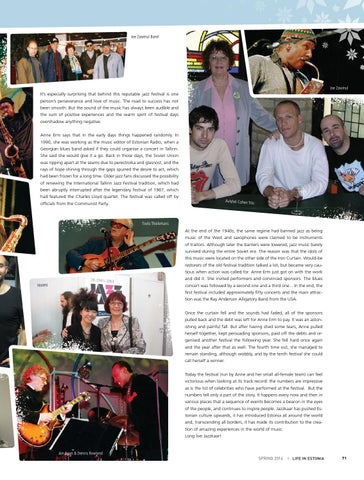
Joe Zawinul Band
Joe Zawinul
It’s especially surprising that behind this reputable jazz festival is one person’s perseverance and love of music. The road to success has not been smooth. But the sound of the music has always been audible and the sum of positive experiences and the warm spirit of festival days overshadow anything negative. Anne Erm says that in the early days things happened randomly. In 1990, she was working as the music editor of Estonian Radio, when a Georgian blues band asked if they could organise a concert in Tallinn. She said she would give it a go. Back in those days, the Soviet Union was ripping apart at the seams due to perestroika and glasnost, and the rays of hope shining through the gaps spurred the desire to act, which had been frozen for a long time. Older jazz fans discussed the possibility of renewing the International Tallinn Jazz Festival tradition, which had been abruptly interrupted after the legendary festival of 1967, which had featured the Charles Lloyd quartet. The festival was called off by officials from the Communist Party.
Avishai Cohen Trio
Toots Thielemans
At the end of the 1940s, the same regime had banned jazz as being music of the West and saxophones were claimed to be instruments of traitors. Although later the barriers were lowered, jazz music barely survived during the entire Soviet era. The reason was that the idols of this music were located on the other side of the Iron Curtain. Would-be restorers of the old festival tradition talked a lot, but became very cautious when action was called for. Anne Erm just got on with the work and did it. She invited performers and convinced sponsors. The blues concert was followed by a second one and a third one... In the end, the first festival included approximately fifty concerts and the main attraction was the Ray Anderson Alligatory Band from the USA.
Hiromi
Once the curtain fell and the sounds had faded, all of the sponsors pulled back and the debt was left for Anne Erm to pay. It was an astonishing and painful fall. But after having shed some tears, Anne pulled herself together, kept persuading sponsors, paid off the debts and organised another festival the following year. She fell hard once again and the year after that as well. The fourth time out, she managed to remain standing, although wobbly, and by the tenth festival she could call herself a winner. Today the festival (run by Anne and her small all-female team) can feel victorious when looking at its track record: the numbers are impressive as is the list of celebrities who have performed at the festival. But the numbers tell only a part of the story. It happens every now and then in various places that a sequence of events becomes a beacon in the eyes of the people, and continues to inspire people. Jazzkaar has pushed Estonian culture upwards, it has introduced Estonia all around the world and, transcending all borders, it has made its contribution to the creation of amazing experiences in the world of music. Long live Jazzkaar!
Ain Agan & Dennis Rowland SPRING 2014
I LIFE IN ESTONIA
71