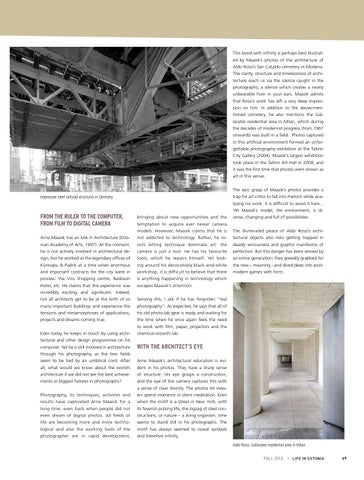
This bond with infinity is perhaps best illustrated by Maasik’s photos of the architecture of Aldo Rossi’s San Cataldo cemetery in Modena. The clarity, structure and timelessness of architecture reach us via the silence caught in the photographs, a silence which creates a nearly unbearable hum in your ears. Maasik admits that Rossi’s work has left a very deep impression on him. In addition to the above-mentioned cemetery, he also mentions the Gallarates residential area in Milan, which during the decades of modernist progress (from 1967 onwards) was built in a field. Photos captured in this artificial environment formed an unforgettable photography exhibition at the Tallinn City Gallery (2004). Maasik’s largest exhibition took place in the Tallinn Art Hall in 2008, and it was the first time that photos were shown as art in this venue.
Impressive steel railroad structures in Germany
From the ruler to the computer, from film to digital camera Arne Maasik has an MA in Architecture (Estonian Academy of Arts, 1997). At the moment, he is not actively involved in architectural design, but he worked at the legendary offices of Künnapu & Padrik at a time when enormous and important contracts for the city were in process: the Viru shopping centre, Radisson Hotel, etc. He claims that this experience was incredibly exciting and significant. Indeed, not all architects get to be at the birth of so many important buildings and experience the tensions and metamorphoses of applications, projects and dreams coming true. Even today he keeps in touch by using architectural and other design programmes on his computer. Yet he is still involved in architecture through his photography, as the two fields seem to be tied by an umbilical cord. After all, what would we know about the world’s architecture if we did not see the best achievements or biggest failures in photographs? Photography, its techniques, activities and results have captivated Arne Maasik for a long time, even back when people did not even dream of digital photos. All fields of life are becoming more and more technological and also the working tools of the photographer are in rapid development,
bringing about new opportunities and the temptation to acquire ever newer camera models. However, Maasik claims that he is not addicted to technology. Rather, he resists letting technique dominate art: the camera is just a tool. He has his favourite tools, which he repairs himself. Yet looking around his decoratively black-and-white workshop, it is difficult to believe that there is anything happening in technology which escapes Maasik’s attention.
The epic grasp of Maasik’s photos provides a trap for art critics to fall into rhetoric while analysing his work. It is difficult to avoid it here... Yet Maasik’s model, the environment, is diverse, changing and full of possibilities. The illuminated peace of Aldo Rossi’s architectural objects also risks getting trapped in deadly seriousness and graphic manifestos of perfection. But this danger has been sensed by an entire generation; they greedily grabbed for the new – meaning - and dived deep into postmodern games with form.
Sensing this, I ask if he has forgotten “real photography”. As expected, he says that all of his old photo-lab gear is ready and waiting for the time when he once again feels the need to work with film, paper, projectors and the chemical wizard’s lab.
With the architect’s eye Arne Maasik’s architectural education is evident in his photos. They have a sharp sense of structure. His eye grasps a construction, and the eye of the camera captures this with a sense of clear divinity. The photos let viewers spend moments in silent meditation. Even when the motif is a street in New York, with its feverish pulsing life, the zigzag of steel constructions, or nature – a living organism, time seems to stand still in his photographs. The motif has always seemed to reveal symbols and therefore infinity. Aldo Rossi, Gallarates residential area in Milan FALL 2013
I LIFE IN ESTONIA
49