I ECONOMY AND BUSINESS
Small crafts in Estonia By 2012, over 23,000 small crafts had been registered in Estonia. There are more than a hundred small harbours and berthing places, twentyfive of which have the capacity to receive larger sail-boats and international maritime tourists. Estonia has a strong network of sailing schools. In addition to sailors, Estonian rowers take part in the Olympic Games. Estonian offshore sailors often bring home prizes from European and world title championships, and motorboating, or powerboating, is of a high standard. In the two decades since regaining independence, recreational seafaring and fishing have once again become popular. Sailing, especially offshore sailing, also has long traditions. Every season several long regattas are organised in Estonia. There are Estonian Championship series in both offshore sailing and Olympic sailing. In Estonia a boating license is required when the sail area of the boat is larger than 25 square metres, its engine power exceeds 25 kW or it is used at night and more than five miles offshore. There is one general certificate for skippers of small boats, which allows them to operate all small crafts which do not exceed 24 metres in length. To get the license, one has to take a course and pass exams, similar to applying for a car license. All official Estonian waters have been measured with the latest hydrographical technology and charted precisely. Entering Estonian harbours is regulated by the Sailing Directions or Pilot Book which is updated on a regular basis. Accurate and user-friendly sea maps for Estonian coastal waters are also available digitally for traditional navigation appliances, as well as iPads and iPhones. The Estonian coastline is covered by the VHF (very high frequency – ed.) radio network, which provides coastal station services and guarantees rescue services in emergencies.
32
LIFE IN ESTONIA I 2012 FALL
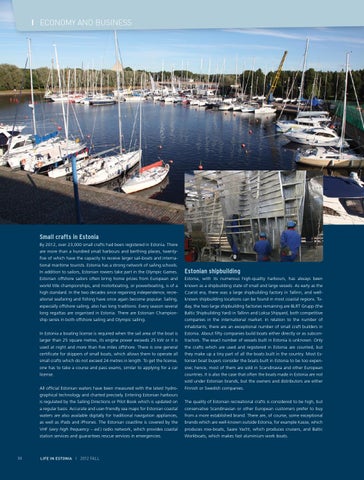
Estonian shipbuilding Estonia, with its numerous high-quality harbours, has always been known as a shipbuilding state of small and large vessels. As early as the Czarist era, there was a large shipbuilding factory in Tallinn, and wellknown shipbuilding locations can be found in most coastal regions. Today, the two large shipbuilding factories remaining are BLRT Grupp (the Baltic Shipbuilding Yard) in Tallinn and Loksa Shipyard, both competitive companies in the international market. In relation to the number of inhabitants, there are an exceptional number of small craft builders in Estonia. About fifty companies build boats either directly or as subcontractors. The exact number of vessels built in Estonia is unknown. Only the crafts which are used and registered in Estonia are counted, but they make up a tiny part of all the boats built in the country. Most Estonian boat buyers consider the boats built in Estonia to be too expensive; hence, most of them are sold in Scandinavia and other European countries. It is also the case that often the boats made in Estonia are not sold under Estonian brands, but the owners and distributors are either Finnish or Swedish companies. The quality of Estonian recreational crafts is considered to be high, but conservative Scandinavian or other European customers prefer to buy from a more established brand. There are, of course, some exceptional brands which are well-known outside Estonia, for example Kasse, which produces row-boats, Saare Yacht, which produces cruisers, and Baltic Workboats, which makes fast aluminium work boats.