how much? how good? The blue planet is not drinkable
97.5% 2.5% Saltwater
freshwater
30% groundwater
0.3% Rivers & Lakes 69.7% ice & Snow
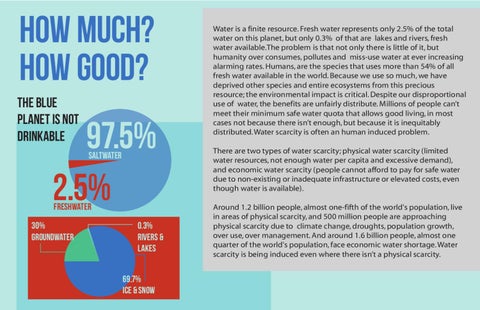
Water is a finite resource. Fresh water represents only 2.5% of the total water on this planet, but only 0.3% of that are lakes and rivers, fresh water available.The problem is that not only there is little of it, but humanity over consumes, pollutes and miss-use water at ever increasing alarming rates. Humans, are the species that uses more than 54% of all fresh water available in the world. Because we use so much, we have deprived other species and entire ecosystems from this precious resource; the environmental impact is critical. Despite our disproportional use of water, the benefits are unfairly distribute. Millions of people can’t meet their minimum safe water quota that allows good living, in most cases not because there isn’t enough, but because it is inequitably distributed. Water scarcity is often an human induced problem. There are two types of water scarcity; physical water scarcity (limited water resources, not enough water per capita and excessive demand), and economic water scarcity (people cannot afford to pay for safe water due to non-existing or inadequate infrastructure or elevated costs, even though water is available). Around 1.2 billion people, almost one-fifth of the world's population, live in areas of physical scarcity, and 500 million people are approaching physical scarcity due to climate change, droughts, population growth, over use, over management. And around 1.6 billion people, almost one quarter of the world's population, face economic water shortage. Water scarcity is being induced even where there isn’t a physical scarcity.