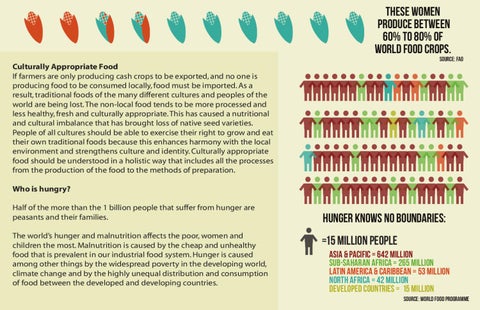
These women produce between 60% to 80% of world food crops. Source: FAO
Culturally Appropriate Food If farmers are only producing cash crops to be exported, and no one is producing food to be consumed locally, food must be imported. As a result, traditional foods of the many different cultures and peoples of the world are being lost. The non-local food tends to be more processed and less healthy, fresh and culturally appropriate. This has caused a nutritional and cultural imbalance that has brought loss of native seed varieties. People of all cultures should be able to exercise their right to grow and eat their own traditional foods because this enhances harmony with the local environment and strengthens culture and identity. Culturally appropriate food should be understood in a holistic way that includes all the processes from the production of the food to the methods of preparation. Who is hungry? Half of the more than the 1 billion people that suffer from hunger are peasants and their families. The world’s hunger and malnutrition affects the poor, women and children the most. Malnutrition is caused by the cheap and unhealthy food that is prevalent in our industrial food system. Hunger is caused among other things by the widespread poverty in the developing world, climate change and by the highly unequal distribution and consumption of food between the developed and developing countries.
hunger knows no boundaries: =15 Million people Asia & pacific = 642 Million Sub-Saharan Africa = 265 Million Latin America & Caribbean = 53 Million North Africa = 42 Million Developed Countries = 15 Million Source: World Food Programme