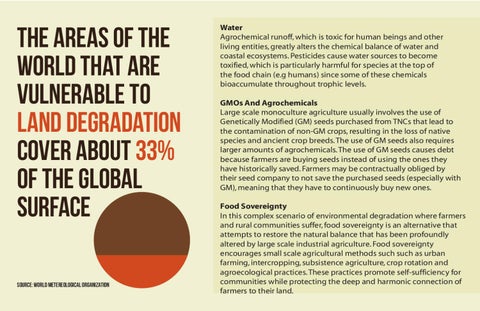
The areas of the world that are vulnerable to land degradation cover about 33% of the global surface Source: world metereological organization
Water Agrochemical runoff, which is toxic for human beings and other living entities, greatly alters the chemical balance of water and coastal ecosystems. Pesticides cause water sources to become toxified, which is particularly harmful for species at the top of the food chain (e.g humans) since some of these chemicals bioaccumulate throughout trophic levels. GMOs And Agrochemicals Large scale monoculture agriculture usually involves the use of Genetically Modified (GM) seeds purchased from TNCs that lead to the contamination of non-GM crops, resulting in the loss of native species and ancient crop breeds. The use of GM seeds also requires larger amounts of agrochemicals. The use of GM seeds causes debt because farmers are buying seeds instead of using the ones they have historically saved. Farmers may be contractually obliged by their seed company to not save the purchased seeds (especially with GM), meaning that they have to continuously buy new ones. Food Sovereignty In this complex scenario of environmental degradation where farmers and rural communities suffer, food sovereignty is an alternative that attempts to restore the natural balance that has been profoundly altered by large scale industrial agriculture. Food sovereignty encourages small scale agricultural methods such such as urban farming, intercropping, subsistence agriculture, crop rotation and agroecological practices. These practices promote self-sufficiency for communities while protecting the deep and harmonic connection of farmers to their land.