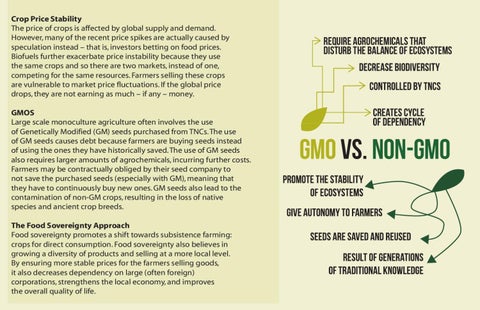
Crop Price Stability The price of crops is affected by global supply and demand. However, many of the recent price spikes are actually caused by speculation instead – that is, investors betting on food prices. Biofuels further exacerbate price instability because they use the same crops and so there are two markets, instead of one, competing for the same resources. Farmers selling these crops are vulnerable to market price fluctuations. If the global price drops, they are not earning as much – if any – money. GMOS Large scale monoculture agriculture often involves the use of Genetically Modified (GM) seeds purchased from TNCs. The use of GM seeds causes debt because farmers are buying seeds instead of using the ones they have historically saved. The use of GM seeds also requires larger amounts of agrochemicals, incurring further costs. Farmers may be contractually obliged by their seed company to not save the purchased seeds (especially with GM), meaning that they have to continuously buy new ones. GM seeds also lead to the contamination of non-GM crops, resulting in the loss of native species and ancient crop breeds. The Food Sovereignty Approach Food sovereignty promotes a shift towards subsistence farming: crops for direct consumption. Food sovereignty also believes in growing a diversity of products and selling at a more local level. By ensuring more stable prices for the farmers selling goods, it also decreases dependency on large (often foreign) corporations, strengthens the local economy, and improves the overall quality of life.
REQUIRE AGROCHEMICALS THAT DISTURB THE BALANCE OF ECOSYSTEMS
GMO vs. non-GMO