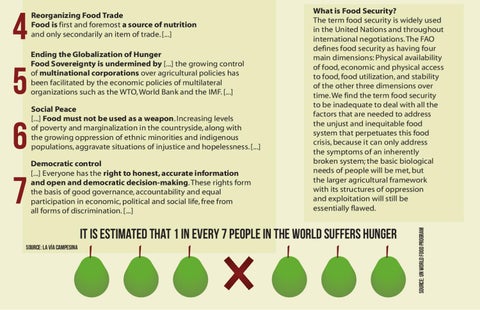
Ending the Globalization of Hunger Food Sovereignty is undermined by [...] the growing control of multinational corporations over agricultural policies has been facilitated by the economic policies of multilateral organizations such as the WTO, World Bank and the IMF. [...] Social Peace [...] Food must not be used as a weapon. Increasing levels of poverty and marginalization in the countryside, along with the growing oppression of ethnic minorities and indigenous populations, aggravate situations of injustice and hopelessness. [...] Democratic control [...] Everyone has the right to honest, accurate information and open and democratic decision-making. These rights form the basis of good governance, accountability and equal participation in economic, political and social life, free from all forms of discrimination. [...]
What is Food Security? The term food security is widely used in the United Nations and throughout international negotiations. The FAO defines food security as having four main dimensions: Physical availability of food, economic and physical access to food, food utilization, and stability of the other three dimensions over time. We find the term food security to be inadequate to deal with all the factors that are needed to address the unjust and inequitable food system that perpetuates this food crisis, because it can only address the symptoms of an inherently broken system; the basic biological needs of people will be met, but the larger agricultural framework with its structures of oppression and exploitation will still be essentially flawed.
It is estimated that 1 in every 7 people in the world suffers hunger Source: La VĂa Campesina
Source: Un World Food Program
Reorganizing Food Trade Food is first and foremost a source of nutrition and only secondarily an item of trade. [...]