CURRICULUM
MTSS: A Research-based System to Ensure Equity and Access for Learning By Joan Schumann, Ph.D. , Tessie Rose, Ph.D. , Keith Collins, Ed.D. , and Kristen Koehler, M.Ed
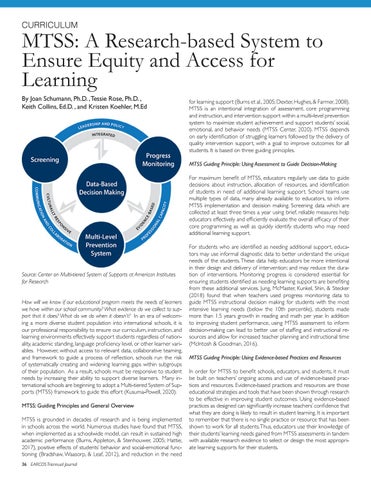
for learning support (Burns et al., 2005; Dexter, Hughes, & Farmer, 2008). MTSS is an intentional integration of assessment, core programming and instruction, and intervention support within a multi-level prevention system to maximize student achievement and support students’ social, emotional, and behavior needs (MTSS Center, 2020). MTSS depends on early identification of struggling learners followed by the delivery of quality intervention support, with a goal to improve outcomes for all students. It is based on three guiding principles. MTSS Guiding Principle: Using Assessment to Guide Decision-Making For maximum benefit of MTSS, educators regularly use data to guide decisions about instruction, allocation of resources, and identification of students in need of additional learning support. School teams use multiple types of data, many already available to educators, to inform MTSS implementation and decision making. Screening data which are collected at least three times a year using brief, reliable measures help educators effectively and efficiently evaluate the overall efficacy of their core programming as well as quickly identify students who may need additional learning support.
Source: Center on Multi-tiered System of Supports at American Institutes for Research How will we know if our educational program meets the needs of learners we have within our school community? What evidence do we collect to support that it does? What do we do when it doesn’t? In an era of welcoming a more diverse student population into international schools, it is our professional responsibility to ensure our curriculum, instruction, and learning environments effectively support students regardless of nationality, academic standing, language proficiency level, or other learner variables. However, without access to relevant data, collaborative teaming, and framework to guide a process of reflection, schools run the risk of systematically creating and widening learning gaps within subgroups of their population. As a result, schools must be responsive to student needs by increasing their ability to support diverse learners. Many international schools are beginning to adopt a Multi-tiered System of Supports (MTSS) framework to guide this effort (Kusuma-Powell, 2020). MTSS: Guiding Principles and General Overview MTSS is grounded in decades of research and is being implemented in schools across the world. Numerous studies have found that MTSS, when implemented as a schoolwide model, can result in sustained high academic performance (Burns, Appleton, & Stenhouwer, 2005; Hattie, 2017), positive effects of students’ behavior and social-emotional functioning (Bradshaw, Waasorp, & Leaf, 2012), and reduction in the need 36 EARCOS Triannual Journal
For students who are identified as needing additional support, educators may use informal diagnostic data to better understand the unique needs of the students. These data help educators be more intentional in their design and delivery of intervention; and may reduce the duration of interventions. Monitoring progress is considered essential for ensuring students identified as needing learning supports are benefiting from these additional services. Jung, McMaster, Kunkel, Shin, & Stecker (2018) found that when teachers used progress monitoring data to guide MTSS instructional decision making for students with the most intensive learning needs (below the 10th percentile), students made more than 1.5 years growth in reading and math per year. In addition to improving student performance, using MTSS assessment to inform decision-making can lead to better use of staffing and instructional resources and allow for increased teacher planning and instructional time (McIntosh & Goodman, 2016). MTSS Guiding Principle: Using Evidence-based Practices and Resources In order for MTSS to benefit schools, educators, and students, it must be built on teachers’ ongoing access and use of evidence-based practices and resources. Evidence-based practices and resources are those educational strategies and tools that have been shown through research to be effective in improving student outcomes. Using evidence-based practices as designed can significantly increase teachers’ confidence that what they are doing is likely to result in student learning. It is important to remember that there is no single practice or resource that has been shown to work for all students. Thus, educators use their knowledge of their students’ learning needs gained from MTSS assessments in tandem with available research evidence to select or design the most appropriate learning supports for their students.