Technical recommendations
Technical recommendations
6
Direct applied decorative renders Some common rules need to be applied when using decorative renders to ensure a successful application and a durable finish.
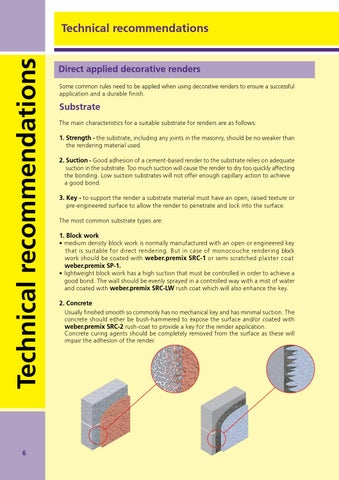
Substrate The main characteristics for a suitable substrate for renders are as follows: 1. Strength - the substrate, including any joints in the masonry, should be no weaker than the rendering material used. 2. Suction - Good adhesion of a cement-based render to the substrate relies on adequate suction in the substrate. Too much suction will cause the render to dry too quickly affecting the bonding. Low suction substrates will not offer enough capillary action to achieve a good bond. 3. Key - to support the render a substrate material must have an open, raised texture or pre-engineered surface to allow the render to penetrate and lock into the surface. The most common substrate types are: 1. Block work • medium density block work is normally manufactured with an open or engineered key that is suitable for direct rendering. But in case of monocouche rendering block work should be coated with weber.premix SRC-1 or semi scratched plaster coat weber.premix SP-1. • lightweight block work has a high suction that must be controlled in order to achieve a good bond. The wall should be evenly sprayed in a controlled way with a mist of water and coated with weber.premix SRC-LW rush coat which will also enhance the key. 2. Concrete Usually finished smooth so commonly has no mechanical key and has minimal suction. The concrete should either be bush-hammered to expose the surface and/or coated with weber.premix SRC-2 rush-coat to provide a key for the render application. Concrete curing agents should be completely removed from the surface as these will impair the adhesion of the render.