29th NOV1st DEC NEXT 2017
EUROPEAN MICROFINANCE WEEK
PAGE 2 - 3
European Microfinance Award PAGE 4
European Microfinance Week PAGE 5 - 6
News from the Secretariat PAGE 7 - 8
Forum PAGE 9 - 11
News from our Members PAGE 12 - 13
News from our Action Groups PAGE 14
New Members PAGE 15 - 16
Announcements
Luxembourg Government Pledges Continued Support to e-MFP
sustainable and inclu-
finance and inclusive finance as tools for foster-
sive financial services
ing development and eradicating poverty with
for the un(der)banked.
the aim of giving disadvantaged populations
The signing took place
access to basic financial services. We’d like to
during a visit by Luxem-
thank the Ministry of Foreign and European
bourg’s
for
Affairs – Directorate for Development Coopera-
We’re delighted to announce that in May e-MFP
Cooperation and Humanitarian Affairs, Romain
tion and Humanitarian Affairs, and the Ministry
signed a new agreement with the Luxembourg
Schneider, and Minister of Finance, Pierre
of Finance for their confidence and support,
Government for the period 2017 – 2021, which
Gramegna to the House of Microfinance, home
and look forward to continuing our close
guarantees the financial support required for
of e-MFP, ADA, the Inclusive Finance Network
collaboration.
implementing our new Strategic Plan. This firm
Luxembourg
commitment will enable us to build on our
Microfinance and Development Fund (LMDF),
We wish you a great summer
achievements and further develop our activities.
the Microinsurance Network and Microlux.
and an enjoyable read.
development and innovation, e-MFP fosters the
Over the past two decades, Luxembourg has
Christoph Pausch
increase in global access to affordable, quality,
actively supported the development of micro-
Executive Secretary
By
driving
knowledge-sharing,
(InFiNe.lu),
the
Minister
Luxembourg
partnership
EUROPEAN MICROFINANCE AWARD
PAGE
|
© Julius Mwelu UN-Habitat
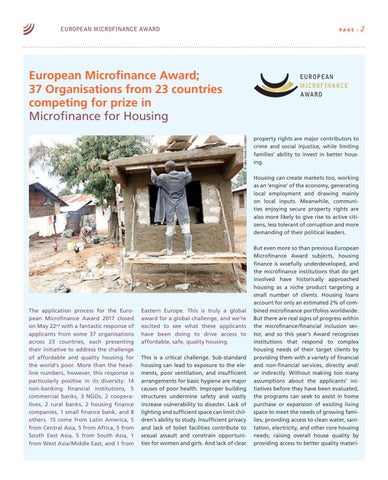
European Microfinance Award; 37 Organisations from 23 countries competing for prize in Microfinance for Housing property rights are major contributors to crime and social injustice, while limiting families’ ability to invest in better housing. Housing can create markets too, working as an ‘engine’ of the economy, generating local employment and drawing mainly on local inputs. Meanwhile, communities enjoying secure property rights are also more likely to give rise to active citizens, less tolerant of corruption and more demanding of their political leaders.
The application process for the European Microfinance Award 2017 closed on May 22nd with a fantastic response of applicants from some 37 organisations across 23 countries, each presenting their initiative to address the challenge of affordable and quality housing for the world’s poor. More than the headline numbers, however, this response is particularly positive in its diversity: 14 non-banking financial institutions, 5 commercial banks, 3 NGOs, 2 cooperatives, 2 rural banks, 2 housing finance companies, 1 small finance bank, and 8 others. 15 come from Latin America, 5 from Central Asia, 5 from Africa, 5 from South East Asia, 5 from South Asia, 1 from West Asia/Middle East, and 1 from
Eastern Europe. This is truly a global award for a global challenge, and we’re excited to see what these applicants have been doing to drive access to affordable, safe, quality housing. This is a critical challenge. Sub-standard housing can lead to exposure to the elements, poor ventilation, and insufficient arrangements for basic hygiene are major causes of poor health. Improper building structures undermine safety and vastly increase vulnerability to disaster. Lack of lighting and sufficient space can limit children’s ability to study. Insufficient privacy and lack of toilet facilities contribute to sexual assault and constrain opportunities for women and girls. And lack of clear
But even more so than previous European Microfinance Award subjects, housing finance is woefully underdeveloped, and the microfinance institutions that do get involved have historically approached housing as a niche product targeting a small number of clients. Housing loans account for only an estimated 2% of combined microfinance portfolios worldwide. But there are real signs of progress within the microfinance/financial inclusion sector, and so this year’s Award recognises institutions that respond to complex housing needs of their target clients by providing them with a variety of financial and non-financial services, directly and/ or indirectly. Without making too many assumptions about the applicants’ initiatives before they have been evaluated, the programs can seek to assist in home purchase or expansion of existing living space to meet the needs of growing families; providing access to clean water, sanitation, electricity, and other core housing needs; raising overall house quality by providing access to better quality materi-
2
EUROPEAN MICROFINANCE AWARD
© Julius Mwelu UN-Habitat
PAGE
als and construction techniques, as well as securing tenure and protection against eviction; and mitigating against natural disasters by using resilient construction design and materials and locating housing outside flood zones and other vulnerable sites. These goals can be achieved with a range of financial services, from micro-mortgages and home improvement loans to housing savings and insur-
ance, and non-financial services such as financial education, training, counselling and technical assistance. Now that the applications are closed, a Pre-Selection Committee will evaluate, including on eligibility, sufficient financial and social performance and the “consistency” or “robustness” of the initiative the organisation has put forward for the
Award. After that, a Selection Committee of experts will, during September, choose a long-list of up to ten semi-finalists, and then a final short-list of three, to be assessed by a High Jury and the winner announced during European Microfinance Week at a ceremony at the European Investment Bank on November 30 th. For those wanting more information, the eligibility and assessment criteria, as well as all other supporting materials, including an Explanatory Note, can be found at www.european-microfinance-award.com. 1.6 billion of the world’s population lives without adequate shelter. One in three still have no access to adequate sanitation. The microfinance sector has the opportunity to do for housing what has been done in financial inclusion more broadly. But it will require experimentation, vision, buy-in from practitioners and investors, and a great sharing of knowledge on what works and what doesn’t. At e-MFP, we’re proud, as always, to be a co-organiser of an Award which can help to achieve this knowledge sharing, and spotlighting the great innovators around the world.
About the Award First held in 2006 and jointly organised by the Luxembourg Ministry of Foreign and European Affairs, e-MFP and the Inclusive Finance Network Luxembourg (InFiNe.lu), it includes a prize of €100,000 to be awarded on November 30th during the European Microfinance Week, at a ceremony to which the three finalists will be invited and will present a short video about their programs. Previous subjects for the Award have included Innovation for Microfinance and Access to Education (2016); Microfinance in Postdisaster, Post-conflict Areas & Fragile States (2015); Microfinance and the Environment (2014); Microfinance for Food Security (2012); Value Chain Finance (2010); Socially Responsible Microfinance (2008) and Outreach in 2006. For more information visit www.european-microfinance-award.com
|
3
EUROPEAN MICROFINANCE WEEK
Save the Date – European Microfinance Week
PAGE
|
29th NOV1st DEC NEXT 2017
EUROPEAN MICROFINANCE WEEK
Preparations are well underway for European Microfinance Week (EMW) taking place 29 November – 1 December 2017, in Luxembourg. EMW, hosted by e-MFP, is one of the top events in the microfinance calendar and a unique meeting point for microfinance professionals working worldwide. Last year’s event attracted close to 500 participants from 58 countries. EMW promotes good practices and facilitates synergies amongst microfi-
nance professionals in Europe and beyond. Its unique structure – with members proposing session topics – offers an unparalleled program with an exciting line-up of prestigious speakers. The event is widely recognised for its high quality sessions tackling the sector’s front line topics and its excellent networking opportunities. Participants consistently rate EMW as the must-attend event in Europe for networking and knowledge sharing.
Thank you to all our members who submitted proposals for this year’s event and we’ll keep you informed of the stimulating programme in store for EMW 2017. Registration on www.e-mfp.eu will open late summer, so block the dates 29 November – 1 December 2017 in your calendar. We look forward to welcoming you back to Luxembourg!
We would like to thank the sponsors of EMW 2017: Platinum sponsor
Silver sponsors
Other sponsors
With the support of
Media partners
4
NEWS • SECRETARIAT
PAGE
|
NEWS FROM THE SECRETARIAT
e-MFP Offsite Sessions Offsite Sessions are a new activity developed under our Strategic Plan 2017-2021 which take place in different members’ countries and provide e-MFP with opportunities for more frequent touchpoints with its members and external stakeholders. For the first e-MFP Offsite Session on 3rd April, e-MFP collaborated with BNP Paribas to bring the MIMOSA Project team to Paris. The project co-founders, Emmanuelle Javoy and e-MFP’s Daniel Rozas,
“The Role of MFIs in improving access to and quality of education: Perspectives on the 7th European Microfinance Award and the European Dialogue” and was timed to coincide both with the launch of Investing in Tomorrow (e-MFP’s latest Dialogue) and the launch of the call for applications for the 2017 Award on Housing. The event brought together a panel including Arc Finance’s Sam Mendelson (who was the lead author of the paper, as well as a member of the Award Selection Committee), Kaspar Wansleben
Paris Offsite Session
London Offsite Session
shared their research on market saturation and overindebtedness, including a review of several countries covered by the MIMOSA Project. The event was wellattended by a cross-section of Paris-based institutions working in microfinance, including Oxus, Grameen Credit Agricole Foundation, Advans, Cerise, and of course staff from BNP Paribas who hosted the event. The forum featured a number of questions and critiques of the MIMOSA market saturation model. The second e-MFP Offsite Session of the year took place in London on 10th April, in partnership with the UK’s Financial Inclusion Forum. The session was entitled
from the Luxembourg Microfinance and Development Fund (a supporter of two of the 2016 Award finalists and key investor in education finance) and Nathan Byrd from Opportunity International’s Education Finance team, along with e-MFP’s Daniel Rozas. Katy Jones from Big Issue Invest and the Financial Inclusion Forum chaired the packed out event, generously hosted by Allen & Overy.
Investing in Tomorrow Our latest European Dialogue entitled Investing in Tomorrow, presents the outcomes of the European Microfinance Award 2016, on Microfinance and Access to Education. Several of the previous editions of the Dialogue have paralleled the subjects of the European Microfinance
Award, and it’s an invaluable way for e-MFP to take to an even wider audience what the Award is all about and how MFIs around the world are expanding beyond their core financial services to improve clients’ lives. Investing in Tomorrow illustrates the broad range of interventions that MFIs are implementing to improve education access, drawing on case examples from the Award finalists and semi-finalists.
For more information read our blog
To read and download the Dialogue visit
http://www.e-mfp.eu/blog/e-mfp-and-financial-
http://www.e-mfp.eu/resources/european-dia-
inclusion-forum-host-london-panel-session-
logue-no11
launch-investing-tomorrow-and
5
NEWS • SECRETARIAT
PAGE
|
e-MFP out & about
On 26th April the e-MFP Secretariat took part in the ALFI Impact Investing Conference which e-MFP also partnered. The event was well attended (more than 200 participants) and offered e-MFP the opportunity to reach out to the broader impact investing sector.
Gabriela Erice participated in the Convergences Working Group “Finance responsible et inclusive”. She was also invited by Convergences to be part of the Editorial Committee of the Microfinance Barometer and of the Jury of the Convergences Award.
Meet the e-MFP team at the 40th Midi de la Microfinance in Luxembourg for the discussion on “Women at the heart of entrepreneurship: the future of Africa” with a panel composed of Félicité
© MFC
e-MFP Chairwoman Anne Contreras participated in the workshop “The Microfinance Industry: Revolution or Footnote?” where 32 microfinance and impact investing participants and analysts from around the world convened March 31 – April 1, hosted by Lehigh University’s Martindale Center, USA and sponsored by the Calmeadow Foundation and the Financial Inclusion Equity Council (of which CFI is the secretariat) to explore what role microfinance will play going forward. For more information on the workshop see page 7.
On 22nd and 23rd June Christoph Pausch attended the Annual Conference of the European Microfinance Network (EMN) in Venice.
Christoph Pausch participated in the 20th MFC annual conference which was held 24th – 26th May, in Sarajevo where MFC also celebrated its 20th anniversary during the event. Mr. Pausch represented e-MFP at the MFC membership meeting which was held on 24th May.
Kambou, COPSA-C, Burkina Faso; Josée Mukandinda, Umutanguha Finance Company, Rwanda; Marèma Bao, COFINA, Senegal and Maimouna Gueye, African Development Bank (BAD), Côte d’Ivoire. This special edition of the Midi also welcomes Her Royal Highness the Grand Duchess of Luxembourg and Mr. Romain Schneider, Minister of Development Cooperation and Humanitarian Affairs.
6
FORUM
PAGE
|
FORUM
The Microfinance Industry: Revolution or Footnote? Lessons for the Next Ten Years © Accion
By Anna Kanze, Grassroots Capital Management PBC
ing the leading impact investing sector focused on low-income populations around the world. These lessons coalesced into four main topics that became the subject of blog posts, summarized briefly below: How will microfinance respond and adapt to its challenges, or is it yesterday’s solution, to be supplanted by more cutting edge, “impactful” initiatives? These were among the questions regarding the future of microfinance addressed by 32 microfinance and impact investing participants and analysts from around the world, including e-MFP Chairwoman Anne Contreras, who convened in late March, hosted by Lehigh Univer-
sity’s Martindale Center, sponsored by the Calmeadow Foundation and the Financial Inclusion Equity Council, and organized by Grassroots Capital Management PBC and LIPAM International. With a view towards provoking ongoing dialogue to sketch the way forward for microfinance and impact investing more broadly, participants extracted key lessons from the successes and failures of microfinance’s thirty-year path to becom-
1. Microfinance Is Dead; Long Live Microfinance!1 Overall, the Lehigh gathering agreed that while dead to some, microfinance is alive and kicking on the ground and vigorously generating diverse business models and approaches to building economies and social value. The future of microfinance and the challenge for those who prioritize social value for clients is in taking advantage of the strengths of incumbent microfinance
7
FORUM
PAGE
institutions (MFIs), particularly their four-decades-deep, hard-earned understanding of their clients’ heterogeneous needs. 2. Time to Ditch Impact Investing’s Unproductive Self-Analysis2 Rather than belabor the definition of “impact,” which is often whatever an investor thinks it is, the group examined how microfinance could leverage its uniquely successful business model and market penetration to generate even more financial and non-financial value and retain its ability to innovate and execute at scale. The discussion focused on experience and research testing the efficacy of specific business models, products and services in achieving non-financial goals, such as better school attendance, better health, or greater productivity. 3. Can MFIs Deliver What Poor People Need?3 There was wide agreement that even as MFIs have commercialized and scaled, they’ve listened to their clients, worked to understand their needs, and served as distributors of a growing variety of financial and non-financial services. The path forward is clear: a wider array of services is beneficial to clients, and product diversification remains the siren call of future growth and profitability. However, product diversification beyond credit has remained fairly limited. For those
|
MFIs with the institutional capacity and financial sustainability to diversify product and service offerings, targeted subsidies and patient impact investments continue to be among the many ways to support innovation. 4. FinTech in Microfinance: In Search of the High Tech – High Touch Unicorn4 As fintech-driven models become more sophisticated, can MFIs hope to deliver anything that technology-sophisticated telecoms and global commercial banks can’t? MFIs, clients, and even global banks themselves demonstrably think the answer is Yes! However, despite broad agreement among workshop participants on the potential of fintech in microfinance, there was also significant unease about many MFIs’ abilities to effectively embrace it. With the help of dedicated impact investors, microfinance can exploit fintech opportunities to keep innovating and delivering better designed, more tailored, higher impact products and services. For the full blog posts, please visit the Center for Financial Inclusion’s blog5, and Grassroots’ site has gathered all four posts6 as well. The key findings will also inform a paper to be circulated and presented in the microfinance and impact investing communities in the fall of 2017.
1
https://cfi-blog.org/2017/04/20/microfinance-is-dead-long-live-microfinance/
2
https://cfi-blog.org/2017/04/27/time-to-ditch-impact-investings-unproductive-self-analysis/
3
https://cfi-blog.org/2017/05/04/can-mfis-deliver-what-poor-people-need/
4
https://cfi-blog.org/2017/05/11/fintech-in-microfinance-in-search-of-the-high-tech-high-touch-unicorn/
5
https://cfi-blog.org/
6
https://www.grassrootscap.com/blog-series-on-the-future-of-microfinance/
8
NEWS • MEMBERS
PAGE
NEWS FROM OUR MEMBERS
Second edition of the free online course (MOOC) on the commercialization of microfinance Some comments left by learners: Bola from Nigeria -
“As a practitioner in the field of microfinance the course met and surpassed my expectations. This course has boosted my confidence in starting my own outreach”. Martin from Germany The Université Libre de Bruxelles (ULB) and the Centre for European Research in Microfinance (CERMi) have just launched the registration for the second edition of the MOOC on the commercialization of microfinance! The first edition was very successful, with participants coming from all around the world, many of them being microfinance practitioners. Professor Marek Hudon is the lead educator of the MOOC. Surrounding the microfinance sector today are questions related to whether these organizations should accept more commercial sources of funding, adopt new revenue strategies or turn to commercial structure to help the organization reach sufficient scale. These are the debates around the commercialization of microfinance. This course aims to deliver practical insight for practitioners at all stages in the MFI life cycle. The MOOC provides insight on the motivations for establishing an MFI and how these institutions fit into the global financial landscape, provides examples of how to profes-
sionalize your microfinance institution’s operational practices, and helps to identify challenges and opportunities for MFIs that are going through the transformation process or considering new sources of funding. Guest contributions include well-known practitioners including, Craig Churchill (ILO), Kurt Moors (BRS), Kimanthi Mutua (K-REP), Jorge Ramirez (EMN), Daniel Rozas (e-MFP), in addition to leading academics such as Paul Collier (Oxford University), Marc Labie (UMONS/ CERMi) or Jonathan Morduch (NYU). The MOOC is organized in partnership with e-MFP and the European Microfinance Network (EMN). The second edition will start on 4th September and will be free of charge. Do not hesitate to register! Learners can follow the whole MOOC (five weeks or around 12 hours) or simply watch some videos. You can register on Futurelearn website or simply using this link: http://tiny.cc/Socent
“It was very clear, well conceived and followed a pedagogic approach”. Alemu from Ethiopia -
“The course was more than what I expected. What I enjoyed most is the contribution of very known experts in each area”.
CERMi CERMi draws together researchers, involved in microfinance activities in developing countries, from the Centre Emile Bernheim (Solvay Brussels School of Economics and Management, Université Libre de Bruxelles) and from the Warocqué Research Centre (Université de Mons). The CERMi also collaborates with the European Microfinance Programme (EMP).
For more information visit www.cermi.eu
|
9
NEWS • MEMBERS
PAGE
|
10
The 12th Annual SPTF Meeting Focuses on Client Outcomes In early June, the Social Performance Task Force (SPTF)1 welcomed 250 global participants to Mexico City for the organization’s 12th Annual Meeting. Spanning four days, the meeting focused on how financial inclusion stakehold-
An Outcomes Working Group meeting explored a list of “harmonized social outcome indicators” proposed for use by the entire industry, with the purpose of creating consistent and stable indicators for many common social outcomes.
responsible inclusive finance, and using fintech to serve clients better. Practical and collaborative workshops included Indications of Financial Stress and Health Among Clients (the Smart Campaign and Grameen Foundation),
ers can implement the SPTF Universal Standards for SPM2, with a particular focus on managing client outcomes.
Participants discussed the results of pilot tests in Peru and India which highlight the importance of asking clients themselves which outcomes they wish to achieve. Workshop participants also practiced analyzing real social outcomes data provided by three different FSPs in Latin America. The workshop was based on the Guidelines on Outcomes Management for Financial Service Providers 4, which present practical guidance for measuring client level outcomes, analyzing the results, and using the findings as part of SPM.
Empowering Customers to Use Digital Financial Services (CGAP) and Managing Employee Retention (Human Capital MF and the SPTF).
While the SPTF promotes all aspects of social performance management (SPM), the organization is increasingly focused on the measurement and management of client outcomes. Several of the sessions at the SPTF Annual Meeting centered on the recent work of the SPTF Outcomes Working Group3, a large constituency of SPTF members whose purpose is to promote strong outcomes management by financial service providers (FSPs), investors, and other stakeholders, through sharing of good practice, development, and dissemination of resources.
The meeting, sponsored by Sparkassenstiftung für internationale Kooperation (and its local subsidiary Fundación Alemana Servicios), PRONAFIM, and ADA Microfinance, drew participants from almost 50 countries. Meeting notes, presentations, and videos can be found on the SPTF website: https://sptf.info/annual-meetings/2017-annual-
Other meeting topics that drew great interest from participants included responsible pricing, regulation for
1
www.sptf.info
2
www.sptf.info/universal-standards-for-spm/universal-standards
3
www.sptf.info/working-groups/outcomes
4
www.sptf.info/images/Guidelines-on-Outcomes-Management-for-FSPs.pdf
meeting
NEWS • MEMBERS
PAGE
|
11
5th European Research Conference on Microfinance Portsmouth Business School was delighted to host the recent 5th European Research Conference on Microfinance from 12th to 14th June in England with over 130 delegates attending the event. A mix of established researchers with a number of leading practitioners infused the financial inclusion debate with insights and thought-provoking panel presentations. Topical themes across gender, Islamic microfinance, Fintech, research and the future of microfinance were probed in wide-ranging panel discussions. The event was opened by Andy Thorpe (Portsmouth Business School) and Christoph Pausch (e-MFP) and commenced by asking whether microfinance would live to the year 2030, a chilling prospect in itself. If so, under what guise would it do so – is there still the well-trodden ‘promise’ of microfinance? What are the challenges to its realisation? In the opening session chaired by Dirk Zetzsche (University of Luxembourg) perspectives were shared by Marek Hudon (Université Libre de Bruxelles and CERMi), Annette Krauss (University of Zurich), Sam Mendelson (Financial Inclusion Forum UK & Arc Finance) and Kimanthi Mutua (Sidian Bank Kenya). Following the opening panel, two parallel sessions allowed for the presentation of 42 research papers distributed by four streams. Closing the first day, the panel ‘Islamic Microfinance – faithbased cosmetic or an advance for everyone?’ was brought to the fore of the research agenda. The panel was moderated by Ajaz Khan (Care International UK) and valuable contributions were made by Malcolm Harper (Cranfield
Management School), Habib Ahmed (University of Durham), Amjad Saqib (Akhuwat Pakistan) and Mohammed Kroessin (Islamic Relief Academy). The second day opened with a panel discussion on the place of gender in the contemporary financial inclusion discourse. Chaired by Robert Lensink (University of Groningen), Susan Johnson (University of Bath), Isabelle Guérin (IRD France) and Supriya Garikipati (University of Liverpool) presented different approaches to the gender research agenda. The third parallel session of paper presentations included 23 different research papers and preceded the afternoon plenary session, chaired by Roy Mersland (University of Agder), which explored new frontiers in microfinance with Ariane Szafarz (ULB/CERMi) and Tyler Wry. The final panel of the day revolved around the increasing connections between Fintech and microfinance with presentations by Wei Wu (University of Birmingham), Phil Mader (University of Sussex), Gunnar Camner (GSMA), Niall Dennehy (Aid:Tech), and moderated by Arvind Ashta (Burgundy School of Business). The afternoon ended with a very special moment, the Best PhD Paper Award
ceremony. Muluneh Hideto (ULB/University of Agder) took the first place with the paper ‘Association between Social Performance Rating Scores and Governance Structure in Microfinance Institutions’ and Francisco Bächler and Jann Goedecke were awarded the second place with the paper ‘Do multiple bank relationships push borrowers into indebtedness? Evidence from a microlending market’. The winners will receive € 1000 and € 500, respectively and will present their work at the European Microfinance Week next November. The conference highlights also include the social events held on both evenings of the event where delegates had a chance to take time to meet old and new colleagues. The final day started with the last parallel session with 17 further paper presentations and concluded with a challenging panel on the role of research in microfinance. ‘(Re)framing Research in Microfinance‘ with James Copestake (University of Bath), Maren Duvendack (University of East Anglia). The panel was moderated by Marc Labie (University of Mons/CERMi) and followed with a number of provocations and suggestions from practitioners Maude Massu (Financial Inclusion Forum UK), Lucia Spaggiari (Microfinanza Rating/SPTF) and Grzegorz Galusek (Microfinance Centre). The three days of the conference passed very quickly. They were full of new ideas, new approaches to old issues and emotions and hopefully they will shape new projects and collaborations in a near future.
NEWS • ACTION GROUPS
PAGE
|
12
NEWS FROM OUR ACTION GROUPS
Train with the e-MFP Action Groups Our Action Groups with their focus on specific topics of interest have their finger on the pulse and identified key areas to support with the following trainings:
Due diligence for MFIs venturing into SME finance Training for Investment Officers
Training at the last European Microfinance Week
In recent years, many MFIs have ventured into SME finance without adequate knowledge or experience, with various degrees of success. When conducting due diligence, its critical for investment fund analysts to be able to differentiate between successful and unsuccessful SME programs. This one-day training will review the key issues that investment fund analysts need
to be aware of when conducting due diligence of MFIs providing or planning to provide SME finance products and services. It will highlight the characteristics of SMEs in comparison to micro enterprises, how to assess SME loans, the procedures that should be in place within the institution to serve this segment, the specific risks of the SME sector and the main challenges for the organization at all levels. The training will include a heavy emphasis
on case studies with sufficient time for indepth discussion and sharing of experience among participants. The full day training will take place on 13th of October 2017, in Addis Ababa, Ethiopia in the framework of the African Microfinance Week.
Please note that the number of participants is limited to 20, so places will be given on a first-come, first-served basis. For more information and price details, contact Gabriela Erice, gerice@e-mfp.eu.
NEWS • ACTION GROUPS
PAGE
Green Trainings for MFIs and investors © GJ Schuite
In the trainings for MFIs the institutions will be introduced to the various dimensions of environmental performance, their challenges and socio-economic opportunities. Thanks to the use of The Green Index1, and interactive case stud-
1
ies, the MFIs will be guided into the realm of green microfinance, and the basic elements will be provided to support the MFIs to prioritize, explore and develop: environmental strategies, environmental risk assessment procedures, and green credit products. In the investors training the aim is to guide investors into the understanding and assessment of the green performance of its investees, and assess trade-offs and synergies between environmental performance and economic return. Practical tools will be provided to guide the investors and support them in their assessment, and the development of their green portfolio and strategy.
https:www.e-mfp.eu/sites/default/files/resources/2016/10/Green_Index_2016_final_web.pdf
13
Other AG news
Training at the last European Microfinance Week
e-MFP’s Microfinance and Environment Action Group is proud to announce that Enclude BV will deliver on its behalf two trainings on green microfinance: one dedicated to microfinance institutions (MFIs), that will be held during the African Microfinance Week in Addis Ababa in October 2017; and a second one dedicated to investors, date and place is still to be confirmed in September 2017, in The Netherlands or Brussels.
|
Based on the webinars done last year and the meeting they had at EMW 2016, the Rural Outreach and Innovation (ROI) AG is proposing to have six new webinars called “e-MFP Rural Outreach and Innovation Talks”. These talks consist of on-line short presentations on the priority topics of the AG: value chain finance, agri-insurance, non-financial services for farmers, social issues in rural finance, digital services for farmers, and inclusive green rural finance. The objective is to promote knowledge exchange, encourage the sharing of best practices and innovative ideas, and catalyse members to create opportunities for partnerships. The e-MFP Digital Innovations for Financial Empowerment Action Group (DIFE) brings together microfinance and financial inclusion professionals with on the ground experience in the field of digital, electronic and mobile finance operations to share knowledge and experience. Jacinta Maiyo, Pamiga, and Alexis Lebel, OpenCBS have recently taken on the role to lead the Action Group and look forward to working with the AG members.
For more information on the e-MFP Action Groups visit http://www.e-mfp.eu/action-groups or contact Gabriela Erice, gerice@e-mfp.eu
NEW MEMBERS
NEW MEMBERS
Maj Invest Maj Invest is a Danish asset management company with USD 10 billion under management, of which, USD 1billion is private equity asset. Headquartered in Copenhagen, with representation in London, Ho Chi Minh City, Jakarta and Lima, Maj Invest successfully manages assets for more than 100 large institutional clients worldwide. Approximately 100 professionals provide high quality asset management and investment services. The mutual fund “Maj Invest Investeringsforeningen” is rated as one of Europe’s best mutual funds by Morningstar. Maj Invest Financial Inclusion Fund II is one of the nine private equity funds under management and builds on the private equity experience of Maj Invest and the track of the previous microfinance fund Danish Microfinance Partners. Fund II is incorporated in Denmark and is licensed according to the Alternative Investment Fund Managers Directive (AIFM) in EU. For more information please visit the company website: https://majinvest.com/en/
Toronto Centre Global Leadership in Financial Supervision Since 2010, Babak Abbaszadeh has been President and CEO of the Toronto Centre for Global Leadership in Financial Supervision. Founded in 1998 by the Government of Canada, the World Bank Group and the Schulich School of Business, the Centre is an independent not-for-profit organization that promotes financial stability and financial inclusion globally by providing training that develops the capacity of central bankers, financial sector regulators and supervisors in banking, insurance, pensions, securities microfinance and microinsurance sectors particularly in emerging markets and low-income countries. Since 1998, the Centre has trained more than 10,000 supervisors and regulators from over 190 countries and territories. The Centre is supported by Global Affairs Canada, the Swedish International Development Cooperation Agency (Sida), the IMF and other valuable international partners. Representatives from the IMF, the World Bank Group, the Chair of Basel Committee on Banking Supervision, and the Head of Superintendent of Financial Institutions (OSFI) Canada sit on the Centre’s board of directors. For more information please visit www.torontocentre.org
PAGE
|
14
ANNOUNCEMENTS
PAGE
|
15
ANNOUNCEMENTS For the 15th time, Frankfurt School is offering development finance online courses starting on September 1st . Choose one of our 9 Certified Expert courses on Microfinance, Risk Management, Climate & Renewable Energy Finance, and more. Some of the courses are offered also in French and Spanish. Register by July 15 and benefit from our early bird discount! If you would prefer to go for an academic programme our Online Master of Leadership in Development Finance will also start on September 1st . If you are an e-MFP-member, please ask for the e-MFP discount.
would support future employability in the tech sectors. If you’d like more information or to be involved, visit www.vluchtelingencarriere.nl
A series of trainings and events are unfolding in the coming months linked to ILO’s programme on Financial Education. A Training for Trainers in French is to be held in Tunisia from 11th - 15th September 2017 and another in English in Sierra Leone during the last quarter of this year. For more details contact hamed@ilo.org
For more information contact us e-campus@fs.de or visit our websites: www.fs.de/e-Campus; www.fs.de/online-master
BlueOrchard’s Chairman, Peter Fanconi, and CEO, Patrick Scheurle, recently published a book on the globally growing importance of microfinance and impact investing. In “Small Money – Big Impact. Fighting Poverty with Microfinance” they give insights into their experience with over 25 million micro borrowers worldwide. By illustrating the mechanisms, considerations, data and strategies that drive the microloans and impact investing industry, they explain how this global trend is reshaping the traditional ways of investing. This book serves as a comprehensive and practice-oriented guide for making a social and environmental impact as well as receiving attractive and stable returns at the same time. For more information visit: http://eu.wiley.com/WileyCDA/WileyTitle/productCd-1119338204.html
or
contact communications@blueorchard.com
At the last TEDxZurich event BlueOrchard’s Chairman, Peter Fanconi, had the pleasure to share BlueOrchard`s extensive experience in fostering financial inclusion. Under the title “How to include the excluded”, he explained the workings and outcomes of microfinance. The video can be watched at https://www.blueorchard.com/tedxzurichsmall-money-big-impact-peter-fanconi/
ILO is holding ‘Inclusive Finance for Workers’, a training for workers organizations interested in improving financial inclusion of their members. It also aims at ensuring that financial service institutions observe and promote decent work. It is to be held in Singapore from 18th - 22nd September 2017 and is targeted to Asian workers organisations and unions. Enhanced financial inclusion of workers is expected to increase income, improve risk management and encourage the formalization of informal workers. For more details contact breda@ilo.org
RIM’s Institution Assessment Training for Independent Assessors, 20th – 22nd September 2017 in Luxembourg. RIM’s Institution Assessment Training for Independent Assessors is an in-depth, 3-day training program designed for risk management experts, consultants, and consulting firms serving the microfinance industry. Through interactive lectures, facilitated discussions, and a case study, assessors learn to conduct a risk management gap analysis and facilitate the creation of a strategic risk management development plan using the RIM Graduation Model and the RIM Institution Assessment framework. RIM’s cost-effective training course builds competencies, develops efficiencies, and eliminates the need to create a comprehensive risk management assessment methodology, enhancing an assessor’s competitive advantage in the bidding process. For additional information visit,
Vluchteling en Carrière is currently helping refugees with talents to find jobs in all types of sectors in The Netherlands. We started (three months ago) a one year learning and working program, deploying for 15 refugees (mainly from Syria and Eretria) in the greenhouses in Westland, The Netherlands. Meanwhile we are expanding our program to other sectors and companies through Corporate Social Responsibility. We have also started an education program first pilot for 60 children of refugees in Amsterdam, The Hague and Haarlem. The purpose of this program is to introduce these youth to technologies such as programming, coding, films, editing etc. that
http://www.riminitiative.org/event/institutionassessment-training-for-independent-assessors-luxembourg-september2017/
WSBI is hosting its 23rd Latin America and Caribbean Annual Assembly (XXIII Asamblea WSBI del Grupo Regional de América Latina y el Caribe - GRULAC) in Lima on 28th - 29th September 2017. The event will explore an array of topics related to the conference theme “Profitability and social impact in the digitized retail banking”, especially the transformation of banking in the 21st century. A closing ceremony will give special atten-
ANNOUNCEMENTS • CALENDAR OF EVENTS
tion to the World Savings Day, highlighting initiatives of GRULAC members. On the following day, 29th September, FEPCMAC will host the 10 th International Congress on Microfinance. Participants are invited to join this event as well. For more information, please visit the event website: https://www.wsbi-esbg.org/Events/GRULAC2017
Register for The Frankfurt School Mini MBA and its Weeks on Campus starting end of September! Learn the essentials of leadership “Leading with Impact”; Learn about Strategy design and implementation “Developing and Executing Strategy”; Understand how to create value through innovation “Business Development through Innovation”; Learn about treasury decision making “Treasury Management”. For more information visit www.fs.de/minimba or email ExecutiveEd@fs.de
Women’s World Banking is holding its biennial “Making Finance Work for Women” Summit in Dar es Salaam, Tanzania, 24th – 25th October. The Summit will convene speakers and participants from financial institutions, mobile network operators, regulators, global brands, technology companies, donors, fintech companies, and others to explore how women’s financial inclusion not only contributes to overall macroeconomic growth but is a driver to gender equality worldwide. Please visit www.mfww2017.womensworldbanking.org for event details and registration
Toronto Centre is holding its Core Curriculum Certificate Course: A Two-Week Course in Financial Regulation and Supervision, 29th October - 10th November 2017 in Toronto. The pro-
PAGE
For more information visit https://www.torontocentre.org/Programs/Sectors/CrossSectoral/541.
ILO’s Making Microfinance Work (MMW) is a management training program that is designed to strengthen microfinance managers’ ability to increase the quality and scale of their institution’s outreach. The “Making Microfinance Work: e-course for managers” is a first one in the series of e-learning modules, which help managers develop a holistic understanding of the different functions that contribute to successful microfinance operations. Enter the course area by clicking https://ecampus.itcilo.org/mod/page/view.php?id=17325 and enjoy the course from anywhere around the globe.
Read Symbiotics’ latest white paper: “Why Microfinance Matters to Investors”. The white paper explores different factors that will contribute to a new investment paradigm over the coming decades, namely demographics, credit markets, and the global internet connectivity. As no investor portfolio is immune to these dynamics, our publication makes a case for why microfinance investments make sense in light of these global challenges and how it offers investors a solution to longterm challenges.
CALENDAR OF EVENTS 11th September
12 September th
e-MFP Board meeting, Zurich
29th November – 1st December European Microfinance Week, Luxembourg
30th November European Microfinance Award, Luxembourg
Follow us on Twitter, Facebook and LinkedIn
16
gram aims to provide a comprehensive core curriculum covering the fundamental principles and best practices of regulation and supervision. The course will address supervisory issues faced by supervisors of the banking, insurance, pensions and securities industries, and will maintain Toronto Centre’s interactive approach to learning through the extensive use of group activities and case studies.
See https://symbioticsgroup.com/publications/
e-MFP Offsite Session, Zurich
|
European Microfinance Platform (e-MFP) 39 rue Glesener L-1631 Luxembourg Tel: +352 26 27 13 82 contact@e-mfp.eu www.e-mfp.eu
With the support of: