disability studies | cultural studies
Crip Temporalities
ELLEN SAMUELS and ELIZABETH FREEMAN , issue editors A special issue of South Atlantic Quarterly
This special issue brings together explorations of crip temporality: the ways in which bodily and mental disabilities shape the experience of time. These include needing to use time-consuming adaptive technologies like screen readers, working slowly during a pain flare-up, or only being able to look at a screen for short periods. Through accessibly written essays, art, and poems, contributors explore both the confines of crip temporality and the freedoms it provides. They offer strategies and narratives for navigating the academy as a disabled person; reclaim self-care as a tool for personal survival instead of productivity; and illustrate how crip time is mobilized in service of biopolitical projects. More than just a space of loss and frustration, they argue, crip time also offers liberatory potential: the contributors imagine how justice, connection, and pleasure might emerge from temporalities that center compassion rather than productivity. Contributors Moya Bailey, Amanda Cachia, María Elena Cepeda, Eli Clare, Finn Enke, Elizabeth Freeman, Matt Huynh, Alison Kafer, Mimi Khúc, Christine Sun Kim, Jina B. Kim, Leah Lakshmi Piepzna-Samarasinha, Margaret Price, Jasbir Puar, Jake Pyne, Ellen Samuels, Sami Schalk, Michael Snediker
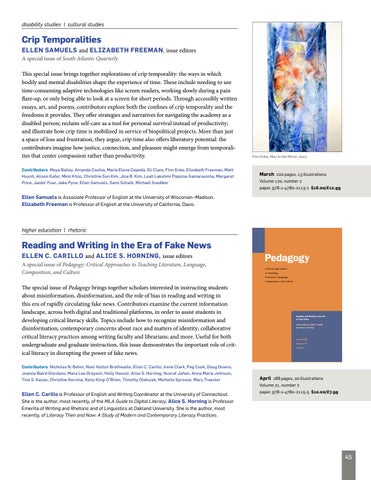
Finn Enke, Man in the Mirror, 2017.
March 220 pages, 13 illustrations Volume 120, number 2 paper, 978-1-4780-2113-1 $16.00/£12.99
Ellen Samuels is Associate Professor of English at the University of Wisconsin–Madison. Elizabeth Freeman is Professor of English at the University of California, Davis.
higher education | rhetoric
Reading and Writing in the Era of Fake News ELLEN C. CARILLO and ALICE S. HORNING, issue editors
A special issue of Pedagogy: Critical Approaches to Teaching Literature, Language, Composition, and Culture
Pedagogy C r i t i c a l A p p roa c h e s t o Te a c h i n g L i t e r a t u re , L a n g u a ge , C om p os i t i on , a n d Cu l t u re
The special issue of Pedagogy brings together scholars interested in instructing students about misinformation, disinformation, and the role of bias in reading and writing in this era of rapidly circulating fake news. Contributors examine the current information landscape, across both digital and traditional platforms, in order to assist students in developing critical literacy skills. Topics include how to recognize misinformation and disinformation; contemporary concerns about race and matters of identity; collaborative critical literacy practices among writing faculty and librarians; and more. Useful for both undergraduate and graduate instruction, this issue demonstrates the important role of critical literacy in disrupting the power of fake news. Contributors Nicholas N. Behm, Noel Holton Brathwaite, Ellen C. Carillo, Irene Clark, Peg Cook, Doug Downs, Joanne Baird Giordano, Mara Lee Grayson, Holly Hassel, Alice S. Horning, Nusrat Jahan, Anna Maria Johnson, Tina S. Kazan, Christine Kervina, Kelly King-O’Brien, Timothy Oleksiak, Michelle Sprouse, Mary Traester
Ellen C. Carillo is Professor of English and Writing Coordinator at the University of Connecticut. She is the author, most recently, of the MLA Guide to Digital Literacy. Alice S. Horning is Professor
Reading and Writing in the Era of Fake News
Guest edited by Ellen C. Carillo and Alice S. Horning
April 2020 Volume 20 Issue 2
April 188 pages, 20 illustrations Volume 21, number 2 paper, 978-1-4780-2115-5 $10.00/£7.99
Emerita of Writing and Rhetoric and of Linguistics at Oakland University. She is the author, most recently, of Literacy Then and Now: A Study of Modern and Contemporary Literacy Practices.
45