native and indigenous studies | science and technology studies | environmental studies Ma x Liboiron
Pollution Is Colonialism MAX LIBOIRON
Pollution Is Colonialism
April 224 pages, 10 illustrations paper, 978-1-4780-1413-3 $25.95/£20.99
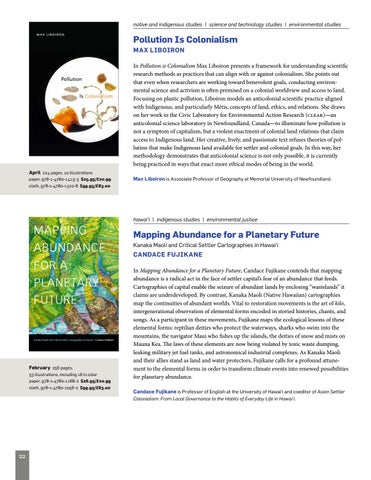
In Pollution is Colonialism Max Liboiron presents a framework for understanding scientific research methods as practices that can align with or against colonialism. She points out that even when researchers are working toward benevolent goals, conducting environmental science and activism is often premised on a colonial worldview and access to land. Focusing on plastic pollution, Liboiron models an anticolonial scientific practice aligned with Indigenous, and particularly Métis, concepts of land, ethics, and relations. She draws on her work in the Civic Laboratory for Environmental Action Research (clear)—an anticolonial science laboratory in Newfoundland, Canada—to illuminate how pollution is not a symptom of capitalism, but a violent enactment of colonial land relations that claim access to Indigenous land. Her creative, lively, and passionate text refuses theories of pollution that make Indigenous land available for settler and colonial goals. In this way, her methodology demonstrates that anticolonial science is not only possible, it is currently being practiced in ways that enact more ethical modes of being in the world. Max Liboiron is Associate Professor of Geography at Memorial University of Newfoundland.
cloth, 978-1-4780-1322-8 $99.95/£83.00
hawai‘i | indigenous studies | environmental justice
MAPPING ABUNDANCE FOR A PLANETARY FUTURE
Kanaka Maoli and Critical Settler Cartographies in Hawaiʻi Candace Fujikane
February 256 pages, 53 illustrations, including 16 in color paper, 978-1-4780-1168-2 $26.95/£20.99 cloth, 978-1-4780-1056-2 $99.95/£83.00
22
Mapping Abundance for a Planetary Future Kanaka Maoli and Critical Settler Cartographies in Hawai‘i
CANDACE FUJIKANE In Mapping Abundance for a Planetary Future, Candace Fujikane contends that mapping abundance is a radical act in the face of settler capital’s fear of an abundance that feeds. Cartographies of capital enable the seizure of abundant lands by enclosing “wastelands” it claims are underdeveloped. By contrast, Kanaka Maoli (Native Hawaiian) cartographies map the continuities of abundant worlds. Vital to restoration movements is the art of kilo, intergenerational observation of elemental forms encoded in storied histories, chants, and songs. As a participant in these movements, Fujikane maps the ecological lessons of these elemental forms: reptilian deities who protect the waterways, sharks who swim into the mountains, the navigator Maui who fishes up the islands, the deities of snow and mists on Mauna Kea. The laws of these elements are now being violated by toxic waste dumping, leaking military jet fuel tanks, and astronomical industrial complexes. As Kanaka Maoli and their allies stand as land and water protectors, Fujikane calls for a profound attunement to the elemental forms in order to transform climate events into renewed possibilities for planetary abundance. Candace Fujikane is Professor of English at the University of Hawai‘i and coeditor of Asian Settler Colonialism: From Local Governance to the Habits of Everyday Life in Hawai‘i.