PA S S I O N P R O J E C T F O R N E U R O C R I T I C A L C A R E P I O N E E R : D R C E C I L B O R E L
“Perseverance is an important trait. If you can just keep going, you’ll get it done, it’s worth it. Boat building is a noble tradition. You must be wholly committed to your project or the project will get lost and is bound to break up. With that mindset, as with anesthesia, just keep trying to figure out what’s going on with your patients, try to do a better job, teach those you’re working with, and learn from those you’re working with.”
BY STACEY HILTON
DUKE ANESTHESIOLOGY | 64
2021: Plans to commission the boat for the first time
2020: Motored to and from the boat yard a few times
JULY 2019: Launched the sailboat (but not yet commissioned) – started on the first pull and motored it from the boat yard to the marina - took a year off to rehabilitate from heart surgery
JULY 2017–JULY 2019: Remained in the boat yard for numerous repairs & endured Hurricane Florence
JULY 2017: Finished building the sailboat. Transported it to a boat yard & planned to launch, but noticed several weather-related damages
JULY 2012: Retired
1999: Began building the sailboat, Janetess, named after his wife
1993: Recruited to Duke Anesthesiology
DR. CECIL BOREL
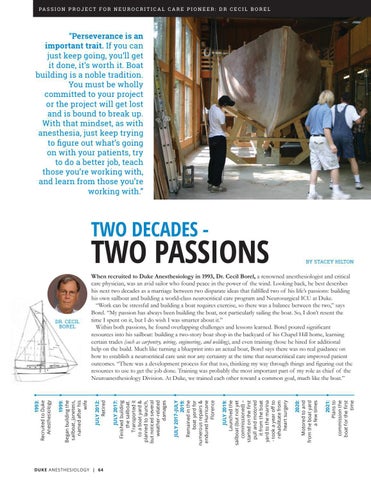
When recruited to Duke Anesthesiology in 1993, Dr. Cecil Borel, a renowned anesthesiologist and critical care physician, was an avid sailor who found peace in the power of the wind. Looking back, he best describes his next two decades as a marriage between two disparate ideas that fulfilled two of his life’s passions: building his own sailboat and building a world-class neurocritical care program and Neurosurgical ICU at Duke. “Work can be stressful and building a boat requires exercise, so there was a balance between the two,” says Borel. “My passion has always been building the boat, not particularly sailing the boat. So, I don’t resent the time I spent on it, but I do wish I was smarter about it.” Within both passions, he found overlapping challenges and lessons learned. Borel poured significant resources into his sailboat: building a two-story boat shop in the backyard of his Chapel Hill home, learning certain trades (such as carpentry, wiring, engineering, and welding), and even training those he hired for additional help on the build. Much like turning a blueprint into an actual boat, Borel says there was no real guidance on how to establish a neurocritical care unit nor any certainty at the time that neurocritical care improved patient outcomes. “There was a development process for that too, thinking my way through things and figuring out the resources to use to get the job done. Training was probably the most important part of my role as chief of the Neuroanesthesiology Division. At Duke, we trained each other toward a common goal, much like the boat.”