FACULTY SPOTLIGHT with Dr. Adjoa Boateng Evans
OPERATING ROOM TO BOARD ROOM
PAGE 4
PAGE 34
INNOVATIVE RESEARCH PAGE 46
SparkingINNOVATION
Dr. Lisa Einhorn’s Journey in Pediatric Anesthesia Research
p28
from the Interim Chair What WeMessage Do Changes The World
T
here is something extraordinary about the people who choose this field. We meet patients at their most vulnerable and guide them through moments they may never remember, but that inform the care of every patient who follows. That responsibility requires both precision and grace, and it connects all of us across operating rooms, ICUs, pain clinics, and research spaces. Duke Anesthesiology has always been defined by those who reach a little further: the ones who question, who invent, who steady others when the path is uncertain. Ours is not a specialty that seeks the spotlight. Yet what we do, protecting consciousness, sustaining life in critical illness, easing pain, and restoring trust in the body, sits at the heart of medicine itself. The discoveries that will redefine perioperative and pain medicine will come from collaboration that is fearless and inclusive, from curiosity that crosses boundaries, and from the courage to ask what else is possible. The years ahead will demand both innovation and intention. Technology will accelerate what we can do, but it is up to us to decide why we do it. That is where our humanity becomes our greatest strength, in how we listen to patients, how we mentor the next generation, and how we care for one another. My commitment is to create the conditions for that kind of excellence: where science and empathy advance together, where every member of this community knows they belong, and where leadership begins with listening and leads to action. Excellence is not a destination; it is something we build every day through the questions we ask, the trust we earn, and the care we deliver. It is a privilege to serve this department and to stand among people whose work continues to shape the future of anesthesiology, and, more importantly, the human experience of medicine. With gratitude,
Padma Gulur, MD
Interim Chair, Duke Anesthesiology
MISSION: We lead with inquiry, teach with intention, and care with precision to push the boundaries of anesthesiology, reimagine perioperative medicine, advance the science of pain relief, and redefine excellence in critical care.
Contents Volume 15 . 2025
COVER 10 Division Highlights
Pediatric Pain Dr. Lisa Einhorn
DREAM CAMPAIGN 41 Donor Honor Roll 42 About DIG 44 2025 DREAM Innovation
Grant Recipient
INNOVATIVE RESEARCH 46 Targeted Treatment
for Lung Diseases Dr. Satya Achanta
48 Listening to the Brain—and
the Patient: Using Attentional Neuroscience to Rewire Perioperative Cognition Dr. Leah Acker
50 Uncovering the Pathology of
28
Oxidative Tissue Injury Dr. Heath Gasier
GLOBAL HEALTH
34
FACULTY SPOTLIGHTwith
Dr. Adjoa Boateng Evans
54 Blogs from Abroad: Ghana RESIDENCY RECAP 60 Resident Spotlight 62 Alumni Shoutout ALUMNI NOTES 64 Q&A with
Tong Joo (TJ) Gan, MD, MBA, MHS
DEPARTMENTAL
4
68 Departmental Faculty
FEATURE | From the Operating Room to the Board Room
Dr. Neil Ray BLUEPRINT 2025 | 1
MESSAGE FROM THE IMMEDIATE PAST CHAIR
BluePrint is published once a year by Duke Anesthesiology. This issue was published in December 2025. Your comments, ideas and letters are welcome. VIEW ISSUES ONLINE: blueprint.duhs.duke.edu PLEASE CONTACT US: Duke Anesthesiology BluePrint Magazine DUMC 3094 Durham, NC 27710 blueprint@duke.edu EDITOR IN CHIEF Stacey Hilton CREATIVE DIRECTOR Stacey Hilton GRAPHIC DESIGNER Lacey Chylack, phase5creative.com CONTRIBUTING WRITERS Stacey Hilton Lindsay Key Ratna Swaminathan Duke Anesthesiology Faculty & Staff PROOFREADERS Lynet Gonzales Christopher Keith Melinda Macalino John “Jack” Newman CONTRIBUTING PHOTOGRAPHERS John “Jack” Newman Duke Anesthesiology Faculty & Staff WEB ADMINISTRATOR Christopher Keith CONNECT WITH US: anesthesiology.duke.edu
A
decade ago, I was entrusted with an incredible opportunity—to serve as chair of Duke Anesthesiology. It is difficult to compress ten years of shared vision, challenges, growth, and extraordinary people into a few paragraphs, but one thing is clear: serving alongside each of you has been the honor of a lifetime. Firmly believing that “everything rises and falls on leadership,” I have invested deeply in leadership development—not only across our department, but in my own journey as well. This year, I found myself revisiting “High Road Leadership,” John Maxwell’s timely call for leaders to rise above offense, division, and cynicism, and to instead lead with humility, integrity, and service. Maxwell reminds us that leaders with integrity commit to character over personal gain, people over things (especially money), service over power, principle over convenience, and the long view over the immediate. Humility, meanwhile, is the willingness to value others above oneself, to listen before speaking, and to serve without needing credit. In today’s world - where division and polarization are often the currency of influence can we begin to imagine how our communities might be transformed if we each led with integrity and humility? Maxwell also writes, “The high road seeks to add value to others.” If there is one thing I am grateful for in these ten years, it is the chance to do just that - to contribute meaningfully to this remarkable department, and to be shaped, challenged, and inspired by all of you in return. I leave this role with deep gratitude, respect, and hope. Hope—for a future where anesthesiology remains not only clinically vibrant, but scientifically trailblazing and relationally rich. Hope that we continue to prioritize people over process, legacy over ego, and impact over impression. And to that last point, it seems no coincidence that North Carolina’s state motto is Esse Quam Videri—a Latin phrase meaning “to be rather than to seem.” So, as we turn the pages of this year’s BluePrint, let us not only celebrate what has been achieved but also ask what more we can become. The future of Duke Anesthesiology is not yet written, but the road we choose will determine the story we tell. Let us choose the high road. Lead with integrity and humility, value people and add value to them. Always. Grace and Peace!
Joseph P. Mathew MD, MHSc, MBA
2
| DUKE ANESTHESIOLOGY
https://anesthesiology.duke.edu/alumni
BLUEPRINT 2025 | 3
4
| DUKE ANESTHESIOLOGY
FACULTYSPOTLIGHT
SHAPING THE FUTURE OF ANESTHESIOLOGY
Faculty SPOTLIGHT
Healing Through Art and Science: Dr. Adjoa Boateng Evans By Ratna Swaminathan
I
“
will forever be drawn to the art of medicine equally as I am, the science of medicine.” For anesthesiologist Adjoa Boateng Evans, MD, the boundaries between art and medicine often blur into a beautiful synthesis. A passionate champion of medical humanities, Boateng Evans is convinced that art and science will inevitably amalgamate in the future. “The more that emerging technologies like artificial intelligence and large language models streamline the mechanics of our work, the more physicians will reconnect with what drew many of us to medicine: humanity, stories, connection, helping, and healing. There remains such a vast unearthed area of medicine that we’re just beginning to understand because of our necessary focus on the science, but I look forward to seeing how these two interconnected layers come together.” Since joining Duke as a clinical assistant professor in the Department of Anesthesiology in 2023 from Stanford, Boateng Evans has brought her humanistic lens to her work in the operating rooms and intensive care units. She draws a compelling artistic parallel between the intricacies of the teamwork required to perform a complex surgery and a well-choreographed orchestra, recounting her amazement at witnessing her first open-heart surgery as a medical student. “This was choreography,” she remembers with wonder. “No one was talking. Everyone was moving, doing. The patient was anesthetized. The surgeon walked in, and much like a conductor, brought the ‘orchestra’ together.” She emphasizes
that, just as in a theatrical production, if any piece goes awry, everything stops—a reminder of medicine’s inherent teamwork. Boateng Evans’ journey to anesthesiology was circuitous and deeply informed by her unique upbringing. Growing up in the New York City metropolitan area with abundant access to arts and theater, she was keenly sensitive to the stark socioeconomic disparities around her—the conspicuous wealth in equal presence as poverty and homelessness. This very unequal distribution of resources, with art however being an accessible constant, would fuel many of her later pursuits. After earning her Bachelor of Arts degree in the History of Science and Medicine from Yale University in 2007, Boateng Evans worked as a clinical research coordinator at Mount Sinai Hospital, enrolling intravenous drug users in East Harlem for a hepatitis C treatment study. Her work took her to needle exchange programs in homeless shelters and on mobile health care vans bringing care to underserved communities. Often, her assignments led to caring for those at the margins of society. In stark contrast, another initiative later took her to the world renowned Betty Ford Center in Rancho Mirage, California. There, she learned more about addiction through the lens of privilege. The experiences would cement that certain disease states, “don’t discriminate,” planting a seed to better understand this phenomenon in medicine. “For someone who grew up in middle class, it was a very eye-opening
BLUEPRINT 2025 | 5
FACULTYSPOTLIGHT
experience,” says Boateng Evans. This pervasiveness of disease and human-to-human connection drew her into medicine and ultimately to anesthesiology and critical care. Boateng Evans describes her upbringing as “binary” with highly educated parents - a father who immigrated from Ghana and a mother from New Jersey. Both instilled in her an ethic and value system colored by grit, gratitude and hard work. “There was an expectation that mediocrity is unacceptable, and you don’t accept things that are sub-par.” As one of very few African American female physicians in critical care medicine (4% of all intensivists are African American*), her experiences strengthened her resolve to not only treat disease with the best that science offers but, more importantly, to treat humans with the dignity they deserve. Over the years, Boateng Evans completed a Master of Public Health degree from Drexel School of Public Health (2011), earned her MD from Robert Wood Johnson Medical College (2015), completed her anesthesiology residency at Yale New Haven Hospital (2019), and then acquired her Critical Care Anesthesiology Fellowship at Stanford University Medical Center, joining the faculty thereafter. In 2023, drawn by a desire to be closer to family on the east coast, she joined the Critical Care Medicine Division at Duke. Boateng Evans views anesthesiology as “a great equalizer” that levels the playing field. “Whether you’re homeless or a CEO, everyone gets the same gown, everyone’s body gets scrubbed and draped in blue towels. The surgery and provision of anesthesiology don’t change overtly because of social differences. That was very inviting for me.” The
academic aspects of anesthesiology—its interplay of pharmacology and physiology and watching medications work in real time—fascinate her. She’s excited about how the field is transforming patient care with cutting-edge technology. “A lot of what we do in the operating room is minimally invasive, which 10 years ago would not have been fathomable,” she explains enthusiastically. As a woman of faith, Boateng Evans finds that anesthesiology brings her “closer to God” through what seems like daily miracles. “We bring patients to the brink of death in a medically induced coma and then bring them back to life,” she reflects with wonder. She prays for her patients while driving to the hospital and for the surgical teams she’ll work with, especially before particularly challenging cases. “We did a brain surgery on a pregnant woman some months back, so we had two patients that day, which was atypical. I felt I needed a divine guiding light to make sure things went well. They did. The patient might forget me; I will never forget her.” It is critical care medicine that brings this humanitarian even closer to humanity. “We have the opportunity to heal—even just by taking a few extra moments to be kind, to connect with people awaiting surgery. Whether it is sitting at eye level, giving space to address subtle concerns or praying with them,” she says. She advises trainees to help craft how a family’s ICU experience will be remembered, emphasizing the importance of clear language and thoughtful non-verbal communication in bridging the gap between medical understanding and patient comprehension. “We can use the tool of language to relate to humanity,” she explains. Boateng Evans recounts *www.binasss.sa.cr/oct24/24.pdf
WASHINGTON AND LEE TALK
“In Critical Condition: A State of the Union on Compassion, Death and Purpose.” Dr. Boateng Evans uses storytelling to emphasize bringing equal purpose to the end of our lives as we are planning the multiple other aspects of our lives.
6
| DUKE ANESTHESIOLOGY
FACULTYSPOTLIGHT TEDx TALK:
“The Prophesy of Pain” Dr. Boateng Evans flips the notion of pain on its head to reconsider it not only for its role in discomfort but truly as a warning sign for something greater. When we feel pain, whether emotional or physical, it typically is for some other purpose. How suffering, tragedy and hardship can be a warning sign for something greater on the other side – a redeeming effect. To understand how to fully experience joy, one must often first experience hardship.
spending many hours with the daughter of a cardiac arrest patient, “explaining the same information in various ways until it was digested, using the gift of language to find a combination of words that stuck.” Sometimes they would pray together, sometimes sit in supportive silence. “I learned a lot about their family—their sense of unity and discerning fortitude, their warmth, their love.” Months later, after the patient was discharged, Boateng Evans received an invitation to celebrate the patient’s life with the family, which she says, “felt like the highest honor.” Experiences like this reinforce Boateng Evans’ confidence in both the science of medicine and the power of communication. “We can’t always save a patient and bring them back to life, but we have a lot of power to heal the suffering and tragedy that many of our patients face in and out of the hospital,” she emphasizes. “In different ways, we are all hurting. Language is an accessible tool to chip away at some of those pains.” For Boateng Evans, the art of medicine lies in connecting with individuals ravaged by grief. “How do you use language to distill this cacophony of data so patients and families can digest it? How do you guide appropriate decisions?” The skill lies in translating “jargony medicine” into accessible language, she says. A lover of language, Boateng Evans advises trainees to be present, find points of connection with patients and relatives, and guide them through healing and
not shy from the dying process—both moments of extreme vulnerability. “We’ve done a great job learning how to treat disease, but we are still in the infancy of learning to treat the human. People can get very unraveled during this time, and we need to figure out how to help them through it.” In her keynote address at Washington & Lee University’s Mudd Center for Bioethics (2024-2025), Boateng Evans discussed compassion, death, and purpose, a talk that resonated deeply with audiences because it addressed universal truths: “No matter what walk of life we are from, we all live, and we all will die. In anesthesiology as in critical care, you are teetering between life and death all day,” Boateng Evans observes. This reality drives her concern about burnout and trauma among health care workers who regularly witness suffering and death. She notes the lack of good systems for physicians to process these experiences and believes narrative medicine—using storytelling to articulate experiences—can help. “Medical humanities stand as a formidable avenue to combat clinician burnout in a way distinct from typical wellness initiatives,” Boateng Evans explains. It gets to the heart of physician professional identity, helping doctors reconnect with their purpose through art. Research suggests it enhances communication with teams, aligns personal and professional goals, heightens emotional intelligence, increases empathy, and improves productivity and work satisfaction.
Dr. Boateng Evans giving a TEDxAccra Talk in April 2016 in Ghana.
BLUEPRINT 2025 | 7
Bringing a Healing Aspect to Anesthesiology: • Remember that most patients are
Do your eyes puff with sunrise’s trickling red, yellow and orange embers as you awake from a night of tear-stained weeping; a reminder that the escape of dreaming is over.
petrified on the day of surgery. Personalize the conversation, don’t rush, avoid excessive jargon. • Read the room when using comedy, most importantly, use wisely. There are patients and families for whom comedy helps humanize the experience diffuse tension. Others will perceive jokes as wholly inconsiderate and terse during this important time. • Remember names and use them often. Of patients, of families, of colleagues. So much of our identity and humanness stems from our name.
Grief, do you also wish that same sleep would rescue you back to dream, because reality is too harsh, too stinging?
How Medical Humanities Combats Clinician Burnout:
Grief, What is Your Name? Today, I write to those entities my mind cannot digest. To the novel tastes that defy even umami, the ones chewed, looking upwards, with eyes closed, to give my tastebuds a bit more bandwidth. Today I write to you, grief. You arrive indiscriminately, luggage brimming with both overwhelming cacophony and also deafening silence. You disrupt conversation, causing coffee to spill over freshly pressed linen. I weep. What was once the fluid and graceful nature of my tongue begins to stutter through poorly concocted words or use inappropriate comedy because life sometimes, is too much to bear. Paradigm shift. Grief is when the life preceding no longer mirrors life thereafter. So I pause, stare towards the muted tones around me and whisper, “Grief, what is your name?” When we are already in mourning and there is more death, what do we call it? From where does more pain emanate when numbness prevails? How do more tears spring from a dried well? Grief, who birthed you? From whose womb were you nourished and sung lullabies? What bosom fed you emotionscattered, overwhelming, speechless pain? How did your mother come to be? Did she adorn with delicate, yet decadent lace that lingers long after death bringing reminders of what was, via song, scripture or sermon?
8
| DUKE ANESTHESIOLOGY
I ask you, again, grief, what is your name??
Acid to an open wound? When the tone of my mother’s voice becomes less rhythmic, more monotone, less laughfilled, more littered with pause - I want to almost say the words with her as if to blunt the stab when she breathes deeply and whispers, “I have some bad news.” But grief, I don’t know you. Not like this. You are to come with warning, preparation, a chance to reconcile replaying voicemails when a voice is no longer. A chance to find old pictures when flesh travels to morgue. You are to give us opportunity to go through ritual. We need ritual…or so we thought. Your son – tragedy, robs and steals from us. So we stand, rather, we crumble, shellshocked. Stranger, what is your name? Until we meet again. But oh! Shall I never you meet again. You make the taste of my own mortality too sweet. Anesthesia & Analgesia, July 2021. DOI: 10.1213/ANE.0000000000005596
Getting to the heart of physician professional identity and helping doctors reconnect with their purpose through art.
• In medicine, we are all storytellers. It is the bloodline by which we communicate. Realizing that this craft can shape how we see one another, how we see patients and ultimately ourselves can better align personal and professional pursuits. • Art, medical humanities more broadly, helps physicians process and express thoughts, emotions and experiences for which routine language falls short. This enhances the ability to develop creative solutions as patient care becomes exceedingly more complex. • Allowing oneself to experience the gamut of emotions involved in anesthesiology, and certainly critical care, can heighten the emotional intelligence and empathy needed to care for ourselves and others.
FACULTYSPOTLIGHT
“We can’t always save a patient and bring them back to life, but we have a lot of power to heal the suffering and the tragedy that so many of our patients are feeling.” - DR. ADJOA BOATENG EVANS Boateng Evans along with Duke colleagues Drs. Vijay Krishnamoorthy and Nazish Hashmi have introduced debrief sessions giving intensivists space to “unpack and unload.” She’s awaiting funding to launch “Healing for Healers,” a quarterly medical humanities conference to help providers overcome trauma and rediscover their “why” by fusing art with medicine. The program will include reflective writing and storytelling workshops with professional editors to help participants hone both personal and professional voices. “When individuals harness art to reflect on the challenging and beautiful aspects of our work, it allows them to feel less isolated,” Boateng Evans explains. “They understand they’re not alone in their experiences.” This community-building aspect of medical humanities initiatives drives faculty retention—a valuable institutional benefit, she emphasizes. “Dr. Boateng brings a rare and deeply humanistic lens to critical care medicine. Her integration of the humanities into the ICU setting reminds us that patients and health care providers are not just collections of data, but complex individuals with stories, fears, dignity, and hope. Through her work, she creates spaces where empathy and reflection coexist with evidence and intervention, ultimately contributing to improved patient care and provider well-being. Her work is also extremely relevant to the current era, especially as we enter the age of artificial intelligence in health care,” according to Krishnamoorthy, chief of the Critical Care Medicine Division at Duke. Boateng Evans notes that while various institutions incorporate humanities into medicine, few focus specifically on integration with anesthesiology. “I came to Duke from Stanford, which had a robust medical humanities program called ‘Medicine and the Muse,’ started by anesthesiologist Dr. Audrey Shafer. Many new residents and medical students are training with humanities backgrounds and seeking ways to incorporate that into their anesthesiology careers. There’s certainly an appetite to grow this relationship.” It’s no surprise that Boateng Evans is
a sought-after speaker on the intersection of art and medicine, presenting at institutions, including Yale University’s Humanities in Medicine Celebration, Washington & Lee’s Mudd Center for Bioethics, and the EndWell Symposium. She is also a celebrated TEDx speaker. A creative thinker, Boateng Evans envisions that another initiative, awaiting funding, named “Critical Care Healing Circles,” will bring together Durham community members affected by critical illness with their Duke University ICU providers. Participants will use narrative medicine tools for sharing, closure, feedback, and healing in this initiative that will bridge cultural gaps between Duke and Durham. Meanwhile, Boateng Evans is taking on more responsibilities. She teaches first-year medical students in “Social and Structural Drivers of Health,” exploring social determinants of health and how policy affects outcomes. As a faculty associate at the Trent Center for Bioethics, Humanities and History of Medicine, she helps select endowed speakers on salient topics. Boateng Evans also serves as assistant director of medical students for the Department of Anesthesiology, working with Dr. Grace McCarthy to advise fourth-year medical students applying to anesthesiology residencies. Additionally, she serves as the assistant director for the Surgical ICU clerkship at Duke. Along with her husband, Terry Evans Jr., son Jackson (4), and daughter Josephine (1), Boateng Evans cherishes the family-friendly atmosphere of Durham. In an age where medicine becomes increasingly technical and data-driven, she stands as a powerful reminder of what gives health care its soul. Whether dancing to Stevie Wonder songs with her children in their Durham home or praying with a patient’s family in the ICU, Boateng Evans embodies the same principle: healing happens through genuine human connection. She feels that the most powerful technology in medicine isn’t found in machines or medications, but in the transcendent moment when one human being truly sees another. This is the art of healing she practices every day—not as a supplement to medical science, but as its essential heart. BP WWW.BOATENGMD.COM
BLUEPRINT 2025 | 9
DIVISIONHIGHLIGHTS
AMBULATORY ANESTHESIOLOGY
Pioneering Outpatient Excellence The Ambulatory Anesthesiology Division continues to demonstrate remarkable growth and innovation across all aspects of operations. The ambulatory total joint program at Duke Ambulatory Surgery Center Arringdon remains at the forefront, spearheading advancements in outpatient surgical care with more than 2,500 arthroplasties performed since its inception. All ambulatory surgery centers at Duke are experiencing unprecedented operating room volumes and utilization rates. This success reflects our commitment to supporting higher acuity cases transitioning to ambulatory platforms, resulting in consistent year-over-year growth that positions the Duke University Health System as leaders in this evolving health care landscape. This expansion continues with critical preparation underway for the Duke ambulatory surgery center in Cary. This exciting addition, scheduled to open its doors to patients in early 2027, will feature six operating rooms and significantly enhance capacity to serve the growing market needs.
Dr. Emily Barney
Dr. Michael Kent
Dr. Stephen Klein
Growth extends beyond facilities to the division’s exceptional team. They recently welcomed Duke Anesthesiology alumna Dr. Emily Barney as a new faculty member. Furthermore, the division is pleased to announce a transition in leadership roles that occurred in July. Dr. Michael Kent was appointed the ambulatory division chief, bringing 14 years of experience to this role. He succeeds Dr. Stephen Klein, who served in this capacity for nearly 20 years and has been appointed associate vice chair for ambulatory anesthesiology. In this position, he will collaborate with key stakeholders to develop and implement a strategic plan that further expands the department’s ambulatory surgery footprint.
CARDIOTHORACIC ANESTHESIOLOGY
Driving Progress: Innovation, Outcomes and Leadership in the Field Continuing the division’s tradition of groundbreaking innovations in cardiothoracic perioperative care, Dr. Luiz Maracaja has notably developed the BlueBridge Open Chest Management System (see figure below), a revolutionary medical device for managing delayed sternal closure following cardiothoracic surgery. Maracaja has successfully designed, prototyped, patented, and obtained regulatory approval for this device, which offers customizable options for all patient populations, from neonates to adults. The initial clinical application occurred earlier this spring. The division has seen significant growth across all of Duke’s cardiovascular surgical and procedural programs, including advanced heart failure therapies (with a 33% increase in temporary and durable mechanical circulatory support devices), thoracic organ transplantation, structural heart disease, and arrhythmia services. Reflecting its team-based approach to preventing failure to rescue, the CTICU has achieved year-onyear reductions in ICU mortality, maintaining the lowest rates across Duke University Health System ICUs despite the highest case mix index and number of encounters. Additionally, Duke’s adult cardiothoracic programs have received 3-star ratings from the Society of Thoracic Surgeons. Key leadership highlights include: Dr. Alina Nicoara received the American Society of Echocardiography’s prestigious Outstanding Achievement in Perioperative 10
| DUKE ANESTHESIOLOGY
Echocardiography Award in recognition of her national and international scholarly efforts as well as leadership and refinement Dr. Brandi Bottiger of the flagship Duke Perioperative Echocardiography Service; Dr. Brandi Bottiger has been appointed director of the Duke Anesthesiology Residency Program; Dr. Michael Cutrone has been appointed director of the Duke Adult Cardiothoracic Anesthesiology Fellowship; Dr. Sachin Mehta serves as the faculty Epic Dr. Michael Cutrone Champion; Dr. Bryan Chow has been appointed anesthesiology quality director within the Duke Transplant Center. On the national stage, Dr. Rebecca Klinger serves as acting chair of the Society of Cardiovascular Anesthesiologists’ Thoracic Anesthesia Symposium. Dr. Luiz Maracaja Matching leadership responsibilities with leadership training, three divisional faculty members have been accepted into highly competitive Duke leadership training programs: Nicoara to Duke Clinical Leadership Program, Maracaja to Leadership Development for Researchers, and Dr. Nazish Hashmi to Academic Leadership, Innovation, and Collaborative Engagement.
DIVISIONHIGHLIGHTS
COMMUNITY
Enhanced Utilization and Efficiency The Community Division has experienced a remarkable year defined by significant achievements in both growth and the delivery of outstanding patient care. The division has been tasked by the Duke University Health System to enhance utilization and operational efficiency. In pursuit of improving access, anesthesiology medical directors Drs. Daniel Kovacs, Richard Runkle and Neel Thomas have collaborated with facility leadership to achieve higher utilization of the operating room platforms, heightened case volumes and efficient staffing models. This year, with the dedication of Thomas, the division has been instrumental in the successful move of outpatient endoscopy cases to Duke Gastroenterology (GI) of Raleigh in the MOB9 building on the Duke Raleigh campus. This move expands access for GI care in Wake County. The division looks forward to additional growth in the coming year with the planned expansion at several sites.
Dr. Richard Runkle
Dr. Daniel Kovacs
Dr. Neel Thomas
The division continues to strive for excellence in patient care by refining standardized care pathways and optimizing the utilization of regional blocks. Collaborating with perioperative nurse leaders, the division has implemented measures to enhance the entire patient journey from admission to discharge, emphasizing a patient-centered approach to perioperative care. These initiatives underscore the division’s unwavering commitment to delivering exceptional patient care. Furthermore, Dr. Matthew Glass has overseen a revamp of resident education training at Duke Regional Hospital this year, aiming to enhance the learning experience for residents.
CRITICAL CARE MEDICINE
Delivering on Clinical and Academic Missions The Critical Care Medicine (CCM) Division experienced The enhancement of another year of significant progress in all three domains. In personalized fellowship the clinical domain, more than 40 anesthesiologists (many training has led to with dual training in fields such as obstetric and cardiac unique dual training anesthesiology) provide outstanding clinical care in six intensive opportunities, including Dr. Nazish Hashmi care units (ICUs) across the Duke University Health System the newly-launched and Dr. Paul Wischmeyer and Durham VA Medical Center. The Duke Critical Care the nation’s first Combined Anesthesiology Critical Care Collaborative, representing all adult ICUs in the health system, Medicine and Perioperative Medicine Pathway (in collaboration expanded its high-functioning learning health care system. with Dr. Basma Mohamed) and the first online nutrition Using the data/informatics, quality improvement and analytic fellowship for physicians (led by Dr. Paul Wischmeyer). framework, the collaborative has driven major improvements Furthermore, for the second year, this division hosted the Duke in care, including a steady decrease in ICU mortality, ICU Critical Care Collaborative Research Symposium and the length of stay, health care associated infections, and variations Duke Datathon and Data Science Symposium; all leading the in key process of care measures over the past three years. The program to prominence as a top training program for critical CCM learning health system dashboard care medicine in the world. has helped drive these improvements In the research domain, initiatives forward through serving as a data encompassing basic science, visualization, curation and analytics tool. translational research, clinical trials, This work has also led to data-driven and population health have led to efforts at enhancing faculty wellness. discovery in broad areas relevant In the education domain, the CCM to critical care, including kidney Fellowship, led by Dr. Nazish Hashmi, injury, delirium, sleep, cognition, has continued to grow its curriculum microbiome, nutrition, rehabilitation, and clinical opportunities, with both trauma, sepsis, respiratory failure, and breadth (training across all adult ICU population health. Additionally, key settings, including the community) and institutional collaborations were built Dr. Trevor Sytsma (Duke Anesthesiology resident) depth (cardiovascular imaging, critical to support burgeoning collaborative presenting his poster at the Duke Critical Care care ultrasound, organ transplantation, efforts in pragmatic clinical trials and Collaborative Research Symposium. and mechanical circulatory support). data science. BLUEPRINT 2025 | 11
DIVISIONHIGHLIGHTS
GENERAL, VASCULAR & TRANSPLANT ANESTHESIOLOGY
Championing Excellence in GME and Simulation Training Dr. Catherine Kuhn has made resident education a dedicated GME policy and practices. Dr. Ankeet focus of her esteemed career. During her years of leadership Udani serves as the director of the Duke as the anesthesiology residency director and vice chair for Human Simulation and Patient Safety education, she has also made national contributions to the Center. Under his leadership, the center Dr. Catherine Kuhn specialty through leadership in the Society for Education in has expanded its offering to more than Anesthesia, the Association of Anesthesiology 30 courses, resulting in a doubling of revenue Core Program Directors, and through roles since 2022. This expansion has notably enhanced in the American Board of Anesthesiology and specialty-specific and interdisciplinary training, the Foundation for Anesthesia Education and with the integration of advanced simulations in Research. Now in her 12th year as an associate airway management, cardiology and neurology, as dean and director of Duke Graduate Medical well as outreach programs to local high schools. Education (GME), Kuhn has led the Duke Simulation leaders from GVT faculty include Drs. GME community to provide top-tier education, Chakib Ayoub, Crosby Culp, Sarada Eleswarpu, while collaborating with the health system to Ryan Gessouroun, and Elizabeth Wilson. elevate both trainee experience and patient care Culp and Gessouroun lead the GVT resident quality. Additionally, she holds the distinction rotations, continually pushing the boundaries of being a charter member and inaugural vice to create educational experiences for learners. president of a new prestigious society of peers, Gessouroun’s contributions to education have Dr. Elizabeth Wilson leading the National Association of Designated also been recognized with his selection as instruction at the Duke Human Institutional Officials, who steer sponsoring a 2025 Academy for Building Leadership institutions’ GME missions and advocate for Simulation and Patient Safety Center. Excellence (ABLE) Program scholar.
NEUROANESTHESIOLOGY, OTOLARYNGOLOGY & OFFSITE ANESTHESIOLOGY
Improving Quality and Perioperative Outcomes in Neurosurgery and Beyond The division welcomed Dr. Basma Mohamed as the new Dr. Jennifer Hauck, co-chair of the director of the Preoperative Anesthesia and Surgical Black Box Committee, has leveraged Black Screening (PASS) clinic this past year. Since her arrival, Box technology to lead interdisciplinary Mohamed was selected for and completed the Duke Clinical initiatives focused on enhancing patient Dr. Basma Mohamed Leadership Program and has been working on perioperative safety and care. Over the past year, she care pathways to improve outcomes in a pilot of spine organized two “Better Together” Grand Rounds, which surgery patients. Under her leadership, Duke is leveraging a brought together surgeons, anesthesiologists, CRNAs, data-driven approach to design a perioperative optimization nurses, and OR technicians. These sessions highlighted both pathway for spine surgery patients, integrating personalized successful interventions and system-wide opportunities to care strategies across the surgical continuum. This includes improve patient safety. Additionally, Hauck spearheaded a unique preoperative optimization process that identifies the formation of multidisciplinary task forces to address high-risk patients before scheduling surgery, allowing system-related issues identified during the Grand Rounds. time for engagement in the Perioperative Enhancement One notable initiative, aimed at improving the process for Team (POET) pathways and active patient engagement. requesting assistance during an OR emergency (“Anesthesia In addition, the path includes Stat”), was led by then chief resident, prioritized interventions in the Dr. Anne Walker, with support intra and postoperative phases of from Baily Dodd, CRNA. Further care to improve the surgical site Black Box initiatives include infection rate, length of stay index, enhancing clinical education for and readmission rates. Currently, the surgeons using laparoscopic and team is working on identifying risk microscopic camera views, providing factors for surgical site infection and training for nurses on robotic readmission rates for spine surgery surgery, and streamlining clinical A “Better Together” Grand Rounds, organized by patients and has plans to expand this processes, such as reducing turnover Dr. Jennifer Hauck. to other populations in the future. times. 12
| DUKE ANESTHESIOLOGY
DIVISIONHIGHLIGHTS
ORTHOPAEDICS, PLASTICS & REGIONAL ANESTHESIOLOGY
Driving Anesthesia Research Forward in the Lab The Human Pharmacology & Physiology Laboratory The HPPL is dedicated to comprehensive (HPPL), led by Dr. David MacLeod, remains crucial in anesthesia-related equipment validation conducting healthy volunteer-based studies that assess the studies. The lab has completed numerous effect of new anesthetic agents (Phase 1 drug trials) and the controlled oxygen desaturation sequences accuracy of new monitors for the OR (equipment validation). (CODS) for pulse oximeter desaturation Dr. Sara Amaral Over the last year, the HPPL has completed the first-insequences and tissue oximeter desaturation human intrathecal administration of liposomal bupivacaine. sequences (TODS). For the CODS, a dedicated gas delivery This was a dose escalating study to examine the safety and system controls the end-tidal oxygen tension (PO2) and tolerability of a single administration between 2 to 4 ml of carbon dioxide tension (PCO2). PO2 is gradually reduced to 1.33% liposomal bupivacaine. Both serial produce plateaus with decreased arterial blood and cerebrospinal (CSF) samples were oxygen saturation from 100 to 70%. obtained from research subjects, along with Serial arterial blood gases are drawn at 4-hour neurological testing throughout the each plateau to determine the accuracy of confinement period. This endeavor required the pulse oximeter. Additionally, a novel a collaborative effort involving regional pulse oximeter has been tested to measure division faculty and fellows, the HPPL study accuracy under conditions of hypoxia in team (including Dr. Sara Amaral, the lab’s the presence of dyshemoglobins, up to first research fellow), and the Duke Early 20%. This year, the focus will continue on Phase Research Unit nursing staff. The study CODS with greater attention to TODS Dr. David MacLeod in the Human team anticipates publishing results of this to determine the accuracy of cerebral and Pharmacology and Physiology Laboratory. somatic near-infrared spectrum devices. groundbreaking study this year.
PAIN MEDICINE
Division Continues Advancement in Pain Therapies Duke Innovative Pain Therapies (DIPT) at Brier Creek, serving NC and neighboring states, has been successfully treating orofacial pain and dental sleep medicine since 2016. Drs. Aurelio Alonso and Daniela Vivaldi provide evidence-based, interdisciplinary care that helps patients regain comfort and Dr. Aurelio Alonso improve their quality of life. DIPT is an arm of the department’s Center for Translational Pain Medicine, facilitating collaboration on translational pain research in orofacial pain. Management of orofacial pain includes oral appliances for musculoskeletal pain and bruxism, trigger point injections, nerve Dr. Daniela Vivaldi blocks and Botox injections for chronic migraines, facial and cervical muscle pain and spasms, and other indications. This team also fabricates custom mandibular advancement devices indicated for mild to moderate obstructive sleep apnea and snoring and offers on-site physical therapy and advanced behavioral pain management services. Furthermore, Dr. Cain Dimon has assumed the position as director of regenerative therapies, aimed at harnessing the body’s natural healing processes. These therapies include platelet rich plasma and autologous conditioned serum injections for patients with a variety of musculoskeletal pain conditions.
Duke Pain Medicine continues to expand its treatment options, including evidencebased advancements in interventional pain treatments. An exciting area of focus over the last few years has been in the expanding field of neuromodulation, particularly the use of peripheral nerve stimulation Dr. Cain Dimon for low back pain in the treatment of multifidus muscle dysfunction. There is now literature supporting durable benefit in pain and function extending beyond five years. Rather than solely addressing the pain symptoms, this therapy targets the underlying etiology and is “restorative” Dr. Peter Yi in treating the underlying cause and preventing further spine degeneration. As one of the leading implant sites in the region, Duke Pain Medicine has seen outstanding results since its first implant in June of 2022. Pain faculty, fellows and residents have presented, published and led international guidelines in this dynamic realm of patient care. Notably, Dr. Peter Yi, director of the Pain Medicine Fellowship, was a recipient of the American Society of Regional Anesthesia and Pain Medicine’s prestigious Excellence in Education Award, recognizing his innovation and success in education. BLUEPRINT 2025 | 13
DIVISIONHIGHLIGHTS
PEDIATRIC ANESTHESIOLOGY
Expanding Global Health, Fellowship Success and a Year of Innovation Drs. Natalia Diaz-Rodriguez and Michael Greenberg have sedation. Beyond treating human patients, we (Dr. Warwick expanded Duke Anesthesiology’s Global Health Program Ames) teamed up with NC State University’s veterinary into Guyana, Honduras and Puerto Rico, building on the school to anesthetize two dogs for open heart surgery on legacy of Dr. Adeyemi Olufolabi. Their efforts have fostered cardiopulmonary bypass, as part of a Duke Heart Center/NC collaborations with the Duke Heart Center and international State collaborative. Other research efforts extended to sickle cell institutions, leading to impactful grand rounds, teaching disease, methadone use for tonsillectomies (featured in the cover and research opportunities. Nationally recognized for their story), regional blocks for pediatric sternotomies, and studies leadership, they co-lead the Congenital Cardiac Anesthesia involving pigs and primates. Society Global Health Committee, solidifying their influence Achieving a decade-long goal, Duke Health and UNC in global pediatric cardiac anesthesia. Health are partnering to create North Carolina’s first The division welcomed Drs. Greenberg and Benjamin freestanding children’s hospital. The planned 500-bed facility Andrew as faculty in 2024. Andrew, a Duke-trained physician, will include an outpatient care center, behavioral health center, earned his Master of Health Sciences in Clinical Research and a research and education enterprise supported by both and MD before completing anesthesiology residency in the universities. department’s prestigious Academic Career Enrichment Scholars program. Greenberg is a recent graduate of the Duke Pediatric Cardiothoracic Anesthesiology Fellowship. Recognized for always going above and beyond, exceeding expectations, and their commitment and passion, the pediatric cardiothoracic anesthesiology team was honored with the inaugural team award as part of the prestigious Duke Pediatric and Drs. Diaz-Rodriguez and Greenberg Congenital Heart Center Impact Awards. continue to mentor medical student This past year has brought a unique blend and aspiring anesthesiologist Rafael of experiences, with expanded off-site presence Team award recipients, Duke Anesthesiology pediatric cardiothoracic faculty members. Avila (pictured left) from Hospital and deeper engagement with pediatric Maria in Tegucigalpa, Honduras.
VETERANS AFFAIRS ANESTHESIOLOGY SERVICE
Hands-On Learning Enhances World-Class Veterans Care Simulation and hands-on experiences are vital to Duke Faculty-led, high-yield workshops further broaden residents’ Anesthesiology education. At the Durham VA Medical Center, skills. The department’s Point-of-Care Ultrasound Workshop the Veterans Affairs Anesthesiology Service enhances veteran care offers hands-on experience with cardiac, lung, gastric, and FAST during morning conferences where faculty guide residents in exams. Residents also participate in defibrillator and arrhythmia practical skill development. workshops, gaining deep knowledge of the defibrillator device Monthly simulation mock codes allow senior residents to lead and practicing to recognize and respond to arrhythmias megacodes, assuming the role of promptly. Additional workshops attending anesthesiologist while cover intraosseous vascular access, sharpening leadership and clinical regional anesthesia techniques, decision-making skills. Quarterly, suturing, communication, and more these simulations include – ensuring diverse, well-rounded OR nursing staff, fostering development. multidisciplinary teamwork This collaborative approach reflects the division’s core values. during critical patient care scenarios. These sessions highlight Through the dedication of faculty the team’s commitment to and staff, residents complete their VA rotation as more versatile and continuous quality improvement Divisional faculty and team leads (of CRNAs, PAs and staff) at proficient anesthesia providers. and self-evaluation. their annual retreat on Veteran's Day in 2024. 14
| DUKE ANESTHESIOLOGY
DIVISION | CENTERS & PROGRAMS | HIGHLIGHTS
WOMEN’S ANESTHESIOLOGY
Enhancing Care with Innovative Approaches to Curriculum, QI and Operations The Women’s Anesthesiology Division welcomed two new faculty members, Drs. Rebecca Himmelwright and Sara Feldman, who have already made significant contributions to the missions of the division. Himmelwright, serving both the women’s and critical care medicine divisions, leads a dedicated, multidisciplinary team who developed a unique curriculum geared to improve the management of postpartum hemorrhages at Duke through monthly multidisciplinary simulations and debriefs, paired with a Learning Management Systems module. She is also spearheading quality improvement initiatives within the division. Feldman assumed the role as director of the resident OB anesthesia rotation, partnering with Drs. Jennifer Mehdiratta and Jean He to enhance the resident experience and maximize learning opportunities in the rotation. Mehdiratta, in her capacity as the OB anesthesia medical director of the Duke Birthing Center, has been a key contributor to a multidisciplinary effort to improve efficiency in the operating rooms on the unit. In addition to optimizing operational efficiency, she is working with Jennifer Easterling,
Dr. Jennifer Mehdiratta
Dr. Sara Feldman
Dr. Rebecca Himmelwright
CRNA clinical lead, to cultivate a more collaborative and structured environment within the unit. Other members of the division continue to make an impact on a regional and national level. Dr. Terrence Allen was appointed as a member of the North Carolina Maternal Mortality Review Committee (MMRC), serving as the only anesthesiologist on the esteemed panel. MMRCs are crucial for improving maternal health outcomes by conducting comprehensive reviews of pregnancy-related deaths to identify causes, preventability and actionable recommendations to reduce future deaths; Dr. Melissa Bauer, an internationally renowned expert in maternal sepsis, was appointed as a guest researcher for the Centers for Disease Control and Prevention on maternal sepsis; Dr. Ashraf Habib, division chief, was appointed section editor for obstetric anesthesiology for Anesthesia & Analgesia, one of the leading journals of the specialty.
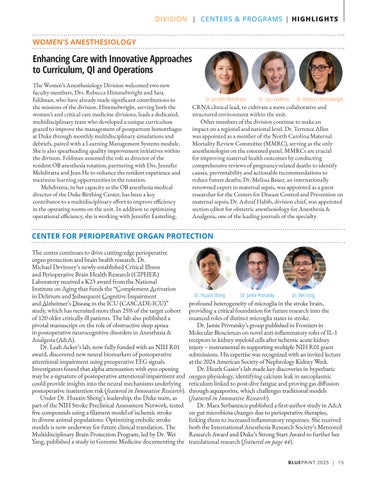
CENTER FOR PERIOPERATIVE ORGAN PROTECTION The center continues to drive cutting-edge perioperative organ protection and brain health research. Dr. Michael Devinney’s newly-established Critical Illness and Perioperative Brain Health Research (CIPHER) Laboratory received a K23 award from the National Institute on Aging that funds the “Complement Activation Dr. Huaxin Sheng Dr. Jamie Privratsky Dr. Wei Yang in Delirium and Subsequent Cognitive Impairment and Alzheimer’s Disease in the ICU (CASCADE-ICU)” profound heterogeneity of microglia in the stroke brain, study, which has recruited more than 25% of the target cohort providing a critical foundation for future research into the of 120 older critically ill patients. The lab also published a nuanced roles of distinct microglia states in stroke. pivotal manuscript on the role of obstructive sleep apnea Dr. Jamie Privratsky’s group published in Frontiers in in postoperative neurocognitive disorders in Anesthesia & Molecular Biosciences on novel anti-inflammatory roles of IL-1 Analgesia (A&A). receptors in kidney myeloid cells after ischemic acute kidney Dr. Leah Acker’s lab, now fully funded with an NIH R01 injury – instrumental in supporting multiple NIH R01 grant award, discovered new neural biomarkers of postoperative submissions. His expertise was recognized with an invited lecture attentional impairment using preoperative EEG signals. at the 2024 American Society of Nephrology Kidney Week. Investigators found that alpha attenuation with eyes opening Dr. Heath Gasier’s lab made key discoveries in hyperbaric may be a signature of postoperative attentional impairment and oxygen physiology, identifying calcium leak in sarcoplasmic could provide insights into the neural mechanisms underlying reticulum linked to post-dive fatigue and proving gas diffusion postoperative inattention risk (featured in Innovative Research). through aquaporins, which challenges traditional models Under Dr. Huaxin Sheng’s leadership, the Duke team, as (featured in Innovative Research). part of the NIH Stroke Preclinical Assessment Network, tested Dr. Mara Serbanescu published a first-author study in A&A five compounds using a filament model of ischemic stroke on gut microbiota changes due to perioperative therapies, in diverse animal populations. Optimizing embolic stroke linking them to increased inflammatory responses. She received models is now underway for future clinical translation. The both the International Anesthesia Research Society’s Mentored Multidisciplinary Brain Protection Program, led by Dr. Wei Research Award and Duke’s Strong Start Award to further her Yang, published a study in Genome Medicine documenting the translational research (featured on page 44). BLUEPRINT 2025 | 15
HIGHLIGHTS | CENTERS & PROGRAMS
CENTER FOR TRANSLATIONAL PAIN MEDICINE Duke Anesthesiology’s Center for Translational Pain Medicine (CTPM) hosted the Second Annual Maixner Pain Research Symposium on November 8, 2024 in Duke University’s Great Hall. This symposium was established in honor of one of our department’s most esteemed faculty members and a pioneer in pain research, Dr. William “Bill” Maixner, the Joannes H. Karis, MD, Professor of Anesthesiology and founder of the CTPM. The symposium, which offered CME credit, brought together 150 pain researchers and clinicians from North Carolina academic hubs, including Duke, UNC, NC State, Wake Forest, and RTI International to share exciting new advances in pain research and pain management, stimulate organic collaborative opportunities, and promote professional development of early career students and trainees. The event featured presentations from six faculty members and six students/trainees that encompassed 1) multi-modal approaches for identification, validation and screening of novel therapeutic targets for pain, 2) molecular and cellular mechanisms of acute and chronic pain across the lifespan, and 3) biopsychosocial models for prediction, prevention and treatment of chronic pain. Of the more than 50 submitted posters, six were selected for a podium presentation and an award. The event was led by Dr. Andrea Nackley, associate director of the CTPM, and Dr. Qin Zhang,
Dr. Katherine Martucci
Dr. Niccolò Terrando
Dr. William Maixner
research scientist. The National Institutes of Health’s National Institute on Aging awarded a multi-institutional, five-year $4,803,691 R01 grant to Dr. Niccolò Terrando (multi-PI), director of the Neuroinflammation and Cognitive Outcomes Laboratory, for the research project, “IL-6 Trans-signaling Increases Vulnerability to Postoperative Cognitive Decline in Aging and Alzheimer’s Disease.” In a Trends in Neuroscience curated review article, Dr. Katherine Martucci, director of the Human Affect and Pain Neuroscience Laboratory, describes current understanding (as based on neuroimaging research) of how opioid use impacts neurophysiology - primarily affecting pain, cognition, and reward/motivation circuits in the brain. Martucci also addresses the limitations of current opioid-related research and proposes several key research questions necessary to improve treatments for chronic pain and opioid use disorder.
Duke Anesthesiology's Drs. Andrea Nackley and Ru-Rong Ji (pictured left) and NCSU's Dr. B. Duncan Lascelles (pictured right) with recipients of the Clinical/Translational Science and Basic Science Poster Presentation Awards.
DEPARTMENTAL RECOGNITION The Tip of the Spear Award Goes to… Congratulations to Dr. Nicole Scouras, chief of the Community Division, on receiving Duke Anesthesiology’s Tip of the Spear award. This trophy is given to team members who significantly advance the mission of the department. Then chairman, Dr. Joseph Mathew, presented Scouras with the award in recognition of her 1) helping to lead a smooth transition of the Community Division into the Duke Health Integrated Practice/Duke University Health System, 2) establishing perioperative anesthesia leadership at Duke Raleigh Hospital and Duke Regional Hospital, driving increased utilization, 3) stabilizing OR platforms for continued growth, despite significant workforce shortages, 4) expanding community-based care in the ECT, and 5) implementing MPOG metrics in the community. The Tip of the Spear award was established in 2017. Previous recipients include Dr. Edward Sanders, Dan Cantrell, Dr. Thomas Buchheit, Dr. Raquel Bartz, Lori Bell, Dr. Nitin Mehdiratta, and Dr. Vijay Krishnamoorthy. 16
| DUKE ANESTHESIOLOGY
A Paradigm Shift
in the Perioperative Optimization Pathway
T
he Post-Surgical Recovery and Optimization Clinic initiative presents a novel approach to perioperative care management. It specifically addresses the critical transition between post-surgical hospital discharge and complete recovery. This innovative program targets medically and surgically complex patients, particularly those requiring critical care management. It aims to optimize outcomes and reduce hospital readmission rates. The primary objective is to extend the services provided at the Perioperative Anesthesia and Surgery Screening (PASS) clinic to address the needs of complex surgical patients, enabling them to achieve targeted expedited recovery. This initiative leverages multidisciplinary expertise in critical care medicine and post-ICU recovery in partnership with Duke Anesthesiology’s Critical Care Medicine Division. This collaboration facilitates comprehensive management of complex post-critical care needs, incorporating specialized medical and post-intensive care syndrome (PICS)
Faculty engaged in the initiative: Drs. Basma Mohamed, Timothy Miller, Rachael Mintz-Cole, and Vijay Krishnamoorthy.
management knowledge and the overall recovery trajectory of the surgical patient. The program encompasses several essential elements, including comprehensive medical management of comorbidities, systematic medication reconciliation and compliance protocols, early identification of surgical complications, coordinated goal-directed rehabilitation services, and specialized care protocols for postICU syndrome. Patient eligibility is determined through evidence-based criteria, including ICU admission duration exceeding 48 hours, complex surgical interventions necessitating intensive care, significant postoperative complications, multiple comorbid
conditions, and extended hospital stays exceeding seven days. The clinic implements a structured approach to post-discharge care, featuring comprehensive follow-up appointments within 7-14 days of hospital discharge. In addition to medical management, services will integrate the existing PeriOperative Enhancement Team (POET) programs for continued perioperative optimization through nutrition and rehabilitation coordination and family education and support services. The program employs a phased implementation approach. It begins with a pilot program consisting of one weekly session serving eight patients, then gradually expands to five weekly sessions, ultimately reaching full operational capacity. The initiative aims to improve key metrics, including 30-day hospital readmission rates, emergency department utilization, patient satisfaction indices, quality of life metrics, recovery trajectory outcomes, and post-discharge care coordination efficiency. The program utilizes a hybrid care delivery model, incorporating in-person and telehealth consultations provided by advanced practice providers under medical supervision by the anesthesiology faculty at the PASS clinic. This approach ensures optimal accessibility while maintaining comprehensive care standards tailored to individual patient requirements. BLUEPRINT 2025
| 17
NOTEWORTHYSTATS
Duke Anesthesiology Duke Anesthesiology BYTHENUMBERS B Y TH E N UM B ERS BY THAnesthesiology E N UM B ERS Duke JULY 1, 2020 - JUNE 30, 2021 July 1, 2025 JULY 1, 2024 2020--June JUNE30, 30, 2021
CASES CASES 21,902 21,902 AMBULATORY
OR CASES: OR CASES: 157,148
9,244 9,244 CARDIOTHOR ACIC
ANESTHESIOLOGY CARDIOTHOR ACIC ANESTHESIOLOGY
57,667 57,667 COMMUNITY
22,781 22,781 GENER AL,
VASCULAR AND GENER AL, TRANSPLANT VASCULAR AND ANESTHESIOLOGY TRANSPLANT ANESTHESIOLOGY
157,148
ANESTHESIOLOGY AMBULATORY ANESTHESIOLOGY
5,291 5,291 NEURO-
10,803 10,803 ORTHOPAEDICS,
10,868 10,868 PEDIATRIC
10,497 10,497 VETERANS AFFAIRS
ANESTHESIOLOGY VETERANS SERVICE AFFAIRS ANESTHESIOLOGY SERVICE
ANESTHESIOLOGY WOMEN’S ANESTHESIOLOGY
OTHER SERVICES: 72,011 OTHER SERVICES: 72,011
23,309 23,309 CRITICAL CARE
36,475 36,475 PAIN CLINIC VISITS
12,227 12,227 INPATIENT PAIN
CRITICAL CARE
PAIN CLINIC VISITS
PLASTICS AND ORTHOPAEDICS, REGIONAL PLASTICS AND ANESTHESIOLOGY REGIONAL ANESTHESIOLOGY
ANESTHESIOLOGY NEUROANESTHESIOLOGY
396 396
CARDIOTHORACIC ANESTHESIOLOGY 102
CRITICAL CARE MEDICINE
81
CENTER FOR TRANSLATIONAL PAIN MEDICINE
35
GENERAL, VASCULAR AND TRANSPLANT ANESTHESIOLOGY
31
WOMEN’S ANESTHESIOLOGY
31
NEUROANESTHESIOLOGY
21
ORTHOPAEDICS, PLASTICS & REGIONAL ANESTHESIOLOGY
21
PEDIATRIC ANESTHESIOLOGY
21
CENTER FOR PERIOPERATIVE ORGAN PROTECTION
19
VA ANESTHESIOLOGY SERVICE
19
PAIN MEDICINE
12
AMBULATORY ANESTHESIOLOGY
3
PUBLICATIONS PUBLICATIONS
18
ANESTHESIOLOGY PEDIATRIC ANESTHESIOLOGY
COMMUNITY
| DUKE ANESTHESIOLOGY
8,095 8,095 WOMEN’S
SERVICE VISITS INPATIENT PAIN SERVICE VISITS
37 NEW GRANTS
(all sources)
totaling more than
$10 million ORTHOPAEDICS, PLASTICS AND REGIONAL ANESTHESIOLOGY BASIC SCIENCES NEUROANESTHESIOLOGY CRITICAL CARE MEDICINE PEDIATRIC ANESTHESIOLOGY
4 8 1 5 5
$2,850,288 $2,718,730 $804,239 $771,190 $758,271
GENERAL, VASCULAR AND TRANSPLANT ANESTHESIOLOGY CARDIOTHORACIC ANESTHESIOLOGY HYPERBARIC MEDICINE WOMEN’S ANESTHESIOLOGY PAIN MEDICINE
3 4 4 2 1
$666,310 $655,108 $598,649 $570,585 $3,000 (not represented)
*Based on preliminary data
$9.8 million TOTAL OF 22 NON-COMPETING CONTINUING GRANTS
148 CURRENT ACTIVE RESEARCH GRANTS
30 Research Laboratories and Programs (*early investigator) Medical Countermeasures and Pain Translational Laboratory Satya Achanta, DVM, PhD
Pain Relief and Opioid Mitigation Innovation Science (PROMIS) Laboratory Padma Gulur, MD
Human Pharmacology and Physiology Laboratory (HPPL) David MacLeod, MBBS
Pain Omics and Informatics Research Laboratory Shad Smith, PhD
Anesthesiology, Cognitive Neuroscience and Engineering Research (ACkER) Laboratory Leah Acker, MD, PhD
Sensory Plasticity and Pain Research Laboratory Ru-Rong Ji, PhD
Human Affect and Pain Neuroscience Laboratory Katherine Martucci, PhD
Neuroinflammation and Cognitive Outcomes Laboratory Niccolò Terrando, PhD
Community Engagement and Implementation Project to Reduce Maternal Sepsis (CIPRES) Melissa Bauer, MD
Chemical Sensing, Pain and Inflammation Research Laboratory Sven-Eric Jordt, PhD
Neurocognitive Outcomes Research Group Joseph Mathew, MD, MHSc, MBA
Outcomes and Clinical Epidemiology in Anesthesiology (OCEAN) Laboratory Miriam Treggiari, MD, PhD, MPH
Critical Illness and Perioperative Brain Health Research (CIPHER) Laboratory *Michael Devinney, MD, PhD
Laboratory for Equity and Pain Science (LEAPS) *Martha Kenney, MD
Regenerative Pain Therapies Program Cain Dimon, MD
Mechanistic and Clinical Pharmacology Laboratory Evan Kharasch, MD, PhD
Neuroimmunology and Applied Pain Research Laboratory Christopher Donnelly, DDS, PhD Pediatric Pain and Analgesic Trials Laboratory Lisa Einhorn, MD Oxygen Transport Laboratory Heath Gasier, PhD
Critical Care and Perioperative Population Health Research (CAPER) Program Vijay Krishnamoorthy, MD, MPH, PhD, and Karthik Raghunathan, MBBS, MPH Molecular Pharmacology Laboratory Madan Kwatra, PhD
FG Hall Environmental Laboratory Richard Moon, MD, CM, MSc, FRCP(C), FACP, FCCP Translational Pain Research Laboratory Andrea Nackley, PhD Kidney Protection Laboratory Jamie Privratsky, MD, PhD Duke Anesthesiology Microbiome Profiling (Duke AMP) Laboratory *Mara Serbanescu, MD Multidisciplinary Neuroprotection Laboratory Huaxin Sheng, MD
Nerve Injury and Pain Mechanism Laboratory Thomas Van de Ven, MD, PhD Duke Multi-Disciplinary Metabolic and Body Composition Assessment Team (MCAT) Laboratory Paul Wischmeyer, MD Molecular Neurobiology Laboratory Wei Yang, PhD, FAHA Multidisciplinary Brain Protection Program Wei Yang, PhD, FAHA
BLUEPRINT 2025
| 19
DEPARTMENTALRESEARCH
20
| DUKE ANESTHESIOLOGY
DEPARTMENTALRESEARCH
HONORSOCIETY BASIC SCIENCES (CPOP/CTPM)
Satya Achanta, PhD, DVM National Institutes of Health $1,109,637 (5-year UG3/UH3)
Identification and Optimization of Medical Countermeasures for Phosgene Inhalation Injuries
VQ Biomedical, Inc. $199,962
IntraVascular Membrane Oxygenator Catheter
Presidio Medical, Inc.
Spinal Cord Stimulation for Treating Lower Back Pain in a Translational Swine Model
Sven-Eric Jordt, PhD
National Institutes of Health $2,395,528 (4-year R01)
Impact of New Tobacco Product Design and Synthetic Additives on Use Initiation and Preference Behavior
Showcasing departmental members’ newly-awarded research ( July 1, 2024—June 30, 2025) listed in total project dollars ( $100,000+) *Based on preliminary data
NEUROANESTHESIOLOGY
National Institutes of Health $1,078,938 (4-year grant)
Patient-Focused Collaborative Hospital Repository Uniting Standards (CHoRUS) for Equitable AI
CRITICAL CARE MEDICINE
Leah Acker, MD, PhD
National Institutes of Health $3,820,100 (R01)
Attentional Resilience in Older Adults
PEDIATRIC ANESTHESIOLOGY
Michael Devinney, MD, PhD
Warwick Ames, MBBS
National Institutes of Health $894,431 (5-year K23)
Abbott Point of Care
The Role of Cerebrospinal Fluid Complement Activation in Delirium and Post-Intensive Care Unit Long-Term Cognitive Impairment
Mara Serbanescu, MD
#1-CS-2022-0010 ACTpro
Lisa Einhorn, MD
National Institutes of Health $1,848,750 (5-year R01)
Revolutionizing Pediatric Tonsillectomy Pharmacology and Therapeutics
National Institutes of Health $2,018,750 (5-year R35)
Unraveling Effects of Gut and Blood Microbial Signatures on Immune Phenotypes and Organ Dysfunction in Sepsis
Paul Wischmeyer, MD
Martha Kenney, MD
Patient-Centered Outcomes Research Institute $124,740
Abbott Nutrition
Creating a Theory of Change for CommunityDriven Research in Sickle Cell Disease
Impact of Hypertension and Aging on Postoperative Delirium
GENERAL, VASCULAR AND TRANSPLANT ANESTHESIOLOGY
REGIONAL ANESTHESIOLOGY
University of California, San Francisco $1,350,945 (5-year grant)
Genentech, Inc.
MDT24046IN4WVL
Niccolò Terrando, PhD
National Institutes of Health $3,465,825 (5-year R01)
IL-6 Trans-Signaling Increases Vulnerability to Postoperative Cognitive Decline in Aging and Alzheimer’s Disease
Niccolò Terrando, PhD (PI), and Chengcheng Song, MD (fellow) Alzheimer’s Association $199,969 (3-year fellowship grant)
The Impacts of Postoperative Delirium on AD Progression
CARDIOTHORACIC
Kamrouz Ghadimi, MD, MHS Octapharma AG ATN-108
Mihai Podgoreanu, MD
National Institutes of Health $1,287,128 (5-year grant)
Minimizing ICU Neurological Dysfunction with Dexmedetomidine-Induced Sleep (MINDDS II)
Duke Online Clinical Nutrition Fellowship #3
Michael Manning, MD Roche-GDC-8264
David MacLeod, MBBS Covidien LP
Cyban Pty Ltd.
Timothy Miller, MB ChB
OBPM: VOCOM- Cyban
Philips Healthcare
Medtronic, Inc.
HIPULSE
MDT23028M2VLS
HYPERBARIC
Medtronic, Inc.
Naval Sea Systems Command $1,991,019
WOMEN’S ANESTHESIOLOGY
MDT23038INSENS
Richard Moon, MD
Perfluoromethane as a Decompression Gas for Human Diving
National Aeronautics and Space Administration $249,022
Ashraf Habib, MBBCh Pacira BioSciences, Inc.
Rectus Sheath Block with Liposomal Bupivacaine
Chamber Pilot Study Plan for NASA Prebreathe Protocol
Vertex Pharmaceuticals, Inc. Vertex-108
in NIH Funding SOURCE: 2024 BLUE RIDGE INSTITUTE FOR MEDICAL RESEARCH
BLUEPRINT 2025
| 21
EDUCATION
GUEST JUDGE
Propelling the Field of Anesthesia Forward
T
he 33rd Annual Academic Evening at Duke Anesthesiology displayed a multitude of scholarly endeavors and scientific acumen, showcasing an unmatched total of 107 abstracts. As the pinnacle of the department’s research pursuits, more than 170 junior-level investigators and faculty gathered for this special event in Duke’s Great Hall on May 20 to share the results of their research discoveries, spanning diverse areas of study including basic and translational science, clinical research, and quality improvement projects. “The work being presented here represents the effort of a lot of people; chief among them, of course, we recognize the tremendous work on the part of our presenters, who are also representing the contributions of their mentors, other faculty, trainees, students, statisticians, data scientists, research staff, and sometimes even patients who are willing to do something extra because they think it’s important,” says Dr. Anne Cherry, program co-chair. In a solemn tradition, Dr. Miriam Treggiari, program co-chair and vice chair for research, reverently rang the bell belonging to the late Dr. David S. Warner, marking the beginning of presentations throughout the evening. This poignant gesture serves as a heartfelt tribute to Warner’s enduring legacy, recognizing his pivotal role as a mentor and his profound contributions to basic science and clinical research. “His passion for science and for this department was absolutely contagious. Many of us in this room still expect to see him smiling every time we hear that bell ring,” adds Cherry.
Dr. Michael Gropper Chair, Department of Anesthesia and Perioperative Care University of California, San Francisco
The David S. Warner Award is one of three awards honoring esteemed legacies at Duke Anesthesiology. The Dick Smith Award for clinical fellow research honors Smith, who was a highly regarded statistician; he made significant contributions to the department’s ability and reputation in conducting high-level science with unrivaled ethical and moral standards. The Bill White Award for resident research honors White, who was involved in the design, data management, and statistical analysis of biomedical studies in both observational and clinical trials. Dr. Jake Thomas received first place in this category for his project titled, “Modulation of Postoperative Cerebrospinal Fluid Proteome Changes by the APOE Mimetic Peptide CN-105.” “I’m very grateful to have been a part of the anesthesiology department’s Academic Evening and for the mentorship from Drs. Berger and Devinney throughout my time here,” says Thomas. “It has been incredible to see the evolution of perioperative neurocognitive research and I’m eager to see how this research progresses as the research infrastructure continues to grow.” Dr. Michael Gropper, chairman of the Department of Anesthesia and Perioperative Care at the University of California San Francisco, was selected to serve as this year’s guest judge. In this role, he received the honor of reviewing the work and presiding over the selection of the award winners in each of the five categories. “I had such an inspiring visit at Duke. They should all be proud of the outstanding department that they’ve built, and seeing it firsthand makes me more optimistic about the future,” says Gropper, who is internationally known for his
2025 ACADEMIC EVENING AWARD WINNERS: Post Doc Basic Science Research (David S. Warner Award)
1st Place: Tyler Reekes, PhD - “Preoperative PCC Microstructural Damage is Linked to Default Mode Network Dysconnectivity and Postoperative Delirium” Mentor: Dr. Michael Devinney 2nd Place: Mohamed Elebasy, MBBCh - “Sex Matters: A Female-Specific Metabolic Signature Independent of Aging in a Mouse Model of Alzheimer’s Disease” / Mentor: Dr. Mara Serbanescu 3rd Place: Lihong Dang, PhD - “Inflammasome Activation Drives PostCardiac Arrest Immunosuppression via the Hypothalamic-Pituitary-Adrenal Axis” / Mentor: Dr. Wei Yang
Clinical Fellow Research (Dick Smith Award)
1st Place: George Cortina, MD, PhD - “Local Anesthetic– Excipient Nanoparticles Designed with Hybrid Machine Learning
22
| DUKE ANESTHESIOLOGY
and Molecular Dynamics Models Provide Extended Postoperative Pain Analgesia in Mice” / Mentor: Dr. Daniel Reker 2nd Place: Sherma Yu, MD - “Right Ventricular Pressure-Strain Derived Global Myocardial Work in Patients Undergoing Left Ventricular Assist Device Implantation” Mentor: Dr. Alina Nicoara 3rd Place: Heather Acuff, MD, PhD - “A Retrospective Study of Associations Between Antepartum Psychiatric Medications and Hypertensive Disorders of Pregnancy in Patients with Mood and Anxiety Disorders” Mentor: Dr. Marie-Louise Meng
Resident Research (Bill White Award)
1st Place: Jake Thomas, MD - “Modulation of Postoperative Cerebrospinal Fluid Changes in the Cerebrospinal Fluid Proteome by the APOE Mimetic Peptide CN-105” Mentors: Drs. Miles Berger & Michael Devinney
EDUCATION
work in improving outcomes in critically ill patients and has spearheaded successful efforts to reduce hospital-acquired harms in the ICU and operating room. Three decades later, the mission of Academic Evening remains constant; to propel forward the field of anesthesia, critical care and pain management, ultimately enhancing the care of our patients. “I am thrilled to see the incredible depth and breadth of research showcased at this Academic Evening. The collaborations and the groundbreaking work presented here not only demonstrate our dedication to
Left: Academic Evening leaders (Dr. Joseph Mathew, former Duke Anesthesiology chairman, Dr. Michael Gropper, guest judge, and Drs. Miriam Treggiari and Anne Cherry, program co-chairs); Right: abstract presentations in the Great Hall.
academic excellence but also highlight the significant impact our institution has had over the past 33 years,” asserts Treggiari. “It is truly inspiring to witness the multidisciplinary collaboration and innovation that has been the hallmark of this flagship event, and I am proud to be a part of a department committed to driving meaningful advancements in research.”
First place award winners, left to right: Tyler Reekes, PhD, George Cortina, MD, PhD, Jake Thomas, MD, Noah Timko, MPH, Meg Hardesty, BA
Graduate/Medical Student Research
1st Place: Noah Timko, MPH - “The ApoE Mimetic Peptide CN-105 in Older Surgical Patients: The MARBLE Phase 2 Randomized Controlled Trial” Mentors: Drs. Miles Berger & Michael Devinney 2nd Place: Jamarc Simon, BA - “The Relationship of Perioperative Plasma and Cerebrospinal Fluid Cytokine Levels with Postoperative Delirium” Mentor: Dr. Michael Devinney
Undergraduage Student Research
1st Place: Meg Hardesty, BA - “Combined Pecto-Intercostal Fascial Plane and Rectus Sheath Blocks vs Local Infiltration for Pain Management Following Pediatric Cardiac Surgery: A Randomized Controlled Trial” / Mentor: Dr. Lisa Einhorn 2nd Place: Elena Webber, BS - “Synaptosomal Neurotransmission and Bioenergetics are Impacted by Repeated HBO2 Exposure in Mice” / Mentor: Dr. Heath Gasier BLUEPRINT 2025 | 23
EDUCATION
CONGRATULATIONS
to our 2025 ABLE Scholars Creating a culture of coaching in which every faculty member is invested and engaged in professional growth. The ABLE Program is designed to accelerate career development for junior faculty in their chosen pathway by pairing them in a one-year program with a personal coach. The program involves training in aspects of career development that include strategies to build resilience, enhance professional skills, and learn the infrastructure that supports their chosen domain. CLINICAL OPERATIONS:
Dr. Jennifer Mehdiratta
24
| DUKE ANESTHESIOLOGY
EDUCATION:
Dr. Jean He
Dr. Ryan Gessouroun
DATA SCIENCE:
TRANSLATIONAL RESEARCH:
Dr. Benjamin Andrew
Dr. Michael Greenberg
Duke Anesthesiology Fellowship Programs Training World-Class Anesthesiologists
READY TO ADVANCE YOUR ANESTHESIOLOGY CAREER? Discover Duke Anesthesiology’s: Specialized Fellowships Renowned Faculty Cutting-Edge Research Personalized Mentorship
Adult Cardiothoracic Global Health Critical Care Medicine Neurosurgical Obstetric Pain Medicine Your future starts here!
Pediatric Pediatric Cardiothoracic Perioperative Medicine Regional & Acute Pain Medicine Undersea & Hyperbaric Medicine
anesthesiology.duke.edu/education/fellowships
REGULATORYSCIENCE
Improving Public Health With Tobacco Regulatory Science Anesthesiologists recognized early that smoking cessation greatly improves surgical outcomes. The Jordt laboratory in the department’s Center for Translational Pain Medicine (CTPM) has become a major contributor to regulatory science supporting smoking cessation and tobacco control. Regulatory science helps agencies like the US Food and Drug Administration (FDA) to assess the safety of pharmaceuticals, medical devices, foods, and the public health impact of tobacco products. Dr. Sven-Eric Jordt, director of the Chemical Sensing, Pain and Inflammation Laboratory within the CTPM, contributed to breakthrough discoveries in pain research in the laboratory of Nobel Laureate David Julius. In 2004, Jordt discovered a receptor in pain-sensing nerves, TRPA1, activated by many noxious chemicals, including irritants in tobacco smoke, toxic chlorine gas and tear gas agents that cause severe pain and nerve-mediated inflammation. Jordt continued to study these mechanisms in his own laboratory, established at Yale in 2005 and relocated to Duke in 2014, in collaboration with Duke Anesthesiology’s Drs. Satya Achanta and Anabel Caceres.
facilitated the inhalation of cigarette smoke and increased nicotine blood levels in mice, proving that menthol cigarettes are more addictive. These findings were cited in the FDA’s 2022 proposal to ban menthol cigarettes and in state bans that led to a significant drop in smoking rates. When Jordt learned that the tobacco industry had launched “non-menthol” versions of menthol cigarette brands banned in California, he and Duke Anesthesiology’s Dr. Sairam Jabba, sprung into action. They detected a cooling synthetic menthol derivative in “non-menthol” cigarettes, added by tobacco manufacturers to circumvent California’s menthol ban. This study, published in the Journal of the American Medical Association (JAMA), caught the eye of California legislators who, in consultation with Jordt, passed a new law that bans any cooling agents in cigarettes, closing this regulatory loophole. Funded by the FDA/NIH Tobacco Regulatory Science Program, the Jordt lab continues to investigate the effects of chemical additives in tobacco products, including the increasingly popular electronic cigarettes. As reported in the journals Tobacco Control and JAMA, Jordt, Jabba and collaborators identified a new strategy by makers of electronic Contributing Authors of the cigarettes, bypassing regulations by 35TH SURGEON GENERAL’S REPORT ON SMOKING AND HEALTH replacing nicotine with a more potent “Eliminating Tobacco-Related Disease and Death: Addressing Disparities” analogue, 6-methyl nicotine. In • Jordt and Jabba contributed their expertise on the pharmacological and behavioral effects of response, California rapidly closed this menthol and other flavor chemicals in tobacco products. loophole, and other states are closely behind. • Their studies revealed that menthol’s cooling and pain-relieving effects make it easier to inhale Jordt has expanded his regulatory irritating tobacco smoke. advisory activities as a member of the • These effects are mediated by TRPM8, a cold- and menthol-activated ion channels in FDA’s Tobacco Product Scientific sensory nerves innervating the airways and lungs. Advisory Committee and an advisor to the World Health Organization’s Study Group on Tobacco Product Previously, Jordt studied the analgesic effects Regulation. For a basic scientist like Jordt, used to of menthol, the natural cooling compound found the often decades-long periods between scientific in peppermint. When Jordt learned in 2009 discovery and clinical translation, “the rapid that Congress had exempted menthol cigarettes translation of scientific findings into new tobacco from a ban on flavored cigarettes, he became control regulations is a breath of fresh air,” he concerned that this decision overlooked the potent says, “however, setbacks also happen.” This was pharmacological effects of menthol. Menthol has illustrated by the cancellation of the FDA’s effort proven anti-tussive effects suppressing the cough to ban menthol cigarettes nationwide in January reflex, leading Jordt to hypothesize that menthol of 2025. Committed for the long term and guided reduces the harshness of cigarette smoke. Teaming by his lab's research, Jordt persists in advocating up with Dr. John Morris, a renowned inhalation for a ban on menthol cigarettes and other flavored toxicologist, the labs reported that menthol tobacco products. 26
| DUKE ANESTHESIOLOGY
SCHOOLOFMEDICINE
Experimental Painkiller
Could Outsmart Opioids – Without the High With opioid deaths still high and chronic pain widespread, researchers hope a new class of non-addictive drugs can shift the paradigm | BY SHANTELL M. KIRKENDOLL
A
n experimental drug developed at Duke University School of Medicine could offer powerful pain relief without the dangerous side effects of opioids. Called SBI-810, the drug is part of a new generation of compounds designed to target a receptor on the nerves and spinal cord. While opioids flood multiple cellular pathways indiscriminately, SBI-810 takes a more focused approach, activating only a specific pain-relief pathway that avoids the euphoric “high” linked to addiction. In tests in mice, SBI-810 worked well on its own and, when used in combination, made opioids more effective at lower doses, according to the study published May 19 in Cell. “What makes this compound exciting is that it is both analgesic and non-opioid,” said senior study author Ru-Rong Ji, PhD, an anesthesiology and neurobiology researcher who directs the Duke Anesthesiology Center for Translational Pain Medicine. Even more encouraging: it prevented common side effects like constipation and buildup of tolerance, which often forces patients to need stronger and more frequent doses of opioids over time. SBI-810 is in early development, but Duke researchers are aiming for human trials soon and have secured multiple patents for the discovery. There’s an urgent need
for non-opioid pain relievers. Drug overdose deaths are declining, but more than 80,000 Americans still die each year most often from opioids. Meanwhile, chronic pain affects one-third of the U.S. population. Researchers said the drug could be a safer option for treating both short-term and chronic pain for those recovering from surgery or living with diabetic nerve pain. SBI-810 is designed to target the brain receptor neurotensin receptor 1. Using a method known as biased agonism, it switches on a specific signal—β-arrestin-2— linked to pain relief, while avoiding other signals that can cause side effects or addiction. “The receptor is expressed on sensory neurons and the brain and spinal cord,” Ji said. “It’s a promising target for treating acute and chronic pain.” SBI-810 effectively relieved pain from surgical incisions, bone fractures, and nerve injuries better than some existing painkillers. When injected in mice, it reduced signs of spontaneous
Ru-Rong Ji, PhD, studies non-opioid pain treatment that targets neurotensin receptor 1 (NTSR1).
discomfort, such as guarding and facial grimacing. Duke scientists compared SBI-810 to oliceridine, a newer type of opioid used in hospitals, and found SBI810 worked better in some situations, with fewer signs of distress. Unlike opioids like morphine, SBI-810 didn’t cause tolerance after repeated use. It also outperformed gabapentin, a common drug for nerve pain, and didn’t cause sedation or memory problems, which are often seen with gabapentin. Researchers said the compound’s dual action—
on both the peripheral and central nervous systems— could offer a new kind of balance in pain medicine: powerful enough to work, yet specific enough to avoid harm. The study was supported by the National Institutes of Health and the Department of Defense. Additional Duke authors include first authors Ran Guo and Ouyang Chen; Sangsu Bang, Sharat Chandra, Yize Li, Gang Chen, Rou-Gang Xie, Wei He, Jing Xu, Richard Zhou, Shaoyong Song, Ivan Spasojevic, Marc G. Caron, William C. Wetsel and Lawrence S. Barak. BP
2025: 7,131 HIGHLY CITED RESEARCHER DESIGNATIONS
6,868 individuals
in 60 countries and regions
31
Duke Scientists
1
Duke Anesthesiology faculty: Dr. Ru-Rong Ji
United States: #1 cited nation with 2,670 awards making up 37% of world's share BLUEPRINT 2025 | 27
28
| DUKE ANESTHESIOLOGY
COVERSTORY
Sparking INNOVATION
Dr. Lisa Einhorn’s Journey in Pediatric Anesthesia Research BY RATNA SWAMINATHAN
I “When our study is complete, we expect to have advanced the understanding of pediatric methadone pharmacology, improved analgesic outcomes in a population of children and adolescents with acute surgical pain, enabled reduced postoperative opioid prescribing, and achieved safer and more effective pediatric precision medicine.” – DR. LISA EINHORN
nstincts have a way of paving the path for innovation. Pediatric anesthesiologist Lisa Einhorn, MD, opened an email back in 2021 unaware that this was the moment that would propel her career trajectory steeply upward in the exciting realm of anesthesia research. The email was from the then vice chair for innovation at Duke Anesthesiology, Evan Kharasch, MD, PhD, a worldrenowned expert on pharmacology of anesthetics and pain drugs in perioperative medicine. He was looking for a potential pediatric anesthesia collaborator to explore a strategy that was never attempted before - the use of methadone, a longacting opioid, for pediatric tonsillectomy surgeries that are typically outpatient procedures. Methadone, informs Associate Professor Einhorn, is an opioid often used intraoperatively for analgesia in inpatient pediatric surgeries, such as spinal fusions for scoliosis, pectus excavatum, and other major musculoskeletal surgeries in the US. Not sure what she was agreeing to, Einhorn, who had done some work on opioids within the Duke system, instinctively said yes. The prospect of incorporating methadone into a broader pediatric surgical population was exciting. Kharasch and Einhorn met, discussed the unmet need and opportunity, found common interest, and decided to launch the collaboration. Tonsillectomies are among the most common painful outpatient procedures performed in 500,000 to 750,000 children in the US every year. “There’s a long history
of how post-tonsillectomy pain in children has been managed, particularly related to the use of opioids. And even after we’ve performed this surgery in millions of children over decades, we still haven’t quite figured out how to improve their analgesic experience after surgery,” says Einhorn. Einhorn worked as a full-time clinician for six years prior to establishing a very successful research career built on a foundation of strong credentials. She completed her undergraduate degree from Emory University in 2007 and attended medical school at the University of Maryland School of Medicine. She then matched at Duke for her anesthesiology residency (2015) and followed that with a pediatric anesthesiology fellowship. Einhorn joined the anesthesiology department as an assistant professor in 2016. She wrote her first ever grant during the summer of 2021 and successfully secured Duke Anesthesiology’s $30,000 DREAM Innovation Grant (DIG). Along with funds from the Fund to Retain Clinical Scientists (FRCS), awarded through the Dean’s Office of Physician Scientist Development, she conducted a pilot study on 60 pediatric tonsillectomy patients, 40 of whom received the long-acting methadone intraoperatively and 20 were given fentanyl as a control short-acting opioid. The results were encouraging. “We found that children who received methadone needed less opioids in the first week after surgery, a result which was not only statistically significant but also clinically meaningful.” Einhorn’s study, published in 2024 in the journal BLUEPRINT 2025 | 29
COVERSTORY
“A cold query to Dr. Einhorn about a potential clinical study has led to an exciting collaboration. Her progress has been meteoric, she has already achieved status as an independent investigator, and her future prospects are bright and limitless. Her progress was so excellent that I suggested she bypass the usual route…she did, and not surprisingly, succeeded.” – DR. EVAN KHARASCH, PRIMARY MENTOR
UNCHARTED TERRITORY
Dr. Einhorn’s Groundbreaking Methadone Research in Pediatric Surgery • In a bold first, Dr. Einhorn launched
the first-ever study investigating the potential benefits of intraoperative methadone - a long-acting, costeffective, and widely accessible opioid for children undergoing outpatient surgery.
• Her innovative application of
Anesthesiology, was the first ever to look at methadone for outpatient surgery in children. Concurrently, Einhorn’s clinical mentor and Pain Medicine Specialist Padma Gulur, MD, recognized her research potential and asked her to apply for the department’s T-32 training grant that would allow her more non-clinical time to hone her research focus. Einhorn has always tried to explore the “why” of doing things as opposed to accepting the status quo. Now, bitten by the research bug, Einhorn used her precious research time to apply for NIH funding through the NICHD R01 and R21 mechanisms with her initial study data and soon secured an R01 grant in 2024 to conduct a five-year fully-powered study on methadone in pediatric tonsillectomy patients. “We are also starting to study other populations now. We are about to begin a randomized trial in infants and young children undergoing cleft palate surgery, which is an entirely novel surgical population. Ultimately, methadone in pediatrics has been underutilized as an analgesic for surgery that historically people don’t consider to be ‘major’ or will cause significant post-operative pain. But we are expanding and studying methadone use in children because we recognize that all surgeries hurt, and we
want to provide the best intraoperative analgesic.” Einhorn anticipates that with a single-dose long-acting methadone used intraoperatively, children will have improved pain control and need fewer opioids post-surgery. As someone who thinks ‘out of the box’, Einhorn focuses on modalities that extend the effects of analgesia immediately after surgery and even beyond discharge, particularly as pain in children is hard to assess. “We know that surgical pain lasts beyond the PACU and lasts more than a day. Investigating new perioperative approaches, like methadone or regional anesthesia, that conceptually provide a longer duration of analgesia is what inspires me.” Einhorn provides care for children at the Duke University Hospital operating rooms, the pediatric cardiac catheterization lab, the Eye Center, radiology, and endoscopy/bronchoscopy suite. As an attending on the Inpatient Pain Service, she manages inpatient care for adults and children. For many years, she was also the only pediatric general anesthesiologist providing care for children with complex congenital heart lesions for non-cardiac surgery. Einhorn built her research on earlier work supported by the PDC Outcomes Research Team (PORT) award in 2020 to develop standardized post-operative
methadone in tonsillectomies - the most common and painful pediatric surgery, affecting more than 500,000 children annually - offers a novel strategy to lessen postoperative pain and decrease or eliminate the need for take-home opioids.
• In her initial randomized controlled
trial, 60 children receiving IV methadone at 0.15 mg/kg ideal body weight had significantly lower opioid use over 7 days and faster PACU discharge times compared to those receiving intermittent fentanyl.
• Now, Dr. Einhorn is leading the
first fully powered randomized controlled trial of intraoperative methadone versus a shortacting opioid in 400 children, a transformative step toward redefining pediatric surgical pain management.
prescribing protocols and minutely track opioid prescribing patterns in children after surgery. When she started digging, she found pediatric patients were prescribed excessive opioids not only in the number of prescriptions but also the number of doses per prescription. “I have been able to use my current work to help support reducing the need for opioids
“Revolutionizing Pediatric 5-Year, $2,204,322 R01 grant Tonsillectomy Pharmacology NIH/Eunice Kennedy Shriver National Institute of Child Health & Human Development “Single-Dose Intraoperative Methadone for Pain Management in Pediatric Tonsillectomy: A Randomized Doubleand Therapeutics” Blind Clinical Trial” | Anesthesiology, 2024 Sep 1; doi: 10.1097/ALN.0000000000005031 30
| DUKE ANESTHESIOLOGY
COVERSTORY
afterwards and to prolong the effects of analgesia safely.” To track both shortand long-term outcomes from a study standpoint, patients are followed up every day for a week after surgery, then after a month, three months and six months. For Einhorn, her ‘aha’ moment to dedicate her life to pediatric pain management came in 2016. As a fellow, she was assigned to take care of a fourmonth-old baby, born prematurely, who had undergone three prior surgeries for gastroschises, a condition where bowels develop outside the body during fetal life and never return to the abdomen. Talking to the baby’s parents, Einhorn
noted their anxious concern about postoperative pain. “With every surgery she had, the pain seemed to get worse,” they informed her. After reviewing records of previous surgeries, Einhorn and her attending anesthesiologist made a call to insert an epidural, a procedure that can be risky in small babies. With parental consent, the epidural was placed before the surgery and used intraoperatively. To everyone’s delight, the baby was extubated after surgery and woke up with no sign of pain, looking around at everything, fully awake and so content, informs Einhorn, adding that the epidural stayed
for four or five days and was completely transformative because the baby was comfortable after surgery. “This is when I realized that we had made a huge difference in the quality of care and postsurgical experience of the baby,” says Einhorn enthusiastically. Einhorn has witnessed the unique complexities of managing pain in children and has always sought to improve the perioperative experience of patients. Mom to an autistic child, she particularly doubles down on her “passion project” to reduce sensory overload in a very stimulating hospital environment for what she BLUEPRINT 2025 | 31
COVERSTORY
calls a vulnerable population within a vulnerable population. “Everything we do in the operative environment is an assault on the senses. For children with autism and other neurodivergent conditions, this can be a miserable experience.” Consequently, Einhorn informs that Duke has implemented a sixquestion rapid screening assessment tool, developed at the University of Arkansas, that parents of every child, aged 2 to 17 years, must answer. This tool gives the anesthesia care team a score to plan their perioperative treatment pathways. According to the Organization for Autism Research (OAR), more than 110,000 autistic children have surgery every year in the US. Einhorn has made it one of her goals to shed light on this population in the pediatric perioperative care space and develop guidelines that will give neurodivergent patients access to more comprehensive, safe and compassionate care across centers. “We are in the process of a culture change here and there is definitely more awareness and recognition that we need to be thoughtful about our approaches particularly to the neurodivergent population,” adds Einhorn, who is the principal investigator of a twoyear, two-site OAR study called “The
32
| DUKE ANESTHESIOLOGY
ON THE FOREFRONT of INNOVATION
Dr. Einhorn’s Three Pillars of Pediatric Pain Research Revolutionizing Acute Postoperative Pain Management
Advancing Regional Anesthesia for High-Risk Pediatric Populations
Predicting and Preventing Chronic Postsurgical Pain
• In an effort to identify • Dr. Einhorn is redefining • Through pioneering which children are at risk pediatric pain care efforts at Duke, Dr. for chronic postsurgical through the novel use Einhorn is studying pain, Dr. Einhorn is of long-acting opioids, regional anesthesia developing biosignatures particularly methadone, techniques into of pain vulnerability in surgical settings where pediatric cardiac through a multifaceted they’ve never been surgery, a population approach: patient studied. historically underserved reported outcomes, by this approach. functional MRI, • Following her biospecimen analysis, groundbreaking work in • Her PRACS trial, a firstand quantitative tonsillectomies, she is of-its-kind randomized sensory testing (QST). now launching a new trial study comparing regional exploring methadone to local anesthesia in this • Building on an initial use in cleft palate group, earned national pilot study, she has now surgery, extending the recognition and sets submitted an NIH R01 (with potential of this low-cost, the stage for a planned Dr. Katherine Martucci) long-duration therapy multicenter expansion. to scale this work, laying to another underserved the foundation for population. personalized, preventative pain care in major pediatric musculoskeletal surgery.
12
3
Impact of Adaptive Environments on the Perioperative Care for Children with ASD.” To help her patients better, Einhorn feels her skills as a clinical researcher must be better too. Consequently, she
enrolled for a Master of Health Science in Clinical Research through the Clinical Research Training Program in 2022, with an anticipated graduation date by 2026. With efforts both relentless and rewarding, Einhorn received the
PIONEERING a NEW STANDARD
Duke’s First Pediatric Perioperative Pain Clinic Dr. Einhorn is building the region’s first dedicated Pediatric Perioperative Pain Clinic, set to open in early 2026 at Duke’s Lenox Baker Children’s Hospital. This groundbreaking clinic will offer a comprehensive approach to surgical pain management for children and adolescents - before and after surgery.
John Downs Research Award at the Society of Pediatric Anesthesiologists National Meeting in 2021 and her work on regional blocks for pediatric cardiac surgery was recognized with the Bosenberg Award for the best anesthesia abstract the subsequent year. In 2023, she was awarded the Society of Pediatric Anesthesia’s Young Investigator Grant for a randomized control trial evaluating novel regional anesthesia blocks in pediatric cardiac surgery patients. Einhorn does not shy away from collaborations. Her concerted efforts extend beyond Duke to forge longstanding research partnerships with investigators at leading children’s hospitals around the world. These relationships keep her at the forefront of pediatric pain research and innovation. Not surprisingly, in 2020, she was the only anesthesiologist selected to colead the pain and behavioral health working group within the Department of Pediatrics Strategic Planning Committee that brought together a think tank of representatives for pediatrics, psychology, palliative care, surgery, etc., to develop a comprehensive vision and recommendations for the hospital leadership. Along with neuroscientist Katherine Marcucci, PhD, she has submitted an R01 grant to prospectively collect data from adolescents to develop biosignatures using machine learning that can accurately predict chronic post-surgical pain. Pain biosignatures, she explains, are inputs, such as brain imaging before and after surgery, blood markers, sensory testing and patientreported outcomes. “We will try to identify potential signatures that will help determine pain chronification or pain resilience post-surgery in individual
•
Designed to fill a critical gap in care, the clinic will provide preoperative evaluations to identify and optimize patients at risk for difficult postoperative recoveries.
•
It will also serve as a crucial resource for managing persistent postsurgical pain, offering outpatient support that is currently unavailable elsewhere in the state.
•
With strong collaboration from Duke Anesthesiology and Duke Surgery, the clinic will offer an integrated model of care that prioritizes safe, effective, and individualized pain management.
•
As the first-of-its-kind in North Carolina, this clinic represents a transformative step toward redefining pediatric surgical recovery and elevating the standard of care across the region.
patients. Early identification of those at high-risk for persistent pain is critical to facilitating full functional recovery,” she informs. Being in the clinical realm not only informs Einhorn’s research in pediatric anesthesiology but also gives her insight into the gaps in the care for the children of North Carolina. She is spearheading efforts to establish an outpatient clinic dedicated to children with chronic pain, expanding access to specialized care beyond the hospital setting by removing silos in which care exists. “We have in-patient management nicely covered. Where we have gaps is in the outpatient world,” she informs. In the Fall of 2025, Einhorn began leading the launch of the region’s first Pediatric Perioperative Pain Clinic at Duke’s Lenox Baker Children’s Hospital to provide customized comprehensive pain management for children and adolescents before and after surgery. This innovative clinic is a collaborative partnership between Duke Anesthesiology and Duke Surgery and will offer preoperative evaluations for patients at risk of difficult recoveries and outpatient support for persistent postsurgical pain. As the first of its kind in North Carolina, it represents a major step forward in addressing a critical gap in the care of pediatric surgical patients across the region.
Chief of the Pediatric Anesthesiology Division, Edmund Jooste, MD, says, “This multidisciplinary, patient-centered approach is designed to prevent, assess, and treat pain in children undergoing surgical procedures. It will address not just physical pain, but also emotional, psychological, and social factors that can influence a child’s pain experience and recovery.” As a pediatric anesthesiologist and as faculty on the Inpatient Pain Service, Einhorn has been able to see how the intraoperative experience can inform a patient’s post-operative experience. “What we do in the OR matters,” says Einhorn, reiterating the need to extend analgesia beyond the OR into the postoperative space to reduce reliance on opioids and therapies that could have negative side effects. Einhorn lives in Durham with her husband, Jeremy and three children – Ari (10), Zoe (6) and Leo (4). A doting wife and mother, she is forging her path forward by working hard every day to look after her patients the same way she would like her children to be taken care of. This pediatric anesthesiologist’s goal is to enhance patient safety in a vulnerable population by infusing the most innovative pain management strategies with the highest dose of care. BP
BLUEPRINT 2025 | 33
FROM THE
Operating Room TO THE
Board Room
During his tenure at Duke, Neil Ray, MD, MBA, MMCi, has developed and launched game-changing strategies for optimizing health care performance and enhancing patient care. BY LINDSAY KEY
34
| DUKE ANESTHESIOLOGY
FEATURE
f you have ever used the virtual assistant to reschedule an appointment in Duke Health’s electronic MyChart System, you can thank the handiwork of Neil Ray, MD, MBA, MMCi, assistant professor of anesthesiology. The feature is just one example of Ray’s work to streamline health care operations to save providers and patients time and money, and offer patients seamless, high-quality care. As an emerging leader at Duke, Ray has led the development of numerous AIdriven technology initiatives. Most recently, he has been the architect behind the FAST (Finance, Analytics, Strategy Tool) platform that helps health care providers visualize and apply financial and operational analytics to strategy, expansion, and hiring practices. Ray’s business development work began with the first technology project that he led for Duke Anesthesiology - development of the electronic chatbot, “Blue,” which enhances website navigation for users by providing quick access to commonly sought-after information. Developed a year before the COVID-19 pandemic but enhanced during the recruitment freeze the following year, the “Blue” AI chatbot addressed a critical need: maintaining engagement with residency candidates when in-person interviews were no longer possible. The bot provided 24/7 access to program details, faculty profiles, and interview logistics, replicating the depth of on-site visits. Prospective students were also able to use the “Blue” bot to register for virtual open houses. In turn, faculty could be matched with internal and external trainees interested in mentorship, and for various other housekeeping activities such as submitting receipts, accessing the continuing medical education (CME) portal, and renewing medical licenses. “The ‘Blue’ chatbot was born out of necessity during the pandemic, when traditional recruitment pipelines froze overnight. We needed a way to differentiate
ourselves and maintain meaningful connections with residency candidates— without in-person interviews,” says Ray. The success of the “Blue” bot ultimately helped Ray introduce conversational AI into the Duke University Health System for the first time, and it is now being used in multiple patient-facing modalities including patient call centers, the chatbot in MyChart, and the chatbot on Duke Health web pages. In 2021, Ray was named chief innovation and technology officer for Duke Health Integrated Practice (DHIP) and associate vice chair for business development for the Department of Anesthesiology. “Neil has been an incredible leader for us as a busy practicing physician who has developed an extraordinary sense of technology, automation, and user experience,” says Simon Curtis, chief operating officer of DHIP. “He has used those two things to uniquely define key complex problems in the health system and then to develop really useful practical solutions through a combination of build, buy, and partner with IT teams. He can communicate with ease with both groups and help translate in a way that benefits our physicians and patients through better care.”
Moving the needle on efficiency Growing up in Missouri, Ray always had an ‘engineer brain,’ with a passion for making everyday operations run more smoothly and successfully. One of his favorite outings in elementary school was a trip to Radio Shack to get equipment to tinker with at home, where he would make solar-powered toy cars or fans. Ray went on to major in biomedical engineering at the University of Michigan, and from there, attended the University of Chicago Pritzker School of Medicine, where he gravitated to anesthesiology. A summer research project in medical school opened his eyes to the business side of
BLUEPRINT 2025
| 35
FEATURE
health care and the importance of efficiency in a medical setting. Working with mentor David Glick, MD, MBA, Ray analyzed surgery cancellation trends and found that patients were about five-and-ahalf times more likely to have a day-of surgery cancellation if they cancelled an outpatient appointment the year leading up to surgery. Furthermore, patients were also almost one-anda-half times more likely to have a day-of surgery cancellation if they visited the emergency room. “I dove into the economics and business side of health care through that project,” says Ray. After completing residency training in anesthesiology at the University of California San Francisco, Ray began a fellowship at Stanford University where he became involved with an informatics platform called Collaborative Health Outcomes Information Registry, or CHOIR. The platform helps clinicians assess and group patients into subsets based on clinical data. Ray says the platform gave him an understanding of how health care providers can use clinical informatics to identify and monitor trends so they can target interventions
S Y S T E M W I D E
and optimize outcomes. For example, finding a link between high-pain catastrophizing patients and increased emergency room visits could help clinicians identify specific patients for targeted interventions and prevent unnecessary visits. In 2015, Ray joined Duke Anesthesiology, where he cares for patients who are undergoing surgeries such as knee or hip replacements or who need help managing acute and chronic pain. His experiences in the clinic, along with his earlier taste of business and informatics during his medical training, convinced him to pursue additional educational training. In 2017, Ray received a Master of Management in Clinical Informatics from Duke. In 2020, he completed the Massachusetts Institute of Technology’s Executive Program in Machine Learning: Implementation in Business program, and in 2022, he received a Master of Business Administration (MBA) from North Carolina State University. “I realized I wanted to learn more about the business side of health care so that I could stitch the whole picture together,” says Ray. “Working directly with patients shows you where the
I M P A C T :
Duke Anesthesiology’s Multifaceted Influence More than the OR. Duke Anesthesiology has quietly become one of the most impactful departments in the health system — architecting digital solutions, analytics platforms, and patient engagement tools that touch multiple corners of health care. Artificial Intelligence & Automation
Analytics & Strategy
Driving systemwide intelligence and patient interaction
Linking operations, finance, and care quality through powerful tools
• • • •
36
Blue – Recruitment-focused conversational AI chatbot for Duke Anesthesiology training programs. Call Center AI Monitoring – Natural language processing system that listens to and analyzes every patient call across Duke Health for quality and opportunity. Conversational AI at Scale – Voice AI infrastructure into the patient call center, enabling faster routing and support. MyChart Bot – Chatbot embedded in the patient portal for appointment self-service. | DUKE ANESTHESIOLOGY
•
FAST (Finance, Analytics, Strategy Tool) – Now licensed to a health care company valued at ~ $1B, this Duke-created platform integrates clinical, financial, and operational analytics to support expansion, hiring, revenue integrity, and operational efficiency.
FEATURE
“Working directly with patients shows you where the gaps are — technology isn’t the goal; it’s a tool. Anesthesiologists have a unique perspective in identifying real problems and quickly wanting to build solutions that make the system work better for everyone.” – DR. NEIL RAY real gaps are — in access, communication, efficiency, reimbursement, etc. Technology isn’t the goal; it’s a tool. My focus is on identifying real problems and building solutions that actually make the system work better for everyone.”
Looking at the whole picture Finding ways to streamline the “business” side of health care is no small task. Duke University’s Health System, for example, facilitated more than 71,000 inpatient stays and close to 5 million outpatient visits in
“Technology should solve real problems — not create new ones.” DR. NEIL RAY integrates artificial intelligence into frontline operations.
Engagement & Experience Redesigning how patients interact with the system
• •
Live Chat – Developed real-time chat functionality to improve digital front door engagement. Qualtrics & Real Time Feedback– Leveraged Qualtrics and other digital tools to collect and act on patient feedback.
BLUEPRINT 2025 | 37
FEATURE
Architecting FAST (Finance, Analytics, Strategy Tool)
“Turning Data Into Direction” FAST is a Duke born platform that empowers health systems to link financial, operational, and clinical analytics — guiding strategic decisions, hospital expansions, and hiring practices.
FAST Use Cases: Anesthesia Revenue Integrity: FAST discovered missing CRNA billing from Medicare and Medicaid Advantage, totaling ~$280K/year for anesthesia services. Hospital Expansion Planning: FAST modeled case volumes, staffing needs, and revenue projections for Duke’s new upcoming Duke Cary hospital, ensuring alignment with serviceline growth (e.g., ASCs, main ORs). Perioperative Efficiency: By unifying hospital and professional billing data, FAST identified around $400K/year in missing GI charge capture and $200K/year in urology device coding gaps, directly improving revenue integrity. Quality Integration: FAST’s linkage with ICU learning health systems revealed cost implications of CLABSI incidents, bridging clinical care with financial accountability. DRG IQueue: A component of FAST focusing on inpatient documentation and coding. Identified ~$30M/year in opportunity helping launch programs to re-evaluate our Clinical Documentation Integrity to assist in retrieving this potential opportunity.
38
| DUKE ANESTHESIOLOGY
fiscal year 2024. Ray’s unique background in medicine, business, and informatics has positioned him well to understand gaps in health system operations and pose solutions. His first largescale project for the health system was partnering with Duke’s Digital Strategy Office to incorporate conversational AI into the patient call center, resulting in approximately 250,000 calls per year becoming automated. This significantly brought down the cost per call and saved $1.5 million over the course of 2024. Next, Ray led the introduction of an AI platform that allows nearly 100 percent of patient calls that come in through Duke’s call center to be monitored and analyzed. Previously, only about three percent of recorded calls were monitored manually by members of the Human Quality Improvement Team. “The platform measures how our call center agents are interacting with our patients,” he explains. “This helps us identify agents that could use some coaching but also celebrate agents that are doing a fantastic job and can be shown as lead examples to peers.” For another project, Ray led the development of a live chat feature on Duke Health’s website, making Duke one of the first health systems in the nation to offer such a feature. The technology was piloted in 2023 and is in the process of being implemented throughout the Duke University Health System. Another system wide technology adoption Ray helped introduce and lead was the transition from a legacy patient feedback vendor to a more real-time feedback system. After a patient leaves a clinic, a patient feedback survey is immediately distributed, says Ray, as opposed to the antiquated process of distributing paper surveys weeks after the fact. “We wanted to meet patients where they are,” adds Ray. “This new approach helps us gain more insights from our patients about the quality of their experience in a real-time manner, helping us to address any gaps or challenges more quickly.” Ray’s most recent project, a visualization tool known as FAST (Finance, Analytics, Strategy Tool), integrates financial, billing, operational, and quality data to optimize strategic planning.
FEATURE
COMMERCIALIZATION
“We didn’t set out to build a commercial product. We set out to solve real problems — and did it so well the market came to us.” Health system leaders can analyze challenges and opportunities and develop data-driven strategies. “Putting all of these different data sets together helps us answer questions like ‘What types of surgeons do I need to hire?’” says Ray.
Analytics that pay off Since its inception, FAST has already helped Duke identify and address critical issues across the health system. For example, when analyzing anesthesia revenue integrity, FAST helped identify missing CRNA billing from Medicare and Medicaid, saving a total of $280,000 per year for anesthesia services. When planning for a hospital expansion in Cary, North Carolina, Duke leaders used FAST to model case volumes, staffing needs, and revenue projects to ensure alignment with service-line growth. FAST also improved perioperative efficiency when it was used to unify hospital and professional billing data, identifying around $400,000 per year in missing gastrointestinal charge capture and $200,000 per year in urology device coding gaps. “I’ve enjoyed working with Neil and have appreciated his ability to blend together operational, financial, and market data to better inform leaders and help them to make the right decisions for the organization,” says Gregory Pauly, MHA, group president for the Duke University Health System. On top of that, a component of FAST focusing on inpatient documentation and coding identified approximately $30 million per year in opportunity, helping lead to the
creation of a Duke Clinical Documentation Integrity Committee to assist with retrieving the large opportunity. FAST’s linkage with ICU learning health systems better revealed the exact cost implications of central lineassociated bloodstream infection incidents, bridging clinical and financial accountability. This widely applicable tool is used by a range of health system staff, including Wendy Webster, MA, MBA, FACHE, system vice president for perioperative services, who says she has used FAST on multiple occasions for many critical use cases. “Dr. Ray has created a platform that has been integral to our strategic development and streamlining operations as Duke grows its surgical footprint,” says Webster. In June 2025, Dr. Ray helped Duke and the technology company LeanTaas agree on commercialization terms for three licenses created as part of the FAST platform. The collaboration will create a revenue stream for both Duke and the Department of Anesthesiology. “These tools were built for Duke, but their impact shouldn’t stop here. Commercialization ensures broader reach— and reinvestment into our next wave of innovation,” says Ray. Outside of work, Ray’s efficiency skills have also proven useful in his personal life. He and his wife have four children and enjoy traveling. He also enjoys the hobby of home automation. His vision for the future entails Duke evolving into a “more nimble, datadriven organization, capable of efficiently dismantling silos as necessary for both large and small scale decisions.” BP
BLUEPRINT 2025 | 39
By encouraging the entrepreneurial spirit, unfettered imagination, and unchecked ambition, the DREAM Campaign inspires Duke Anesthesiology faculty and provides them with the wherewithal to achieve the impossible. Together with our supporters, we are transforming the future of patient care.
Help us continue to train the leaders of tomorrow, develop the careers of our faculty, and protect quality of life for years to come.
40
| DUKE ANESTHESIOLOGY
Thank you to our 2024-2025 donors DREAM CAMPAIGN | WILLIAM MAIXNER PROFESSORSHIP | DAVID S. WARNER PROFESSORSHIP
Aaron Ali
Joseph Mathew
Brian Barrett
John McManigle, Jr.
Miles Berger
Richard Moon
Enrico Camporesi
Eugene Moretti
John Caso
Mark Newman
William Corkey
Alina Nicoara
James Doughton
Stephen Packer
Lisa Einhorn
John Parham, Jr.
James Feix
Helen Pavilonis
Brenda Gerhardt
Keith Phillippi
Katherine Grichnik
Patricia Pritchard
Dhanesh Gupta
Jamie Privratsky
Ashraf Habib
Lloyd Redick
Lawrence Haynes
Christina Reiter
Timothy Heine
Debra Schwinn
Michael “Luke” James
Jennifer Sposito
Taylor Jones
Mark Stafford-Smith
Kathryn King
Thomas Stanley, III
Stephen Kushins
Timothy Stanley
E. Wayne Larsen
Stanley Research Foundation
Michael Lasecki
Kevin Vorenkamp
Steve Lipson
Anil Vyas
Andrew Lutz
Rose Warner
Viravan Maixner
Richard Watson
William Maixner
Richard Wolman
Celia Martin
17 years of giving DREAMCAMPAIGN.DUHS.DUKE.EDU
BLUEPRINT 2025 | 41
DREAMCAMPAIGN
The
Duke DREAM Campaign was established to
support Duke Anesthesiology’s research programs and initiatives. As implied by our motto, we empower great minds to turn dreams into reality. The DREAM Innovation Grant (DIG) supports innovative high-risk investigations with potential for high-reward to accelerate anesthesiology, perioperative, critical care, and pain management research.
Read more about the campaign and make a gift! Visit: dreamcampaign.duhs.duke.edu
DREAM CAMPAIGN GOALS
Establish Endowed Professorships
to invest in world-class faculty who would, in turn, secure extramural funding. Interest dollars from these endowments are to be used to support investigator salaries and provide them with the time and resources necessary to develop research programs.
Establish Philanthropic Support as
a long-term mechanism of limiting the adverse consequences of cyclical federal funding.
Raise Funds to support research through
the DREAM Innovation Grant, known as DIG.
DREAM CAMPAIGN UPDATE
17 Years of the DREAM Campaign
42
| DUKE ANESTHESIOLOGY
27M
$1,101,109 $
>
in DREAM Innovation Grants have led to more than . . .
>
in extramural funding received to-date
What is “DIG?” The concept behind the DREAM Innovation Grant (DIG) – first launched in 2010 – is simple, yet brilliant. An annual competition is held among early to mid-career faculty members within Duke Anesthesiology, who do not have established NIH funding (past or present). Competitors submit their most innovative research ideas to a panel of judges for review. Proposals that demonstrate the perfect blend of ingenuity and practicality are selected, and winners are announced at the department’s annual alumni reception.
$
DIG recipients can receive up to $40,000 in seed money for their innovative pilot studies, which ultimately help them apply for and obtain extramural funding.
This grant creates an avenue for healthy competition among faculty, inspires ingenuity, promotes the careers of young physician investigators, enhances donor communication, and furthers the department’s academic mission. DIG funds are reserved to support an early career scientist (within five years of completion of a residency, fellowship or PhD) and/or used as a seed grant to help mid-career investigators obtain preliminary data to support a new application to the National Institutes of Health or other federal agency. DREAM INNOVATION GRANTS ARE FUNDED THROUGH A COMBINATION OF: Alumni, Faculty, Private Companies, and Private Donors
DIG IMPACT:
“I received the Dream Innovation Grant several months after joining faculty, which enabled me to quickly obtain key preliminary data on cerebrospinal fluid protein changes (using mass spec proteomics) following surgery. This data allowed my team to examine potential mechanisms underlying postoperative delirium and provided a basis for further clinical-translational studies of cerebrospinal fluid proteins changes in delirium and subsequent dementia, such as my ongoing NIA K23-funded study, ‘Complement Activation in Delirium and Subsequent Cognitive Impairment and Alzheimer’s Disease in the Intensive Care Unit’ (CASCADE-ICU).” - DR. MICHAEL DEVINNEY, 2021 DIG RECIPIENT
DREAM INNOVATION GRANT
Bridging the gap between research training and progression to early stage independent investigator.
2024 TOP DONOR: Stanley Research Foundation
15K
$
DIG IMPACT:
“The Dream Innovation Grant (DIG) was the first award I received after joining Duke Anesthesiology from the Karolinska Institute in Stockholm. It was instrumental for me to develop key preliminary data using novel (at that time) technologies that we applied to better understand how systemic factors contribute to postoperative delirium. Data generated from the DIG directly supported my first R01, which was subsequently renewed in 2022 and is currently ongoing. The DIG also cross-pollinated a number of other projects aimed at further defining neuroimmune contributions to delirium in dementia.” - DR. NICCOLÒ TERRANDO, 2016 DIG RECIPIENT
BLUEPRINT 2025 | 43
DREAM INNOVATION GRANT
Dr. Mara Serbanescu BACKGROUND MD: Emory University Anesthesiology Residency: Johns Hopkins University Adult Critical Care Fellowship: Johns Hopkins University
PILOT STUDY
“The Role of Gut Microbial Factors in Delirium in Critically Ill Older Adults” Dr. Mara Serbanescu is an intensivist, anesthesiologist and early-stage physician-scientist whose research focuses on how the gut microbiome influences the development of complications such as organ failure, secondary infections, and cognitive dysfunction in critically ill and postoperative patients. Her work uses systems-level approaches to integrate microbial genome community profiling, metabolomics and immune function data with clinical outcomes to uncover mechanisms that modulate recovery. Advances in culture-independent sequencing have revolutionized our understanding of the gut microbiota, revealing its critical role in regulating immune and metabolic processes. During the perioperative period or acute critical illness, disturbances in the gut microbiota—including the loss of beneficial microbes and expansion of pathogens—are common due to inflammation, antibiotics and other interventions. Preclinical studies suggest that these microbial disruptions influence systemic immunity and neuroinflammation, with microbiota-targeted therapies showing promise in preventing complications such as sepsis and delirium. Serbanescu’s work aims to bridge the gap between these findings and clinical practice by identifying specific microbial features and mechanisms responsible for adverse outcomes. With funding from the International Anesthesia Research Society Mentored Research Award and the Duke PhysicianScientist “Strong Start” award, she is specifically focusing on how derangements in the gut microbiota in critically ill patients shape the types of microbial DNA components that enter the blood in the setting of gut barrier hyperpermeability, as well as the downstream consequences of these gut and blood microbial signatures on immune cell activation and markers of inflammation.
44
| DUKE ANESTHESIOLOGY
Now, with support from Duke Anesthesiology’s Dream Innovation Grant, Serbanescu is expanding her scope to investigate the role of the gut microbiome in ICU delirium in older adults – a condition that affects 50% of this population and is associated with long-term cognitive impairment and neurodegenerative diseases. Despite its prevalence, the underlying mechanisms of ICU delirium remain poorly understood, hindering the development of effective treatments. For the pilot study, Serbanescu is collaborating with Dr. Michael Devinney (Duke Anesthesiology) and his clinical research team (the CIPHER Lab), as well as Dr. Jason Arnold (Duke Molecular Genetics and Microbiology), Dr. James Bain (Duke Medicine) and Mary Cooter Wright, MS (Duke Anesthesiology biostatistician). The investigators will use state-of-the-art metabolomics and long-read 16S rRNA sequencing to characterize microbial factors leveraging samples (blood, cerebrospinal fluid and rectal swabs), delirium assessments and clinical data collected from Devinney’s study of older critically ill adults, “Complement Activation in Delirium and Subsequent Cognitive Impairment and Alzheimer’s Disease” (CASCADE-ICU). By analyzing samples from multiple body sites, the study aims to provide a holistic understanding of gut-brain interactions in critical illness and ICU delirium. The findings from Serbanescu’s study have the potential to revolutionize our understanding of ICU delirium by revealing a novel role of the gut microbiota in its development. Additionally, the study will provide foundational data for future research into the gut-brain axis and its implications for neurodegenerative diseases like Alzheimer’s. Long-term, this research could pave the way for microbiota-targeted therapies to prevent or treat delirium, ultimately improving outcomes for critically ill older adults.
2025 RECIPIENT The DREAM Innovation Grant will further Dr. Serbanescu’s novel investigation into the gut microbiome’s impact on ICU delirium in older adults, with the potential to uncover vital insights into the underlying mechanisms of ICU delirium, revolutionizing our approach to treatment and significantly improving the lives of critically ill patients.
BLUEPRINT 2025 | 45
3
INNOVATIVE RESEARCH Providing state-of-the-art methodology for clinical, basic science and translational research empowers Duke Anesthesiology to explore revolutionary clinical inquiries by using innovative investigation methods. Through significant research in neuroscience, molecular biology, molecular and human pharmacology endeavors, our team is making crucial advancements for patients worldwide.
46
| DUKE ANESTHESIOLOGY
DREAM INNOVATION GRANT RECIPIENTS
Dr. Satya Achanta
RESEARCH: Targeted Treatment for Lung Diseases
Dr. Leah Acker
RESEARCH: Listening to the Brain—and the Patient: Using Attentional Neuroscience to Rewire Perioperative Cognition
Dr. Heath Gasier
RESEARCH: Uncovering the Pathology of Oxidative Tissue Injury
BLUEPRINT 2025
| 47
INNOVATIVERESEARCH
Targeted Treatment for Lung Diseases BY SATYA ACHANTA, DVM, PHD, DABT
S
atya Achanta, DVM, PhD, DABT, director of the Medical Countermeasures and Pain Translational Laboratory, has been pursuing medical countermeasures research for more than 10 years. The Achanta lab focuses on identifying drug targets and developing mechanism-based targeted medical countermeasures against pulmonary diseases.
Phosgene Gas: A Multidimensional Chemical Threat Agent With No Effective Treatment Phosgene (carbonyl chloride, COCl2; military designation, CG) is a highly toxic chemical that exists as a gas at room temperature. The toxic effects of phosgene gas were first reported in 1899 by a group of surgeons and anesthesiologists when chloroform was converted into phosgene. In the modern era, phosgene is widely used as an intermediate in the chemical manufacture of pharmaceuticals, polymers, dyes, and other products. Despite its use as a chemical weapon since World War I, there is no effective antidote against phosgene inhalationinduced lung disease. Therefore, phosgene gas remains an important threat, potentially released in industrial accidents, or diverted or synthesized by terrorist groups. Following a latency period of about 6-8 hours after inhalation, the pulmonary effects of phosgene gas manifest. These include shortness of breath, cough and severe pulmonary edema leading to high mortality. Chronic effects in survivors include persistent inflammation, pulmonary remodeling, emphysema, and fibrosis. Currently, there are no mechanism-based treatment options for phosgene gas-induced lung injuries. Symptomatic treatment is considered standard of care, with limited success. Only a few experimental therapeutics are in pre-clinical testing and additional candidate strategies are 48
| DUKE ANESTHESIOLOGY
required. Repurposing current United States Food and Drug Administration (US FDA)-approved drugs as potential medical countermeasures has been encouraged by the NIH CounterACT program that funds research studies in developing medical countermeasures. As clinical trials are not feasible and ethical, the US FDA has a provision to approve drugs based on data from
animal models under the animal rule for chemical threat agents. Therefore, the first challenge in this research program is to develop reproducible animal models that recapitulate the natural history of disease progression in humans. As a research veterinarian, Achanta is well-known for developing rodent and non-rodent animal models in this research field. Novel Approaches The National Institutes of Health’s National Institute of Environmental Health Sciences (NIEHS) has awarded Achanta, a two-year UG3 grant for his project titled, “Identification and Optimization of Medical Countermeasures for Phosgene
FUNDING SOURCES: Achanta received funding (R21, R01, R56, UG3/UH3) from the NIH CounterACT program to develop animal models, understand pathophysiology, identify drug targets, and discover forensic diagnostic biomarkers and potential medical countermeasures.
FIGURE 1: RAAS Modulators Involved in ARDS. ACE, angiotensin-converting enzyme; ACE2, angiotensin-converting enzyme 2; Ang, angiotensin; AT1-R, angiotensin II receptor type 1; AT2-R, angiotensin II receptor type 2; Mas-R, Mas-Receptor; ARB, angiotensin II receptor blockers; MR, mineralocorticoid receptors.
INNOVATIVERESEARCH
FIGURE 2: Soluble Epoxide Hydrolase Inhibition. Phosgene gas inhalation causes alveolar-capillary membrane disruption, leading to life-threatening pulmonary edema through a series of events. Because of chemical inhalation insult, arachidonic acid metabolism begins and generation of pro-inflammatory and pro-resolving mediators. Inhibition of soluble epoxide hydrolase (sEH) enzyme will lead to maintenance of beneficial epoxyeicosatrienoic acids (EETs) and block formation of pro-inflammatory dihydroxyeicosatrienoic acids (DHETs) and several other possible pro-inflammatory pathways. Regioisomers of the EET class of epoxy fatty acids (EpFAs) inhibit vascular cell adhesion molecule 1 (VCAM-1), E-selectin, and intercellular adhesion molecule 1 (ICAM-1) expression in
Inhalation Injuries.” In this initial phase (UG3), Achanta will evaluate the therapeutic efficacy of two classes of drugs, including FDA-approved drugs and late-stage novel clinical drug candidates as potential medical countermeasures for phosgene inhalation injuries. The renin-angiotensin-aldosterone system (RAAS) plays a key role in cardiopulmonary homeostasis. However, RAAS is dysregulated during acute respiratory distress syndrome (ARDS), contributing to underlying pathophysiology. Achanta has found that angiotensin-converting enzyme (ACE) levels have significantly increased in phosgene-exposed mice compared to air-exposed animals. As a first approach, Achanta and his team will evaluate various FDA-approved and investigational RAAS modulators (Figure 1).
endothelial cells, which blocks the adherence and infiltration of activated monocytes. EETs also reduce inflammation by inhibiting nuclear factor kappa-light-chain-enhancer of activated B cells (NFĸB) signaling. This results in the downregulation of several enzymes, including calcium insensitive nitric oxide synthase (iNOS), lipoxygenase-5 (LOX-5), and cyclooxygenase-2 (COX-2), which are upregulated in inflammation. EETs also decrease inflammatory cytokines. Additional anti-inflammatory mechanisms through activation of signal transducer and activator of transcription 3 (STAT3) and peroxisome proliferator activated receptor (PPAR) alpha and gamma have been also documented. Hydroxyeicosatetraenoic acids (HETEs).
Successful completion of this research could mark a pivotal advancement in targeted treatments against phosgene gas injuries, addressing a significant gap in current medical countermeasures. Achanta and his team are committed to paving the way in conducting studies that support the Biomedical Research Development Authority and potentially expediting FDA approval under the Animal Rule, ultimately offering hope for those vulnerable to this deadly chemical. In the second approach, Achanta has been focusing on stimulating proresolving pathways to accelerate the resolution phase of inflammation. Some of the pro-resolving mediators that are generated during the inflammation cascade are short-lived due to degradation by an enzyme called soluble epoxide hydrolase (sEH). Achanta has found that sEH enzyme levels have significantly increased after phosgene inhalation injury and small molecule inhibitors of sEH improved survival
rates and mitigated inflammation in the pilot data. In the UG3 phase, Achanta and his team will evaluate short-term and longterm therapeutic effects of potential RAAS modulators and sEHIs in rodent models. Upon successful completion of milestones in the UG3 phase, a threeyear UH3 phase of funding will be granted to evaluate the most effective therapeutic drugs in non-rodent models — bringing the total funding for the five-year project to $3.25 million. BP BLUEPRINT 2025 | 49
INNOVATIVERESEARCH
Listening to the Brain—and the Patient: Using Attentional Neuroscience to Rewire Perioperative Cognition BY LEAH ACKER, MD, PHD
P
oor cognitive control is a familiar comic trope. Whether it is Homer Simpson’s helplessness around donuts, Michael Scott’s fixation on a joke that turns wildly inappropriate, or the infamous Cookie Monster, we laugh because we recognize the discomfort of losing control over our thoughts and actions. In real life, though, cognitive control—especially the ability to focus one’s attention—is serious business. Even in ideal circumstances, the brain does not have enough bandwidth to attend to everything in our environment. Attentional control—a key form of cognitive control—helps us to overcome this limitation by allocating neural resources to the most relevant environmental stimuli. Attentional control helps us follow a conversation in a noisy café or stay focused during a meeting, despite a pencil-tapping colleague. More broadly, it allows us to make the most of limited neural resources to support goal-directed behavior. When those resources are diminished— as they often are with aging, illness, or injury— attentional control becomes even more essential. In the Anesthesiology Cognitive Neuroscience and Engineering Research (ACkER) Lab, we study attentional resilience—the ability to retain strong attentional control despite physiological stress. We hypothesize that attentional resilience protects some older adults from developing postoperative delirium, an acute confusional state that affects up to half of older surgical patients. Delirium increases the risk of later dementia and death, yet no pharmacological treatment exists, in part because delirium is not caused by a single factor. Instead, it likely reflects a final common pathway: a combination of physiological stressors—like inflammation or metabolic abnormalities—that drain neural resources beyond the point where attentional control can compensate. To explore the mechanisms that support attentional resilience, we are enrolling 150 older adults in a new NIH-funded study, Cognitive Health, Attentional Resilience, and Effects on Delirium (CHARMED). Before surgery, participants complete
50
| DUKE ANESTHESIOLOGY
attention-based tasks while we record their electrical brain activity using electroencephalography (EEG). EEG captures real-time responses to stimuli and brain rhythms such as alpha (7–13 Hz) oscillations, which reflect overall attentional state. Participants also undergo advanced neuroimaging, including functional MRI and diffusion imaging, to map the structure and connectivity of attention-related brain networks. Overall, we aim to understand what makes some brains more resilient, identify patients at highest risk for delirium, and develop interventions that enhance attentional control. Preliminary findings from our group suggest that even simple EEG-based measures may offer useful insights. For example, we found that patients whose alpha oscillations failed to attenuate when shifting from eyes-closed to eyes-open were more likely to experience attentional problems after surgery. This brief test (published in the British Journal of Anaesthesia: doi.org/10.1016/j.bja.2023.10.037), which takes just a few minutes and uses existing EEG monitors, could one day serve as a low-cost, preoperative screening tool. Attention is shaped not only by the brain, but also by the body—particularly through the autonomic nervous system and what we call the brain-heartimmune axis (BHI-A). In a recent NIH-funded study—Heart Rate Variability in Postoperative Delirium and Postoperative Inflammatory Endpoints (HiPPIE)—we used at-home wearable devices to measure heart rate variability before surgery, a marker of BHI-A function. We found that diminished autonomic control was linked to a higher risk of postoperative delirium, reflecting something many of us have experienced: trouble concentrating when we are emotionally stressed or physically tense. In a parallel pilot study, partly funded by a Duke Anesthesiology DREAM Innovation Grant, we tested transcutaneous auricular vagus nerve stimulation (taVNS), a noninvasive method that gently stimulates the vagus nerve through the ear. First, we demonstrated that taVNS was safe, well tolerated, and feasible for at-home use in older surgery patients.
INNOVATIVERESEARCH
“This research will advance our understanding of why some older adults maintain strong attentional performance post-surgery while others do not.” – DR. LEAH ACKER
RESEARCH DISCOVERY TIMELINE: 2022 ACkER Lab founded HiPPIE clinical study launched “Heart Rate Variability in Postoperative Delirium and Postoperative Inflammatory Endpoints” 2-year $322,000 NIH R03: “The Role of the Aging Brain-Heart-Immune Axis in Postoperative Delirium” SNACC Bill Young Research Award 2-year Duke Pepper Center Research Education Core Grant
2023 POTENT clinical study launched “Pre-Op taVNS Effects on Neuro-Cognitive and Neuro-Inflammatory Trends” 2-year FAER GEMSSTAR Award 3-year Duke Health Strong Start Award Duke Anesthesiology Dream Innovation Grant
Then, in a follow-up study of 30 healthy college students performing attentional tasks, we found that taVNS altered EEG responses compared to sham stimulation— suggesting a possible role in enhancing attentional control. We look forward to larger studies testing taVNS as a potential intervention to support attentional resilience. Finally, my team and I listen carefully to patients themselves. In a recent secondary analysis of our HiPPIE cohort, we analyzed both survey data and patients’ own words to understand their experiences in the days before surgery. These data revealed an “overwhelmed” phenotype—patients who described too many moving parts and too little control. The “overwhelmed” group faced worse outcomes, including more pain, longer
2024 HiPPIE and POTENT clinical studies completed CHARMED study launched “Cognitive Health, Attentional Resilience, and Effects on Delirium” 5-year $3.82M NIH R01: “Attentional Resilience in Older Adults”
hospital stays, and higher delirium rates. The patient experiences we observed may reflect more than emotional distress; they may reveal early vulnerabilities in cognitive control. In future work, we plan to link the overwhelmed phenotype to neural measures of attention, creating tools that bridge patient experience and brain-based risk markers. While poor cognitive control is a familiar TV joke, even Cookie Monster eventually gained enough attentional control to forgo cookies and embrace vegetables. Here in the real world, we aim to help patients do the same—strengthening attentional control through the vulnerable perioperative period to promote neurocognitive resilience, ultimately supporting better health and greater patient autonomy. BP
BLUEPRINT 2025
| 51
INNOVATIVERESEARCH
Uncovering the Pathology of Oxidative Tissue Injury BY HEATH GASIER, PHD
W
hen I was first introduced to the field in 2009, “why” oxygen is toxic to mammals seemed straightforward. The PO2 within cells is contained within a narrow range (~2 - 6%) — above this will exceed mitochondrial respiratory demand in most instances and antioxidant defenses, leading to increased oxidant production. Since antioxidant capacities are exceeded, oxidation of lipids, proteins and nucleic acids ensues, resulting in lung injury and possibly tonic-clonic seizures and death. Precisely “how” this occurs is unknown, a question I was encouraged to study out of “necessity” for the US Navy. Specifically, if you breathe pure oxygen, decompression sickness is no longer a concern. For two years, I studied under Dr. Claude Piantadosi and Dr. Ivan Demchenko at the Duke Center for Hyperbaric Medicine and Environmental Physiology (CHMEP). Our investigations identified or expanded upon existing knowledge of the physiological responses in hyperbaric oxygen (HBO2) (Figure 1) and led to pharmacological testing. The goal? To dive deeper for extended periods, critical for the preservation of undersea superiority. After retiring from the US Navy in 2019, Piantadosi and Dr. Richard Moon invited me to return to the CHMEP and continue researching the mechanisms of oxygen toxicity. Despite my enthusiasm, I realized the hypotheses and aims that should be tested required instrumentation not available within the CHMEP’s Oxygen Transport Laboratory. For instance, the Office of Naval Research (ONR)
52
| DUKE ANESTHESIOLOGY
supported research ($228K) directed at determining whether HBO2-induced fatigue during aerobic exercise reported in US Navy divers was due to impaired mitochondrial activity or dysregulated calcium trafficking. Specifically, rodent metabolic treadmill and respirometry systems were required to confirm that repeated HBO2 caused fatigue in mice
like humans and if it is due to a lower mitochondrial bioenergetic capacity. Solution? Submission of proposals to the Defense University Research Instrumentation Program (DURIP), designed to enhance the capabilities of Department of Defense directed research at US institutions. In 2021 and 2022, I received DURIP awards ($191K) to
FIGURE 1. Physiological responses in HBO2 that contribute to toxicity. Baroreflex impairment leads to tachycardia, LV dysfunction and reduced CO. Pulmonary HTN causes pulmonary edema. Hyperventilation is induced by oxidants in the medulla. A reduction in systemic •NO and/or elevated NE leads to vasoconstriction and HTN. In the brain, an increase in •NO and NE reduces initial cerebral vasoconstriction and vascular resistance that results in cerebral hyperemia and a further increase in brain PO2. Inevitably, this causes oxidation to lipids, proteins and nucleic acids. GAD activity is reduced by S-nitrosylation of GAD65, reducing GABA, which promotes neuroexcitation. In skeletal muscle, SR-calcium content is reduced in part by S-nitrosylation of RyR1, a potential mechanism of fatigue during aerobic exercise performed after repeated HBO2.
INNOVATIVERESEARCH
FIGURE 2. Mitophagy in a murine model of experimental lung injury. Mice (mito-QC) were exposed to room air or 100% O2 for 48-h and the lungs were harvested 16-h later. Hoeschst stain (nuclei, blue), GFP (mitochondria, green), mCherry (mitochondria, red), LAMP1 (lysosomes, magenta), prosurfactant protein C (AEC II, alveolar type II cells, yellow). PCE, pulmonary capillary endothelial cells. Yellow arrows show areas of increased mitophagy.
procure a Columbus Instruments Oxymax Metabolic Treadmill for mice and rats along with an Agilent Seahorse XF HS Mini Analyzer, LI-COR Odyssey XF Imager, and a gentleMACS™ Dissociator. The equipment enabled my team to confirm that repeated HBO2 accelerated fatigue in mice during running and it is not due to a bioenergetic limitation but to calcium trafficking (Figure 1). Additionally, it has improved efficiency and reproducibility in organelle isolation and immunoblotting. Our group has found that antiepileptic drugs are efficacious in delaying oxygeninduced seizures. Specifically, tiagabine prevents tachycardia, a secondary rise in mean arterial blood pressure, and preserves cerebral blood flow in HBO2. The responses are accompanied by reduced oxidative injury and mitophagy signaling. These findings led to an ONR renewal ($845K) focused on understanding whether tiagabine is efficacious in repeated HBO2 and lowers oxidative brain and
“High-resolution imaging is a pivotal tool in unraveling the intricate mechanisms that govern cellular behavior. By delving into the microscopic realm, we can discern the nuances of how cells and their organelles react and adapt in the face of various stimuli including stress, disease and therapeutic interventions.” - HEATH GASIER, PhD
lung injury and is related to mitophagy activation. The ability to visualize the location of multiple proteins with high resolution was necessary for aims testing, attainable with a confocal microscope. In 2023, I was awarded a DURIP* award ($242K) for the purchase of a FV3000 Confocal Laser Scanning Microscope with hybrid galvanometer/resonant scanners equipped with four spectral detectors and seven lasers, allowing for multiplexing. The system has made an immediate impact on the labs’ current research and for generating preliminary data in other areas where oxidant production is amplified
*DURIP Repair Mechanisms of Oxidative Tissue Damage
Breathing oxygen at increased atmospheric pressure is toxic to the lungs and central nervous system. Breathing oxygen at greater than one atmosphere absolute, HBO2, affects skeletal muscle function that is accompanied by decreased post-dive work performance. Understanding pathological mechanisms of HBO2 is critical for achieving a goal of the
and impacts mitochondrial turnover, e.g., aging and critical illness. One example is that we have measured mitophagy within alveolar type II cells in a murine model of experimental lung injury to determine its role in recovery (Figure 2). Joseph Priestly said, “the air which nature has provided for us is as good as we deserve.” While he was correct, breathing a high PO2 is often required in treatment and survival. I am optimistic that my work will not only advance our knowledge but also lead to targeted treatment options that will reduce oxidant stress when exposed to an increased PO2. BP
United States Navy to safely extend diving operations at greater depths. Gasier’s latest research aims to determine how HBO2 causes oxidant damage and activates repair mechanisms in tissues and cells using a laser scanning confocal microscope by defining abnormalities in tissue/cellular structure and function initiated by HBO2.
BLUEPRINT 2025 | 53
GLOBALHEALTH
Blogs from
Abroad
GHANA
Making a Difference 5,365 Miles from Durham
Atop Elmina Castle.
54
| DUKE ANESTHESIOLOGY
GLOBALHEALTH
Allison Apfel, MD
Residents visited several public hospitals in Ghana, including Tema General Hospital, reflecting the medical care reality across the country more starkly than the well-resourced UGMC.
RESIDENCY CLASS OF 2025
A
s I close out the last months of residency, I will remember my time in Accra as one of the most enjoyable and meaningful months of them all. It was a trip that I had looked forward to since my early years as an intern and CA1 – the opportunity to step outside of a familiar environment, experience a new culture, and learn about how anesthesia is practiced in a resource-limited setting. I wanted to see ways in which global health ventures could create a lasting impact on health care infrastructure through education and innovation in resource-limited areas. The experience exceeded every expectation. We had the fortune of having Dr. Adeyemi Olufolabi as our mentor and host throughout the trip. As an obstetric anesthesiologist, his main focus is on improving obstetric anesthesia practices in the local hospitals there. He is specifically focused on improving epidural education and usage amongst providers. We spent a large majority of our time at the University of Ghana Medical Center, which is a newer hospital with somewhat more resources than other local hospitals, and we also got to visit more resourcepoor hospitals. Dr. Olufolabi was basically a celebrity everywhere we went – Robert and I continued to be
shocked at just how many people knew him. His popularity wasn’t just about familiarity, however; it is a testament to how passionate and dedicated he is to improving the anesthetic care in Ghana. His energy is contagious, and it is impossible not to be inspired by his commitment to making a lasting difference. In addition to spending time on labor and delivery, Robert and I were able to be involved in several other types of environments such as the cardiac ORs, the ICUs, and the neonatal ICU. As a future pediatric anesthesiologist, being able to see the advancements made in key safety measures, such as enhanced monitoring practices, structured resuscitation training, and better infection control protocols in the neonatal ICU, was impressive. Outside of our clinical time, Robert and I were able to experience the culture, warm hospitality, and vibrant energy of Ghana. We explored national parks, visited monuments and art museums, and took in the bustling markets. We also got to experience the local food; this turned out to be one of my biggest challenges of the trip, far more challenging than anything related to anesthesia. I learned that my taste buds were not fully equipped to handle the spice levels of Ghanaian food.
Overall, I think the most meaningful part of this experience was being able to see the importance and effectiveness of sustainable, education-driven change. Innovation doesn’t always need to come in the form of technology, and in Ghana, it is driven by a passion for improving patient care and outcomes. BP
Visiting a local orphanage sponsored by Dr. Olufolabi, with a farm and garden to raise funds and provide training and upkeep for the orphanage.
BLUEPRINT 2025
| 55
GLOBALHEALTH
Robert Chu, MD
RESIDENCY CLASS OF 2025
Y
ou are going to have fun. Welcome to Africa.” Those were the first words out of Dr. Olufolabi’s mouth as he embraced me in the muggy air outside of Kotoka International Airport in Accra. As we bounced down the road in the little black pickup truck that would be our ferry to so many adventures in Ghana, I had no idea exactly how much fun – and how many lessons, both in medicine and in life – I would experience over the coming four weeks. The majority of our time in Ghana was spent at the University of Ghana Medical Center (UGMC), one of the country’s most advanced medical centers. While there, we worked alongside fellow trainees from the Ghanaian military and local hospitals, who welcomed us warmly into their operating rooms. Although UGMC is well-resourced compared to the other public hospitals we visited during our stay, some of the critical technological advancements that have made anesthesia so safe in the United States (and that we take for granted every day) were relatively new to their staff, so we spent time educating on and demonstrating the use of video laryngoscopes, neuromuscular blockade monitors, and ultrasound-guided access. Of course, we were also often humbled by the resourcefulness and skill of our colleagues in their ability to provide safe and effective anesthetics without consistent access to the latest technology that we enjoy in the U.S. I will never forget watching as one of the Ghanaian anesthesiologists placed the quickest central line I have ever seen - a blind IJ (!) on an 11-year-old (!) getting open heart surgery – faster than I could have even opened the kit. We were also able to participate in various educational activities at the School of Anaesthesia at Ridge Hospital in Accra, which was founded to provide education for 56
| DUKE ANESTHESIOLOGY
much-needed anesthetists not only in Ghana itself, but also for visiting students from across Africa. We spent a day helping run an airway workshop for the trainees. Since general anesthesia is much less commonly used in Ghana compared to neuraxial or local techniques, the students really appreciated having hands-on education practicing with the donated laryngoscopes and mannequins in the school’s airway lab. As they honed their skills in bag-mask ventilation, supraglottic airway placement, and intubation, their good cheer and enthusiasm for learning were infectious; I couldn’t help but crack a smile as the students jokingly teased their friends or cheered them on after dunking a tube. Finally, our month in Ghana served as a cultural experience that broadened
our horizons and viewpoint on the world. From the chaotic streets of Makola Market to the sobering castles in Cape Coast that served as the final departure point for slaves headed to the New World, Ghana amazed us daily with its historical richness and its people’s fierce pride in their country and culture. Never have I before encountered a group of people as friendly, open, and willing to share with total strangers. One day, Dr. Olufolabi brought us along to a funeral (which are, to put it lightly, a big deal in Ghana), where, despite not knowing anyone in attendance, we were feted with seats of honor and plied with more delicious food and drink than we could handle. Such hospitality was the rule, not the exception, wherever we went, in a way that made the whole country feel like one tight-knit community. In the end, it was this sense of togetherness – among anesthesiologists, health care workers, and most importantly just people living in a society – that was the most valuable takeaway from my time abroad. So yes, Dr. Olufolabi, I did have fun in Ghana. But I’d like to think that I left a little bit wiser, and better, as a physician and a person. BP
Above, Dr. Olufolabi with the residents and Dr. Chu at UGMC campus; Top, Drs. Apfel and Chu working with one of the anesthesia trainees who came from across Ghana to practice their skills and gain experience with modern equipment and anesthesia techniques.
WHERE DO YOU WANT TO CHANGE LIVES? Duke Anesthesiology Global Health Program
“We have a role to play in global health to — Adeyemi J. Olufolabi make the world a better place.” MBBS, DCH, FRCA Professor of Anesthesiology Affiliate, Duke Global Health Institute
Ready to make a difference? Visit https://anesthesiology.duke.edu/global-health
Our Class of
Residents2025 MEET THE GRADUATES (left to right): Drs. Madeline Stovall, Christopher Haxhi, Daisy Ogede, Robert Chu, Emily Masterson, Jennifer Anderson, Danielle Isham, Anne Walker, Adriana McMichael, Allison Apfel, Gina Russell, Marc Ghabach, Haley Amenson, Sarah Slightom, Niki Winters, and Andrew Whang.
58
| DUKE ANESTHESIOLOGY
BL UE PR IN T 20 25
| 59
RESIDENCYRECAP
residentspotlight Dr. Sujatha Cumaran | CA-3 I live by F. E. Marie’s quote, “Choose the life you want and run in that direction. DON’T settle.” Medicine has always been my passion, and I have relentlessly pursued that dream, though my journey has been far from conventional. Growing up in rural India, I developed a deep respect for doctors while witnessing my mother’s battle with heart failure. Due to financial hardship and personal loss, I couldn’t pursue medicine initially and instead chose nursing, where I found immense fulfillment, particularly in serving underserved communities. I continued to grow academically and professionally, earning a master’s, post-master’s, and doctorate in nurse anesthesia. Despite my success in this field, my aspiration to become a physician never wavered. As a CRNA, I was closely involved in patient care, working in high-stakes environments where quick thinking and an in-depth understanding of pharmacology and physiology were crucial. Yet, despite the satisfaction I found in this role, I was always drawn to the broader scope of patient care, particularly the diagnostic and decisionmaking aspects that physicians engage in throughout the perioperative period. I admired the expertise physicians held, especially when managing complex cases. My
transition from CRNA to MD is not just a career shift, it’s the fulfillment of my lifelong dream, driven by passion, resilience, and a deep commitment to providing the highest level of patient care. The transition to medical school and residency brought its own challenges, particularly in relearning the foundational sciences of medicine and broadening my approach to patient care. As a CRNA, I had advanced knowledge in pharmacology, physiology, and perioperative care. However, becoming an MD requires adopting a holistic, integrated view of patient care, moving beyond anesthesia. This shift required humility, as I went from a leadership role to a learner, reorienting my professional identity and relearning several aspects of medical practice. I thoroughly enjoy my residency at Duke, which has been transformative, blending rigorous clinical training, exceptional mentorship, leadership development, and research opportunities. My cardiac rotation sparked an interest in cardiothoracic anesthesia, where I plan to pursue a fellowship. My goal is to become a leader and safety officer in cardiac anesthesia, enhancing safety protocols, mentoring future anesthesiologists, and contributing to care quality in high-risk cardiac procedures.
Transition in Leadership program through robust mentorship Following 11 years as director of the Duke Anesthesiology Residency Program and unparalleled clinical and educational — during which she set a standard of experiences. excellence that will resonate for years to Thompson, a nationally acclaimed come — and nearly nine months of interim educator and leader in perioperative service, Dr. Annemarie Thompson was Drs. Annemarie Thompson and Brandi Bottiger population health, has proven an integral appointed the department’s vice chair for part of Duke Anesthesiology’s overall education in April 2024. With this transition, we welcomed success in graduate medical education. Under her leadership, Dr. Brandi Bottiger (in May 2025) to her new role as residency she implemented innovative teaching methods, curriculum enhancements, and mentorship programs that have significantly program director. elevated the residency program’s national ranking, notably As a Duke Anesthesiology alumnus and award-winning maintaining a “top five” reputation nationwide, despite having educator, Bottiger brings 14 years of experience to her position in the smallest residency in the top 10 programs. She brings 19 which she will lead and mentor approximately 60 future health years of experience to her new vice chair role in which she aims care leaders within our acclaimed program. For nearly the past to implement a comprehensive educational strategy that targets decade, she has served as the department’s Adult Cardiothoracic the needs of a diverse group of trainees and attending physicians. Anesthesiology Fellowship director and in 2019, became the first Her broad vision for education encompasses curriculum anesthesiologist to hold a medical directorship position within enhancement, amplifying interdisciplinary collaboration, the transplant center at the Duke University Health System. implementing robust mentorship programs, expanding global Bottiger is a visionary leader who will continue to advance outreach, and advancing research in education. the innovative, clinically rigorous, and supportive residency 60
| DUKE ANESTHESIOLOGY
RESIDENCYRECAP
Match Class of Ezra Bass University of Virginia
Brian Critelli Weill Cornell Medicine
Nickolas Davies University of Florida
2029
Kayla Ervin Virginia Commonwealth University
Hannah Ford Duke University
Mona Hashemaghaie Tehran University of Medical Sciences
Erick Herrera University of Nevada, Reno
Nicolas Hutt University of Vermont
Donald Keating Kansas City University
Mallory Maza University of Virginia
Tanner Metcalfe Yale University
Ibtehaj Naqvi Duke University
Ahaan Singhal Indiana University
Trevor Sytsma Duke University
Lauren Vaughn Georgetown University
BLUEPRINT 2025
| 61
RESIDENCYRECAP
alumnishoutout
with Drs. Tera Cushman and Stephen Gregory
3
TRACKS Tera Cushman, MD ‘16
Associate Program Director, Adult Cardiothoracic Anesthesiology Oregon Health and Science University
Categorical ACES
How has your training at Duke Anesthesiology accelerated your practice of anesthesiology?
One of the photos above my desk is of the six women in my class banding together to help me pick out a wedding dress - that’s a memory that’ll never get old. Find good people, ideally better than you, and have a blast working with them.
Duke is a program that constantly pushes the edge of the field forward. I came away from training with an ingrained habit of looking for ways to innovate, constantly re-examining how I do things, and gleefully rushing towards challenges.
What do you miss the most about Duke/Duke Anesthesiology?
How did your training prepare you for your leadership role as APD?
Why did you choose anesthesiology as your specialty?
I learned in training that it’s important to care more for the hands that do the work than for the work itself. Yes, you need people to show up on time and to be competent. Yes, you need learners to listen to your feedback and achieve their learning objectives. But if you only care about the work product and not the human doing it, you rarely get someone’s best out of them and you rarely get the honest, unvarnished feedback that helps you improve as an educator and program director. I had excellent role models like Drs. Flanagan, Jones, Malinzak, Colin, Thompson, Olufolabi, and many others. I’m doing my best to pay it forward! What are your greatest lessons learned from the Duke Anesthesiology Residency Program?
I was blessed to be part of outstanding residency and fellowship cohorts. I was extra blessed not to be the smartest (looking at you, Ben and Brittney), nor the best organizer (hi, Eun), or best resident (all of them, really) because it made me better to be around absolute bosses. The greatest lesson I learned was to surround yourself with the best and team up. It doesn’t matter what you’re doing.
Running in the Duke Gardens after a long OR day. Irreplaceable.
In my undergraduate days, I sought solace from all chemistry all the time in producing, directing, and doing theater tech work for big splashy musicals. If you put chemistry and stage management in a particle accelerator, you’d get anesthesiology. All of the planning, cajoling, and hot gluing things together beforehand and then you’re in the thick of it and the show must go on. You can’t press ‘pause’ on an anesthetic and scrub out to clear your head and figure out what you’re doing. You have to keep things on the rails despite the best efforts of actors, surgeons, and whatever you didn’t expect to happen.
(Academic Career Enrichment Scholars) A highly-selective resident research track designed to increase the number of graduates pursuing academic careers and help them gain status as independentlyfunded researchers.
R-position
60 RESIDENTS 40
MEDICAL SCHOOLS
(20 states)
What keeps you going?
My family, community, patients, and colleagues. I get to live and work with wonderful people in a beautiful place and eat my weight in berries. Advice for graduating residents?
Do work that makes you happy. The good doctors are usually the happy ones.
7 COUNTRIES (birthplace)
100%
BOARD CERTIFICATION FOR 10+ YEARS Data representative of 2026-2029 Residency Program Classes
62
| DUKE ANESTHESIOLOGY
RESIDENCYRECAP
Stephen Gregory, MD ‘16
FACULTY
Division Chief, Washington University in St. Louis How has your training at Duke Anesthesiology accelerated your practice of anesthesiology?
Dr. Brandi Bottiger
Director Residency Program
Dr. Angela Pollak Assistant Director Residency Program
Duke made me a great anesthesiologist. The acuity, the high expectations, and the people there all taught me how to handle pretty much any clinical situation I have found myself in while practicing in the OR. How did your training prepare you for your leadership role as division chief of perioperative medicine?
One of the best things I learned at Duke is how to manage people and processes, both inside and outside of the OR. I served as a chief resident in my last year of residency, and that experience really helped me learn how to make and present decisions fairly, even when they weren’t 100% popular. As a leader in my own department, many of the same skills that were required when I was a chief resident (diplomacy, decision-making, communication, and conflict resolution, in particular) are a regular part of my work in our preoperative assessment clinic. I also really benefited from having mentors during my residency who demonstrated to me how to be firm and fair in the way they approached leadership. What are your greatest lessons learned from the Duke Anesthesiology Residency Program?
Dr. Sarah Cotter Assistant Director Residency Program
KEEP IN TOUCH! Update your alumni profile today:
https://anesthesiology. duke.edu/alumni
Two things: how to be a great clinical anesthesiologist and the importance of good colleagues and collaboration. I still routinely talk to my residency classmates about challenging cases or clinical scenarios. What do you miss the most about Duke/Duke Anesthesiology?
I miss my residency classmates and the beautiful weather in Durham. I had an incredible residency class, and it has been great to see everyone find success. I still travel multiple times a year with two of my classmates (Suraj and Mike) where we hang
out, mountain bike, and occasionally make a field trip to the local emergency department. Why did you choose anesthesiology as your specialty?
Anesthesiology is fun. I originally was attracted to it because I really liked the people. They seemed easygoing but also capable of handling the most serious situations in the hospital. As a cardiac anesthesiologist, I love my job. I get to take care of some of our sickest surgical patients and get them through major operations. I also get to teach other people how to do anesthesia, which is a great privilege. What keeps you going?
I have a lot of hobbies, and I have a great family here in St. Louis. I am an avid cyclist, video gamer, weightlifter, basketball player, and collector of hobbies. My wife, Katie, and I have two kids (Richter and Emery—both born at Duke during my residency!) and we love to travel. All of our family is here in the St. Louis area, so we are very fortunate to get to spend time with them as well. Advice for graduating residents?
Be a good anesthesiologist first. If your colleagues see you as a truly excellent clinician, a lot of opportunity will follow. Also, don’t try to do something fancy you saw one of your attendings do in your first year of practice. Advice for graduating residents?
Give yourself grace. Be honest with yourself. Recognize you’re human and thus not perfect.
Stay Connected Follow the Duke Anesthesiology Residency-Run Instagram Page
BLUEPRINT 2025 | 63
ALUMNINOTES
I N T E R V I E W with
Tong Joo (TJ) Gan, MD, MBA, MHS Professor and Mildred M. Oppenheimer Distinguished Endowed Chair and Head Division of Anesthesiology, Critical Care and Pain Medicine The University of Texas MD Anderson Cancer Center Faculty, Duke Anesthesiology & Duke Clinical Research Institute Senior Research Fellow, Duke Center for Integrative Medicine Master of Health Sciences, Duke University
Why anesthesiology?
In medical school, I was particularly interested in physiology and pharmacology. My mentor advised me to spend some time with anesthesiologists in the operating room; the few days I spent observing ultimately led to my decision to choose anesthesiology as a specialty. The people I met were very friendly and welcoming. I liked its fast-paced nature, seeing the effect of a drug working almost at the end of an IV injection, and being able to reverse the effects of the drugs equally rapidly. I was fascinated by the pharmacology of the drugs used in anesthesia and the intricate physiology at play during the intraoperative period. It also takes special skill to establish a rapport with the patients in a very short space of time, gaining their trust at the most vulnerable time of their lives. Often, one can see a rapid change in the patient’s facial expression from anxiety to some degree of relief and calmness when given reassurance by the anesthesiologist. How did your 21 years at Duke Anesthesiology influence your approach to clinical practice and research in the field?
I like to say that I grew up professionally at Duke, having spent a significant portion of my career there. 64
| DUKE ANESTHESIOLOGY
I credit my academic career to my mentors at Duke. When I first arrived as a visiting associate from the United Kingdom, I had made up my mind to pursue an academic career. I went to see the then vice chair for clinical research, Dr. Peter Glass, who was conducting a series of opioid-sedative drug interaction studies. That was my first clinical research experience at Duke. At that time, anesthetic drug development was in its golden era, when many of the drugs we use today were investigated for FDA approval. Over the next 10 years, I was closely involved in many of the clinical trials on drugs targeted for the perioperative environment. Along with intravenous fluid research, I became interested in hemodynamic monitoring. I was fascinated with the new cardiac output monitors, and I started performing clinical trials on various hemodynamic devices. The concept of goal directed fluid therapy (GDFT) was actively investigated at that time, and we tested the clinical utility of the various hemodynamic devices when used for GDFT. How has the mentorship you received at Duke Anesthesiology impacted your career trajectory?
I can’t emphasize enough the importance of mentorship in one’s academic career. I was fortunate to have
great mentors during my time at Duke. This has helped me enormously in a variety of ways, from learning practical skills such as research methodology, manuscript preparation and grant submission, to network development, career advancement and advocacy during promotion to confidence building through constructive feedback. What are the essential qualities and traits of a good mentor?
There are many, but some of the important ones are having deep subject matter expertise and experience, good communication skills, approachability, respect for mentee’s autonomy and perspectives, genuine empathy and emotional intelligence, as well as identifying opportunities and sponsorship in professional settings. What key lessons did you learn at Duke that equipped you to become a leader in the field?
You need the help and support of colleagues and a conducive environment. Duke Anesthesiology provided these ingredients to be a successful leader. There are many role models to emulate. The spirit of lifelong learning encouraged me to seek additional skillsets to equip myself to lead. For example, pursuing a master’s
degree helped me with my clinical research and manage multicenter trials at the Duke Clinical Research Institute, and attending leadership courses at the Fuqua School of Business encouraged me to pursue an MBA degree. The value of collaborating with other investigators with specific expertise enabled me to learn from others. What are some significant leadership lessons, particularly during your time as chair of one of the largest clinical departments at Stony Brook?
Successful chairs need to strive for excellence in four main areas of the academic mission: clinical care, education (including residency and fellowship programs), research, and administrative responsibilities. Building an effective leadership team with complementary talents is critical, as no individual can excel in all aspects of department leadership. Regular, honest updates about departmental challenges and successes build trust and alignment. Create a psychological safe environment where staff feel comfortable speaking up about problems. This is not as easy as it seems, and it must be genuine. For example, allocate time during a faculty meeting for open Q&A sessions or create an anonymous digital suggestion/ problem box, where anyone in the department can use it to address their “pebble in the shoe” issues. Health care is constantly evolving and hence change is inevitable. Managing change in the midst of day-to-day activities requires focus and frequent follow-up in order to achieve the goals. One of the most emotionally demanding aspects of being a chair is making difficult decisions on personnel issues. It is critical to address poor performance or personnel creating a toxic environment quickly to maintain standard and morale. Identifying and mentoring promising faculty ensure departmental sustainability and creates a pipeline of talent. Equally important is to advocate for faculty and staff. Their successes reflect on your leadership and guidance.
What motivated you to pursue an MBA and how has it complemented your medical career?
Many physicians pursue MBAs to develop leadership and management capabilities that aren’t taught in medical training. Medical education traditionally focuses on clinical skills rather than organizational leadership, financial management, or operational efficiency. An MBA helps bridge this knowledge gap, especially for those interested in administrative or executive roles. My MBA experience provides a valuable perspective on health care as an industry rather than just clinical practice. This broader view can help identify opportunities for innovation in care delivery, technology integration, or practice management that might not be apparent from a purely clinical standpoint. What key skills and qualities do you believe are essential for success in anesthesiology practice and research, based on your experience?
In addition to clinical excellence, which we are trained to do, it is important to remain curious and ask the right questions, e.g. is there a better way to do this? Research requires methodological rigor and attention to detail. It helps critical thinking skills. Having gone through formal clinical research training helps supplement those needed skills. Research is a 24/7 activity. Patients may develop adverse events; protocol queries may require immediate attention; analysis of data and manuscript preparation often take place outside normal clinical hours. It’s hard work but it’s rewarding, adding variety to routine clinical practice and potentially contributing towards science and improving how we do things. As a PI/co-PI for 100+ clinical trials, what advice do you have for early career physician-scientists looking to make significant contributions to the field of anesthesiology research?
Be curious and ask questions. There is always a better way of doing what
RESEARCH MILESTONES: •
•
•
•
•
Played an influential role in proving the efficacy of antiemetics and establishing postoperative nausea and vomiting (PONV) consensus guidelines that are now an international standard of care. Found acupuncture can prevent PONV and postoperative pain and is highly effective in reducing the severity and frequency of chronic headaches. Conducted pioneering work in the concept of perioperative goal-directed therapy and the use of bispectral index to monitor the depth of anesthesia – a technology now used around the world. Internationally renowned for his clinical research in perioperative outcomes and anesthetic pharmacology. Primary author of the four international consensus guidelines on the management of postoperative nausea and vomiting, including the one published in 2020.
KEY LEADERSHIP ROLES: •
•
• •
• •
•
•
Chair, Department of Anesthesiology, Stony Brook University Vice-Chair, Clinical Research and Faculty Development, Duke Anesthesiology Vice Chair, Stony Brook Medicine Physician Group Founding President, American Society for Enhanced Recovery (ASER) Past President, Perioperative Quality Initiative (POQI) President Elect, Association of Academic Anesthesiology Chairs (AAAC) Past President, Society for Ambulatory Anesthesia (SAMBA) & International Society for Anesthetic Pharmacology (ISAP) Perioperative Medicine Section Editor, Anesthesia and Analgesia
BLUEPRINT 2025 | 65
IN THE NEWS
Dr. Gan demonstrating an electro-acupuncture stimulating box, which he showed to reduce postoperative nausea and vomiting (PONV) in patients undergoing major breast cancer surgery (pubmed.ncbi.nlm.nih.gov/15385352).
we are currently doing. Do not be satisfied with the status quo. Start small and stay focused but start today, as it is easy to be distracted by the many demands of the day. I advise junior investigators to tackle manuscript writing in small manageable sections, e.g. use the abstract that was submitted for a poster presentation as a skeleton to build the manuscript. Start with the introduction, then the method and the result section. Once you have a draft on those sections, you are on a home stretch writing the discussion. As a prolific clinical researcher, what initially inspired your involvement in clinical research?
My first clinical trial was on the comparison of ondansetron and droperidol for the prevention of postoperative nausea and vomiting. Ondansetron had just been launched in the market and other than the phase 3 clinical trials for the approval of the drug by the FDA, which involved comparison with placebo (saline), there was no comparative trial with other routinely used antiemetics. Droperidol was widely used at that time, so it was natural to design a study to compare the efficacy between these two antiemetics. From this study, I 66
| DUKE ANESTHESIOLOGY
went on to conduct other studies on antiemetics and on the management of postoperative nausea and vomiting (PONV), which became a lifelong research passion. As an award-winning educator, what challenges have you faced in training others and what lessons did you learn from those teaching experiences?
Learning is a two-way process. I learn as much from the residents as they learn from me. One of the most enjoyable sessions when I was chair at Stony Brook was to meet with the residents weekly during lunch to address any issues they may face, offer career advice and discuss topics on leadership, to prepare them for their future roles. This is one aspect that is lacking in the residency formal curriculum. Similarly, as the anesthesiology specialty is increasingly embracing perioperative medicine, there is inadequate training on this topic during residency. Recently, as part of the Center for Perioperative Medicine, we created a formal curriculum for a Perioperative Medicine Fellowship and plan to submit the education content to the American Board of Anesthesiology and MOCA Committee for consideration.
How do you manage balancing the roles as researcher, educator and clinical leader?
Strategic time management is the key. Each of these roles need dedicated protected time blocks. It is important to be realistic and acknowledge the true time requirements of each responsibility as well as periodic review of time allocation that align with the current priorities and institutional expectations. It is also critical to set boundaries and learn to decline opportunities that do not align with core priorities. Most importantly, recognizing that effectiveness across all domains requires personal wellbeing and appropriately incorporating downtime to take care of that aspect. Most successful academic clinicians often find ways to create virtuous cycles where each role enhances rather than competes with the others. For example, clinical observations spark research questions, research findings inform educational content, and leadership roles provide platforms to implement evidence-based improvements. Among the institutions that you’ve trained and practiced, what sets Duke Anesthesiology apart?
It’s the people and unique environment.
How do you see the role of anesthesiologists evolving in the future, and what opportunities do you envision for innovation in the field?
Growth in perioperative medicine, where anesthesiologists manage the entire surgical journey from preoperative optimization through post-discharge recovery. I foresee a continued expansion beyond the OR and increased involvement in procedural sedation across the hospital and the office, along with greater leadership in coordination of acute care, development of enhanced recovery protocols, quality improvement and outcomes. Anesthesiologists have a significant opportunity to demonstrate their impact on outcomes beyond the immediate perioperative period, potentially reshaping their role and influence within health care systems, in its transition to value-based care. As a father of three, what is your philosophy on work-life balance?
I am blessed with a very supportive family. I have three daughters, who are now adults and each engaged in their respective career. I was very busy with clinical and research work when they were growing up, but I was able to find time to spend with them after most
Above: Dr. Gan's family at Zoe's MD graduation (left to right: Sophie, Audrey (wife), Zoe, TJ, and Julia). Top: Dr. Gan with former Duke Anesthesiology chairman Dr. Joseph Mathew (left) and Dr. David Warner.
workdays as well as weekends, when we spent much of our leisure time at the Duke Faculty Club, swimming and playing tennis. My wife would make and pack dinner, which we would enjoy as a family at the club. These activities helped them develop a passion for swimming and tennis, which led to my oldest daughters becoming recruited college swimmers and the youngest, a recruited tennis player. What advice do you have for aspiring anesthesiologists?
Academic anesthesiology is a great career choice and I would not trade it for anything else. Duke is such a great environment and if you set your goals
early on in your career, with hard work and resilience, coupled with good mentorship, you are likely to achieve your objectives. It is exciting to be in the forefront of engaging in scientific discovery and improving clinical care as well as sharing your work with peers through meeting presentations, manuscripts and generating clinical practice guidelines. Last year, the key words in “Alumni Notes” were opportunity and transformation. What are the key words of your journey?
Lifelong learning and developing emotional intelligence. BP BLUEPRINT 2025
| 67
DEPARTMENTAL LEADERSHIP INTERIM CHAIR
VICE CHAIRS
ASSOCIATE VICE CHAIRS
Atilio Barbeito, MD, MPH Vice Chair Faculty Development
Chakib Ayoub, MD, MBA Associate Vice Chair Perioperative Care Innovation
Gavin Martin, MB ChB, FRCA, MMCi Vice Chair Clinical Operations
Neil Ray, MD, MBA, MMCi Associate Vice Chair Business Development
Stephen Klein, MD Associate Vice Chair Ambulatory Anesthesiology
Padma Gulur, MD Professor of Anesthesiology and Population Health
ADMINISTRATION
Annemarie Thompson, MD, FAHA, MBA Vice Chair Education John Borrelli, MBA, FACMPE Chief Administrative Officer
Miriam Treggiari, MD, PhD, MPH Vice Chair Research
68
| DUKE ANESTHESIOLOGY
DEPARTMENTAL FACULTY CHIEF: Michael Kent, MD, MSQM
Ambulatory Anesthesiology Emily Chen, MD Alex Cravanas, MD, MBA Emily Barney Hall, MD Steve Melton, MD Karen Nielsen, MD
CHIEF: Mihai V. Podgoreanu, MD, FASE
Daniel Kovacs, MD Jonathan Mathew, MD Elizabeth Nichols, MD Shannon Page, MD Gary Pellom, MD Lisette Ramos, MD Benjamin Redmon, MD Richard Runkle III, MD Siddharth Sata, DO Zaneta Strouch, MD, MPH Leonard Talbot, MD Neel Thomas, MD Danai Udomtecha, MD Reed VanMatre, MD, FASA Niki Winters, MD Andrew Wong, MD
CHIEF: Vijay Krishnamoorthy, MD, MPH, PhD
Cardiothoracic Anesthesiology Brandi Bottiger, MD Anne Cherry, MD Bryan Chow, MD Sarah Cotter, MD Crosby Culp, MD Michael Cutrone, DO Kamrouz Ghadimi, MD, MHS Loreta Grecu, MD Nazish Hashmi, MBBS Eric JohnBull, MD, MPH Rebecca Klinger, MD, MS Sundar Krishnan, MBBS Yasmin Maisonave, MD Negmeldeen Mamoun, MD, PhD Luiz Maracaja, MD Joseph Mathew, MD, MHSc, MBA Grace McCarthy, MD Sharon McCartney, MD, FASE Sachin Mehta, MD Alina Nicoara, MD, FASE Angela Pollak, MD Timothy Stanley, MD Katherine Sun, MD Ian Welsby, MBBS, FRCA Meredith Whitacre, MD
CHIEF: Nicole Scouras, MD, MBA
Community
Lu Adams, MD Lindsey Bewley, DO Ryan Bialas, MD Stephanie Cooper, MD William Crocker, MD Benjamin Dunne, MD Matthew Glass, MD Elsje Harker, MD Erica Heniser, MD
Critical Care Medicine
Omar Al-Qudsi, MD Sandy An, MD, PhD Adjoa Boateng Evans, MD, MPH Yuriy Bronshteyn, MD Robert Clark, MD Kathleen Claus, MD George Cortina, MD, PhD Desiree Coutinho, MD Michael Devinney, MD, PhD Tiffany Dong, MD Taylor Herbert, MD, PhD Rebecca Himmelwright, MD Ehimemen Iboaya, MD John Lemm, MD Nitin Mehdiratta, MD Rachael Mintz-Cole, MD, PhD Tetsu Ohnuma, MD, PhD, MPH Jamie Privratsky, MD, PhD Karthik Raghunathan, MBBS, MPH Mara Serbanescu, MD Arturo Suarez, MD Keith VanDusen, MD Paul Wischmeyer, MD, EDIC Miguel Yaport, MD
Ryan Gessouroun, MD Heath Gasier, PhD Evan Kharasch, MD, PhD Catherine Kuhn, MD Michael Manning, MD, PhD Richard Moon, MD, CM, MSc, FRCP(C), FACP, FCCP Eugene Moretti, MD, MHSc Ankeet Udani, MD, MSEd Elizabeth Wilson, MD
CHIEF: Nicole Guinn, MD, MBA
Neuroanesthesiology, Otolaryngology & Offsite Anesthesiology
Leah Acker, MD, PhD Dhanesh Gupta, MD, MBA Jennifer Hauck, MD Michael “Luke” James, MD, FAHA, FNCS Basma Mohamed, MD Andrew Peery, MD, MPH Vijay Ramaiah, MBBS
CHIEF: Jeffrey C. Gadsden, MD, FRCP(C), FANZCA
Orthopaedics, Plastics & Regional Anesthesiology
W. Michael Bullock, MD, PhD Stephen Davies, MD Joshua Dooley, MD Sophia Dunworth, MD Amanda Kumar, MD David MacLeod, MBBS, FRCA, Dip IMC Erin Manning, MD, PhD Hector Martinez-Wilson, MD, PhD Brian Mendelson, MD Brian Ohlendorf, MD
Education Faculty
General, Vascular & Transplant Anesthesiology Bruce Derrick, MD Jonathan Dunkman, MD Sarada Eleswarpu, MD Arun Ganesh, MD
CHIEF: Edmund H. Jooste, MB ChB
Pediatric Anesthesiology
Warwick Ames, MBBS Benjamin Andrew, MD Natalia Diaz-Rodriguez, MD, MHS John Eck, MD Lisa Einhorn, MD Michael Greenberg, MD Ji Yeon Kang, MD Hercilia Homi, MD, PhD Martha Kenney, MD Elizabeth Malinzak, MD Matthew McDaniel, MD John McManigle, MD Andrea Udani, MD
Research Faculty
Satya Achanta, DVM, PhD Andrey Bortsov, MD, PhD Christopher Donnelly, DDS, PhD Ru-Rong Ji, PhD Sven-Eric Jordt, PhD Francis Keefe, PhD Madan Kwatra, PhD Katherine Martucci, PhD Andrea Nackley, PhD Huaxin Sheng, MD Shad Smith, PhD Niccolò Terrando, PhD Wei Yang, PhD
CHIEF: Ashraf S. Habib, MBBCh, MSc, MHSc, FRCA
Women’s Anesthesiology
Lana Minshew, PhD, MEd
CHIEF: Timothy E. Miller, MB ChB, FRCA
Thomas Van de Ven, MD, PhD Daniela Vivaldi, DDS JJ Ward, MD Peter Yi, MD, MSEd
CHIEF: Kevin Vorenkamp, MD, FASA
Pain Medicine
Aurelio Alonso, DDS, MS, PhD Muhammad Anwar, MD, MBA Cain Dimon, MD Dimitri Putilin, PhD Srinivas Pyati, MD, MBBS Lance Roy, MD Scott Runyon, MD Jean Elie Tabbal, MD
Terrence Allen, MBBS Melissa Bauer, DO Jennifer Dominguez, MD, MHS Sara Feldman, MD Jean He, MD Jennifer Mehdiratta, MD, MPH Abigail Melnick, MD Adeyemi Olufolabi, MBBS, DCH, FRCA Mary Yurashevich, MD, MPH
BLUEPRINT 2025
| 69
Uniting in the City of Brotherly Love and the alamo city DUKE ANESTHESIOLOGY marked its 34th and 35th Annual American Society of Anesthesiologists
(ASA) Alumni Events by hosting receptions on October 19, 2024 at Stratus Rooftop Lounge, just steps away from Philadelphia’s iconic Liberty Bell, and on October 11, 2025 at Acenar, along San Antonio’s iconic River Walk, for a night of celebration. The anticipated highlight of the 2024 event was the reveal of the 2025 DREAM Innovation Grant (DIG) recipient, Dr. Mara Serbanescu (see page 44), for her project, “The Role of Gut Microbial Factors in Delirium in Critically Ill Older Adults.” Guests also celebrated successful ASA meetings; 83 faculty and trainees participated in the two conferences, including 146 lectures, workshops, panel discussions, presentations, and more.
70
| DUKE ANESTHESIOLOGY
2024
2025
BLUEPRINT 2025 | 71
# in NIH funding EXTRAORDINARY SCIENCE. LIFE-CHANGING DISCOVERIES.
2024 Blue Ridge Institute for Medical Research
5
#
1
#
in the south
in the nation
1
#
in the state
DOXIMITY 2025-26 / RESIDENCY PROGRAM
There’s no place like Duke. V IS IO N:
Bold Science. Exceptional Care. Transformative Impact. M IS S IO N : We lead with inquiry, teach with intention, and care with precision to push the boundaries of anesthesiology, reimagine perioperative medicine, advance the science of pain relief, and redefine excellence in critical care.