F FEATURE INDUSTRIAL + DATA CENTERS
NESTLE CENTRAL BOTTLING FACILITY The Nestle Central Bottling Facility in Dallas received LEED Silver certification in 2009.
INTERNAP DALLAS DATA CENTER
In 2012, the Internap Dallas Data Center was the first public data center in Texas to receive Green Globes certification from the Green Building Initiative. PHOTO: GEORGE W.BUSH PRESIDENTIAL CENTER
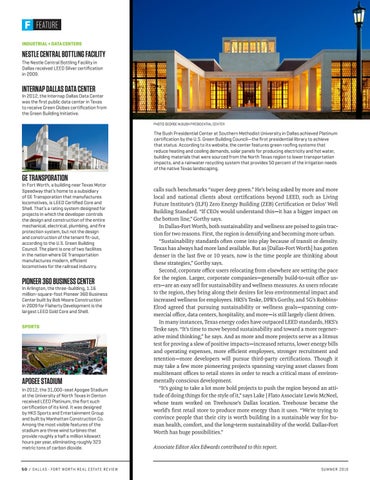
The Bush Presidential Center at Southern Methodist University in Dallas achieved Platinum certification by the U.S. Green Building Council—the first presidential library to achieve that status. According to its website, the center features green roofing systems that reduce heating and cooling demands, solar panels for producing electricity and hot water, building materials that were sourced from the North Texas region to lower transportation impacts, and a rainwater recycling system that provides 50 percent of the irrigation needs of the native Texas landscaping.
GE TRANSPORATION
In Fort Worth, a building near Texas Motor Speedway that’s home to a subsidiary of GE Transporation that manufactures locomotives, is LEED Certified Core and Shell. That’s a rating system designed for projects in which the developer controls the design and construction of the entire mechanical, electrical, plumbing, and fire protection system, but not the design and construction of the tenant fit-out, according to the U.S. Green Building Council. The plant is one of two facilites in the nation where GE Transportation manufactures modern, efficient locomotives for the railroad industry.
PIONEER 360 BUSINESS CENTER
In Arlington, the three-building, 1.16 million-square-foot Pioneer 360 Business Center built by Bob Moore Construction in 2009 for Flaherty Development is the largest LEED Gold Core and Shell. SPORTS
APOGEE STADIUM In 2012, the 31,000-seat Apogee Stadium at the University of North Texas in Denton received LEED Platinum, the fisrt such certification of its kind. It was designed by HKS Sports and Entertainment Group and built by Manhattan Construction Co. Among the most visible features of the stadium are three wind turbines that provide roughly a half a million kilowatt hours per year, eliminating roughly 323 metric tons of carbon dioxide.
5 0 / D A L L A S - F O R T W O R T H R E A L E S TAT E R E V I E W
calls such benchmarks “super deep green.” He’s being asked by more and more local and national clients about certifications beyond LEED, such as Living Future Institute’s (ILFI) Zero Energy Building (ZEB) Certification or Delos’ Well Building Standard. “If CEOs would understand this—it has a bigger impact on the bottom line,” Gorthy says. In Dallas-Fort Worth, both sustainability and wellness are poised to gain traction for two reasons. First, the region is densifying and becoming more urban. “Sustainability standards often come into play because of transit or density. Texas has always had more land available. But as [Dallas-Fort Worth] has gotten denser in the last five or 10 years, now is the time people are thinking about these strategies,” Gorthy says. Second, corporate office users relocating from elsewhere are setting the pace for the region. Larger, corporate companies—generally build-to-suit office users—are an easy sell for sustainability and wellness measures. As users relocate to the region, they bring along their desires for less environmental impact and increased wellness for employees. HKS’s Teske, DPR’s Gorthy, and 5G’s RobbinsElrod agreed that pursuing sustainability or wellness goals—spanning commercial office, data centers, hospitality, and more—is still largely client driven. In many instances, Texas energy codes have outpaced LEED standards, HKS’s Teske says. “It’s time to move beyond sustainability and toward a more regenerative mind thinking,” he says. And as more and more projects serve as a litmus test for proving a slew of positive impacts—increased returns, lower energy bills and operating expenses, more efficient employees, stronger recruitment and retention—more developers will pursue third-party certifications. Though it may take a few more pioneering projects spanning varying asset classes from multitenant offices to retail stores in order to reach a critical mass of environmentally conscious development. “It’s going to take a lot more bold projects to push the region beyond an attitude of doing things for the style of it,” says Lake | Flato Associate Lewis McNeel, whose team worked on Treehouse’s Dallas location. Treehouse became the world’s first retail store to produce more energy than it uses. “We’re trying to convince people that their city is worth building in a sustainable way for human health, comfort, and the long-term sustainability of the world. Dallas-Fort Worth has huge possibilities.” Associate Editor Alex Edwards contributed to this report.
SUMMER 2018