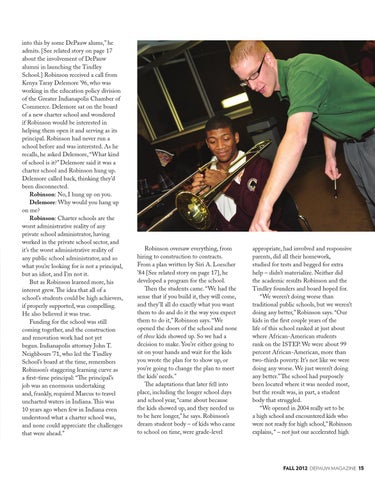
into this by some DePauw alums,” he admits. [See related story on page 17 about the involvement of DePauw alumni in launching the Tindley School.] Robinson received a call from Kenya Taray Delemore ’96, who was working in the education policy division of the Greater Indianapolis Chamber of Commerce. Delemore sat on the board of a new charter school and wondered if Robinson would be interested in helping them open it and serving as its principal. Robinson had never run a school before and was interested. As he recalls, he asked Delemore, “What kind of school is it?” Delemore said it was a charter school and Robinson hung up. Delemore called back, thinking they’d been disconnected. Robinson: No, I hung up on you. Delemore: Why would you hang up on me? Robinson: Charter schools are the worst administrative reality of any private school administrator, having worked in the private school sector, and it’s the worst administrative reality of any public school administrator, and so what you’re looking for is not a principal, but an idiot, and I’m not it. But as Robinson learned more, his interest grew. The idea that all of a school’s students could be high achievers, if properly supported, was compelling. He also believed it was true. Funding for the school was still coming together, and the construction and renovation work had not yet begun. Indianapolis attorney John T. Neighbours ’71, who led the Tindley School’s board at the time, remembers Robinson’s staggering learning curve as a first-time principal: “The principal’s job was an enormous undertaking and, frankly, required Marcus to travel uncharted waters in Indiana. This was 10 years ago when few in Indiana even understood what a charter school was, and none could appreciate the challenges that were ahead.”
Robinson oversaw everything, from hiring to construction to contracts. From a plan written by Siri A. Loescher ’84 [See related story on page 17], he developed a program for the school. Then the students came. “We had the sense that if you build it, they will come, and they’ll all do exactly what you want them to do and do it the way you expect them to do it,” Robinson says. “We opened the doors of the school and none of those kids showed up. So we had a decision to make. You’re either going to sit on your hands and wait for the kids you wrote the plan for to show up, or you’re going to change the plan to meet the kids’ needs.” The adaptations that later fell into place, including the longer school days and school year, “came about because the kids showed up, and they needed us to be here longer,” he says. Robinson’s dream student body – of kids who came to school on time, were grade-level
appropriate, had involved and responsive parents, did all their homework, studied for tests and begged for extra help – didn’t materialize. Neither did the academic results Robinson and the Tindley founders and board hoped for. “We weren’t doing worse than traditional public schools, but we weren’t doing any better,” Robinson says. “Our kids in the first couple years of the life of this school ranked at just about where African-American students rank on the ISTEP. We were about 99 percent African-American, more than two-thirds poverty. It’s not like we were doing any worse. We just weren’t doing any better.” The school had purposely been located where it was needed most, but the result was, in part, a student body that struggled. “We opened in 2004 really set to be a high school and encountered kids who were not ready for high school,” Robinson explains, “ – not just our accelerated high
FALL 2012 DEPAUW MAGAZINE 15