The Paper of Record for Greenwich Village, East Village, Lower East Side, Soho, Union Square, Chinatown and Noho, Since 1933
June 15, 2017 • $1.00 Volume 87 • Number 24
0
15465
10500
9
24-story tower could work at old Chelsea Vocational H.S.: City BY RICHARD BLODGETT
T
he Chelsea Vocational High School building, on the west side of Sixth Ave., between Dominick and Broome Sts., may be in play for development. Jennifer Maldonado, executive director of the New York City Educational Con-
struction Fund, attended the Community Board 2 Schools and Education Committee meeting Monday night and discussed plans to issue a Request for Expressions of Interest, or R.F.E.I., to private developers to seek proposals for redeveloping the building. DEVELOP continued on p. 5
Veteran feminists show they’re young at heart at reunion BY MARY REINHOLZ
T
he pictures flashing across a wall inside Judson Memorial Church in Greenwich Village showed icons of the women’s liberation movement from the last half of the 20th century: activists like Betty Friedan, Bella Abzug, Shirley Chisholm, Gloria
Steinem and Flo Kennedy taking aim at gender inequality in America. A couple of venerable speakers, who had lived through the movement’s early triumphs and disappointments, delivered stinging attacks against Donald J. Trump, 45th presi-
PHOTO BY BOB KRASNER
At the star t of the Body Pride Parade on Saturday in Tompkins Square Park, Clarence from Brooklyn “got his paint on” with help from Ilona, left, and Eric. For more photos, see Page 19.
One word at a time... ‘taking’ Trump Tower
FEMINISTS continued on p. 6
BY TEQUIL A MINSK Y
H
e’s in the belly of the beast. Reverend Billy — the infamous political performance-artist preacher of the Church of Stop Shopping Choir — and his creative partner and wife, Savitri D., have started a writing room of sorts, using the public space on the fifth floor of Trump Tower on Fifth Ave.
at E. 56th St. Who knew? In this space, Reverend Billy, real name Bill Talen, regularly writes in his blackand-white Mead composition book. A number of commercial buildings in New York have indoor or outdoor public spaces created primarily in exchange for zoning variances. Trump Tower has two such “plaza / gardens.”
(For creating 15,000 square feet of “gardens and atrium public space,” Trump won a zoning variance that enabled him to increase his building’s height by 20 floors. That amount of space actually represents what Trump still owns in his tower and is worth $530 million.) While the skyscraper’s WRITE-IN continued on p. 8
Lenin rises again on Lower East Side ................p. 4 Protest for persecuted Chechen gays .............. p. 10 Here’s to your health! ............p. 22
www.TheVillager.com
NOT VERY NYSE, BEN: Congressmember Nydia VelĂĄzquez blasted Ben Carson, the secretary of the Department of Housing and Urban Development, for visiting the New York Stock Exchange on his visit to New York City. “Rather than visiting Wall Street, I would hope Secretary Carson would spend all his time in New York City gathering a deeper understanding of the perennial housing challenges facing New Yorkers, she said. “Given that the ad-
PHOTOS BY FREDDA TONE
Kids learned about nature and had lots of fun at the Jefferson Market Garden’s Children’s Music and Flower Festival on Sun., June 11. They found out how worms help aerate the soil so that plants bloom better, decorated flower cookies donated by Citarella, and listened to music provided by Greenwich House Music School.
ministration’s budget proposed deep and devastating cuts to the New York City Housing Authority and other programs that New York’s working families rely on, it is clear this administration does not understand housing policy and how it affects the day-to-day lives of Americans — in New York and elsewhere. Especially in light of Dr. Carson’s recent comments,� Velazquez added, “about poverty being a ‘state of mind’, I would think he could fi nd better ways to spend his time than ringing the closing bell at the Stock Exchange.�
4]` []`S W\T]`[ObW]\ O\R A=<G;/ ZS\RS`a QOZZ & !& "$$! ]` dWaWb a]\g[O ]`U
2
June 15, 2017
NIGHT OF STARS: The Greenwich Village Society for Historic Preservation honored seven local “leading lights� with its 27th Annual Village Awards on Tues., June 6, at The New School. The winners included The Public Theater, B & H Dairy, Patisserie Claude, GOLES (Good Old Lower East Side), Jefferson Market Library branch manager Frank Collerius, Dinosaur Hill toy store (check out their ad below on this page in our print edition!) and a combo award, the restoration of 30 Seventh Ave. (the new Lenox Health Greenwich Village comprehensive care center) and the new AIDS Memorial at St. Vincent’s Triangle Park. We’ll have a full report in next week’s print issue. TheVillager.com
Push for E.V. protective zoning for small stores BY LESLEY SUSSMAN
T
he Community Board 3 Economic Development Committee is trying to do something about the growing number of empty storefronts in the East Village. The committee held a special public forum last Wednesday to get input on a proposal to preserve the neighborhood’s unique character and support small businesses. The forum, at Sirovich Senior Center & Volunteers of America-Greater New York 12th St. Residence, at 331 E. 12th St., drew a large and vocal crowd. Local residents, community activists and representatives of local politicians expressed anger and concern about the loss of East Village small businesses over the past 10 years and a resulting decrease in the diversity and affordability of local goods and services. The “Special District Protection� proposal would create a new zoning area from Avenue D to, roughly, Third Ave. between E. 14th and Houston Sts. It would attempt to curtail the burgeoning number of banks and big-box stores the city is seeing, such as Walgreens, Old Navy and Walmart, so that smaller, local shops could have a better chance of serving community needs. Such special zoning districts have been designated by the City Planning Commission since 1969 and allow neighborhoods to modify an area’s zoning to meet specific goals. Among its aims, the C.B. 3 proposal would limit the presence of vacant storefronts, support existing small businesses, and preserve the unique character of a neighborhood that has drawn millions of tourists over the years. The new district would not push out existing businesses and nightlife establishments, as some critics claim, but, instead, help strike a balance and try to create a level playing field for local merchants. For example, it would limit restaurants and bars to just 25 percent of any given block’s street frontage and allow just one bank or chain-store franchise per block. Speakers lamented the gradual destruction of the East Village’s unique and colorful character and also the high-rent blight affecting small businesses — and residents Also high on the list of concerns was the large number of “drunken N.Y.U. students� who create noise and other late-night disruptions that often awaken sleeping tenants. C.B. 3 Chairperson Jamie Rogers started off by telling the audience, “We are not here tonight to present a plan to you but to get your input. We will not move forward on anything without your input.� TheVillager.com
David Ford, chairperson of the board’s Economic Development Committee, followed by saying the proposal was “not a reaction to any building developer or store operating right now. What we’re doing is looking ahead to the future of the neighborhood.� Forty-eight speakers had two minutes each to have their say. Lorcan Otway, owner of Theatre 80 St. Mark’s, said small Off Off Broadway theaters are being driven out of the neighborhood because they’re being “overwhelmed by taxes and high rents.� “Landlords are hiking up rents to drive out small restaurants, theaters and businesses, so that they could rent to large-scale businesses,� Otway said. “New York is not dying — it’s being murdered by taxation,� he added. Abby Ehmann, owner of Lucky bar, at 168 Avenue B, also complained about New York University students. “The kids who live in those N.Y.U. dorms just dump all their crap on the sidewalk when they go off to wherever they go off to in the summer,� Ehmann said. “They don’t contribute anything to the neighborhood.� Jorge Vasquez, a City Council candidate, backed a special district, but also suggested limiting chain stores that “pop up for a season, like tax-preparation services and Halloween stores.� “Once our small businesses go,� he said, “then your community changes because that’s the kind of businesses where we work at. That’s who supports our baseball teams and schools.� Most speakers were small business owners and voiced uniformed support of the C.B. 3 proposal. One who did not, and was soundly booed, was Sam Levy, a research analyst with the Real Estate Board of New York. “The community board’s assertion that local small businesses are suffering due to ‘exorbitant rents’ is not based on any factual analysis of whether the businesses are failing or moving on for other reasons,� he charged. Levy added that, in fact, both national chains and small merchants are “facing unprecedented retail challenges that stem from lack of demand due to burgeoning e-commerce — not high rents.� Afterward, CB 3 Chairperson Rogers said he was pleased by what he heard from area residents and merchants. “The feedback was exceedingly helpful,� he said. “There’s a lot of anxiety about the loss of small business that people cherish and a lot of concern that people won’t be able to afford to start new businesses. I’m really encouraged by the potential solutions being offered, and it will all be synthesized into a proposal we can take to the proper officials.�
JOIN US FOR OUR R E G I S T E R E D N U R S E S C A R E E R D AY !
Seeking Licensed RNs
Saturday, June 24, 2017 10 AM - 1 PM 95-25 Queens Boulevard Rego Park, NY 11374 Be part of Fidelis Care’s growth in New York City, and across New York State! is the heart and soul of everything we do. With opportunities for collaboration as part of a dedicated team, personal and career growth, great work-life balance with many weekday schedules from 8:30 AM to 5 PM, and a competitive compensation package, Fidelis Care is the place to be for clinical careers.
• •
Onsite Interviews Guaranteed! Please bring copies of your resume.
Fidelis Care is fully committed to Equal Employment Opportunity and to
without regard to their race, gender, color, religion, sexual orientation, national origin, age, physical or mental disability, citizenship status, veteran status, or any other characteristic prohibited by state or local law. EOE. June 15, 2017
3
Lenin rises again, on Norfolk St. Named best weekly newspaper in New York State in 2001, 2004 and 2005 by New York Press Association News Story, First Place, 2015 Editorial Page, First Place, 2015 Editorials, First Place, 2014 News Story, First Place, 2014 Overall Design Excellence, First Place, 2013 Best Column, First Place, 2012 Photographic Excellence, First Place, 2011 Spot News Coverage, First Place, 2010 Coverage of Environment, First Place, 2009
PUBLISHER JENNIFER GOODSTEIN
EDITOR IN CHIEF LINCOLN ANDERSON
ARTS EDITOR SCOTT STIFFLER
CONTRIBUTORS ALBERT AMATEAU IRA BLUTREICH TINA BENITEZ-EVES SARAH FERGUSON BOB KRASNER TEQUILA MINSKY CLAYTON PATTERSON JEFFERSON SIEGEL SHARON WOOLUMS
GRAPHIC DESIGNER CRISTINA ALCINE
ADVERTISING AMANDA TARLEY
ACCOUNT EXECUTIVES GAYLE GREENBURG JIM STEELE JULIO TUMBACO
CIRCULATION SALES MNGR. MARVIN ROCK
W
ithout any apparent signs of Russian hacking, the Lower East Side’s landmark Lenin statue was reinstalled last Friday morning at a new home, on a plinth atop the rooftop of 178 Norfolk St. It’s just a stone’s throw from its former longtime perch, atop the formerly aptly named Red Square, at 250 E. Houston St., where it had stood since 1994, three years after the building’s opening. The statue of the Red leader was exiled from Red Square last September, shortly after it was reported that the 130-unit building was in contract to be sold to new owners for $100 million. Michael Rosen, Red Square’s original developer, and Michael Shaoul, who runs the building’s managing agent, were behind originally putting Lenin on the E. Houston St. building’s rooftop nearly 25 years ago. They are owner partners in the nearby 178 Norfolk St. Peter Marciano, who maintains all of Rosen and Shaoul’s properties, had the statue’s reinstallation videoed with a drone. The monument once again faces toward Wall Street. As for the erstwhile Red Square, its name was also stripped by the new owners.
Lincoln Anderson
Member of the New York Member of the National Press Association Newspaper Association
PHOTOS BY STACIE JOY
Workers installing the Lenin statue on a plinth on 178 Nor folk St., with the former Red Square, the monument’s longtime home, in the background. The Villager (USPS 578930) ISSN 0042-6202 Copyright © 2017 by the NYC Community Media LLC is published weekly by NYC Community Media LLC, One Metrotech North, 10th floor Brooklyn, NY 11201. 52 times a year. Business and Editorial Offices: One Metrotech North, 10th floor Brooklyn, NY 11201. Accounting and Circulation Offices: NYC Community Media LLC, One Metrotech North, 10th floor Brooklyn, NY 11201. Call 718-260-2500 to subscribe. Periodicals postage prices is paid at New York, N.Y. Postmaster: Send address changes to The Villager, One Metrotech North, 10th floor, Brooklyn, NY 11201 Annual subscription by mail in Manhattan and Brooklyn $29 ($35 elsewhere). Single copy price at office and newsstands is $1. The entire contents of newspaper, including advertising, are copyrighted and no part may be reproduced without the express permission of the publisher - © 2017 NYC Community Media LLC. PUBLISHER’S LIABILITY FOR ERROR
The Publisher shall not be liable for slight changes or typographical errors that do not lessen the value of an advertisement. The publisher’s liability for others errors or omissions in connection with an advertisement is strictly limited to publication of the advertisement in any subsequent issue. Published by NYC Community Media, LLC One Metrotech North, 10th floor Brooklyn, NY 11201 Phone: (718) 260-2500 • Fax: (212) 229-2790 On-line: www.thevillager.com E-mail: news@thevillager.com © 2017 NYC Community Media, LLC
4
June 15, 2017
Greetings, comrades! Lenin gazes out over the Lower East Side from his new Nor folk St. perch.
TheVillager.com
City eyes Sixth Ave. school as development site DEVELOP continued from p. 1
E.C.F. works with developers on mixed-use real estate projects that include school facilities. In an era of scarce city funds for schools, the goal in the case of Chelsea Vocational is to raise funds for a badly needed interior renovation and expansion of classroom space by selling air rights to a developer. The building currently contains two schools: Chelsea Career and Technical Education High School and the NYC iSchool. Maldonado said it was far too early to know what might be proposed, or whether developers would even be interested. If they are, one possibility is a residential tower on top of the school. Under zoning for the site, the tower could be up to 240 feet tall, perhaps higher, but whether that would actually happen is unknown. A second possibility is a new building on the Trinity-owned parking lot on Varick St. behind the school using Chelsea Vocational air rights. A third option is relocation of the school to a different site at the developer’s expense, allowing the developer to convert the school to a residential condo.
PHOTO BY TEQUILA MINSKY
The old Chelsea Vocational High School building could be in play for development.
Maldonado promised to get back to the community board when she knew more. The school building — whose exterior is not landmarked — is in sore
need of an interior renovation. It was originally built in 1905 as an elementary school and the scale of its interior design and facilities is for smaller children. The cafeteria is so small, students
must eat in shifts throughout the school day. The gym, formerly an auditorium, has a sloping floor. Electrical outages plague graphic-design and tech students working on computers.
Smell gas? Leave the area immediately and call 911 or 1-800-75-CONED (26633). Don’t expect someone else to make the call. conEd.com/GasSafety
Live in a world where everyone acts fast when they smell gas.
TheVillager.com
June 15, 2017
5
Veteran feminists show they are young at heart FEMINISTS continued from p. 1
dent of the United States. But Trump’s persona did not loom large at an event focused on marking a historic time that had nothing to do with him. “We’re still here, but so is that maniac in the White House,” said Susan Brownmiller, the 82-year-old Jane St. author of the groundbreaking 1975 treatise on rape, “Against Our Will: Men, Women and Rape,” after she took the open microphone at a reunion of second-wave feminists held Saturday afternoon in Judson, at 55 Washington Square Park South. Brownmiller went on to recount the need for today’s activists to resist rightwing efforts throughout the U.S. to roll back Roe v. Wade, the 1973 Supreme Court decision that granted women the right to terminate unwanted pregnancies. Brownmiller noted that she carried a sign promoting abortion during one of the women’s marches that sprang up around the U.S. a day after Trump’s inauguration on Jan. 21. “Abortion is empowerment,” she said to applause from about 120 other older women seated at long tables, who drank bottled water and nibbled on chicken, egg and tuna sandwiches. “Motherhood should be for women who want to be mothers. It’s a choice, not a mandatory destiny for anyone anywhere in the world,” Brownmiller added, sounding like a young radical on the barricades 50 years ago. “Right on!” shouted a woman of a certain age who stood in the back of the second-floor Judson Hall, where there were books on sale by feminist lawyer / author Jo Freeman and Bowery artist / scribe Kate Millett, author of “Sexual Politics,” a bestselling 1970 book of literary criticism based on her Ph.D. dissertation. There were also handouts describing the decades-long reissuing of “Our Bodies, Ourselves,” a controversial booklet put together by a Boston feminist collective in 1969. It sparked the women’s health movement, and was derided as “obscene trash” by Reverend Jerry Falwell of the Moral Majority during the early 1980s. The hours-long reunion, billed as a speak-out and sponsored by the nonprofit Veteran Feminists of America, drew at least 20 women from out of state, according to Carole DeSaram, a former New York chapter president of NOW and a board member of V.F.A. who helped to organize it. Attendees paid $50 each for tickets to cover the costs of food and renting the hall at Judson, where volunteers welcomed them in red T-shirts emblazoned with the words, “We Won’t Go Back!” Several men also showed up, including a bearded gent from Oregon who wore a T-shirt bearing the slogan, “I’m With That Nasty Woman!” He heaped praise on Berkeley archivist Laura X, founder of the National Clearinghouse on Marital and Date Rape, and another speaker at
6
June 15, 2017
Yolanda Bako founded New York City’s first shelter for abused women.
PHOTOS BY TEQUILA MINSKY
Carole DeSaram, left, and Barbara Love at the reunion of second-wave feminists at Judson.
the event. DeSaram gave the speakers two minutes each to offer their messages. Some went considerably overtime, such as mixed-media artist Suzanne Benton from Connecticut, who at one point in her remarks donned a white mask and intoned in a raspy sepulchral voice: “I am from the graves of [women] martyrs here to give you courage!” One second-wave feminist stirred laughter and enthusiastic applause as she taught the audience sign language by singing lyrics that included lines like: “If it wasn’t for women / We would not be living.” Early on in the program, Rebecca Lubetkin of New Jersey, a longtime NOW activist, reminded the assembled sistahs
that the Center for Women’s History — run by the New-York Historical Society — opened its museum doors in March on Central Park West. The new center requires potential contributors to fill out forms and send them in advance to determine if the center could use artifacts that tell “personal stories” and “reflect women’s struggle for their rights.” Another speaker noted that the ERA (Equal Rights Amendment), dormant since its deadline for passage by Congress in 1982, had been ratified this year by Nevada in March, “and only two more states” are needed for possible passage by Congress. She urged the audience members to contact their local politicians to support the long-stalled amendment. It guarantees, among other things, that
“equality of rights under the law shall not be denied or abridged by the United States or by any state on account of sex.” The Nevada senators passed a measure sent to them by the state Assembly, which had already approved it, according to NPR. There were profiles in courage at the get-together as some attendees arrived with their canes and walkers and met old friends. Yolanda Bako, 70, from the Bronx, rolled up in her wheelchair to the microphone. She explained how she founded the “first” New York City shelter for abused women in 1976 in Sunset Park, Brooklyn. An activist in the movement against domestic violence, Bako was coordinator of the Rape Prevention Committee of the New York City chapter of NOW. She helped coordinate the 1976 Women’s Walk Against Rape at night in Central Park. DeSaram told The Villager later that Bako “took on a project that no one else wanted to touch because society at that time treated rape victims like it was their fault or they asked for it. The police were terrible.” And so it went as the speakers chronicled and celebrated some of the accomplishments of second-wave feminism. One of the last at the mic was Alix Kates Shulman, 84, author of the bestselling 1972 “Memoirs of an Ex-Prom Queen.” Shulman was active in the civil-rights and antiwar movements of the early 1960’s before she became a radical feminist. “Most of us didn’t know [much] about the first wave of feminists,” she said, alluding to the suffragists who fought for passage of the 19th Amendment to the U.S. Constitution, which granted women the right to vote on Aug. 26, 1920. “Now the young women who are newly calling themselves feminists and who joined the women’s march after Trump’s [inauguration] look at us like we looked at the first wave. We’re separated in time because we’re from the 1960s. “That’s something they want to correct,” Shulman continued. “Their history is us. We made history, we tried to change history but now we are simply history. I think that is one of the goals we always had. I’m just very grateful that at my age I’ve lived long enough to see that happen with a generation of feminists coming up.” When the speak-out ended around 4:30 p.m., painter Diana Kurz, an 81year-old Soho resident who first joined a women’s march for peace in 1967, remarked that she was “very moved” by the words of the second-wave feminists who keep on keeping on. “I think being active and committed to a cause keeps you young,” she said. Manhattan attorney Emily Jane Goodman, a retired New York State Supreme Court justice, e-mailed this reporter on Sunday: “It’s great to see that the energy is still with us and our revolution continues.” TheVillager.com
POLICE BLOTTER No-peace pipe A man was hit in the head with a metal pipe in front of 36 E. 14th St., at University Place, on Thurs., June 8, at 3:18 a.m., police said. According to a report, the victim and the suspect were arguing when the suspect hit him, gashing the left side of his head. The victim was taken to Bellevue Hospital where he received multiple staples to close the wound. Goda Saber, 28, was arrested for felony assault.
Stadium steal During a traffic stop on W. 14 St., an officer noticed there was identification on the car’s floor that did not belong to its occupants. Subsequently, three suspects were arrested inside 2 Columbus Ave., on Wed., June 7 at 12:15 a.m. One of the suspects was found to be in possession of stolen credit cards belonging to a 40-year-old man. Upon further investigation, it was determined the suspect made unauthorized purchases on the victim’s credit card while inside 350 W. 14th St. A skimmer device was recovered, which one of the suspects attempted to destroy by stepping on it. The victim last recalls having his property at Yankee Stadium on Tues., June 6.
Johnathan Garcia and Hercy Ramos, both 26, and Hassan Simmons, 27, were arrested for felony grand larceny.
Photos filcher According to police, a woman saw naked photos and video of herself on her friend’s phone, which were obtained without her knowledge or permission. The incident occurred inside 22 Leroy St. on Mon., May 23, 2016, at 7 p.m. The suspect wrote and signed a confession letter to the 29-year-old victim, explaining what he did. The victim also stated that the suspect hacked her social-media account and stole information from it. Bruno Faustino Mehech, 29, was busted Tues., June 6, for felony unlawful surveillance.
Astor robber arrest Police said a man stole a woman’s wallet from her pocketbook on Mon., June 5, at 2:30 p.m. in front of 747 Broadway, near Astor Place. Ronevy Marte, 18, was charged with felony grand larceny.
Tabia Robinson
GLENN KAINO | TOM WERNER | GARY GODDARD ENTERTAINMENT
IN & OF ITSELF PREDICTION PRODUCTIONS AND
NEIL PATRICK HARRIS PRESENT
CREATED & PERFORMED BY
DIRECTED BY
DEREK DELGAUDIO
FRANK OZ
PO PU LAR DE MA ND EX TEN DE D THR U 9/3 BY
“DEREK DELGAUDIO SETS HIMSELF APART FROM THE ABRACADABRA CROWD. BEAUTIFUL. TENDER. ASTONISHING.” “IN THE ASTONISHING IN & OF ITSELF, DEREK DELGAUDIO PERFORMS SOME OF THE MOST HEART-STOPPINGLY WONDROUS PIECES OF MAGIC I’VE EVER SEEN.”
++++ inandofitselfshow.com DARYL ROTH THEATRE
PHOTO: MATTHEW MURPHY
COMING IN SEPTEMBER OF 2017
Manhattan. 2 Fifth Avenue, New York NY 10011 A new day care center for children ages two to five will open its door for 2017/2018 school year. The TheVillager.com
center will be offering enhanced academic programs, dance/ movement, languages, sports, and art classes. The specific disciplines will be finalized based on the enrollment and the selection made
by the parents. For information and application please contact our Main office at 212-938-1223 ext. 112 vborsen@lifeadjustmentcenter.com
June 15, 2017
7
One word at a time, Rev. Billy and choir ‘taking’ WRITE-IN continued from p. 1
commercial restaurants and shops are touted, it takes detail-oriented vision for a visitor to spot a sign that mentions the “gardens.” Talen and others want to use the space for its intention — open space for the people. After going through security and taking the escalator up, up, up, ascending the shaft of gold and pink marble to the fifth floor, one enters through glass doors onto an outdoor patio space — the public space of Trump Tower. It’s got 12 Japanese maple trees, Talen points out. “For us, it reminds of Zuccotti Park,” he said. “It’s a park with no dirt. This is the leftover conscience of the city. “We’re here in this city garden forced on Trump,” he stated. He was, of course, referring to Occupy Wall Street — another privately owned public space, or POPS — which had a “tent city” encampment in the Lower Manhattan park for more than two months in 2011. (There’s another space like this on the fourth floor that the building has closed, probably for security reasons. And Talen talks about Secret service, probably watching as he and this reporter speak.) Since May 23, three to four times a week, Talen and Savitri have been writing, longhand, for 45 minutes in this space. Their daughter, Lena, was busy writing, too, on the day this reporter visited. They have dubbed the write-ins “radical ritual.” Talen has almost filled up his first composition book. Prior to the tenth writing session, he and Savitri went public, and it seems that others now want to join them for this timed writing. As it turned out, Arizona State University Professor Mathew Sandoval, a former New York University performance studies student who has been following Talen for years, was coordinating a “New York Experience” trip for A.S.U. honors college students. Their first full day in New York, they meet Talen and participated in this writing experience. “It’s what comes to you and through you,” Talen explained, “from the first word to the last, all kinds of things come out.” And, it’s not just a meditative exercise. He emphasized that he is rooted in direct action from the free writing. Talen and choir have sung in Walmarts and other commercial venues, proudly owning the stat that he’s been arrested more than 50 times. “Culture is so dark,” he said. “It’s that Yeats moment. We don’t know what to do now. We’re like a water
8
June 15, 2017
PHOTOS BY TEQUILA MINSKY
Lena, the daughter of Reverend Billy and Savitri D., writing in her notebook in a privately owned public space in Trump Tower.
started with just a notion,” he reiterated. So Talen with his creative partners that also include other groupings and organizations are nurturing the public of the Trump Tower public space. At noon, an Art Rising public performance will take place in this space, organized by #TakeTrumpTower.com and curated by Caterina Bartha — the latest in a series of direct actions at Trump Tower. Art Rising bills itself as a living lab to educate voters and elected leaders about the risks of Trump’s presidency. The Church of Stop Shopping Choir will open and Arizona State Universit y students joined Reverend Billy and Co. at the Trump Tower write-in last week.
close the hour-long the performance. The Radical Ritual will be taking
buffalo with a lion biting its spine. They go for the basic nerves.” It’s not just Trump that is the lion — it’s the 1 percent, generally, the banks, armies, big religions, big corporations, he added. “There’s a tremendous grouping of deadly power right now,” Talen
warned. He mentioned the Dadaists and the Wovoka Ghost Dance as moments in history when new culture must take place. It begged the question, which he asked: How do you start new culture? “The largest blocks of power all
place at varying times in the coming weeks on Tues., June 20, Thurs., June 22, and Wed., June 28. Check the event calendar at http: www.taketrumptower.com for the times and other events that, as Talen put it, “put back the people into public space.” TheVillager.com
Trump Tower public space, in spirit of Occupy
Savitri D. puts pen to paper in the Trump Tower POPS — privately owned garden / plaza space.
Bill Talen, a.k.a. Reverend Billy, feels the spirit move him in the Trump Tower garden / plaza space, as an Arizona student looks on. There are a lot of dark forces at work in the world right now, he warned.
BRAVE NEW BOOK Justin Time Autobiographical Stories from an American Spiritual Master
J. JAYE GOLD
From the N.Y. City of the 1960s that produced Allen Ginsberg, Bob Dylan, and Paul Simon, comes the story of J. Jaye Gold’s journey from ordinary Bronx kid to profound philosopher and spiritual teacher. ************
poignant, but always clichĂŠ-free stories from the life of a truly unique human being. Available on Amazon.com TheVillager.com
Please Join Us for the 24th Annual Meeting of the Village Alliance Tuesday, June 20th 5:00 - 7:00 PM NY Studio School 8 West 8th Street (Btw 5th/6th Aves.)
RSVP Required 212.777.2173 info@villagealliance.org
ublishe by era am ress pera ampress gmail.com
June 15, 2017
9
U.S. must fight Chechen ‘gay genocide’: Activists BY ANDY HUMM
F
ifty demonstrators from Rise and Resist — a group largely focused on protesting right-wing assaults by the Trump administration on American democratic institutions and ideals — and their allies took to the sunny streets of Greenwich Village and Chelsea on Sun., June 11. But they weren’t protesting Trump this time. Instead they were calling attention to the plight of gay people in Chechnya — a federal republic within Russia — who are being interned in concentration camps and murdered by their government or their families. The marchers gathered on the Christopher St. Pier at noon Sunday and marched through the West Village and Chelsea — past lots of sympathetic brunchers, among others — before rallying in Union Square. “Stop the Torture! Stop the Murder!” their signs read. The group was under no illusions that it could have much impact on Russian President Vladimir Putin, who enacted anti-L.G.B.T.Q. “propaganda” laws in the run-up to the 2014 Sochi Olympics, or his anti-gay puppet — not Trump, in this case, but rather President Ramzan Kadyrov of Chechnya. Both Putin and Kadyrov deny the murderous crackdown on gay people is taking place, though it has been documented by Human Rights Watch. When French President Emmanuel Macron publicly confronted Putin about the Chechen crisis during their first meeting two weeks ago in Paris, all the Russian strongman would pledge to do was to look into it. Rise and Resist’s lead organizer for the demonstration, Branden Hayward, said he is new to this kind of street protest. “My sights are set in the immediate future,” he said, “on getting chief-level executives at BP, Exxon, Shell and Chevron that have enormous investments in Russia and claim to support L.G.B.T. rights to take action.” OutRight Action International has an online petition addressed to oil executives demanding they speak up about the detention, torture and killing of gay men in Chechnya. “If Russia will not listen to other governments or even the United Nations, it is time to see if we can get money to talk in a language that they will listen to,” reads the OutRight petition at iglhrc. nonprofitsoapbox.com/demand-stop-todetentions-in-chechnya. Lyosha Gorshkov is co-president of RUSA-LGBT, a group for Russianspeaking L.G.B.T.Q. émigrés. “We’re trying to save lives,” she told the crowd. “More than 300 have been detained and more than 20 killed by the government. We cannot do anything with Putin and Kadyrov, but we can pressure the government here in the U.S. to issues special visas,” so that the crackdown’s victims can find refuge here.
10
June 15, 2017
PHOTOS BY CHRISTIAN MILES
Among those at Sunday’s protest against anti-gay persecution in Chechnya was Jim Fouratt, above, whose activism stretches back to the Gay Liberation Front, which formed in 1969 during the Stonewall Rebellion.
Branden Hay ward, from Rise and Resist, center, was the lead organizer of the protest against anti-gay persecution in Chechnya.
However, Gorshkov added, “Even here and in Europe, they are not safe from the brutal and violent Chechen diaspora,” noting the dangers gay men may face even if they manage to escape Chechnya — and Russia altogether. On May 23, U.S. Congressmember Ileana Ros-Lehtinen, a Florida Republican, introduced House Resolution 351 to condemn the violence and persecution. But the activists hope to pressure Congress to go further and offer emergency visas to the fleeing Chechen gays — which, so far, the U.S. has not done. The activists urge New Yorkers to focus on co-sponsors of Ros-Lehtinen’s resolution from the Empire State, including Democrats Jerry Nadler, Sean Patrick Maloney, Adriano Espaillat, Joe Crowley, Eliot En-
gel, Nita Lowey and Brian Higgins, and Republicans Dan Donovan, Claudia Tenney and John Katko. Rise and Resist’s Ken Kidd is a veteran of the Queer Nation anti-Putin protests in 2013 and 2014. “Not enough people know about this,” he said. “This is genocide, and our country is not doing enough.” Veteran gay activist Rick Landman, a son of Holocaust survivors, noted that even amid the dire climate in Nazi Germany prior to World War II, his grandfather “kicked Julius Streicher in the ass” while Streicher was still the regime’s leading anti-Semitic propagandist. Landman talked about how the treatment of gay people in Chechnya is based in the classic political tool of “scapegoating.”
“When they need someone to pick on and dehumanize, they pick on us now,” Landman said. Faye Kilburn, 29, of Rise and Resist, said activists’ concern over anti-gay oppression and violence of this kind anywhere knows no borders. “The biggest injustice in the world is being persecuted for who you are,” she said. “While we were marching, someone yelled at us, ‘There are bigger problems at home!’ Because this is happening in a different country, it is easy to feel helpless.” The activists, however, believe their efforts could help bring the plight of the Chechen gay men to the fore in global politics. Hayward said that their demonstration “was an amazing combination of gay-rights movement vets from groups like ACT UP and people in their 20s and 30s. It was history and the future.” Among those marching were Jim Fouratt, a veteran of the Gay Liberation Front formed in 1969 during the Stonewall Rebellion, and Mark Milano, who has been with ACT UP since the 1980s. The activists encouraged donations to Rainbow Railroad, a Canadian group working to get victimized gay men out of Chechnya with emergency visas. That effort can be supported at RainbowRailroad.ca/donate. TheVillager.com
‘Classic’ tale of 1 student’s amazing turnaround RHYMES WITH CRAZY BY LENORE SKENAZY
T
his is for all the parents worried that their kids are cutting class, falling through the cracks, overeating, underachieving, or spending all day playing video games — and for all the kids doing just that. Dominick Vandenberge was raised in the Bronx — Pelham Bay — and no one would call him a star student. He was forced to repeat first grade, and already felt like a failure at age 6. He became the oldest kid in the class. He hated everything to do with school. And then his weight started to balloon. By high school, Dominck weighed 220 pounds and he struggled to make friends. He started skipping class. And then, things got even worse. His dad died of a heart attack, at home. That same night, the family moved into his aunt’s basement in Queens. Dominick transferred to Francis Lewis High School and when he arrived that first day, his teacher mocked his weight in front of the whole class. She asked him
if he was on drugs. Everyone laughed. Except Dominick. He’d played hooky before? Now he became a serious truant. Sometimes he didn’t show up for an entire month. The principal called him in and said if he missed one more day, he’d be out. Out he was. At that point in his life, Dominick recalls, “I can remember me wanting to change.” But how? He was fat, friendless, fatherless. “I had nothing to show for the past 17 years, other than that I had completed some video games.” He remembers lying down on his bed, “and, cliché as it was, I was looking up into the sky at night and I was just hoping that one day I could find someone, because I don’t want to be alone, and I wanted to be successful.” He decided that the first thing he’d do was try to lose some weight. If he could
do that… . Well, first things first. Dominck started watching exercise videos, and kind of “lying” to himself. He told himself he was just going to “stretch a little bit.” He didn’t want to aim for anything harder. He’d disappointed himself enough already. But instead of just stretching, he added a little more exercise each day — some push-ups, some squats. He started walking in the park, which turned into power-walking, then jogging. At the same time, he changed his diet. Now he ate mostly oatmeal, apples, carrots and water. In seven months, Dominick lost 80 pounds. He applied to a GED program in Elmhurst, passed the test and applied to his dream school, Hunter College. He didn’t get in. So he enrolled at Borough of Manhattan Community College — and promptly failed every class. But by now, Dominick knew all about starting over. So he did, and this time he took a course in “Classics.” He thought it was going to be about classical music. Instead, it was about the history of Western civilization, starting with the ancient Greeks and Romans, taught by the toughbut-fair Professor Gerald Clock. “He’d teach the class as if he was telling a story,” Dominick recalled. When Prof. Clock told the class about how the Athenians needed help fighting the Persians, so they sent their fastest
runner to the ask Sparta for help, Dominic was hooked. After all, he was a runner now, too. Clock took an interest in this motivated student, advising him in academic matters, and encouraging him, too. When he found out Dominick’s educational past, he was shocked. He thought Dominic had always been an “A” student. For his part, Dominick started writing papers on things like the Code of Hammurabi. He liked Prof. Clock so much, he took his class on American history, too. But classics really turned Dominic on. Upon graduating, Dominick was finally accepted at Hunter. He studied Greek and Latin. He got a scholarship to study in Athens, a scholarship to study in Rome, a scholarship to present his paper at Harvard University. Last week, along with dozens of other exceptional graduates, Dominick stood on the stage at Hunter commencement at Radio City Music Hall as the college president, Jennifer Raab, announced his grade point average: 3.96. Then she also announced a surprise guest. Onto the stage strode Prof. Clock. Wild applause. Dominick will return to Hunter this fall to earn his master’s in classical literature. His goal is to become a Latin teacher and inspire students like he had been. You know, the brilliant ones — who just don’t know it yet.
De Blasio Affordable Housing Myth #3 “Keeping New Yorkers in their homes has been a top priority… and our rent freeze program is designed to do just that.” –Mayor Bill de Blasio (Source: City of New York Website)
The Facts: • Here’s the result of de Blasio’s rent freeze program: 61,935 New Yorkers, including 23,445 children, are in the city’s shelter system – the highest homeless levels in NYC since the Great Depression. (Source: Coalition for the Homeless Website) • “At a time of record homelessness … de Blasio’s self-congratulatory victory lap on affordable housing is offensive and wrong.”–Katie Goldstein, Real Affordability for All (Source: Newsday, 1/12/17)
De Blasio’s Housing Policies: Politics & Hypocrisy Next Week: de Blasio Myth #4 TheVillager.com
June 15, 2017
11
News, arts,politics, police, opinion and more... It’s all in the Villager
LETTERS TO THE EDITOR Harassing tenants a crime To The Editor: Re “Croman to serve 1 year on mortgage, tax fraud� (news article, June 8): It is unbelievable that the current criminal penal codes do not include provisions for harassment, intimidation or creating conditions for uninhabitable apartments, all of which have caused so much agony and pain to Steven Croman’s tenants over the past decades. Currently, only civil remedies are available. Croman’s penalty of $5 million is nothing compared to the value of the equity he has amassed in his 140-plus buildings. Bob Dal
Grateful for coverage
The Paper of Record for Greenwich Village, East Village, Lower East Side, Soho, Union Square, Chinatown and Noho, Since 1933
June 16, 2016 • $1.00 Volume 86 • Number 24
0
15465
10500
9
Critics blast landmark bill as ‘anti-preservation’; Say ‘loophole’ offers little hope BY YANNIC R ACK
A
contentious bill that will put deadlines on the city’s preservation agency to designate landmarks within two years was passed by the City Council last week. There was heavy opposition from preservationists and even initial disapproval from the city’s Landmarks Preservation Commission itself — but the measure might be moot due
to a loophole, according to its chief critics. The legislation, Intro 775A, mandates that L.P.C. vote within one year to designate proposed individual landmarks, and take no longer than two years to vote on proposed historic districts — limits that the bill’s opponents charge could lead to the loss of countless potential landmarks. LANDMARKS continued on p. 12
Hoylman pushes Albany to pass child sex-abuse reform, but Senate stalls BY MICHAEL OSSORGUINE
T
he Omnibus Child Victims Act, or Senate Bill S6367, is the latest effort from state Democrats to reform the statute of limitations on victims of child sexual abuse. The bill, though still in committee, has momentum in the Senate as victims are stepping forward
To The Editor: Re “Roll away the dew: Dead fans party like it’s 1967� (news article, June 8): Thank you so much for the great article. I’m the drummer for Ice Petal Flowers, and both your photos and kind words for the band are deeply appreciated. Thanks again for coming and taking such cool pics. Have a Grateful day!
and Senate Democrats are arguing against entrenched opposition. State Senator Brad Hoylman introduced the Senate version of the bill with several co-sponsors, including Senator Andrea Stewart-Cousins, the leader of the Democratic Conference.
PHOTO BY TEQUILA MINSKY
Thousands of points of light: Monday night’s vigil stretched along Christopher St. from Waverly Place to Seventh Ave. South.
Adrian R. Mullins
‘We shall overcome’: Vigils draw thousands to Village BY PAUL SCHINDLER
I
ABUSE continued on p. 14
n two vigils in the West Village on Sunday evening, one crowd numbering in the thousands, another in the hundreds voiced shock, grief, and anger over the murder of 50 patrons of an Orlando, Florida, gay bar in the early morning hours of the same day. Speaker after speaker emphasized that the violence cannot be isolated from a climate of anti-L.G.B.T. hatred that continues to persist across the nation, but also pledged to continue building community to respond to hostility and bigotry where it exists.
At the same time, both crowds rejected the notion that hate is an appropriate response to the violence and speciďŹ cally called out efforts to pit the L.G.B.T. community against the Muslim community over a tragedy in which the shooter, 29-year-old Omar Mateen, is reported to have phoned 911 just prior to the massacre and pledged his allegiance to ISIS. Ken Kidd, a member of Queer Nation New York, took the lead in organizing a rally outside the Stonewall Inn that drew several thousand people. “We come together because this is a community that will
never be silent again,� he said. “I ask every person to think of someone you knew who was killed because of anti-L.G.B.T. hatred. Think of a time when you felt unsafe in your own community. And I want every single one of you to think not of what anyone else, not of what I, but of what you can do to change that.� Kidd said the L.G.B.T. community should draw strength from the 49 patrons of the Pulse nightclub who were killed. “We must go forward in love,� he said. Mirna Haidar, a representaVIGILS continued on p. 5
Graffiti artist tags Haring group in lawsuit ...... p. 16 Remembering Ramrod rampage of 1980.........p. 21 Here comes the sun energy...p. 18
www.TheVillager.com
Masaryk insensitivity To The Editor: Re “Masaryk gates are a disgrace� (talking point, by Dodge Landesman, June 8): Sad to see how insensitive the locals are toward the disabled and elderly. Susan L. Yung
The Paper of Record for Greenwich Village, East Village, Lower East Side, Soho, Union Square, Chinatown and Noho, Since 1933
January 14, 2016 • $1.00 Volume 86 • Number 2
0
15465
10500
9
They wanted Kuby gone
Squadron slams Senate for refusing to consider the Elevator Safety Act BY YANNIC RACK
T
enants and politicians joined in calling on state legislators to prove regulation and licens % &' crushed to death in an elevator on New Year’s Eve. ( ) *
* + !,! * ( /
/ 0 ,! When the elevator got ) Brown reportedly helped oth ELEVATOR continued on p. 10
Composting comes to Spring St., twice a week BY TEQUILA MINSKY AND LINCOLN ANDERSON
T
he term “scrappy New Yorkers� is taking on added meaning at a spot on the Lower West Side where local resi
grounds. gram to encourage residents to separate out their organic at Spring St. and Sixth Ave. !! "#$ -
PHOTO BY Q. SAKAMAKI
A photo of David Bowie during his Ziggy Stardust period amid votive candles and flowers at the memorial in front of his Soho building.
Fans bid Bowie farewell, good luck amid the stars BY LINCOLN ANDERSON
COMPOST continued on p. 12
Grey Art Gallery goes global........page 21
A
lison Dalton was walking down La ( 1 0 % * 2 3
4 2 53 ( 26
* 2 !78, 4) 6 The superstar singer died
early Sunday in London at age 97 ! with liver cancer. Along with : had lived at the Soho address !777 Asked what Bowie meant 0 '7 4) was going through.� ( ed cards with “Aladdin Sane� ( 40 % ; % 6 % < Stardust and the Thin White
0 4 % 6 4; % % = : > % 6 ( came to pay their respects & ' ; ( * 2 + ever-changing stage perso %
To The Editor: Re “I’m fired; Who cares why? Kuby as Eboni enters� (news article, June 8): Curtis and Kuby, together, were the best talk-show hosts on radio, bar none. The chickenbleeps at WABC got rid of Kuby, ostensibly for “budgetary� reasons, but really because Trump, or someone acting on his behalf, wanted him gone.
I tend to agree with Curtis more often than I agree with Kuby (on matters other than Trump). But the firing of Kuby was an act of political and moral cowardice. Dan Silagi
Not a nameless statistic To The Editor: Re “Woman killed by truck was longtime W. 8th St. resident, financial wiz� (news article, May 25): Kudos to The Villager for providing this profile of Fern. Do not let the victims of quotidian car-nage be nameless and faceless statistics. Bill Weinberg
Responds to letters To The Editor: In regards to the letter by Cormac Flynn (“Amusing Atzmon articles,� May 25), because Bill Weinberg, in promoting and calling for protests at the Theatre 80 event, repeatedly referenced both Milo Yiannopoulos and Ann Coulter antifascist protests, it was reasonable for Stanley Cohen and Lorcan Otway to assume that Weinberg was suggesting the same Black Bloc tactics used at Berkeley protests, which turned into riots. Regarding the letter on Lynne Stewart (“Blood on Stewart’s hands,� by Joseph Marra, May 25), it was never alleged by the government that anything done by Lynne caused loss of life in Egypt. Look at what she was convicted of and also note that the sentence, at first, was relatively minor until the judge, under pressure from the government, upped it. Also, if loss of life in Egypt had been linked to her, she would never have been released. The comments in the letter attacking her are not based in fact. John R. Penley E-mail letters, not longer than 250 words in length, to news@thevillager.com or fax to 212-229-2790 or mail to The Villager, Letters to the Editor, 1 MetroTech North, 10th floor, Brooklyn, NY 11201. Please include phone number for confirmation purposes. The Villager reserves the right to edit letters for space, grammar, clarity and libel. Anonymous letters will not be published.
IRA BLUTREICH
BOWIE continued on p. 6
Ex-chef dies in skateboard accident...........page 8 Are kids’ playdates really for parents?......page 14 www.TheVillager.com
To subscribe, call 718-260-2516 or email: pbeatrice@cnglocal.com
Different ears on Comey: Different conclusions 12
June 15, 2017
TheVillager.com
Renew mayoral control of city’s public schools
TALKING POINTS BY COREY JOHNSON
I
t’s another legislative session in Albany, and once again State Senate Republicans are holding a key New York City issue hostage in order to extract concessions: mayoral control of New York City’s schools. Let’s put aside the obvious question of why legislators who represent districts hundreds of miles away from here have the authority to determine how New York City runs its schools. We must then ask whether or not mayoral control has been a success. The answer is yes, and it’s outrageous that it’s being held up for political horse-trading. Before mayoral control, New York City schools were run by a myriad of school boards and a seven-member Board of Education, appointed by six different entities. This labyrinth resulted in no accountability, no direct lines of authority and no centralized decision-making. It was unclear who was responsible for the failing education system. Therefore, no one was responsible. Mayoral control allows for a singular vision for our school system with stabil-
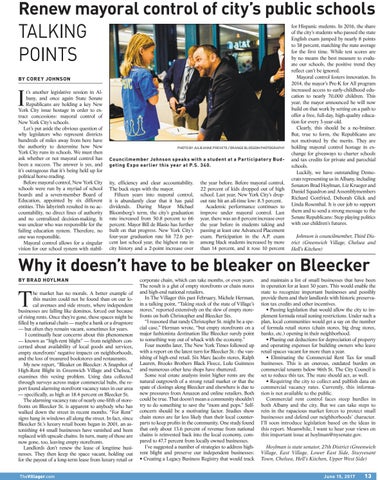
PHOTO BY JULIEANNE PREVETE / ORANGE BLOSSOM PHOTOGRAPHY
Councilmember Johnson speaks with a student at a Par ticipator y Budgeting Expo earlier this year at P.S. 340.
ity, efficiency and clear accountability. The buck stops with the mayor. Fifteen years into mayoral control, it is abundantly clear that it has paid dividends. During Mayor Michael Bloomberg’s term, the city’s graduation rate increased from 50.8 percent to 66 percent. Mayor Bill de Blasio has further built on that progress. New York City’s four-year graduation rate hit 72.6 percent last school year, the highest rate in city history and a 2-point increase over
the year before. Before mayoral control, 22 percent of kids dropped out of high school. Last year, New York City’s dropout rate hit an all-time low: 8.5 percent. Academic performance continues to improve under mayoral control. Last year, there was an 8 percent increase over the year before in students taking and passing at least one Advanced Placement exam. Participation in the A.P. exam among black students increased by more than 14 percent, and it rose 10 percent
for Hispanic students. In 2016, the share of the city’s students who passed the state English exam jumped by nearly 8 points to 38 percent, matching the state average for the first time. While test scores are by no means the best measure to evaluate our schools, the positive trend they reflect can’t be ignored. Mayoral control fosters innovation. In 2014, the mayor’s Pre-K for All program increased access to early-childhood education to nearly 70,000 children. This year, the mayor announced he will now build on that work by setting on a path to offer a free, full-day, high-quality education for every 3-year-old. Clearly, this should be a no-brainer. But, true to form, the Republicans are not motivated by the merits. They are holding mayoral control hostage in exchange for giveaways to charter schools and tax credits for private and parochial schools. Luckily, we have outstanding Democrats representing us in Albany, including Senators Brad Hoylman, Liz Krueger and Daniel Squadron and Assemblymembers Richard Gottfried, Deborah Glick and Linda Rosenthal. It is our job to support them and to send a strong message to the Senate Republicans: Stop playing politics with our children’s futures. Johnson is councilmember, Third District (Greenwich Village, Chelsea and Hell’s Kitchen)
Why it doesn’t have to be bleaker on Bleecker BY BR AD HOYLMAN
T
he market has no morals. A better example of this maxim could not be found than on our local avenues and side streets, where independent businesses are falling like dominos, forced out because of rising rents. Once they’re gone, these spaces might be filled by a national chain — maybe a bank or a drugstore — but often they remain vacant, sometimes for years. I continually hear concerns about this phenomenon — known as “high-rent blight” — from neighbors concerned about availability of local goods and services, empty storefronts’ negative impacts on neighborhoods, and the loss of treasured bookstores and restaurants. My new report, “Bleaker on Bleecker: A Snapshot of High-Rent Blight in Greenwich Village and Chelsea,” examines this vexing problem. Using data collected through surveys across major commercial hubs, the report found alarming storefront vacancy rates in our area — specifically, as high as 18.4 percent on Bleecker St. The alarming vacancy rate of nearly one-fifth of storefronts on Bleecker St. is apparent to anybody who has walked down the street in recent months. “For Rent” signs hang in windows all along the street. In fact, since Bleecker St.’s luxury retail boom began in 2001, an astonishing 44 small businesses have vanished and been replaced with upscale chains. In turn, many of those are now gone, too, leaving empty storefronts. Landlords don’t renew the lease of longtime businesses. They then keep the space vacant, holding out for the payout of a long-term lease from luxury retail or TheVillager.com
corporate chain, which can take months, or even years. The result is a glut of empty storefronts or chain stores and high-end national retailers. In The Villager this past February, Michele Herman, in a talking point, “Taking stock of the state of Village’s stores,” reported extensively on the slew of empty storefronts on both Christopher and Bleecker Sts. “I reasoned that randy Christopher St. might be a special case,” Herman wrote, “but empty storefronts on a major fashionista destination like Bleecker surely point to something way out of whack with the economy.” Four months later, The New York Times followed up with a report on the latest turn for Bleecker St.: the vanishing of high-end retail. Six Marc Jacobs stores, Ralph Lauren, Brooks Brothers Black Fleece, Lulu Guinness and numerous other luxe shops have shuttered. Some real estate analysts insist higher rents are the natural outgrowth of a strong retail market or that the spate of closings along Bleecker and elsewhere is due to new pressures from Amazon and online retailers. Both could be true. That doesn’t mean a community shouldn’t try to do something to save the “mom and pops.” Selfconcern should be a motivating factor. Studies show chain stores are far less likely than their local counterparts to keep profits in the community. One study found that only about 13.6 percent of revenue from national chains is reinvested back into the local economy, compared to 47.7 percent from locally owned businesses. I’ve suggested a number of strategies to address highrent blight and preserve our independent businesses: • Creating a Legacy Business Registry that would track
and maintain a list of small businesses that have been in operation for at least 30 years. This would enable the state to recognize important businesses and possibly provide them and their landlords with historic preservation tax credits and other incentives. • Passing legislation that would allow the city to implement formula retail zoning restrictions. Under such a plan, local communities would get a say on the number of formula retail stores (chain stores, big drug stores, banks, etc.) opening in their neighborhood. • Phasing out deductions for depreciation of property and operating expenses for building owners who leave retail spaces vacant for more than a year. • Eliminating the Commercial Rent Tax for small businesses. This is an onerous, outdated burden on commercial tenants below 96th St. The City Council is set to reduce this tax. The state should act, as well. • Requiring the city to collect and publish data on commercial vacancy rates. Currently, this information is not available to the public. Commercial rent control faces steep hurdles in both Albany and the city. But we can take steps to rein in the rapacious market forces to protect small businesses and defend our neighborhoods’ character. I’ll soon introduce legislation based on the ideas in this report. Meanwhile, I want to hear your views on this important issue at hoylman@nysenate.gov. Hoylman is state senator, 27th District (Greenwich Village, East Village, Lower East Side, Stuyvesant Town, Chelsea, Hell’s Kitchen, Upper West Side)
June 15, 2017
13
PHOTOS BY TEQUILA MINSKY
Flashback to the 1950s and heroic moms’ protest It looked like 1958, as Jane Jacobs’s “Stroller Brigade” invaded Washington Square Park once again last week as they prepared to protest Rober t Moses’ plan to run a sunken roadway through the park. It was actually for an episode of the Amazon series “The Mar velous Mrs. Maisel,” about a woman with a staid Upper East Side life who gets adventurous and becomes a stand-up comic in Greenwich Village.
14
June 15, 2017
TheVillager.com
Do It Again A bright book and solid arc give ‘Groundhog’ loopy appeal
Photos by Joan Marcus
Andy Karl, center, and the cast of “Groundhog Day.”
BY CHRISTOPHER BYRNE It seems like I never see the movies inspiring musicals these days, so I upon “Groundhog Day: The Musical” as a complete tabula rasa. With a book by Danny Rubin and music and lyrics by Tim Minchin (of “Matilda”), the result is one of the most delightfully diverting shows to hit Broadway in a while. Phil Connors, a disgruntled local weatherman has been assigned to go to Punxsutawney, Pennsylvania, to cover the groundhog. He’d rather chew glass and makes no bones about it. Stranded by a blizzard, he has to spend the night with his crew and wakes up to February 2 again and again. You can see the plot coming from as far away as Philadelphia, and Connors can’t get out of this incessant loop until he learns his lesson and becomes a nice guy. While that might sound like a nightmare for the audience as well as Connors, the bright book has a solid arc that sparkles with heart and hilarity. It’s so much fun to watch the loathsome Connors turn into a romantic leading man, even though you know that’s where it’s going. Andy Karl’s phenomenal performance as Connors, even with his leg in a brace after an injury that forced some early performances to be canceled, is the centerpiece of this show. Since his days in TheVillager.com
“Altar Boyz,” Karl has had an unmistakable magnetism on stage, and he channels all that talent into this role. Great as he is, he’s also got terrific material to work with. Minchin’s music and lyrics are delightfully mordant, revealing a dark worldview even when they’re bouncy, and make this a decidedly sophisticated and grown-up show. Matthew Warchus’ direction is masterfully comic without avoiding the human side of the characters, and Peter Darling’s choreography is perfect for the tone of the show, as it was in “Matilda.” The rest of the tireless company is top-notch, especially Barrett Doss as the fledgling producer who has to deal with Connors throughout the day’s innumerable iterations. Doss manages to be jejune and tough at the same time, and her voice is outstanding. This is easily the happiest, most tightly crafted large-scale musical on the boards right now. I’d be happy to see it — wait for it — again and again. At The August Wilson Theatre (245 W. 52nd St., btw. Broadway & Eighth Ave.). Tues., Thurs. at 7pm; Wed., Fri.– Sat. at 8pm; Wed., Sat. at 2pm; Sun. at 3pm. For tickets ($79–$249), visit ticketmaster.com or call 800-653-8000. Runtime: 2 hrs., 30 mins., with intermission.
L to R: Andy Karl and Barrett Doss in Danny Rubin and Tim Minchin’s “Groundhog Day,” directed by Matthew Warchus.
June 15, 2017
15
Just Do Art BY SCOTT STIFFLER
R2R: RIVER TO RIVER FESTIVAL As reliable as the tide but considerably less predictable, a deep dive into the sheer volume of events scheduled for the Lower Manhattan Cultural Council’s River to River Festival will leave your head swimming with ways to soak in this annual genre-blurring, boundary-bursting celebration of dance, music, theater, and visual art. Offering 100+ performances and events at 31 indoor and outdoor sites spread across Lower Manhattan and Governors Island, this year’s R2R artists have a hunger for exploring uncharted waters that befits the festival’s waterfront setting. Here’s a modest sampling of what the schedule boasts. Choreographing events that meld the “social nature of dance, the charge of a party, and the sharpness of a music video” to create a “fresh dance vocabulary that any Joe can get down with” is the promising premise of immersive events hosted by The Dance Cartel. With guest DJs in tow and audience participation on tap, they’ll take over Pier A’s Harbor House twice, on June 21 and 25. The Winter Garden at Brookfield Place is the site-specific setting for “Harbored” (June 22-25). Dramatizing the ups and downs of the American dream as experienced by immigrants during a two-century span, En Garde Arts’ return to “civic spectacle” is an epic mix of oral histories, dance, poetry, and music. Brooklyn-based visual artist Kamau Ware’s “Black Gotham Experience” has the Seaport District’s 192 Front Street as its central hub throughout the festival, with satellite programs and projects featuring art, music, performance, walking tours, and a graphic novel. From 4-8pm on June 20, Night at the Museums happens at 15 of Downtown’s most culturally significant destinations. You’ll get
Photo by Jenny Rubin
Photo courtesy the artists
In a smooth move groove: The Dance Cartel floors it at Harbor House, June 21 and 25, as part of the River to River Festival.
Courtesy Barbara Rachko Studio
Get the inside scoop on their creative process, and scoop up some of their work, during your June 17 and 18 West Chelsea Artists Open Studios self-guided tour.
access to special programming, tours, and all of the stunning stuff you normally find by visiting the likes of Poets House, China Institute, The Skyscraper Museum, the Museum of Jewish Heritage, South Street Seaport Museum, the National Museum of the American Indian, and more (nine more, in fact). All events are free. Through June
Mary V
Nowhere Man
410 [Gone]
by: Rebekah Carrow Directed by: Charlotte Murray
by: Claude Solnik Directed by: Donna Mejia
by:
Performances: Thurs. - Sat. 8PM Sun. 3PM
Performances: Thurs. - Sat. 8PM Sun. 3PM
June 15, 2017
$14 organic smoothies, while occasionally favoring us with her earnest if not exactly chapbook-worthy poetry. Like the nachos Molly consumes with reckless abandon, you’ll soon find yourself acquiring a taste for that poetry, and going all bullish on this daffy and defiant dyke. “Mullet” shares the evening with the improv troupe “It’s A Good Thing You’re Pretty” and solo comedy from double minority (gay, Mohawk) T. Leclaire. Sat., June 17, 7pm at the Peoples Improv Theater (aka PIT; 123 E. 24 St., btw. Park & Lexington Aves.). Tickets ($10) at the door or via thepit-nyc.com. Contact the PIT at 212-563-7488.
WEST CHELSEA ARTISTS OPEN STUDIOS
Theater for the New City • 155 1st Avenue at E. 10th St. Reservations & Info (212) 254-1109 For more info, please visit www.theaterforthenewcity.net
16
No bull: Molly “Equality” Dykeman brings her brand of mullet-powered comedy to the QueerCom fest on June 17.
Frances Ya- Chu Chowhig
Directed by: Chongren Fan Performances: Weds. - Sat. 8PM Sun. 3PM
25 at sites across Lower Manhattan and Governors Island. Visit rivertorivernyc.com.
“POWER TO THE MULLET!” Her love of the ladies matched only by her capacity for cluelessness, compassion, and anything-goes substance abuse, we last saw Molly “Equality” Dykeman in the 2016 FringeNYC show “A Microwaved Burrito Filled With E. coli” — in which she and an equally irrepressible trans waitress commiserated when Molly was booted out of a lesbian wedding reception for rowdy behavior. Now, the ballsy and occasionally bitter bestie of underdogs everywhere (seven hours sober and counting!) returns for one hell of a night only, on a triple bill that’s part of the QueerCom festival. “Power to the Mullet!” finds Molly (an improv-curious sketch comedy creation of the voraciously versatile Andrea Alton) tackling abominations like our “big orange Cheeto head” president and
Step into their minds by walking through their doors, by taking this selfguided tour that gives you access to over 30 artists located in buildings throughout the West Chelsea area. More than just an opportunity to browse, this annual event provides a rare chance to engage artists in conversation and, as a result, learn about what sets their chosen medium apart, and why they chose that particular style of expression. Haggling might even be part of that dialogue — but be gentle, kind patron of the arts, because the very fact you’re on their home turf means the price you pay to walk away with a oneof-a-kind creation won’t include a gallery markup fee (which can be 50 percent or more). Free. 12-6pm Sat., June 17 and Sun., June 18. The self-guided tour starts at the West Chelsea Arts building lobbies (508526 W. 26th St., btw. 10th & 11th Aves.), where visitors can pick up tour maps. Maps are also available at co-sponsor Blick Art Materials locations (among them, 237 W. 23rd St., btw. Seventh & Eighth Aves.) and 650 Sixth Ave., at W. 20th St.). Visit westchelseaartists.com for a list of participating artists. TheVillager.com
Buhmann on Art Florine Stettheimer at the Jewish Museum BY STEPHANIE BUHMANN Marking the first major solo exhibition for the artist in over 20 years, “Florine Stettheimer: Painting Poetry” promises to help re-evaluate this great modernist’s importance. No less than 50 paintings, drawings, costume and theater designs, photographs, and ephemera will offer thorough insight into Stettheimer’s impressively eclectic output, which she delivered with an unusual mélange of whimsy and sharp satirical wit. Born into a wealthy Jewish family in Rochester, New York, Stettheimer (18711944) studied at the Art Students League in New York City before heading to Europe. While there, she encountered perhaps her most significant influences: the Symbolist painters and poets, as well as the Ballets Russes. When Stettheimer returned to New York at the beginning of World War I in 1914, she was already in her mid-40s. Though Stettheimer regularly accepted invitations to show her paintings at Whitney Annuals and Courtesy MoMA/SCALA/Art Resource, NY Carnegie Internationals, she only agreed Florine Stettheimer: “Euridice and her Snake,” a costume deCourtesy Yale University Art Gallery, New Haven to one commercial solo show at Knoedler sign for the artist’s ballet “Orphée of the Quat-z-arts ” (1912. Oil, Florine Stettheimer: “Christmas” (1930-1940. Oil on canvas, 60 1/16 x 40 in.). beads, metal lace on canvas. 18 5/8 x 15 1⁄8 in.). Gallery in 1916. When the latter proved unsuccessful, her sisters and mother offered an alternative by establishing an elite salon that attracted many of the leading avant-garde artists of the time, including Marcel Duchamp and Georgia O’Keeffe. In the following years, Stettheimer would continue to depict aspects of her social and intellectual environment but refused any other gallery shows. Instead, she preferred to unveil new paintings to select friends in her studio overlooking Bryant Park. Painting life between the Gilded Age and the Jazz Age, Stettheimer’s work reflects a fastchanging world, in which the emancipation of women was one major achievement. Luckily, her family ignored Stettheimer’s final wish, which stipulated that her art should be destroyed after her death. Through Sept. 24 at the Jewish Museum (1109 Fifth Ave., at 92nd St.). Gallery Hours: Sun.–Tues. and Fri.– Sat., 11am–5:45pm; Thurs., 11am– 8pm. Admission: Adults, $15; seniors 65+, $12; students, $7.50; free for ages 18 and under. Thurs., 5–8pm, pay-whatCourtesy collection of Halley K. Harrisburg and Michael Rosenfeld, New York you-wish. Call 212-423-3271 or visit thejewishmuseum.org. Florine Stettheimer: “Asbury Park South” (1920. Oil on canvas. 50 x 60 in.). TheVillager.com
June 15, 2017
17
18
June 15, 2017
TheVillager.com
READY, SET, SUBSCRIBE! PHOTOS BY BOB KRASNER
Reza from Brooklyn, left, and Iv y from New Jersey get “dressed up� in Tompkins Square Park for the Body Pride Parade.
Fleshing out Body Pride call to subscribe
In a way, the small but enthusiastic crowd that gathered at Tompkins Square Park on Saturday was “dressed up� for the Body Pride Parade. Body paint, alien-head pasties, bright pink underwear and a leather jockstrap (and, we hope, some strong sunscreen) were a few of the ways that the participants chose to adorn their semi-
nakedness. The organizers proclaimed on their Facebook page that, “The Body Pride Parade is for all those who have a body and are not afraid to show it.� The diverse group marched proudly from the East Village to Washington Square Park, holding signs that proclaimed, “Love Your Body� and, more specifically, “Love Yer Booty.�
MAIL TO: One Metrotech North, 10th oor • Brooklyn, NY 11201 YES! I want to receive The Villager every week of the year.
CHECK ONE:
New Subscription
Renewal
(New Subscription $29•Renewal $24, for 52 weeks, by check or credit card, will be added to your current subscription)
Name: Address: Zip Code: City: State: Email: Phone: Card Type: [ ] Visa [ ] Mastercard [ ] Amex [ ] Discover Card Holder’s Signature: Credit Card Number: Exp. Date: Security Code:
TheVillager.com
Staying cool in Tompkins Square Park at the star t of the Body Pride Parade.
READ THE VILLAGER! June 15, 2017
19
! @ # "
20
June 15, 2017
TheVillager.com
! @ # "
To Advertise Here Call: 646-452-2490 TheVillager.com
June 15, 2017
21
Health forum helps seniors to ‘trump’ stress
PHOTO BY SCOTT R. AXELROD
At the Sixth Annual Communit y Health Forum, from left, Sara Vogeler; Lynne Brown; Emma DeVito, Village Care president and C.E.O.; Dr. Jonathan Whiteson; Elizabeth Butson; Dr. Tara Cor tes; Dr. Suzanne Steinbaum, and Dr. Max Gomez.
BY SCOTT R. A XELROD
M
ore than 200 senior citizens gathered at New York University’s Kimmel Center, on Washington Square South, for some hearty health advice, plus a light lunch, at the sixth annual Take Charge of Your Health Today! free community health forum and expo on June 7. The event was cosponsored by the N.Y.U. Office of Civic Engagement and VillageCare. Dr. Max Gomez, the Emmy awardwinning CBS television medical reporter, returned for his sixth stint as moderator, administering a healthy dose of humor, while stressing the importance of this year’s theme: “Stress Less and Living Well.” “After a certain age, if you wake up in the morning and something doesn’t hurt, it’s because you’re dead,” Gomez joked. “So look at it as a good thing. It doesn’t mean it’s all over, it just means I’m alive and I’m going to keep going.” Lynne Brown, N.Y.U.’s senior vice president, noted the large turnout and the timeliness of the event’s theme. “I don’t know if the organizers pick these topics way ahead of time, but 2016 turned out to be a stressful year,” Brown said. Elizabeth Butson, the event’s chairperson and a member of the VillageCare board of directors, offered a more politically pointed reason for the topic of the day. “This year the choice was obvious —
22
June 15, 2017
Sarah Vogeler of The Neuromuscular Center Inc. per forms massage on an attendee at the health forum.
stress happens,” Butson said. “No one was prepared for the stress and insanity that hit us the week leading to the presidential election and the post-election week. Some families did not attend family dinners, so they did not get into fierce arguments with family members. Psychotherapists cried, places were crowded, and healthcare worried everybody.” Milling about the spacious tenth-floor Rosenthal Pavilion — with its picturesque view of Lower Manhattan — attendees sat for complimentary blood pressure and
blood glucose tests, while others lined up to lie down for massages. Tote bags brimming with an assortment of pamphlets and promotional tchotchkes vied for table space and seats — including complimentary issues of and subscriptions to The Villager, the event’s media sponsor. Back in their seats, the audience members sat listening raptly to the five guest panelists, who each spoke about how they’ve found stress to be prevalent in all of their areas of specialty, and offered strategies on how to minimize it, spe-
cifically, in situations that can’t be controlled. “The week before the election, week of the election, and week after, I ran out of [heart] monitors in my office,” Dr. Susan Steinbaum, director of women’s heart health at Lennox Hill Hospital said. “All of my women patients were coming in with palpitations,” she added, unable to avoid connecting the current political climate with peoples’ mental and physical well-being. Dr. Jonathan Whiteson, director of cardiopulmonary rehabilitation at N.Y.U. Langone Medical Center, Rusk Rehabilitation, spoke at length about the beneficial effects on mood and anxiety of exercise and movement — from yoga, running and hiking to tai chi and dancing. “I love to dance,” Whiteson said. “I dance at home and embarrass my kids. It’s so much fun. You can do Zumba, the foxtrot, whatever — but do it. And while Whiteson didn’t bust out any special moves for the occasion, Sara K. Vogeler, founder and director of The NeuroMuscular Center, Inc., literally brought the crowd to its feet. Channeling Richard Simmons, Vogeler stepped off the stage to lead the room through a spirited medley of wiggles, twists, claps, shouts and breathing exercises, before seguing into a hands-on aroma-therapy relaxation presentation. “You have let the Grinch go,” Vogeler insisted. “That’s the topic, and that’s what we just did. We let the tension go, and that’s the Grinch.” TheVillager.com
READY, SET, SUBSCRIBE!
MAIL TO: One Metrotech Ctr North, 10th floor • Brooklyn, NY 11201
1SZSP`ObS
YES! I want to receive The Villager every week of the year.
CHECK ONE:
New Subscription
Renewal
(New Subscription $29•Renewal $24, for 52 weeks, by check or credit card, will be added to your current subscription)
Name: Address: City: State: Zip Code: Email: Phone: Card Type: [ ] Visa [ ] Mastercard [ ] Amex [ ] Discover Card Holder’s Signature: Credit Card Number: Exp. Date: Security Code:
call ûõüĘöúôĘöùõú to subscribe
THE NEW SOUND OF
BROOKLYN
E7< D7> 53<3@/: /2;7AA7=<A B7193BA
The Community News Group is proud to introduce BROOKLYN PAPER RADIO. Join Brooklyn Paper Editor-in-Chief Vince DiMiceli and the New York Daily News’ Gersh Kuntzman every Tuesday at 2:00 for an hour of talk on topics Brooklynites hold dear. Each show will feature instudio guests and call-out segments, and can be listened to live or played anytime at your convenience.
WITH
SPONSORED BY
JOSEPH LICHTER, D.D.S.
VINCE DIMICELI
GERSH KUNTZMAN
LISTEN EVERY TUESDAY AT 2:00PM ON BrooklynPaper.com/radio TheVillager.com
Â’ D7> @]]Tb]^ >O`bg Â’ BSOhS Â’ >`WRS 7aZO\R Â’ ;O`QV @SdWSeW\U AbO\R B] S\bS`( 5Og1Wbg<Sea \gQ >`WRSBWf % June 15, 2017
23
ADVERTORIAL
TOP DRIVER DISTRACTIONS Using mobile phones
Leading the list of the top distractions behind the wheel are mobile phones. Phones now do more than just place calls, and drivers often cannot pull away from their phones, even when driving. According to the California Department of Motor Vehicles, studies have shown that driving performance is lowered and the level of distraction is higher for drivers who are heavily engaged in cell
24
June 15, 2017
phone conversations. The use of a hands-free device does not lower distraction levels. The percentage of vehicle crashes and nearcrashes attributed to dialing is nearly identical to the number associated with talking or listening.
Daydreaming
Many people will admit to daydreaming behind the wheel or looking at a person or object outside of the car for too long. Per-
haps they’re checking out a house in a new neighborhood or thought they saw someone they knew on the street corner. It can be easy to veer into the direction your eyes are focused, causing an accident. In addition to trying to stay focused on the road, some drivers prefer the help of lane departure warning systems.
Eating
Those who haven’t quite mastered walking and
chewing gum at the same time may want to avoid eating while driving. The majority of foods require a person’s hands to be taken off of the wheel and their eyes to be diverted from the road. Reaching in the back seat to share some French fries with the kids is also distracting. Try to eat meals before getting in the car. For those who must snack while en route, take a moment to pull over at
a rest area and spend 10 minutes snacking there before resuming the trip.
Reading
Glancing at an advertisement, updating a Facebook status or reading a book are all activities that should be avoided when driving. Even pouring over a traffic map or consulting the digital display of a GPS system can be distracting.
TheVillager.com