CIVIL RIGHTS
Unprecedented Ruling Favors Anti-Gay Baker California judge departs from consensus about nondiscrimination protections for same-sex couples BY ARTHUR S. LEONARD
B
reaking the consensus among courts developed over the past several years that people with religious or moral objections to same-sex weddings are not entitled to exempt their business from selling goods or services for such events, a California Superior Court judge has ruled that a baker has a First Amendment exemption from complying with that state’s law banning sexual orientation discrimination by businesses. Judge David Lampe, who ruled in a February 5 decision in favor of Cathy Miller, owner of Tastries Bakery in Bakersfield, was the first judge to find for a business in such a case. Miller refused to make a wedding cake for Eileen and Mireya Rodriguez-Del Rio, who came to her bakery in August 2017 to plan for their October wedding celebration. The couple selected a design of a cake in the display case, which they wanted Miller to prepare specifically for their event. “The couple did not want or request any written words or messages on the cake,” wrote the judge in his opinion. Despite that fact, Miller told the women she had religious objections to same-sex marriage and offered to refer them to another bakery in town happy to make wedding cakes for lesbian and gay couples. The Rodriguez-Del Rios filed a complaint with the California Department of Fair Employment and Housing, charging Miller and her business with a violation of the Unruh Civil Rights Act, which prohibits discrimination by businesses. The department, in turn, filed suit against the bakery, asking the court to issue an injunction requiring that Miller’s business not refuse to make wedding cakes for samesex couples. Miller’s defense relied on two provisions of the US Constitution’s First Amendment, one forbidding laws that abridge freedom of speech and
6
FACEBOOK.COM
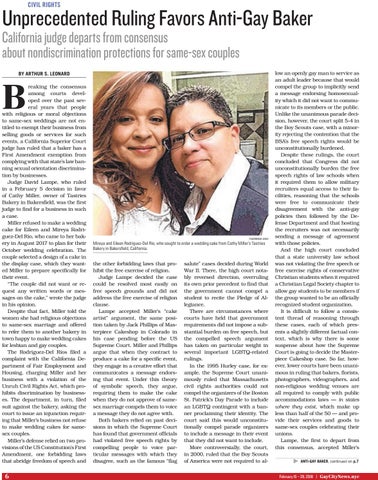
Mireya and Eileen Rodriguez-Del Rio, who sought to order a wedding cake from Cathy Miller’s Tastries Bakery in Bakersfield, California.
the other forbidding laws that prohibit the free exercise of religion. Judge Lampe decided the case could be resolved most easily on free speech grounds and did not address the free exercise of religion clause. Lampe accepted Miller’s “cake artist” argument, the same position taken by Jack Phillips of Masterpiece Cakeshop in Colorado in his case pending before the US Supreme Court. Miller and Phillips argue that when they contract to produce a cake for a specific event, they engage in a creative effort that communicates a message endorsing that event. Under this theory of symbolic speech, they argue, requiring them to make the cake when they do not approve of samesex marriage compels them to voice a message they do not agree with. Both bakers relied on past decisions in which the Supreme Court has found that government officials had violated free speech rights by compelling people to voice particular messages with which they disagree, such as the famous “flag
salute” cases decided during World War II. There, the high court notably reversed direction, overruling its own prior precedent to find that the government cannot compel a student to recite the Pledge of Allegiance. There are circumstances where courts have held that government requirements did not impose a substantial burden on free speech, but the compelled speech argument has taken on particular weight in several important LGBTQ-related rulings. In the 1995 Hurley case, for example, the Supreme Court unanimously ruled that Massachusetts civil rights authorities could not compel the organizers of the Boston St. Patrick’s Day Parade to include an LGBTQ contingent with a banner proclaiming their identity. The court said this would unconstitutionally compel parade organizers to include a message in their event that they did not want to include. More controversially, the court, in 2000, ruled that the Boy Scouts of America were not required to al-
low an openly gay man to service as an adult leader because that would compel the group to implicitly send a message endorsing homosexuality which it did not want to communicate to its members or the public. Unlike the unanimous parade decision, however, the court split 5-4 in the Boy Scouts case, with a minority rejecting the contention that the BSA’s free speech rights would be unconstitutionally burdened. Despite these rulings, the court concluded that Congress did not unconstitutionally burden the free speech rights of law schools when it required them to allow military recruiters equal access to their facilities, reasoning that the schools were free to communicate their disagreement with the anti-gay policies then followed by the Defense Department and that hosting the recruiters was not necessarily sending a message of agreement with those policies. And the high court concluded that a state university law school was not violating the free speech or free exercise rights of conservative Christian students when it required a Christian Legal Society chapter to allow gay students to be members if the group wanted to be an officially recognized student organization. It is difficult to follow a consistent thread of reasoning through these cases, each of which presents a slightly different factual context, which is why there is some suspense about how the Supreme Court is going to decide the Masterpiece Cakeshop case. So far, however, lower courts have been unanimous in ruling that bakers, florists, photographers, videographers, and non-religious wedding venues are all required to comply with public accommodations laws — in states where they exist, which make up less than half of the 50 — and provide their services and goods to same-sex couples celebrating their unions. Lampe, the first to depart from this consensus, accepted Miller’s
䉴
ANTI-GAY BAKER, continued on p.7
February 15 – 28, 2018 | GayCityNews.nyc