ENCAMPMENTS continued from p. 5
resigned themselves to the thought that this was all the world had to offer. What they didn’t know was they were floating in just a small part of a wide world of solutions. Even still, they could not see the possibilities beyond survival and their current limited circumstances. When I asked Cassandra and Chris, a couple from the encampment, if they had dreams, if they could have whatever they wanted, anything at all, what would they be doing now? Cassandra, with earnest contemplation answered, “A minimum wage job.” Chris, with proud ambition said, “I have this idea for a T-shirt.” I encouraged them to broaden their scope of possibility. I got them interested and it gave me some credibility. Now progress was paramount. They needed opportunities, extraordinary care, and individual attention to their particular needs. Finding services to match each case required research and networking. There was no one-size-fits-all solution. The various service providers — the city, not-for-profit groups, and faith-based homeless outreach services — had rules and requirements, some more stringent than others. Were they elderly? A veteran? An alcoholic? Were they having a gender crisis? Were they mentally challenged or depressed? Were they a transient or a victim of happenstance? How long have they been on the streets? Were they chronically homeless? I did the best I could to source a fix for their needs in the time that I had. Besides contacting city, not-for-profit, and church-based services, I had the
support of Inspector Russel J. Green of the NYPD’s Midtown South Precinct. Our network (in some cases) was able to confirm identities and clarify stories. Our diverse group was able to make more resources available, but more was still needed. We worked diligently to help those individuals find options outside their circumstances. Initially, the dynamics of the encampment escaped the naked eye. It continually morphed as various tenants came and went. Some were just passing through, while others were there for trade. Skirting the lines of homeless to sell drugs and bodies were easy reasoning for disbanding the camp, but in that you had to wonder where the dealers, users, prostitutes, and pimps might take their business. It was not our desire to move Paul and the others to another part of the city. We wanted to help resolve their issues and try and transition them to a healthier lifestyle. We worked to pull Michelle away from her pimp and our presence hampered drug sales. We focused on the encampment’s anchor, and watched for anyone wavering from their commitment to continue their camping adventure. As October 2016 approached, Mother Nature pitched in, the population thinned, and so did our patience. A date of action was set. We made regular visits to inform the group that we would be removing any items left on the sidewalk come the following Tuesday. The operation went well. With three volunteers to remove the collected items, outreach services to provide assistance to the remaining individuals, Midtown Precinct officers to tamp down any conflicts, and the sanitation department to pick up the considerable garbage,
we made the block a happier place and we like to think we were able to help a few homeless people in the process. The homeless condition begs for a cure. New York City, with an approximate 60,000 homeless, still leads our nation’s homeless population indices, with California a distant second. The housing, shelters, and day centers are near or at capacity. The badly managed and remote shelters cause many homeless to prefer the streets. Day spaces are fewer. We are in a crisis; before and through the 2016 homeless boom, funds were held up by political wrangling. Someone wanted something in return; a mix of developers and politicians were motivated less by the immediate needs of the homeless. While the squabbling for self-interest is leaving our brothers and sisters on pitted sidewalks, progressive waves are eroding ideas of old. “Social” and “restorative” justice are taking root. Inequality and its long-term impact are being understood. People are leaning towards the welfare of others. But still there is work to do. There still exists an unwillingness to accept change or impinge on a system that puts wealth, individualism, and success in the same sentence. This puts us at a pivotal point; a time for change. The answers are with the new wave of thinkers and doers, who are sifting through the subterfuges of life, throwing off prejudices, and questioning those who would strangle progress and defy logic to pursue selfish needs to the detriment of others. Our current administration knew better than to arrest homelessness away. Infringing upon their rights was not an option. Our societal problem can’t be ignored; shooing the homeless away, dis-
JAM continued from p. 18
and Clark Terry also appear. Beyond serving as a place for established jazz musicians to come together, Romance called the Monday night gathering “a good fraternity” to support local musicians — old, new, and in-between. For each jam, a different combination of musicians plays in the band, accompanying the vocalists and players who sign up to perform. Anyone who didn’t know otherwise, however, would think they were part of a regular band. The bandleaders lend their support to the “newbies,” as Feiler put it. JFA’s work to support jazz and blues musicians encompasses much more than the weekly jam though. Feiler explained how scarcity of work, low payment, and unreliable work add up to difficult fi nancial circumstances for many jazz players.
24
August 24, 2017
Photos by Nicole Javorsky
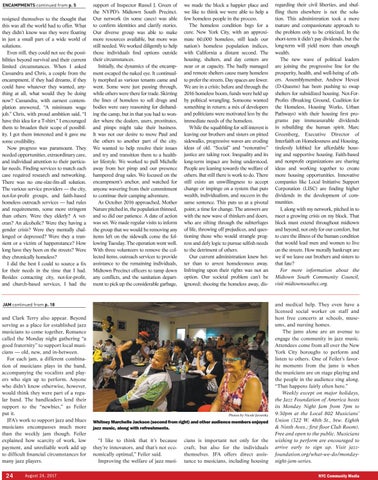
Whitney Marchelle Jackson (second from right) and other audience members enjoyed jazz music, along with refreshments.
“I like to think that it’s because they’re innovators, and that’s not economically optimal,” Feiler said. Improving the welfare of jazz musi-
cians is important not only for the craft, but also for the individuals themselves. JFA offers direct assistance to musicians, including housing
regarding their civil liberties, and shuffling them elsewhere is not the solution. This administration took a more mature and compassionate approach to the problem only to be criticized. In the short-term it didn’t pay dividends, but the long-term will yield more than enough wealth. The new wave of political leaders are joining the progressive line for the prosperity, health, and well-being of others. Assemblymember, Andrew Hevesi (D-Queens) has been pushing to swap shelters for subsidized housing. Not-ForProfits (Breaking Ground, Coalition for the Homeless, Housing Works, Urban Pathways) with their housing first programs pay immeasurable dividends in rebuilding the human spirit. Marc Greenberg, Executive Director of Interfaith on Homelessness and Housing, tirelessly lobbied for affordable housing and supportive housing. Faith-based and nonprofit organizations are sharing ideas and working together to create more housing opportunities. Innovative companies like Local Initiative Support Corporation (LISC) are finding higher dividends in the development of communities. I, along with my network, pitched in to meet a growing crisis on my block. That block must extend throughout midtown and beyond, not only for our comfort, but to cure the illness of the human condition that would lead men and women to live on the streets. How morally bankrupt are we if we leave our brothers and sisters to that fate? For more information about the Midtown South Community Council, visit midtownsouthcc.org.
and medical help. They even have a licensed social worker on staff and host free concerts at schools, museums, and nursing homes. The jams alone are an avenue to engage the community in jazz music. Attendees come from all over the New York City boroughs to perform and listen to others. One of Feiler’s favorite moments from the jams is when the musicians are on stage playing and the people in the audience sing along. “That happens fairly often here.” Weekly except on major holidays, the Jazz Foundation of America hosts its Monday Night Jam from 7pm to 9:30pm at the Local 802 Musicians’ Union (322 W. 48th St., btw. Eighth & Ninth Aves.; first floor Club Room). Free and open to the public. Musicians wishing to perform are encouraged to arrive early to sign up. Visit jazzfoundation.org/what-we-do/mondaynight-jam-series. NYC Community Media