28
November 13, 2013 | www.gaycitynews.com
FILM
The Ecstasy and Its Underbelly
Paolo Sorrentino remains one of Fellini’s faithful children BY STEVE ERICKSON
I
talian director Paolo Sorrentino doesn’t make films that are easy to warm up to. My favorite Sorrentino film, 2011’s “This Must Be the Place,” had me convinced it was a put-on for its first half hour. What else to make of a film about a Goth rocker, played by Sean Penn and obviously modeled on the Cure’s singer Robert Smith, turned
Directed by Paolo Sorrentino in Italian with English subtitles Janus Films Opens Nov. 15 Lincoln Plaza 1886 Broadway at 63rd St. lincolnplazacinema.com
Nazi hunter? Sorrentino’s films, however, have the courage of their convictions, strange as they might be, and “This Must Be the Place” eventually turns into a more imaginative Jewish revenge fantasy than Quentin Tarantino’s “Inglourious Baster ds.” The pr oblem with his new film, “The Great Beauty,” isn’t gratuitous weirdness or incongruities like asking us to take a 104-year old nun’s inane babble as spiritual wisdom. It’s that so much of this weirdness is second-hand. After writing one novel in his 20s, Jep Gambardella (Toni Servillo) found his creative well running dry and
c
BRITS, from p.27
men — Robert and Jerry are literary types — and the poet’s line, “cast a cold eye on life, on death,” would argue for the realist. Pinter is no slouch. The stellar cast is more than equal to the material. Rachel Weisz is complex and conflicted as Emma, who manages to be sympathetic even in her betrayals. Rafe Spall is outstanding as Jerry, the character most conflicted by the contradictory elements in his nature. Daniel Craig, the production’s crowd appeal, is extraordinary. The cold cynicism behind his charming nature and the conflict between his love for Emma and suppressed rage at Jerry are at first understated, but the power of his performance is in its subtlety. Robert is the kind of killer who waits as his victims exhaust themselves before
GIANNI FIORITO
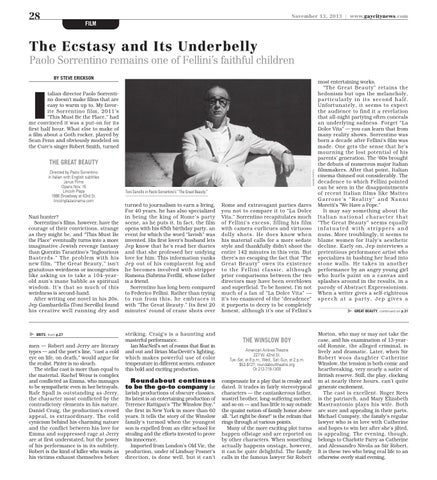
THE GREAT BEAUTY
Toni Servillo in Paolo Sorrentino’s “The Great Beauty.”
turned to journalism to earn a living. For 40 years, he has also specialized in being the king of Rome’s party scene, as he puts it. In fact, the film opens with his 65th birthday party, an event for which the word “lavish” was invented. His first lover’s husband lets Jep know that he’s read her diaries and that she professed her undying love for him. This information yanks Jep out of his complacent fog and he becomes involved with stripper Ramona (Sabrina Ferilli), whose father is a friend. Sorrentino has long been compared to Federico Fellini. Rather than trying to run fr om this, he embraces it with “The Great Beauty.” Its first 20 minutes’ round of crane shots over
striking. Craig’s is a haunting and masterful performance. Ian MacNeil’s set of rooms that float in and out and Brian MacDevitt’s lighting, which makes powerful use of color temperature in different scenes, enhance this bold and exciting production.
Roundabout continues to be the go-to company for
lavish productions of obscure classics. Its latest is an entertaining production of Terrence Rattigan’s “The Winslow Boy,” the first in New York in more than 60 years. It tells the story of the Winslow family’s turmoil when the youngest son is expelled from an elite school for stealing and the efforts invested to prove his innocence. Imported from London’s Old Vic, the production, under of Lindsay Posner’s direction, is done well, but it can’t
Rome and extravagant parties dares you not to compare it to “La Dolce Vita.” Sorrentino recapitulates much of Fellini’s excess, filling his film with camera curlicues and virtuoso d ol l y shots. H e d oes kno w whe n his material calls for a more sedate style and thankfully didn’t shoot the entire 142 minutes in this vein. But there’s no escaping the fact that “The Great Beauty” owes its existence to the Fellini classic, although prior comparisons between the two directors may have been overblown and superficial. To be honest, I’m not much of a fan of “La Dolce Vita” –– it’s too enamored of the “decadence” it purports to decry to be completely honest, although it’s one of Fellini’s
THE WINSLOW BOY American Airlines Theatre 227 W. 42nd St. Tue.-Sat. at 8 p.m.; Wed., Sat.-Sun. at 2 p.m. $52-$127; roundabouttheatre.org Or 212-719-1300
compensate for a play that is creaky and dated. It trades in fairly stereotypical characters — the cantankerous father, wastrel brother, long-suffering mother, and so on — and has little to say outside the quaint notion of family honor above all. “Let right be done!” is the refrain that rings through at various points. Many of the more exciting plot turns happen offstage and are reported on by other characters. When something actually happens onstage, however, it can be quite delightful. The family calls in the famous lawyer Sir Robert
most entertaining works. “The Great Beauty” retains the hedonism but ups the melancholy, particularly in its second half. Unfortunately, it seems to expect the audience to find it a revelation that all-night partying often conceals an underlying sadness. Forget “La Dolce Vita” –– you can learn that from many reality shows. Sorrentino was born a decade after Fellini’s film was made. One gets the sense that he’s mour ning the lost potential of his parents’ generation. The ‘60s brought the debuts of numerous major Italian filmmakers. After that point, Italian cinema thinned out considerably. The decadence to which Fellini pointed can be seen in the disappointments of recent Italian films like Matteo Garrone’s “Reality” and Nanni Moretti’s “We Have a Pope.” It may say something about the Italian national character that “The Great Beauty” seems equally infatuated with strippers and nuns. More troublingly, it seems to blame women for Italy’s aesthetic decline. Early on, Jep interviews a pretentious performance artist who specializes in bashing her head into stone walls. He takes in another performance by an angry young girl who hurls paint on a canvas and splashes around in the results, in a parody of Abstract Expressionism. When a writer gives a self-righteous speech at a party, Jep gives a
c
GREAT BEAUTY, continued on p.31
Morton, who may or may not take the case, and his examination of 13-yearold Ronnie, the alleged criminal, is lively and dramatic. Later, when Sir Robert woos daughter Catherine Winslow, the tension is both comic and heartbreaking, very nearly a satire of British reserve. Still, the play, clocking in at nearly three hours, can’t quite generate excitement. The cast is excellent. Roger Rees is the patriarch, and Mary Elizabeth Mastrantonio plays his wife. Both are sure and appealing in their parts. Michael Cumpsty, the family’s regular lawyer who is in love with Catherine and hopes to win her after she’s jilted, is appealing. The evening, though, belongs to Charlotte Parry as Catherine and Alessandro Nivola as Sir Robert. It is these two who bring real life to an otherwise overly staid evening.