4
August 7, 2013 | www.gaycitynews.com
INTERNATIONAL
With Russia as Target, Stoli is the Symbol
Protests against anti-gay crackdown at Consulate and Splash focus on imported vodka, 2014 Olympics BY PAUL SCHINDLER
GAY CITY NEWS
A
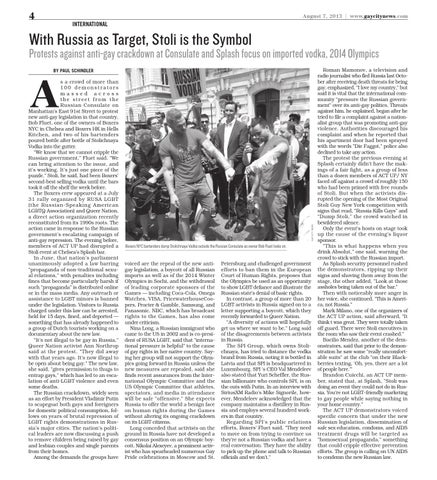
s a crowd of more than 100 demonstrators massed across the street from the Russian Consulate on Manhattan’s East 91st Street to protest new anti-gay legislation in that country, Bob Fluet, one of the owners of Boxers NYC in Chelsea and Boxers HK in Hells Kitchen, and two of his bartenders poured bottle after bottle of Stolichnaya Vodka into the gutter. “We know that we cannot cripple the Russian government,” Fluet said. “We can bring attention to the issue, and it’s working. It’s just one piece of the puzzle.” Stoli, he said, had been Boxers’ second-best selling vodka until the bars took it off the shelf the week before. The Boxers crew appeared at a July 31 rally organized by RUSA LGBT (the Russian-Speaking American LGBTQ Association) and Queer Nation, a direct action organization recently reconstituted from its 1990s roots. The action came in response to the Russian government’s escalating campaign of anti-gay repression. The evening before, members of ACT UP had disrupted a Stoli event at Chelsea’s Splash bar. In June, that nation’s parliament unanimously adopted a law barring “propaganda of non-traditional sexual relations,” with penalties including fines that become particularly harsh if such “propaganda” is distributed online or in the mass media. Any outreach or assistance to LGBT minors is banned under the legislation. Visitors to Russia charged under this law can be arrested, held for 15 days, fined, and deported — something that has already happened to a group of Dutch tourists working on a documentary about the new law. “It’s not illegal to be gay in Russia,” Queer Nation activist Ann Northrop said at the protest. “They did away with that years ago. It’s now illegal to be open about being gay.” The new law, she said, “gives permission to thugs to entrap gays,” which has led to an escalation of anti-LGBT violence and even some deaths. The Russian crackdown, widely seen as an effort by President Vladimir Putin to scapegoat both gays and foreigners for domestic political consumption, follows on years of brutal repression of LGBT rights demonstrations in Russia’s major cities. The nation’s political leaders are now discussing a push to remove children being raised by gay and lesbian couples and single parents from their homes. Among the demands the groups have
Boxers NYC bartenders dump Stolichnaya Vodka outside the Russian Consulate as owner Bob Fluet looks on.
voiced are the repeal of the new antigay legislation, a boycott of all Russian imports as well as of the 2014 Winter Olympics in Sochi, and the withdrawal of leading corporate sponsors of the Games — including Coca-Cola, Omega Watches, VISA, PricewaterhouseCoopers, Procter & Gamble, Samsung, and Panasonic. NBC, which has broadcast rights to the Games, has also come under criticism. Nina Long, a Russian immigrant who came to the US in 2002 and is co-president of RUSA LGBT, said that “international pressure is helpful” to the cause of gay rights in her native country. Saying her group will not support the Olympics going forward in Russia unless the new measures are repealed, said she finds recent assurances from the International Olympic Committee and the US Olympic Committee that athletes, spectators, and media in attendance will be safe “offensive.” She expects Russia to offer the world a benign face on human rights during the Games without altering its ongoing crackdown on its LGBT citizens. Long conceded that activists on the ground in Russia have not developed a consensus position on an Olympic boycott. Nikolai Alexeyev, a prominent activist who has spearheaded numerous Gay Pride celebrations in Moscow and St.
Petersburg and challenged government efforts to ban them in the European Court of Human Rights, proposes that the Olympics be used as an opportunity to show LGBT defiance and illustrate the Russian state’s denial of basic rights. In contrast, a group of more than 20 LGBT activists in Russia signed on to a letter supporting a boycott, which they recently forwarded to Queer Nation. “A diversity of actions will hopefully get us where we want to be,” Long said of the disagreements between activists in Russia. The SPI Group, which owns Stolichnaya, has tried to distance the vodka brand from Russia, noting it is bottled in Latvia and that SPI is headquartered in Luxembourg. SPI ‘s CEO Val Mendeleev also stated that Yuri Scheffler, the Russian billionaire who controls SPI, is on the outs with Putin. In an interview with SiriusXM Radio’s Mike Signorile, however, Mendeleev acknowledged that the company maintains a distillery in Russia and employs several hundred workers in that country. Regarding SPI’s public relations efforts, Boxers’ Fluet said, “They need to move on from trying to convince us they’re not a Russian vodka and have a real conversation. They have the ability to pick up the phone and talk to Russian officials and we don’t.”
Roman Mamonov, a television and radio journalist who fled Russia last October after receiving death threats for being gay, emphasized, “I love my country,” but said it is vital that the international community “pressure the Russian government” over its anti-gay politics. Threats against him, he explained, began after he tried to file a complaint against a nationalist group that was promoting anti-gay violence. Authorities discouraged his complaint and when he reported that his apartment door had been sprayed with the words “Die Faggot,” police also declined to take any action. The protest the previous evening at Splash certainly didn’t have the makings of a fair fight, as a group of less than a dozen members of ACT UP/ NY faced off against a crowd of roughly 150 who had been primed with free rounds of Stoli. But when the activists disrupted the opening of the Most Original Stoli Guy New York competition with signs that read, “Russia Kills Gays” and “Dump Stoli,” the crowd watched in bewildered silence. Only the event’s hosts on stage took up the cause of the evening’s liquor sponsor. “This is what happens when you drink Absolut,” one said, warning the crowd to stick with the Russian import. As Splash security personnel rushed the demonstrators, ripping up their signs and shoving them away from the stage, the other added, “Look at those assholes being taken out of the bar.” Then with noticeably more anger in her voice, she continued, “This is America, not Russia.” Mark Milano, one of the organizers of the ACT UP action, said afterward, “It think t was great. They were totally taken off guard. There were Stoli executives in the room who saw their event crashed.” Bacilio Mendez, another of the demonstrators, said that prior to the demonstration he saw some “really uncomfortable suits” at the club “on their Blackberries texting, ‘Oh, yes, there are a lot of people here.’” Brandon Cuicchi, an ACT UP member, stated that, at Splash, “Stoli was doing an event they could not do in Russia. You’re not LGBT-friendly marketing to gay people while saying nothing in your home country.” The ACT UP demonstrators voiced specific concern that under the new Russian legislation, dissemination of safe sex education, condoms, and AIDS treatment drugs will be targeted as “homosexual propaganda,” something that could cripple effective prevention efforts. The group is calling on UN AIDS to condemn the new Russian law.