Downtown Auroran an arts & culture magazine
Fall 2009 ~ INDUSTRIAL
THE COLLECTIONS AND SCULPTURE OF SOTERIOS GARDIAKOS Plus. . . • imaginative artist Maureen Gasek • parking problems? citizens answer! • poetry • recipe • photography • culture calendar
FREE
Downtown Auroran downtownauroran@gmail.com Marissa Amoni Publisher, Editor & Art Director
Samantha Oulavong
A turtle sunning itself on a rock in the Fox River, a barefoot man drying his socks on the picnic table at Broadway Avenue and Downer Place, jack hammering and trucks idling on Downer Place and River Street… These are the sights and sounds of downtown Aurora as I experienced them on a late Thursday morning towards the end of August.
I’m downtown nearly everyday mostly for two reasons: the Aurora Public Library and River’s Edge Café. But we also enjoy splashing in the fountains in the heat of the summer and treating ourselves to lunch at one of several yummy restaurants in the heart of downtown. This day, however, was different. I was downtown just to experience downtown. It was my birthday and I wanted to spend it walking around downtown Aurora while taking the cell phone walking tour. I was pretty excited when I came up with this birthday activity a few weeks prior, so I was equally bummed out when I woke up to rain that morning. Alas the rain stopped and my boyfriend and I headed out -- minus our three-year-old, but with umbrellas in hand. We drove downtown (a rarity, but didn’t want to be caught in the rain on our bikes) and parked right in front of the first tour stop – SciTech on Benton Street. Standing outside of SciTech, the old post office, I pulled out my cell phone and dialed the 11 digits printed in the architectural tour guide and waited in glee. Soon, a professionally recorded voice with the addition of clever sound effects transported me through historic downtown Aurora while pointing out impressive architectural features and facts related to more than a dozen downtown buildings. I was a tourist in my very own downtown. I loved it!
Kim Granholm Production Director Maggie Gibson Graphic Designer Susan Merriman Proofreader Ad Sales Team: Marissa Amoni & Melissa Stoneking On the Cover: Film projector owned by Soterios Gardiakos. Photo by Jennifer Tanner Trudo. Downtown Auroran (DTA) is a local independent operation. We are focused on the downtown and its success – especially the burgeoning arts and culture mo ve ment. Opi ni o ns are encouraged and expressed, but they are not necessarily those of DTA. Downtown Auroran is published quarterly, and 1500 copies are distributed free of charge throughout downtown and select locations in the Aurora area. One copy of DTA per person, please. Share it and recycle it.
P.S. I never have a problem parking downtown, albeit I am usually parking my bike at a bike rack. But when I do drive, I find parking to be plentiful. And I’m pretty sure that even if the Olympics were being held downtown Aurora, I could find a nice parallel parking spot on Benton Street east of the library. See pg. 11 for more opinions on parking.
The entire content of Downtown Auroran is copyrighted 2009. Please ask permission before reproducing any part of this publication. Join us on Facebook!
Editor’s note: The tour guide pamphlet titled “Architectural Tours” can be picked up at SciTech as well as the library, city hall and other downtown locations – or download it at www.auroradowntown.org. Allow one to two hours for a leisurely tour – it is self-guided so take your time.
Please support the businesses that support us. Keep it local!
2
Downtown Auroran
Fall 2009
index
features Bliss Woods by Karen Fullett-Christensen Mother’s Hand by Jo Fredell Higgins
c ove r s t o r y
Given by Revon Sims E, F, G by Rachel Storm
page
Auroran Words
4
DTA profile: Maureen Gasek
page
13
The Fascinating Machinery of Soterios Gardiakos
Artist Profile
By Marissa Amoni Soterios Gardiakos is a collector of things. Gardiakos is downtown to the core: eclectic, artsy and diverse. Prepare to be wowed as we peek inside the building he owns in downtown Aurora.
7-15 W. Downer The Sherer Building, built 1910
Historical Notes
page
15
page
9
Table of Contents 4 5 7 9
auroran words the ash tree the hughes review cover story
Fall 2009
11 citizen voices 12 downtown voices 13 artist profile
14 culture shock 15 historical notes 16 movie review & recipe
Downtown Auroran
17 book reviews 18 short story 19 submissions
3
Auroran Words E, F, G.
Mother's Hand
If there were dripping words I could tie up with string and hang one-by-one from the
Her hand is now bony and aged old. Her hand that fed me and taught me
ceiling, I would grab the ladder and make a day of it.
seems rather frail and yet sturdy.
And you'd still sit there poised as everYour brain would be crawling from your ears and under, but your shoelaces would have already imagined themselves the roots of trees. And I'd still laugh at your predicament-
Our hands fold into each other and mine keeps her warm. Like two identical cups,
And he'd come into this filthy room like a sudden clash of wicked thunder scolding you for not watching the weather channel and knowing what was to come. And you'd still die there, jerking and quivering like a fishYour canvas stretcher would carry you like some lazy Egyptian pharaoh over the emerald hills where Dorothy remembered she was homeless.
---
inside one another and holding each, a lifetime of memories. Her hand, my mother's hand, grows quiet as she sleeps.
---
Rachel Storm grew up in Aurora and now resides in Urbana, Illinois where she works as a program coordinator at U of I’s Women's Resources Center. Her writing takes on varied forms--from poetry to editorials--and she's been published in Soupy Stories and the Seminary Co-Op's Online Journal, as well as, Buzz Magazine and Montage Literary Arts Journal.
Jo Fredell Higgins is the author of four local photo
Given
Township Youth Commission. She has lived in Aurora
Reserve your questions and answers to what I am about to say. I have nothing left to give you, I've given it all away. I gave my virtue to a man, and now our souls are tied. Last night while my body rested my soul stayed up and cried. I gave my dreams to tomorrow, just trying to live for today. Not realizing the suffering, or the price I would have to pay.
history books including “Aurora.” She was chosen a YWCA Woman of Distinction in 2004. Jo is chair of the GAR Commission in Aurora and chair of the Aurora since 1971
I gave my children my resources, my energy and smile. I guess that is the sacrifice of raising up a child. I gave this paper my words for no one else to see. I have given so much of myself there is nothing left of me.
---
Revon (Yarbrough) Sims, 32, went to Bardwell, Gates and then on to Waldo M.S. and graduated from East Aurora in 1996. And says she is a Tomcat for life. She presently lives in Batavia with her two children Alan, 11, and Phillip, 8. Sims assists people with disabilities to live a fulfilling life at the Association for Individual Development in Aurora.
Bliss Woods Just before dusk the birds take command They reclaim the woods and call to each other Hidden but heard The forest is filled with their chirping and trilling The peeping of babies hungry for food And their mother’s return We walk on the path Taking note of the plants And the shifting of breezes Closing our eyes to conjure the spirits Of long-ago souls who settled this place Who planted their crops and cut down the trees Mowing the prairie, draining the marsh Now the grasses grow tall Jack-in-the pulpit and Solomon’s seal Carpet the floor Where once cabins stood Trillium, violets, ginger abound The meandering creek reshapes a landscape Where once ground was tilled And timber was felled Slowly restored - now we are guests Where once we were kings.
--Karen Fullett-Christensen is the downtown development director
Teresa Fiehn
for the City of Aurora, and the director of the Cultural Creatives
Teresa Fiehn grew up in Elgin and has lived in Aurora most of her adult life. She also answers to the name "Molly," her alter ego. Her most recent project is her Web site, www.MollyMonochrome.com, which serves the purpose of promoting her photographs and other artistic endeavors.
in downtown Aurora. She is the author of four poetry
4
Downtown Auroran
manuscripts: Alarms and Metaphors is her latest. She has two grown daughters and lives with her husband, Larry, in Aurora.
Summer 2009
The Ash Tree Reporting on the news and gossip in downtown Aurora
5.
4. 3. 2. 1.
Top five reasons why Diana Martinez resigned from the Paramount in July: Couldn’t get “Make it Big,” a Wham cover band, to commit to a 2012 performance Tired of circling Stolp Ave. for a parking spot Is now selling Tupperware with Dixie Just realized she is 2,000 miles away from the actual Hollywood Arachnophobia
In reality, Martinez resigned on July 31 from the Paramount Theatre, because as she says, she had a difference with the goals of the Aurora Civic Center Authority and Paramount boards. Martinez, who joined the Paramount in 2001, will be replaced on an interim basis by Civic Center Authority board member, Dick Hawks. Hawks is retired from the Chicago Mercantile Exchange. His wife, Arlene, is a retired East High drama teacher.
River’s Edge Café adjusted their hours to accommodate a “healthier” café business. The café opens on weekdays at 6:30 a.m. They are open until 3 p.m. Monday through Wednesday and until 10 p.m. on Thursday and Friday. Stop by some morning for an Aunt Babe’s muffin. Live entertainment on Friday nights!
is awesome and she is excited about the path her life is taking.
studios this summer. Professional photographer, Donnell Collins, taught a four-week session on how to manipulate a camera to get the best shot. And acclaimed artist, Cheryl Holz, instructed classes on collage and painting at Gallery 44.
Kona Café might be more than an attractive awning soon. Owner, Charlie Zine, is partnering with River Street Plaza developer, Joe Vantreese, to open the Polynesian Coffee House. Zine said that he’d like to open the café by summer’s end. Sightings indicate that the awning has been up since 2007.
Facebook is the place to be on the Web and Aurora’s downtown businesses are there! Do a quick search of your favorite downto wn hangouts (Paramount Theatre, The Riverfront Playhouse, Backthird Audio, etc.) and become a fan! Check out “City of Aurora, Illinois” and “Aurora Downtown” for great downtown photos and keep your Facebook home page full of A-town fun.
Annie Craig is opening a Yoga, Pilates, and "Hiptease" studio this fall in downtown Aurora on New York Street. Craig, the former Aurora Township Supervisor, hopes to start offering classes at Annie's Omtowne Fitness in October. She said the second story location across from Ballydoyle
Both an artist and a photographer offered classes at their downtown
The new River Breeze Lofts has their banner hung high at 60 S. River Street. The nine environmentally friendly apartments in the now-posh 100-yearold building are appearing very close to being move-in ready. Owner, Dan Hites, said many are already leased and construction is coming to an end.
Where in the world is the GAR Memorial Hall Soldier Sculpture? The 1877 Civil War soldier has been shipped to Forest Park, IL to be recast in bronze before returning to its lofty post at 23 E. Downer Place. The original statue will be refurbished as an interior display. The soldier restoration is estimated to cost $50,000. Donations are accepted online.
Get ready to wave to David Lewis, curator of the Aurora Regional Fire Museum, as he starts moving into the restored Holbrook Mill at 37 W. Benton Street in October. Please e-mail your reports to downtownauroran@gmail.com
coffee tea sandwiches soup & more
all homemade...all yummy!
18 W Downer Place ~ downtown Fall 2009
Downtown Auroran
5
Hours: Tues-Fri 10-5 Sat 9-1 Closed Sun & Mon or by appointment
6
Downtown Auroran
Fall 2009
The Hughes Review Do
you know any working musicians?
Ask them how they do it. You might hear one of a dozen different answers. What you won’t hear is a myth. When I was a kid, we had a great myth about how to make a living as a musician. It was called “getting discovered,” and it went like this: You got an awesome guitar, started an awesome band and played awesome sets at every bar in town. Eventually, a guy with shorter hair than you would hear one of your awesome sets and say, “You kids have talent!” Then the short-haired guy would handle your band’s marketing, distribution and recording costs for the rest of your life. He would put your band in music videos and on Tshirts. At the end of the myth, you died playing electric guitar in a hot tub full of champagne at age 97. This was the career model demonstrated in the 1996 film, “That Thing You Do,” in which The Wonders reach stardom in a matter of months. But in the real world, most musicians have a better chance of getting struck by lightning than they do of having this happen to them. “Getting discovered” made for good movies. But it didn’t make for good careers. (The lighting was probably healthier, too.) Over the last 20 years, there’s been a revolution in music. We have a new tool: computers. And a new myth about making it big: You record your own albums, design your own T-shirts, and market and distribute everything yourself over the Internet. You don’t need the short-haired guy – you are the short-haired guy! You are a one-person marketing machine! The fans come flocking and the e-checks roll in.
Most music-folk are discovering this new myth works about as often as the old one did. What happens is that ugly photos and badly recorded albums show up on 100 different Web sites. It makes for good blog posts. But it doesn’t make for good careers. Most of the musicians I know who’ve made a healthy life for themselves “doing music” have two things going for them. First, they’re diverse within their areas of strength. They write and record their own music – but they also play at weddings or in cover bands. They teach lessons. They compose 10-second background tracks for television. They do what they’re good at – in a dozen different ways. And they find others to do for them the things they’re not good at, whether it’s marketing, recording or Tshirt design. Second, the folks I know who are professional musicians have learned to treat it as a profession. They manage calendars and return phone calls. They do what they said they’d do, on time, every time. They’ve figured out how to give 20 lessons a week and play with three bands without dropping the ball. Because they’ve figured out that “doing music” for a living means treating it like a job. You get up every day and do your job, or you risk losing it. And who would want to get fired from the best job in the world? Benjie Hughes is the owner of Backthird Audio, a recording studio and wedding-music business at 67 S. Stolp Ave. He’s been wearing his hair short since 2004.
The steps are simple: buy a Mac, record an album, take some photos of yourself, then upload it all to MySpace, Facebook, Twitter, Typepad, Virb, Reverbnation, iTunes, Amazon and whatever cool new Web sites have come out since I wrote this column. Then sit back and watch what happens.
Self portrait by Steve Panella "I decided to have a neutral look to my face with eyes closed because I had seen another artist create portraits with eyes closed. For me it makes the viewer consider more of the color, technique and the features of the face in the painting. I didn't want the viewer to look too closely at the painted eyes for information." Steve Panella grew up on the west side of Aurora and returned home after living in Florida, New Mexico and California – followed everywhere by his beloved cat, Lulu. His passion for art dominated his life; he rented an artist’s loft at River Street and Downer Place in downtown Aurora. Before his death in the fall of 2008, Panella concentrated on capturing the body’s energies and spirituality. This issue of Downtown Auroran is dedicated to his memory.
Fall 2009
Downtown Auroran
7
Soterios Gardiakos Photos by Jennifer Tanner Trudo
8
Downtown Auroran
Fall 2009
Cover Story
The Fascinating Machinery of Soterios Gardiakos By Marissa Amoni - west of downtown
oterios Gardiakos owns a Kinetoscope 35mm S “spoolbank.” It is the oldest known Edison Kinetoscope projector in the world and uses a continuous loop of film wound on a spoolbank instead of reels of film. It is the first thing Gardiakos shows off once in his hidden by-appointment-only museum that houses an extensive movie projector collection. Gardiakos has more than 260 projectors, along with several film reels and other cinematic machinery. “I was born a collector,” said Gardiakos, 65, who also displays some of his vast collection of more than 11,000 cataloged classical Greek and Roman books on the shelves at 64 S. Water Street in downtown Aurora. Collecting is in Gardiakos’ blood. His mother collected kitchen paraphernalia and other miscellany and his father, a jeweler and watchmaker, had every kind of tool whether needed or not. Aside from collector, Gardiakos titles himself as sculptor, businessman and proud father. His world is an eclectic one - full of art and invention - and, luckily, he is more than happy to share his collections and creations with those who take an interest. 63 S. Broadway There aren’t posted hours at the art gallery at 63 S. Fall 2009
Broadway, which features the industrial sculptures by Gardiakos, and daughter Chryssa’s colorful punk paintings, but Gardiakos is eager and willing to guide the curious around the showroom of wood and metal sculptures. He bought the building that stretches back to 64 S. Water Street in 1992 for $90,000. “I love the building. I’ve never had so much space in my life,” Gardiakos said. He and his wife, Irlanda, also own a historic home on the neareast side of Aurora. Gardiakos was born in Greece and came to the United States with his family in 1952. In 1960, Gardiakos landed a job in Aurora selling magazine subscriptions. “I just fell in love with Aurora. I don’t know why,” he said. But other things called to him and Gardiakos settled in Chicago for several years with his wife and four children. While in Chicago, he started a publishing company, Obol International, which he sold in 2003. Fast food, though, is how Gardiakos has made a living since buying his first Burger King in Mundelein, IL in 1979. “Originally, I was going to be an artist,” said Gardiakos, who returned to Aurora in the early 1990s. “A lot of things just happen. I had a family that I had to feed.” He jokes that he has always liked the Whopper. Now, Gardiakos uses industrial materials (reclaimed metal, copper pipe, aluminum and wood) to create the sculptures he labels “industrial expressionism.” He doesn’t weld the metal, but rather uses industrial fasteners to bind the materials. The result is finely tuned geometric pieces that recall the sleek modern era of the mid-20th century.
Downtown Auroran
9
Cover Story Cont. Several of Gardiakos’ abstract works take on classical Greek names. Many others are untitled or titled “Alien Artifact.” “Roswell Alien Machine” and “Alien Wave Generator” are two of his larger, metal pieces that utilize machine parts. “I love machines,” said Gardiakos, who sees the irony in creating machine-like sculptures, when explaining, “Machines are supposed to do something, but *the sculptures+ don’t do anything.” Early in his life, Gardiakos was a tool and die apprentice – and that is how his love of machines was born. In the basement of his downtown building, this love is apparent. A large room resembles a machine shop with lathes, drills and worktables, along with scrap wood and metal parts. Gardiakos said his art is influenced by his affinity for science fiction, but said the creative process is a hard one to define. “You just have to start working,” he said. Gardiakos on his sculptures: “The shapes and forms of my art encompass both the feminine and masculine that exist universally within our earthly environment and also in the collective subconscious that binds us together.” Another room
Gardiakos’ large early film projector collection is one of the finest. It includes the Greek-made Rotoscope from 1898 and the only known first type of Bioscope made in New York City in 1897. A Selig Polyscope from Chicago circa 1906 is one of Gardiakos’ prized possessions. It is the only complete model known to exist. William Selig was a pioneer in the movie industry and started the movement to Hollywood, CA. “I do like to buy projectors with history,” said Gardiakos, who is now semi-retired. He has written 10 books on cinematic machinery; they can be downloaded for free and his collection can be viewed at www.bioscope.biz. From pre-cinema magic lanterns that show slides to Simplex early talkie projectors, Gardiakos takes his collection seriously and hopes that the public can enjoy the collection on a more permanent and regular basis at some point. “I’d like to have a museum get *the collection+ or a place in Aurora, but no one has shown any interest,” Gardiakos said. He has approached the city and SciTech about future possibilities for the collection. “It’s more than just a hobby. It is a serious thing,” he said.
Through Gardiakos’ downstairs machine shop and into a kind of staging room where some unfinished sculptures wait, there is another back room with a collection of scientific instruments, slides and film reels. Movies like Disney’s “Alice’s Eggplant” and reels of “Ulysses” are stacked on metal shelves that line the walls from floor to ceiling.
Newly opened on the west side!
In the center of the room are electronics and more projectors. Neatly organized old radios and speakers occupy shelf space at the rear of the storage room.
630-730-1029
Gardiakos collected electronics and cameras before he started his projector collection.
Yoga & Pilates 514 Terry Ave.
just south of Prairie St.
www.AuroraYogaCenter.com
“It was unusual how I got involved *with collecting projectors]. I was collecting cameras and I had a friend who knew someone selling a projector,” said Gardiakos, who purchased the “rusted junk pile” for $50. He ended up cleaning up the projector and restoring it on his own. A love of machines “They don’t make them the way they used to no matter what anybody says,” Gardiakos said as he walked from a Simplex projector to a KH17/600 Russian-built projector made from a pre-WWII German design.
10
Downtown Auroran
Fall 2009
Citizen Voices What do you think of parking downtown? Ma Zepeda Aurora resident and WCC student
Pam Abuhl Oswego resident
“I got a ticket for one minute (on an expired meter), so I park in the garage. It’s not bad. It’s better than getting a ticket for $5.” Zepeda said that as a Waubonsee student, she pays 85 cents a day to park in the parking garage on Downer.
“It’s tight. I didn’t even bother going down Downer. I don’t think it’s that easy to find spots all the time. I take the first spot, and then I walk a little bit to avoid having to circle (looking for a spot).”
Ciera Flowers Aurora resident and WCC student Judith Russell Oswego resident and mother
“It’s not all that great because people get tickets,” said Flowers, who parks in the parking garage at Stolp Avenue and Downer Place when she goes to classes at Waubonsee Community College.
“It’s always been easy for me – day or night,” said Russell, who frequently visits downtown Aurora with her two young daughters. “I love that you don’t have to pay after 5 p.m. and there is never anyone down here. Now that I know that we can park at the garage and have the library validate for free parking, I’m very happy,” she said.
Zechariah McGhee Aurora resident and musician “It is really easy for me to find something. If you know downtown Aurora, you work with the rotation (of when it’s busy and when it’s not) and you’ll be good. I like that you don’t have to pay after 5 p.m. – then you don’t have to worry about where you are parking. It gives you the opportunity to start your evening earlier.”
John Clark Owner of Wardell Art Glass Studio 28 S. Stolp Avenue “I think *parking+ is a problem. Depending on the time of day, there are times when the street is full. We’ve gotten savvy enough to tell people when to come – what hours of the day [are best for parking] and we warn people to feed the meters. We luckily don’t have that much demand on a daily basis due to our type of business, but there have been neighbors we’ve lost who were expecting more traffic.” Clark has been on Stolp Avenue for 13 years. He said the majority of parking issues occurs when there is an influx of students during certain times of the day, and with people who “hog meters,” including businesses. “I don’t know how it will be handled, but the truth is – it is a problem,” he said.
BRIAN J. HIPP
Located on the Fox River at Stolp Island
HIPP LAW OFFICE Attorney at Law
Sal Arenella 26 East Downer Place • Aurora, IL 60505 Eye Exams • Contact Lenses • 1-Hour Service • Designer Frames
20% off for downtown businesses
Fall 2009
1026 Prairie Aurora, IL 60506
Downtown Auroran
Phone 630-844-1234 630-631-5192 Fax 630-859-0205 Email bjhippx2@aol.com
11
Downtown Voices Downer bridges coming down Guest column by Dan Hites
It was
announced recently that the two
Downer Place bridges over the Fox River will be torn down and rebuilt (starting in the summer of 2011). Although this will result in many temporary problems for the businesses and building owners located on Downer between Broadway and River streets, even a quick glance at the structures will confirm the necessity for the project. This should be taken as an opportunity to enhance and revive not only the bridges, but also the whole of downtown. One of the problems in downtown is that all the east-west streets have been changed into one-ways. This was done to enhance the flow through, not to, the downtown, and encourages drivers to rush past the stores and businesses on their way to other destinations. Studies have shown that oneway streets are detrimental to retail businesses. Stores, restaurant, etc. need people to see them and pedestrians need to feel comfortable on a street; both are diminished by the rushing by of one-way traffic. During reconstruction, Benton Street will be temporarily changed back into a two-way street. Perhaps when the dust has settled it should remain as a twoway and Downer Place should also be converted back to a two-way. The return of Downer Place into a two-way could be part of a grand makeover. The majority of the road from Broadway to River will be torn up; sidewalks and gutters will be removed; and the street and bridges stripped to their essence. With a little more effort during reconstruction, Downer Place could be rebuilt as a beautiful boutique area. Pedestrian landscaping throughout these three blocks could make it the most enticing place to shop in Aurora. Imagine: curb bump-outs on both ends of the two bridges planted with trees and benches; planters and garden areas; wider sidewalks with small
12
cafes - a street designed for people, and not just cars. In the two years remaining before construction, the city could also finish the river walks on both sides of the west branch. This would help the businesses along the river to survive by allowing them to turn their back doors into their main entries. As part of the Elk Club’s renovation, the land along the river will be retained by the city in order to bring the river walk along that parcel’s riverbank. The northern parcel of the three parcels on the east bank already has the beginnings of a nice walkway, which could easily be incorporated into a simple river walk plan. The middle parcel has a parking lot and a weed infested strip along the river. Perhaps the city can buy or gain an easement to landscape the embankment and join the two segments. The west side would be more complicated but a bit more enjoyable for pedestrians. The west bank could have four segments. On the west side of the river along the school district building on the south there is already a wide cement sidewalk from the bridge that ends at a 15-foot drop into an overgrown lot. In the far corner of this jungle is an entry into a large hidden courtyard. The sidewalk could easily be reopened to use, leading to a suspended walkway over a natural “Eden,” currently the overgrown lot. The skywalk would allow pedestrians to look down into a nature preserve while observing the birds and other animals living in the trees. This is similar to a path that the Morton Arboretum has in the children’s section, which is a major attraction. The skywalk could cross this “Eden” on a diagonal and land at the opening of the hidden courtyard. With some sprucing up, the courtyard could be turned into a pleasant European-like strolling area. The complicated piece in all of this is how to access Downer Place and thereby connect to the new river walk currently being built on the other side of Downer. A long, halfempty building at 40 W. Downer Place blocks the way and several street-level spaces have been vacant for years. I would
Downtown Auroran
not be surprised if the building’s owners would be willing to lease out one storefront, which could be converted into a passageway and retail shop. Taken together (the rebuilding of the bridges, pedestrian landscaping of Downer Place, conversion back to two-way traffic and the completion of the river walk with the additional improvements suggested here) all would go a long way to reviving the downtown. Dan Hites owns the Metropolitan Business College complex at 14 W. Downer Place in downtown Aurora. Part of the complex is the Stolp Mill’s Dye House, the oldest structure in downtown Aurora, which serves as a residence for him and his wife, Oksana, and daughter, Vanessa. Recently, Hites converted the building at 60 S. River Street into ecofriendly high-end loft apartments. His home and the lofts were part of the Living Downtown tour in June.
5 hours Start at Downer Place & Stolp Avenue: 10 a.m. Grab a muffin at River’s Edge Café and fill your to-go mug with fair-trade coffee. 10:30 a.m. Cell phone walking tour 12 p.m. Downer Pl.: Enchiladas at Tecalitlan Restaurant or Galena Blvd.: Burrito at Julio’s Grill 1 p.m. Downer Pl.: See & shop Aurora Public Art Commission 2:30 p.m. Stolp Ave.: Wardell Stained Glass Studio 3 p.m. Cross the street and relax at Millennium Plaza overlooking the Fox River. * APAC is closed due to city layoffs. Contact the city for more info.
Fall 2009
Artist Profile DTA profile: Maureen Gasek
Maureen Gasek uses color like it’s her best friend. She knows what makes red work, blue shine and orange light up. And Gasek, 46, can become so intimate with color that a canvas might blush.
Sea Illuminations
“Color is my thing,” she says. “You have to know color theory to know how color works.” So orange is never just straight orange – it’s a mixture of yellow and red. “You get vibrancy when you mix colors,” said Gasek in her unique half-round house on Aurora’s northeast side. “I really want to get people to look at my art. Everybody looks and nobody sees anymore. I want people to really look at things. It is such a hectic world. We are inundated with so much stuff. People can relate to color, shape, movement – that is my goal – to have them use their imagination,” she said. Gasek says she has always had her “hand in art.” She sold her first piece – a collage of her hands – for a quarter when she was in first grade. When she was only 13 years old, Gasek taught plaster classes to adults at the plaster studio that her brother and uncle owned in Wisconsin, where she grew up. She taught them how to paint; stain and varnish the miniature plaster statues that were popular at the time.
Planetary Sunset Reef Fire
Cavernous Exploration
Gasek has worked with clay and metals in the past and now focuses on mostly acrylics. She teaches acrylic painting as well as a jewelry-making class at Water Street Studios in Batavia. She’s involved in the local art scene, is a member of the Aurora Art League and serves on the Cultural Creatives committee in downtown Aurora. She assisted in the selection of artists for the Aurora ArtWalk this fall. Gasek paints her stunning, expressive pieces in a converted back room of the home she shares with her handy husband – carpenter and sculptor, Scott Robertson. She dove into painting full time about three years ago and still runs her graphic design business, Epsilon Design and Consulting. She says that balancing both professions gives both the left and right side of her brain a workout. She paints her canvases on a spinning easel, a gift from her husband. And she signs each piece on the back so it can be turned on the wall to suit the viewer. “I have a real organic style,” Gasek says of her paintings. Some people see planetary or landscape themes in her work; others see dragons, fish, monsters and faces. Whether the viewer feels they are in space or under water when staring at Gasek’s imaginative paintings, they are transported to a different reality.
Fall 2009
Downtown Auroran
13
Culture Shock OCTOBER POSTER ART OF THE WORLD WARS Thru Nov 15 The Aurora Historical Society exhibit highlights historic posters from WWI and WWII, along with related artifacts. Open Wed-Sun, noon to 4. Free$3. David L. Pierce Art & History Center, 20 E.Downer. (630) 906-0650. www.aurorahistory.net. THE CRUISE MACHINE Fri Oct 2 at 7:30 A jam band that grooves on funky, classic rock and blues music. www.cruisemachine.net. River’s Edge Café, 18 W. Downer Place. (630) 8973343. EAST HIGH CLASS OF 1979 Sat Oct 3 at 7 30-year-reunion for the ’79 Tomcats. $25 per person. Ballydoyle Irish Pub, 28 W. New York St. 630.264.2366. AUTO ROW CAR SHOW Sun Oct 4 from 9-4 Inaugural show open to cars 1975 and older. Rain date Oct. 11. $15 day of show. Spectators FREE! LaSalle St. between Benton St. and Downer Pl. 630.251.3533. LaSalle60505@sbcglobal.net. THREE GENERATIONS OF ARTISTS Oct 9 thru Nov 29 The work of Anton Witek of Aurora, his mother, Patricia Humay, and his grandmother, Helen Balun Humay. Open Wed-Sun, noon to 4. Free$3. Aurora Public Art Commission at the David L. Pierce Center, 20 E. Downer Place. 630-906-0654. www.aurora-il.org. ANDREA DAWN Fri Oct 9 at 7:30 Experience the enchanting sound of downtown’s very own songstress, Andrea Dawn. River’s Edge Café, 18 W. Downer Place. (630) 897-3343. AURORA ARTWALK Fri Oct 9 from 6-9 The fall ArtWalk is here! Meet artists. See and experience their work. Watch the streets come alive with culture. Several locations throughout downtown Aurora. www.auroraartwalk.org.
14
PHOTOGRAPHY BY BRIDGET FINNEGAN Thurs & Fri Oct 15/16 and 22/23 from 6 -9:30 Finnegan, a Montgomery photographer, will exhibit her HDR images, African prints, cityscapes and more. River’s Edge Café, 18 W. Downer Place. (630) 897-3343. OPEN MIC Fri Oct 30 at 7:30 Open Mic hosted by "Latte" Joe Holman. Family friendly and full of fun – everyone is invited to come participate and have a blast. River’s Edge Café, 18 W. Downer Place. (630) 8973343. PAINKILLER HOTEL Fri Oct 30 at 9 Get your live music fix! Local rockers don’t disappoint with their original jams. Ballydoyle Irish Pub, 28 W. New York St. (630) 897-3343.
NOVEMBER GALLERY 44’S ANNUAL OPEN STUDIO Sat Nov 1 at 5:30 Join Gallery 44 artists in their studios overlooking the Fox River. Gallery 44, 50 E. Galena Blvd. 2nd floor. VETERAN’S DAY PARADE Wed Nov 11 at 10:15 Step off at Benton and Water streets. Ceremony at 10:30. GAR Hall, 23 E. Downer Place. www.aurora-il.org. GINA GLOCKSEN Fri Nov 20 at 9 Get your live music fix! Gina of American Idol fame rocks the house with spunk and soul. Ballydoyle Irish Pub, 28 W. New York St. (630) 8973343.
Amy Roth Downtown Auroran
A MINIATURE CHRISTMAS Opens Nov 27 The Aurora Historical Society exhibit features a train layout, a Christmas village and four dollhouses. Open Wed-Sun, noon to 4. Free-$3. David L. Pierce Art & History Center, 20 E.Downer. (630) 906-0650. www.aurorahistory.net. CITY TREE LIGHTING Fri Nov 27 from 6-7 Get your holiday spirit on in downtown Aurora! North Island Center, 8 E. Galena Blvd. www.aurora-il.org.
DECEMBER WINTER GARDEN OF YOUTH Opens Dec 11 An annual exhibit of works of art by Aurora students in grades K through 12. Open Wed-Sun, noon to 4. Free-$3. Aurora Public Art Commission at the David L. Pierce Center, 20 E. Downer Place. 630-906-0654. www.aurora-il.org. RED WANTING BLUE Sat Dec 19 at 9 Get your live music fix! Serve yourself a good plate of Americana with this solid indie band out Columbus, OH. Ballydoyle Irish Pub, 28 W. New York St. (630) 897-3343.
LIMITED RUNS & SHOWINGS GRAND GALLERY ART OPENINGS Oct 6 and Dec 19 Join artists on the 2nd floor for appetizers and a cash bar. Linda Carlson and WCC Aspiring Artists thru Nov. Pamela Hart and Joyce Reuland thru Jan. Paramount Arts Centre, 8 E. Galena Blvd. 630-896-6666. www.paramountaurora.com RIVERFRONT PLAYHOUSE Call for current schedule. Riverfront Playhouse, 11-13 Water Street Mall, is a 90 seat, not-for-profit theatre located next to City Hall on the Water Street Mall in downtown Aurora. $12-$15. 630-8979496. www.riverfrontplayhouse.com. Reservations recommended for most shows. ART AT CITY HALL: COLOR RULES Thru Feb 26 An exhibit of oil pastel and oil stick paintings by the Yellow House Artists. Open Mon-Fri, 8-5. Free. Aurora City Hall, 44 E. Downer Place. www.aurora-il.org. Fall 2009
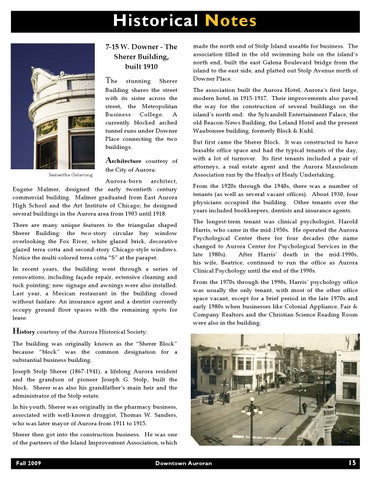
Historical Notes 7-15 W. Downer - The Sherer Building, built 1910
The stunning Sherer Building shares the street with its sister across the street, the Metropolitan Business College. A currently blocked arched tunnel runs under Downer Place connecting the two buildings. Architecture Samantha Oulavong
courtesy of the City of Aurora:
Aurora-born architect, Eugene Malmer, designed the early twentieth century commercial building. Malmer graduated from East Aurora High School and the Art Institute of Chicago; he designed several buildings in the Aurora area from 1903 until 1918. There are many unique features to the triangular shaped Sherer Building: the two-story circular bay window overlooking the Fox River, white glazed brick, decorative glazed terra cotta and second-story Chicago-style windows. Notice the multi-colored terra cotta “S” at the parapet. In recent years, the building went through a series of renovations, including façade repair, extensive cleaning and tuck pointing; new signage and awnings were also installed. Last year, a Mexican restaurant in the building closed without fanfare. An insurance agent and a dentist currently occupy ground floor spaces with the remaining spots for lease.
History courtesy of the Aurora Historical Society:
made the north end of Stolp Island useable for business. The association filled in the old swimming hole on the island’s north end, built the east Galena Boulevard bridge from the island to the east side, and platted out Stolp Avenue north of Downer Place. The association built the Aurora Hotel, Aurora’s first large, modern hotel, in 1915-1917. Their improvements also paved the way for the construction of several buildings on the island’s north end: the Sylvandell Entertainment Palace, the old Beacon-News Building, the Leland Hotel and the present Waubonsee building, formerly Block & Kuhl. But first came the Sherer Block. It was constructed to have leasable office space and had the typical tenants of the day, with a lot of turnover. Its first tenants included a pair of attorneys, a real estate agent and the Aurora Mausoleum Association run by the Healys of Healy Undertaking. From the 1920s through the 1940s, there was a number of tenants (as well as several vacant offices). About 1930, four physicians occupied the building. Other tenants over the years included bookkeepers, dentists and insurance agents. The longest-term tenant was clinical psychologist, Harold Harris, who came in the mid-1950s. He operated the Aurora Psychological Center there for four decades (the name changed to Aurora Center for Psychological Services in the late 1980s). After Harris’ death in the mid-1990s, his wife, Beatrice, continued to run the office as Aurora Clinical Psychology until the end of the 1990s. From the 1970s through the 1990s, Harris’ psychology office was usually the only tenant, with most of the other office space vacant, except for a brief period in the late 1970s and early 1980s when businesses like Colonial Appliance, Fair & Company Realtors and the Christian Science Reading Room were also in the building.
The building was originally known as the “Sherer Block” because “block” was the common designation for a substantial business building. Joseph Stolp Sherer (1867-1941), a lifelong Aurora resident and the grandson of pioneer Joseph G. Stolp, built the block. Sherer was also his grandfather’s main heir and the administrator of the Stolp estate. In his youth, Sherer was originally in the pharmacy business, associated with well-known druggist, Thomas W. Sanders, who was later mayor of Aurora from 1911 to 1915. Sherer then got into the construction business. He was one of the partners of the Island Improvement Association, which Fall 2009
Downtown Auroran
15
Movie Movie Reviews Review Jeanne Norris: City Cineaste (west of downtown)
I
go out of my way to see special
movies and avoid mediocre ones. I see a lot. Many are compelling; a precious few are funny. Occasionally they're disturbing. The rarest of them, though, is a revelation. KILLER OF SHEEP (1977) is all of the above, which may be the key to why it's widely considered a masterpiece of American cinema. (It's part of the National Film Registry and it won the critic's prize at the Berlin Film Festival in 1981.) Director Charles Burnett (born 1944, Vicksburg Mississippi) was raised in Los Angeles - Watts, actually. Killer of Sheep was a grad school project from Burnett's time in film school at UCLA. Because of its limited release initially and later its unauthorized use of music in the superb soundtrack, and because of the eternal difficulty of marketing anything "thoughtful" to the general public, this film has been overlooked. The soundtrack (Dinah Washington, Etta James, Paul Robeson, George Gershwin, Sergei Rachmaninoff, Earth Wind & Fire and Louis Armstrong) added a music-rights tab of $150,000 to a $10,000 film, thus obstructing commercial distribution for 30 years. Thanks to the intervention of director Steven Soderburgh (Ocean’s 11), among others, the new 35mm print was restored by the UCLA Film & Television Archive and released by Milestone Films in 2007. I saw it at the Music Box Theater in Chicago exactly two years ago. I watched it again last night. This film IS a revelation. South Central L.A. slaughterhouse worker Stan (Henry G. Sanders) struggles to support himself and his family and to deflect the destructive and pernicious circumstances and people that dog him. As happens to people who lack education, opportunity and connections in society, Stan's problems and the nature of his work are making him detached and withdrawn from the very family he is struggling to sustain. Yet this movie is not the story of these struggles or of the overwhelming obstacles that threaten to destroy the humanity of a working black man in 1970's America. It's the story of this particular man's innate humanity and the lyricism of his life whatever the difficulties. As the film begins, you enter in medias res - no introduction, no overture, no preamble, no preface – with just an immediate recognition of a situation in which Stan is berating his son for not defending his brother. The expression in the eyes of this boy is a reflection of the father's own pain, humiliation and resentment of an utterly unfair circumstance. The black and white cinematography is flawless in clarity, composition, timing and framing. There are times when you might sigh with pleasure at the vitality of the images or whisper thanks for the sensibility that compelled Burnett to film these scenes. Some filmmakers look for stories by which they can make their films. Others have their stories; they choose to tell them with film. Like Jean Renoir, Robert Altman, Yasujiro Ozu, or even Ken
16
Loach, Burnett lets his characters reveal the story. He doesn't manipulate our response; his characters don't conform to the roles of hero, villain, love interest or comic foil. Whether we're woman, man, educated, limited, young, old, conventional, progressive, urban or rural, we recognize ourselves as this man and this man as us. Nelson Kim, in a 2001 interview with Burnett, notes that he "rejects sensationalism, stereotype and genre convention in favor of humanscaled, richly observed tales of African-American life." Perhaps that's why Burnett replies in the way he does when Kim remarks on the matter of creative control. Burnett: "It's not a matter of control; it's a matter of responsibility. It's what you do with the media, what you do with the story, what you want to say." That is the ultimate gift of an artist - it's a form of integrity ... this initiative, this generosity and this restraint in bringing the audience an authentic experience, a true revelation. Happily, the Aurora Public Library has this film on DVD (with several other short films, including one on Hurricane Katrina, and commentary by Burnett.) It's in black and white and 81 minutes long. Jeannie Norris has been an Auroran for 30 years, the past 14 of them living near Blackberry Farm. She runs estate sales when she's not teaching at her after-school program at Gates Elementary School. As a vouched-for member of couchsurfing.com, she has slept on couches the world over and her home serves as a hostel for travelers alike. Her husband, Jamie, is heroically tolerant.
Whole Grain Salad
Contributed by Sara Knigge – west of downtown This is as close as I can get in replicating the yummy Seven Grain Salad at Prisco’s Fine Foods on Prairie Street in Aurora. I know I might be missing some important spices but cannot figure them out. Maybe after seeing this, Prisco’s will let us know the real recipe. Ingredients: 1 c. each of barley, couscous, brown rice, garbanzo beans (from can), small white beans (from can) Dressing: 1/3 c. olive oil Juice of one lemon 2 tbsp. fresh flat parsley minced Dash of dried dill Dash of dried basil Salt and pepper to taste 1 tbsp. chopped onion or two green onions, chopped 2 tbsp. roasted red pepper (from jar) chopped Cook the barley, couscous and brown rice separately, according to packaging and let cool. Stir all grains together with the drained beans. Mix all ingredients for dressing together then pour over grains and beans. Mix well and serve chilled.
Downtown Auroran
Fall 2009
Book Reviews For Kids
Scaredy Squirrel Series by Mélanie Watt Picture Book – Ages 4-8 Reviewed by Nancy Barnett - O'Neil Children’s Department – Aurora Public Library
Aside from the fact that squirrels are just naturally cute and funny (at least in picture books), Mélanie Watt’s Scaredy Squirrel serves as an endearing alter ego for children who may be a bit shy and apprehensive about facing everyday hurdles in the big wide world. Scaredy Squirrel tries to do what we all wish we could, which is to plan for every contingency and control the unknown. He makes very detailed (and amusing) supply lists and escape plans that actually make perfect sense. Of course, like all bestlaid plans of rodents and men, the unexpected always happens and, like the rest of us, Scaredy learns to accept and appreciate the curves life has thrown. (After a suitable period of playing dead, of course.) The illustrations are simple but colorful and clever, and Scaredy’s expressions perfectly convey his feelings on every page. Children will feel they have found a friend who knows how they might feel but don’t or can’t always express their feelings. Most importantly, it is reassuring to find that we are all scaredy cats -- that is, scaredy squirrels -- about certain things and, like our hero, we grow and change.
For Adults
The Steel Wave by Jeff Shaara Reviewed by Jill Steinmetz, Popular Materials Librarian – Aurora Public Library
Jeff Shaara’s second part of his World War II trilogy (after The Rising Tide) is a superb and epic account of the D-Day invasion in June 1944 and its aftermath. This story follows the men involved, from the common soldier to the supreme commander, General Eisenhower. While the details are fascinating, the author also humanizes the battles and their effects, including historical details into the stories of the soldiers involved. The personalities of the leaders from Eisenhower to Bradley, Montgomery and Rommel are clearly shown. Most of all, though, the experiences of the lowly soldiers, especially U.S. Army Sgt. Jesse Adams provides a clear view of D-Day and the days following. Along with the doubts, hopes, frustrations and fears of both the leaders and soldiers, there are the political implications of the actions carried out by both sides. The result is compelling and suspenseful reading for all readers, whether they are history buffs or not. Published 2008. 528 pages.
The most recent Scaredy Squirrel was published this September.
For Teens
Thirteen Reasons Why by Jay Asher Reviewed by Hannah Berry, Teen Librarian – Aurora Public Library
The inner workings of the lives of teens are described in Jay Asher’s 2007 book in a way that kept me on the edge of my seat. Thirteen Reasons Why is a must-read for all teens. A box of cassette tapes on Clay Jensen’s front porch and a map that mysteriously appears in his locker guide him through the town and the reasons why classmate Hannah Baker killed herself. Uncovering the reasons why Hannah committed suicide leads Clay on a path to realizing just how much we can affect others without knowing it. The book grabs hold of the reader and shoves the causes of teen suicide at them in a way that will really make them think about how they treat others. Teen suicide is on the rise and it is a big issue that sometimes gets over looked. Everyone young and old can relate to both Hannah and Clay in one way or another. I look forward to many more “hard subject” books from Asher. Get ready for Hannah’s story and read this incredible novel. Fall 2009
Downtown Auroran
Jeff Millies
17
Story Huay Xai I Have Not Forgotten by Samantha Oulavong
My trip to Huay Xai was a hasty trip. It was a day-trip that Sue, the director of the Ayui Foundation, and I took to Laos this past summer. It was surreal to be there again, and no words could describe my thoughts as we crossed the Mekong River from Chiang Kong to Huay Xai (the capital of the Laos province of Bokèo) on the boat. I looked up and down the river trying to figure out which way my family and I escaped Laos that night so long ago. I looked at the Chiang Kong side to see where my aunt's house should have stood. It was there that we stayed for a few nights once I crossed the river the last time. Looking at Laos now, I could see a temple upon the hill and thought to myself how strange it was that I was crossing over in broad daylight, not shrouded in the secret of darkness like the night we escaped.
Samantha Oulavong
My emotions were a mixture of joy and sadness when Sue and I reached the province of Bokeo. I had imagined this moment for a while and each time I would get all misty-eyed. I remember vaguely as a child that I would sit upon our wooden fence to see the Mekong River dividing Laos and Thailand. I would get a glimpse of a cargo boat floating along the river. When I heard the sound of a motorcycle, I would run down the hill to sit upon the dirt steps preceding the dirt road to have a sniff of the combusted gas from the motorbike's exhaust pipe. Across the road was a straw-thatched house with bamboo for its walls. I remembered walking home from the movie theatre and how my older sister would yell at me for not wanting to walk because I was too sleepy after our night at the cinema. The night that we escaped, I remember the hill on our left side as we were walking towards the Mekong River in the dark. We were questioned by one of the soldiers that spotted us. We lied and said that we were visiting our ill relative in the countryside. All I remember was that of a four-year-old child. Now, as our driver took us through Bokèo, I looked for these things - I think I saw them all. I wish that my mom could see me now - see that I have not forgotten where I came from and that I visited the place where I was born to be closer to her and to find myself. Oulavong teaches art at Washington Middle School. Oulavong visited Chiang Rai, in northern Thailand, during her summer break to teach photography to at-risk Akha children at Baan Ayui (translated as “our older sister’s house”). Baan Ayui is a not-for-profit home run by the Ayui Foundation for hill tribe children so they can go to school. While teaching the Akha children, Oulavong said, “I felt as if I was holding a mirror and seeing a reflection of myself when I looked at them. I remembered being young and wanting to live like all my American friends and thinking that my mom's culture and ways of life were strange or ancient. However, as I've gotten older, I have observed how the elders of the community are disappearing and the younger generations don't know much about the traditions or customs of our own people.”
18
Downtown Auroran
Fall 2009
25 YEARS OF EXCELLENCE & GROWING!
Submit to DTA! We welcome submissions in the following categories: Recipes (vegetarian, organic and ethnic) Poetry or lyrics Artwork Photography
local,
Please e-mail to downtownauroran@gmail.co m. By submitting to DTA, you give expressed permission for DTA to publish your work in print or on the Web for purposes related solely to Downtown Auroran magazine. There is no payment for submissions. Note: submitted material should relate to downtown Aurora either through the content or the author. We are also looking for news,
Fall 2009
events and happenings related to downtown. Deadline for submissions to the winter “EMERGE” issue: Nov 10
We provide professional management for approximately 15,000 “doors” in 65 local Condominium and Homeowner Associations.
Up next in Downtown Auroran: the reemergence of Auto Row and a profile of the ArtWorks teacher and artist with a conscience, Jen Evans.
www.baumprop.com ~ (630) 897-0500
Available in January!
Drapery by Katie Klaus Katie Klaus lives in Aurora and is a junior at Waubonsie Valley High School. Art is a newfound passion for Klaus.
Downtown Auroran
19