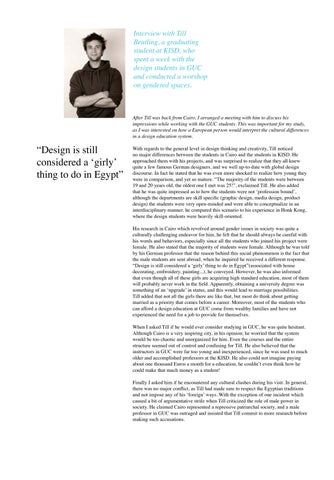
Interview with Till Beutling, a graduating student at KISD, who spent a week with the design students in GUC and conducted a worshop on gendered spaces.
After Till was back from Cairo, I arranged a meeting with him to discuss his impressions while working with the GUC students. This was important for my study, as I was interested on how a European person would interpret the cultural differences in a design education system.
“Design is still considered a ‘girly’ thing to do in Egypt”
With regards to the general level in design thinking and creativity, Till noticed no major differences between the students in Cairo and the students in KISD. He approached them with his projects, and was surprised to realize that they all knew quite a few famous German designers, and we well up-to-date with global design discourse. In fact he stated that he was even more shocked to realize how young they were in comparison, and yet so mature. “The majority of the students were between 19 and 20 years old, the oldest one I met was 25!”, exclaimed Till. He also added that he was quite impressed as to how the students were not ‘profession bound’, although the departments are skill specific (graphic design, media design, product design) the students were very open-minded and were able to conceptualize in an interdisciplinary manner, he compared this scenario to his experience in Honk Kong, where the design students were heavily skill-oriented. His research in Cairo which revolved around gender issues in society was quite a culturally challenging endeavor for him, he felt that he should always be careful with his words and behaviors, especially since all the students who joined his project were female. He also stated that the majority of students were female. Although he was told by his German professor that the reason behind this social phenomenon is the fact that the male students are sent abroad, when he inquired he received a different response. “Design is still considered a ‘girly’ thing to do in Egypt”(associated with house decorating, embroidery, painting...), he conveyed. However, he was also informed that even though all of these girls are acquiring high standard education, most of them will probably never work in the field. Apparently, obtaining a university degree was something of an ‘upgrade’ in status, and this would lead to marriage possibilities. Till added that not all the girls there are like that, but most do think about getting married as a priority that comes before a career. Moreover, most of the students who can afford a design education at GUC come from wealthy families and have not experienced the need for a job to provide for themselves. When I asked Till if he would ever consider studying in GUC, he was quite hesitant. Although Cairo is a very inspiring city, in his opinion; he worried that the system would be too chaotic and unorganized for him. Even the courses and the entire structure seemed out of control and confusing for Till. He also believed that the instructors in GUC were far too young and inexperienced, since he was used to much older and accomplished professors at the KISD. He also could not imagine paying about one thousand Euros a month for a education, he couldn’t even think how he could make that much money as a student! Finally I asked him if he encountered any cultural clashes during his visit. In general, there was no major conflict, as Till had made sure to respect the Egyptian traditions and not impose any of his ‘foreign’ ways. With the exception of one incident which caused a bit of argumentative strife when Till criticized the role of male power in society. He claimed Cairo represented a repressive patriarchal society, and a male professor in GUC was outraged and insisted that Till commit to more research before making such accusations.