Check out our annual ranks as well as insights from some of Pro AV’s top integrators.
By Mark J. Pescatore
People
22 Executive Q&A
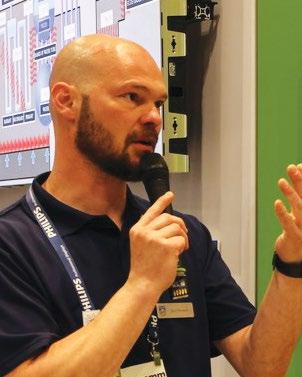
Chief product officer Jason Cremins from Navori Labs discusses new trends in digital signage.
By Mark J. Pescatore
24 On Your Business
A lot of Pro AV contributors are introverts. Learn why that’s not a bad thing.
By Steve Greenblatt
Business
26 Trends 2026: Pro AV Hangs Tough Manufacturers and integrators demonstrate adaptability with current industry obstacles and opportunities.
By Carolyn Heinze
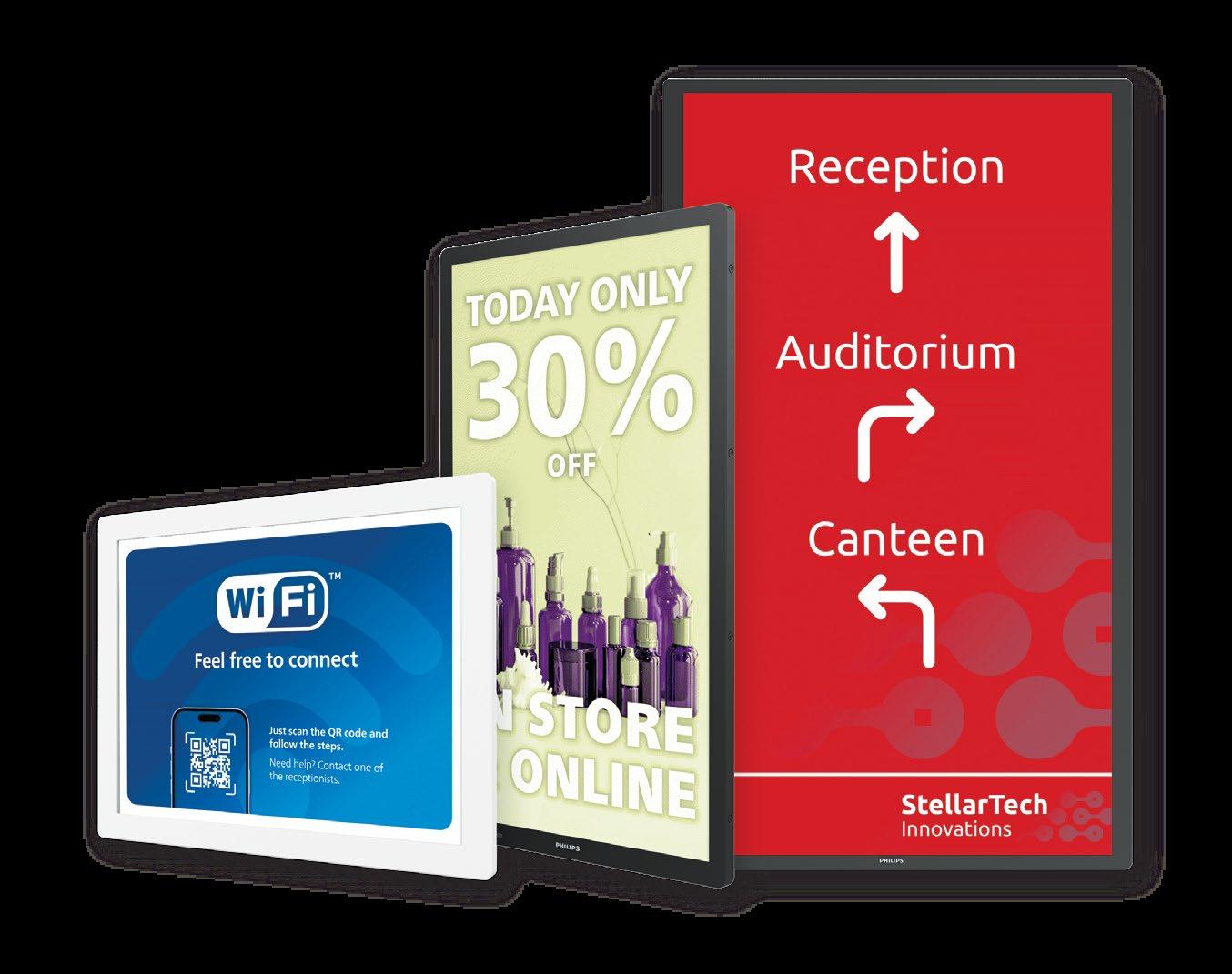
34 E-Paper Makes Its Case as Digital Signage Option
It’s sleek, sustainable, and you can put it (just about) anywhere.
By Carolyn Heinze
72 Pro AV: By the Numbers
The SCN Top 50 opens a window into deeper industry analysis.
By Sean Wargo
76 Executive Q&A
AVI-SPL CEO John Zettel talks acquisitions, managed services, and other realities of today’s top integrators. By Mark J. Pescatore
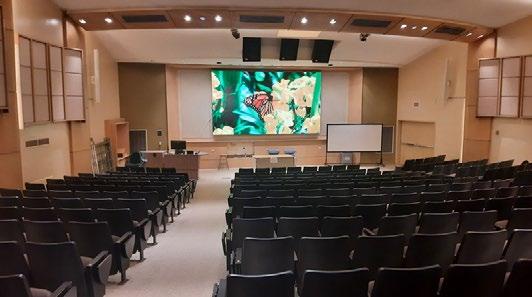
The Integration Guide to Video Displays and Mounts
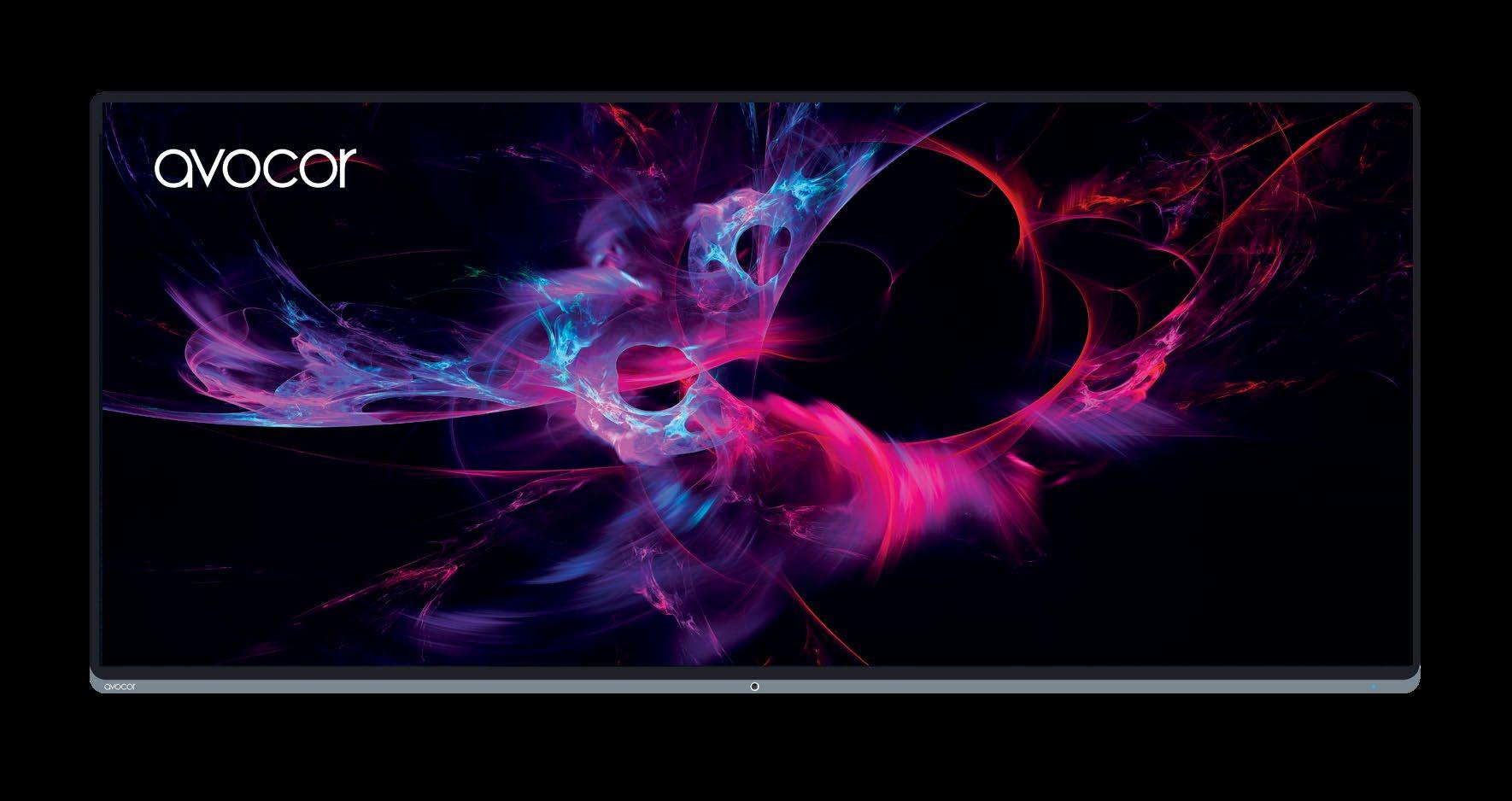
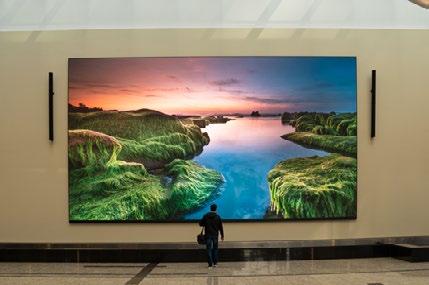
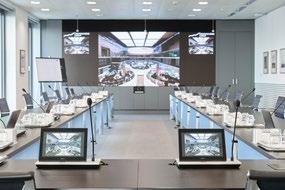
38 Wide Appeal for Ultra-Widescreen
How popular is the 21:9 aspect ratio in today’s corporate environment?
By James Careless
Technology
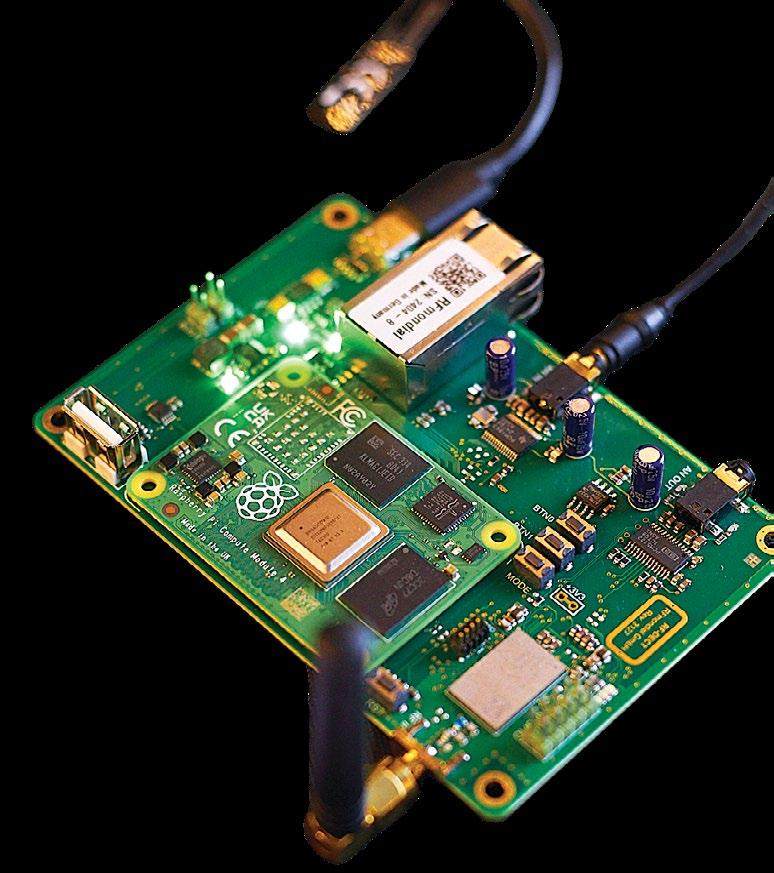
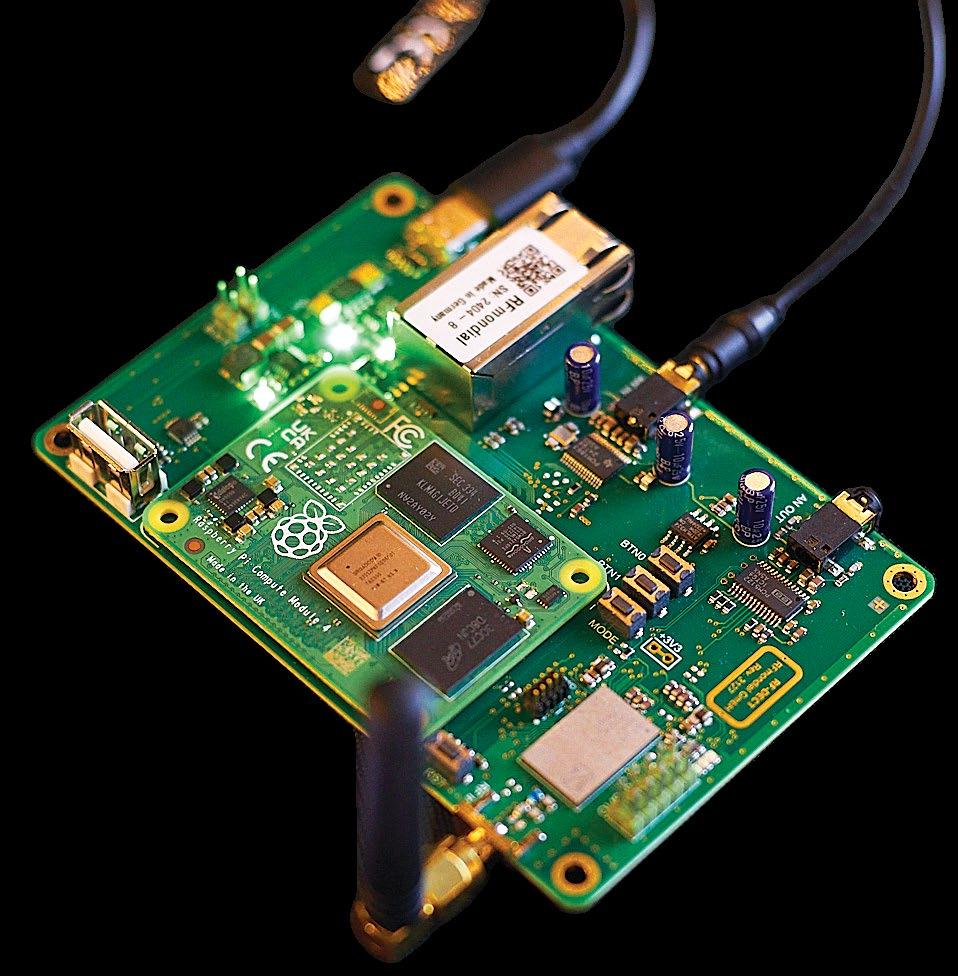
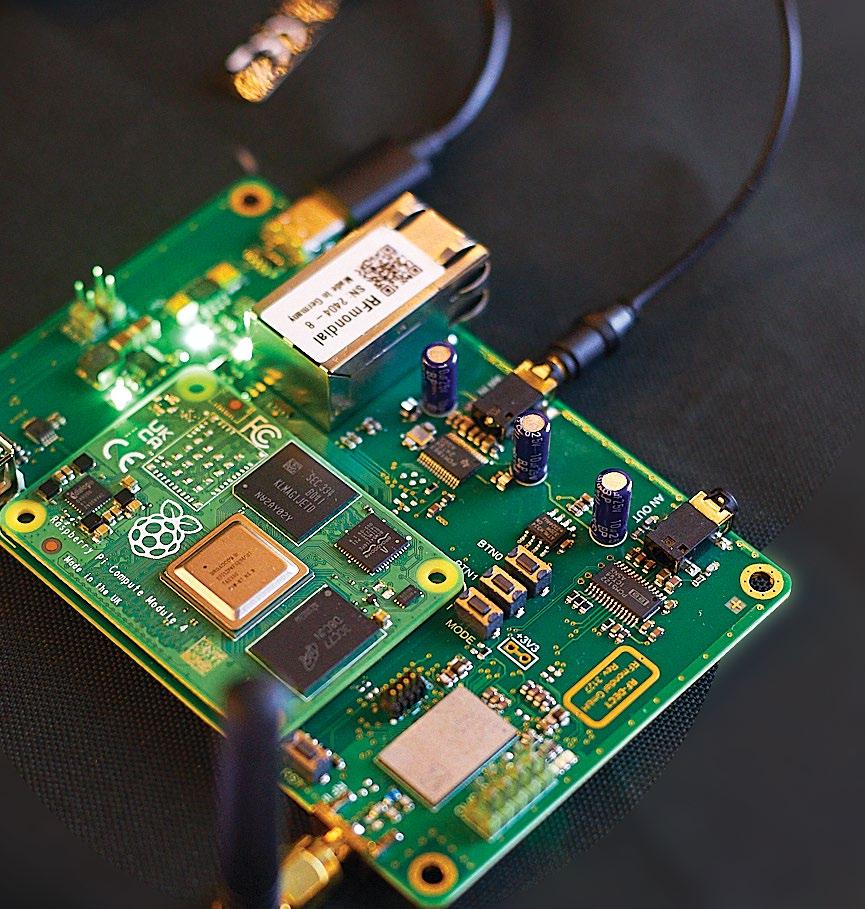
78 Coming Soon to Pro AV: DECT NR+
A new standard is in position to redefine wireless audio for challenging environments.
By James Careless
Viewpoint
82 What Convergence Really Means for Pro AV
The overlap is undeniable, but how does it actually impact integrators?
By Kevin Henneman
DN-300 Series
The Ultimate AVoIP Platform
The Future of AV Distribution is Here
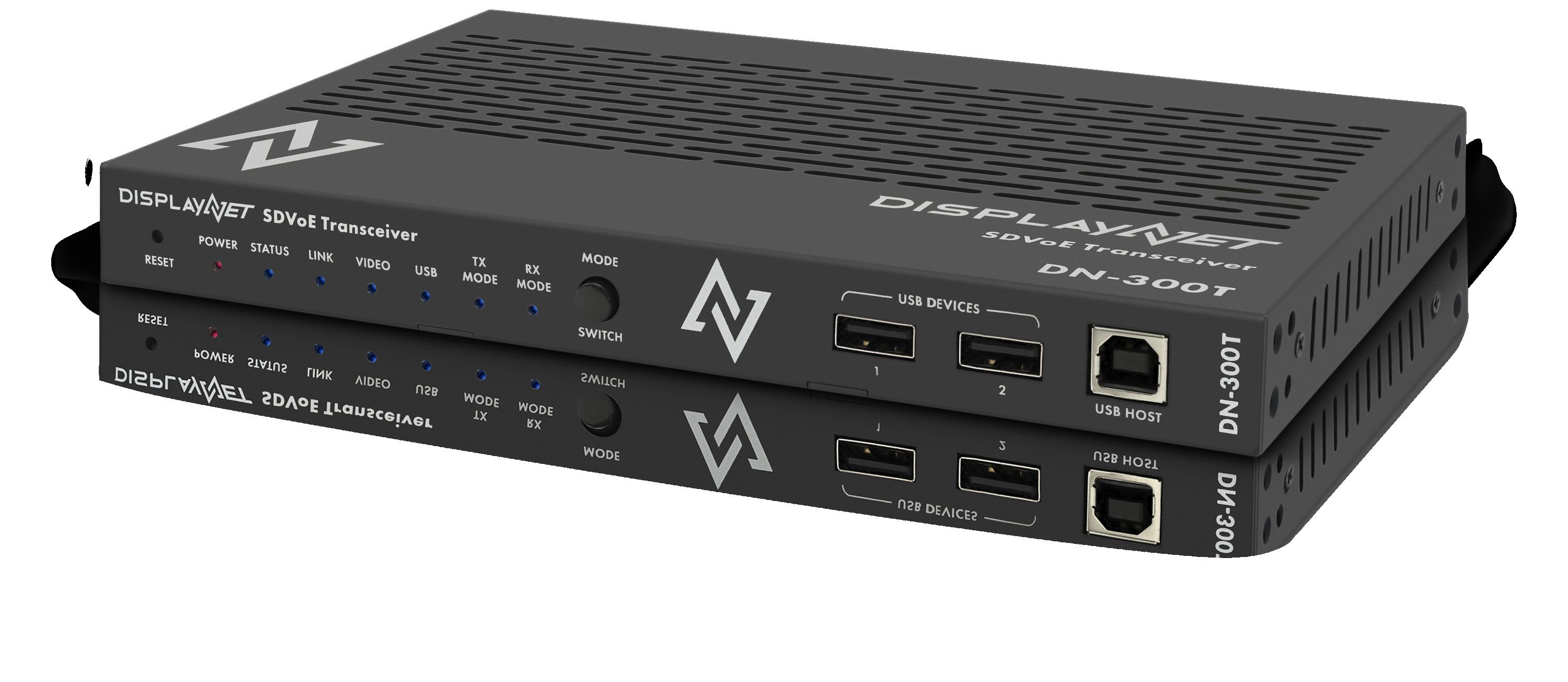
The DisplayNet DN-300 Series delivers an unprecedented level of AVoIP performance, versatility and reliability— at a price point that defines the industry benchmark for value. Based on the latest SDVoE technology, the DN-300 Series provides 4K/60 (4:4:4) video distribution with limitless scalability, zero-frame latency and zero image artifacts.
These units offer unique features that provide system designers with exceptional versatility:
Switchable Transmitter / Receiver operation
Bi-directional Transceiver mode (DN-300T)
Dual (copper / fiber) 10G network interfaces
Long Range: 100 meters (copper), 30 km (optical)
Auxiliary H.264/5 video output streams
Powerful network security features
PoE+ support
Silent, fanless operation
Ultra-compact, rackmountable case
Versatile KVM Routing
DN-300H: USB HID device instant switching
DN-300T: full-bandwidth USB 2.0 routing
DisplayNet also provides software-defined MultiViewer and Advanced Video Wall engines that power a wide range of applications without the expense and complexity of ancillary products. A highly intuitive web-based UI and API greatly simplifies setup and installation, as well as integration into third-party control systems.
Contact us today to see how DisplayNet can move your next AV system into the future.
ZERO COMPROMISE – INFINITE POSSIBILITIES
sales@dvigear.com
(888) 463-9927
www.displaynet.com
All’s Fair in Projection Mapping
Next month, after the holidays have created a new set of memories, many of you will be avoiding the outdoors. But while your temperatures are uncomfortably low, down here we’ll be getting ready for the South Florida Fair. And if I’m very lucky, my family will attend on one of a handful of days before spring when I get to wear my heavy(ish) Miami Dolphins jacket without breaking out in a heat rash.
There’s so much to love about the fair, starting with the food. For me, all other treats take a back seat to the almighty funnel cake. Fried dough and powdered sugar. That’s it. Additional toppings, from chocolate syrup to fruit, are simply improper. Cotton candy is a distant but delicious second.
Then come the product vendors who promise the best soup mix you ever tasted, the cleanest sneakers you ever wore, and the finest T-shirts that may or may not be officially licensed. This year, they got me for a spray bottle of eyeglass cleaner and a small tub of organic jewelry cleaner, both of which work surprisingly well.
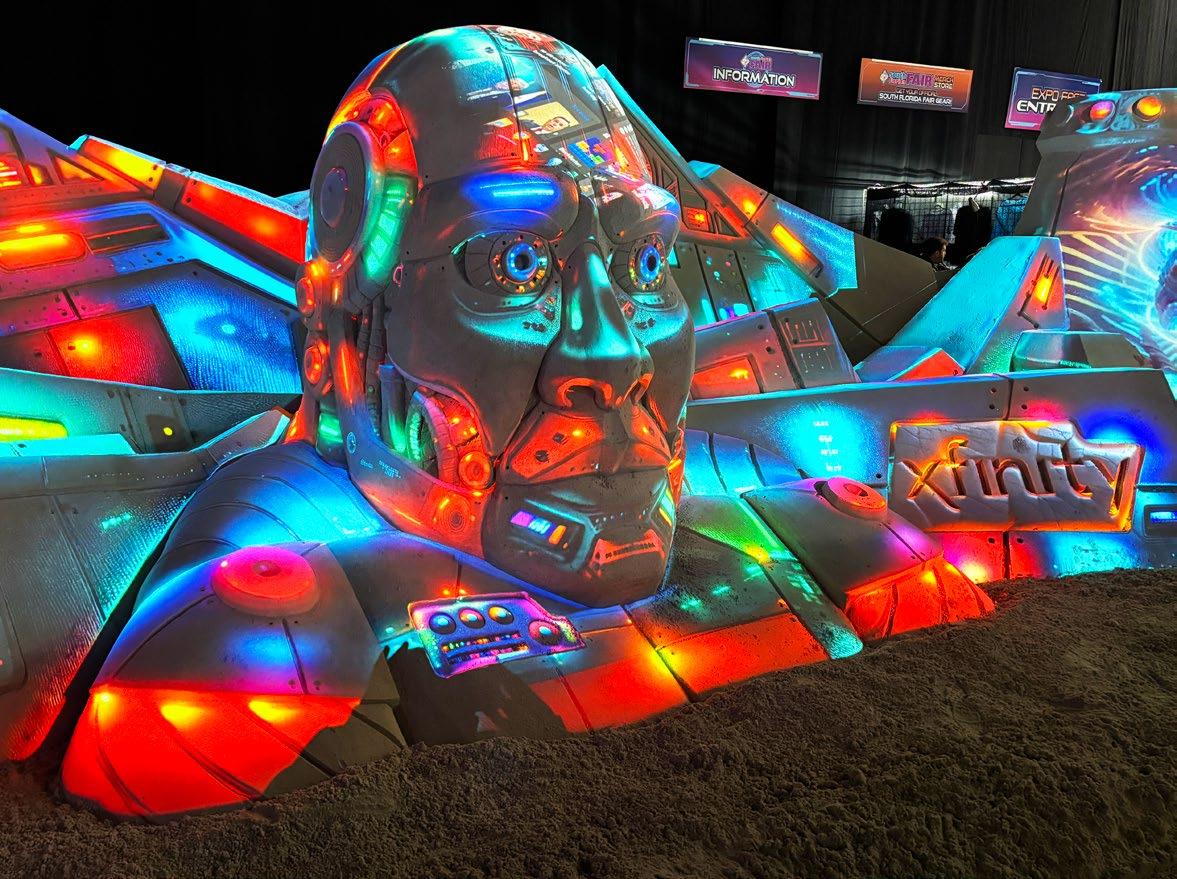
We also have activities that are free, from concerts to pig racing (don’t judge). One of the recurring attractions is a sand sculpture. It greets you inside the main building right after your ticket is scanned. The theme changes every year, but it’s always a sight to behold.
In 2025, the theme was “Imagine the Future,” with a sand sculpture featuring a giant cyborg head and other tech touchpoints (that you’re not allowed to touch). The sculpture was about 40 feet long and 12 feet tall. We take playing in the sand very seriously down here.
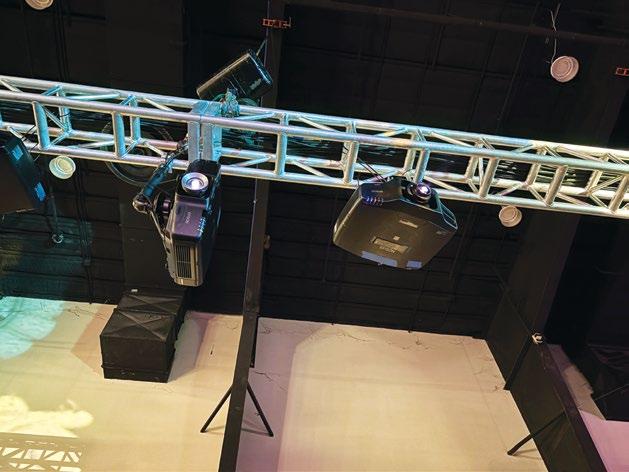
As if the sculpture wasn’t impressive enough, fair officials took it up a notch. Jasper and Shelby Mosher from the Electric Dream Machine (EDM) have been breathing new life into art displays at the fair for more than a decade. This year, they used mostly Epson Pro L1500UH laser projectors to add color, graphics, and AI-generated video.
Next to the sand sculpture was a talking hologram who got his own dedicated EB-PQ2213B projector. His name is “Ribby,” and he’s the fair’s ribbon-shaped mascot. EDM programmed Ribby’s multiple speeches that greeted fairgoers. Another display, the “Design Lab,” used five more projectors to show simulated carnival rides of the future on a projector mapped computer control panel.
It took three weeks to build the installation and create all the content for the projection mapping using Resolume projection mapping software. “As soon as we heard ‘Imagine the Future’ would be the theme, we saw an opportunity to elevate the projection and dive further into the world of generative AI content,” said Jasper Mosher.
“This was our first production where we exclusively used AI-generated visuals for all the animated content.”
Displays like that sand sculpture remind me to step back and appreciate how creative our industry can be. It’s not just about black boxes and connecting cables. Pro AV technology can still deliver the “wow,” and I hope you get a chance to be part of a project or two like that in the New Year.
In the meantime, I wish all of you a joyous holiday season. Y’all can keep your sugar-plum visions; I’ll be dreaming of funnel cake.
CONTENT
Content Director Mark J. Pescatore, Ph.D. mark.pescatore@futurenet.com
Senior Content Manager Wayne Cavadi Contributors
Erin Budnik, James Careless, Steve Greenblatt, Carolyn Heinze, Kevin Henneman, Jake Stone, Sean Wargo Art Editors
Rob Crossland, Sam Richwood Production Managers
Nicole Schilling, Heather Tatrow
ADVERTISING SALES
Managing Vice President of Sales, B2B Tech
Adam Goldstein, adam.goldstein@futurenet.com, 212-378-0465
Sales
John Casey, john.casey@futurenet.com, 845-678-3839
To subscribe, change your address, or check on your current account status, go to avnetwork.com and click on About Us, email futureplc@computerfulfillment. com, call 888-266-5828, or write P.O. Box 1051, Lowell, MA 01853.
LICENSING/REPRINTS/PERMISSIONS
SCN is available for licensing. Contact the Licensing team to discuss partnership opportunities. Head of Print Licensing Rachel Shaw licensing@futurenet.com
MANAGEMENT
SVP, MD, B2B Amanda Dawrman-Allen VP, Global Head of Content, B2B Carmel King MD, Content,
Multiple Epson projectors were used to bring a sand sculpture to life at the South Florida Fair.
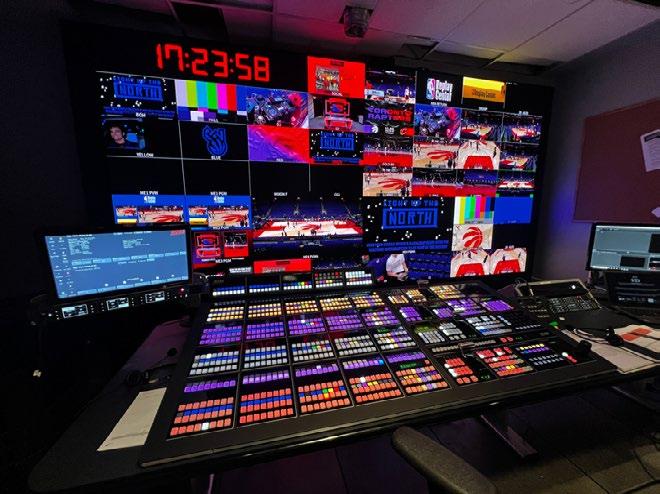
Florida Panthers Invest in Immersive Fan Experience at Amerant Bank Arena
By Mark J. Pescatore
After winning back-to-back Stanley Cup championships, it’d be easy for the Florida Panthers to rest on their laurels. Instead, the offseason was spent installing a new center-hung video scoreboard and other significant AV upgrades at Amerant Bank Arena in Sunrise, FL. The new elements, which debuted on Sept. 29 during a preseason Panthers game, have taken the fan experience to a level befitting the reigning NHL champs.
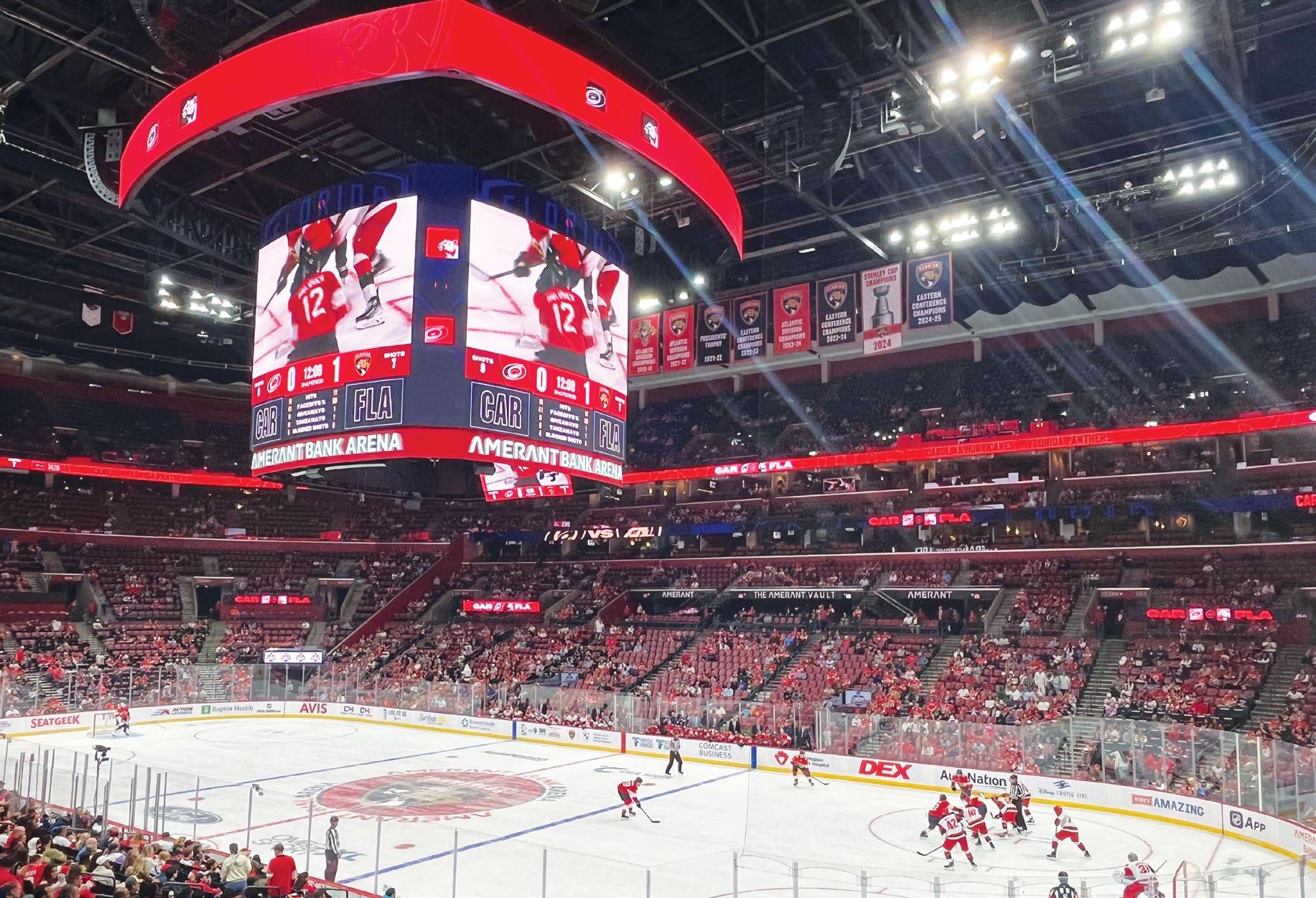
The new 4K scoreboard features four joined displays that produce a 360-degree canvas that’s 31 feet high and has 27.6 million pixels. “The scoreboard itself provides us with 180% larger viewing area than the prior scoreboard,” explained Mike Masino, VP of game entertainment and operations for the Florida Panthers.
But wait—there’s more. Underbelly screens ensure that premium seating around the arena gets a good look at the video action. There’s also a 7-foot-high LED halo screen above the scoreboard providing additional display space above the ice.
The Panthers had been using its previous video scoreboard since 2012. Masino told SCN the unit had reached the end of its lifecycle—and with limited service options available, it was time to bring in a new system that would improve the fan experience and show off the talents of the franchise’s creative team. Typically, the Panthers have 30-45 crew members during a game, including producers, directors, announcers, and camera operators. “We function the same way as a broadcast truck on game day,” Masino noted.
Arena audio also got some attention during the upgrade. If left alone, the center-hung JBL Professional speakers would have been too low and interfered with the new scoreboard. Masino said the system was raised and repositioned to avoid any
issues, and new end zone fill speakers were added to ensure there were no coverage gaps.
The project was designed and overseen by Anthony James Partners (AJP). ANC manufactured and integrated the scoreboard and other displays across the facility using Yaham LED displays. Masino also credited the scoreboard project to a “huge public private partnership between us and Broward County.” Amerant Bank Arena is owned by the county but operated by the Panthers.
Beyond the scoreboard, the Panthers also refaced the arena’s 360-degree ribbon and its club-level horseshoe ribbon, installed new vomitory displays throughout the arena, and upgraded its lobby displays. According to Jon Holvey, senior project manager at AJP, the entire project, from design to deployment, took 10 months, though the installation only took about 90 days.
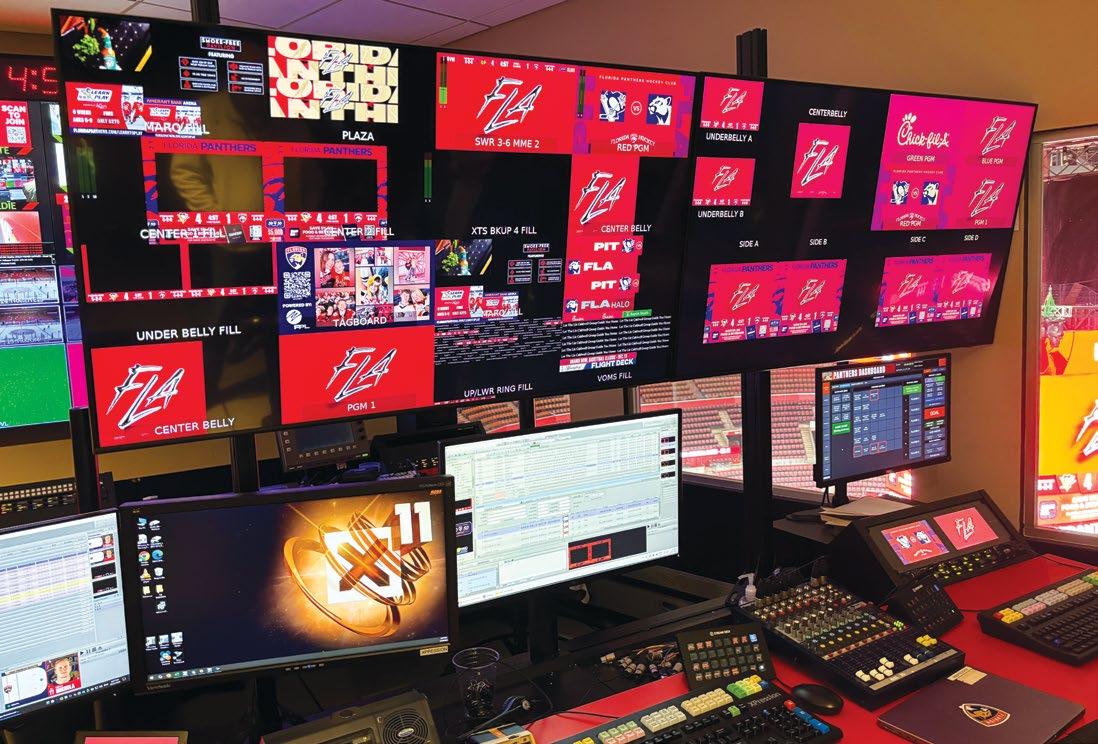
To control all this screen area, the control room was upgraded around a Ross Video Xpress Tessera One content management system powered by NovaStar processors. (The existing Ross Vision switcher remained.) With the renovation, the Panthers also made the move to ST 2100, because it provided the “flexibility to scale video and provide content autonomy,” Masino said.
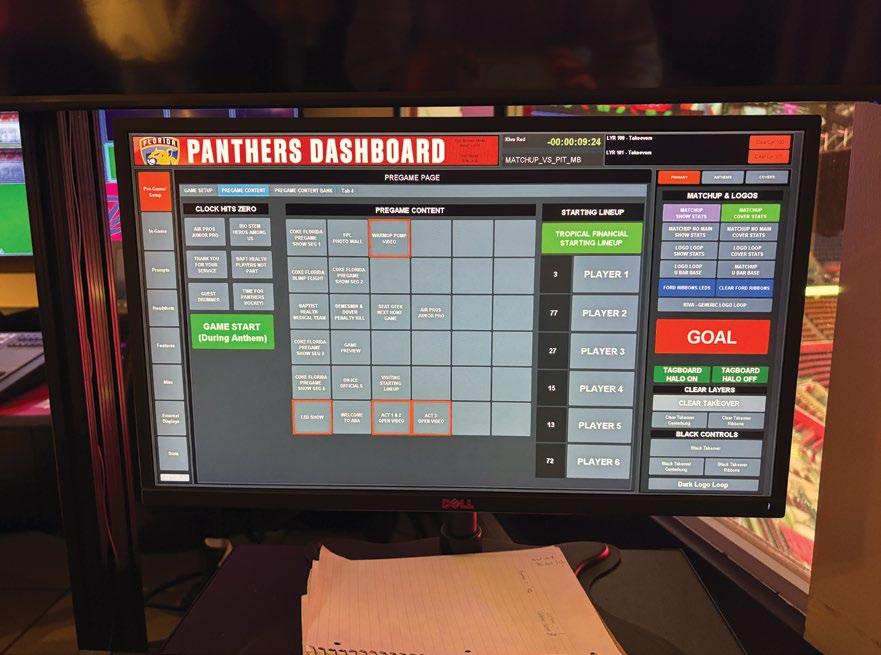
BeckTV built the systems off site to save time, then spent several weeks on site with wiring, cabling, and testing. Ross even came to the buildout to create the Panthers Dashboard, a customized user interface for
the Tessera that includes a “GOAL” button, which launches coordinated celebratory graphics over all displays in the building with one button press.
“The fan experience is why we’re here,” Masino said. “It’s everything that we pour our passion into from a creative and game presentation standpoint. We want to create an immersive fan experience. We want to make sure that we are meeting the needs of our fans from a statistical and information display standpoint, but also from a content standpoint. From our augmented sound system to our brand-new Ross Tessera video system for our video scoreboard outputs and LED displays, everything we do from an AV standpoint enhances the fan experience.”
The new 4K scoreboard has a 360-degree canvas, along with underbelly screens and a halo screen.
The customized Ross Tessera touchscreen at Amerant Bank Arena includes a dedicated “GOAL” button, which makes it easy for operators to launch coordinated celebratory graphics.
A new Ross Video Xpress Tessera One content management system controls what visitors see on screens throughout the arena.
By Jake Stone
F5 Stadium AV Trends to Watch in 2026
or decades, stadiums operated on a traditional, seasonal model. Their primary purpose was to support live sports, with limited secondary programming and minimal fan-facing technology. Today, venues such as the Sphere have redefined audience expectations for immersive entertainment, prompting a global shift toward stadiums as year-round, multi-purpose destinations.
Sports fans now expect the same level of quality and immersion found in premium concert venues and broadcast environments, regardless of where they are seated. Stadium operators are responding with large-format LED displays, advanced content ecosystems, and entirely new experiential revenue models.
After structuring technology and marketing partnerships with more than 50 stadiums throughout my career—and working for brands such as Disney, ESPN, and now Disguise—I believe the trajectory of the market is unmistakable: The future of stadium AV lies in scale, flexibility, monetization, and personalization. The following five trends illustrate how the next evolution of sports venue technology will take shape in 2026.
1The experience will begin before the entry gate.
The game day journey increasingly starts well before fans find their seats. Stadium districts are expanding with mixed use amenities that encourage fans to arrive earlier and remain engaged long after the final buzzer. What comes next is the extension of digital storytelling into the exterior architecture itself. Large-format outdoor LEDs, façade displays, and
plaza activations will support elevated pre-game content, sponsor takeovers, and community watch parties. These assets not only improve the fan experience, but they also create new premium inventory for advertising and partnerships.
2
Large-scale visual environments will redefine immersion.
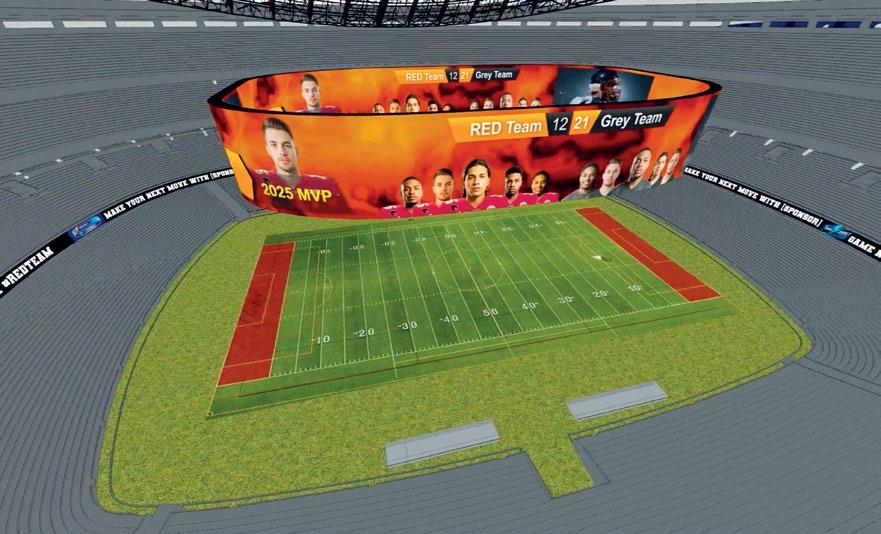
Advances in real-time rendering and content distribution are enabling scoreboards and ribbon boards to scale to unprecedented dimensions while maintaining broadcast-quality resolution. Stadiums are also integrating alternative display technologies. Projection mapping has matured into a reliable, turnkey method for transforming the field of play into a dynamic storytelling platform.
3
Gamification and AR will deepen engagement and revenue.
Interactive content is rapidly shifting from a novelty to a strategic engagement tool. Integrated controls at seating positions, second-screen participation, and real-time fan competitions ensure spectators remain active contributors rather than passive viewers.
Gamification offers measurable commercial upside. Premium branded experiences tied to gameplay and audience interaction can generate significant incremental revenue while improving dwell time. Augmented reality overlays, contextual statistics, and automated content that reacts to live moments will elevate the entertainment value for every fan.
4
Broadcast-grade reliability will become a core requirement.
The convergence of live entertainment, broadcast workflows, and real-time data is driving heightened
expectations for infrastructure reliability. In 2026, venues will continue to deploy scalable media servers, redundant playback paths, and centralized control systems to ensure uninterrupted performance across increasingly complex visual networks. Operators managing staged modernization programs will leverage technologies such as projection mapping or portable LED assets to extend the life of existing systems. These modular upgrades broaden revenuegenerating inventory without requiring full structural retrofits.
5
Personalization will transition from concept to implementation.
A new frontier is emerging where every fan could receive a tailored blend of entertainment, information, and game-specific context. This vision is accelerating through advancements in AI, sensor-driven content automation, and synchronized playback across distributed displays. While fully individualized in-venue media remains aspirational, stadiums are beginning to deploy dynamic content pipelines that adjust to audience behavior, premium tiering, and real-time moments in the game. The main takeaway from all this: Stadiums are becoming media platforms. The stadium of 2026 will serve as a high-capacity, data-aware media ecosystem delivering immersive storytelling at scale.
Operators investing in flexible AV infrastructure and future-proof content workflows will unlock substantial incremental revenue across sponsorship, premium hospitality, and non-event programming. The opportunity for innovation is significant, and the transformation is already underway.
Jake Stone is the SVP of global commercial strategy at Disguise.
InfoComm América Latina Celebrates Successful Launch
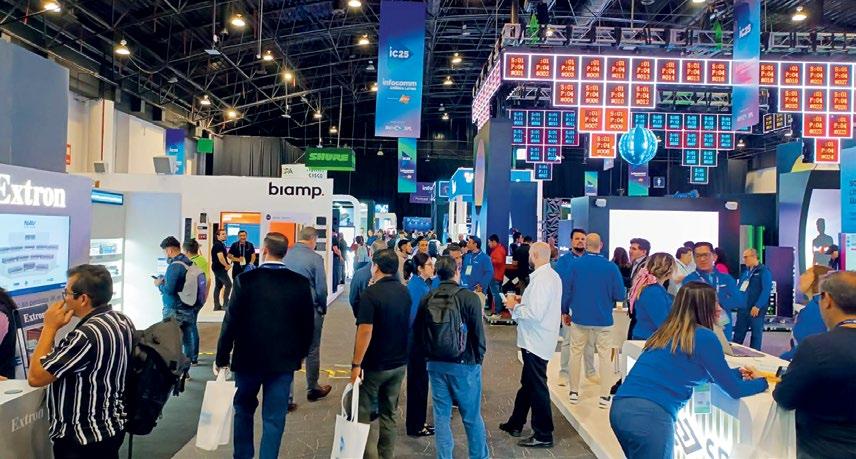
AVIXA had a successful launch of its InfoComm América Latina 2025 show at the WTC International Exhibition and Convention Center in Mexico City in October. The show welcomed 5,193 verified attendees, with about 9,500 total registrants. The show featured 64 exhibitors showcasing more than 100 brands on the exhibit floor and in seven demo rooms.
Numerous global manufacturers, familiar from other InfoComm shows, participated alongside companies from Mexico, Argentina, Chile, and Spain. These exhibitors sought to strengthen their regional presence and create new connections and business
opportunities. InfoComm América Latina 2025 was sponsored by headline partner AVI-SPL and top
The show featured a variety of educational sessions, manufacturer training, technology tours, and networking events. During an in-person edition of Congreso AVIXA, industry leaders outlined the expected trends for AV technology through 2030, emphasizing the impact of AI and the need for a people-centric adaptability strategy. The education program was sponsored by Biamp and Ross Video. Next year’s show is already scheduled for Oct. 21-23, and exhibition space is expected to expand by 50%.
The inaugural InfoComm América Latina 2025 attracted more than 5,000 attendees.
Companies like Disguise are helping stadiums deliver complex graphics to a variety of displays in real time.
Zones Brings IT Solutions to Pro AV Industry
By Wayne Cavadi
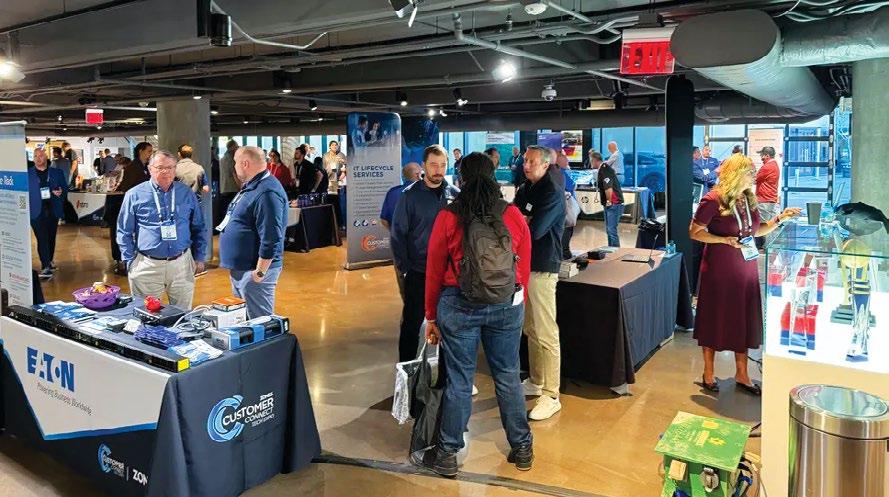
Zones, a longtime global provider of end-toend IT solutions and managed services that’s known for its work in the retail and QSR verticals, officially announced its expansion into the Pro AV industry in October at its Zones Customer Connect Tech Expo in Atlanta.
The line between AV and IT continues to blur, and the Zones IT solutions portfolio makes it an ideal fit for the Pro AV side of the industry. While the company will focus on the retail and QSR sectors, the overarching goal will be to help all Pro AV installations in the not-so-distant future. As Doug Eckrote, EVP/ COO, explained, the timing was right to invest in the opportunity and drive it home.
“I think integrators are looking for scale,” Jeff Cobb, SVP, Integrated Solutions, told SCN “[Integrators will] have pieces of a project of things that we’ve been doing for a very long time. So, it makes sense to include us in those types of conversations.”
Zones’ business practices are broken down into four main pillars, and each was showcased on the Customer Connect exhibition floor. Ivan Tetyushev, director of technology solutions, began the tour, discussing its IT lifecycle services. From procurement
Telemetrics Camera Robotics Support Baker Institute Production
Located on the campus of Rice University in Houston, the Baker Institute for Public Policy is one of the nation’s foremost nonpartisan research centers, dedicated to providing insights to policymakers, business leaders, academics, and the public. The institute employs scholars and researchers from a variety of backgrounds, and its work spans a wide range of issues, from advancing green energy initiatives to hosting foreign ambassadors and heads of state.
Heading up the production of high-quality audio and video content that supports the institute’s mission is Kevin Young, AV director, who oversees the production of more than 100 live events (and videos) each year. These take place across the Commons, which seats 300, a second room for about 150 people, and a third, more intimate space for smaller gatherings. Supporting them all is a central control room equipped with advanced production technologies,
to end-of-life, Zones can provide IT management all in-house, with no need for third parties, as the company aims to be an all-in-one source for integrations worldwide. Other areas of expertise attendees saw on the exhibition floor included simplifying collaboration in the digital workplace, customized cloud and data center, and networking and security.
“We’re global, so we have resources all over the world,” Ashley Flaska, VP of marketing, offered as yet another benefit Zones brings to the industry. “If a customer wants to do a global deployment, then we’re able to facilitate that, whether it’s through Zones or our partners that we work with throughout the world.”
Cobb, who recently joined Zones, came to the company with 30 years of expertise in integrated solutions, working very closely with cybersecurity and managed services. With AWS and Microsoft having sweeping effects on the industry this week alone, security is more important than ever—and Zones is equipped with the solutions and knowledge to prepare its customers.
“Security has come a long way in my 30 years of being in IT,” Cobb said. “But there is still so much more that organizations need to do. It’s always a contention of where a dollar is going to go, where resources are going to go. That’s why managed services are so important. It’s that age old saying that
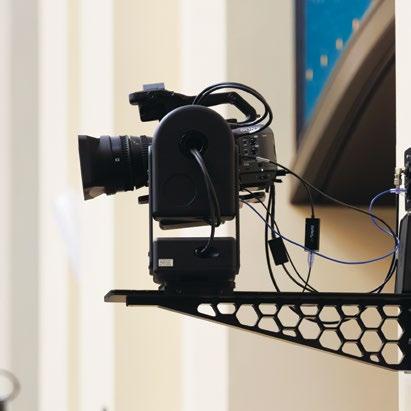
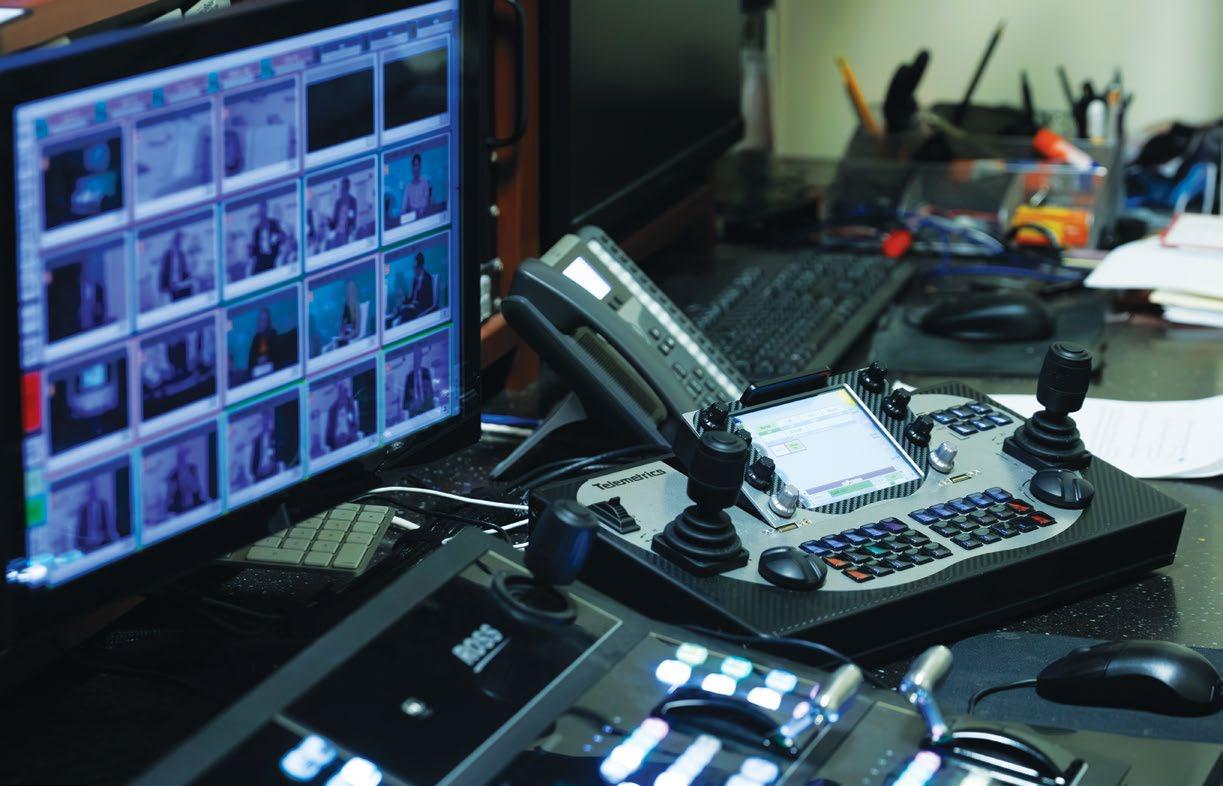
including a Telemetrics RCCP-2A robotic control panel used to remotely operate six Sony FX-6 cameras mounted on Telemetrics PT-CP-S5 robotic pan/tilt heads across the two main event spaces. Some are permanently installed on the wall, while others are mounted on dollies that can be easily moved from room to room.
Although the cameras are about 200 feet from the control room, they are precisely controlled, including full camera and lens movements, by a single operator. The setup also incorporates a Telemetrics DS-4 device server within a patch panel, enabling the robotic heads to communicate over an Ethernet network between the two main event rooms.
“The server allows us to get the most out of the cameras we have,” said Young. “Along with the permanently installed wall cameras, we also use a ‘swing’ camera, which we can reposition for side shots or larger events. This gives us added flexibility, and it’s all controlled remotely.”
Young has been a proponent of camera robotics since 2010, when he acquired his first Telemetrics
we have to be right 100% of the time, where the bad guys, they just have to be right once.”
As Zones prepares to enter the Pro AV world, do they have plans to work alongside integrators, or are they the new kids on the block, a competitor looking to make its mark? “That’s a very good question,” said Flaska. “In Pro AV, we don’t compete with integrators, we want to collaborate with them. By combining AV specialization with our IT deployment scale, we deliver better outcomes for customers together.”
Whether it is updating outdated digital signage—a struggle many are facing as signage shifts from simple menus and messaging to an enhancement to the customer experience—or modernizing their IT infrastructure, Zones aims to be an all-in-one partner to limit the complications and stress installations may bring.
control panel. That system was so dependable they didn’t upgrade until August 2024, when they installed Telemetrics’ RCCP-2A panel.
Young added that the biggest benefit for his team is cost effectiveness. The robotics system eliminates the need to hire camera crews, a critical factor for a nonprofit that operates with a three-person staff.
“Having repeatability in the robotics and the ability to move quickly between venues, without bringing in outside contractors, is a huge advantage for us,” he explained.
The Zones Customer Connect Expo was held in Atlanta.
Telemetrics solutions help the Baker Institute remotely operate Sony cameras (inset) across multiple event spaces.
Biamp Acquires Assets of ClearOne Intellectual Property and Brands
By Mark J. Pescatore
In late October, Biamp announced it was acquiring assets from ClearOne. Those assets include several patents, plus intellectual property and brands related to audio processing, microphone array processing, echo cancellation, and beamforming designs and techniques. According to Rashid Skaf, Biamp president, CEO, and co-chairman, the move strengthens the company’s “deep audio engineering foundation and will enhance future product innovations across our portfolio.”
Joe Andrulis, EVP of corporate development for Biamp, provided SCN with more details about the
acquisition. First, he clarified that the transaction was an asset purchase through which Biamp acquired only select designs, patents, and related technologies from ClearOne.
“We do not plan to offer or support ClearOnebranded products,” he continued. “Instead, we’ll leverage these assets to accelerate innovation in areas such as microphone array design, DSP processing, and overall room audio performance—enhancing our future product roadmap.”
So, will the ClearOne brand remain? “ClearOne remains a publicly traded company with operations independent of the assets acquired by Biamp,” Andrulis explained. “However, use of the ClearOne brand in association with products derived from the acquired
technology is unlikely to continue beyond 2026.”
The transaction was an asset purchase and did not involve personnel, so where does this leave ClearOne? According to Derek Graham, CEO of ClearOne, it’s not going anywhere and it’s not leaving its customers in a lurch.
“ClearOne will continue to exist as a public company after this asset sale,” Graham said. “We believe that this asset sale is the best way to maximize value for current shareholders while allowing the company to pivot to take advantage of new business opportunities in the future. We appreciate the support of our channel partners and customers over the years, and we plan to continue to provide support for our products consistent with our published warranty policy.”
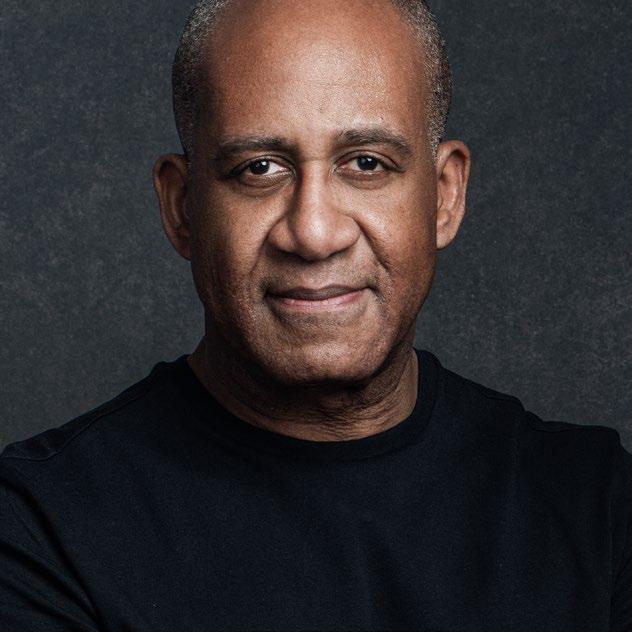
Derek Graham (left) and Joe Andruilis
Sound Productions Acquires ProAudio.com
Sound Productions (SoundPro) has acquired ProAudio.com, a strategic acquisition to strengthen SoundPro’scommitment to serving customers with expertise, product selection, and personalized service. The acquisition comes during a period of rapid growth for SoundPro, which has recently expanded its national footprint and invested in advanced operational technology and logistics capabilities.
ProAudio.com is integrating its operations under the Sound Productions brand. During the transition, customers will have expanded access to SoundPro’s extensive inventory, educational resources, and technical expertise.
Founded in 1971 as Crouse-Kimzey Company and based in Grand Prairie, TX, ProAudio.com has deep roots in broadcast, installation, and live sound markets. The company built its reputation on technical excellence and dedicated customer care, values that align with SoundPro’s culture and mission.
“We’re thrilled to welcome the talented ProAudio. com team to the SoundPro family,” said Joshua Curlett, CEO of Sound Productions. “Our companies share a long history in this industry and a deep respect for the professionals who power it. With this acquisition, SoundPro is expanding what we can offer customers across every market we serve nationally."
New Owner Relaunches The Screen Works
After more than six decades, The Screen Works is writing a new chapter—under new ownership and with a renewed sense of purpose.
Earlier this year, longtime consultant and entrepreneur Andrew Schmahl acquired the Chicago-based manufacturer known for its EZ FOLD portable screens and more. “What drew me to it wasn’t just the products, but the people—the craftsmanship, the reliability, and the pride in making something that lasts,” said Schmahl. “My goal is to carry that forward while positioning projection screens where they belong: at the intersection of creative freedom and practical affordability.”
The company’s first steps include a complete rebrand and redesigned website, as well as the launch of a Replacement Surfaces Program, allowing customers to more quickly and easily replace worn or damaged surfaces on existing frames with new materials at lower cost.
October Predicts Slight Year-End Dip
By Erin Budnik
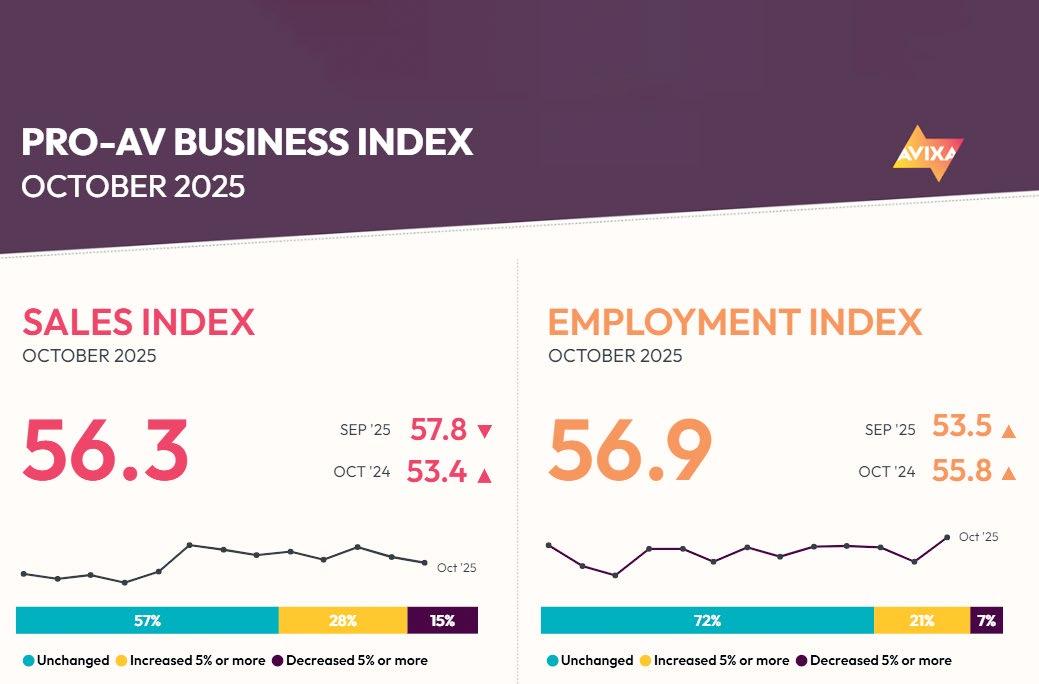
The AV Sales Index (AVI-S) was 56.3 in October, slightly down from September. Although not above 60 as in previous periods, this moderate growth suggests consistent market demand with potential for stabilization.
Tariffs, political instability, and inflation are key concerns affecting the AV industry. These factors contribute to uncertainty in business investments and lead to increased equipment and project costs, influencing client decisions and project scopes. Despite current challenges, some companies are strategically investing in talent and technology to prepare for expected market improvements and busy periods, such as end-of-year events and ongoing digital transformation demands.
“Summer is always our slowest season so fall-winter always is busier for us. Themed
attractions we work on tend to be closed over the winter months, so this is when we do a lot of our installs,” shared a North American AV provider.
The AV Employment Index (AVI-E) increased to 56.9, indicating a stronger hiring environment. This aligns with the general positive trend in employment, though at a cautious pace given broader market uncertainty. While the Bureau of Labor Statistics has gone dark with the government shutdown (at press time), other reports outside the government data suggest the labor market just plodded along in September-October.
comprises two diffusion indexes: the AV Sales Index (AVI-S) and the AV Employment Index (AVI-E). In each case, an index above 50 indicates an increase in sales or employment activity.
The Pro AV Business Index report is derived from a monthly survey of the AVIXA Insights Community, a research community of industry members that tracks business trends in commercial AV. The report
Visit www.avixa.org/AVindex to access the free monthly Pro-AV Business Index reports and learn more about the methodology. For more information about joining the AVIXA Insights Community, visit www.avixa.org/AVIP
Erin Budnik is the manager of market insight for AVIXA..
PEOPLE NEWSMAKERS
Rep Report
AC AMERICAS announced its exclusive partnership with German audio innovator INNOSONIX for distribution across the United States. Its technology is designed for demanding applications in immersive audio, themed entertainment, and architectural installations—where precision, scalability, and reliability are paramount. This strategic alliance marks a significant expansion of AC Americas audio portfolio, bringing Innosonix’s multichannel amplifier technology to the U.S. market for the first time under an exclusive agreement.
CLOCKAUDIO (U.K.) has launched a new distribution operation in the United States. As part of this transition, distribution operations will shift from Canada to the United States to better serve the growing American market. The move will facilitate the logistics by having all the products shipped domestically and ensure faster delivery times across the United States. Clockaudio USA will be based in Minnesota and includes a solid team with years of experience and expertise in microphones, audio hardware and software integration.
LYNTEC announced a new partnership with SSRC, a custom manufacturer of theatrical, entertainment, and broadcast products. LynTec will now offer select SSRC products, including the BAL, SL, and H/L V Connector Strips, as well as a variety of outlet boxes, company switches, transfer panels, and cable management hardware. The collaboration establishes LynTec as a comprehensive, one-stop shop for power and distribution systems, making it easier and more efficient for systems integrators to purchase the equipment needed to complete projects in the entertainment and arts industries.
ROLAND PROFESSIONAL A/V has a new distribution partnership with TECHNI+CONTACT, a Canadian distributor of AV and UC technologies. As an official distributor of Roland Professional A/V’s full suite of products, Techni+Contact now offers Roland V-series video switchers and streaming solutions designed for live events, corporate presentations, education, and worship environments.
VISIONARY has partnered with MAINLINE, an independent manufacturers’ representation firm based in Winter Park, FL. The partnership appoints Mainline as Visionary’s manufacturer representative for Florida, strengthening sales and support for Visionary’s growing portfolio of AV over IP and IPTV solutions.
AVPRO GLOBAL appointed WALLY WHINNA as the inaugural member of its expert advisory board, an assemblage of industry leaders who provide strategic insights and recommend solutions for advancing AVPro’s growth and market impact. Whinna’s extensive expertise in customer acquisition and retention, channel development, and industry partnerships helps guide AVPro’s efforts to deepen market reach, cement dealer relationships, and deliver greater value to customers across AVPro’s balanced portfolio of connectivity and control brands.
BOSE PROFESSIONAL has promoted MATT CALHOUN to COO and SHAWN WATTS to VP of product. Calhoun has been a driving force at Bose Professional for more than two decades, helping to shape the company’s identity and guiding its transformation into a fully independent business. As COO, Calhoun oversees global operations and continues to lead initiatives that enhance speed, efficiency, and customer impact. Watts brings more than seven years of experience at Bose Professional, along with a unique perspective shaped by his time as both a customer and a competitor. He will oversee product strategy, development, and lifecycle management across the company’s expanding portfolio.
DIVERSIFIED has appointed ZACK TOBACK , a 30-year media veteran and former VP of production and studio operations at The Walt Disney Company, as VP of business development, hospitality and lifestyle, within advisory services. At Diversified, he spearheads the company’s global hospitality strategy within the advisory services team and partners with clients to deliver scalable, reliable solutions that merge creative vision with technology execution.
EASTERN ACOUSTIC WORKS (EAW) appointed CHRIS WILSON as education and training engineer. In his new role at EAW, Wilson leads both in-person and virtual product certification sessions while also developing general education trainings on audio fundamentals including system design, the physics of sound, and
loudspeaker technology. Wilson brings more than two decades of experience as an audio engineer, trainer, and product specialist, with a career spanning live sound, system design, electroacoustic development, and technical education.
FIVESTONE STUDIOS welcomed PEDRO ANDRES SANCHEZ to its team as executive creative director. A creative leader with nearly two decades of experience, he has directed permanent experiential projects for brands including T-Mobile, Verizon, IBM, Harley-Davidson, and McDonald’s. Most recently as group creative director for Razorfish, he led the Physical x Digital team in crafting large-scale immersive retail experiences and interactive brand activations.
FOR-A AMERICA named JO AUN senior manager of product management and engineering. In this new position, Aun guides the planning, development, and rollout of FOR-A’s broadcast and video technology across the United States. He serves as the key connection between U.S. customers and FOR-A’s engineering teams in Japan, ensuring that customer feedback directly informs product strategy. He also leads engineering activities, manages system integrations, and supports training for U.S. staff on FOR-A’s proprietary IP technologies.
KOKUSAI DENKI ELECTRIC AMERICA has appointed industry veteran ADAM DANIUL to its sales team. Daniul takes on the role of Southeast regional manager, initially covering the states of Alabama, Arkansas, Florida, Georgia, Louisiana, South Carolina, Tennessee, and Texas. He joined KOKUSAI DENKI direct from FOR-A Corporation where he spent 12 years, including nearly four years as VP of sales and more than five years serving the Southeast.
LISTEN TECHNOLOGIES and AMPETRONIC have promoted KIM FRANKLIN to chief marketing officer. In this role, Franklin defines and drives global marketing strategy across Ampetronic and Listen Technologies. Franklin joined Listen Technologies in 2014 and most recently was global VP of marketing. Franklin has formulated and implemented strategic marketing initiatives that have helped Listen Technologies increase brand awareness and revenue.
Wally Whinna
Matt Calhoun
Shawn Watts
Zach Toback
Chris Wilson
Jo Aun
Adam Daniul
Kim Franklin
Pedro Andres Sanchez
Can I Take Your Digital Signage Order?
Following its acquisition of Signagelive, Navori Labs is focused on analytics, AI, and digital menu boards.
By Mark J. Pescatore
SCN: How long have you been with Navori Labs Group, and what are your responsibilities?
Jason Cremins: I officially joined Navori Labs Group on Sept. 1, coinciding with the completion of its acquisition of Signagelive. It’s a unique professional convergence where both Signagelive and Navori were founded in 1997, making us among the original pioneers of digital signage. I’m responsible for guiding the overall vision and strategic direction of our software, devices, and product development. I’ll also work closely with the executive team to drive growth. We’ve built a highly collaborative environment that positions us well for the future.
SCN: What are some of the new trends in digital signage?
JC: We continue to see strong momentum around screen monetization, along with a shift in how network control is approached. Retailers, in particular, are showing greater interest in managing their own networks rather than relying on third parties. Many have direct relationships with media buyers and are looking to leverage those connections. Navori digital signage software has long included an ad management feature, and more customers are now using this functionality to its full potential. LED is also growing quickly. These displays are being used in more locations, and we’re seeing interesting integrations with media player devices, analytics tools, and other technologies in the digital signage ecosystem. We’re actively partnering with companies that have integrated our StiX 3800 devices into their LED cabinets. Moving forward, we expect a focus on simplifying LED design, improving compatibility with CMS platforms and media engines, and ensuring seamless integration between software and display scalers.
SCN: What’s the secret to designing effective digital signage messaging?
JC: It still first comes down to knowing your audience and understanding what inspires their visits. That ties into understanding the proximity of the audience to the screen, and captivating audiences with timely messages that matter. Analytics are essential to creating that landscape with precision. The footfall component is
critical to accurately and anonymously identifying your audience.
SCN: What makes Navori’s content management system unique?
JC: The Navori CMS was built with that single pane of glass ethos in mind, meaning that the media, the playlists, the calendar, and the devices came together as one holistic solution. That was now-chairman Jerome Moeri's vision, fueled through a desire to efficiently manage across large-scale networks. Navori has always been ahead of its time with deployment capability. They deploy on-premise, as a SaaS, or via private cloud—or it can be installed on a customer’s private server. They are not tied to one model and remain very flexible.
SCN: AI seems to be part of every Pro AV conversation these days, so how is Navori using AI in its service offerings?
JC: Navori has long considered AI part of the computer vision world, which has long been an active element in our software. One example is context-based automation, which triggers and serves content relevant to the audience. Computer vision was also an essential element when we launched their first holistic analytics solution several years ago. We have now extended the use of AI operationally inside the organization, often as a test bed. We use it for development and quality assurance purposes. And I think that sets a foundation for Navori to apply and utilize AI for customer deployments and network maintenance.
SCN: Do Navori customers have to use your StiX 3800 digital signage player for all deployments?
JC: The StiX 3800 is Navori’s preferred media player, engineered from the chipset up to deliver a purposebuilt, high-performance experience. It’s optimized for seamless integration with our digital signage software and supports advanced features such as AI-powered analytics, offering unmatched value within the Navori ecosystem. At the same time, we maintain a selectively agnostic approach. Our platform supports a wide range of digital signage players and SoC displays that are globally available, manufacturer-supported, and aligned with scalable growth opportunities for our customers and partners.
SCN: How can a facility best determine how many
Jason Cremins
Position:
Chief Product Officer
Company: Navori Labs Group
Overtime: I enjoy spending time with my family including two grandchildren, walking my dogs, reading, indoor rowing, and exploring the English countryside with my wife, Eloise, on our e-bikes.
screens it needs in its digital signage network?
JC: This is subjective in most scenarios, and the relevance will typically depend on the size of the space, the size of the screens, and their proximity to the audience. A large open warehouse benefits from one large LED video wall. A corporate office will benefit from screens that are strategically placed throughout the building to ensure that everyone sees and consumes the message. And in any scenario, the decision will correlate with how focused the signage mission needs to be. All successful digital signage strategies rely on reaching audiences, but screen count, position, and density may increase if the emphasis is on increased dwell times to absorb critical, need-to-know information.
SCN: How much is the digital menu board business growing?
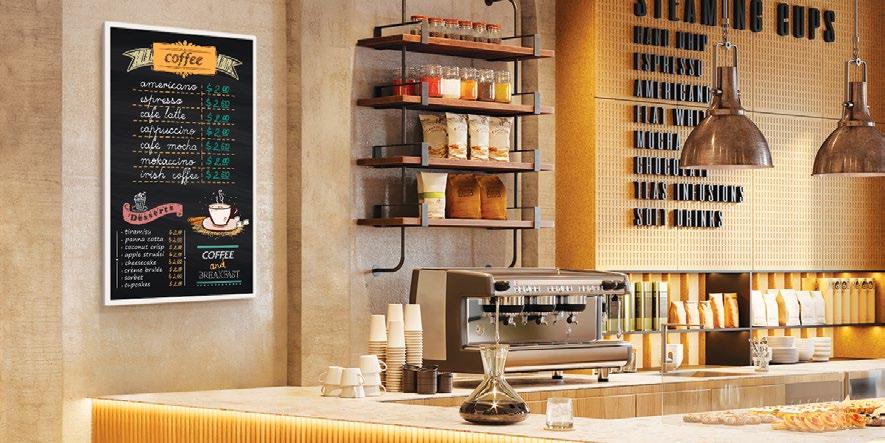
JC: It’s a rapidly growing business. QSRs of all types are deploying some form of signage, from single-store independents with indoor digital menu boards to regional and national chains installing outdoor digital menu boards across all locations. We see more single-panel preview screens positioned along the drive-thru journey and double or triple panel menu boards at the ordering stage. The barrier to entry for vendors is lower than before, as it’s easier than ever to build menu board solutions. The question any QSR or fast casual restaurant business needs to ask is whether that solution is scalable and supportable.
The next wave of growth lies in smart menu boards powered by analytics. QSRs can use this data in real time to make updates across the network, right down to individual locations. The era of rotating static carousels of images and videos is over. Today’s menu boards must integrate with point-of-sale systems for dynamic ordering and with monitoring tools for loss prevention. Data is essential for pricing, product mix, and location-specific decisions, making computer vision a key component of any modern solution.
SCN: What new initiatives are we likely to see from Navori?
JC: A new generation of Navori’s pioneering digital signage software is on the horizon. This next evolution will mark the beginning of a powerful integration of expertise from both Navori and Signagelive. More details will be revealed as we build up to ISE.
PEOPLE ON YOUR BUSINESS Understanding Introverts
Not every Pro AV contributor craves social interaction, and that’s not a bad thing.
By Steve Greenblatt
In the fast-paced, sensory-driven world of AV, where communication and experience are core offerings, much of the attention tends to be drawn to the loudest voices in the room, figuratively and sometimes literally. Whether it’s the buzz of trade show floors, high-energy sales conversations, or motivational team meetings, the AV industry (like many others) often projects an extroverted culture.
However, it’s important to recognize that many of the most essential contributors—those who build, design, support, and deliver AV solutions—are actually introverts. Business leaders and managers who can recognize and understand introverts and adapt their management, communication, and collaboration styles will find that it is more than just good leadership; it’s vital for building strong relationships, boosting productivity, and improving team member satisfaction and retention.
Especially in the AV industry, where roles like programmers, engineers, designers, administrators, finance professionals, and technicians are essential, a large part of the workforce may lean toward introversion. Ignoring their needs or expecting them to conform to extroverted norms could mean some of your most capable minds are being overlooked or misunderstood.
From the outside, introverts can appear quiet, reserved, standoffish, or even unfriendly. While some of these traits can be accurate, knowing how to engage with introverts effectively reduces negative stereotypes and highlights their positive qualities like thoughtfulness, genuineness, and loyalty.
Understanding Introverts in Business
By definition, an introvert is someone who feels drained after spending time with others and needs to recharge alone. An extrovert, on the other hand, gains energy from being around people and can become exhausted if they don’t have social interaction for too long.
Although an introvert’s strength may not be their conversational skills, they usually make up for it with a strong ability to listen and understand others’ emotions. The difference between introverts and extroverts isn’t about who is shy or social—it’s about how people process energy, interact with information, and communicate. Generally, introverts:
• prefer quiet, independent work environments
• need time to prepare for meetings or presentations
• reflect before responding rather than thinking out loud
• communicate more comfortably in writing than in speaking
• avoid the spotlight and prefer not to be the center of attention
• may not volunteer input unless specifically invited
• require time to process information before offering insights.
None of this is a liability. Indeed, it can be a strategic advantage. But only if their working environment is designed to support how they operate best.
Leading with Intention
Leading introverts effectively requires a shift from charismatic leadership to intentional leadership. Managers must understand that silence isn’t disengagement, and a lack of engagement or visible enthusiasm doesn’t indicate a lack of interest or commitment. Here are some things to consider.
Allow time to prepare in advance. Introverts thrive with preparation. Sending meeting agendas in advance, outlining expectations, or even previewing discussion topics can lead to better engagement and more thoughtful input. Springing a question, discussion topic, or idea on an introvert is unlikely to produce the best results.
Create space for introverts to speak. In meetings, extroverts tend to dominate and be the loudest voices. Introverts may not speak up unless asked. Consider structured turn-taking, small-group discussions, or direct invitations, such as, “What’s your perspective on this?”
Offer written channels. Not everyone expresses their best ideas verbally. Encourage email updates, project notes, or written feedback.
Respect recharge time. Avoid overloading introverts with back-to-back meetings. They may need time between interactions to process, regroup, and return to their most productive state.
Team dynamics should balance both extroverted and introverted communication styles. Extroverts tend to voice their ideas aloud, while introverts prefer to process internally. When these differences are misunderstood, introverts may be seen as disengaged while extroverts are perceived as overwhelming.
Fostering a balanced team means:
• valuing different forms of contribution, not just who speaks the most
• ensuring quiet voices are heard and appreciated
• encouraging team members to understand each other’s styles, possibly through personality assessments.
Success-driven teams in AV, and in business
overall, must consider more than just diverse backgrounds; they need to recognize and adapt to the different personalities and work styles of their members. Valuable contributions from introverts are often ignored, overlooked, or excluded when awareness and intentional effort are not focused on ensuring they are acknowledged, included, and heard.
Awareness and Adaptation
In sales or client-facing settings, introverts are less likely to engage in small talk or steer the conversation, but they often excel at relationship building, active listening, and problem-solving. Especially in technical sales, like AV integration, clients may appreciate:
• a thoughtful approach rooted in understanding rather than persuasion
• the ability to listen deeply and align solutions to finer client needs
• preparation, documentation, and clarity over charm or flash.
Sales leaders should not underestimate introverts. They might not be the “closers” in the usual sense, but they are often the reason clients feel understood and trust the organization. Also, much of the repeat business companies get can be traced back to introverts’ hard work, carefulness, and systematic approach.
Another important point to consider in any sales situation is that clients may be introverts. Being able to read and understand them—and apply some of the same principles previously discussed—will enhance the ability to be effective and can be the difference between successful and unsuccessful client engagements.
Misunderstanding or mismanaging introverts can be a blind spot for both extroverts and introverts. It can even become a quiet organizational killer, particularly when introverts are in the minority. Leaders need to become students of their teams, adapting not only who they are but also how they engage.
For introverts to shine, they must be seen, heard, and appreciated—not forced to fit an extroverted mold, but valued for what they contribute. As leaders, managers, and colleagues, the simple invitation is to listen more deeply, ask more purposefully, and create space for the quiet strength that moves business forward.
Steve Greenblatt, CTS, is the founder of Control Concepts, Inc., which provides specialized software and services for the Pro AV industry. Contact him at steveg@controlconcepts.net.
Trends 2026: Pro AV Hangs Tough
Manufacturers and integrators demonstrate adaptability with current industry obstacles and opportunities.
By Carolyn Heinze
Global instability, technology disruption, and a drastic shift in trade practices continue to affect business as we head into 2026. One thing is clear: The uncertainty continues, but so, too, does the demand to keep moving forward regardless of how unpredictable things are. Here’s what is on the minds of AV professionals as the industry ramps up for another year.
Trust Issues and AI
AI has a significant presence in Pro AV, with its integration into PTZ cameras, speakerphones, and transcription and translation tools. For Aaron Xia, CEO and co-founder of Telycam, the next trend to watch is AI’s evolution from being an assistant into becoming a more autonomous operator in, say, the production environment, where systems would be able to predict what users need and make changes in real time when needed.
“For example, in multi-camera live streaming, PTZ cameras would be able to communicate with each other and analyze the environment to automatically coordinate camera switching and live directing based on the scene,” Xia illustrated.
That said, Xia recognized rolling out these features isn’t without its challenges. “The main obstacles to breaching this barrier have been a lack of sufficiently diverse real-world data and limited on-device processing power within individual AV products for that level of AI,” he explained. He added that privacy concerns, as well as the need for ultra-low latency, render it difficult to train and deploy advanced AI models capable of operating effectively in live production settings.
Jason Roberts, VP of workplace strategy at FORTÉ, also noted that data collection and integration remain an obstacle to AI’s evolution within Pro AV. “Most AV environments have dozens of disconnected systems— from meeting platforms, room schedulers, control processors, and sensors—all generating valuable insights, but very few of those systems speak the same language,” he observed. “Without that interoperability layer, AI can’t reach its contextual depth or deliver meaningful automation.”
Trust is another issue that AI must address, Roberts added. Many companies won’t go all-in on AI until they are confident that it’s reliable and transparent about what exactly it’s doing with their data. “Organizations are understandably cautious about letting AI make autonomous adjustments in live collaboration spaces, especially in industries with
strict privacy or compliance requirements,” he said.
Bill Chamberlin, president of Verrex, believes that one of the next applications for AI in Pro AV is selfrepair, which could improve integrators’ efficiency significantly. “I think we’re going to see a lot of growth with proactive break/fix and self-healing,” he said. “Even today, with some of the systems out there, you can write proactive scripts so if it’s not seeing a display or it’s on the wrong port, it’s automatically fixing itself.”
Not only does this capability eliminate the need to roll a truck to resolve these issues, but Chamberlin said it also builds increased trust in the systems AV professionals are deploying.
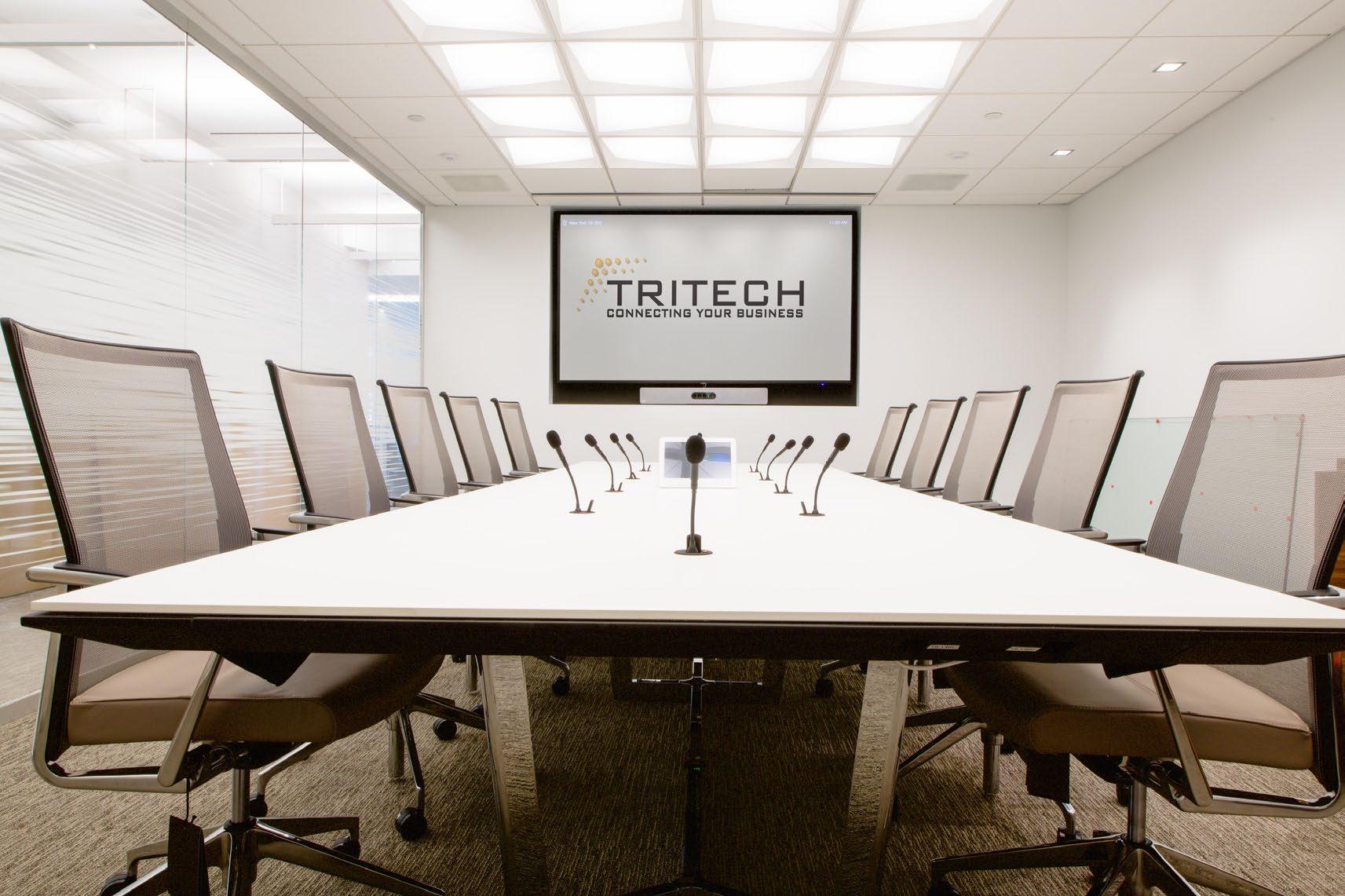
According to Rob Pickering, director of technology at TRITECH Communications, for clients to truly benefit from AI, AV integrators need to understand how they are already using it and their goals for leveraging it in the future. This requires determining what AI tools organizations have already deployed and examining how Pro AV solutions intersect with these technologies.
“If you think about something like Copilot, how is that client using it?” Pickering asked. “To what level does it come into the conference rooms? What are the features that we need to [provide]?” Integrators should be thinking about their systems in the context of the client’s entire workday, he added.
On an internal level, Pickering would like to see AI technology that can create a set of drawings (a baseline design) that teams can then review, edit, and validate.
He also sees the potential for AI to streamline the design process for system upgrades. For this latter application, AI would analyze previous deployments and summarize that data, giving designers quick insight into the customer’s present technology profile. AI is also being tasked with voice messaging, audio translations, written transcriptions, and even script summaries. "With the latest advancements in AI come dramatically improved options to reach people from a variety of languages and reading or hearing abilities, while maximizing consistency in the quality of announcements and messaging," said Bill Bennett, media solutions architect at ENCO Systems.
For example, AI can create very humanlike synthetic or modeled voices and offer real-time translation in multiple languages. In fact, GenAI can go further, summarizing an emergency weather report, creating a script from the report, and creating a voice recording that can be dispersed. "Now, when it's 3:00 in the morning and the gruff voice of a sleepy security guard is all that's available, AI can create a quality of voice that can be consistent day in, and day out," Bennett said.
While AI is that powerful, it's not quite that easy. "Like any new technology, AI requires some skill in learning how to choose from the multitude of technology options in the marketplace, including how to adapt to the workflows and signal and file formats required in the professional audiovisual industry in ways which are both reliable and efficient," Bennett added. "Designers and integrators need to trust in
Integrators are seeing more demand for larger displays, with some customers using them as design features.
BUSINESS TRENDS FOR 2026
resources who have been doing this already, to help get them up to speed. ENCO has more than 1,000 broadcast customers using AI tools to create their messaging, many in fully automated settings, which is not dissimilar from messaging and announcing in commercial spaces where quality and consistency are key to repeatable, understandable messaging, regardless of the audience."
Dishing on Displays
Outside of the impact that tariffs may have on display technology, Chamberlin estimated that the Pro AV industry will continue to see price decreases, which will, in turn, render large-format screens more accessible to a wider client base. “It will make it more [feasible] to put large-format displays in more multipurpose spaces, more experience centers, and things along those lines,” he offered. “It’s just going
to make it more affordable.”
Pickering also sees an uptick in demand for larger displays. “Spaces are scaling up, meaning newer technologies are allowing larger displays to be rapidly ordered, deployed, and commissioned to where it was just not possible before,” he said.
This is because, in part, several manufacturers are packaging their offerings in a more streamlined fashion, according to Pickering, which simplifies both procurement and installation. “Manufacturers have provided an ordering mechanism [where the display] comes with everything,” he explained. “It’s a single SKU. It’s got the mounts. It’s one line item on a bill of materials.”
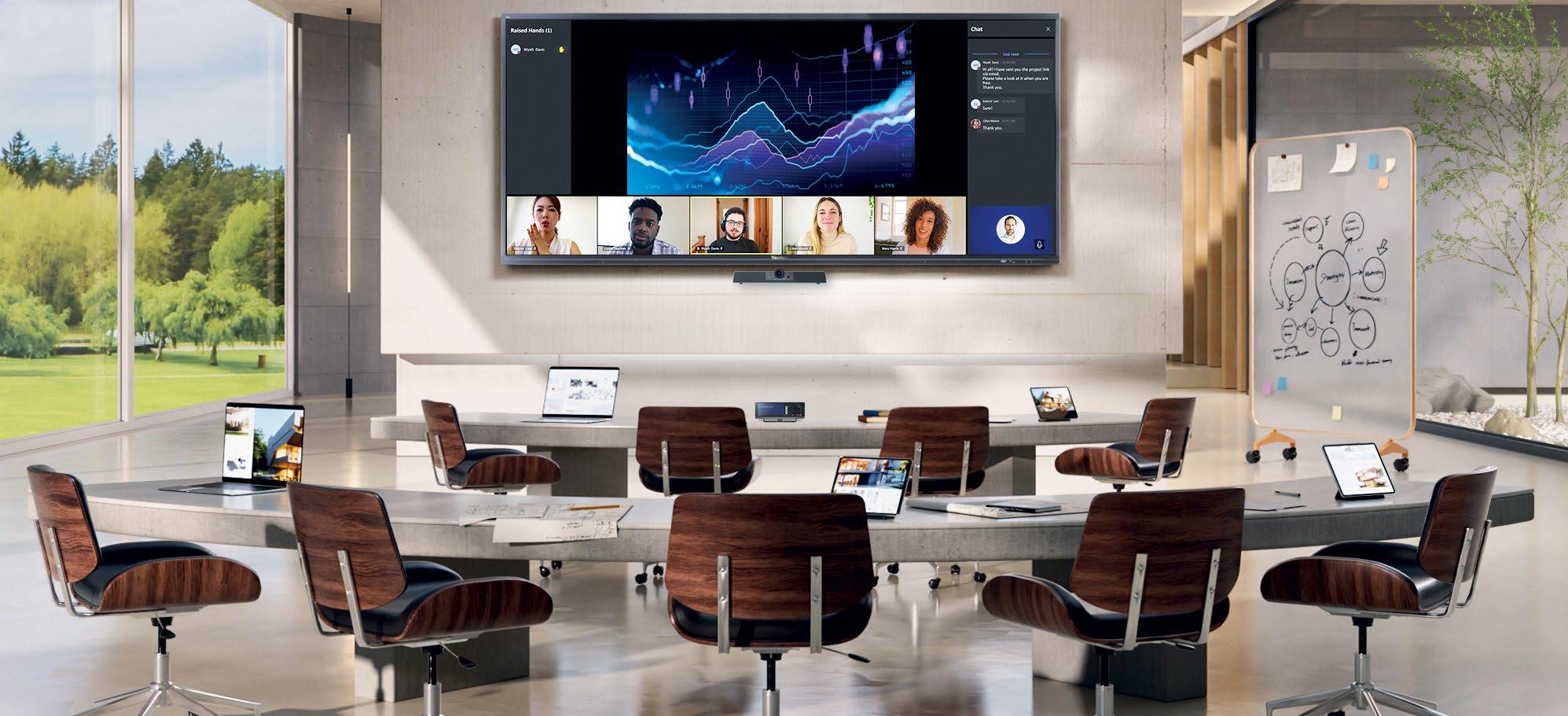
For hybrid meeting environments, FORTÉ’s customers are standardizing on 21:9 displays for executive boardrooms, high-end collaboration spaces, and innovation centers, according to Roberts.
He said clients like the aspect ratio’s support of immersive layouts (such as Microsoft Teams Front Row), and also appreciate its wider perspective, which creates more meeting equity between on-site and remote participants.
“The added horizontal real estate enables dynamic content zones for people and data that create a more engaging visual balance and reduce cognitive fatigue during long meetings,” Roberts added.
At Planar, chip on board (COB) will continue to be a focus in 2026. Robert Detwiler, senior director of product management, called it a “mainstay” within the company’s LED offerings. He also predicted the arrival of the next generation of MicroLEDs in the coming year.
Additionally, Detwiler pointed out the growing number of facilities that are treating their displays as a design feature. “Displays need to blend into the architecture or be designed to work with architecture,
From left, Aaron Xia, Bill Bennett, Jason Roberts, Bill Chamberlin, Rob Pickering, Robert Detwiler, Chuck Lewis, and Paul Harris
BUSINESS TRENDS FOR 2026
as spaces become more and more highly designed,” he said.
While Planar will continue to invest in LED, the company also acknowledges the continued demand for large-format LCDs, tiled LCDs, as well as smallerformat touchscreens and desktop monitors. “LCD displays are a very good option for space-constrained environments and applications that require the highest resolutions,” Detwiler said. “While the cost of LED continues to be more accessible, the cost of LCD displays continues to remain below LED.” This is why, he explained, Planar remains committed to expanding and improving its LED family of products.
Palmer Digital Group manufactures indoor and outdoor digital kiosks, display enclosures, and menu boards. Chuck Lewis, EVP at the company, believes the incorporation of voice-activated AI into digital kiosks and signage will become increasingly prevalent. He noted that this feature can be especially helpful in quick service restaurant (QSR) applications, as well as retail.
“For example, you can go into a clothing store, approach one of our kiosks, and ask it where you can find women’s jeans,” Lewis illustrated. “It can direct you to the right aisle without you having to wait in line [for a salesperson] to tell you [where you go].”
Trial of the Tariffs
Few would argue that predicting the 2026 tariff landscape is possible. However, one could submit that navigating today’s trade climate requires similar skills to those AV professionals applied during the pandemic, such as adaptability, agility, and communication. But while this industry may have refined these chops just a few years ago, it’s becoming apparent that when it comes to tariffs, everyone pays in one form or another.
Take Aurora Multimedia, for example. It’s a U.S.-based AV technology manufacturer, its assembly line is in the United States, and it employs American workers. It is, as CEO/CTO Paul Harris quipped, “living the American Dream.”
If all of this is true, why is Harris quipping about anything right now? “Made in the USA” companies shouldn’t be complaining—aren’t they benefiting from the tariffs? Maybe some are. But if you’re an AV tech manufacturer, you probably need to source a few rather important bits and pieces from overseas to make your complex electronics. That means that you’re paying tariffs.
“If you’re putting tariffs on the raw materials that are only made overseas right now, and you don’t give me an exemption, you are causing me to pay a higher
price for those materials,” Harris explained.
For Aurora Multimedia, that’s not a hypothetical concern. The semiconductors essential to its AV over IP product lines are produced exclusively in Taiwan. With no tariff exemptions in place, every shipment carries additional cost.
Another challenge, according to Harris, is blanket ordering—purchasing components in bulk under long-term contracts. While those agreements lock in pricing, new tariffs are applied to any units that haven’t yet shipped, causing unanticipated cost spikes.
“All of a sudden, a product that cost $300 to build might now be $600,” Harris said. “You’re playing an odds game. If you think a trade deal is coming, you might wait a month or two, but in doing so, you risk gaps in your supply chain.”
That wait-and-see strategy can quickly backfire. Delays make parts harder to source, and scarcity drives prices even higher. “Simply put,” Harris said, “it’s a mess.”
Aurora has done its best to minimize the impact all of this has on its customers by absorbing some of these costs. However, despite the desire to avoid passing on these new expenses to its clients, it cannot continue to absorb everything.
“I think everybody is realizing we have no choice,”
BUSINESS TRENDS FOR 2026
Harris admitted. “You’ve got to [add] a separate line item that says ‘tariff,’ [and] you’ve got to accept the fact that this is the way it’s going to be.”
At TRITECH, regular communications between project teams and clients help everyone continue to move forward. Pickering explained that the firm includes language in its proposals that alerts clients of the potential need to reassess pricing when and if tariffs change.
For Chamberlin, an attitude of acceptance helps companies better focus on their core purpose. After all, he said, tariffs are just tax. He acknowledged that over-communication with both clients and employees helps to reduce the level of panic that can manifest in the face of uncertainty, as was the case during the pandemic. “Our job as our clients’ partner is to help guide them, and be the voice of calm, and really look at things long term,” he added. Roberts has observed a transition from what he calls “short-term reaction” into “strategic recalibration.” He argued that in recalibrating, integrators will need to be agile to serve their clients well. In conversations with customers, FORTÉ is highlighting the benefits of scalable solutions that can be adapted when required, while at the same time providing the features that clients need.
“Organizations will increasingly favor partners who can guarantee availability, interoperability, and long-term service continuity, not just deliver hardware,” Roberts said. “Internally, our teams have focused on design flexibility, building solutions that can pivot between platforms, components, or brands without compromising performance or user experience.”
For Roberts, being agile and flexible means that system designs shouldn’t be reliant on one manufacturer or even one supply region. “The integrators who succeed in 2026 will be the ones who can flex, offering equivalent solutions, consistent performance, and continuity of service even when sourcing challenges arise,” he added.
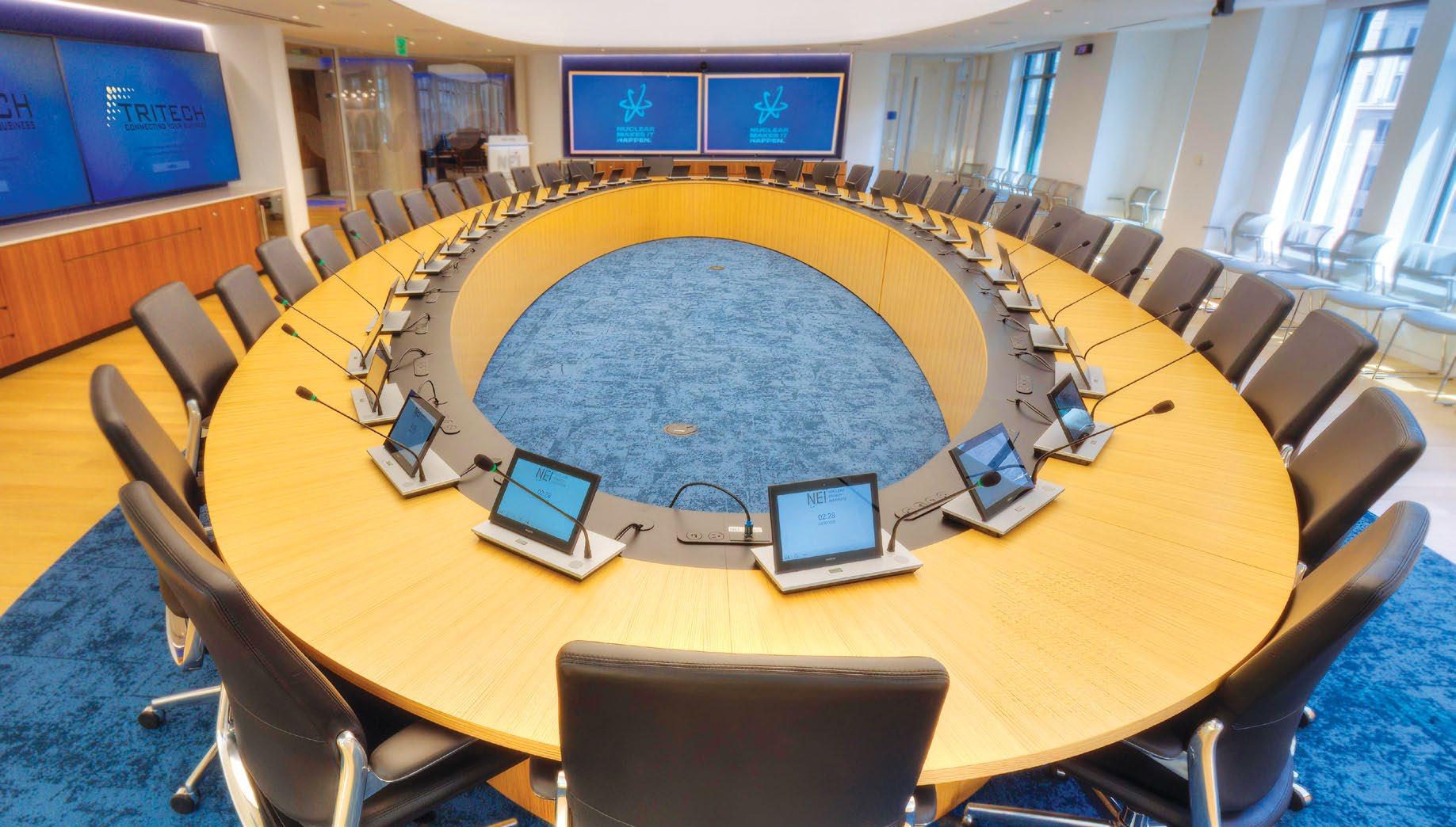
While the industry faces questions about AI and other technologies, business for integrators continues, such as TRITECH’s recent delegate system project for the Nuclear Energy Institute.
E-Paper Makes Its Case as Digital Signage Option
It’s sleek, sustainable, and you can put it (just about) anywhere.
By Carolyn Heinze
If you’ve ever swiped through a Kindle, or any other e-reader, you’re already familiar with electronic paper, or e-paper, at least on a consumer level. For Pro AV, however, there are a few more things to know beyond how to download the next Stephen King novel, if you wish to gain sales while informing clients about the pros and cons of this technology, and how it fits into their communications and sustainability goals.
For Till Gotterbarm, VP of business development at AUO Display Plus, a Taiwanese commercial and industrial display company that acquired Avocor in 2024, e-paper offers AV integrators yet another opportunity to help customers deliver their messaging. “We’re really addressing a market where the AV integrator can extend their value to large, global corporations and even SMBs,” Gotterbarm said. “Now you can provide something very new.”
Screen Comparisons
E-paper is basically a digital version of paper-paper.
Timothy O’Malley, assistant VP for the U.S. Regional Business Unit at E Ink, explained that the combination of electronic ink film with patterned electronics results in e-paper displays (also known as electrophoretic displays or EPDs) that don’t require much power and can be positioned in places unsuitable for traditional video screens.
Christopher Kwon, director of product marketing, smart signage, at Samsung Electronics America, noted that one of e-paper’s primary elements is its bistability, meaning that people can view its content even when the
device is not drawing power. “This property allows e-paper displays to maintain an image for long periods with extremely low energy use, making them an energy-efficient signage option,” he said.
While LCD and LED displays require constant power, e-paper does not. “Once an image is set on the display, it stays in place without drawing any power until it next changes,” O’Malley explained. Devices can be battery and even solar powered, which decreases the need for wiring and increases energy savings. (Wired connection is possible too, via PoE or USB-C, for example.)
Not only does this make e-paper more energy
efficient, it also results in cooler devices, since they don’t produce the heat of traditional video displays. They’re also easier to view in direct sunlight. “E-paper reflects ambient light the same way as ink on paper,” O’Malley noted, “which makes it comfortable to view in bright or dim environments without straining the eyes or consuming large amounts of energy.”
Another difference between video displays and e-paper is how the two technologies use light. According to Kwon, LCD and LED screens need a constant backlight to generate images. On the other hand, the charged ink particles in e-paper reflect ambient light. “This approach reduces glare and maintains excellent
From left, Till Gotterbarm, Timothy O’Malley, Christopher Kwon, Victoria Fox, Bart Wouters, and Kevin Christopherson
Sharp’s new EP-CA22 e-paper display is ideal for bright areas like retail stores and more.
BUSINESS DIGITAL SIGNAGE
visibility even in bright conditions,” Kwon added, arguing that like paper, e-paper delivers its best viewing experience in bright spaces.
Kwon added that lightweight, ultra-thin displays, such as Samsung’s Color E-Paper, are a good option for spaces where smart signage is better than traditional paper, especially if the messaging needs to be updated regularly. Like video-driven digital signage, e-paper can be updated remotely—in Samsung’s case, through its VXT management platform or its E-Paper mobile app.
E-paper also has an advantage in environments with few or no power sources, little to no wiring, and limited mounting options. “This combination of low power consumption, portability, and remote updating makes e-paper well suited for areas without a permanent power source,” Kwon said, adding that features such as network standby off mode and sleep mode serve to increase energy efficiency even more.
Current Use Cases
Aside from energy savings, e-paper enables organizations to maximize their technology usage, argued Victoria Fox, global head of communications at Philips Professional Display Solutions (PPDS). Plus, e-paper can help organizations work toward their sustainability goals associated with technology acquisition and inventory management. “The fact that it is so portable—and it can be moved around from location to location rather than it being stuck on a wall or on a mount that has to stay in one place— means that people can make much better use of it,” Fox added.
Bart Wouters, international product manager of professional displays at PPDS, said that right now, e-paper is best suited for displaying static images. While there are e-paper technologies that can run video, he said they are “very limited in the amount of color that the product is capable of showing.” As a result, it is less than ideal for signage applications involving advertising and branding, since most brands
have very specific requirements related to the color accuracy of their logos and the reproduction of other marketing materials.
“We don’t really see it as a replacement for LCD,” Wouters admitted. Instead, e-paper is an additional option for certain use cases.
That’s not to say that manufacturers aren’t striving to improve the color quality of their e-paper offerings. Late this summer, for example, Sharp launched its EP-CA22 28.6-inch diagonal Advanced Color ePaper display with a 180-degree viewing angle. Based on the A2 poster print size, the model delivers more vivid colors and high contrast, according to Sharp. Kevin Christopherson, Sharp’s director of display product marketing, noted that the new model, which features SoC technology and doesn’t require power when showing static imagery, offers a sustainable display choice to customers while also providing AV integrators with a solution that’s easy to install.
Because e-paper displays are low power and perform well in high ambient light conditions, like their old-fashioned counterpart, they make for good reading in both commercial and educational purposes. O’Malley noted that they are used for Digital Out of Home (DOOH) advertising, wayfinding, and electronic shelf labels in big box stores.
Transit is another growing use case. For example, the Massachusetts Bay Transportation Authority (MBTA) is currently piloting solar-powered E Ink displays to provide real-time scheduling information to passengers. Plus, Papercast, which has deployed e-paper solutions in dozens of countries, recently installed E Ink displays at bus stops in downtown Los Angeles for LA Metro to help keep passengers informed about arrivals and departures.
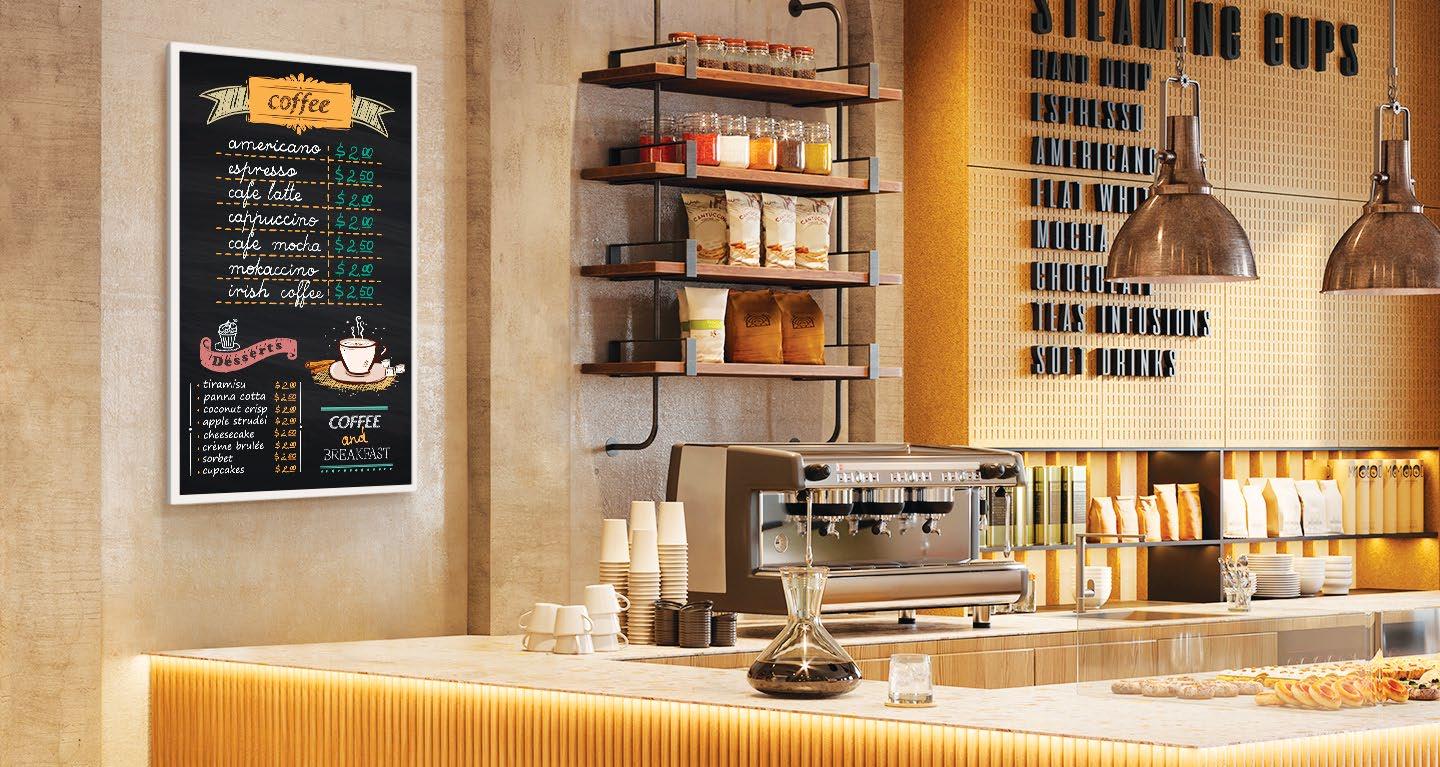
Kwon points to dining as another prime e-paper use case. He relayed that an event catering company recently swapped out its chalkboard menu with a 32-inch Samsung Color E-Paper display, managed through the manufacturer’s VXT platform and Samsung E-Paper mobile app. “The lightweight,
E-Paper Deployment Considerations
E-paper products aren’t like traditional video screens, which requires AV designers and integrators to adopt a slightly different mindset. Bart Wouters from PPDS offered a few key points to consider before embarking on a rollout.
• The more ambient light, the better e-paper works. “It’s like a piece of paper; if you open your newspaper in a dark room, you will not be able to see it,” Wouters explained. “Don’t put it in a corner that’s very dark with no lighting—that’s not the best location for it.”
• One display can serve multiple locations. E-paper’s portability makes it a good option for creating movable point-of-sale advertisements or educational displays. “This is a clear advantage of e-paper technology: Because it doesn’t need power to show an image, it is portable,” Wouters said.
• There are still limitations associated with color accuracy. If the client has strict requirements for the pantones featured in their brand’s logo, e-paper is probably not the best choice … at least not right now.
ultra-thin design makes it easy for staff to transport and set up at different venues, eliminating the need to manually update the menu, and reducing setup time,” he explained.
Meanwhile, Restaurant Nenuphar, a fine dining and events establishment outside of Ghent, Belgium, replaced its paper signage with Philips Tableaux e-paper displays. Now the business can easily update content to coincide with the time of day, current customers, or even weather conditions.
Gotterbarm emphasized that e-paper provides AV integrators another way to assist customers with their communications needs. “It’s a good thing for integrators,” he added, “because they can add value if they take the time to understand it.”
E-paper solutions from Samsung and others can be good replacements for paper signage that needs regular updates.
The MBTA is using solar-powered E Ink displays to provide scheduling information.
VIDEO DISPLAYS AND MOUNTS
SPONSORED BY AVOCOR • JUPITER SYSTEMS
Ultra-widescreen 21:9 displays from ViewSonic and other manufacturers are gaining popularity but are still considered niche.
Wide Appeal for UltraWidescreen Displays
More horizontal real estate is a useful feature for many applications.
By James Careless
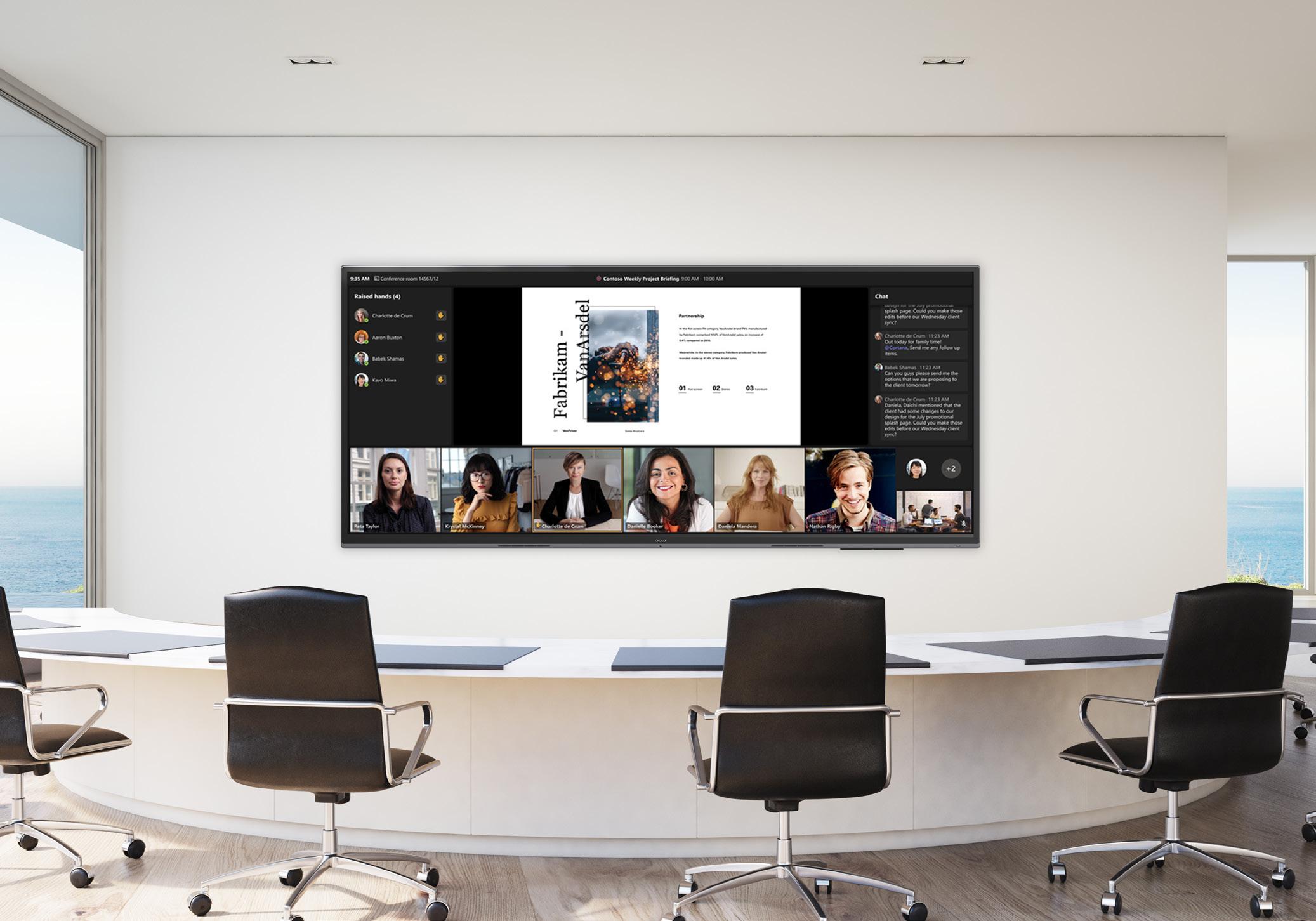
For the past few years, Microsoft Teams has been promoting 21:9 ultra-widescreen displays as a more inclusive viewing experience for videoconferencing rooms. Indeed, the 21:9 format offers approximately 31% more horizontal display area than a 16:9 screen of the same vertical height. This is why 21:9 displays are being used to support Microsoft Teams’ Front Row feature, along with immersive gaming and eye-catching video presentations.
However, despite the eye-catching ultrawidescreen advantages, Keith Yanke, Sharp’s VP of product and solutions marketing, told SCN that traditional displays significantly outsell 21:9 displays.
That assessment is endorsed by Rob Meiner, Peerless-AV’s senior technical solutions engineer. “While 21:9 displays are gaining popularity and increasing in demand,” he explained, “traditional 16:9 displays remain predominant in many categories, as ultra-wide displays are still considered a more specialized offering. Recent reports project market growth for ultrawidescreen displays at a compound annual growth rate
[CAGR] of around 10% from 2026 to 2033.”
So, what happened? “After the initial announcement from Microsoft, the topic of 21:9 display solutions was common, but it never really translated into additional sales,” offered Rob Pickering, Tritech’s director of technology. “Some clients may install one or two specialty rooms to validate the experience but keep the majority at 16:9.”
Compelling Applications
Despite 21:9’s slow sales growth, there are many compelling Pro AV applications for the technology. The standout application is in conference rooms and hybrid meeting spaces that use Microsoft Teams in the Front Row layout, or other UC solutions that benefit from ultra-wide video and graphics presentations.
A key advantage of the 21:9 aspect ratio in these spaces is its ability to boost productivity and streamline multitasking. As Meiner noted, “It’s especially beneficial for professionals managing multiple spreadsheets, communication platforms, creative assets, and organizational dashboards simultaneously. Compared to a dual-monitor setup, a single ultra-wide display offers a more seamless and cohesive layout, eliminating visual interruptions that can come from
misaligned screens. By consolidating content on one clean display, users can improve focus, reduce eyestrain, and work more efficiently and accurately.”
“Using ultra-widescreen displays can avoid the downfalls of dual screen setups by not having a bezel,” Yanke agreed. “In some cases, this setup provides a better experience for content and collaboration.”
Plus, the “wow” factor should not be discounted. “Spaces with 21:9 displays can create a more immersive feeling and provide more pixels when sharing documents on screen,” said Pickering. “Since they’re not super common, they can also create an elevated feeling when first participating in the space.”
21:9 displays are well suited to nonvideoconferencing applications as well. “This ultra-wide format provides graphic designers, photo and video editors, and other creative professionals with a more ergonomic workspace, ideal for displaying timelines, tools, full mockups, and side-by-side comparisons on a single screen,” Meiner said.
“Professionals who frequently work with large spreadsheets or detailed data sets, such as financial analysts, can also take advantage of the ability to view multiple windows simultaneously without the need to toggle between them or use an additional monitor.”
In educational environments, ultra-wide displays can enhance classroom settings by enabling the display of multiple content types, such as lecture videos alongside slides, simultaneously. “This facilitates student interaction and offers a more immersive experience, particularly in hybrid learning scenarios,” Meiner added.
Finally, 21:9 displays also provide Pro AV integrators and managers with greater operational flexibility in AV integration. This is because 21:9
INTEGRATION GUIDE VIDEO DISPLAYS AND MOUNTS
displays can show multiple simultaneous video sources without requiring operators to switch inputs or add extra screens during immersive presentations. This makes 21:9 displays particularly useful in highengagement business settings such as training rooms, command centers, and client pitch environments.
Installation and Cost Considerations
Compared to traditional 16:9 displays, 21:9 displays are physically wider and heavier. This means that they require larger and more robust wall mounts that can support their size and weight. “It doesn’t necessarily complicate installation, but there might be some unique considerations, such as having an extra person to help lift the display because it’s so wide,” said Jeff Muto, director of product management with ViewSonic Corporation.
“In smaller rooms, ultra-wide screens may also present viewing angle challenges for people seated at the edges,” Meiner added. “This is where curved 21:9 displays offer an advantage, by helping to maintain consistent visibility across a wider viewing area.”
Adding a 21:9 video format to a room’s playout system can also pose problems. As Meiner observed, many software applications and user interfaces, such as videoconferencing apps, are primarily designed for the standard 16:9 aspect ratio.
Plus, most videos are not 21:9. “Content compatibility can be an issue,” added Yanke. “Standard 16:9 material may not scale properly on a 21:9 display, leading to stretched images or black bars on the sides when content doesn’t match the ultra-wide format.”
B eyond these factors, Muto said cost is the primary drawback. 21:9 displays cost more than 16:9 displays—not just because they are larger, but also
because they are not being produced in the same volumes. As a result, mass-produced 16:9 displays benefit from per-unit economies of scale that nicheproduced 21:9 displays do not.
Is 32:9 the Answer?
The 21:9 display format was created to provide a wider viewing experience than 16:9 monitors, but it does so using a format that doesn’t always play nice with 16:9 content. This is why 32:9 “super ultra-wide TVs” are now being produced. The advantage of this format is that it can display two 16:9 video streams side-by-side in their original aspect ratios, like having two regular 16:9 monitors together without the distracting center bezel.
“This is why 32:9 is definitely a thing,” said Muto. “However, a single, super ultra-wide 32:9 panel can present some logistical challenges, especially in terms of mounting and transport. This is why ViewSonic offers a flexible alternative with our LDC series dvLED displays, which are configurable to achieve a 32:9 layout.”
“We see more of a need for 32:9 than 21:9,” noted Yanke. “With that said, whether it is 21:9 or 32:9, we
are not sure these solutions are catching on outside of those spaces that require these wide aspect ratios. But yes: The 32:9 is more appealing because of the ability to simulate two 16:9 screens side by side.”
Given the above considerations, the experts agree that 21:9 displays will remain niche for now. “While wider displays are gaining momentum in meeting rooms, hybrid work setups, learning environments, and productivity-intensive roles, they are unlikely to fully replace the widespread use of 16:9 displays,” said Meiner. “Standard consumer TVs, typical office setups, and classrooms equipped with 16:9 projectors or flat panels are much more wellestablished and may remain the norm for the foreseeable future.”
“21:9 display sales are growing, but there is a long way to go before it can be considered mainstream,” Muto concluded. “In the short term, 21:9 will remain niche due to some of the things discussed like price and content compatibility. But if hybrid meetings continue to be the norm, we’ll likely see greater adoption of 21:9 devices in meeting/conference rooms as displays are refreshed.”
From left, Jeff Muto, Keith Yanke, Rob Pickering, and Rob Meiner
Beyond standard boardroom tasks, 21:9 displays from Sharp and others can help deliver a "wow" factor.
INTEGRATION GUIDE VIDEO DISPLAYS AND MOUNTS
At Issue
When it comes to video displays for conference rooms, how big is too big?
Dan Baker
Senior Technical Business Development Manager, LG Electronics USA
There’s no single rule for “too big.” While large conference rooms often take center stage, it’s the smaller spaces like huddle rooms, focus rooms, and overlooked corners that power everyday collaboration. High-resolution displays should facilitate dynamic content sharing and provide a focal point for presentations without overwhelming the environment. Turnkey, room-in-a-box solutions like the Express Install Video Conferencing Solution from LG, Jabra, and Salamander
Designs unify displays, videobars, and furniture into one ready-to-go kit, helping organizations deliver reliable, user-friendly video collaboration experiences across every room, making video accessible from flagship boardrooms to compact spaces alike.
Jeremy Sternhagen
Technical Marketing Manager, Planar Conference rooms come in all uses and sizes, so the ideal size of a video display depends on the room’s dimensions, content being displayed, and optimal viewing distance. For large conference rooms with a viewing distance of 20-plus feet, one should consider an LED display. When considering the size, pixel pitch plays a crucial role in image clarity and resolution. Video walls with ultra-wide aspect ratios are a popular choice for today’s conference rooms, allowing organizations to simultaneously view multiple sources of content while collaborating with teammates near and far. LCD displays can be well-suited for small conference rooms, providing excellent viewing experiences when the farthest viewer is less than 20 feet away.
Ben Hardy
Senior Product Manager, Sharp
There are several factors to consider when selecting the right display size for your conference room, including viewing distance, content resolution, anti-reflective panel properties, and brightness. The standard viewing distance for the best comfort and clarity for UHD resolution content is roughly 1.6x the display’s height (per ITU standards), but this is even greater with FHD resolution with an approximately 3x multiplier instead. At Sharp, we offer displays from 32 to 98 inches, with projection and dvLED options for larger environments. The goal is to create clear, engaging visuals that support effective collaboration in any meeting space.
Dana Corey
SVP and General Manager, Avocor
Ultra-wide 21:9 displays are redefining conference rooms by creating immersive, inclusive environments bridging the gap between remote and in-room participants. The key is balance: The display should enhance engagement and clarity without dominating the space or distracting attendees. 21:9 isn’t just a wider screen; more importantly, it’s a strategic shift toward richer content and natural collaboration with future-ready flexibility. The right fit better complements room proportions and seating, ensuring technology enhances communication rather than becoming the focal point. Size should serve purpose, not overwhelm. Ultra-wide displays, when balanced with purpose, transform meetings from routine to remarkable.
Dimitris Katsis, Ph.D.
Director, Display Engineering, Jupiter Systems
When determining the ideal display size for conference rooms, “too big” is rarely a technical concern.
Technology-forward display manufacturers now offer a variety of 21:9 sizes as well as modular LED walls, enabling virtually any size or configuration. The real challenge lies in selecting displays that match the room’s dimensions, viewing distances, and audience needs, ensuring those farthest away can see details clearly without creating distortion or visual strain for those seated closer. Ultra-wide displays offer a particular advantage, aligning with the human eye’s naturally wider horizontal field of view. When properly planned, larger or wider displays feel more natural and immersive rather than excessive. In short, thoughtful design eliminates the perception of “too big.”
INTEGRATION GUIDE VIDEO DISPLAYS AND MOUNTS
Sharp MultiSync PN-M2
With exceptional brightness and stunning visual clarity, Sharp’s MultiSync PN-M2 Display Series delivers premium, large-format performance backed by 40 years of display innovation. Designed for 24/7 reliability, these professional displays feature SpectraView Engine technology for vivid, out-of-the-box, color-accurate imagery, as well as a USB-C connection, with upstream, hub, and power delivery for streamlined setup. Ideal for presenting, advertising, entertaining, or delivering mission-critical information, the PN-M2 Series combines brilliance, versatility, and dependable performance in any environment.
Planar Komodo Series
The Planar Komodo Series introduces premium, ultra-fine pixel pitch LED video walls in 0.7, 0.9, and 1.2mm pixel pitches, delivering visual excellence for demanding indoor applications. The series combines chip on board MicroLED technology for energy efficiency and durability, with an advanced manufacturing process that presents unmatched color uniformity and viewing angles. Designed to support today’s most in-demand formats, including 16:9 and 21:9, Planar Komodo Series is ideal for conferencing, unified communications, hybrid collaboration, and other applications benefiting from ultra-wide 5K
LG Express Install Video Conferencing Solution
The LG Express Install Video Conferencing Solution for Microsoft Teams Rooms (Model EXROOM-01.EUS) is a turnkey system that transforms any space into a high-performance hybrid meeting room in under 90 minutes. Featuring an LG 4K UHD display, Jabra PanaCast 50 videobar, and Salamander Designs Acadia tabletop stand, it delivers professional-grade video, audio, and cable management in one streamlined package, eliminating complex mounting or wiring to enable fast, consistent, and connected collaboration across enterprise environments.
VIDEO DISPLAYS AND MOUNTS
Jupiter Systems Pana 81T/81D
The Pana 81D and Pana 81T from Jupiter Systems are the only 81-inch ultra-wide 21:9 5K displays on the market, offering 33% more pixels for enhanced collaboration in hybrid workspaces. Available in touch (20-point capacitive) and non-touch variants, the Pana 81 features 700 nits brightness, 60Hz refresh, 65W USB-C power delivery, and built-in speakers. Its size is ideal for medium-sized conference rooms and executive briefings.
Avocor L Series / E92
Avocor’s ultra-wide displays redefine the modern workspace with expansive 21:9 canvases engineered for next-generation collaboration. Available in touch and non-touch models, including the premium brushedaluminium L Series and the highly versatile E92, these 5K solutions deliver crystal-clear detail, exceptional usability, and a sleek, contemporary aesthetic. Designed for hybrid workflows, they provide ample space for ideation, content, and remote participants, transforming meeting rooms into dynamic, immersive environments that elevate communication and productivity.
By Mark J. Pescatore
When many people were breaking out their grills for Labor Day cookouts, SCN was reaching out to integrators to help us with our annual overview of the Pro AV industry. The data they provide is the basis for this list, which showcases some of our industry's top integrators. Our rankings are based on the projected revenue from commercial AV systems installations for the current year. (If you want your company to be part of the Top 50, head to our website, avnetwork.com, in September to find our Call for Entries.)
This year's top five should look familiar, with one notable change. AVI-SPL retains the top spot, followed by Diversified. But FORTÉ, formerly known as AVI Systems, moved up to third ahead of Ricoh and EOS IT Solutions, with about 11% in additional revenue over its 2024 numbers.
As part of last year’s Top 50, we featured an Executive Q&A with Eric Hutto, who was CEO of Diversified (Paul Lidsky has since been appointed CEO). At the time, the company had narrowed its focus, a shift that moved the company toward taking fewer, higher-value projects. “The outcome has been a growing business with a higher profitability rate,” Hutto said, “allowing us to invest in both our associates and innovative solutions.”
Now, don't worry about Diversified. The company grew its installation revenue in 2025. However, the number of installations dropped
significantly. Company officials confirmed that was by design, as the focus was on larger projects.
Also, government business was disrupted this year—and no, that wasn’t an exclusive issue for Diversified. From the Department of Government Efficiency (DOGE) to reorganization efforts, it has most assuredly not been business as usual at the federal level. That said, Diversified told me they are up a healthy 30% in the house of worship vertical, and there are plans to increase installations in 2026 with more downmarket projects.
Similar to last year, the numbers tell me the industry is healthy, but you'd need a turbo-charged Ouija board and Miss Cleo on speed dial from the afterlife to try and predict revenues among our integrators.
Paladin Technologies, for example, had a good year. Although the company stood pat at number nine, it brought in about $130 million more in 2025, a significant bump no doubt powered by a major jump in installations (from 3,700 to 4,700). American Sound, which debuted on our list last year, moved up a couple of spots in 2025 with a more than 15% jump in revenue from its AV projects.
Meanwhile, TRITECH Communications only had 20 fewer installations than in 2024, but the company dropped two spots and was about $10 million down. Then there’s ITI Systems, which (like Diversified) brought in more money with fewer installations in 2025. Ditto for Cal Coast Telecom, which earned $5 million more this year but with 150 fewer installs.
Before you turn the page, please remember that
all Top 50 submissions are voluntary. The following information is received directly from the participating companies. There is no charge for an integrator to submit their entry, nor do we pay integrators to participate. To my knowledge, there is also no industry-wide movement to invite Uncle Mark to the bookkeeping department and invite him to verify the submitted numbers.
We do not take for granted the fact that dozens of companies share their financials publicly through this list. And we appreciate that the leaders in the participating companies think this list is as important as we do. All of us at SCN hope this year's Top 50 provides you with valuable information about the Pro AV industry.
Honorable Mentions
As in years past, SCN received more entries than we have slots available in the Top 50. The following five integrators were very close to making the list, so don’t be surprised if they move up in 2026.
• Crescent Digital, Cleveland, OH
• PIVIUM, Phoenix, AZ
• VisionPoint, Newington, CT
• ClearVista, Salt Lake City, UT
• SuperTech Systems, Vancouver, BC, Canada
SCN TOP 50
1 AVI-SPL
2 DIVERSIFIED
3 FORTÉ
4 RICOH
SCN TOP 50
5 EOS IT SOLUTIONS
YORKTEL-KINLY
expertise in AV integration, UCC, digital signage, workplace management, event services, and AI-driven managed services, Yorktel-Kinly ensures smarter solutions, consistent delivery, and innovation at scale.
7 IES COMMUNICATIONS Tempe, AZ | (480) 379-6200 | iescomm.com
IES delivers AV systems that work dependably in boardrooms, broadcast centers, and large-scale displays. The focus is on clear communication, smooth connections, and solutions that can grow with the organization. With certified teams and nationwide reach, IES makes complex environments easier to manage and ready for what’s next. 8 PALADIN TECHNOLOGIES New York, NY | (855) 296-3199 | paladintechnologies.com
Paladin Technologies designs and installs technology solutions for companies requiring AV, network cabling, data center, OSP, security, and network services. From the basic conference room to enterprise-wide videoconferencing deployments, Paladin handles all aspects of a project from design to implementation to post-installation maintenance. Paladin’s team consists of in-house programmers, engineers, project managers, and technicians certified to support a wide range of commercial equipment.
SCN TOP 50
9 SOLOTECH
$345 1,350 Installations
Montreal, Canada, and Nashville, TN | (514) 526-7721 | solotech.com
$345 1,531 Employees 20 Locations 48 Years in Business
10 SOLUTIONZ
$273 2,600 Installations
11
Solotech is a global AV and technology provider with expertise in live productions and systems integration. The company offers audiovisual technologies, services, and solutions for a wide array of clients, including corporate offices, educational centers, experiential, live performance, sports, and house of worship venues. The Solotech team also supports music and touring, corporate events, festivals, and special events.
Pacific Palisades, CA | (888) 815-6128 | solutionzinc.com
$274 440 Employees 17 Locations 23 Years in Business
Solutionz delivers AV solutions for audio and conferencing, command and control centers, conference and meeting rooms, lecture hall and classroom technology, digital signage and content creation, professional audio, systems design and integration, video walls and large-format displays, legal/courtrooms, remote monitoring and management, cybersecurity, on-site staffing, integrated support, digital training, device support, and success management.
PAVION Chantilly, VA | (866) 572-8466 | pavion.com
$227
4,700 Installations
12 AVIDEX
$215
2,507 Installations
$212 2,800 Employees 88 Locations 56 Years in Business
Pavion connects and protects by providing design, installation, maintenance, management, monitoring, and support to customers in more than 70 U.S. locations and 23 countries.
Cary, NC | (800) 999-8590 | avidex.com
$180 518 Employees 14 Locations 21 Years in Business
Avidex is a global AV integrator specializing in the design, integration, and support of innovative and collaborative AV solutions. From strategic planning and system design through deployment, training, and managed services/support, Avidex creates an unparalleled client experience. Avidex is a subsidiary of ITOCHU Corporation, a Fortune Global 500 company.
SCN TOP 50
SCN TOP 50
AV SYSTEMS INTEGRATION POWERHOUSE
Experience an unrivalled combination of world-class expertise, innovative solutions and a customer-centric approach.
SCN TOP 50
20 [TIE] AMERICAN SOUND
EKC ENTERPRISES
24
CONSTANT TECHNOLOGIES North Kingstown, RI | (401) 294-7171 | constanttech.com
$68
Constant Technologies designs and implements high-performance, mission-critical video wall systems. It is a trusted commandand-control center solutions provider for some of the world’s most prominent organizations. With more than 40 years of experience as a specialist in mission-critical environments, Constant Technologies has the depth of knowledge and expertise needed to deliver premium-quality visualization solutions built to withstand the 24/7 demands of an operations control center.
SCN TOP 50
SCN TOP 50
SCN TOP 50
PROMOTION TECHNOLOGY GROUP
and digital engagement strategies. The company designs, engineers, installs, and supports scalable systems for national brands—transforming spaces into connected, data-driven environments that elevate customer experiences and drive measurable business impact.
INFINITY SOUND
36 DGI COMMUNICATIONS Billerica, MA | (978) 495-3800 | dgicommunications.com
$28.5 493 Installations $39 70 Employees 1 Location 31 Years in Business
DGI creates seamless AV environments that make communication effortless. From concept to completion, the company designs, integrates, and supports systems that keep teams connected, confident, and ready for anything. Our services span AV integration, LED video walls, digital signage, acoustic solutions, and managed services—helping organizations deliver meaningful collaboration and reliable performance every day. 37 IMMEDIA Scottsdale, AZ | (623) 309-7309 | immedia-tech.com
$28 431 Installations $21.5 68 Employees 1 Location 21 Years in Business Immedia offers design-build commercial technology solutions—including UC, presentation, performance, gaming, studios, and hospitality.
How have tariffs impacted your business in 2025?
Jon Fine, VP of Solution Architecture, Vision Technologies
Tariffs have really shaken the AV industry. Equipment costs, especially for displays and cameras have jumped, sometimes by more than 10%. Integrators are dealing with tighter margins, longer lead times, and
tougher budgeting as suppliers shift where they source products. With tariffs being a moving target, vendors are being forced to add in legal clauses to contracts, which creates angst for many potential buyers. Many companies are turning to U.S.-made options or locking in prices early to stay ahead of rising costs. Overall, tariffs are forcing the AV world to rethink how it buys, prices, and plans projects.
We have seen an increase in costs, some due to tariffs and some simply using the cover of tariffs, which have certainly created a budgeting challenge for our customers. However, the unpredictability around the threat and fluctuation of tariff and policy changes have created a lot of burden for us internally as well. We are either needing to reduce our quote validity dates drastically or having to stock equipment ourselves in anticipation of orders. Even when there are no pricing changes, having to revalidate manufacturer pricing so frequently creates a lot of additional burden to our internal resources. When we stock equipment, there is the financial impact of tying down capital simply to absorb the effects of uncertainty.
Bill Baretz, AV Principal and EVP, USIS AV
What looked to be a cost challenge we approached as a client relationship opportunity. Of course, tariffs created disruptions by destabilizing manufacturer prices: Quoting new projects when we could not hold pricing for more than a few weeks and the added risk on approved projects where we had to absorb costs of the tariffs or have it affect clients. What it came down to was the trust we’d already built with our clients and manufacturer partners, and the shared willingness for us all to be successful. Open communication helped and is still helping us to navigate those challenges.
Travis Askew, COO, Solutionz
The tariffs definitely made us take a pause, catch our breath, and pivot. Just like any other challenge in integration, we had to adapt. It pushed us to find new ways to tighten communication inside the company and with our clients. We also had to be more strategic with every purchase to protect our margin and keep projects moving. In the end, it’s about balance and staying flexible without losing focus.
Get additional insights from these Top 50 integrators and others on the industry's hottest trends, the impact of AI, and more at AVNetwork.com.
SCN TOP 50
$23
TECHNOLOGIES
SYSTEMS Beltsville, MD | (855) 805-4484 | itisystems.com
$21.2
$21
ITI Systems delivers complex, turnkey AVoIP systems. Its range of services includes design, integration, project management, programming, maintenance, and managed services. In particular, the company specializes in dvLED video walls, simultaneous interpretation systems, multicast VTC infrastructure, and multi-enclave environments.
Cal Coast Telecom is a full-service, design-build integrator that bridges the gap between AV/IT and construction. At Cal Coast Telecom, the focus is on AV, security, network, and wireless systems. From startups to enterprises, technology to life sciences, colleges to hospitals, Cal Coast Telecom is active in every vertical.
46 [TIE] APPLIED VIDEO TECHNOLOGY Kimberton, PA | (610) 407-0776 | appliedvideo.com
$20
1996, Applied Video Technology has been the team organizations trust to get it right the first time. Whether building a new space, upgrading technology, or managing ongoing operations, its services are built to ensure systems perform when it matters most—with its people there every step of the way. Applied Video Technology offers consultation and design, system integration and installation, project management, training and support, maintenance and service, and creative services.
By Sean Wargo
EPro AV: By the Numbers
The SCN Top 50 opens a window into deeper industry analysis.
very year, the Pro AV marketplace eagerly awaits the release of SCN Top 50. Not because it’s the definitive take on the state of the channel, but because it represents a touchpoint on how integrators may be faring in the current climate and, of course, who is leading the charge.
We all know self-reported data has its caveats— bragging rights are a key takeaway. But in a market with so little data about how companies are performing, some key insights can be gleaned from the list, particularly when taken in combination with other sources of data.
So, how does the Top 50 fit into the global context of AV integration? Are these 50 companies representative of the greater whole? And what insights can be taken from the top 50 and applied more broadly? Let’s check the numbers.
Collecting Key Stats
As we’ll see, while there is an expected large firm and positivity bias to the data, the Top 50 still provides a useful take on the market. The first data point you might be tempted to focus on is total revenues and then use that to derive a growth rate for benchmarking. Doing so would suggest a declining market, since the total reported revenues dropped from $13.8 billion in 2024 to $9.1 billion in 2025, a 34% decline!
The problem is the revenues are an artifact of who is in the list, so they don’t truly reveal a usable growth rate. A different methodology is needed to get a clearer sense of growth. The total revenue number is at least an indication of the Top 50 market share, once we derive a market total (coming soon).
A weighted average derived from the growth rates of the listed companies provides a much better view of overall growth rates. It starts with calculating growth for each company and then weighing by their revenue contribution to the whole. This reveals a growth rate of about 8% from 2024 to 2025. This may somewhat reflect growth from consolidation or a positivity bias, but it’s a signal that the market did fairly well this year. As we’ll see, it’s also consistent with other sources.
The next and perhaps best data is the average value of an installation. Here, we first calculate the average number of installations per company (2,164) and then use that to derive the average installation value from the total revenues. The result is an average value of $76,385. This is skewed by the inclusion of some of the largest firms in the industry, but it is a fair representation of an installation. We’ll see how it compares to other sources later. For now, having an average installation cost can help with deriving a total value of the channel, if you are able to get the number of projects completed and a count of companies.
Keep It in Context
For context, we’ll start with AVIXA’s Industry Outlook and Trends Analysis (IOTA) to gauge the size and growth of the larger industry. The study draws a very large circle around the industry and includes some new and emerging adjacencies. It also includes estimates for projects completed by embedded AV professionals, so it doesn’t focus only on the work done by integrators.
That said, it provides a usable sizing estimate and an indicator of growth. Specifically, AVIXA estimates that $332 billion in revenues were generated around the globe in 2025, growing at 3.5%. This means the 8% growth among the top 50 is very realistic, particularly given the greater growth reported in the IOTA for services provided by integrators.
It’s also confirmed by AVIXA’s monthly business
index, which shows slow but steady growth for solution providers. Digging into the IOTA, you could reasonably assume traditional AV integrators of the type listed in the Top 50 account for perhaps one third, or $110 billion. That’s not an official estimate, but if it’s true, the top 50 represents just under 10% of total channel revenues, which is reasonable given some concentration effects.
Project Platform Data
Now, let’s look at other sources. Project software platforms represent even more extensive samples of the work being done by integrators. Two of the most noted are Jetbuilt and D-Tools. Both have sizable integrator user bases who specified billions of dollars of commercial projects on them, with all the commensurate scoping details captured along the way.
Starting with D-Tools data, the average number of won projects went up significantly in 2025 (13.8%) and average commercial project value up slightly (3.8%). Combined, this results in an overall average growth of 18.1%. This is despite a lower average project size than shown in the Top 50, indicative of the more resimercial profile of the average dealeruser in the D-Tools community.
Jetbuilt data is next. Here, we see a dealer profile that more closely matches the Top 50. The average won project count increased even more substantially among the commercial integrators (16%), indicating volume increases. The average project value declined a bit and was also lower than the number in the Top 50, though less so.
The decline makes sense given a client base that is more likely to be hedging their bets in an environment of rising costs. Regardless, the math results in a 5.3% growth rate in average won revenues. Given that the data represents actual project work completed, it is free of any positivity bias and aligns well to the AVIXA data. Other biases like geographics may be at play here, but those align well with the Top 50.
The Big Finish
The last step of this journey is to use the data above in conjunction with an estimate of the number of integration firms to extrapolate a total market figure. Caretta Research is helpful here, as they have built out a sophisticated data stack and analytic process to help identify firms of certain types around the world. Their research revealed an astounding 155,000 AV integration firms. This may come as a surprise to those who have their own databases and are used to figures
closer to 15,000-20,000 globally. But given the small and cottage nature of AV around many parts of the world, we will take it as given. However, the large number means aligning to the right estimate for average project value, so average revenues will be an issue.
The fundamental problem for global roll-up is currency rates. All the data we’ve discussed is largely from U.S.-based companies, where project values are high. Similar projects in other parts of the world will have lower values when converted to U.S dollars. Thus, just using the averages from any of the sources above without modification would yield estimates for AV integration that would be in the realm of ridiculous.
To help this problem, we’ll apply a discount rate of 10% as a starting point, and we’ll apply this to the Jetbuilt data, since it’s a realistic corollary to the Top 50. This results in a figure of $84 billion, which is not wildly different from the estimate using AVIXA’s IOTA.
Here’s the thing—we can and should do better benchmarking the Pro AV industry. But we’ve at least determined a reasonable benchmark that puts the Top 50 into a larger market context and further supports an estimated 10% share.
Sean Wargo is a principal of Apogee Insight, a data, analytics, and insight company serving Pro AV and its adjacencies.
Congratulations to this year’s Top 50 Integrators for leading the way in innovation, service,and integration excellence.
ADI is proud to support the Pro AV community with access to top brands, local expertise,and more than 200 branch locations worldwide. Partner with ADI for the products, training,and tools you need to keep growing.
SCN TOP 50
$17.5
The Winning Strategy
AVI-SPL CEO John Zettel talks acquisitions, managed services, and other challenges of today’s top integrators.
By Mark J. Pescatore
SCN: How long have you been with AVI-SPL, and what are your responsibilities?
John Zettel: I joined AVI-SPL back in April of 2000. Hard to believe it’s been 25 years. I started as CFO, focused on strengthening our financial side, and about five years later I stepped into the CEO role. My role is to ensure we’re moving in the right direction and creating the kind of company where our people and our customers can be successful. That means working with our leadership team to keep our vision front and center, continuing to grow the business, and always looking for ways to make AVI-SPL a great place to work and a great partner to work with.
SCN: How has the recent acquisition by 26North impacted AVI-SPL?
JZ: The partnership with 26North has been very positive for us. It gives AVI-SPL financial backing and strategic support to accelerate our growth, expand globally, and continue investing in innovation. What’s important is that our leadership team and culture remain intact, so our customers and employees get the benefit of added resources without losing what makes AVI-SPL unique. It really helps us to deliver even greater value to the organizations we serve.
SCN: Speaking of acquisitions, AVI-SPL sure does a lot of them, including CCS Southwest not long after the 26North acquisition was completed. What’s the strategy here?
JZ: CCS Southwest is a very respected provider of AV and UC in Arizona. Bringing them into the AVI-SPL family strengthens our overall presence in the Southwest and helps us expand into new market verticals that we previously did not have to focus on, like education. The cultural fit is what makes this acquisition especially meaningful. Over the past 34 years, CCS Southwest has built a strong reputation for helping clients transform how they communicate and collaborate, and we see a strong cultural alignment that’s dedicated to doing what’s right for our teams and communities.
Acquisitions are an important part of our growth strategy. They help us reach new markets and go deeper in the ones we’re already in. But the truth is, less than a third of AVI-SPL’s growth comes from acquisitions. Most of it is organic, driven by the great work our teams are doing and the deep relationships we have with our customers.
SCN: Last year, you created an SVP role for ESG and
sustainability. How important is sustainability to AVI-SPL, and are you seeing it growing in importance for your customers?
JZ: Sustainability is central to how AVI-SPL operates and creates value for our customers. It’s not a separate initiative. It’s embedded in how we design, deliver, and support technology solutions worldwide. We’ve now published two annual ESG Impact Reports to demonstrate this.
Our customers are on similar journeys. Many now include ESG and sustainability criteria in RFPs and procurement decisions, looking for partners who can help them reduce their carbon footprint, manage electronic waste responsibly, ensure cybersecurity, and verify their impact with real data. We see that shift every day. Sustainability is moving from being a differentiator to being a core expectation.
SCN: How important has managed services become for AVI-SPL?
JZ: Organizations today need more than just great technology. They need a partner who can make sure that technology runs reliably, scales globally, and adapts as their needs evolve. That is where AVI-SPL’s managed services come in. It is one of the fastest-growing parts of our business, because it allows our customers to focus on their core priorities while we ensure their digital workplace is performing at its best every day.
SCN: What can AVI-SPL’s Symphony do for customers, and how popular is the service?
JZ: AVI-SPL Symphony takes the complexity out of managing collaboration technology. It gives IT and workplace teams one powerful platform to monitor, manage, and support meeting spaces across their entire organization. Today, Symphony is trusted by many of the world’s largest companies, managing tens of thousands of spaces globally and proving the real value of simplifying how the world works and connects.
SCN: Is hiring still an issue for Pro AV integrators?
JZ: The demand for skilled talent continues to grow as the market expands and technology evolves. At AVI-SPL, we have put a lot of focus on building strong career pathways, investing in training and development, and creating a culture where people want to stay and grow. In 2025, our global employee retention numbers reached 91%. As of now, we have more than 1,400 industry certifications, along with more than 4,600 manufacturer certifications and more than 1,500 cloud platform certifications. We’ve made the training and certification of our employees a key advantage in the marketplace, and our employees, in turn, are
John Zettel
Position: CEO Company: AVI-SPL
Overtime: My wife and I love paddleboarding and kayaking on Florida’s beautiful springs and rivers. We’re big fans of Tampa’s sports teams, and I like to get in some distance running whenever I can. Most of all, we enjoy spending time with our daughters every chance we get to visit them.
happier and stay with us longer. Hiring top talent remains a focus, but it’s the retention and upleveling of our existing talent that must also be a priority.
SCN: What are some of the other significant challenges facing integrators today?
JZ: The pace of change, supply chain pressures, and higher customer expectations are real challenges in our industry. What sets AVI-SPL apart is that we have the scale, partnerships, and expertise to turn those challenges into opportunities and deliver consistent, innovative solutions worldwide.
SCN: What’s the secret to AVI-SPL’s success?
JZ: We have built a company over the last two decades that we believe is uniquely differentiated in terms of our size, presence, and platform of what we offer. All of that has allowed us to work with global companies and be their strategic partner throughout their lifecycle, which not only goes into design and integration, but also the services that manage that on a continual basis. The secret comes down to our people and their commitment to our customers. With rapid changes in our industry, our team continually adapts to customers’ needs by staying abreast of the changes in technology, committing to training, and obtaining certifications to instill confidence with our customers.
SCN: What’s the next big thing for the Pro AV industry?
JZ: It’s all about elevating the user experience. That means creating immersive environments where people can see, hear, and truly feel the technology at work, while also enhancing everyday life in meaningful ways. The technology we deliver should make work and life easier, more flexible, and more enjoyable. A specific example of the continued evolution within the industry is the deeper integration of AI and data analytics into the workplace experience. We are moving beyond just connecting people to enhancing how they collaborate, using intelligence to make meetings more productive, spaces more efficient, and support more proactive. Coupled with continued advances in immersive technologies and sustainability, we are on the verge of a new era where AV is not just enabling work but actively shaping the future of how people engage and create together.
Coming Soon to Pro AV: DECT NR+
This new standard is in position to redefine wireless audio for challenging environments.
By James Careless
There’s a new wireless transmission standard coming to the audio market: DECT NR+. Short for Digital Enhanced Cordless Telecommunications New Radio+, DECT NR+ is poised to deliver more reliable wireless performance in challenging audio environments.
When DECT NR+ starts to be implemented in pro audio gear, AV technicians and producers will see significant performance improvements in wireless microphones, in-ear monitoring systems, intercom solutions, and professional headsets, among others. In other words, DECT NR+ is set to redefine wireless audio.
The DECT NR+ project has been spearheaded by Sennheiser and the MERCI Project. Dr. Andreas Wilzeck is Sennheiser’s head of spectrum policy and standards, as well as head of the MERCI Consortium that is driving DECT NR+.
“I have been deeply involved
in the field of DECT standardization for over a decade, beginning my journey in 2014,” he told SCN. “The MERCI [Media and Event Production via Resilient Communication on IoT Infrastructure] Project is a Franco-German, government co-funded project focused on developing cutting-edge solutions for private 5G networks, particularly those powered by or building upon DECT-2020 NR [marketed by the DECT Forum as DECT NR+] technology.”
Telephone Roots
MHz range in most countries, the original DECT wireless standard still offers several advantages to audio professionals. They include interference-free operation, good range and building penetration, stable and acceptable latency (for many applications), and secure communications.
If the acronym DECT seems familiar, that’s because it is—at least to people who used home cordless telephones a few decades ago. “DECT was initially developed and introduced for cordless telephones,” said Wilzeck. “The first ETSI [European Telecommunications Standards Institute] standard was published in 1992 to enable digital cordless telephony, delivering much higher voice quality and security compared to older analog systems.” DECT was always envisioned as a flexible digital wireless telecommunication standard that could be used for much more than cordless telephones. In fact, while cordless phones became the most recognizable application, Wilzeck said the original DECT standard was drafted to also support enterprise systems, wireless microphones, baby monitors, industrial sensors, and even public access networks. “In practice, the overwhelming early market success was in home and office phones,” he noted, “but DECT’s design always allowed for, and increasingly delivers, many more applications in digital communications.” Operating in the license-free 1880-1900
Because of its technical strengths and suitability for professional use, DECT has gained a “strong foothold in the digital audio transmission market,” Wilzeck said. “Its success is attributed to a unique combination of ease of use, audio quality, low and fixed latency, reliability, and security, making it the ideal choice for demanding audio scenarios.”
Case in point: Cordless headsets in call centers benefit from DECT’s ability to support high device densities, ensuring clear and interference-free conversations in crowded environments. “For audio-for-video applications, solutions like Sennheiser AVX deliver reliable, high-quality audio essential for professional video productions,” Wilzeck added. “Meanwhile, Sennheiser SpeechLine provides a user-friendly and dependable option for corporate and educational settings, simplifying wireless microphone deployment and operation.
“Additionally, DECT technology is widely deployed in intercom systems for live events and broadcast productions, where reliable, low-latency audio transmission and straightforward setup are critical for seamless communication. These advantages have made DECT the preferred wireless solution for missioncritical, professional audio and communication needs across industries.”
What’s Different?
DECT is clearly good for wireless audio communications. But DECT NR+ is better.
The reason: DECT NR+ has been specifically designed to meet the ITU’s IMT-2020 (5G) requirements for Ultra-Reliable Low Latency Communication (URLLC) and massive Machine Type Communication (mMTC).
“DECT NR+ is a complete reimagining of DECT, offering a highly flexible wireless technology foundation that can be easily adopted across diverse industry ecosystems,” Wilzeck explained. “It operates below 6 GHz, including the globally available 1.9 GHz bands, and supports reliable, scalable deployments.”
When compared to the original DECT standard, DECT NR+ provides better multipath operation,
The DECT NR+ evaluation circuit board.
The DECT NR+ evaluation circuit board.
JULIA JUNG
Dr. Andreas Wilzeck
improved radio sensitivity, enhanced resistance to interference, more efficient bandwidth utilization, low latency, high reliability, scalability, and automatic interference handling. DECT NR+ also supports various network configurations, including tar topology, mesh networking, and point-to-point cable replacement.
“At its core, DECT NR+ delivers a state-of-the-art PHY and MAC layer engine built on OFDM modulation, combined with Time Division Duplex [TDD] and both Time and Frequency Division Multiple Access [TDMA/ FDMA],” said Wilzeck. “These technical advances provide enhanced interference resilience, robust multipath operation, and facilitate a broad range of deployment topologies—from simple cable replacements and star networks to advanced, selforganizing mesh networks. With support for both unscheduled and scheduled services, automatic frequency management, and high security, DECT NR+ is engineered to address a wide spectrum of industrial and professional communication needs, well beyond the capabilities of classic DECT.”
Next-Level Benefits
As previously explained, the common benefits of DECT technologies include user-friendly operation, true mobility, automatic frequency and interference management, and support for high connection densities. Thanks to its advanced foundation, DECT NR+ elevates these benefits to an entirely new level.
“By introducing modern radio technologies such as OFDM, adaptive modulation, turbo coding, and self-organizing network architectures, DECT NR+ dramatically improves latency, reliability, and data throughput compared to previous generations,” Wilzeck explained. “Ultimately, DECT NR+ combines the trusted ease, mobility, and flexibility of classic DECT with the performance, scalability, and resilience demanded by next-generation digital wireless communication. What makes it truly remarkable is that DECT NR+ is an independent, openly standardized, and user-deployed 5G technology.”
Currently, DECT NR+ is making its way out of the lab and into the design of future audio products, so there’s no point asking Google for DECT NR+ audio products that you can buy today. (We know; we checked.) So, how will it be deployed? Wilzeck has some ideas.
“DECT NR+ is expected to be adopted by a wide range of industries and user groups that require reliable, scalable, and user-controlled wireless connectivity, especially where low latency, high density, and autonomy are critical,” he said. “With its advanced features and flexible architecture, DECT NR+ will not only reimagine classic DECT solutions, but also expand into applications far beyond the reach of previous generations. From industrial automation and smart buildings to healthcare, live event production, and smart cities, DECT NR+ delivers the flexibility and future-readiness needed for the next wave of digital transformation.”
According to Wilzeck, DECT NR+ emerged in
WIRELESS AUDIO TECHNOLOGY
market-ready solutions between late 2024 and 2025, initially targeting professional and industrial technology sectors. As for audio applications, especially in professional wireless and event technology, Wilzeck said these are just beginning to accelerate. Successful trial demonstrations have
resulted in fresh industry interest. “This phased market rollout highlights both the versatility of DECT NR+ and the varying readiness levels across industries,” he concluded, “shaping a staggered adoption curve that responds to the unique needs and innovation cycles of each sector.”
TECHNOLOGY NEW PRODUCTS
Marshall Electronics CV355-27X-ND3
The CV355-27X-ND3 optical zoom NDI camera utilizes a professional-grade 8.5 MP sensor to capture crisp HD video up to 1920x1080 at 60fps with support for all HD formats. The CV355-27X-ND3 features a 27x optical zoom and includes NDI (NDI
HX2, NDI HX3) for high-quality, low-latency video to be transferred over a standard IP network. NDI preserves visual quality, frame accuracy, and source synchronization—and opens up a wide range of NDI tools that are available to make this new camera easily discoverable, controllable, adjustable, and consumable into NDI workflows. The CV35527X-ND3 operates with exceptional low-light sensitivity, ensuring a clear picture in variable and challenging lighting conditions, including live events, indoor or outdoor sporting events, houses of worship, and other dynamic lighting environments.
Draper Acrobat
The Draper Acrobat is a utility lineset used to suspend AV products including projection screens from the ceiling. It was phased out of the Draper lineup, but now it’s back due to customer demand. Its 1,000-pound lifting capacity allows Acrobat to easily handle many different AV and other products, including projection screens, lights, speakers, and LED video walls. Acrobat’s streamlined design makes it easy to order and install. It can be ordered as a complete assembly or in select sub-assemblies to address unique jobsite requirements. Each Acrobat is made to order with the drive pipe cut to size. Universal mounting brackets can be mounted parallel or perpendicular to steel beams or using 4-inch diameter steel pipe.
Just Add Power MC-TX1-RACK
The MC-TX1-RACK is designed to simplify and accelerate video installations. It combines three MaxColor encoders into a 1 RU chassis, providing a cleaner, more efficient way to manage multiple video sources. It supports 4K60 4:4:4 resolution and all audio formats, and its Audio Return Channel (ARC) functionality ensures smooth two-way audio integration. The space-saving MC-TX1-RACK simplifies cable management, reduces clutter, and speeds up installations in various environments, from compact setups to large-scale AVoIP systems. By centralizing multiple encoders in one chassis, the MC-TX1-RACK reduces potential points of failure and simplifies troubleshooting, leading to more reliable system performance. Plus, centralized PoE simplifies installation by eliminating the need for separate power supplies.
Yorkville Sound Paraline Series
The next generation of Yorkville’s Paraline series includes four new powered enclosures. Designed for ground stack and flown configurations, the new speakers offer essential features and high output in compact cabinets. The full-range PSA26 and PSA28 combine the patented Paraline Lens and Synergy Horn technologies to minimize comb filtering while maximizing efficiency and directivity. They also feature lightweight neodymium drivers, tone shaping controls, onboard limiting, and integrated rigging hardware. The PSA15S and PSA18S subwoofers are designed to pair perfectly with the top boxes, and offer 3,000 watts of peak power with a choice of 15 or 18-inch woofers. All four new models are IP54 rated for outdoor use, and can provide powerful sound reinforcement that is easy to transport and set up in any venue.
Extron FOX3 211
Extron has expanded its FOX3 fiber optic platform with two new DisplayPort fiber optic extenders. The FOX3 T 211 and FOX3 SR 211 provide long haul transmission of DisplayPort video, stereo audio, control, IR, and 3D sync signals over fiber optic cabling. Engineered for exceptional high resolution image performance, they deliver mathematically lossless 4K/60 @ 4:4:4 over one fiber. Designed specifically for AV systems, the FOX3 DisplayPort extenders include many integrator-friendly features such as EDID Minder, audio embedding/ de-embedding, Ethernet monitoring and control, audio gain and attenuation, and real-time system monitoring. The FOX3 Series is compatible with Extron’s line of FOX3 matrix switchers, which are available in standard sizes up to 840x840 as well as custom designs up to 2,000x2,000 and larger.
Bluefin COLORFRAME
COLORFRAME is a new option that lets customers choose from dozens of RAL color finishes for their screen frames. The addition expands Bluefin’s longstanding commitment to design and technical flexibility, allowing clients to tailor not only the size, specifications, and operating system of their displays, but now the frame color as well. Black will always be a classic, but more clients are asking for frames that integrate seamlessly with their space or make a visual statement. For interior designers, architects, and brand managers, COLORFRAME extends creative freedom into the technology itself. Frame colors can help digital signage blend in or stand out, turning functional displays into intentional design elements. COLORFRAME orders can be produced quickly and affordably. Options start at just $10 extra per screen, with a typical 4–6 week turnaround and no engineering fees required.
What Convergence Really Means for Pro AV
The overlap is undeniable, but how does it actually impact integrators?
By Kevin Henneman
Iremember sitting in conference rooms several times over the past 15 or so years, debating with network executives, sports teams, and CEOs the current state of broadcast or AV workflows, and which new protocol or platform would be the “Next Big Thing.” At each meeting, the specific topic may have been different— HDR, IP, or cloud—but the main theme was always constant: convergence.
Yes, there is an undeniable convergence of the broadcast and Pro AV worlds. But what does that really mean? Specifically, what does “convergence” mean for the Pro AV industry and how does this impact integrators? Do we all need to learn new skills? How does this change our approach with customers?
The answers are a mix of yes, no, and maybe.
From Meeting Room to Media Platform
The convergence of Pro AV and broadcast technologies is no longer theoretical. It’s here, it’s operational, transformational, and accelerating fast. The playing field for everyone is more level than it ever was. Camera technology is shrinking, software capabilities are expanding, and IP workflows are now center stage.
New hybrid media production models are emerging, reshaping the way content is created, managed, and delivered. Modern organizations aren’t just holding meetings; they’re broadcasting and streaming. Whether it’s internal town halls, client presentations, or external communications streamed to CNBC or YouTube, the production quality standards for corporate messaging now rival those of traditional broadcast studios.
Advances in PTZ and DSLR-style cameras as well as integrated software control systems have made it possible for organizations to achieve broadcast-level quality without the complexity or cost of legacy equipment. This gives them access to features and capabilities that, until recently, were exclusively available on higher-end, higher-priced technology.
New Era, New Skill Sets
So, do we all need to go back to square one and relearn everything we’ve practiced for decades? Not necessarily—but for integrators, this convergence demands more than just cabling know-how. It requires fluency in software, APIs, and IP-based system design. While physical installs still rely on more traditional infrastructure (we still do a lot of
SDI baseband), design and engineering teams must now understand VLANs, multicast, network security, and system interoperability.
The line between IT and AV has blurred to the point where broadcast engineers must now speak the language of switches and firewalls, and IT managers need to grasp broadcast workflows.
The shift to software-driven and cloud-enabled production is also changing procurement models. While cloud-based services offer flexibility and scalability, the associated operational expenses, like ingress/egress fees, are prompting some clients to reassess their approach. Integrators must know how to design hybrid CapEx/OpEx models that align with both technical requirements and financial strategies. Think of it almost as content-as-a-service.
Clients want options. Some prefer spinning up cloud services on demand, others want to own their infrastructure outright. Our role is to help them evaluate and balance those decisions.
Amid this innovation, the need for standards remains critical. Without adherence to industry protocols, like SMPTE ST 2110 or IPMX, systems can quickly become fragmented, compromising interoperability and long-term scalability. Yet some end users, especially those newer to broadcast workflows, may not appreciate the reasons why standardization still matters.
Software tools are powerful, but without a true
The line between IT and AV has blurred to the point where broadcast engineers must now speak the language of switches and firewalls, and IT managers need to grasp broadcast workflows.
North Star, things can drift to the point of getting lost forever. We’ve seen clients get caught in cycles of troubleshooting simply because they abandoned basic engineering principles.
The Human Factor: A Shifting Mindset
Perhaps the most telling shift isn’t technical, it’s cultural. The ability to manage audio, video, graphics, and streaming from a single interface is no longer a rarity. Today’s production teams are often one or two people handling tasks that once required a dozen specialized operators.
People who are comfortable toggling between apps, adjusting code, and multitasking are the ones redefining what’s possible from a control room. It’s not just all about hiring younger professionals, it’s finding people with the right mindset. Youth is no guarantee of innovation, while age doesn’t automatically classify you as outdated. I’ve seen professionals in their 20s who are rigid and set in their ways, while there are colleagues in their 60s and beyond who embrace change every day.
This evolution is particularly evident in sectors like finance, education, and media startups, where ability and agility beat legacy and tradition. In fact, many of our customers, organizations that you might normally associate with being monoliths, are actually early adopters of this hybrid model, combining traditional broadcast workflows with the flexibility of AV and IT systems.
Over the next three to five years, IP-based systems are expected to dominate. Baseband won’t disappear entirely—its simplicity still appeals for certain use cases—but the balance is shifting. Costs are dropping, ease of use is improving, and global vendors are stepping up with interoperable solutions. Standards bodies like AIMS and SMPTE are accelerating this convergence, while more manufacturers are making IP switch architecture more accessible to mid-market clients.
Some of the strongest evidence of this industry shift is found within our own walls. We’ve moved from being a company known for wiring rooms to one that designs global, scalable production ecosystems. What everyone else calls convergence, we like to think of it as “AV Casting.” But it’s really about focusing more on what the customer needs and less about what their market is. This industry is focused on technology, but success is based on relationships.
Kevin Henneman is the president of KMH Integration.