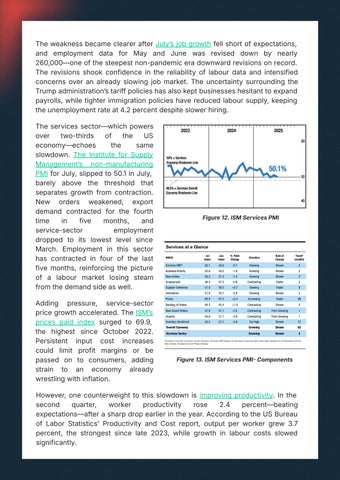
The weakness became clearer after Julyʼs job growth fell short of expectations, and employment data for May and June was revised down by nearly 260,000—one of the steepest non-pandemic era downward revisions on record. The revisions shook confidence in the reliability of labour data and intensified concerns over an already slowing job market. The uncertainty surrounding the Trump administrationʼs tariff policies has also kept businesses hesitant to expand payrolls, while tighter immigration policies have reduced labour supply, keeping the unemployment rate at 4.2 percent despite slower hiring. The services sector—which powers over two-thirds of the US economy—echoes the same slowdown. The Institute for Supply Managementʼs non-manufacturing PMI for July, slipped to 50.1 in July, barely above the threshold that separates growth from contraction. New orders weakened, export demand contracted for the fourth time in five months, and service-sector employment dropped to its lowest level since March. Employment in this sector has contracted in four of the last five months, reinforcing the picture of a labour market losing steam from the demand side as well. Adding pressure, service-sector price growth accelerated. The ISMʼs prices paid index surged to 69.9, the highest since October 2022. Persistent input cost increases could limit profit margins or be passed on to consumers, adding strain to an economy already wrestling with inflation.
Figure 12. ISM Services PMI
Figure 13. ISM Services PMI Components
However, one counterweight to this slowdown is improving productivity. In the second quarter, worker productivity rose 2.4 percent—beating expectations—after a sharp drop earlier in the year. According to the US Bureau of Labor Statisticsʼ Productivity and Cost report, output per worker grew 3.7 percent, the strongest since late 2023, while growth in labour costs slowed significantly.