Function
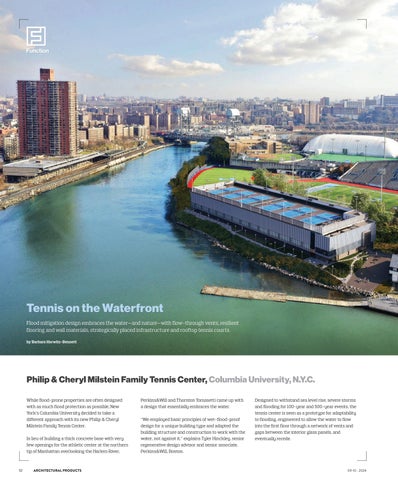
Tennis on the Waterfront Flood mitigation design embraces the water—and nature—with flow-through vents, resilient flooring and wall materials, strategically placed infrastructure and rooftop tennis courts. by Barbara Horwitz-Bennett
Philip & Cheryl Milstein Family Tennis Center, Columbia University, N.Y.C. While flood-prone properties are often designed with as much flood protection as possible, New York’s Columbia University decided to take a different approach with its new Philip & Cheryl Milstein Family Tennis Center. In lieu of building a thick concrete base with very few openings for the athletic center at the northern tip of Manhattan overlooking the Harlem River,
52
ARCHITECTURAL PRODUCTS
2410ARP_52_FXN.indd 52
Perkins&Will and Thornton Tomasetti came up with a design that essentially embraces the water. “We employed basic principles of wet-flood-proof design for a unique building type and adapted the building structure and construction to work with the water, not against it,” explains Tyler Hinckley, senior regenerative design advisor and senior associate, Perkins&Will, Boston.
Designed to withstand sea level rise, severe storms and flooding for 100-year and 500-year events, the tennis center is seen as a prototype for adaptability to flooding, engineered to allow the water to flow into the first floor through a network of vents and gaps between the interior glass panels, and eventually recede.
09-10 . 2024
9/30/24 6:44 AM