Technical
6.4L Powerstroke diesel fuel system An overview of the system and a few tips regarding glitches If your customers who own diesel light trucks use their vehicles either for work or fun in dirty and muddy conditions, they are exposing their trucks to engine contamination issues. Dirt that gets past the air filter can pose a risk to the turbocharger. Although diesel components are beefier in construction than those in vehicles with gas engines, they are still susceptible to problems. Here are some solutions! By Mike Mavrigian
A
s you know, a diesel engine differs from other liquid fuel engines in one major respect: the fuel/air charge is ignited by cylinder pressure and resulting heat, instead of via an electrical ignition system (diesel-fueled engines don’t use spark plugs). On its downstroke, a piston draws air into the cylinder. On the compression stroke, the fuel injection system (depending on how it’s timed) sprays fuel into the combustion area, and the resulting cylinder pressure (and residual heat from previous firings) combusts the fuel/air mix, etc. Diesel heads generally don’t feature combustion chambers (flat decks with no chambers). Instead, the combustion chamber is afforded by the piston’s “bowl” cavity. Partly because of the serious cylinder pressures and forces exerted on the bottom end, diesel components (blocks, cranks, rods, pistons) are, for lack of a better term, heavy-duty and very beefy in construction. As compared to gas engines, just about everything on a diesel is bigger, heavier and more massive. Rather than provide an overall discussion of diesels in general, in this article we’ll
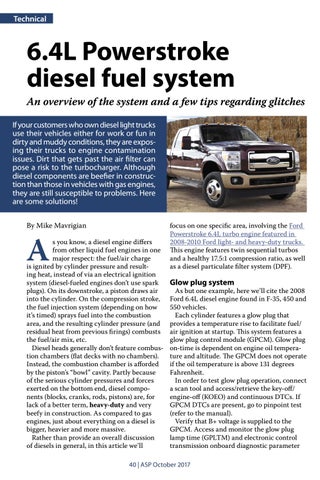
focus on one specific area, involving the Ford Powerstroke 6.4L turbo engine featured in 2008-2010 Ford light- and heavy-duty trucks. This engine features twin sequential turbos and a healthy 17.5:1 compression ratio, as well as a diesel particulate filter system (DPF).
Glow plug system As but one example, here we’ll cite the 2008 Ford 6.4L diesel engine found in F-35, 450 and 550 vehicles. Each cylinder features a glow plug that provides a temperature rise to facilitate fuel/ air ignition at startup. This system features a glow plug control module (GPCM). Glow plug on-time is dependent on engine oil temperature and altitude. The GPCM does not operate if the oil temperature is above 131 degrees Fahrenheit. In order to test glow plug operation, connect a scan tool and access/retrieve the key-off/ engine-off (KOEO) and continuous DTCs. If GPCM DTCs are present, go to pinpoint test (refer to the manual). Verify that B+ voltage is supplied to the GPCM. Access and monitor the glow plug lamp time (GPLTM) and electronic control transmission onboard diagnostic parameter
40 | ASP October 2017