

2023 Employee Benefits Guide


Welcome to the 2022 ABC Company Employee Benefits Guide. This guide offers you and your family members a look into your comprehensive benefits program. We encourage you to take the time to educate yourself about your options and choose the best coverage options for you and your family. We have included brief descriptions of our benefit offerings and the cost. If you have any questions, please contact the Human Resources Department at 012.345.6789. Welcome to your Benefits













Contents Enrollment 4 Medical Plan 6 Health Savings Account 12 Wellness Program 14 HealthJoy 16 KISx Card 17 Dental Insurance 18 Vision Insurance 20 Disability Insurance (STD & LTD) 21 Life Insurance 22 Employee Assistance Program 25 Contributions 26
Enrollment
Open Enrollment
This benefit guide provides an overview of the benefits that ABC Company offers.
Each year, ABC Company conducts a benefits open enrollment, which allows employees to make changes to their benefit plan elections. Benefits elected during open enrollment are effective from January 1st through December 31st
Who is eligible?
To be eligible for benefits, you must be a full-time employee of ABC Company. Your spouse and dependents are also eligible for coverage under applicable benefit plans.
When does coverage become effective?
New employees will become eligible for benefits effective on the first day of the month following 60 days of employment, provided you have completed the enrollment process and all required information and documents.
Enrollment Changes
As long as you remain eligible, your benefit elections will be in place until December 31st , 2022. However, you may make mid-year changes if you have a qualifying event. Examples of qualifying events that allow you to change your benefits elections during the year are:
• Marriage or divorce
• Birth, adoption or change in the custody of a child
• Death of your spouse or dependent child
• A change in the employment status of a spouse, impacting your benefit eligibility
• A change in your dependent’s status (due to age or eligibility for medical coverage through his/her own employer)
• A significant reduction in the average number of hours worked
If you have a qualifying event, you must change your benefit elections within 30 days of the event. If you do not make a change within 30 days, you must wait until the next open enrollment period. Please contact human resources for more information.
4
Enrollment
How to Enroll for 2022
This year ABC Company is pleased to offer employees the ability to enroll for their benefits online through Employee Navigator. You will receive an email inviting you to login into the system and begin your benefit selections. As you navigate through the screens it will give you the opportunity to add dependents, verify information and review what your benefit choices were last year. At the end of the process you will be shown a summary of your choices that you can print. You can make changes to your elections any time during the open enrollment period. Please see instructions below:
Step 1: Log In
First time users: Click on your “Registration Link” in the email sent to you by your admin or “Register as a new user”. Create an account and create your own username and password.
Step 2: Welcome!
After you login click “Let’s Begin” to complete your required tasks.
Step 3: Start Enrollments
After clicking “Start Enrollment”, you’ll need to complete some personal & dependent information before moving to your benefit elections.
Step 4: Benefit Elections
To enroll dependents in a benefit, click the checkbox next to the dependent’s name under “Who am I enrolling”? Below your dependents you can view your available plans and the cost per pay. To elect a benefit, click “Select Plan” underneath the plan cost. “Save & Continue” at the bottom of each screen to save your elections. If you do not want a benefit, click “Don’t want this benefit” at the bottom of the screen and select a reason from the drop-down menu.
Step 5: Forms
If you have elected benefits that require a beneficiary designation, primary care physician, or completion of an evidence of insurability form, you will be prompted to add in those details.
Step 6: Review & Confirm Elections
Review the benefits you selected on the enrollment summary page to make sure they are correct then click “Sign & Agree” to complete your enrollment. You can either print a summary of your elections for your records or login at any point during the year to view your summary online.
5
Medical Plan
Medical Plan Details
ABC Company offers eligible full-time employees a choice between two health insurance plan options.
Both the PPO and HSA-Qualified Health Insurance Plans
• Are administered by UMR and use the United Health Care Choice Plus PPO network
• Cover preventive care, such as your annual routine physical and related preventive tests at 100% with no deductible or copayment
• Cover the same types of medical expenses and have the same exclusions
• Have an unlimited lifetime maximum benefit
• Meet and exceed the minimum coverage requirement under the Affordable Care Act
UMR Online Services
• Visit www.umr.com
• Select “Members”
• Enter the member ID located on your ID card
• Click “Go to my online services”
• Submit your username and password. If you have not yet registered for online services, click “Need a Username?” and follow the prompts to complete your registration.
• There will be a link to log in to OptumRx to review your prescription claims.
UMR online services are fast, easy, and free with convenient access to tools and resources such as:
• Claim status (including copies of Explanations of Benefits - EOBs)
• Status of medical deductibles and out-of-pocket amounts
• Frequently used forms
• Ordering ID cards (duplicates or replacements)
• Health information
• Prescription benefits information
• Note: Once logged in to your account on umr.com, there is a link to log in to OptumRx where you can view your prescription claims.
If you have questions or problems, you can contact the UMR technical support team at 866-922-8266.

6
Medical Plan
UHC Choice Plus Network
Our Health Plans utilize the United HealthCare (UHC) Choice Plus network. The UHC Choice Plus network is one of the broadest networks of physicians and hospitals available. The UHC Choice Plus PPO network includes both Saint Joseph Health System and Memorial Hospital of South Bend, as well as most physicians in our area. Additionally, the UHC Choice Plus PPO includes most hospitals within Indiana, as well as a broad national network of providers across the country. Please visit their website, www.umr.com, for a complete list of participating providers. It is very likely that your physician already participates in the UHC Choice Plus PPO, but it is recommended that you verify this with your doctor’s office before each visit.
To find physicians within the PPO network:
• Please visit www.umr.com
• Click “Find a Provider”
• Click “Medical”
• Select “United Health Care Choice Plus PPO”
• Follow the prompts OR
• Call customer service for a PPO referral at 800-826-9781
Additional Information
Enhanced Preventive Benefits
Maintaining or improving your health is important. Remember the old saying that “an ounce of prevention is worth a pound of cure”? This can be especially true when it comes to preventive health care. Better health may lower your health care costs, both in the amount you pay out of your pocket for deductibles and copays, as well as in future premium contributions you may pay for your coverage.
As a reminder, our health plans cover routine and preventive care at 100% with no deductible or copayment. This includes your annual routine physical, routine and preventive mammograms, pap tests, PSA tests, immunizations, etc. Please note that claims must be coded by your doctor as “routine and preventive” rather than “diagnostic” in order to be covered at 100% under the Preventive Care benefit.
How Does the Mail Order Prescription Program Work?
The Mail Order program is a great way to help you save money on medications you take every day. Once you begin using the mail order plan, getting refills is easier than waiting in line at the store, and it can save you money. Get started in two easy steps:
Step 1: Obtain a prescription from your doctor for a 90-day supply, plus 3 refills.
Step 2: Call OptumRx at 877-559-2955 or visit www.optumrx.com. Have your prescription handy and the name and phone number of your doctor.
7
Medical Plan
Cost Estimator
Did you know that the cost for the same test or procedure can differ by thousands of dollars from one PPO provider to the next? myHealthcare Cost Estimator allows you to compare quality and cost measures for each facility and know what your out-of-pocket cost will be before you schedule it. Be an informed patient!

Healthcare Advisor
UMR provides a wealth of information and services to help you live a healthier life. Tools, such as Healthcare Advisor, can help you make the best decisions about health conditions and prescription drugs. In addition, there are excellent health information sites, articles, and much more available.
8 UMR Customer Service 800.826.9781 www.umr.com
Medical Plan
Rx Help Centers
What is RX Help Centers (RXHC)?

Primarily targeted to more expensive brand name and specialty drugs, this concierge service can be a help to you if those ‘not so expensive’ drugs in total cost you $100 or more per month. There’s no guarantee that RXHC can help. But if they can you should be able to experience significantly lower costs for your prescriptions.
As a reminder, specialty drugs are not covered under our medical plans. If you have been prescribed a specialty drug, you will need to obtain your prescription through Rx Help Centers instead of the medical plan.
Who is eligible?
This program is available to members enrolled in the health plan. Members are not required to use this service, but there is potential cost savings if you’re spending more than $75 for any one prescription or $100 or more per month for multiple prescriptions.
What are the costs?
There are no costs to you. If you decide this service will benefit you and/or your family, ABC Company will pay 100% of the cost of this service for you and your family as long as you are enrolled in ABC Company's health plan. Prescriptions obtained through this service could often be free for you and your family. Sometimes a copay or out of pocket amount will be required but this out of pocket may be substantially less than what you are paying now.
You would still have the option and possibly need to obtain some drugs through your current health plan with the normal out of pocket for you and your family, but this service is aimed at helping you with the costlier specialty drugs making it more affordable.
What to expect
It is important to note that this is not an overnight solution and usually takes from two to four weeks on average to implement your cost savings, depending on outside circumstances of doctor cooperation, ease of communication, and understanding.
Please understand that this service is not insurance. RXHC is not an insurance company and they are not offering insurance. They are a prescription drug advocacy firm helping people like you lower the cost of their prescription and medications.
Please note: your current health plan, prescription drug card, and other vendors are not changing. This program is an added benefit to your current healthcare coverage!
9
Medical Plan
Health Plan In-Network Benefits Summary
This brief benefit summary includes in-network benefits only. Anthem is a well-recognized health insurance carrier whose network includes most local physicians and hospitals. As always, please check with your health care provider to verify participation before receiving services.

CDHP Plan 1 Anthem Blue Access CDHP Plan 2 Anthem Blue Access Deductible: Individual/Family $3,000 / $6,000 $2,500 / $5,000 Coinsurance (You Pay) 20% 30% Out of Pocket Max: Individual/Family $4,000 / $8,000 $6,350 / $12,700 Preventive Care 100% - No Deductible 100% - No Deductible Primary Care Provider Deductible & Coinsurance Deductible & Coinsurance Specialist Urgent Care Emergency Room Prescription Drugs Retail (30 day supply) Tier 1 Tier 2 Tier 3 Tier 4 $10 Copay (After Deductible) $20 $30 $40 Deductible & Coinsurance Mail Order (90 day supply) Tier 1 Tier 2 Tier 3 Tier 4 $10 $20 $30 $40 Deductible & Coinsurance 10
Medical Plan
Understanding Health Insurance Terminology
What is a deductible?
It is a set dollar amount determined by your plan that you will pay out of your pocket if you have claims. The deductible accumulates on a calendar year basis and is reset at $0 each January 1.
What is coinsurance?
After your deductible is met, you then pay a share of your eligible medical expenses. This is called coinsurance. For Plan 1 you pay 20% of the charges after the deductible for each covered person on your plan up to the maximum of $4,000 ($8,000 for family coverage). For Plan 2, you pay 30% after the deductible for each covered family member up to the maximum of $6,350 ($12,700 for family coverage). This is your share of the coinsurance.

What is my out of pocket maximum?
This is the maximum amount (deductible and coinsurance combined) you are responsible to pay per calendar year. For Plan 1, it is $4,000 per person ($8,000 family). For Plan 2, it is $6,350 per person ($12,700 per family).
11
Health Savings Account
Understanding A Health Savings Account
What is an HSA?
It is your personal tax-exempt account used to pay for out-of-pocket medical expenses.
Am I eligible to establish an HSA?
Both health insurance plans are specially designed to meet the IRS requirements that allow you to establish and make contributions to an HSA, although you are not required to do so. You cannot open an HSA or make contributions to an HSA if you are enrolled in a health plan that is not a qualified “High Deductible Health Plan” (“HDHP”) as defined by the IRS. A qualifying HDHP is one that does not reimburse covered medical expenses until a maximum annual deductible established by the IRS is met. You are not eligible for an HSA if you are:
• Covered under another medical plan that is not an HDHP;
• Entitled to (eligible for AND enrolled in) Medicare benefits; or
• Eligible to be claimed on another person’s tax return.
Who holds my HSA funds?
The HSA is an individual bank account owned by you. ABC Company Industries has chosen Key Bank as our preferred bank to administer all HSA accounts for our employees. After you open a Health Savings Account at (bank name), any pre-tax payroll deductions and HSA wellness incentives will be deposited into the account by ABC Company Industries. If you are not approved by (bank name) for an account, please contact Human Resources.
How and when do I make contributions to my HSA?
You may have contributions direct deposited from your paycheck on a pre-tax basis. You may also make contributions directly into your HSA on an after-tax basis. You will receive a Form 1099 from your HSA bank annually that will show your annual HSA contribution. You then report your HSA contribution by completing Form 8889 with your annual federal income tax return.
What can I spend my HSA funds on?
The IRS allows you to use your HSA funds to pay for your out-of-pocket costs for qualified medical, dental, and vision expenses that are incurred after your HSA is established. Qualified expenses are those as defined by IRC Section 213(d). Visit https://www.irs.gov/pub/irs-pdf/p502.pdf for a list of allowed expenses. Amounts distributed from your HSA for any other reason are subject to income tax and an additional 20% penalty tax.
12
Health Savings Account
How do I access my HSA funds?
The bank will provide you with a debit card and check book (if requested). Remember, in the event of an IRS audit, you are responsible for providing your receipts for services and other items purchased with money from your HSA.
What if I don’t have enough money in my HSA account to pay for my medical expenses during the year which apply toward my deductible and coinsurance out-of-pocket?
The good thing about an HSA is that it is flexible and allows you to add additional money (up to the maximum below) if your medical claims are more than you had anticipated. You can either request a change in the amount of your pre-tax payroll deduction during the year, or you can deposit after-tax money and generally take a deduction when you file your taxes. Talk to your tax advisor about this option.
How much can I contribute to an HSA?
The annual HSA contribution limits for 2020 are:
• $3,550 for individual coverage and $7,100 for family coverage
• Individuals age 55 or older may be eligible to make a catch-up contribution of $1,000.
What if I enroll in an HSA in the middle of the year?
Your HSA contributions are generally determined on a monthly basis. However, if you enroll in an HSA mid-year, you are allowed to make a full year’s contribution, provided you are eligible on Dec. 1 of that year and you remain eligible for HSA contributions for at least the 12-month period following that year.
Who is eligible to use my HSA funds?
You can use your HSA funds to reimburse Qualified Medical Expenses incurred by you, your spouse, and your tax dependents, as long as the expenses are incurred after the date that your HSA is established.
What happens to my HSA funds if I leave?
You take your HSA account and funds with you because it’s your personal bank account. Remaining HSA funds may continue to be spent on qualified out-of-pocket medical, dental, and vision expenses.
For further information and a list of HSA qualified medical expenses, please visit https://www.irs.gov/pub/irs-pdf/p502.pdf
13
Wellness Program
Wellness and Health Management
Earn wellness incentives for your Health Savings Account. ABC Company wellness incentives include money earned for an annual physical and different wellness activities (e.g. exercise affidavit, smoking cessation, nutrition, or parenting class).
• Associates may earn $400 in HSA money simply by completing an annual physical exam with their physician.
• Associates may earn $100 per wellness activity up to a maximum of three ($300) per year.
The Value of Preventive Care
Wellness and Health Management. Understanding the full value of covered benefits allows you to take responsibility for maintaining good health and incorporating healthy habits into your lifestyle. Some examples include: getting regular physical examinations, mammograms and immunizations.
Which Preventive Care Services Are Covered?
Below is a list of common services that are included in the health plan coverage. Qualifying preventative care services are age and gender specific – not every individual qualifies for all offered plan services. Some services may require prior authorization from Anthem and/or may only be covered for certain persons who meet nationally recommended age, gender, and health history requirements. Please contact Anthem with any questions about which preventive services are covered.
Please note that your physician must code the bill as “Routine & Preventive” in order to be covered at 100% as a preventive benefit.
Included Services
• Routine Physical Exam
• Well Baby and Child Care
• Well Woman Visits
• Immunizations
• Routine Bone Density Test
• Routine Breast Exam
• Routine Gynecological Exam
• Screening for Gestational Diabetes
• Routine Digital Rectal Exam
• Routine Physical Exam
• Well Baby and Child Care
• Well Woman Visits
• Immunizations
• Routine Bone Density Test
• Routine Breast Exam
• Routine Gynecological Exam
• Screening for Gestational Diabetes
• Routine Digital Rectal Exam
14
Wellness Program
Activate Health & Wellness Center

The Activate Health & Wellness Center is a primary and urgent care center dedicated to ABC Company employees who are covered under the medical plan. Services are also available to those who elect to pay for their spouses and dependents covered under the medical plan. We’ve lowered the cost for spouses and dependents to participate in the clinic!
• The cost for spouses to access the clinic is now $2.30 per week!
• The cost for children to access the clinic is now $5.00 per child per week!
The clinic provides easy access to high-quality care with no out-of-pocket costs. Service at the Health & Wellness Center include:
• Complete adult primary care services
• Urgent care
• Treatment for minor injuries
• Comprehensive physicals
• Labs
Gift Card Rewards
• Flu shots
• Common generic medications for acute and ongoing needs
Our focus has always been to reward employees for making healthy choices and living healthy lifestyles. That's why we are introducing a new rewards system that centers on meeting your goals and improving your health! When you work on a health goal through the Activate Clinic, you will have the opportunity to earn a $50 gift card. Gift cards will be given out at the discretion of the Activate Clinic and can be earned by Daman employees and spouses. Due to EEOC regulations, dependent children are not eligible to receive rewards through the Better Living Program.
The Health & Wellness Center provides complete primary care, labs, and many common prescription drugs at no out-of-pocket cost to you. The clinic is not able to fill prescriptions written by doctors outside the clinic.
Children ages 3 and up may use the clinic of you elect to pay for your child to have access. From age 3 to 11, we encourage you to maintain your child's relationship with their pediatrician for routine preventive care and immunizations.
Please make an appointment before visiting the Heath & Wellness Center, even for an urgent need. The goal of the clinic is to respect your time with little waiting when you arrive at your scheduled time. If you have an urgent need, the clinic can typically schedule your appointment for the same day or the next morning.
The clinic is not a walk-in clinic and is unable to see patients without an appointment.
The Health and Wellness Center is open by appointment during the following hours:
Monday: Tuesday: Wednesday:
7:00 AM - 5:00 PM 7:00 AM - 6:00 PM 7:00 AM - 5:00 PM
To make an appointment, call
Thursday: Friday: 7:00 AM - 6:00 PM 7:00 AM - 4:00 PM
15
574.314.5950 333 E Mishawaka Ave | Mishawaka, IN 46545
HealthJoy




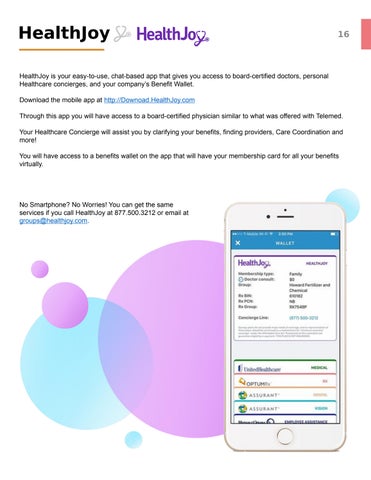
HealthJoy is your easy-to-use, chat-based app that gives you access to board-certified doctors, personal Healthcare concierges, and your company’s Benefit Wallet.
Download the mobile app at http://Downoad.HealthJoy.com


Through this app you will have access to a board-certified physician similar to what was offered with Telemed. Your Healthcare Concierge will assist you by clarifying your benefits, finding providers, Care Coordination and more!
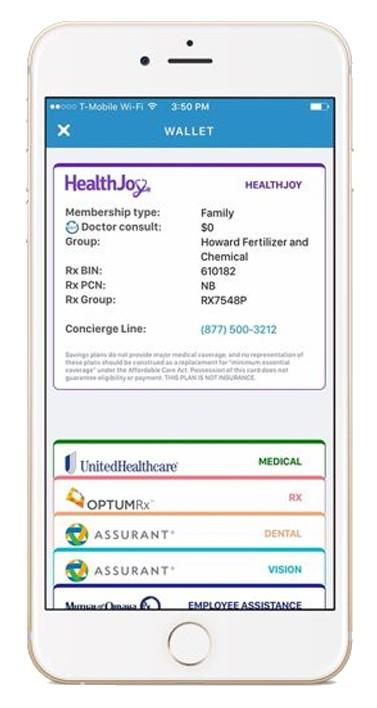
You will have access to a benefits wallet on the app that will have your membership card for all your benefits virtually.
No Smartphone? No Worries! You can get the same services if you call HealthJoy at 877.500.3212 or email at groups@healthjoy.com.
16
KISx Card
KISx Card
The KISx Card, or Keep It Simple Surgery, is a surgical and imaging program that ABC Company has made available to you for the most common surgical and imaging procedures. Some of the most common procedures through the KISx Card include:

• Orthopedic
• General Surgery
• Colonoscopies
• MRIs
• CT Scans
• PET Scans
If you utilize the program, you will receive your procedure at no cost!
How Does it Work?
If your doctor recommends a surgery or imaging procedure listed above, call KISx to see if they can assist with your elective procedure by choosing a KISx Card provider, your total cost will be $0 out of pocket to you.
Step 1: Call a KISx Card Nurse at 717.766.8844 to find out more about your procedure and how the program works. They will assist you in finding the right facility close to home.
Step 2: Your KISx Card Nurse will help you schedule your procedure. Upon scheduling, they will provide you with a voucher to take to your initial consultation.
Step 3: Save! You will not pay anything out of pocket for choosing a KISx Card provider. Every aspect of your procedure is covered through the KISx Card.
17
Dental Insurance
Anthem Blue Cross Blue Shield
You have the option to enroll in a comprehensive dental insurance plan, administered by Anthem Blue Cross Blue Shield. You do not need to be enrolled in the health insurance plan to enroll in dental insurance.
This is a partial listing of benefits and services only. All covered services are subject to the conditions, limitations, exclusions, terms and provisions of the Dental Certificate.
Type of Service In Network Out Of Network Calendar Year Deductible Single Family $50 $150 Annual Dental Maximum per Person $1,000 Preventive Services Oral Exams & Cleanings, Bitewing X-rays & Fluoride Treatments, Sealants (children up to age 14) 100% Basic Services Fillings, Simple Extractions, X-rays, Periodontics 80% Major Services Major Restorative Services, Crowns, Bridges, Dentures 50% Orthodontia for Children to Age 19 Coinsurance Lifetime Max per Individual 50% $1,000
18 2022 Weekly Dental Payroll Deductions Dental Plan Employee Only $33.84 Employee + Spouse $85.68 Employee + Children $76.80 Employee + Family $125.57
Dental Insurance
Dental Blue 300 PPO Dentists
You may utilize the dental provider of your choice, and the benefit level (100%, 80%, or 50%, depending on the type service) is the same regardless of the provider being considered in or out of network. However, by using a provider participating in the Anthem Dental Blue 300 PPO Network, you may have lower out-of-pocket costs due to pre-negotiated rates and maximum allowable costs in the provider contract.

If you utilize a dental provider that does not participate in the Dental Blue 300 Network, you are responsible for any amount charged by the provider which exceeds the reasonable and customary (R&C) allowable fee. The R&C fee is the amount the insurance company considers the reasonable charge based on the type of service and the geographical area where you receive treatment.
Note: Even if you use a participating dentist, you are always responsible for your deductible and coinsurance amount.
You may visit www.anthem.com to find participating providers in your area. Click on “Find A Doctor:”
1. Click on “Dental”
2. Click “Dental plan dentists”
3. Fill in your dentist’s name or choose a specialty
4. Fill in your zip code
5. Choose “Indiana” (even if you’re not in Indiana), then choose “Dental Plans”, then choose “Dental Blue 300”
19
Vision Insurance
Vision Service Plan
You have the option to enroll in a vision insurance plan through Vision Service Plan (VSP). You may visit www.vsp.com to find participating providers in your area. No ID Card is necessary for your provider to file claims with VSP.
Benefits When Using a Participating VSP Provider Copay

• Focuses on your eyes and
overall
wellness
Well Vision Exam
• One every calendar year (two per year for dependent children*) $10
• $180 allowance for a wide selection of frames
Frame
• 20% off amount over your allowance
• Every other calendar year (one per year for dependent children*)
• Single vision, lined bifocal, and lined trifocal lenses

• Polycarbonate lenses
Lenses
• Every calendar year (more frequent lenses for children may be covered in full if prescription changes*)
• Standard progressive lenses
Lens Enhancements
Contacts (in lieu of glasses)
• Premium progressive lenses
• Custom progressive lenses
• Average 35 – 40% off other lens enhancements
• $150 allowance for contacts; copay does not apply
• Contact lens exam (fitting and evaluation)
• Every calendar year Up to $60
*Dependent children are covered to the end of the month in which they turn age 26.
$25
Included in Prescription Glasses
$0 $80
$120
- $90
- $160
20
2022
Deductions Vision Plan Employee Only $33.84 Employee + Spouse $85.68 Employee + Children $76.80 Employee + Family $125.57
Weekly Vision Payroll
Disability Insurance
Short Term Disability (STD) – Plan Features
Short-Term disability insurance provides you with weekly income if you become disabled due to injury or illness, including maternity.
• STD benefits begin on the 8th day of a disability, whether your disability is due to injury or sickness.
• Your weekly benefit is equal to 66 2/3% of your salary to a maximum of $750. The benefit is reduced by other income you may receive, including Social Security.
• You are eligible to receive STD benefits for up to 25 weeks, provided you remain disabled.
Please carefully consider this benefit- your ability to work and provide an income for yourself and your family is one of your most important assets. If you are unable to work due to an illness, or non-work-related injury, this benefit helps replace your lost income.
Long Term Disability (LTD) – Plan Features

Long Term Disability insurance helps protect you and your family’s income in the event of a long-term illness or disability. You may elect LTD in addition to Short Term Disability, or by itself.
• LTD benefits begin on the 181st day of a disability due to an injury or illness.
• Your monthly benefit is equal to 60% of your salary to a maximum of $10,000.
• The monthly benefit is reduced by Social Security or other income you receive.
• LTD benefits continue to age 65, provided you remain disabled.
• Benefits are generally tax-free.
• Pre-existing condition limitation: If you become disabled due to a pre-existing condition during the first 12 months that you are covered, the benefit will not be paid.
21
Life Insurance
Basic Life and AD&D Insurance
ABC Company provides you with a $20,000 Basic Life and AD&D benefit through Reliance Standard. ABC Company provides this benefit to you at no cost.
Supplemental Term Life Insurance
Term Life insurance is an important part of your benefits. It’s not easy to think about, but an unexpected death in the family could burden the surviving family members with large expenses on less income. Purchasing additional term life insurance could assist your loved ones with mortgage payments, funeral expenses, medical expenses, childcare expenses, etc.
Guaranteed issue amounts are available to you one time as a new hire at your initial benefits eligibility
If you are not a new hire electing benefits for the first time, you must complete a health questionnaire, and coverage is not guaranteed.
*Term Life: Benefit paid to designated beneficiary upon death of insured.
Coverage is for a certain term and has no cash value.
Choice of $10,000 increments. Not to exceed 5 times your salary. Employees age 70 and older, maximum benefit is $50,000.
Choice of $5,000 increments. Employee must elect coverage for spouse to be eligible. Not to exceed 50% of employee elected amount.
$10,000 (6 Months to Age 26; Birth to 6 Months limited to $250). Employee must elect coverage for child(ren) to be eligible.
Issue*
*Available amounts shown are offered to any eligible applicant (employee and dependent(s) without regard to health status if you enroll during the initial new employee waiting period. No medical questions are asked on the application unless the amount applied for exceeds the amounts shown.
$250,000 of coverage is available on a guaranteed acceptance basis within your new employee waiting period. $20,000 of coverage is available on a guaranteed acceptance basis for new employees 70 to 74 within your waiting period. No guarantee issue age 75+.
$50,000 of coverage is available on a guaranteed acceptance basis within your new employee waiting period. Spouses of employees age 60 and over are not eligible for coverage on a guaranteed acceptance basis.
No health questions required for eligible children.
Continued next page >
22
Employee
Term Life Benefit*
Spouse Dependent Child
Minimum Amount $10,000 $5,000 $10,000 Maximum Amount $750,000 $100,000 $10,000 Guarantee
Life Insurance
Amount *AD&D (Accidental Death & Dismemberment): Double indemnity for accidental death or a percentage of the benefit payable per covered non-work-related accidental injury.
Benefit
The benefit amount is equal to the life amount elected by you. Cost included in the schedule.
Employee must elect coverage for dependent to be eligible.
Employee must elect coverage for dependent to be eligible.
Benefits will reduce:
• 35% at age 65
• Add’l 25% of the original amount at age 70
• Add’l 15% of the original amount at age 75
• Benefits terminate at age 80 or retirement, whichever is first.
• 35% at employee age 65.
• Benefits terminate when the employee reaches age 70.
Additional Benefits
N/A
Accelerated Death Benefit Cash advance against the death benefit available if insured has a terminal illness.
Portability
Conversion
Eligibility
You may continue your term insurance coverage when employment ends by paying the required premiums.
You may apply to convert your term life insurance to a whole life policy at termination of employment.
Spouse & Dependents
All full-time active employees working 30 or more hours per week in an eligible class are eligible for coverage on the policy effective date. A delayed effective date will apply if the employee is not actively at work.
Cannot be in a period of limited activity* on the day coverage takes effect. *Period during which a dependent is confined to a health care facility and/or unable to perform what would be considered regular.
Employee
AD&D Benefit*
Spouse Dependent Child
Reduction Employee Spouse Dependent Child
Employee
23
Life Insurance
This is an estimate of premium cost. Actual deductions may vary slightly due to rounding and payroll frequency. Example: Use this formula to calculate premium for benefit amounts over $100,000.
Dependent Child(ren) Benefit: $10,000 per child
Dependent Children Rate = $.46 Weekly (52 Weeks) Premium is the same regardless of the number of children.
Employee
Supplemental
Employee
Spouse
Refer to Program Specifications
maximum benefit amounts. Benefits and premium amounts reflect age reductions. 24
Weekly (52 Weeks) Premium
Life and AD&D Premium for sample benefit amounts
and
premiums are calculated separately.
for your
Age Weekly Rate per $1,000 $10K $20K $30K $40K $50K $60K $70K $80K $90K $100K <25 0.0249 0.25 0.50 0.75 1.00 1.25 1.49 1.74 1.99 2.24 2.49 25-29 0.0249 0.25 0.50 0.75 1.00 1.25 1.49 1.74 1.99 2.24 2.49 30-34 0.0277 0.28 0.55 0.83 1.11 1.39 1.66 1.94 2.22 2.49 2.77 35-39 0.0302 0.30 0.60 0.91 1.21 1.51 1.81 2.11 2.42 2.72 3.02 40-44 0.0406 0.41 0.81 1.22 1.62 2.03 2.44 2.84 3.25 3.65 4.06 45-49 0.0535 0.54 1.07 1.61 2.14 2.68 3.21 3.75 4.28 4.82 5.35 50-54 0.0766 0.77 1.53 2.30 3.06 3.83 4.60 5.36 6.13 6.89 7.66 55-59 0.1052 1.05 2.10 3.16 4.21 5.26 6.31 7.36 8.42 9.47 10.52 60-64 0.1620 1.62 3.24 4.86 6.48 8.10 9.72 11.34 12.96 14.58 16.20 65-69 6,500 13,000 19,500 26,000 32,500 39,000 45,500 52,000 58,500 65,000 0.2395 1.56 3.11 4.67 6.23 7.78 9.34 10.90 12.45 14.01 15.57 70-74 4,000 8,000 12,000 16,000 20,000 N/A N/A N/A N/A N/A 0.2395 0.96 1.92 2.87 3.83 4.79 N/A N/A N/A N/A N/A 75-79 2,500 5,000 7,500 10,000 12,500 N/A N/A N/A N/A N/A 0.2395 0.60 1.20 1.80 2.40 2.99 N/A N/A N/A N/A N/A
Age Weekly (52 Weeks) Rate Per $1,000 X Benefit In $1,000s = Weekly (52 Weeks) Cost Example: 35 0.0302 150 0.75 1.00 4.53
Employee Assistance Program
Mutual of Omaha
ABC Company pays the full cost of this coverage for you.
The Employee Assistance Program (EAP) is designed to help you with life challenges. The EAP gives you and your dependents access to a network of licensed and/or certified professionals who can provide confidential support for a variety of matters like:

• Family and relationships: Marriage and partners, divorce, parenting, childcare and elder care assistance, domestic violence
• Emotional well-being: Anger management, coping with stress and anxiety, coping with depression, working through grief, traumatic life events
• Financial wellness: Managing finances
• Substance Abuse and Addiction: Alcohol, drugs, gambling and other addictions, support for families
• Physical Health: Diet and nutrition, exercise and fitness, sleep, smoking cessation
• Work and Career: Relationships in the workplace, work stress and transitions, career development
Information gathered by the EAP is confidential – it is not shared with ABC Company unless there is a risk of harm to you or others.
To learn more or get help, visit mutualofomaha.com/eap or call 800.316.2796.
25


Contributions 26 Dental Medical Vision Employee Weekly (52 Weeks) Premium. Supplemental Life and AD&D Premium for sample benefit amounts. 2022 Weekly Vision Payroll Deductions Vision Plan Employee Only $0 Employee + Spouse $0 Employee + Children $0 Employee + Family $0 2022 Weekly Dental Payroll Deductions Dental Plan Employee Only $0 Employee + Spouse $0 Employee + Children $0 Employee + Family $0 2022 Weekly Medical Payroll Deductions CDHP Plan 1 Wellness CDHP Plan 1 Non-Wellness CDHP Plan 2 Wellness CDHP Plan 2 Non-Wellness Employee Only $0 $0 $0 $0 Employee + Spouse $0 $0 $0 $0 Employee + Children $0 $0 $0 $0 Employee + Family $0 $0 $0 $0
Supplemental Benefits
The following supplemental benefit plans are offered through UNUM. These benefits are offered during our annual open enrollment. Please watch for an announcement and more details.
Disability Insurance
• Helps replace your paycheck if you are unable to work due to illness or non-work related injury or illness
• Pays a predetermined amount per week based on the benefit you select
Critical Illness Insurance
• Pays money directly to you when you are diagnosed with specific critical illnesses
• This money can help you pay out-of-pocket medical expenses and help with other out-of-pocket costs that aren’t covered by health insurance
• Examples of critical illnesses are heart attacks, strokes, cancer, and others (a full list is included in your UNUM application)
Accident Insurance
• Pays a lump sum benefit directly to you for accidental injuries
• This benefit can help offset the out-of-pocket expenses that health insurance doesn’t pay, such as deductibles and coinsurance
27
The following notices provide important information about the group health plan provided by your employer. Please read the attached notices carefully and keep a copy for your records.
If you have any questions regarding any of these notices, please contact:
General Contact: Plan Administrator:
Phone: Phone:
Email: Email:
Mailing Address: _______________________
Mailing Address: _______________________ _______________________
If you (and/or your dependents) have Medicare or will become eligible for details.
HIGHLIGHTED NOTICES ARE OPTIONAL – Include if employer requests and doesn’t provide elsewhere

of Special Enrollment Rights Pg. XX Women’s Health and Cancer Rights Act Notice Pg. XX Newborns and Mothers Health Protection Act Pg. XX Michelle’s Law Notice Pg. XX HIPAA Notice of Privacy Practices Pg. XX
Plan Notice Pg. XX Medicare Part D Notice Pg. XX Medicare Part D Notice Pg. XX CHIP Notice Pg. XX Surprise Medical Billing Notice Pg. XX Wellness Program – Notice of Reasonable Alternatives Pg. XX ADA/GINA Wellness Program Notice Pg. XX 28
Notice
Grandfathered
Compliance Notices
Notice of Special Enrollment Rights
If you are declining enrollment for yourself or your dependents (including your spouse) because of other health insurance or group health plan coverage, you may be able to enroll yourself and your dependents in this plan if you or your dependents lose eligibility for that other coverage (or if the employer stops contributing toward your or your dependents’ other coverage). However, you must request enrollment within 30 days after your or your dependents’ other coverage ends (or after the employer stops contributing toward the other coverage). In addition, if you have a new dependent as a result of marriage, birth, adoption, or placement for adoption, you may be able to enroll yourself and your dependents. However, you must request enrollment within 30 days after the marriage, birth, adoption, or placement for adoption.
If you are declining enrollment for yourself or your dependents (including your spouse) while coverage under Medicaid or a state Children’s Health Insurance Program (CHIP) is in effect, you may be able to enroll yourself and your dependents in this plan if you or your dependents lose eligibility for that other coverage. However, you must request enrollment within 60 days after your or your dependents’ Medicaid or CHIP coverage ends. If you or your dependents (including your spouse) become eligible for a state premium assistance subsidy from Medicaid or a CHIP program with respect to coverage under this plan, you may be able to enroll yourself and your dependents (including your spouse) in this plan. However, you must request enrollment within 60 days after you or your dependents become eligible for the premium assistance.
Notice of Patient Protection
If your health plan generally requires the designation of a primary care provider, you have the right to designate any primary care provider who participates in our network and who is available to accept you or your family members. For children, you may designate a pediatrician as the primary care provider. Until you make this designation, the health plan generally may designate one for you. For information on how to select a primary care provider, and for a list of the participating primary care providers, contact your plan administrator or your Human Resources Department.
You do not need prior authorization from the health plan or from any other person (including a primary care provider) in order to obtain access to obstetrical or gynecological care from a health care professional in our network who specializes in obstetrics or gynecology. The health care professional, however, may be required to comply with certain procedures, including obtaining prior authorization for certain services, following a pre-approved treatment plan, or procedures for making referrals. For a list of participating health care professionals who specialize in obstetrics or gynecology, contact your plan administrator or Human Resources Department.
Women’s Health and Cancer Rights Act Notice
If you have had or are going to have a mastectomy, you may be entitled to certain benefits under the Women’s Health and Cancer Rights Act of 1998 (WHCRA). For individuals receiving mastectomy-related benefits, coverage will be provided in a manner determined in consultation with the attending physician and the patient, for:
• All stages of reconstruction of the breast on which the mastectomy was performed;
• Surgery and reconstruction of the other breast to produce a symmetrical appearance;
• Prostheses; and
• Treatment of physical complications of the mastectomy,
including
lymphedema.
These benefits will be provided subject to the same deductibles and coinsurance applicable to other medical and surgical benefits provided under this plan. If you would like more information on WHCRA benefits, contact the Plan Administrator.
Newborns’ and Mothers’ Health Protection Act Notice
Group health plans and health insurance issuers generally may not, under Federal law, restrict benefits for any hospital length of stay in connection with childbirth for the mother or newborn child to less than 48 hours following a vaginal delivery, or less than 96 hours following a cesarean section. However, Federal law generally does not prohibit the mother's or newborn's attending provider, after consulting with the mother, from discharging the mother or her newborn
29
Compliance Notices
earlier than 48 hours (or 96 hours as applicable). In any case, plans and issuers may not, under Federal law, require that a provider obtain authorization from the plan or the insurance issuer for prescribing a length of stay not in excess of 48 hours (or 96 hours).
Michelle’s Law Notice
Michelle’s Law was signed into law effective January 1, 2010. This law generally allows seriously ill or injured fulltime college students, who are covered under their parent’s health insurance plan, to take up to one year of medically necessary leave of absence if the leave normally would cause the dependent child to lose eligibility for coverage under the plan due to loss of student status. For the Michelle’s Law extension of eligibility to apply, a dependent child’s treating physician must provide written certification of medical necessity (i.e., certification that the dependent child suffers from a serious illness or injury that necessitates the leave of absence or other enrollment change that would otherwise cause loss of eligibility).
*Under the Patient Protection and Affordable Care Act, group health plans are required to offer coverage to dependent children up to age 26, regardless of student status.
HIPAA Notice of Privacy Practices
The Health Insurance Portability and Accountability Act of 1996 ("HIPAA") requires that we maintain the privacy of protected health information, give notice of our legal duties and privacy practices regarding health information about you and follow the terms of our notice currently in effect. Participants in insured group health plans may also receive a notice of privacy practices from those plans. You may request a copy of the current Privacy Practices, explaining how medical information about you may be used and disclosed and how you can get access to this information.
As Required by Law. We will disclose Health Information when required to do so by international, federal, state or local law. You have the right to inspect and copy, right to an electronic copy of electronic medical records, right to get notice of a breach, right to amend, right to an accounting of disclosures, right to request restrictions, right to request confidential communications, right to a paper copy of this notice and the right to file a complaint if you believe your privacy rights have been violated.
Grandfathered Plan Notice (Provide this annual notice only if the plan is grandfathered)
ABC COMPANY believes this plan is a ‘‘grandfathered health plan’’ under the Patient Protection and Affordable Care Act (the Affordable Care Act). As permitted by the Affordable Care Act, a grandfathered health plan can preserve certain basic health coverage that was already in effect when that law was enacted. Being a grandfathered health plan means that your plan may not include certain consumer protections of the Affordable Care Act that apply to other plans, for example, the requirement for the provision of preventive health services without any cost sharing. However, grandfathered health plans must comply with certain other consumer protections in the Affordable Care Act, for example, the elimination of lifetime limits on benefits.
Required Annually for All Grandfathered Plans
Questions regarding which protections apply and which protections do not apply to a grandfathered health plan and what might cause a plan to change from grandfathered health plan status can be directed to the plan administrator. You may also contact the Employee Benefits Security Administration, U.S. Department of Labor at 1–866–444–3272 or www.dol.gov/ebsa/healthreform. This website has a table summarizing which protections do and do not apply to grandfathered health plans.
30 Compliance Notices
Compliance Notices
Important Notice from [ABC COMPANY] About Your Prescription Drug Coverage and Medicare (CREDITABLE)
Please read this notice carefully and keep it where you can find it. This notice has information about your current prescription drug coverage with [ABC COMPANY Group Health Plan] and about your options under Medicare’s prescription drug coverage. This information can help you decide whether or not you want to join a Medicare drug plan. If you are considering joining, you should compare your current coverage, including which drugs are covered at what cost, with the coverage and costs of the plans offering Medicare prescription drug coverage in your area. Information about where you can get help to make decisions about your prescription drug coverage is at the end of this notice.
There are two important things you need to know about your current coverage and Medicare’s prescription drug coverage:
1.Medicare prescription drug coverage became available in 2006 to everyone with Medicare. You can get this coverage if you join a Medicare Prescription Drug Plan or join a Medicare Advantage Plan (like an HMO or PPO) that offers prescription drug coverage. All Medicare drug plans provide at least a standard level of coverage set by Medicare. Some plans may also offer more coverage for a higher monthly premium.
Required Annually – Include Customized Applicable Creditable or Non-Creditable Notice in Guide, unless provided separately by employer
2.[ABC COMPANY] has determined that the prescription drug coverage offered by the [ABC COMPANY Group Health Plan] is, on average for all plan participants, expected to pay out as much as standard Medicare prescription drug coverage pays and is therefore considered Creditable Coverage. Because your existing coverage is Creditable Coverage, you can keep this coverage and not pay a higher premium (a penalty) if you later decide to join a Medicare drug plan.
When Can You Join A Medicare Drug Plan?
You can join a Medicare drug plan when you first become eligible for Medicare and each year from October 15th to December 7th .
However, if you lose your current creditable prescription drug coverage, through no fault of your own, you will also be eligible for a two (2) month Special Enrollment Period (SEP) to join a Medicare drug plan.
What Happens To Your Current Coverage If You Decide to Join A Medicare Drug Plan?
If you decide to join a Medicare drug plan, your current [ABC COMPANY Group Health Plan] coverage will not be affected. If you keep your current coverage and elect Medicare Part D, your [ABC COMPANY Group Health Plan] coverage may coordinate with your Medicare Part D coverage. If you do decide to join a Medicare drug plan and drop your current [ABC COMPANY Group Health Plan] coverage, be aware that you and your dependents will not be able to get this coverage back, unless you have a qualifying life event or until the next open enrollment.
When Will You Pay A Higher Premium (Penalty) To Join A Medicare Drug Plan?
You should also know that if you drop or lose your current coverage with [ABC COMPANY] and don’t join a Medicare drug plan within 63 continuous days after your current coverage ends, you may pay a higher premium (a penalty) to join a Medicare drug plan later.
31
If you go 63 continuous days or longer without creditable prescription drug coverage, your monthly premium may go up by at least 1% of the Medicare base beneficiary premium per month for every month that you did not have that coverage. For example, if you go nineteen months without creditable coverage, your premium may consistently be at least 19% higher than the Medicare base beneficiary premium. You may have to pay this higher premium (a penalty) as long as you have Medicare prescription drug coverage. In addition, you may have to wait until the following October to join.
For More Information About This Notice Or Your Current Prescription Drug Coverage
Contact the person listed below for further information.
NOTE: You’ll get this notice each year. You will also get it before the next period you can join a Medicare drug plan, and if this coverage through [ABC COMPANY] changes. You also may request a copy of this notice at any time.
For More Information About Your Options Under Medicare Prescription Drug Coverage
More detailed information about Medicare plans that offer prescription drug coverage is in the “Medicare & You” handbook. You’ll get a copy of the handbook in the mail every year from Medicare. You may also be contacted directly by Medicare drug plans.
For more information about Medicare prescription drug coverage:
• Visit www.medicare.gov
• Call your State Health Insurance Assistance Program (see the inside back cover of your copy of the “Medicare & You” handbook for their telephone number) for personalized help
• Call 1-800-MEDICARE (1-800-633-4227). TTY users should call 1-877-486-2048.
If you have limited income and resources, extra help paying for Medicare prescription drug coverage is available. For information about this extra help, visit Social Security on the web at www.socialsecurity.gov, or call them at 1-800-772-1213 (TTY 1-800-325-0778).
Remember: Keep this Creditable Coverage notice. If you decide to join one of the Medicare drug plans, you may be required to provide a copy of this notice when you join to show whether or not you have maintained creditable coverage and, therefore, whether or not you are required to pay a higher premium (a penalty).
Effective Date: [Insert MM/DD/YYYY]
Name of Entity/Sender: [Insert Name of Entity]
Contact--Position/Office: [Insert Position/Office]
Address: [Insert Street Address, City, State & Zip Code]
Phone Number: [Insert Entity Phone Number]
Distribution Date: [Insert MM/DD/YYYY]
32
Compliance Notices
Important Notice from [ABC COMPANY] About Your Prescription Drug Coverage and Medicare (NON-CREDITABLE)
Please read this notice carefully and keep it where you can find it. This notice has information about your current prescription drug coverage with [ABC COMPANY Group Health Plan] and about your options under Medicare’s prescription drug coverage. This information can help you decide whether or not you want to join a Medicare drug plan. Information about where you can get help to make decisions about your prescription drug coverage is at the end of this notice.
There are three important things you need to know about your current coverage and Medicare’s prescription drug coverage:
1. Medicare prescription drug coverage became available in 2006 to everyone with Medicare. You can get this coverage if you join a Medicare Prescription Drug Plan or join a Medicare Advantage Plan (like an HMO or PPO) that offers prescription drug coverage. All Medicare drug plans provide at least a standard level of coverage set by Medicare. Some plans may also offer more coverage for a higher monthly premium.
2. [ABC COMPANY] has determined that the prescription drug coverage offered by the [ABC COMPANY Group Health Plan] is, on average for all plan participants, NOT expected to pay out as much as standard Medicare prescription drug coverage pays. Therefore, your coverage is considered Non-Creditable Coverage. This is important because, most likely, you will get more help with your drug costs if you join a Medicare drug plan, than if you only have prescription drug coverage from the [ABC COMPANY Group Health Plan]. This also is important because it may mean that you may pay a higher premium (a penalty) if you do not join a Medicare drug plan when you first become eligible.
3. You can keep your current coverage from [ABC COMPANY Group Health Plan]. However, because your coverage is non-creditable, you have decisions to make about Medicare prescription drug coverage that may affect how much you pay for that coverage, depending on if and when you join a drug plan. When you make your decision, you should compare your current coverage, including what drugs are covered, with the coverage and cost of the plans offering Medicare prescription drug coverage in your area. Read this notice carefully - it explains your options.
When Can You Join A Medicare Drug Plan?
You can join a Medicare drug plan when you first become eligible for Medicare and each year from October 15th to December 7th.
However, if you decide to drop your current coverage with [ABC COMPANY Group Health Plan], since it is employer/union sponsored group coverage, you will be eligible for a two (2) month Special Enrollment Period (SEP) to join a Medicare drug plan; however you also may pay a higher premium (a penalty) because you did not have creditable coverage under [ABC COMPANY Group Health Plan.]
When Will You Pay A Higher Premium (Penalty) To Join A Medicare Drug Plan?
Since the coverage under [ABC COMPANY Group Health Plan], is not creditable, depending on how long you go without creditable prescription drug coverage you may pay a penalty to join a Medicare drug plan. Starting with the end of the last month that you were first eligible to join a Medicare drug plan but didn’t join, if you go
33
Compliance Notices
Required Annually – Include Customized Applicable Creditable or Non-Creditable Notice in Guide, unless provided separately by employer
63 continuous days or longer without prescription drug coverage that’s creditable, your monthly premium may go up by at least 1% of the Medicare base beneficiary premium per month for every month that you did not have that coverage. For example, if you go nineteen months without creditable coverage, your premium may consistently be at least 19% higher than the Medicare base beneficiary premium. You may have to pay this higher premium (penalty) as long as you have Medicare prescription drug coverage. In addition, you may have to wait until the following October to join.
What Happens To Your Current Coverage If You Decide to Join A Medicare Drug Plan?
If you decide to join a Medicare drug plan, your current [ABC COMPANY Group Health Plan] coverage will not be affected. If you keep your current coverage and elect Medicare Part D, your [ABC COMPANY Group Health Plan] coverage may coordinate with your Medicare Part D coverage. If you do decide to join a Medicare drug plan and drop your current [ABC COMPANY Group Health Plan] coverage, be aware that you and your dependents will not be able to get this coverage back, unless you have a qualifying life event or until the next open enrollment.
For More Information About This Notice Or Your Current Prescription Drug Coverage
Contact the person listed below for further information.
NOTE: You’ll get this notice each year. You will also get it before the next period you can join a Medicare drug plan and if this coverage through [ABC COMPANY Group Health Plan] changes. You also may request a copy of this notice at any time.
For More Information About Your Options Under Medicare Prescription Coverage
More detailed information about Medicare plans that offer prescription drug coverage is in the “Medicare & You” handbook. You’ll get a copy of the handbook in the mail every year from Medicare. You may also be contacted directly by Medicare drug plans. For more information about Medicare prescription drug coverage:
• Visit www.medicare.gov
• Call your State Health Insurance Assistance Program (see the inside back cover of your copy of the “Medicare & You” handbook for their telephone number) for personalized help
• Call 1-800-MEDICARE (1-800-633-4227). TTY users should call 1-877-486-2048.
If you have limited income and resources, extra help paying for Medicare prescription drug coverage is available. For information about this extra help, visit Social Security on the web at www.socialsecurity.gov, or call them at 1-800-772-1213 (TTY 1-800-325-0778).
Effective Date: [Insert MM/DD/YYYY]
Name of Entity/Sender: [Insert Name of Entity]
Contact--Position/Office: [Insert Position/Office]
Address: [Insert Street Address, City, State & Zip Code]
Phone Number: [Insert Entity Phone Number]
Distribution Date: [Insert MM/DD/YYYY]
34
Compliance Notices
Premium Assistance Under Medicaid and the Children’s Health Insurance Program (CHIP)
If you or your children are eligible for Medicaid or CHIP and you’re eligible for health coverage from your employer, your state may have a premium assistance program that can help pay for coverage, using funds from their Medicaid or CHIP programs. If you or your children aren’t eligible for Medicaid or CHIP, you won’t be eligible for these premium assistance programs but you may be able to buy individual insurance coverage through the Health Insurance Marketplace. For more information, visit www.healthcare.gov.
If you or your dependents are already enrolled in Medicaid or CHIP and you live in a State listed below, contact your State Medicaid or CHIP office to find out if premium assistance is available.
If you or your dependents are NOT currently enrolled in Medicaid or CHIP, and you think you or any of your dependents might be eligible for either of these programs, contact your State Medicaid or CHIP office or dial 1-877-KIDS NOW or www.insurekidsnow.gov to find out how to apply. If you qualify, ask your state if it has a program that might help you pay the premiums for an employer-sponsored plan.
If you or your dependents are eligible for premium assistance under Medicaid or CHIP, as well as eligible under your employer plan, your employer must allow you to enroll in your employer plan if you aren’t already enrolled. This is called a “special enrollment” opportunity, and you must request coverage within 60 days of being determined eligible for premium assistance. If you have questions about enrolling in your employer plan, contact the Department of Labor at www.askebsa.dol.gov or call 1-866-444-EBSA (3272)
If you live in one of the following states, you may be eligible for assistance paying your employer health plan premiums. The following list of states is current as of January 31, 2023. Contact your State for more information on eligibility.
ALABAMA-Medicaid
Website: http://myalhipp.com/
Phone: 1-855-692-5447
ALASKA-Medicaid
The AK Health Insurance Premium Payment Program
Website: http://myakhipp.com/
Phone: 1-866-251-4861
Email: CustomerService@MyAKHIPP.com
Medicaid Eligibility: https://health.alaska.gov/dpa/Pages/default.aspx
ARKANSAS – Medicaid CALIFORNIA – Medicaid
Website: http://myarhipp.com/
Phone: 1-855-MyARHIPP (855-692-7447)
Website: Health Insurance Premium Payment (HIPP) Program
http://dhcs.ca.gov/hipp
Phone: 916-445-8322
Fax: 916-440-5676
Email: hipp@dhcs.ca.gov
COLORADO – Health First Colorado (Colorado’s Medicaid Program) & Child Health Plan Plus (CHP+)
Health First Colorado Website:
https://www.healthfirstcolorado.com/
Health First Colorado Member Contact Center: 1-800-221-3943/ State Relay 711
CHP+: https://hcpf.colorado.gov/child-health-plan-plus
CHP+ Customer Service: 1-800-359-1991/ State Relay 711
Health Insurance Buy-In Program (HIBI): https://www.mycohibi.com/
HIBI Customer Service: 1-855-692-6442
FLORIDA – Medicaid
Website: https://www.flmedicaidtplrecovery.com/flmedicaidtplrecovery. com/hipp/index.html
Phone: 1-877-357-3268
35
Compliance Notices
Compliance Notices
GEORGIA – Medicaid
GA HIPP Website: https://medicaid.georgia.gov/health-insurance-premium-paym ent-program-hipp
Phone: 678-564-1162, Press 1
GA CHIPRA Website: https://medicaid.georgia.gov/programs/third-party-liability/child rens-health-insurance-program-reauthorization-act-2009-chipr a
IOWA – Medicaid and CHIP (Hawki)
INDIANA – Medicaid
Healthy Indiana Plan for low-income adults 19-64
Website: http://www.in.gov/fssa/hip/
Phone: 1-877-438-4479
All other Medicaid
Website: https://www.in.gov/medicaid/ Phone 1-800-457-4584
KANSAS – Medicaid
Phone: (678) 564-1162, Press 2
Medicaid Website:
https://dhs.iowa.gov/ime/members
Medicaid Phone: 1-800-338-8366
Hawki Website: http://dhs.iowa.gov/Hawki
Hawki Phone: 1-800-257-8563
HIPP Website:
https://dhs.iowa.gov/ime/members/medicaid-a-to-z/hipp
HIPP Phone: 1-888-346-9562
Website: https://www.kancare.ks.gov/
Phone: 1-800-792-4884
HIPP Phone: 1-800-766-9012
KENTUCKY – Medicaid LOUISIANA – Medicaid
Kentucky Integrated Health Insurance Premium Payment Program (KI-HIPP) Website: https://chfs.ky.gov/agencies/dms/member/Pages/kihipp.aspx
Phone: 1-855-459-6328
Email: KIHIPP.PROGRAM@ky.gov
KCHIP Website: https://kidshealth.ky.gov/Pages/index.aspx
Phone: 1-877-524-4718
Kentucky Medicaid Website: https://chfs.ky.gov
MAINE – Medicaid
Enrollment Website: https://www.mymaineconnection.gov/benefits/s/?language=en _US
Phone: 1-800-442-6003; TTY: Maine relay 711
Private Health Insurance Premium Webpage: https://www.maine.gov/dhhs/ofi/applications-forms
Phone: 1-800-977-6740; TTY: Maine relay 711
Website: www.medicaid.la.gov or www.ldh.la.gov/lahipp
Phone: 1-888-342-6207 (Medicaid hotline) or 1-855-618-5488 (LaHIPP)
MASSACHUSETTS – Medicaid and CHIP
Website: https://www.mass.gov/masshealth/pa
Phone: 1-800-862-4840
TTY: (617) 886-8102
MINNESOTA – Medicaid MISSOURI – Medicaid
Website: https://mn.gov/dhs/people-we-serve/children-and-families/heal th-care/health-care-programs/programs-and-services/other-ins urance.jsp
Phone: 1-800-657-3739
Website: http://www.dss.mo.gov/mhd/participants/pages/hipp.htm
Phone: 573-751-2005
MONTANA – Medicaid NEBRASKA – Medicaid
Website: http://dphhs.mt.gov/MontanaHealthcarePrograms/HIPP
Phone: 1-800-694-3084
Email: HHSHIPPProgram@mt.gov
NEVADA – Medicaid
Medicaid Website: http://dhcfp.nv.gov
Medicaid Phone: 1-800-992-0900
Website: http://www.ACCESSNebraska.ne.gov
Phone: 1-855-632-7633
Lincoln: 402-473-7000
Omaha: 402-595-1178
NEW HAMPSHIRE – Medicaid
Website: https://www.dhhs.nh.gov/programs-services/medicaid/h ealth-insurance-premium-program
Phone: 603-271-5218
Toll free number for the HIPP program: 1-800-852-3345, ext. 5218
36
Compliance Notices
NEW JERSEY – Medicaid and CHIP
Medicaid Website: http://www.state.nj.us/humanservices/ dmahs/clients/medicaid/
Medicaid Phone: 609-631-2392
CHIP Website: http://www.njfamilycare.org/index.html
CHIP Phone: 1-800-701-0710
NORTH CAROLINA – Medicaid
Website: https://medicaid.ncdhhs.gov/
Phone: 919-855-4100
OKLAHOMA – Medicaid and CHIP
Website: http://www.insureoklahoma.org
Phone: 1-888-365-3742
PENNSYLVANIA – Medicaid and CHIP
NEW YORK – Medicaid
Website: https://www.health.ny.gov/health_care/medicaid/ Phone: 1-800-541-2831
NORTH DAKOTA – Medicaid
Website: http://www.nd.gov/dhs/services/medicalserv/medicaid/ Phone: 1-844-854-4825
OREGON – Medicaid
Website: http://healthcare.oregon.gov/Pages/index.aspx
http://www.oregonhealthcare.gov/index-es.html
Phone: 1-800-699-9075
RHODE ISLAND – Medicaid and CHIP
Website:
https://www.dhs.pa.gov/Services/Assistance/Pages/HIPP-P rogram.aspx
Phone: 1-800-692-7462
CHIP Website: Children's Health Insurance Program (CHIP) (pa.gov)
CHIP Phone: 1-800-986-KIDS (5437)
SOUTH CAROLINA – Medicaid
Website: https://www.scdhhs.gov
Phone: 1-888-549-0820
Website: http://www.eohhs.ri.gov/ Phone: 1-855-697-4347, or 401-462-0311 (Direct RIte Share Line)
SOUTH DAKOTA - Medicaid
Website: http://dss.sd.gov
Phone: 1-888-828-0059
TEXAS – Medicaid UTAH – Medicaid and CHIP
Website: http://gethipptexas.com/
Phone: 1-800-440-0493
VERMONT– Medicaid
Medicaid Website: https://medicaid.utah.gov/
CHIP Website: http://health.utah.gov/chip
Phone: 1-877-543-7669
VIRGINIA – Medicaid and CHIP
Website:
Health Insurance Premium Payment (HIPP) Program | Dep artment of Vermont Health Access
Phone: 1-800-250-8427
WASHINGTON – Medicaid
Website: https://www.hca.wa.gov/
Phone: 1-800-562-3022
WISCONSIN – Medicaid and CHIP
Website: https://www.dhs.wisconsin.gov/badgercareplus/p-10095.ht m
Phone: 1-800-362-3002
Website: https://www.coverva.org/en/famis-select https://www.coverva.org/en/hipp
Medicaid/CHIP Phone: 1-800-432-5924
WEST VIRGINIA – Medicaid and CHIP
Website: https://dhhr.wv.gov/bms/ http://mywvhipp.com/
Medicaid Phone:304-558-1700
CHIP Toll-free phone: 1-855-MyWVHIPP (1-855-699-8447)
WYOMING – Medicaid
Website: https://health.wyo.gov/healthcarefin/medicaid/programs-and -eligibility/
Phone: 1-800-251-1269
To see if any other states have added a premium assistance program since January 31, 2023, or for more information on special enrollment rights, contact either:
U.S. Department of Labor Employee Benefits Security Administration www.dol.gov/agencies/ebsa
1-866-444-EBSA (3272)
U.S. Department of Health and Human Services
Centers for Medicare & Medicaid Services www.cms.hhs.gov
1-877-267-2323, Menu Option 4, Ext. 61565
37
Your Rights and Protections Against Surprise Medical Bills
When you get emergency care or are treated by an out-of-network provider at an in-network hospital or ambulatory surgical center, you are protected from balance billing. In these cases, you shouldn’t be charged more than your plan’s copayments, coinsurance and/or deductible.
What is “balance billing” (sometimes called “surprise billing”)?
When you see a doctor or other health care provider, you may owe certain out-of-pocket costs, like a copayment, coinsurance, or deductible. You may have additional costs or have to pay the entire bill if you see a provider or visit a health care facility that isn’t in your health plan’s network.
“Out-of-network” means providers and facilities that haven’t signed a contract with your health plan to provide services. Out-of-network providers may be allowed to bill you for the difference between what your plan pays and the full amount charged for a service. This is called “balance billing.” This amount is likely more than in-network costs for the same service and might not count toward your plan’s deductible or annual out-of-pocket limit.
“Surprise billing” is an unexpected balance bill. This can happen when you can’t control who is involved in your care—like when you have an emergency or when you schedule a visit at an innetwork facility but are unexpectedly treated by an out-of-network provider. Surprise medical bills could cost thousands of dollars depending on the procedure or service.
You are protected from balance billing for:
Emergency services
If you have an emergency medical condition and get emergency services from an out-of-network provider or facility, the most they can bill you is your plan’s in-network cost-sharing amount (such as copayments, coinsurance, and deductibles). You can’t be balance billed for these emergency services. This includes services you may get after you’re in stable condition, unless you give written consent and give up your protections not to be balanced billed for these post-stabilization services.
Certain services at an in-network hospital or ambulatory surgical center
When you get services from an in-network hospital or ambulatory surgical center, certain providers there may be out-of-network. In these cases, the most those providers can bill you is your plan’s innetwork cost-sharing amount. This applies to emergency medicine, anesthesia, pathology, radiology, laboratory, neonatology, assistant surgeon, hospitalist, or intensivist services. These providers can’t balance bill you and may not ask you to give up your protections not to be balance billed.
If you get other types of services at these in-network facilities, out-of-network providers can’t balance bill you, unless you give written consent and give up your protections.
38 Compliance Notices
You’re never required to give up your protections from balance billing. You also aren’t required to get care out-of-network. You can choose a provider or facility in your plan’s network.
When balance billing isn’t allowed, you also have the following protections:
• You’re only responsible for paying your share of the cost (like the copayments, coinsurance, and deductible that you would pay if the provider or facility was in-network). Your health plan will pay any additional costs to out-of-network providers and facilities directly.
• Generally, your health plan must:
o Cover emergency services without requiring you to get approval for services in advance (also known as “prior authorization”).
o Cover emergency services by out-of-network providers.
o Base what you owe the provider or facility (cost-sharing) on what it would pay an in-network provider or facility and show that amount in your explanation of benefits.
o Count any amount you pay for emergency services or out-of-network services toward your in-network deductible and out-of-pocket limit.
If you think you’ve been wrongly billed, contact the federal No Surprises Help Desk at 1-800-9853059.
Visit www.cms.gov/nosurprises/consumers for more information about your rights under federal law.
39
Compliance Notices
Wellness Program – Notice of Reasonable Alternatives (Provide this notice annually only if you have a wellness program that considers health status)
Required Annually for Wellness Plans
Your health plan is committed to helping you achieve your best health. Rewards for participating in a wellness program are available to all eligible employees. If you think you might be unable to meet a standard for a reward under this wellness program, you might qualify for an opportunity to earn the same reward by different means. Contact us at [insert contact information] and we will work with you (and, if you wish, with your doctor) to find a wellness program with the same reward that is right for you in light of your health status.
Notice Regarding Wellness Program (Provide this notice annually only if you have a wellness program that includes a health risk assessment, biomedical screening, or medical exam (including incentives for having a yearly physical, etc.)
[Name of wellness program] is a voluntary wellness program available to all employees. The program is administered according to federal rules permitting employer-sponsored wellness programs that seek to improve employee health or prevent disease, including the Americans with Disabilities Act of 1990, the Genetic Information Nondiscrimination Act of 2008, and the Health Insurance Portability and Accountability Act, as applicable, among others. If you choose to participate in the wellness program you will be asked to complete a voluntary health risk assessment or "HRA" that asks a series of questions about your health-related activities and behaviors and whether you have or had certain medical conditions (e.g., cancer, diabetes, or heart disease). You will also be asked to complete a biometric screening, which will include a blood test for [be specific about the conditions for which blood will be tested.] You are not required to complete the HRA or to participate in the blood test or other medical examinations.
Required Annually for Wellness Plans with HRA, screening or medical exam
However, employees who choose to participate in the wellness program will receive an incentive of [indicate the incentive] for [specify criteria]. Although you are not required to complete the HRA or participate in the biometric screening, only employees who do so will receive [the incentive].
Additional incentives of up to [indicate the additional incentives] may be available for employees who participate in certain health-related activities [specify activities, if any] or achieve certain health outcomes [specify particular health outcomes to be achieved, if any]. If you are unable to participate in any of the health-related activities or achieve any of the health outcomes required to earn an incentive, you may be entitled to a reasonable accommodation or an alternative standard. You may request a reasonable accommodation or an alternative standard by contacting [name] at [contact information].
The information from your HRA and the results from your biometric screening will be used to provide you with information to help you understand your current health and potential risks, and may also be used to offer you services through the wellness program, such as [indicate services that may be offered]. You also are encouraged to share your results or concerns with your own doctor.
Protections from Disclosure of Medical Information. We are required by law to maintain the privacy and security of your personally identifiable health information. Although the wellness program and [name of employer] may use aggregate information it collects to design a program based on identified health risks in the workplace, [name of wellness program] will never disclose any of your personal information either publicly or to the employer, except as necessary to respond to a request from you for a reasonable accommodation needed to participate in the wellness program, or as expressly permitted by law. Medical information that personally identifies you that is provided in connection with the wellness program will not be provided to your supervisors or managers and may never be used to make decisions regarding your employment.
Your health information will not be sold, exchanged, transferred, or otherwise disclosed except to the extent permitted by law to carry out specific activities related to the wellness program, and you will not be asked or required to waive the confidentiality of your health information as a condition of participating in the wellness program or receiving an incentive. Anyone who receives your information for purposes of providing you services as part of the wellness program will abide by the same confidentiality requirements. The only individual(s) who will receive your personally identifiable health information is (are) [indicate who will receive information such as "a registered nurse," "a doctor," or "a health coach"] in order to provide you with services under the wellness program.
40 Compliance
Notices
Compliance Notices
In addition, all medical information obtained through the wellness program will be maintained separate from your personnel records, information stored electronically will be encrypted, and no information you provide as part of the wellness program will be used in making any employment decision. [Specify any other or additional confidentiality protections if applicable.] Appropriate precautions will be taken to avoid any data breach, and in the event a data breach occurs involving information you provide in connection with the wellness program, we will notify you immediately.
You may not be discriminated against in employment because of the medical information you provide as part of participating in the wellness program, nor may you be subjected to retaliation if you choose not to participate.
If you have questions or concerns regarding this notice, or about protections against discrimination and retaliation, please contact [insert name of appropriate contact] at [contact information].
41
Genetic Information Nondiscrimination Act of 2008 (GINA)
The Genetic Information Nondiscrimination Act of 2008 (“GINA”) prohibits the Plan from discriminating against individuals on the basis of genetic information in providing any the benefits under included benefit plans. GINA generally:
• Prohibits the Plan from adjusting premium or contribution amounts for a group on the basis of genetic information;
• Prohibits the Plan from requesting or mandating that an individual or family member of an individual undergo a genetic test, provided that such prohibition does not limit the authority of a health care professional to request an individual to undergo a genetic test, or preclude a group health plan from obtaining or using the results of a genetic test in making a determination regarding payment;
• Allows the Plan to request, but not mandate, that a participant or beneficiary undergo a genetic test for research purposes if the Plan does not use the information for underwriting purposes and meets certain disclosure requirements; and
• Prohibits the Plan from requesting, requiring, or purchasing genetic information for underwriting purposes, or with respect to any individual in advance of or in connection with such individual’s enrollment.
Mental Health Parity Act Notice
The Mental Health Parity Act (“MHPA”) requires that the annual or lifetime dollar limits on mental health benefits may not be lower than any such dollar limits for health and surgical benefits offered by a group health plan or health insurance issuer offering coverage in connection with a group health plan. The lifetime limit ceased to apply effective January 1, 2011 and the annual limit ceased to apply effective January 1, 2014. Beginning with the 2010 plan year, federal law also will require that plans providing both health/surgical and mental health benefits may not impose more restrictive financial requirements (such as deductibles and copayments) and treatment limitations (such as limits on days of coverage) on mental health benefits than are imposed on health/surgical benefits.
Qualified Medical Child Support Order Notice
A Qualified Medical Child Support Order (QMCSO) is a court order or an order issued by a state administrative agency in accordance with federal and state laws that requires an alternate beneficiary (for example, a child or stepchild) to be covered by a plan participant’s group health plan. The Plan honors QMCSOs that meet the legal requirements for such orders. It is important to note that a QMCSO cannot require a plan to provide a type or form of benefit, or an option, that is not currently available from the plan to which the order is directed, unless receiving this benefit or option is necessary to meet the requirements of the Social Security Act, which relates to the enforcement of state child support laws and reimbursement of Medicaid. A QMCSO must be provided to the Plan Administrator to determine if it meets the legal requirements for a QMCSO. If it does, the alternate beneficiary is considered a beneficiary for the purposes of ERISA and is enrolled as a dependent of the employee participant. If the Plan Administrator receives a medical child support order that relates to you, you will be notified and then informed of the decision as to whether the order is qualified.
42 Compliance Notices
OPTIONAL – Include if employer doesn’t provide elsewhere
OPTIONAL – Include if employer doesn’t provide elsewhere
OPTIONAL – Include if employer doesn’t provide elsewhere
Uniformed Services Employment and Reemployment Rights Act (USERRA)
Continuation and reinstatement rights may also be available if you are absent from employment due to service in the uniformed services pursuant to the Uniformed Services Employment and Reemployment Rights Act of 1994 (USERRA). If you take leave under USERRA, to the extent required by USERRA, your Employer may continue to maintain your benefits on the same terms and conditions as if you were still an active employee.
OPTIONAL – Include if employer doesn’t provide elsewhere
Employees going into or returning from service in the uniformed services may have Plan rights mandated by USERRA. These rights apply only to employees and their dependents covered under the Plan before the employee left for military service. To be entitled to USERRA rights, the employee must give the employer advanced notice of the employee’s absence from employment for uniformed service, unless precluded by military necessity or if it is otherwise impossible or unreasonable under all the circumstances. Additionally, subject to certain exceptions, the employee’s absence from work may not exceed five years.
USERRA rights include up to 24 months of continued health care coverage. For periods of leave less than 31 days, the employee only needs to pay his or her normal portion of the premium. For periods of leave 31 days or more, coverage will only be extended upon payment of the entire cost of coverage plus a reasonable administrative fee.
If you comply with USERRA upon returning to active employment after military service, you may re-enroll yourself and your eligible dependents in health coverage immediately upon returning to active employment, even if you and your eligible dependents did not elect USERRA continuation coverage during your military service. Reinstatement will occur without any waiting periods or pre-existing condition exclusions, except for illnesses or injuries connected to the military service.
USERRA rights terminate if the employee’s discharge from the uniformed service was a result of “dishonorable” or other undesirable conduct, the employee fails to report back to work or apply for reemployment within the time period required under USERRA, or if the employee fails to pay coverage premiums.
The time periods within which to elect and pay for USERRA continuation of coverage shall be the same time periods within which to elect and pay for COBRA coverage under the Plan. If both USERRA and COBRA apply, an election for continuation coverage will be an election to take concurrent COBRA/USERRA coverage. Note also that state law may provide continuation and/or conversion coverage.
43 Compliance Notices
Compliance Notices
General Notice of COBRA Continuation Coverage Rights
Continuation Coverage Rights Under COBRA - Introduction. You’re getting this notice because you recently gained coverage under a group health plan (the Plan). This notice has important information about your right to COBRA continuation coverage, which is a temporary extension of coverage under the Plan. This notice explains COBRA continuation coverage, when it may become available to you and your family, and what you need to do to protect your right to get it. When you become eligible for COBRA, you may also become eligible for other coverage options that may cost less than COBRA continuation coverage.
The right to COBRA continuation coverage was created by a federal law, the Consolidated Omnibus Budget Reconciliation Act of 1985 (COBRA). COBRA continuation coverage can become available to you and other members of your family when group health coverage would otherwise end. For more information about your rights and obligations under the Plan and under federal law, you should review the Plan’s Summary Plan Description or contact the Plan Administrator.
OPTIONAL – Include if employer doesn’t provide elsewhere
You may have other options available to you when you lose group health coverage. For example, you may be eligible to buy an individual plan through the Health Insurance Marketplace. By enrolling in coverage through the Marketplace, you may qualify for lower costs on your monthly premiums and lower out-of-pocket costs. Additionally, you may qualify for a 30-day special enrollment period for another group health plan for which you are eligible (such as a spouse’s plan), even if that plan generally doesn’t accept late enrollees.
What is COBRA continuation coverage? COBRA continuation coverage is a continuation of Plan coverage when it would otherwise end because of a life event. This is also called a “qualifying event.” Specific qualifying events are listed later in this notice. After a qualifying event, COBRA continuation coverage must be offered to each person who is a “qualified beneficiary.” You, your spouse, and your dependent children could become qualified beneficiaries if coverage under the Plan is lost because of the qualifying event. Under the Plan, qualified beneficiaries who elect COBRA continuation coverage must pay for COBRA continuation coverage.
If you’re an employee, you’ll become a qualified beneficiary if you lose your coverage under the Plan because of the following qualifying events:
• Your hours of employment are reduced, or
• Your employment ends for any reason other than your gross misconduct.
• If you’re the spouse of an employee, you’ll become a qualified beneficiary if you lose your coverage under the Plan because of the following qualifying events:
• Your spouse dies;
• Your spouse’s hours of employment are reduced;
• Your spouse’s employment ends for any reason other than his or her gross misconduct;
• Your spouse becomes entitled to Medicare benefits (under Part A, Part B, or both); or
• You become divorced or legally separated from your spouse.
Your dependent children will become qualified beneficiaries if they lose coverage under the Plan because of the following qualifying events:
• The parent-employee dies;
• The parent-employee’s hours of employment are reduced;
• The parent-employee’s employment ends for any reason other than his or her gross misconduct;
• The parent-employee becomes entitled to Medicare benefits (Part A, Part B, or both);
• The parents become divorced or legally separated; or
• The child stops being eligible for coverage under the Plan as a “dependent child.”
44
Sometimes, filing a proceeding in bankruptcy under title 11 of the United States Code can be a qualifying event. If a proceeding in bankruptcy is filed with respect to [enter name of employer sponsoring the Plan], and that bankruptcy results in the loss of coverage of any retired employee covered under the Plan, the retired employee will become a qualified beneficiary. The retired employee’s spouse, surviving spouse, and dependent children will also become qualified beneficiaries if bankruptcy results in the loss of their coverage under the Plan.
When is COBRA continuation coverage available? The Plan will offer COBRA continuation coverage to qualified beneficiaries only after the Plan Administrator has been notified that a qualifying event has occurred. The employer must notify the Plan Administrator of the following qualifying events:
• The end of employment or reduction of hours of employment;
• Death of the employee;
• Commencement of a proceeding in bankruptcy with respect to the employer;]; or
• The employee’s becoming entitled to Medicare benefits (under Part A, Part B, or both).
For all other qualifying events (divorce or legal separation of the employee and spouse or a dependent child’s losing eligibility for coverage as a dependent child), you must notify the Plan Administrator within 60 days [or enter longer period permitted under the terms of the Plan] after the qualifying event occurs. You must provide this notice to: [Enter name of appropriate party]. [Add description of any additional Plan procedures for this notice, including a description of any required information or documentation ]
How is COBRA continuation coverage provided? Once the Plan Administrator receives notice that a qualifying event has occurred, COBRA continuation coverage will be offered to each of the qualified beneficiaries. Each qualified beneficiary will have an independent right to elect COBRA continuation coverage. Covered employees may elect COBRA continuation coverage on behalf of their spouses, and parents may elect COBRA continuation coverage on behalf of their children.
COBRA continuation coverage is a temporary continuation of coverage that generally lasts for 18 months due to employment termination or reduction of hours of work. Certain qualifying events, or a second qualifying event during the initial period of coverage, may permit a beneficiary to receive a maximum of 36 months of coverage.
There are also ways in which this 18-month period of COBRA continuation coverage can be extended:
• Disability extension of 18-month period of COBRA continuation coverage. If you or anyone in your family covered under the Plan is determined by Social Security to be disabled and you notify the Plan Administrator in a timely fashion, you and your entire family may be entitled to get up to an additional 11 months of COBRA continuation coverage, for a maximum of 29 months. The disability would have to have started at some time before the 60th day of COBRA continuation coverage and must last at least until the end of the 18-month period of COBRA continuation coverage.
• Second qualifying event extension of 18-month period of continuation coverage. If your family experiences another qualifying event during the 18 months of COBRA continuation coverage, the spouse and dependent children in your family can get up to 18 additional months of COBRA continuation coverage, for a maximum of 36 months, if the Plan is properly notified about the second qualifying event. This extension may be available to the spouse and any dependent children getting COBRA continuation coverage if the employee or former employee dies; becomes entitled to Medicare benefits (under Part A, Part B, or both); gets divorced or legally separated; or if the dependent child stops being eligible under the Plan as a dependent child. This extension is only available if the second qualifying event would have caused the spouse or dependent child to lose coverage under the Plan had the first qualifying event not occurred.
45 Compliance
Notices
Compliance Notices
Are there other coverage options besides COBRA Continuation Coverage? Yes. Instead of enrolling in COBRA continuation coverage, there may be other coverage options for you and your family through the Health Insurance Marketplace, Medicare, Medicaid, Children’s Health Insurance Program (CHIP), or other group health plan coverage options (such as a spouse’s plan) through what is called a “special enrollment period.” Some of these options may cost less than COBRA continuation coverage. You can learn more about many of these options at www.healthcare.gov
Can I enroll in Medicare instead of COBRA continuation coverage after my group health plan coverage ends? In general, if you don’t enroll in Medicare Part A or B when you are first eligible because you are still employed, after the Medicare initial enrollment period, you have an 8-month special enrollment period to sign up for Medicare Part A or B, beginning on the earlier of
• The month after your employment ends; or
• The month after group health plan coverage based on current employment ends.
If you don’t enroll in Medicare and elect COBRA continuation coverage instead, you may have to pay a Part B late enrollment penalty and you may have a gap in coverage if you decide you want Part B later. If you elect COBRA continuation coverage and later enroll in Medicare Part A or B before the COBRA continuation coverage ends, the Plan may terminate your continuation coverage. However, if Medicare Part A or B is effective on or before the date of the COBRA election, COBRA coverage may not be discontinued on account of Medicare entitlement, even if you enroll in the other part of Medicare after the date of the election of COBRA coverage.
If you are enrolled in both COBRA continuation coverage and Medicare, Medicare will generally pay first (primary payer) and COBRA continuation coverage will pay second. Certain plans may pay as if secondary to Medicare, even if you are not enrolled in Medicare.
For more information visit https://www.medicare.gov/medicare-and-you
What if I have questions? Questions concerning your plan or your COBRA continuation coverage rights should be addressed to the contact or contacts identified below. For more information about your rights under the Employee Retirement Income Security Act (ERISA), including COBRA, the Patient Protection and Affordable Care Act, and other laws affecting group health plans, contact the nearest Regional or District Office of the U.S. Department of Labor’s Employee Benefits Security Administration (EBSA) in your area or visit www.dol.gov/ebsa. (Addresses and phone numbers of Regional and District EBSA Offices are available through EBSA’s website.) For more information about the Marketplace, visit www.HealthCare.gov
Keep your plan informed of address changes. To protect your family’s rights, let the Plan Administrator know about any changes in the addresses of family members. You should also keep a copy, for your records, of any notices you send to the Plan Administrator.
Plan contact information: [Enter name of the Plan and name (or position), address and phone number of party or parties from whom information about the Plan and COBRA continuation coverage can be obtained on request.]
46
Compliance Notices
Family and Medical Leave Act (FMLA) (Applicable for employer with 50 or more employees)
Leave Entitlements. Eligible employees who work for a covered employer can take up to 12 weeks of unpaid, jobprotected leave in a 12-month period for the following reasons:
• The birth of a child or placement of a child for adoption or foster care;
• To bond with a child (leave must be taken within one year of the child’s birth or placement);
OPTIONAL – Include if employer doesn’t provide elsewhere
• To care for the employee’s spouse, child, or parent who has a qualifying serious health condition;
• For the employee’s own qualifying serious health condition that makes the employee unable to perform the employee’s job;
• For qualifying exigencies related to the foreign deployment of a military member who is the employee’s spouse, child, or parent.
An eligible employee who is a covered servicemember’s spouse, child, parent, or next of kin may also take up to 26 weeks of FMLA leave in a single 12-month period to care for the servicemember with a serious injury or illness. An employee does not need to use leave in one block. When it is medically necessary or otherwise permitted, employees may take leave intermittently or on a reduced schedule.
Employees may choose, or an employer may require, use of accrued paid leave while taking FMLA leave. If an employee substitutes accrued paid leave for FMLA leave, the employee must comply with the employer’s normal paid leave policies.
Benefits and Protections. While employees are on FMLA leave, employers must continue health insurance coverage as if the employees were not on leave. Upon return from FMLA leave, most employees must be restored to the same job or one nearly identical to it with equivalent pay, benefits, and other employment terms and conditions. An employer may not interfere with an individual’s FMLA rights or retaliate against someone for using or trying to use FMLA leave, opposing any practice made unlawful by the FMLA, or being involved in any proceeding under or related to the FMLA.
Eligibility Requirements. An employee who works for a covered employer must meet three criteria in order to be eligible for FMLA leave. The employee must:
• Have worked for the employer for at least 12 months;
• Have at least 1,250 hours of service in the 12 months before taking leave;* and
• Work at a location where the employer has at least 50 employees within 75 miles of the employee’s worksite. *Special “hours of service” requirements apply to airline flight crew employees.
Requesting Leave. Generally, employees must give 30-days’ advance notice of the need for FMLA leave. If it is not possible to give 30-days’ notice, an employee must notify the employer as soon as possible and, generally, follow the employer’s usual procedures. Employees do not have to share a medical diagnosis but must provide enough information to the employer so it can determine if the leave qualifies for FMLA protection. Sufficient information could include informing an employer that the employee is or will be unable to perform his or her job functions, that a family member cannot perform daily activities, or that hospitalization or continuing medical treatment is necessary. Employees must inform the employer if the need for leave is for a reason for which FMLA leave was previously taken or certified. Employers can require a certification or periodic recertification supporting the need for leave. If the employer determines that the certification is incomplete, it must provide a written notice indicating what additional information is required.
Employer Responsibilities. Once an employer becomes aware that an employee’s need for leave is for a reason that may qualify under the FMLA, the employer must notify the employee if he or she is eligible for FMLA leave and, if eligible, must also provide a notice of rights and responsibilities under the FMLA. If the employee is not eligible, the employer must provide a reason for ineligibility. Employers must notify its employees if leave will be designated as FMLA leave, and if so, how much leave will be designated as FMLA leave.
Enforcement. Employees may file a complaint with the U.S. Department of Labor, Wage and Hour Division, or may bring a private lawsuit against an employer. The FMLA does not affect any federal or state law prohibiting discrimination or supersede any state or local law or collective bargaining agreement that provides greater family or medical leave rights.
47
Carrier Policy Website Customer Service Precertification Anthem – Medical/Rx #W12732 www.anthem.com 800.295.4119 877.814.4803 Benefits Contact Information 48 Carrier Policy Website Customer Service Mail Order/Specialty Anthem – IngenioRx #W12732 www.ingenio-rx.com 800.345.2460 Mail Order: 800.236.6196 Specialty: 833.255.0645 Carrier Policy Website Customer Service Precertification Anthem – Dental #W12732 www.anthem.com/myde ntalvision 866.589.0578 866.589.0578 (Provider must call) Carrier Policy Website Customer Service Email VSP – Vision #12250043 www.vsp.com 800.877.7195 imember@vsp.co m Carrier Policy Website Customer Service New Avenues – EAP #12345678 www.newavenuesonline.com 800.731.6501 Carrier Policy Website Customer Service Email Symetra –Supplemental Life and AD&D #01-018069-00 www.symetra.com 877.377.6773 LADCLA@symetra .com Carrier Policy Website Customer Service UNUM – Supplemental #12345678 www.unum.com/claims 800.227.9985 Carrier Policy Website Customer Service UNUM – Supplemental #12345678 www.unum.com/claims 800.227.9985 Carrier Policy Website Customer Service UNUM – Supplemental #12345678 www.unum.com/claims 800.227.9985
Notes


www.abccompany.com