The AgriPost
“Mr. Bean” Projects Soybean Acres to Drop
Who Has Your Back?
By Harry Siemens On a recent Twitter discussion some producers expressed concerns especially in Saskatchewan about how some grain companies may be discounting soybeans because of lower protein content. Mr. Bean aka Dennis Lange Pulse Specialist with Manitoba Agriculture working out of the Altona office while not commenting on the alleged protein discounts by certain grain companies offered his advice on what had happened in some areas during the 2017 growing season. “We had some very dry conditions in July and August, and that’s critical when it comes to yield at that period because that’s when the beans tend to put the yield on. But also too, we see some lower proteins from certain areas of the province,” said Lange. Looking back at their provincial trials, two trials showed that protein content was 45 per cent less than what it was in the previous year on the same site, and both of those sites had less moisture during those summer months, about 55 per cent of average moisture during that period. “That contributed to some lower proteins in some regions of the province, but not in every area because some did receive enough rainfall during that August period and protein content seems to be okay,” said Lange. He cautioned farmers that when Mother Nature is in control of moisture whether too much, just right or not enough, there is not much farmers and researchers can
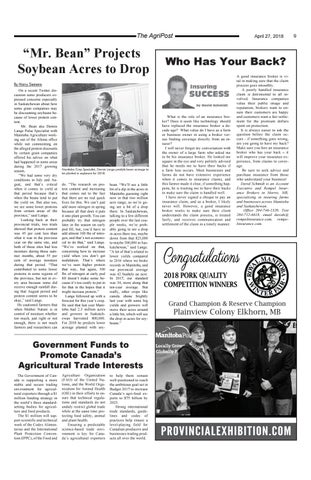
Manitoba Crop Specialist, Dennis Lange predicts lower acreage to be planted in soybeans for 2018.
do. “The research on protein content and increasing that comes out to the fact that there are no real quick fixes for this. We can’t just add more nitrogen in spring because all that does it puts it into plant growth. You can probably try that nitrogen later in the season on early pod fill, but, you’d have to add almost 100 lbs of nitrogen, and that’s not economical to do that,” said Lange. “We’ve worked on that, concerning how to increase yield when you don’t get nodulation. That’s where we’ve seen higher protein that way, but again, 100 lbs of nitrogen at early pod fill doesn’t make sense because it’s too costly to put in for that in the hopes that it might increase protein.” Lange followed up with a forecast for this year’s crop. He said that last year Manitoba had 2.3 million acres and growers in Saskatchewan harvested 800,000. For 2018 he predicts lower acreage planted with soy-
bean. “We’ll see a little bit of a dip in the acres in Manitoba guessing right now in that two million acre range, so we’re going see a bit of a drop there. In Saskatchewan, talking to a few different people over the last couple weeks, we’re probably going to see a drop in acres there too, maybe down from that 825,000 to maybe 500,000 in Saskatchewan,” said Lange. “A lot of that’s related to lower yields compared to 2016 where we broke records in Manitoba, and our provincial average was 42 bushels an acre. In 2017, our standard was 34, more along that ten-year average. But really, other crops like canola shone brightly last year with some big yields and growers will move their acres around a little bit, which will see the drop in acres for soybeans.”
Government Funds to Promote Canada’s Agricultural Trade Interests The Government of Canada is supporting a more stable and secure trading environment for agricultural exporters through a $1 million funding strategy in the world’s three standardsetting bodies for agriculture and food products. The $1 million will support scientific and technical work of the Codex Alimentarius and the International Plant Protection Convention (IPPC), of the Food and
Agriculture Organization (FAO) of the United Nations, and the World Organization for Animal Health (OIE) in their efforts to ensure that technical regulations and standards do not unduly restrict global trade while at the same time protecting food safety, animal and plant health. Ensuring a predictable science-based trade environment is key for Canada’s agricultural exporters
to help them remain well-positioned to reach the ambitious goal set in Budget 2017 to increase Canada’s agri-food exports to $75 billion by 2025. Strong international trade standards, guidelines and codes of practices help ensure a level-playing field for Canadian producers and businesses trading products all over the world.
April 27, 2018
What is the role of an insurance broker? Does it seem like technology should have replaced the insurance broker a decade ago? What value do I have as a farm or business owner in using a broker versus finding coverage directly from an insurer? I will never forget my conversation with the owner of a large farm who asked me to be his insurance broker. He looked me square in the eye and very politely advised that he needs me to have their backs if a farm loss occurs. Most businesses and farms do not have extensive experience when it comes to insurance claims, and this farmer made it clear, if something happens, he is trusting me to have their backs to make sure the claim is handled well. I have never signed a cheque to pay an insurance claim, and as a broker, I likely never will. However, a good insurance broker works to make sure their client understands the claim process, is treated fairly, and receives communication and settlement of the claim in a timely manner.
A good insurance broker is vital in making sure that the claim process goes smoothly. A poorly handled insurance claim is detrimental to all involved. Insurance companies value their public image and reputation, brokers want to ensure their customers are happy and customers want a fair settlement for the premium dollars spent on protection. It is always easier to ask the question before the claim occurs - if something goes wrong, are you going to have my back? Make sure you hire an insurance broker who has your back – it will improve your insurance experience, from claims to coverage. Be sure to seek advice and purchase insurance from those who understand your business! David Schmidt is an Account Executive and Rempel Insurance Brokers in Morris, MB, specializing in insuring farms and businesses across Manitoba and Saskatchewan. Office 204-746-2320, Text 204-712-6618, email davids@ rempelinsurance.com, rempelinsurance.com.