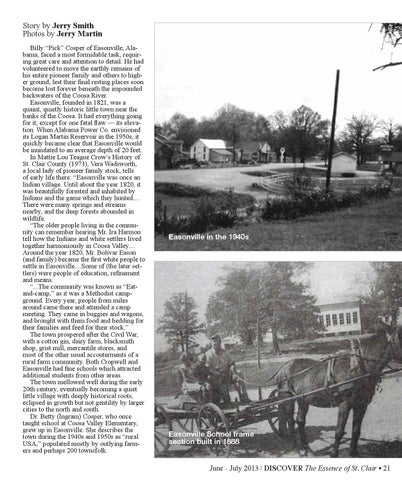
Story by Jerry Smith Photos by Jerry Martin Billy “Pick” Cosper of Easonville, Alabama, faced a most formidable task, requiring great care and attention to detail. He had volunteered to move the earthly remains of his entire pioneer family and others to higher ground, lest their final resting places soon become lost forever beneath the impounded backwaters of the Coosa River. Easonville, founded in 1821, was a quaint, quietly historic little town near the banks of the Coosa. It had everything going for it, except for one fatal flaw — its elevation. When Alabama Power Co. envisioned its Logan Martin Reservoir in the 1950s, it quickly became clear that Easonville would be inundated to an average depth of 20 feet. In Mattie Lou Teague Crow’s History of St. Clair County (1973), Vera Wadsworth, a local lady of pioneer family stock, tells of early life there: “Easonville was once an Indian village. Until about the year 1820, it was beautifully forested and inhabited by Indians and the game which they hunted.... There were many springs and streams nearby, and the deep forests abounded in wildlife. “The older people living in the community can remember hearing Mr. Ira Harmon tell how the Indians and white settlers lived together harmoniously in Coosa Valley.... Around the year 1820, Mr. Bolivar Eason (and family) became the first white people to settle in Easonville....Some of (the later settlers) were people of education, refinement and means. “...The community was known as “Eatand-camp,” as it was a Methodist campground. Every year, people from miles around came there and attended a camp meeting. They came in buggies and wagons, and brought with them food and bedding for their families and feed for their stock.” The town prospered after the Civil War, with a cotton gin, dairy farm, blacksmith shop, grist mill, mercantile stores, and most of the other usual accouterments of a rural farm community. Both Cropwell and Easonville had fine schools which attracted additional students from other areas. The town mellowed well during the early 20th century, eventually becoming a quiet little village with deeply historical roots, eclipsed in growth but not gentility by larger cities to the north and south. Dr. Betty (Ingram) Cosper, who once taught school at Coosa Valley Elementary, grew up in Easonville. She describes the town during the 1940s and 1950s as “rural USA,” populated mostly by outlying farmers and perhaps 200 townsfolk.
Easonville in the 1940s
Easonville School frame section built in 1888 June - July 2013 | DISCOVER The Essence of St. Clair • 21