D E BAT E |DIPLO M ATICA
diplomat and international canada
periods of both increasing and decreasing temperature and an overall rise of about 0.7°C over that period, within a range of observed temperatures of nearly 150°C. Ottawa experiences a temperature range of approximately 77°C. The satellite record shows frequent day-to-day and month-tomonth changes, but no statistically significant change since 1979. Any signs of warming, of course, wherever they appear on the globe, are not evidence of anthropogenic warming, only of nature’s ever-changing patterns. Despite billions of dollars spent on finding a human signature in climate change, no physical evidence has yet to be isolated. The much-sought-after signature is only
united nations photo
It calls for annual Conferences of the Parties (COPs), a process that began in 1995 in Berlin and has continued every year since, including last December’s 18th COP in Qatar. The driving force for these conferences is the work of the Intergovernmental Panel on Climate Change (IPCC), set up in 1988 jointly by the UN’s Environmental Program and the World Meteorological Organization following the Toronto conference. It has a mandate to summarize the science of human influence on global climate change. This last point is critical. It was not set up to summarize the science of climate change, but to document the human fingerprint. From the beginning, its mandate was more political than scientific, although it was sold to the public as an authoritative scientific body, counting on a scientifically illiterate media and a public not appreciating that in science, authority comes from the evidence available to substantiate a theory, not from official pronouncements. The IPCC’s political nature became clear with its first report in 1990. In addition to a generally balanced summary of the scientific literature, it was crowned with a contentious summary for policymakers (SPM) prepared by government officials, many of them with little or no scientific background, but with a keen eye for advancing their agenda. Three subsequent reports, each with its own SPM, have carried the agenda to increasing heights, as traces of dissenting science have been scrubbed to make room for the global salvationism that now animates much of the UN’s work. Its fifth report is due in 2014, but leaked drafts have already made clear that it will carry alarmism to new heights, ignoring the inconvenient fact that global temperatures have failed to rise for 16 years despite steady growth in the world’s emissions of carbon dioxide. Despite its limitations, the alarmist community chose global temperature as its signature metric. Temperature is a spatially and temporally bound phenomenon. Calculating an average for thousands of observations may yield an interesting metric, but one that has no physical meaning. Even then, warmists have to face the inconvenient fact that for the globe’s 4.5 billion years of geological history, we only have an imperfect and scandal-marred instrumental record going back 150 years and a better satellite record going back 33 years. The former, based on dodgy, highly manipulated data, shows
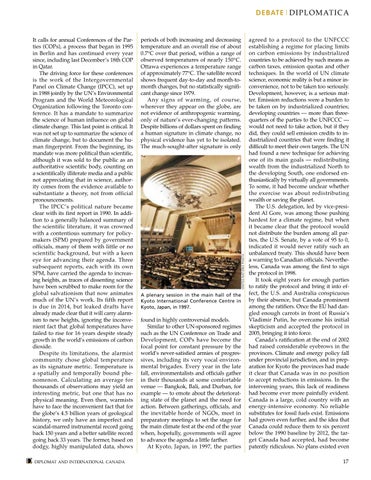
A plenary session in the main hall of the Kyoto International Conference Centre in Kyoto, Japan, in 1997.
found in highly controversial models. Similar to other UN-sponsored regimes such as the UN Conference on Trade and Development, COPs have become the focal point for constant pressure by the world’s never-satisfied armies of progressives, including its very vocal environmental brigades. Every year in the late fall, environmentalists and officials gather in their thousands at some comfortable venue — Bangkok, Bali, and Durban, for example — to emote about the deteriorating state of the planet and the need for action. Between gatherings, officials, and the inevitable horde of NGOs, meet in preparatory meetings to set the stage for the main climate fest at the end of the year when, hopefully, governments will agree to advance the agenda a little farther. At Kyoto, Japan, in 1997, the parties
agreed to a protocol to the UNFCCC establishing a regime for placing limits on carbon emissions by industrialized countries to be achieved by such means as carbon taxes, emission quotas and other techniques. In the world of UN climate science, economic reality is but a minor inconvenience, not to be taken too seriously. Development, however, is a serious matter. Emission reductions were a burden to be taken on by industrialized countries; developing countries — more than threequarters of the parties to the UNFCCC — would not need to take action, but if they did, they could sell emission credits to industrialized countries that were finding it difficult to meet their own targets. The UN had found a new technique for achieving one of its main goals — redistributing wealth from the industrialized North to the developing South, one endorsed enthusiastically by virtually all governments. To some, it had become unclear whether the exercise was about redistributing wealth or saving the planet. The U.S. delegation, led by vice-president Al Gore, was among those pushing hardest for a climate regime, but when it became clear that the protocol would not distribute the burden among all parties, the U.S. Senate, by a vote of 95 to 0, indicated it would never ratify such an unbalanced treaty. This should have been a warning to Canadian officials. Nevertheless, Canada was among the first to sign the protocol in 1998. It took eight years for enough parties to ratify the protocol and bring it into effect, the U.S. and Australia conspicuous by their absence, but Canada prominent among the ratifiers. Once the EU had dangled enough carrots in front of Russia’s Vladimir Putin, he overcame his initial skepticism and accepted the protocol in 2005, bringing it into force. Canada’s ratification at the end of 2002 had raised considerable eyebrows in the provinces. Climate and energy policy fall under provincial jurisdiction, and in preparation for Kyoto the provinces had made it clear that Canada was in no position to accept reductions in emissions. In the intervening years, this lack of readiness had become ever more painfully evident. Canada is a large, cold country with an energy-intensive economy. No reliable substitutes for fossil fuels exist. Emissions had grown even further, and the idea that Canada could reduce them to six percent below the 1990 baseline by 2012, the target Canada had accepted, had become patently ridiculous. No plans existed even 17