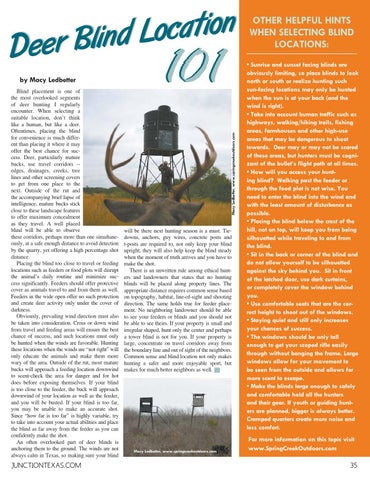
n o i t a c o L d n i l B Deer Blind placement is one of the most overlooked segments of deer hunting I regularly encounter. When selecting a suitable location, don’t think like a human, but like a deer. Oftentimes, placing the blind for convenience is much different than placing it where it may offer the best chance for success. Deer, particularly mature bucks, use travel corridors -edges, drainages, creeks, tree lines and other screening covers to get from one place to the next. Outside of the rut and the accompanying brief lapse of intelligence, mature bucks stick close to these landscape features to offer maximum concealment as they travel. A well placed blind will be able to observe these corridors, perhaps more than one simultaneously, at a safe enough distance to avoid detection by the quarry, yet offering a high percentage shot distance. Placing the blind too close to travel or feeding locations such as feeders or food plots will disrupt the animal’s daily routine and minimize success significantly. Feeders should offer protective cover as animals travel to and from them as well. Feeders in the wide open offer no such protection and create deer activity only under the cover of darkness. Obviously, prevailing wind direction must also be taken into consideration. Cross or down wind from travel and feeding areas will ensure the best chance of success, and such locations must only be hunted when the winds are favorable. Hunting these locations when the winds are “not right� will only educate the animals and make them more wary of the area. Outside of the rut, most mature bucks will approach a feeding location downwind to scent-check the area for danger and for hot does before exposing themselves. If your blind is too close to the feeder, the buck will approach downwind of your location as well as the feeder, and you will be busted. If your blind is too far, you may be unable to make an accurate shot. Since “how far is too far� is highly variable, try to take into account your actual abilities and place the blind as far away from the feeder as you can confidently make the shot. An often overlooked part of deer blinds is anchoring them to the ground. The winds are not always calm in Texas, so making sure your blind
JUNCTIONTEXAS.COM
101
0DF\ /HGEHWWHU ZZZ VSULQJFUHHNRXWGRRUV FRP
by Macy Ledbetter
will be there next hunting season is a must. Tiedowns, anchors, guy wires, concrete posts and t-posts are required to, not only keep your blind upright, they will also help keep the blind steady when the moment of truth arrives and you have to make the shot. There is an unwritten rule among ethical hunters and landowners that states that no hunting blinds will be placed along property lines. The appropriate distance requires common sense based on topography, habitat, line-of-sight and shooting direction. The same holds true for feeder placement. No neighboring landowner should be able to see your feeders or blinds and you should not be able to see theirs. If your property is small and irregular shaped, hunt only the center and perhaps a tower blind is not for you. If your property is large, concentrate on travel corridors away from the boundary line and out of sight of the neighbors. Common sense and blind location not only makes hunting a safer and more enjoyable sport, but makes for much better neighbors as well.
0DF\ /HGEHWWHU ZZZ VSULQJFUHHNRXWGRRUV FRP
27+(5 +(/3)8/ +,176 :+(1 6(/(&7,1* %/,1' /2&$7,216 Â&#x2021; 6XQULVH DQG VXQVHW IDFLQJ EOLQGV DUH REYLRXVO\ OLPLWLQJ VR SODFH EOLQGV WR ORRN QRUWK RU VRXWK RU UHDOL]H KXQWLQJ VXFK VXQ IDFLQJ ORFDWLRQV PD\ RQO\ EH KXQWHG ZKHQ WKH VXQ LV DW \RXU EDFN DQG WKH ZLQG LV ULJKW Â&#x2021; 7DNH LQWR DFFRXQW KXPDQ WUDIILF VXFK DV KLJKZD\V ZDONLQJ KLNLQJ WUDLOV ILVKLQJ DUHDV IDUPKRXVHV DQG RWKHU KLJK XVH DUHDV WKDW PD\ EH GDQJHURXV WR VKRRW WRZDUGV 'HHU PD\ RU PD\ QRW EH VFDUHG RI WKHVH DUHDV EXW KXQWHUV PXVW EH FRJQL ]DQW RI WKH EXOOHW¡V IOLJKW SDWK DW DOO WLPHV Â&#x2021; +RZ ZLOO \RX DFFHVV \RXU KXQW LQJ EOLQG" :DONLQJ SDVW WKH IHHGHU RU WKURXJK WKH IRRG SORW LV QRW ZLVH <RX QHHG WR HQWHU WKH EOLQG LQWR WKH ZLQG DQG ZLWK WKH OHDVW DPRXQW RI GLVWXUEDQFH DV SRVVLEOH Â&#x2021; 3ODFLQJ WKH EOLQG EHORZ WKH FUHVW RI WKH KLOO QRW RQ WRS ZLOO NHHS \RX IURP EHLQJ VLOKRXHWWHG ZKLOH WUDYHOLQJ WR DQG IURP WKH EOLQG Â&#x2021; 6LW LQ WKH EDFN RU FRUQHU RI WKH EOLQG DQG GR QRW DOORZ \RXUVHOI WR EH VLOKRXHWWHG DJDLQVW WKH VN\ EHKLQG \RX 6LW LQ IURQW RI WKH ODWFKHG GRRU XVH GDUN FXUWDLQV RU FRPSOHWHO\ FRYHU WKH ZLQGRZ EHKLQG \RX Â&#x2021; 8VH FRPIRUWDEOH VHDWV WKDW DUH WKH FRU UHFW KHLJKW WR VKRRW RXW RI WKH ZLQGRZV Â&#x2021; 6WD\LQJ TXLHW DQG VWLOO RQO\ LQFUHDVHV \RXU FKDQFHV RI VXFFHVV Â&#x2021; 7KH ZLQGRZV VKRXOG EH RQO\ WDOO HQRXJK WR JHW \RXU VFRSHG ULIOH HDVLO\ WKURXJK ZLWKRXW EDQJLQJ WKH IUDPH /DUJH ZLQGRZV DOORZ IRU \RXU PRYHPHQW WR EH VHHQ IURP WKH RXWVLGH DQG DOORZV IRU PRUH VFHQW WR HVFDSH Â&#x2021; 0DNH WKH EOLQGV ODUJH HQRXJK WR VDIHO\ DQG FRPIRUWDEOH KROG DOO WKH KXQWHUV DQG WKHLU JHDU ,I \RXWK RU JXLGLQJ KXQW HUV DUH SODQQHG ELJJHU LV DOZD\V EHWWHU &UDPSHG TXDUWHUV FUHDWH PRUH QRLVH DQG OHVV FRPIRUW
)RU PRUH LQIRUPDWLRQ RQ WKLV WRSLF YLVLW ZZZ 6SULQJ&UHHN2XWGRRUV FRP
35