trol the horse when being ridden. It will have reins for the rider and typically has a bit.
legs hit the ground simultaneously (right hind / left front and left hind / right front).
Bit – The metal mouthpiece that attaches to the bridle. Bits can be made out of plastic, rubber, steel, copper or other similar materials and can be mild or severe. The most common material is stainless steel. Only simple, mild bits should be used by beginners.
Canter – A 3 beat gait that’s normally faster than a trot.
Halter – A headstall used to control the horse from the ground. A lead shank (lead rope) is usually attached. Sweat pad – A thin fabric liner placed under the saddle pad to extend the life of the pad and keep it cleaner. Sweat pads are not bulky to wash and dry quickly. Lunge line – A cotton or nylon “rope” approximately 20 feet long, used for exercising horses on a circle. A handler can also use it for controlling a horse for a rider from the middle of the circle. Crop or bat – Approximately 2 feet long, the crop is used to reinforce the aids for jumping. A bat is a shorter version that’s great for kids on ponies, too. ATTIRE:
Breeches – Pants specifically designed for riding, made with small seams and knee patches for jumping or “full seat” patches for dressage. Paddock Boots – Short, ankle boots with low heels made for riding. Half Chaps – These are leg protectors that look like spats. Leather or synthetic, they wrap around your legs and are secured with Velcro or zippers to fit over your paddock boots. ABOUT THE HORSE:
Walk – A slow, but regular 4 beat gait. Trot – A quicker, rythmic 2 beat gait where the diagonal pairs of www.horsebackmagazine.com www.horsebackmagazine.com
ABOUT RIDING:
Our Beauty
Is More Than Skin Deep!
Equitation – The art of sitting and using the aids correctly to control the horse with finesse. Hunt Seat – The style of riding that is used for jumping horses. Dressage – Classical riding that resembles Ballet on horseback. It is both a sport and an art where the horse performs a variety of gymnastic movements with great control and accuracy. Posting – When trotting, the rider rhythmically rises from the saddle on one beat and then sits on the next beat. Diagonals – When posting to the trot, the rider rises with the outside (next to the fence) front leg. Two Point – The rider stands on his stirrups in a squatting position. It is commonly used when jumping or racing. Natural Aids – the rider’s use of his hands, legs, seat and voice to control the horse. Although these definitions may not make you an expert, perhaps they will enlighten you and familiarize you enough that you can comfortably engage in an intelligent conversation with your rider or even another parent as you proudly watch from the sidelines.
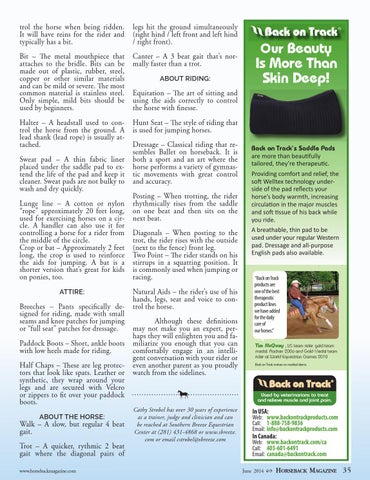
Back on Track’s Saddle Pads are more than beautifully tailored, they’re therapeutic. Providing comfort and relief, the soft Welltex technology underside of the pad reflects your horse’s body warmth, increasing circulation in the major muscles and soft tissue of his back while you ride. A breathable, thin pad to be used under your regular Western pad. Dressage and all-purpose English pads also available.
“Back on Track products are one of the best therapeutic product lines we have added for the daily care of our horses.” Tim McQuay , US team rider, gold team
medal, Aachen 2006 and Gold Medal team rider at World Equestrian Games 2010
Back on Track makes no medical claims.
Used by veterinarians to treat and relieve muscle and joint pain.
Cathy Strobel has over 30 years of experience as a trainer, judge and clinician and can be reached at Southern Breeze Equestrian Center at (281) 431-4868 or www.sbreeze. com or email cstrobel@sbreeze.com
In USA: Web: www.backontrackproducts.com Call: 1-888-758-9836 Email: info@backontrackproducts.com In Canada: Web: www.backontrack.com/ca Call: 403-601-6491 Email: canada@backontrack.com June 2014 2 June
HORSEBACK ORSEBACK MAGAZINE AGAZINE 35