PHOTO BY REUBEN MADRID
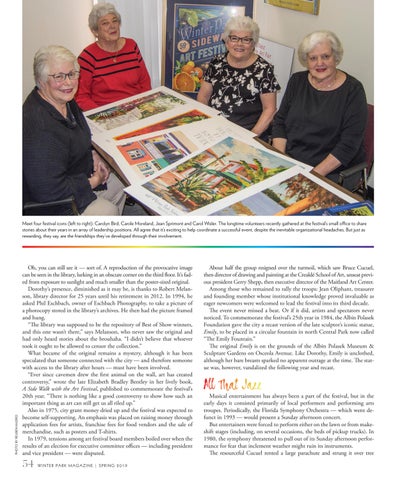
Meet four festival icons (left to right): Carolyn Bird, Carole Moreland, Jean Sprimont and Carol Wisler. The longtime volunteers recently gathered at the festival’s small office to share stories about their years in an array of leadership positions. All agree that it’s exciting to help coordinate a successful event, despite the inevitable organizational headaches. But just as rewarding, they say, are the friendships they’ve developed through their involvement.
Oh, you can still see it — sort of. A reproduction of the provocative image can be seen in the library, lurking in an obscure corner on the third floor. It’s faded from exposure to sunlight and much smaller than the poster-sized original. Dorothy’s presence, diminished as it may be, is thanks to Robert Melanson, library director for 25 years until his retirement in 2012. In 1994, he asked Phil Eschbach, owner of Eschbach Photography, to take a picture of a photocopy stored in the library’s archives. He then had the picture framed and hung. “The library was supposed to be the repository of Best of Show winners, and this one wasn’t there,” says Melanson, who never saw the original and had only heard stories about the brouhaha. “I didn’t believe that whoever took it ought to be allowed to censor the collection.” What became of the original remains a mystery, although it has been speculated that someone connected with the city — and therefore someone with access to the library after hours — must have been involved. “Ever since cavemen drew the first animal on the wall, art has created controversy,” wrote the late Elizabeth Bradley Bentley in her lively book, A Side Walk with the Art Festival, published to commemorate the festival’s 20th year. “There is nothing like a good controversy to show how such an important thing as art can still get us all riled up.” Also in 1975, city grant money dried up and the festival was expected to become self-supporting. An emphasis was placed on raising money through application fees for artists, franchise fees for food vendors and the sale of merchandise, such as posters and T-shirts. In 1979, tensions among art festival board members boiled over when the results of an election for executive committee offices — including president and vice president — were disputed.
54 W I N T E R P A R K M A GAZI N E | SP RI N G 2019
About half the group resigned over the turmoil, which saw Bruce Cucuel, then director of drawing and painting at the Crealdé School of Art, unseat previous president Gerry Shepp, then executive director of the Maitland Art Center. Among those who remained to rally the troops: Jean Oliphant, treasurer and founding member whose institutional knowledge proved invaluable as eager newcomers were welcomed to lead the festival into its third decade. The event never missed a beat. Or if it did, artists and spectators never noticed. To commemorate the festival’s 25th year in 1984, the Albin Polasek Foundation gave the city a recast version of the late sculptor’s iconic statue, Emily, to be placed in a circular fountain in north Central Park now called “The Emily Fountain.” The original Emily is on the grounds of the Albin Polasek Museum & Sculpture Gardens on Osceola Avenue. Like Dorothy, Emily is unclothed, although her bare breasts sparked no apparent outrage at the time. The statue was, however, vandalized the following year and recast.
All That Jazz Musical entertainment has always been a part of the festival, but in the early days it consisted primarily of local performers and performing arts troupes. Periodically, the Florida Symphony Orchestra — which went defunct in 1993 — would present a Sunday afternoon concert. But entertainers were forced to perform either on the lawn or from makeshift stages (including, on several occasions, the beds of pickup trucks). In 1980, the symphony threatened to pull out of its Sunday afternoon performance for fear that inclement weather might ruin its instruments. The resourceful Cucuel rented a large parachute and strung it over tree